fuel FORD FOCUS 2011 2.G Owner's Manual
[x] Cancel search | Manufacturer: FORD, Model Year: 2011, Model line: FOCUS, Model: FORD FOCUS 2011 2.GPages: 301, PDF Size: 2.19 MB
Page 174 of 301
Starting the engine
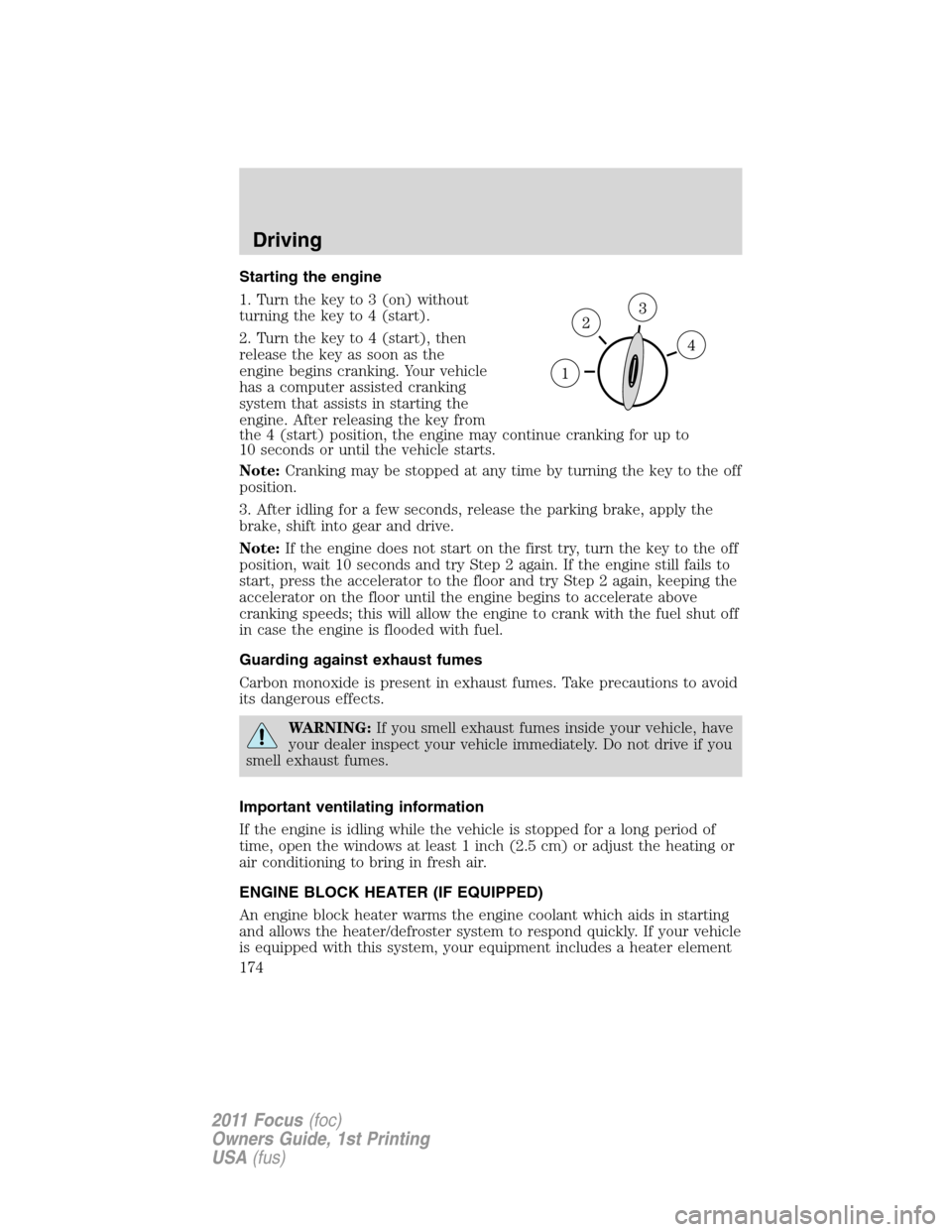
1. Turn the key to 3 (on) without
turning the key to 4 (start).
2. Turn the key to 4 (start), then
release the key as soon as the
engine begins cranking. Your vehicle
has a computer assisted cranking
system that assists in starting the
engine. After releasing the key from
the 4 (start) position, the engine may continue cranking for up to
10 seconds or until the vehicle starts.
Note:Cranking may be stopped at any time by turning the key to the off
position.
3. After idling for a few seconds, release the parking brake, apply the
brake, shift into gear and drive.
Note:If the engine does not start on the first try, turn the key to the off
position, wait 10 seconds and try Step 2 again. If the engine still fails to
start, press the accelerator to the floor and try Step 2 again, keeping the
accelerator on the floor until the engine begins to accelerate above
cranking speeds; this will allow the engine to crank with the fuel shut off
in case the engine is flooded with fuel.
Guarding against exhaust fumes
Carbon monoxide is present in exhaust fumes. Take precautions to avoid
its dangerous effects.
WARNING:If you smell exhaust fumes inside your vehicle, have
your dealer inspect your vehicle immediately. Do not drive if you
smell exhaust fumes.
Important ventilating information
If the engine is idling while the vehicle is stopped for a long period of
time, open the windows at least 1 inch (2.5 cm) or adjust the heating or
air conditioning to bring in fresh air.
ENGINE BLOCK HEATER (IF EQUIPPED)
An engine block heater warms the engine coolant which aids in starting
and allows the heater/defroster system to respond quickly. If your vehicle
is equipped with this system, your equipment includes a heater element
Driving
174
2011 Focus(foc)
Owners Guide, 1st Printing
USA(fus)
Page 185 of 301
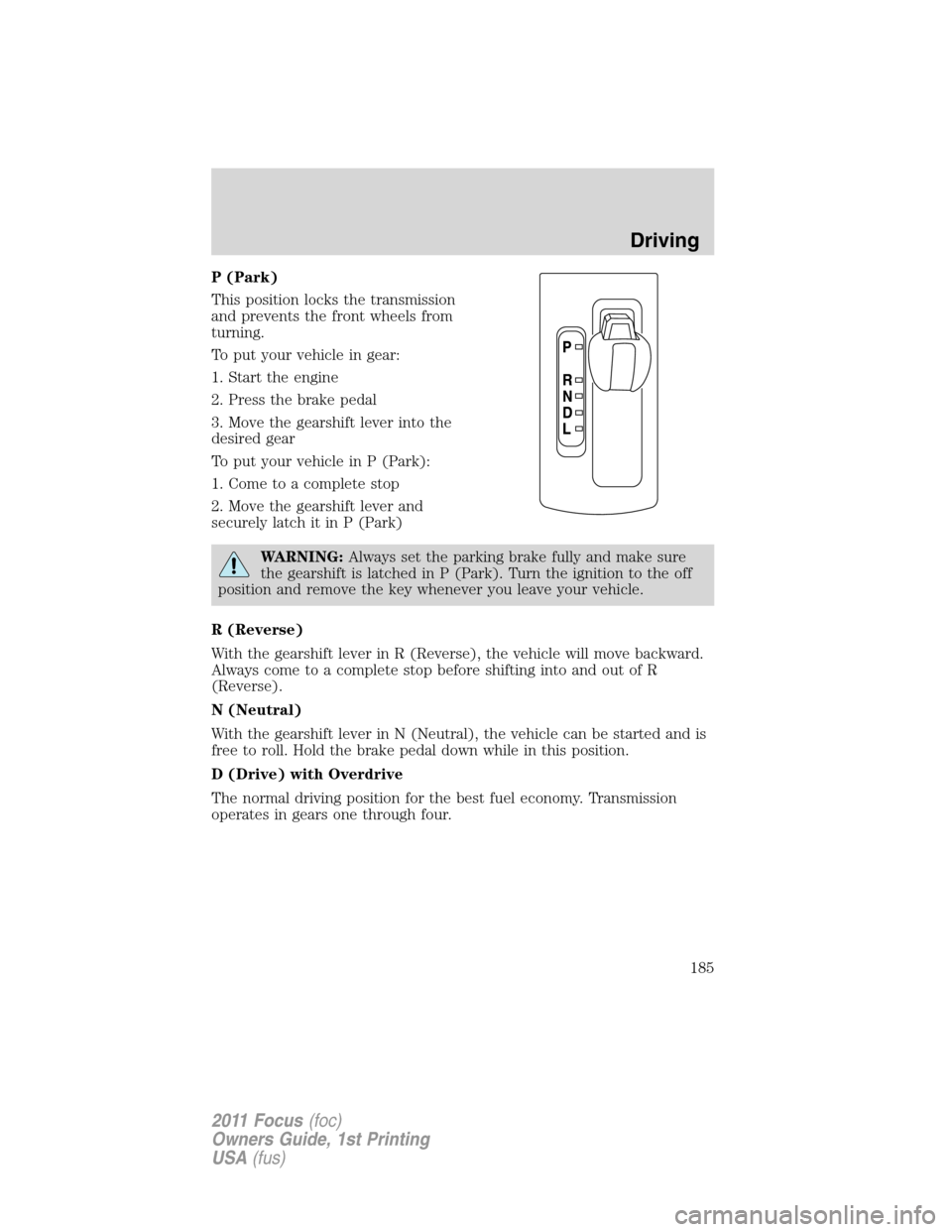
P (Park)
This position locks the transmission
and prevents the front wheels from
turning.
To put your vehicle in gear:
1. Start the engine
2. Press the brake pedal
3. Move the gearshift lever into the
desired gear
To put your vehicle in P (Park):
1. Come to a complete stop
2. Move the gearshift lever and
securely latch it in P (Park)
WARNING:Always set the parking brake fully and make sure
the gearshift is latched in P (Park). Turn the ignition to the off
position and remove the key whenever you leave your vehicle.
R (Reverse)
With the gearshift lever in R (Reverse), the vehicle will move backward.
Always come to a complete stop before shifting into and out of R
(Reverse).
N (Neutral)
With the gearshift lever in N (Neutral), the vehicle can be started and is
free to roll. Hold the brake pedal down while in this position.
D (Drive) with Overdrive
The normal driving position for the best fuel economy. Transmission
operates in gears one through four.
Driving
185
2011 Focus(foc)
Owners Guide, 1st Printing
USA(fus)
Page 186 of 301
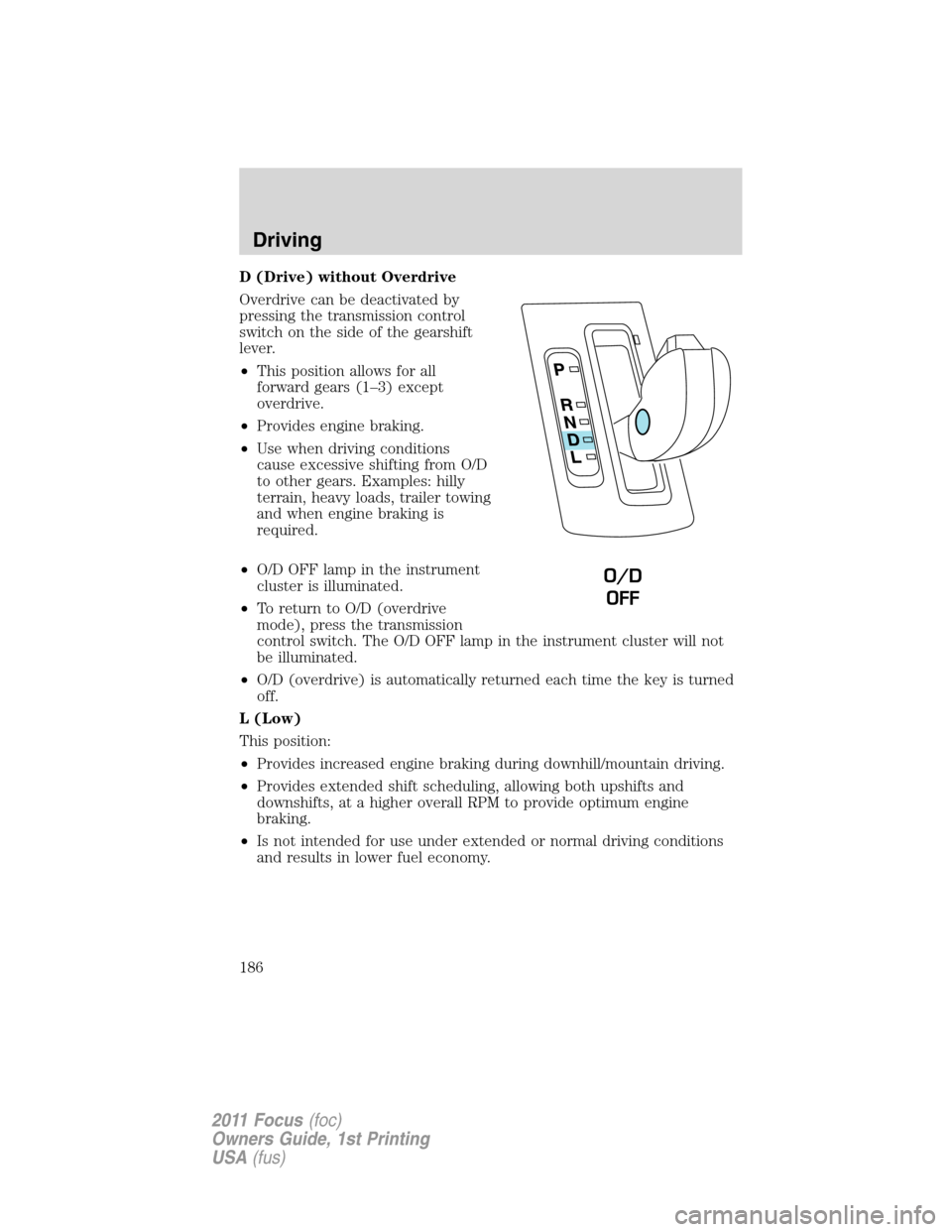
D (Drive) without Overdrive
Overdrive can be deactivated by
pressing the transmission control
switch on the side of the gearshift
lever.
•This position allows for all
forward gears (1–3) except
overdrive.
•Provides engine braking.
•Use when driving conditions
cause excessive shifting from O/D
to other gears. Examples: hilly
terrain, heavy loads, trailer towing
and when engine braking is
required.
•O/D OFF lamp in the instrument
cluster is illuminated.
•To return to O/D (overdrive
mode), press the transmission
control switch. The O/D OFF lamp in the instrument cluster will not
be illuminated.
•O/D (overdrive) is automatically returned each time the key is turned
off.
L (Low)
This position:
•Provides increased engine braking during downhill/mountain driving.
•Provides extended shift scheduling, allowing both upshifts and
downshifts, at a higher overall RPM to provide optimum engine
braking.
•Is not intended for use under extended or normal driving conditions
and results in lower fuel economy.
O/D
OFF
Driving
186
2011 Focus(foc)
Owners Guide, 1st Printing
USA(fus)
Page 188 of 301
Recommended shift speeds
Do not downshift into 1 (First) when your vehicle is moving
faster than 15 mph (24 km/h). This will damage the clutch.
Upshift according to the following chart:
Recommended upshifts (for best fuel economy) when
accelerating
5-speed manual transmission
Shift from:
1 - 2 14 mph (23 km/h)
2 - 3 24 mph (39 km/h)
3 - 4 32 mph (51 km/h)
4 - 5 44 mph (71 km/h)
Reverse
Make sure that your vehicle is at a complete stop before you shift
into R (Reverse). Failure to do so may damage the transmission.
Hold the clutch pedal down and move the gearshift lever into the neutral
position. Wait at least three seconds before shifting into R (Reverse).
Note:The gearshift lever can only be moved into R (Reverse) by moving
it from left of 3 (Third) and 4 (Fourth) before shifting into R (Reverse).
This is a lockout feature that protects the transmission from accidentally
being shifted into R (Reverse) from 5 (Fifth).
If R (Reverse) is not fully engaged, press the clutch pedal down and
return the gearshift to the neutral position. Release the clutch pedal for
a moment, then press it down and shift to R (Reverse) again.
Parking your vehicle
1. Apply the brake and shift into the neutral position.
2. Fully apply the parking brake, hold the clutch pedal down, then shift
into 1 (First).
3. Turn the ignition off.
WARNING:Do not park your vehicle in Neutral, it may move
unexpectedly and injure someone. Use 1 (First) gear and set the
parking brake fully.
Removing the key
Turn the ignition to position 1 (off) and remove the key.
Driving
188
2011 Focus(foc)
Owners Guide, 1st Printing
USA(fus)
Page 190 of 301
ROADSIDE ASSISTANCE
Getting roadside assistance
To fully assist you should you have a vehicle concern, Ford Motor
Company offers a complimentary roadside assistance program. This
program is separate from the New Vehicle Limited Warranty. The service
is available:
•24-hours, seven days a week
•for the coverage period listed on the Roadside Assistance Card
included in your Owner Guide portfolio.
Roadside assistance will cover:
•a flat tire change with a good spare (except vehicles that have been
supplied with a tire inflation kit)
•battery jump start
•lock-out assistance (key replacement cost is the customer’s
responsibility)
•fuel delivery – Independent Service Contractors, if not prohibited by
state, local or municipal law shall deliver up to 2.0 gallons (7.5L) of
gasoline or 5.0 gallons (18.9L) of diesel fuel to a disabled vehicle. Fuel
delivery service is limited to two no-charge occurrences within a
12-month period.
•winch out – available within 100 feet (30.5 meters) of a paved or
county maintained road, no recoveries.
•towing – Ford/Mercury/Lincoln eligible vehicle towed to an authorized
dealer within 35 miles (56 km) of the disablement location or to the
nearest authorized dealer. If a member requests to be towed to an
authorized dealer more than 35 miles (56 km) from the disablement
location, the member shall be responsible for any mileage costs in
excess of 35 miles (56 km).
Trailers shall be covered up to $200 if the disabled eligible vehicle
requires service at the nearest authorized dealer. If the trailer is disabled,
but the towing vehicle is operational, the trailer does not qualify for any
roadside services.
Roadside Emergencies
190
2011 Focus(foc)
Owners Guide, 1st Printing
USA(fus)
Page 192 of 301
FUEL PUMP SHUT-OFF SWITCH
This device stops the electric fuel pump from sending fuel to the engine
when your vehicle has had a substantial jolt.
After an accident, if the engine cranks but does not start, this switch
may have been activated.
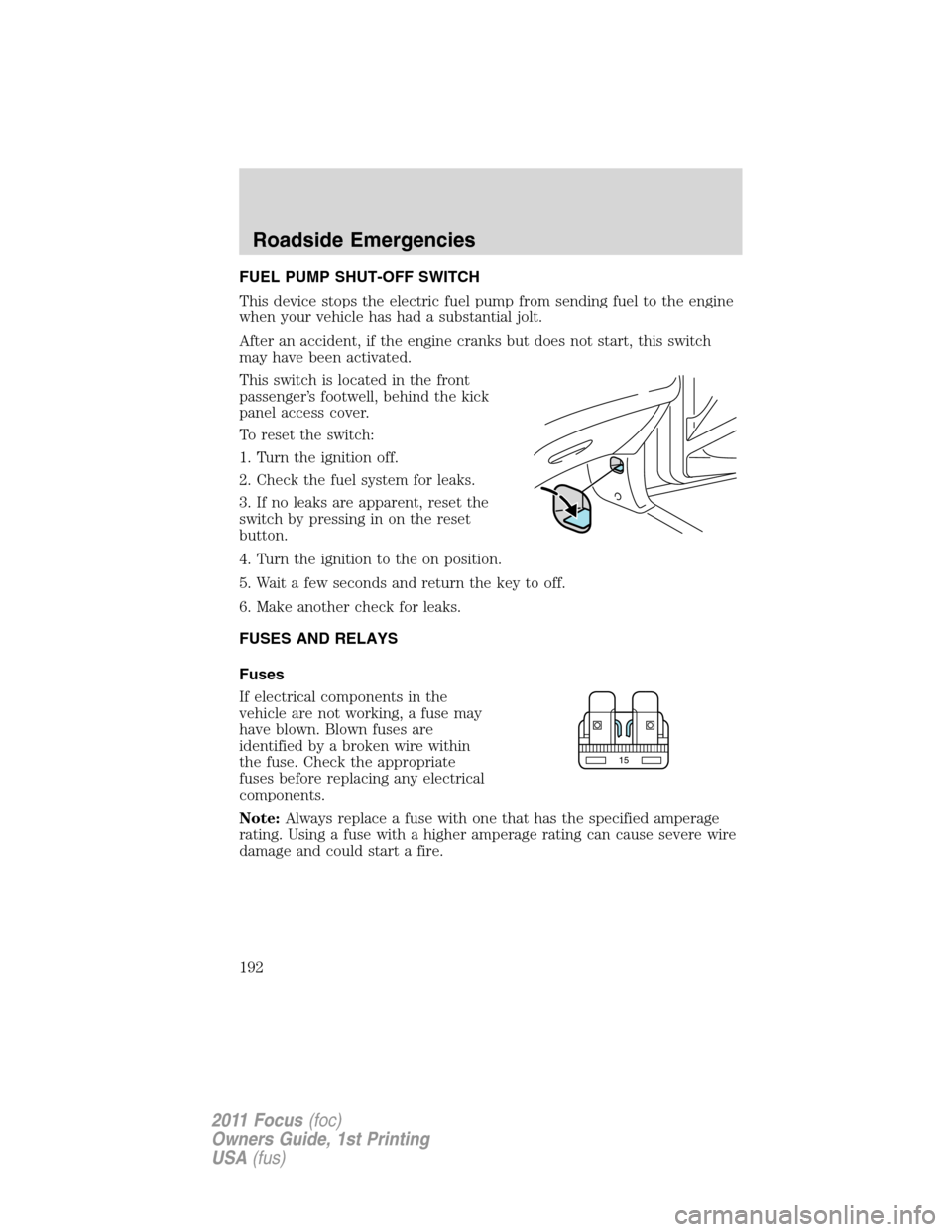
This switch is located in the front
passenger’s footwell, behind the kick
panel access cover.
To reset the switch:
1. Turn the ignition off.
2. Check the fuel system for leaks.
3. If no leaks are apparent, reset the
switch by pressing in on the reset
button.
4. Turn the ignition to the on position.
5. Wait a few seconds and return the key to off.
6. Make another check for leaks.
FUSES AND RELAYS
Fuses
If electrical components in the
vehicle are not working, a fuse may
have blown. Blown fuses are
identified by a broken wire within
the fuse. Check the appropriate
fuses before replacing any electrical
components.
Note:Always replace a fuse with one that has the specified amperage
rating. Using a fuse with a higher amperage rating can cause severe wire
damage and could start a fire.
15
Roadside Emergencies
192
2011 Focus(foc)
Owners Guide, 1st Printing
USA(fus)
Page 197 of 301
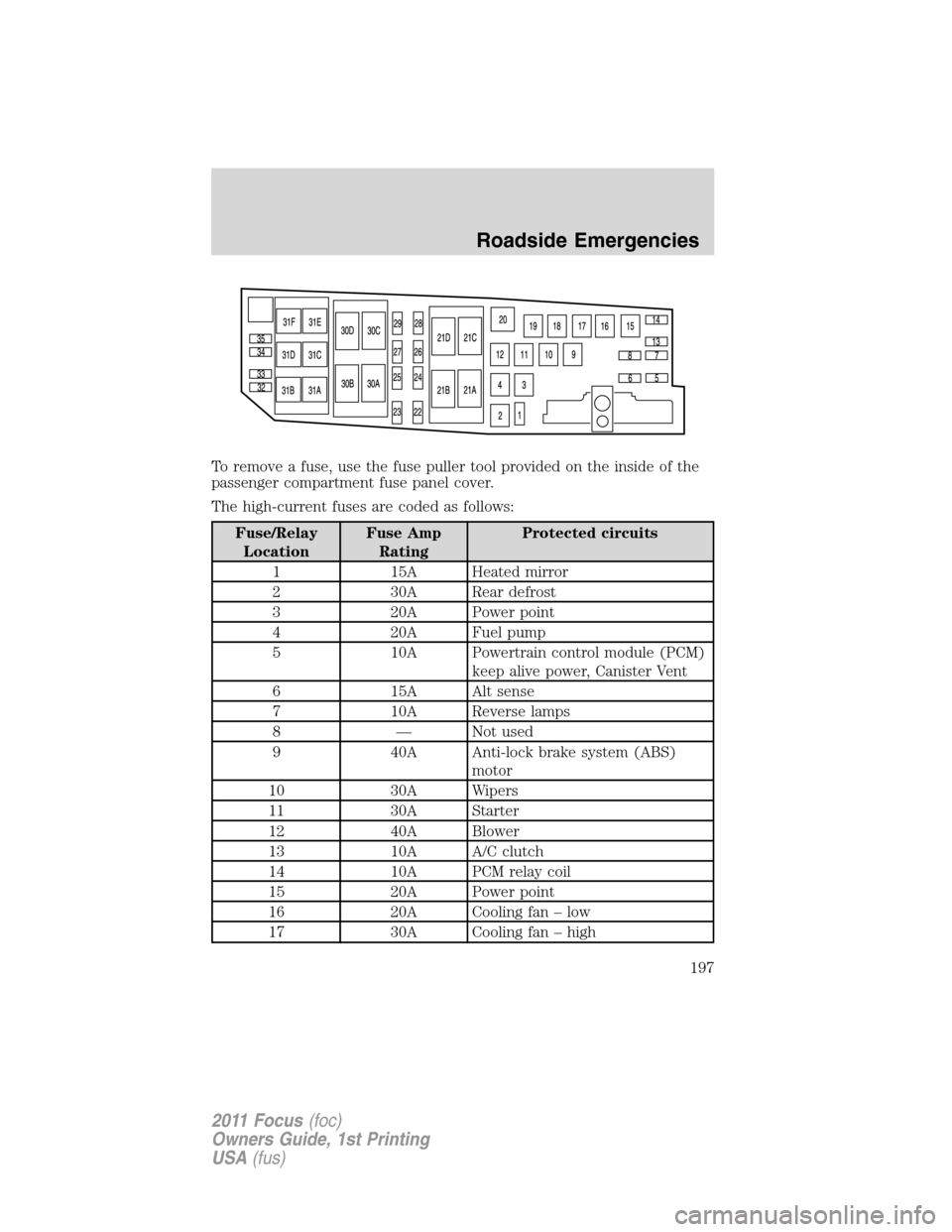
To remove a fuse, use the fuse puller tool provided on the inside of the
passenger compartment fuse panel cover.
The high-current fuses are coded as follows:
Fuse/Relay
LocationFuse Amp
RatingProtected circuits
1 15A Heated mirror
2 30A Rear defrost
3 20A Power point
4 20A Fuel pump
5 10A Powertrain control module (PCM)
keep alive power, Canister Vent
6 15A Alt sense
7 10A Reverse lamps
8 — Not used
9 40A Anti-lock brake system (ABS)
motor
10 30A Wipers
11 30A Starter
12 40A Blower
13 10A A/C clutch
14 10A PCM relay coil
15 20A Power point
16 20A Cooling fan – low
17 30A Cooling fan – high
Roadside Emergencies
197
2011 Focus(foc)
Owners Guide, 1st Printing
USA(fus)
Page 198 of 301
Fuse/Relay
LocationFuse Amp
RatingProtected circuits
18 20A ABS solenoid
19 — Not used
20 — A/C clutch relay
21A Rear defrost relay
21B — Not used
21C — Blower relay
21D — PCM relay
22 10A Fuel injector
23 — Not used
24 — Not used
25 — Not used
26 15A PCM – emission related
powertrain components
27 — Not used
28 15A PCM
29 15A Ignition
30A — Cooling fan low speed relay
30B — Starter relay
30C — Not used
30D — Cooling fan high speed relay
31A — Reverse lamp relay
31B — Fuel pump relay
31C — Wiper power relay
31D — Not used
31E — Not used
31F — Not used
32 — Not used
33 — EEC diode
34 — One-touch integrated start (OTIS)
diode
35 10A Run/Start
Roadside Emergencies
198
2011 Focus(foc)
Owners Guide, 1st Printing
USA(fus)
Page 207 of 301
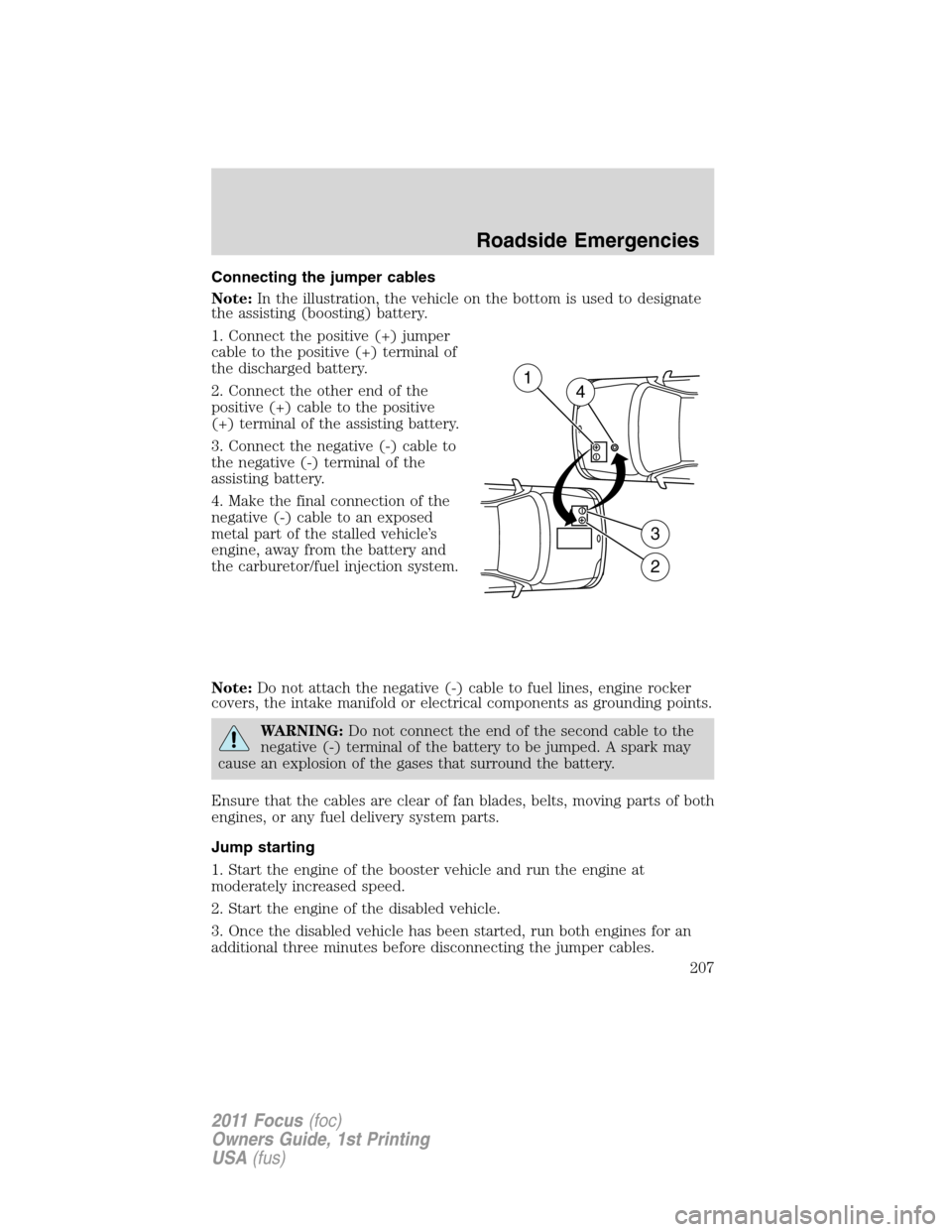
Connecting the jumper cables
Note:In the illustration, the vehicle on the bottom is used to designate
the assisting (boosting) battery.
1. Connect the positive (+) jumper
cable to the positive (+) terminal of
the discharged battery.
2. Connect the other end of the
positive (+) cable to the positive
(+) terminal of the assisting battery.
3. Connect the negative (-) cable to
the negative (-) terminal of the
assisting battery.
4. Make the final connection of the
negative (-) cable to an exposed
metal part of the stalled vehicle’s
engine, away from the battery and
the carburetor/fuel injection system.
Note:Do not attach the negative (-) cable to fuel lines, engine rocker
covers, the intake manifold or electrical components as grounding points.
WARNING:Do not connect the end of the second cable to the
negative (-) terminal of the battery to be jumped. A spark may
cause an explosion of the gases that surround the battery.
Ensure that the cables are clear of fan blades, belts, moving parts of both
engines, or any fuel delivery system parts.
Jump starting
1. Start the engine of the booster vehicle and run the engine at
moderately increased speed.
2. Start the engine of the disabled vehicle.
3. Once the disabled vehicle has been started, run both engines for an
additional three minutes before disconnecting the jumper cables.
+–
+–
2
3
14
Roadside Emergencies
207
2011 Focus(foc)
Owners Guide, 1st Printing
USA(fus)
Page 216 of 301
GETTING ASSISTANCE OUTSIDE THE U.S. AND CANADA
Before exporting your vehicle to a foreign country, contact the
appropriate foreign embassy or consulate. These officials can inform you
of local vehicle registration regulations and where to find unleaded fuel.
If you cannot find unleaded fuel or can only get fuel with an anti-knock
index lower than is recommended for your vehicle, contact a regional
office or owner relations/customer relationship office.
The use of leaded fuel in your vehicle without proper conversion may
damage the effectiveness of your emission control system and may cause
engine knocking or serious engine damage. Ford Motor Company/Ford of
Canada is not responsible for any damage caused by use of improper
fuel. Using leaded fuel may also result in difficulty importing your vehicle
back into the U.S.
If your vehicle must be serviced while you are traveling or living in
Asia-Pacific Region, Sub-Saharan Africa, U.S. Virgin Islands, Central
America, the Caribbean, and Israel, contact the nearest authorized
dealer. If the authorized dealer cannot help you, contact:
FORD MOTOR COMPANY
FORD EXPORT OPERATIONS
1555 Fairlane Drive
Fairlane Business Park #3
Allen Park, Michigan 48101
U.S.A.
Telephone: (313) 594-4857
FAX: (313) 390-0804
Email: [email protected]
If your vehicle must be serviced while you are traveling or living in
Puerto Rico, contact the nearest authorized dealer. If the authorized
dealer cannot help you, contact:
Ford International Business Development Inc.
Customer Assistance Center
P.O. Box 11957
Caparra Heights Station
San Juan, Puerto Rico 00922-1957
Telephone: (800) 841-FORD (3673)
FAX: (313) 390-0804
Email: [email protected]
Customer Assistance
216
2011 Focus(foc)
Owners Guide, 1st Printing
USA(fus)