height FORD FOCUS 2018 Owners Manual
[x] Cancel search | Manufacturer: FORD, Model Year: 2018, Model line: FOCUS, Model: FORD FOCUS 2018Pages: 473, PDF Size: 39.91 MB
Page 4 of 473
Introduction
About This Manual...........................................7
Symbols Glossary.............................................7
Data Recording..................................................9
California Proposition 65..............................11
Perchlorate.........................................................11
Ford Credit..........................................................11
Replacement PartsRecommendation.......................................12
Special Notices................................................12
Mobile CommunicationsEquipment.....................................................13
Export Unique Options..................................13
Environment
Protecting the Environment........................15
Child Safety
General Information.......................................16
Installing Child Restraints.............................17
Booster Seats..................................................24
Child Restraint Positioning.........................26
Child Safety Locks..........................................27
Seatbelts
Principle of Operation..................................29
Fastening the Seatbelts..............................30
Seatbelt Height Adjustment......................32
Seatbelt Warning Lamp and IndicatorChime..............................................................32
Seatbelt Reminder.........................................33
Child Restraint and SeatbeltMaintenance................................................35
Seatbelt Extension........................................35
Personal Safety System™
Personal Safety System™..........................37
Supplementary RestraintsSystem
Principle of Operation..................................38
Driver and Passenger Airbags...................39
Front Passenger Sensing System............40
Side Airbags.....................................................43
Driver Knee Airbag.........................................44
Safety Canopy™............................................44
Crash Sensors and Airbag Indicator.......45
Airbag Disposal..............................................46
Keys and Remote Controls
General Information on RadioFrequencies..................................................47
Remote Control - Vehicles With: KeylessEntry................................................................47
Remote Control - Vehicles With:Integrated Key Transmitter....................50
Remote Control - Vehicles With: KeylessEntry with Remote Start..........................51
Replacing a Lost Key or RemoteControl...........................................................54
MyKey™
Principle of Operation..................................55
Creating a MyKey...........................................56
Clearing All MyKeys.......................................57
Checking MyKey System Status..............58
Using MyKey With Remote StartSystems.........................................................58
MyKey Troubleshooting...............................58
Doors and Locks
Locking and Unlocking................................60
Manual Liftgate..............................................64
Keyless Entry...................................................65
Interior Luggage Compartment Release- 4-Door.........................................................66
Security
Passive Anti-Theft System........................68
12018 Focus (CDH) Canada/United States of America, JM5J 19A321 AA enUSA, Edition date: 201706, Second PrintingTable of Contents
Page 19 of 473
GENERAL INFORMATION
See the following sections for directionson how to properly use safety restraintsfor children.
WARNINGS
Always make sure your child issecured properly in a device that isappropriate for their height, age andweight. Child safety restraints must bebought separately from your vehicle.Failure to follow these instructions andguidelines may result in an increased riskof serious injury or death to your child.
All children are shaped differently.The National Highway Traffic SafetyAdministration and other safetyorganizations, base their recommendationsfor child restraints on probable child height,age and weight thresholds, or on theminimum requirements of the law. Werecommend that you check with a NHTSACertified Child Passenger Safety
WARNINGS
Technician (CPST) to make sure that youproperly install the child restraint in yourvehicle and that you consult yourpediatrician to make sure you have a childrestraint appropriate for your child. Tolocate a child restraint fitting station andCPST, contact NHTSA toll free at1-888-327-4236 or go towww.nhtsa.dot.gov. In Canada, contactTransport Canada toll free at1-800-333-0371 or go to www.tc.gc.ca tofind a Child Car Seat Clinic in your area.Failure to properly restrain children in childrestraints made especially for their height,age and weight, may result in an increasedrisk of serious injury or death to your child.
On hot days, the temperature insidethe vehicle can rise very quickly.Exposure of people or animals tothese high temperatures for even a shorttime can cause death or serious heatrelated injuries, including brain damage.Small children are particularly at risk.
162018 Focus (CDH) Canada/United States of America, JM5J 19A321 AA enUSA, Edition date: 201706, Second PrintingChild Safety
Page 20 of 473
Recommendations for Safety Restraints for Children
Recommended restrainttypeChild size, height, weight, or ageChild
Use a child safety seat(sometimes called aninfant carrier, convertibleseat, or toddler seat).
Children weighing 40 lb (18 kg) or less(generally age four or younger).Infants ortoddlers
Use a belt-positioningbooster seat.
Children who have outgrown or no longerproperly fit in a child safety seat (gener-ally children who are less than 4 ft. 9 in.(1.45 m) tall, are greater than age fourand less than age 12, and between 40 lb(18 kg) and 80 lb (36 kg) and upward to100 lb (45 kg) if recommended by yourchild restraint manufacturer).
Small children
Use a vehicle safety belthaving the lap belt snugand low across the hips,shoulder belt centeredacross the shoulder andchest, and seatbackupright.
Children who have outgrown or no longerproperly fit in a belt-positioning boosterseat (generally children who are at least4 ft. 9 in. (1.45 m) tall or greater than80 lb (36 kg) or 100 lb (45 kg) if recom-mended by child restraint manufacturer).
Larger children
•You are required by law to properly usesafety seats for infants and toddlers inthe United States and Canada.
•Many states and provinces require thatsmall children use approved boosterseats until they reach age eight, aheight of 4 feet 9 inches (1.45 meters)tall, or 80 lb (36 kg). Check your localand state or provincial laws for specificrequirements about the safety ofchildren in your vehicle.
•When possible, always properlyrestrain children 12 years of age andunder in a rear seating position of yourvehicle. Accident statistics suggest thatchildren are safer when properlyrestrained in the rear seating positionsthan in a front seating position. SeeFront Passenger Sensing System(page 40).
INSTALLING CHILD
RESTRAINTS
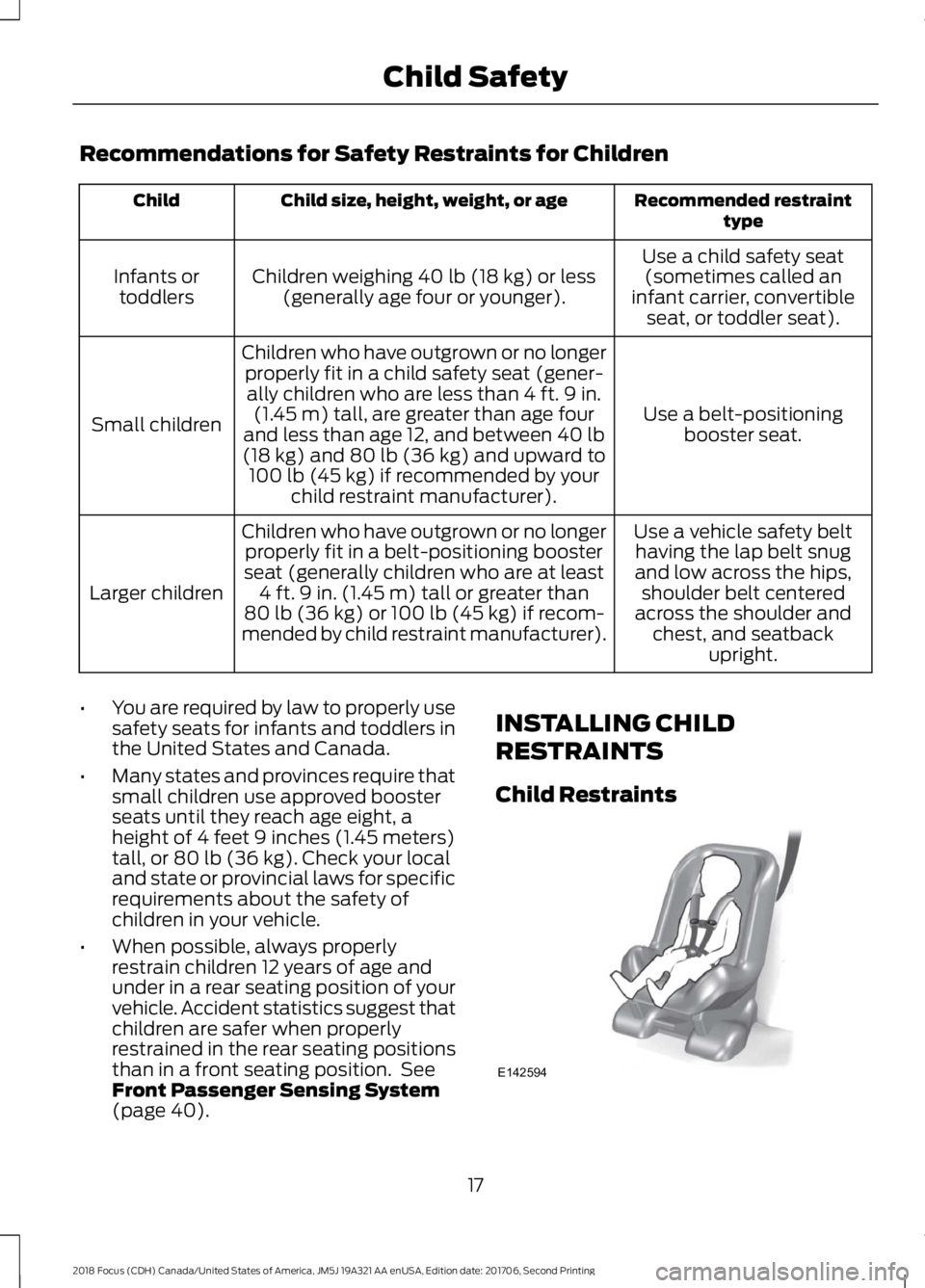
Child Restraints
172018 Focus (CDH) Canada/United States of America, JM5J 19A321 AA enUSA, Edition date: 201706, Second PrintingChild SafetyE142594
Page 27 of 473
BOOSTER SEATS
WARNING
Do not put the shoulder section ofthe seatbelt or allow the child to putthe shoulder section of the seatbeltunder their arm or behind their back. Failureto follow this instruction could reduce theeffectiveness of the seatbelt and increasethe risk of injury or death in a crash.
Use a belt-positioning booster seat forchildren who have outgrown or no longerproperly fit in a child safety restraint(generally children who are less than 57 in(1.45 m) tall, are greater than age 4 andless than age 12, and between 40 lb (18 kg)and 80 lb (36 kg) and upward to 100 lb(45 kg) if recommended by your childrestraint manufacturer). Many state andprovincial laws require that children useapproved booster seats until they reachage eight, a height of 57 in (1.45 m) tall, or80 lb (36 kg).
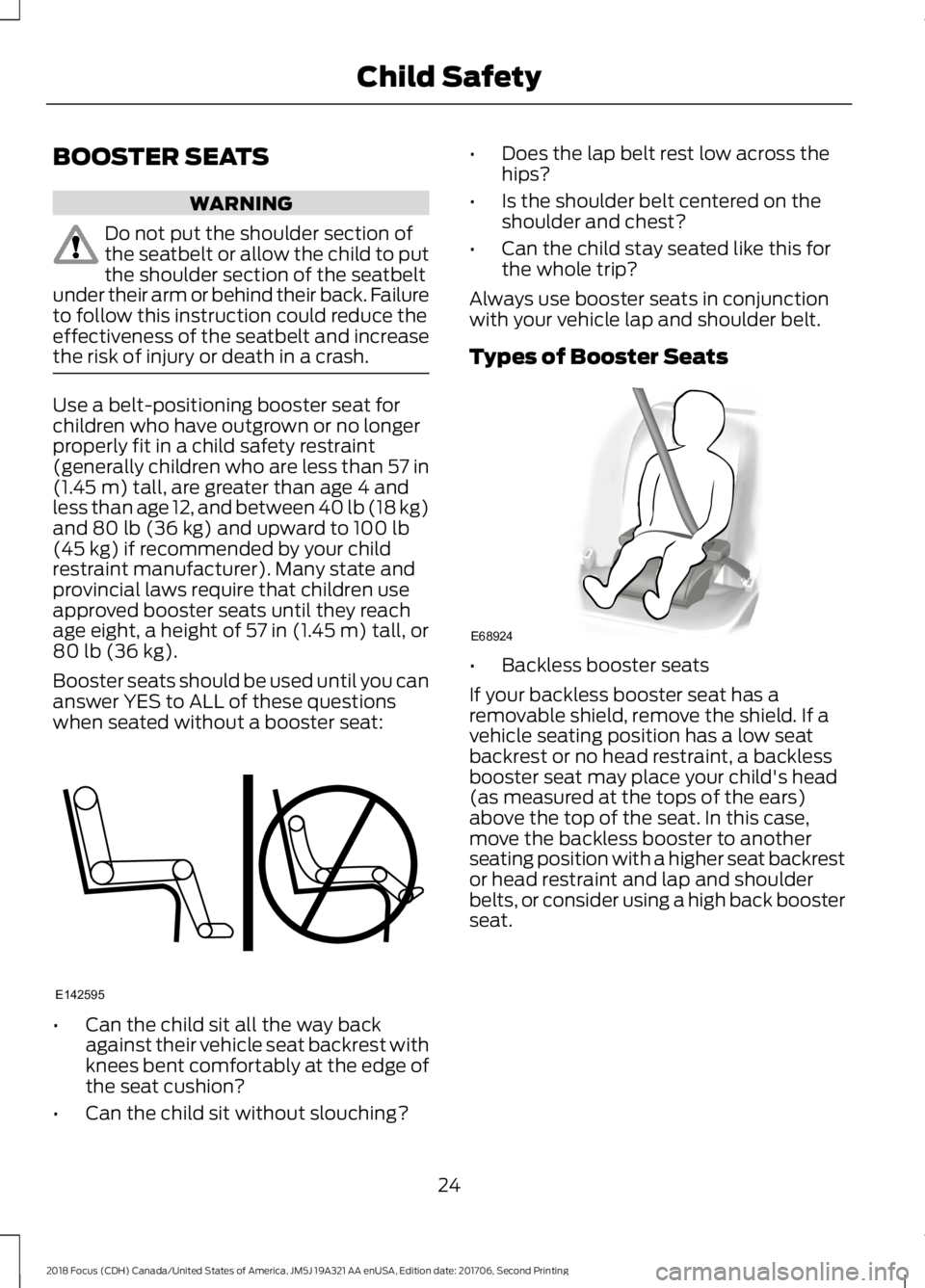
Booster seats should be used until you cananswer YES to ALL of these questionswhen seated without a booster seat:
•Can the child sit all the way backagainst their vehicle seat backrest withknees bent comfortably at the edge ofthe seat cushion?
•Can the child sit without slouching?
•Does the lap belt rest low across thehips?
•Is the shoulder belt centered on theshoulder and chest?
•Can the child stay seated like this forthe whole trip?
Always use booster seats in conjunctionwith your vehicle lap and shoulder belt.
Types of Booster Seats
•Backless booster seats
If your backless booster seat has aremovable shield, remove the shield. If avehicle seating position has a low seatbackrest or no head restraint, a backlessbooster seat may place your child's head(as measured at the tops of the ears)above the top of the seat. In this case,move the backless booster to anotherseating position with a higher seat backrestor head restraint and lap and shoulderbelts, or consider using a high back boosterseat.
242018 Focus (CDH) Canada/United States of America, JM5J 19A321 AA enUSA, Edition date: 201706, Second PrintingChild SafetyE142595 E68924
Page 29 of 473
If the booster seat slides on the vehicleseat upon which it is being used, placing arubberized mesh sold as shelf or carpetliner under the booster seat may improvethis condition. Do not introduce any itemthicker than this under the booster seat.Check with the booster seatmanufacturer's instructions.
CHILD RESTRAINT
POSITIONING
WARNINGS
Airbags can kill or injure a child in achild seat. Never place a rear-facingchild seat in front of an active airbag.If you must use a forward-facing child seatin the front seat, move the vehicle seatupon which the child seat is installed allthe way back. When possible, all childrenage 12 and under should be properlyrestrained in a rear seating position. If allchildren cannot be seated and restrainedproperly in a rear seating position, properlyrestrain the largest child in the front seat.
Always carefully follow theinstructions and warnings providedby the manufacturer of any childrestraint to determine if the restraint deviceis appropriate for your child's size, height,weight, or age. Follow the child restraintmanufacturer's instructions and warningsprovided for installation and use in
WARNINGS
conjunction with the instructions andwarnings provided by your vehiclemanufacturer. A safety seat that isimproperly installed or utilized, isinappropriate for your child's height, age,or weight or does not properly fit the childmay increase the risk of serious injury ordeath.
Never let a passenger hold a child onhis or her lap while your vehicle ismoving. The passenger cannotprotect the child from injury in a crash,which may result in serious injury or death.
Never use pillows, books, or towelsto boost a child. They can slidearound and increase the likelihoodof injury or death in a crash.
Always restrain an unoccupied childseat or booster seat. These objectsmay become projectiles in a crash orsudden stop, which may increase the riskof serious injury.
Never place, or allow a child to place,the shoulder belt under a child's armor behind the back because itreduces the protection for the upper partof the body and may increase the risk ofinjury or death in a crash.
To avoid risk of injury, do not leavechildren or pets unattended in yourvehicle.
262018 Focus (CDH) Canada/United States of America, JM5J 19A321 AA enUSA, Edition date: 201706, Second PrintingChild Safety
Page 32 of 473
PRINCIPLE OF OPERATION
WARNINGS
Always drive and ride with yourseatback upright and the lap beltsnug and low across the hips.
To reduce the risk of injury, makesure children sit where they can beproperly restrained.
Never let a passenger hold a child onhis or her lap while your vehicle ismoving. The passenger cannotprotect the child from injury in a crash.
All occupants of your vehicle,including the driver, should alwaysproperly wear their seatbelts, evenwhen an airbag supplemental restraintsystem is provided. Failure to properly wearyour seatbelts could seriously increase therisk of injury or death.
It is extremely dangerous to ride in acargo area, inside or outside of avehicle. In a crash, people riding inthese areas are more likely to be seriouslyinjured or killed. Do not allow people to ridein any area of your vehicle that is notequipped with seats and seatbelts. Be sureeveryone in your vehicle is in a seat andusing a seatbelt properly.
In a rollover crash, an unbeltedperson is significantly more likely todie than a person wearing a seatbelt.
Each seating position in your vehiclehas a specific seatbelt assemblywhich is made up of one buckle andone tongue that are designed to be usedas a pair. 1) Use the shoulder belt on theoutside shoulder only. Never wear theshoulder belt under the arm. 2) Neverswing the seatbelt around your neck overthe inside shoulder. 3) Never use a singlebelt for more than one person.
WARNINGS
When possible, all children 12 yearsold and under should be properlyrestrained in a rear seating position.Failure to follow this could seriouslyincrease the risk of injury or death.
Seatbelts and seats can become hotin a vehicle that has been closed upin sunny weather; they could burn asmall child. Check seat covers and bucklesbefore you place a child anywhere nearthem.
Front and rear seat occupants,including pregnant women, shouldwear seatbelts for optimumprotection in an accident.
All seating positions in your vehicle havelap and shoulder seatbelts. All occupantsof the vehicle should always properly weartheir seatbelts, even when an airbagsupplemental restraint system is provided.
The seatbelt system consists of:
•Lap and shoulder seatbelts.
•Shoulder seatbelt with automaticlocking mode, (except driver seatbelt).
•Height adjuster at the front outboardseating positions.
•Seatbelt pretensioner at the frontoutboard seating positions.
•Belt tension sensor at the frontoutboard passenger seating position.
· Seatbelt warning light andchime.
· Crash sensors and monitoringsystem with readiness indicator.
292018 Focus (CDH) Canada/United States of America, JM5J 19A321 AA enUSA, Edition date: 201706, Second PrintingSeatbeltsE71880 E67017
Page 34 of 473
Pregnant women should always wear theirseatbelt. The lap belt portion of acombination lap and shoulder belt shouldbe positioned low across the hips belowthe belly and worn as tight as comfortallows. The shoulder belt should bepositioned to cross the middle of theshoulder and the center of the chest.
Seatbelt Locking Modes
WARNINGS
After a crash, have a qualifiedtechnician check all the seatbelts tomake sure the seatbelts includingthe automatic locking retractor feature forchild restraints operate properly. Werecommend replacing any system that hasdamage or does not operate properly.Failure to do so can result in personal injuryor death in the event of a sudden stop oranother crash.
You must replace the seatbelt if theautomatic locking retractor or anyother seatbelt function is notoperating correctly. Failure to replace theseatbelt and retractor assembly couldincrease the risk of injury in a crash.
All safety restraints in your vehicle arecombination lap and shoulder belts. Thedriver seatbelt has the first type of lockingmode. The front outermost passenger andrear seat seatbelts have both types oflocking modes described as follows:
Vehicle Sensitive Mode
This is the normal retractor mode whichallows free shoulder belt lengthadjustment to your movements andlocking in response to vehicle movement.For example, if you brake suddenly or turna corner sharply, or your vehicle receivesan impact of approximately 5 mph(8 km/h) or more, the combinationseatbelts lock to help reduce forwardmovement of the driver and passengers.
In addition, the retractor is designed to lockif you pull the webbing out too quickly. Ifthe seatbelt retractor locks, slowly lowerthe height adjuster to allow the seatbeltto retract. If the retractor does not unlock,pull the seatbelt out slowly then feed asmall length of webbing back toward thestowed position. For rear seatbelts, reclinethe rear seat backrest or push the seatbackrest cushion away from the seatbelt.Feed a small length of webbing backtoward the stowed position.
Automatic Locking Mode
In this mode, the shoulder beltautomatically pre-locks. The seatbelt stillretracts to remove any slack in theshoulder belt. The automatic locking modeis not available on the driver seatbelt.
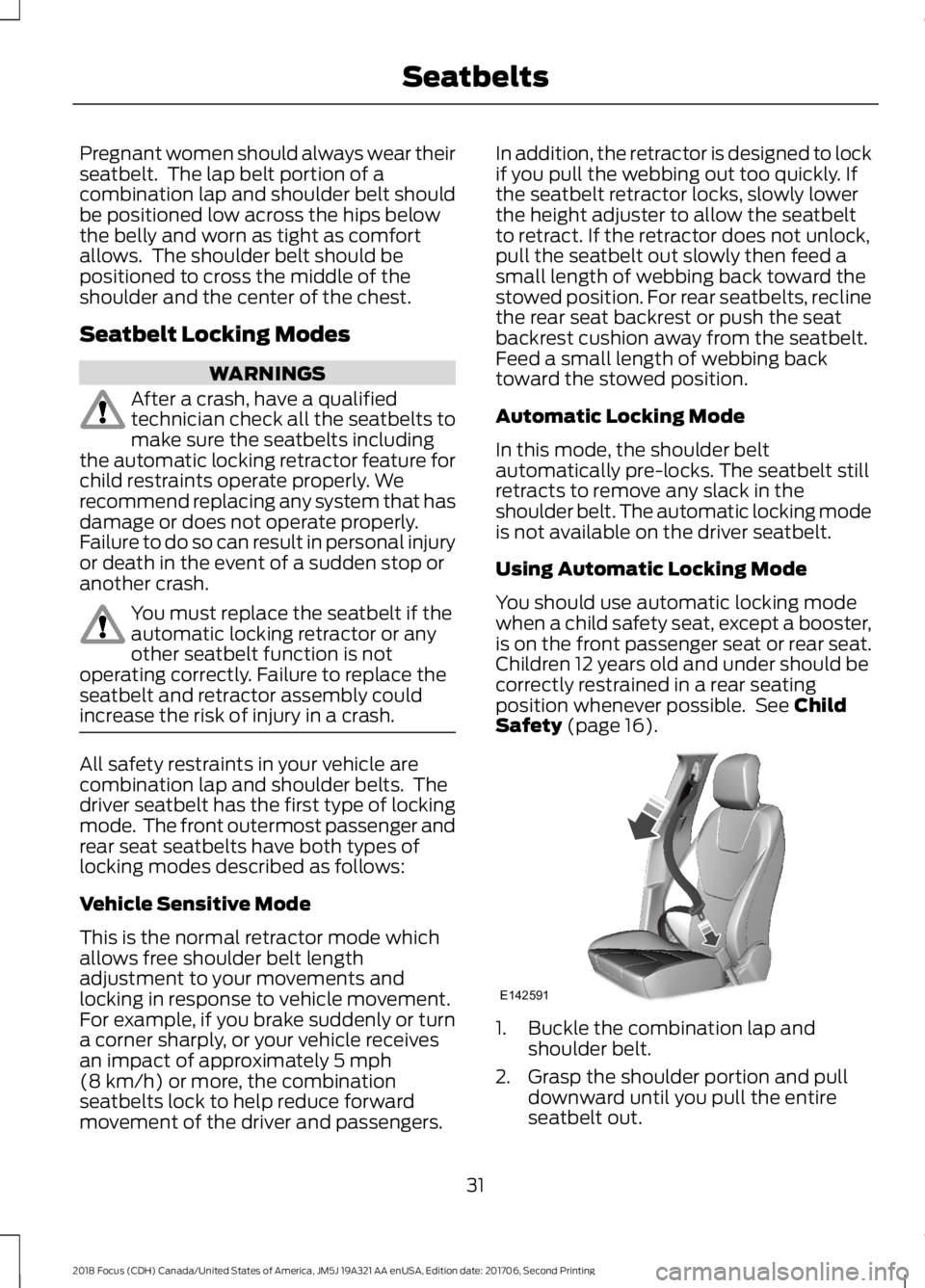
Using Automatic Locking Mode
You should use automatic locking modewhen a child safety seat, except a booster,is on the front passenger seat or rear seat.Children 12 years old and under should becorrectly restrained in a rear seatingposition whenever possible. See ChildSafety (page 16).
1.Buckle the combination lap andshoulder belt.
2.Grasp the shoulder portion and pulldownward until you pull the entireseatbelt out.
312018 Focus (CDH) Canada/United States of America, JM5J 19A321 AA enUSA, Edition date: 201706, Second PrintingSeatbeltsE142591
Page 35 of 473
3.Let the seatbelt retract.
Note:As the seatbelt retracts, you will heara clicking sound. This indicates the seatbeltis now in the automatic locking mode.
Disengaging Automatic Locking Mode
Unbuckle the combination lap andshoulder belt and allow it to retractcompletely to disengage the automaticlocking mode and return the seatbelt tothe vehicle sensitive mode.
SEATBELT HEIGHT
ADJUSTMENT
WARNING
Position the seatbelt height adjusterso that the seatbelt rests across themiddle of your shoulder. Failure toadjust the seatbelt correctly could reduceits effectiveness and increase the risk ofinjury in a crash.
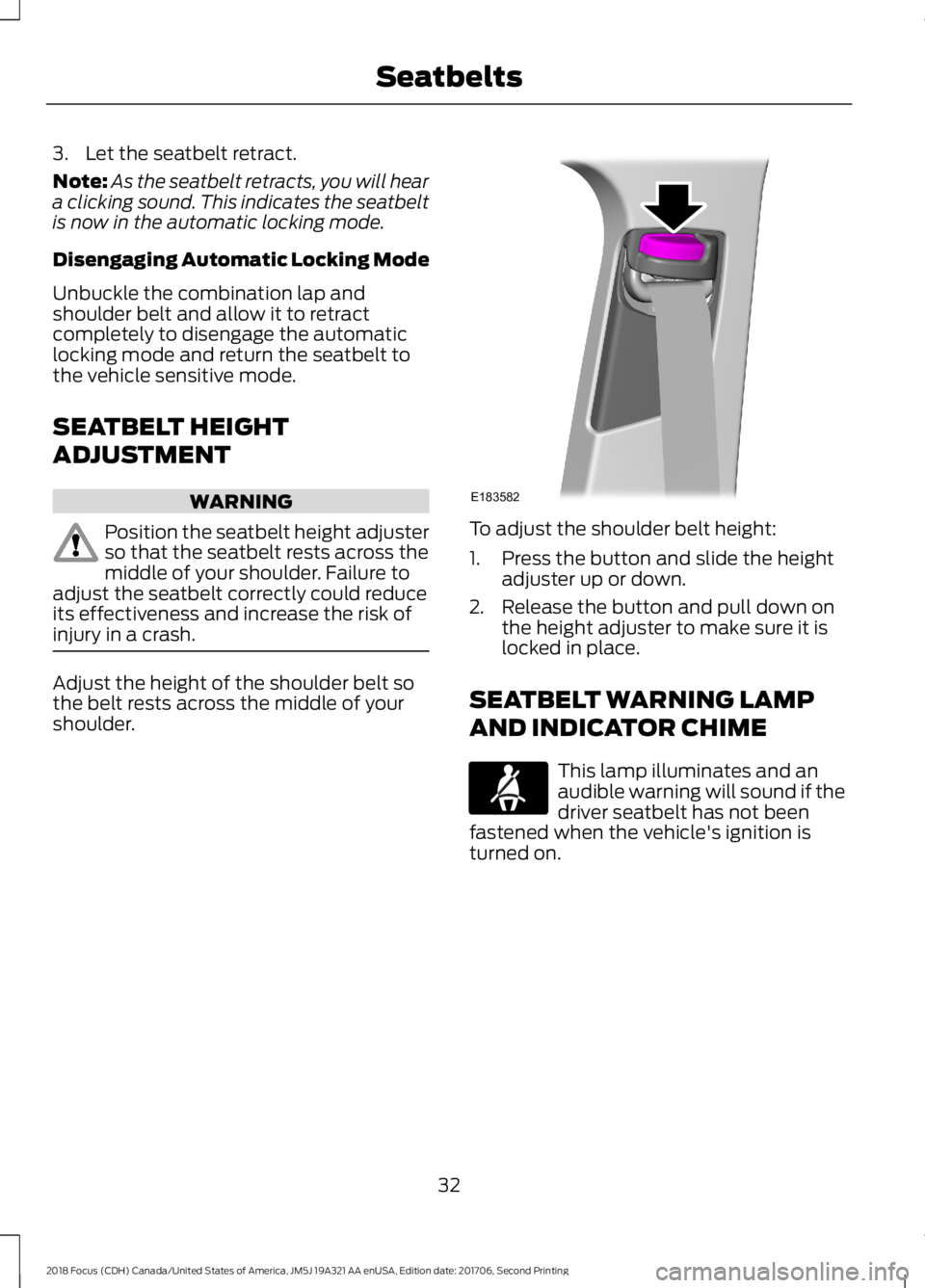
Adjust the height of the shoulder belt sothe belt rests across the middle of yourshoulder.
To adjust the shoulder belt height:
1.Press the button and slide the heightadjuster up or down.
2.Release the button and pull down onthe height adjuster to make sure it islocked in place.
SEATBELT WARNING LAMP
AND INDICATOR CHIME
This lamp illuminates and anaudible warning will sound if thedriver seatbelt has not beenfastened when the vehicle's ignition isturned on.
322018 Focus (CDH) Canada/United States of America, JM5J 19A321 AA enUSA, Edition date: 201706, Second PrintingSeatbeltsE183582 E71880
Page 38 of 473
3.For the seating position you areswitching off, buckle then unbuckle theseatbelt three times at a moderatespeed, ending in the unbuckled state.After Step 3, the seatbelt warning lightturns on.
4.While the seatbelt warning light is on,buckle and then unbuckle the seatbelt.After Step 4, the seatbelt warning lightflashes for confirmation.
•This will switch the feature off for thatseating position if it is currently on.
•This will switch the feature on for thatseating position if it is currently off.
CHILD RESTRAINT AND
SEATBELT MAINTENANCE
Inspect the vehicle safety belts and childsafety seat systems periodically to makesure they work properly and are notdamaged. Inspect the vehicle and childseat safety belts to make sure there are nonicks, tears or cuts. Replace if necessary.All vehicle safety belt assemblies, includingretractors, buckles, front safety belt buckleassemblies, buckle support assemblies(slide bar-if equipped), shoulder beltheight adjusters (if equipped), shoulderbelt guide on seat back (if equipped), childsafety seat LATCH and tether anchors, andattaching hardware, should be inspectedafter a crash. Read the child restraintmanufacturer's instructions for additionalinspection and maintenance informationspecific to the child restraint.
Ford Motor Company recommends thatall safety belt assemblies in use in vehiclesinvolved in a crash be replaced. However,if the crash was minor and an authorizeddealer finds that the belts do not showdamage and continue to operate properly,they do not need to be replaced. Safetybelt assemblies not in use during a crashshould also be inspected and replaced ifeither damage or improper operation isnoted.
Properly care for safety belts. See VehicleCare (page 236).
SEATBELT EXTENSION
WARNINGS
Persons who fit into the vehicle'sseatbelt should not use an extension.Unnecessary use could result inserious personal injury in the event of acrash.
Only use extensions provided free ofcharge by Ford Motor Companydealers. The dealer will provide anextension designed specifically for thisvehicle, model year and seating position.The use of an extension intended foranother vehicle, model year or seatingposition may not offer you the fullprotection of your vehicle’s seatbeltrestraint system.
Never use seatbelt extensions toinstall child restraints.
Do not use a seatbelt extension withan inflatable seatbelt.
Do not use extensions to change thefit of the belt across the torso, overthe lap or to make the seatbeltbuckle easier to reach.
352018 Focus (CDH) Canada/United States of America, JM5J 19A321 AA enUSA, Edition date: 201706, Second PrintingSeatbelts
Page 82 of 473
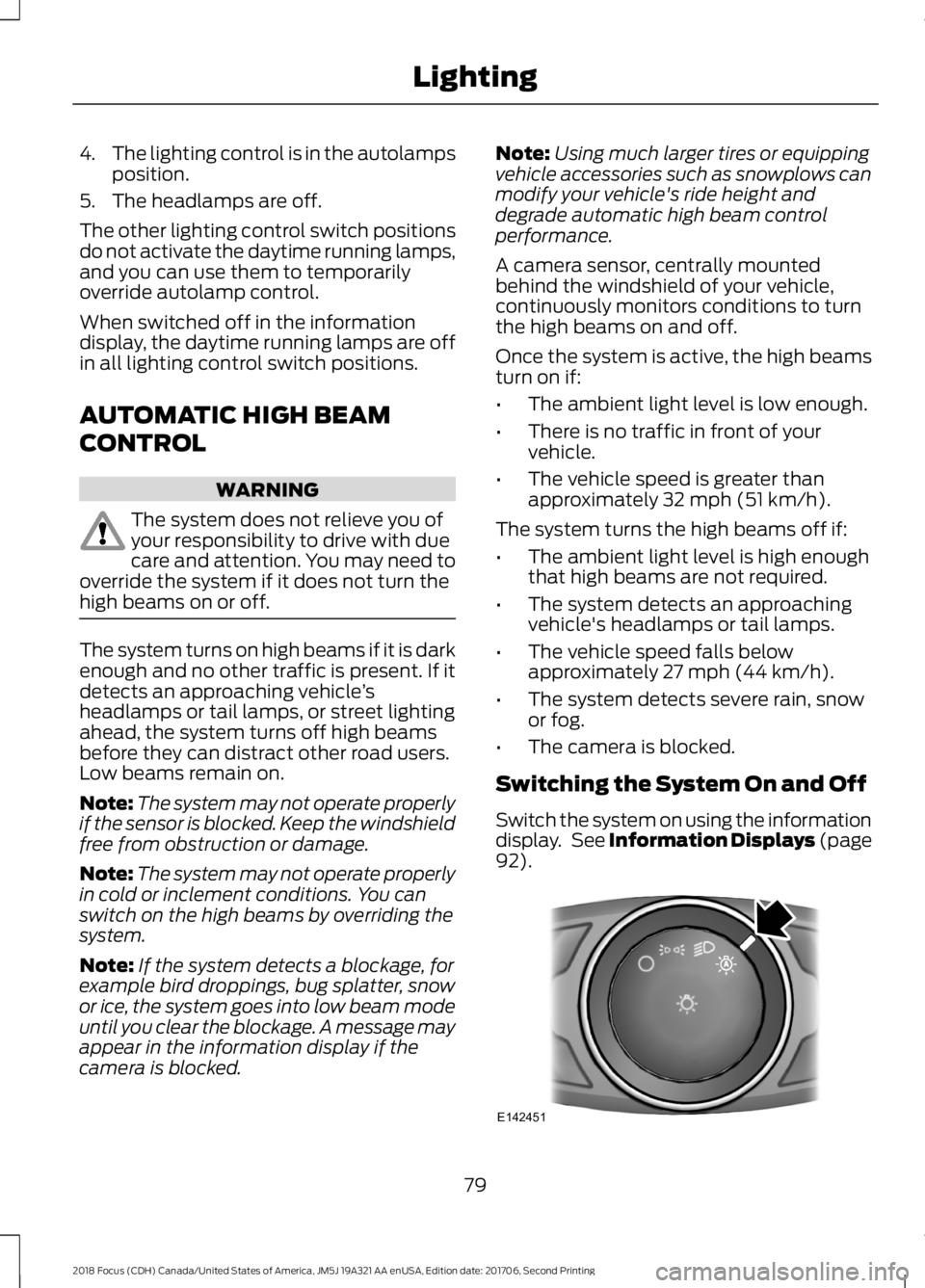
4.The lighting control is in the autolampsposition.
5.The headlamps are off.
The other lighting control switch positionsdo not activate the daytime running lamps,and you can use them to temporarilyoverride autolamp control.
When switched off in the informationdisplay, the daytime running lamps are offin all lighting control switch positions.
AUTOMATIC HIGH BEAM
CONTROL
WARNING
The system does not relieve you ofyour responsibility to drive with duecare and attention. You may need tooverride the system if it does not turn thehigh beams on or off.
The system turns on high beams if it is darkenough and no other traffic is present. If itdetects an approaching vehicle’sheadlamps or tail lamps, or street lightingahead, the system turns off high beamsbefore they can distract other road users.Low beams remain on.
Note:The system may not operate properlyif the sensor is blocked. Keep the windshieldfree from obstruction or damage.
Note:The system may not operate properlyin cold or inclement conditions. You canswitch on the high beams by overriding thesystem.
Note:If the system detects a blockage, forexample bird droppings, bug splatter, snowor ice, the system goes into low beam modeuntil you clear the blockage. A message mayappear in the information display if thecamera is blocked.
Note:Using much larger tires or equippingvehicle accessories such as snowplows canmodify your vehicle's ride height anddegrade automatic high beam controlperformance.
A camera sensor, centrally mountedbehind the windshield of your vehicle,continuously monitors conditions to turnthe high beams on and off.
Once the system is active, the high beamsturn on if:
•The ambient light level is low enough.
•There is no traffic in front of yourvehicle.
•The vehicle speed is greater thanapproximately 32 mph (51 km/h).
The system turns the high beams off if:
•The ambient light level is high enoughthat high beams are not required.
•The system detects an approachingvehicle's headlamps or tail lamps.
•The vehicle speed falls belowapproximately 27 mph (44 km/h).
•The system detects severe rain, snowor fog.
•The camera is blocked.
Switching the System On and Off
Switch the system on using the informationdisplay. See Information Displays (page92).
792018 Focus (CDH) Canada/United States of America, JM5J 19A321 AA enUSA, Edition date: 201706, Second PrintingLightingE142451