warning FORD FOCUS ELECTRIC 2014 3.G Repair Manual
[x] Cancel search | Manufacturer: FORD, Model Year: 2014, Model line: FOCUS ELECTRIC, Model: FORD FOCUS ELECTRIC 2014 3.GPages: 403, PDF Size: 6.42 MB
Page 137 of 403
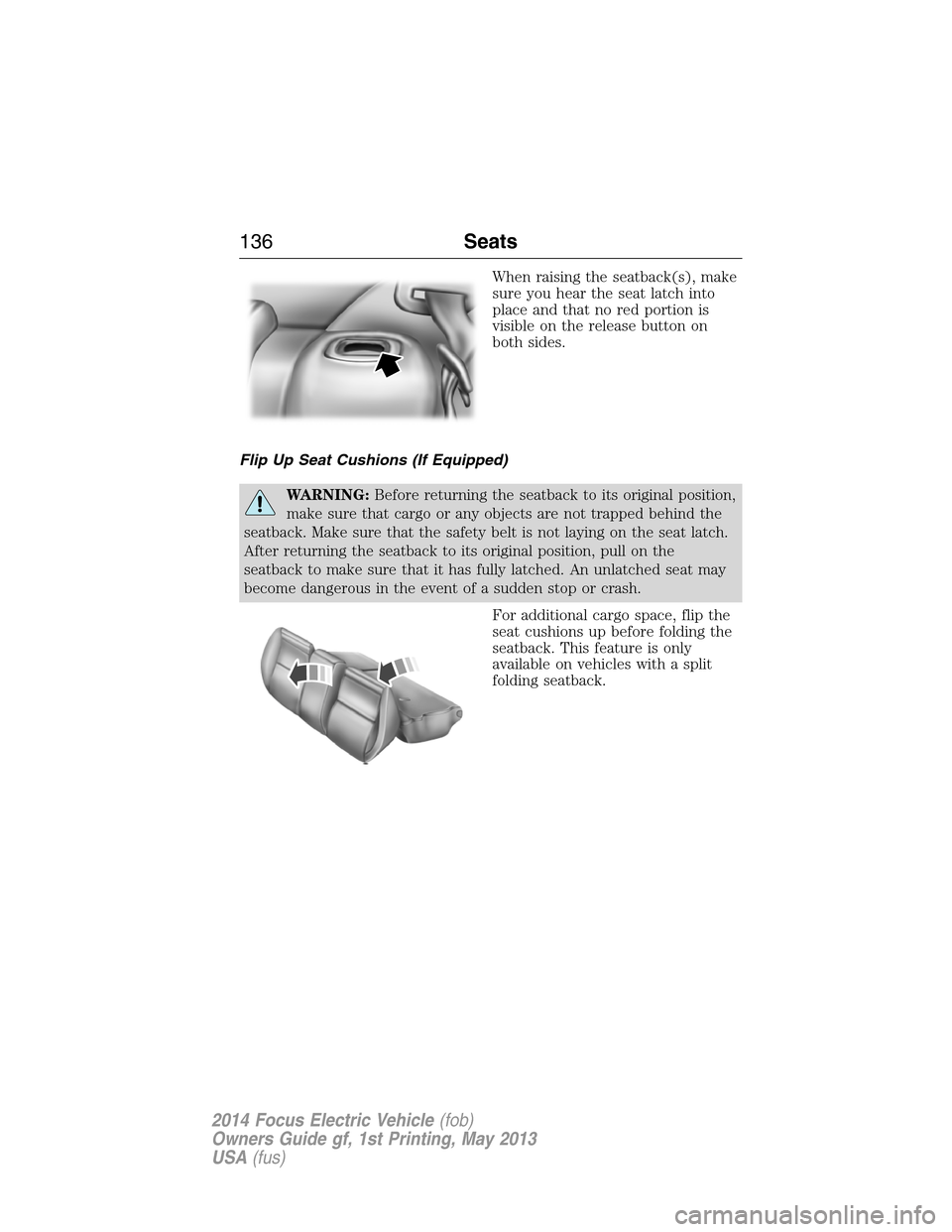
When raising the seatback(s), make
sure you hear the seat latch into
place and that no red portion is
visible on the release button on
both sides.
Flip Up Seat Cushions (If Equipped)
WARNING:Before returning the seatback to its original position,
make sure that cargo or any objects are not trapped behind the
seatback. Make sure that the safety belt is not laying on the seat latch.
After returning the seatback to its original position, pull on the
seatback to make sure that it has fully latched. An unlatched seat may
become dangerous in the event of a sudden stop or crash.
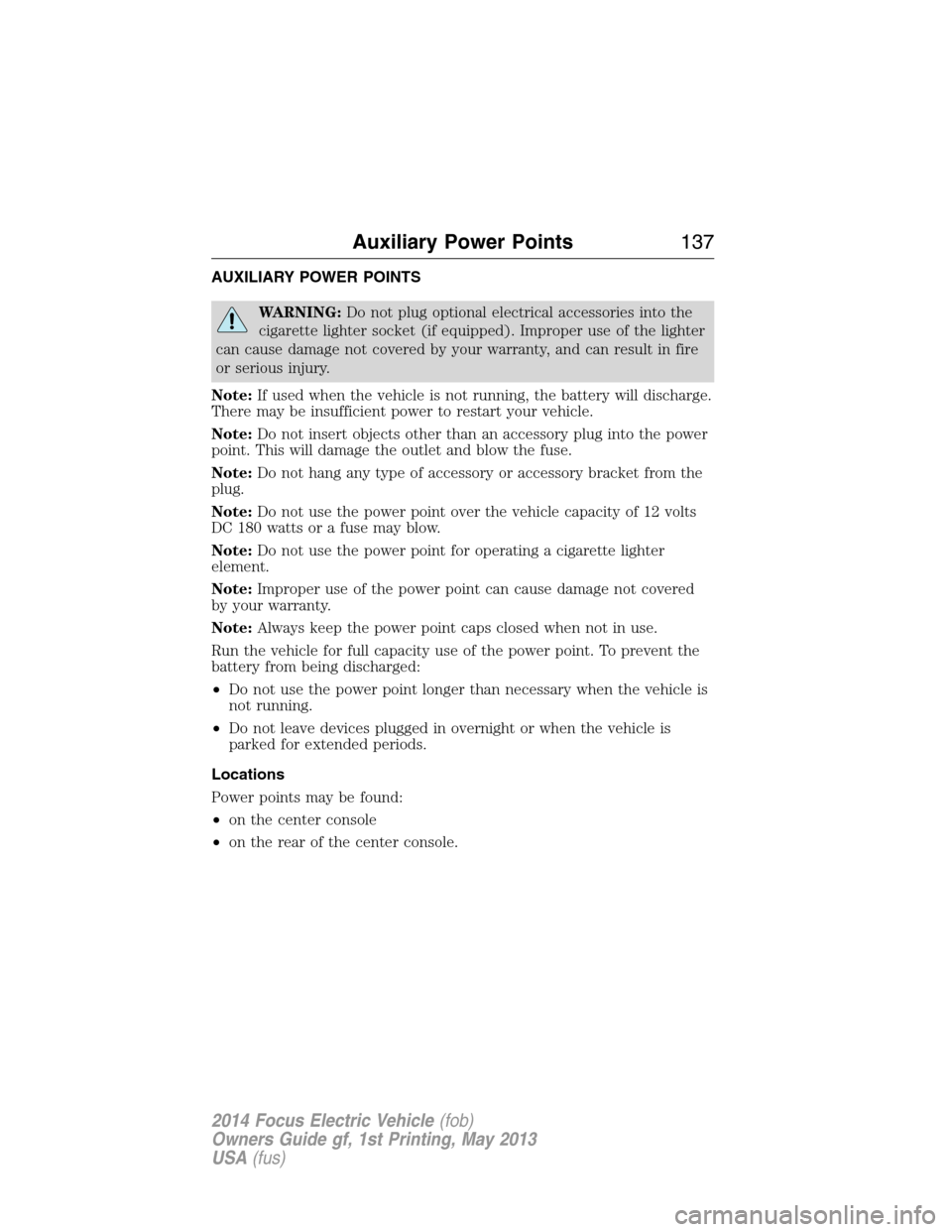
For additional cargo space, flip the
seat cushions up before folding the
seatback. This feature is only
available on vehicles with a split
folding seatback.
136Seats
2014 Focus Electric Vehicle(fob)
Owners Guide gf, 1st Printing, May 2013
USA(fus)
Page 138 of 403
AUXILIARY POWER POINTS
WARNING:Do not plug optional electrical accessories into the
cigarette lighter socket (if equipped). Improper use of the lighter
can cause damage not covered by your warranty, and can result in fire
or serious injury.
Note:If used when the vehicle is not running, the battery will discharge.
There may be insufficient power to restart your vehicle.
Note:Do not insert objects other than an accessory plug into the power
point. This will damage the outlet and blow the fuse.
Note:Do not hang any type of accessory or accessory bracket from the
plug.
Note:Do not use the power point over the vehicle capacity of 12 volts
DC 180 watts or a fuse may blow.
Note:Do not use the power point for operating a cigarette lighter
element.
Note:Improper use of the power point can cause damage not covered
by your warranty.
Note:Always keep the power point caps closed when not in use.
Run the vehicle for full capacity use of the power point. To prevent the
battery from being discharged:
•Do not use the power point longer than necessary when the vehicle is
not running.
•Do not leave devices plugged in overnight or when the vehicle is
parked for extended periods.
Locations
Power points may be found:
•on the center console
•on the rear of the center console.
Auxiliary Power Points137
2014 Focus Electric Vehicle(fob)
Owners Guide gf, 1st Printing, May 2013
USA(fus)
Page 140 of 403
GENERAL INFORMATION
The powertrain control system meets all Canadian interference-causing
equipment standard requirements regulating the impulse electrical field
or radio noise.
KEYLESS STARTING
Note:The keyless starting system may not function if the key is close to
metal objects or electronic devices such as cellular phones.
Note:A valid key must be located inside your vehicle to switch the
ignition on and start the vehicle.
Note:When locking your vehicle, any remote controls left inside the
vehicle may become disabled. A message may appear in the information
display indicating that there is no key detected if you try to start the
vehicle. Press the unlock button on the remote control to enable it, and
then start the vehicle.
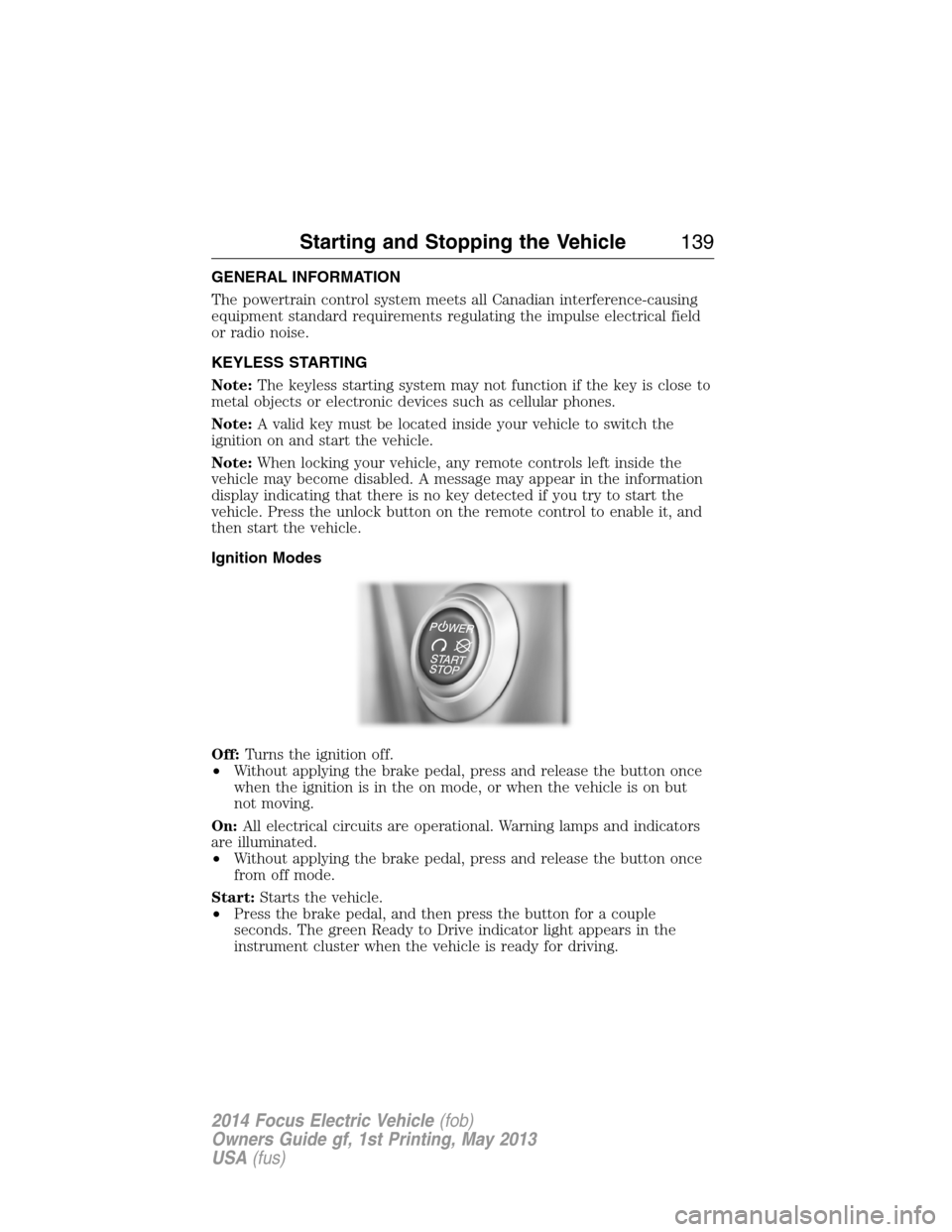
Ignition Modes
Off:Turns the ignition off.
•Without applying the brake pedal, press and release the button once
when the ignition is in the on mode, or when the vehicle is on but
not moving.
On:All electrical circuits are operational. Warning lamps and indicators
are illuminated.
•Without applying the brake pedal, press and release the button once
from off mode.
Start:Starts the vehicle.
•Press the brake pedal, and then press the button for a couple
seconds. The green Ready to Drive indicator light appears in the
instrument cluster when the vehicle is ready for driving.
Starting and Stopping the Vehicle139
2014 Focus Electric Vehicle(fob)
Owners Guide gf, 1st Printing, May 2013
USA(fus)
Page 142 of 403
Stopping the Electric Vehicle’s Motor When the Vehicle Is
Stationary
1. Move the transmission selector lever to positionP.
2. Press the button once.
3. Apply the parking brake.
Note:This switches off the ignition, all electrical circuits, warning lamps
and indicators.
Stopping the Electric Vehicle’s Motor When the Vehicle Is Moving
WARNING:Switching off the vehicle when it is still moving will
result in a loss of brake and steering assistance. The steering
will not lock, but higher effort will be required. When the ignition is
switched off, some electrical circuits, warning lamps and indicators may
also be off.
1. Move the transmission selector lever to positionNand use the brakes
to bring your vehicle to a safe stop.
2. When your vehicle has stopped, move the transmission selector lever
to positionP.
3. Switch the ignition off by pressing and holding the button for one
second, or pressing it three times within two seconds.
4. Apply the parking brake.
Starting and Stopping the Vehicle141
2014 Focus Electric Vehicle(fob)
Owners Guide gf, 1st Printing, May 2013
USA(fus)
Page 143 of 403
HIGH-VOLTAGE BATTERY
WARNING:This battery pack should only be serviced by an
authorized electric vehicle technician. Improper handling can
result in personal injury or death.
Your vehicle consists of various high-voltage components and wiring. All
of the high-voltage power flows through specific wiring assemblies which
are labeled as such and/or are covered with a solid orange convolute or
orange striped tape. Do not come in contact with these components.
No regular maintenance, other than regular charging is required.
The high-voltage battery system is a high-voltage, lightweight lithium-ion
battery system comprised of two individual packs. One pack is located in
the rear cargo area behind the second row seats, and the other is located
underneath the vehicle. The high-voltage battery system uses an advanced,
active liquid heating and cooling system to regulate high-voltage battery
temperature and help maximize high-voltage battery life.
Note:The lithium-ion, high-voltage battery will experience gradual
capacity loss with time and use, which is considered normal wear and tear.
CHARGING THE HIGH-VOLTAGE BATTERY
WARNING:Do not use the 120 volt convenience cord with an
extension cord or adapter.
WARNING:In Canada, do not use the 120 volt convenience cord
in commercial garages.
WARNING:This equipment has arcing or sparking parts that
should not be exposed to flammable vapors. This equipment
should be located at least 18 inches (80 mm) above the floor.
142High Voltage Battery
2014 Focus Electric Vehicle(fob)
Owners Guide gf, 1st Printing, May 2013
USA(fus)
Page 150 of 403
SINGLE-SPEED AUTOMATIC TRANSMISSION
WARNING:Always set the parking brake fully and make sure
the gearshift lever is latched in P (Park).
The single-speed transmission is built specifically to handle the high RPM
range that comes with an all-electric motor.
P (Park)
Note:The vehicle can only be
started in P (Park).
This position locks the transmission
and prevents the front wheels from
turning.
To put your vehicle in gear:
•Press the brake pedal.
•Move the gearshift lever into the desired gear.
To put your vehicle in P (Park):
•Come to a complete stop.
•Move the gearshift lever and securely latch it in P (Park).
R (Reverse)
With the gearshift lever in R (Reverse), the vehicle will move backward.
Always come to a complete stop before shifting into and out of R (Reverse).
N (Neutral)
With the gearshift lever in N (Neutral), the vehicle can be started and is
free to roll. Hold the brake pedal down while in this position.
D (Drive)
The normal driving position for your vehicle. The transmission operates
in a single gear built specifically to handle the high RPM range that
comes with an all-electric motor.
L (Low)
•Provides maximum motor braking.
•Is not intended for use under extended or normal driving conditions
and results in less miles per charge.
•The transmission may be shifted into L (Low) at any vehicle speed.
PRNDL
Transmission149
2014 Focus Electric Vehicle(fob)
Owners Guide gf, 1st Printing, May 2013
USA(fus)
Page 152 of 403
4. Apply the brake pedal. Using a screwdriver (or similar tool), press and
hold the white brake shift interlock lever forward while pulling the
gearshift lever out of the P (Park) position and into the N (Neutral)
position.
5. Reinstall the console side panel and attach the fastener.
6. Reinstall the access cover.
7. Apply the brake pedal, start the vehicle and release the parking brake.
See your authorized dealer as soon as possible if this procedure
is used.
WARNING:Do not drive your vehicle until you verify that the
brake lamps are working.
WARNING:When doing this procedure, you will be taking
the vehicle out of park which means the vehicle can roll freely.
To avoid unwanted vehicle movement, always fully set the parking
brake prior to doing this procedure. Use wheel chocks if appropriate.
WARNING:If the parking brake is fully released, but the brake
warning lamp remains illuminated, the brakes may not be
working properly. See your authorized dealer.
If Your Vehicle Gets Stuck in Mud or Snow
Note:Do not rock the vehicle if the motor is not at normal operating
temperature or damage to the transmission may occur.
Note:Excessive rocking of the vehicle may eventually cause a loss of
power as the powertrain protects against overheating or damage.
If your vehicle gets stuck in mud or snow, it may be rocked out by
shifting between forward and reverse gears, stopping between shifts in a
steady pattern. Press lightly on the accelerator in each gear.
Transmission151
2014 Focus Electric Vehicle(fob)
Owners Guide gf, 1st Printing, May 2013
USA(fus)
Page 153 of 403
HILL START ASSIST
WARNING:The hill start assist feature does not replace the
parking brake. When you leave the vehicle, always apply the
parking brake and shift the transmission into P (Park).
WARNING:You must remain in the vehicle once you have
activated the hill start assist feature.
WARNING:During all times, you are responsible for controlling
the vehicle, supervising the hill start assist system and intervening,
if required.
WARNING:If the motor is revved excessively, or if a malfunction
is detected when the hill start assist feature is active, the hill
start assist feature will be deactivated.
The hill start assist feature makes it easier to pull away when the vehicle is
on a slope without the need to use the parking brake. When the hill start
assist feature is active, the vehicle will remain stationary on the slope for
up to two seconds after you release the brake pedal. During this time, you
have time to move your foot from the brake to the accelerator pedal and
pull away. The brakes are released automatically once the motor has
developed sufficient drive to prevent the vehicle from rolling down the
slope. This is an advantage when pulling away on a slope; for example from
a car park ramp, traffic lights or when reversing uphill into a parking space.
The hill start assist feature is activated automatically when the vehicle is
stopped on a slope greater than five degrees. The hill start assist feature
operates with the vehicle facing downhill if reverse gear is selected.
To activate hill start assist, do the following:
1. Press the brake pedal to bring the vehicle to a complete standstill.
Keep the brake pedal pressed.
2. If the sensors detect that the vehicle is on a slope, the hill start assist
feature will be activated automatically.
3. When you remove your foot from the brake pedal, the vehicle will
remain on the slope without rolling away for approximately up to two
seconds. This hold time will automatically be extended if you are in the
process of driving off.
4. Drive off in the normal manner. The brakes will be released
automatically.
152Transmission
2014 Focus Electric Vehicle(fob)
Owners Guide gf, 1st Printing, May 2013
USA(fus)
Page 154 of 403
GENERAL INFORMATION
Note:Occasional brake noise is normal. If a metal-to-metal, continuous
grinding or continuous squeal sound is present, the brake linings may be
worn out. Have them inspected by an authorized dealer. If your vehicle
has continuous vibration or shudder in the steering wheel while braking,
have your vehicle inspected by an authorized dealer.
Note:Brake dust may accumulate on the wheels, even under normal
driving conditions. Some dust is inevitable as the brakes wear and does
not contribute to brake noise. See theVehicle Carechapter for wheel
cleaning instructions.
See theInstrument Clusterchapter for information on the
brake system warning light.
Wet brakes result in reduced braking efficiency. Gently press the brake
pedal a few times when driving from a car wash or standing water to dry
the brakes.
Brake Over Accelerator
In the event the accelerator pedal becomes stuck or entrapped, apply
steady and firm pressure to the brake pedal to slow the vehicle and
reduce motor power. If you experience this condition, apply the brakes
and bring your vehicle to a safe stop. Turn the motor off, shift to position
Pand apply the parking brake, then inspect the accelerator pedal for any
interferences. If none are found and the condition persists, have your
vehicle towed to the nearest authorized dealer.
Brake Assist
Brake assist detects when you brake heavily by measuring the rate at
which you press the brake pedal. It provides maximum braking efficiency
as long as you press the pedal. Brake assist can reduce stopping
distances in critical situations.
Anti-Lock Brake System
This system helps you maintain steering control during emergency stops
by keeping the brakes from locking.
This lamp momentarily illuminates when you turn the ignition
on. If the light does not illuminate during start-up, remains on
or flashes, the anti-lock brake system may be disabled and may
need to be serviced.
Brakes153
2014 Focus Electric Vehicle(fob)
Owners Guide gf, 1st Printing, May 2013
USA(fus)
Page 155 of 403
If the anti-lock brake system is disabled, normal braking is still
effective. If the brake warning lamp illuminates with the parking
brake released, have your brake system serviced immediately.
Regenerative braking system
Your vehicle uses a feature known as regenerative braking. This is used to
simulate the engine braking of an internal combustion engine and assist the
standard brake system while recovering some of the energy of motion and
storing it in the battery to improve fuel economy. The standard brake
system is designed to fully stop the car if regenerative braking is not
available. During regenerative braking, the motor is spun as a generator to
create electrical current. This recharges the battery and slows the vehicle.
In effect, once the accelerator pedal is released, the motor changes from an
energy user to an energy producer.
When the accelerator pedal is released or the brake pedal is applied,
the brake controller automatically detects the amount of deceleration
requested and optimizes how much of the deceleration will be produced
by regenerative braking. The remaining portion is generated by standard
friction braking. When the battery is almost fully charged, the amount of
regenerative braking is limited to avoid overcharging, and the requested
deceleration is produced by standard friction braking alone.
Regenerative braking does not take the place of the standard friction
brakes; it only assists them. Regenerative braking has also been designed
to interact with the anti-lock brake system. Regenerative braking is
disabled when the anti-lock brake system is activated or the battery is
fully charged.
HINTS ON DRIVING WITH ANTI-LOCK BRAKES
When the system is operating, the brake pedal will pulse and may travel
further. Maintain pressure on the brake pedal. You may also hear a noise
from the system. This is normal.
The anti-lock braking system will not eliminate the dangers inherent when:
•you drive too closely to the vehicle in front of you.
•your vehicle is hydroplaning.
•you take corners too fast.
•the road surface is poor.
154Brakes
2014 Focus Electric Vehicle(fob)
Owners Guide gf, 1st Printing, May 2013
USA(fus)