towing FORD FREESTYLE 2005 1.G User Guide
[x] Cancel search | Manufacturer: FORD, Model Year: 2005, Model line: FREESTYLE, Model: FORD FREESTYLE 2005 1.GPages: 288, PDF Size: 2.32 MB
Page 186 of 288
average 220 pounds each and the golf bags weigh approximately
30 pounds each. Is there enough load capacity to carry you, 4 of
your friends and all the golf bags? The calculation would be:
1400–(5 x 220) - (5 x 30) = 1400–1100–150 = 150 pounds; yes,
you have enough load capacity in your vehicle to transport 4 of your
friends and golf bags.
•A final example for your vehicle with 1400 pounds of cargo and
luggage capacity. You and one of your friends decide to pick up
cement from the local home improvement store to finish that patio
you have planning for the past 2 years. Measuring the inside of the
vehicle with the rear seat folded down, you have room for 12–100
pound bags of cement. Do you have enough load capacity to transport
the cement to your home? If you and your friend each wighed 220
pounds, the calculation would be: 1400–(2 x 220) - (12 x 100) =
1400–440–1200 =–40 pounds; no, you do not have enough cargo
capacity to carry that much weight. You will need to reduce the load
weight by at least 240 pounds. If you remove 3–100 pound cement
bags, then the load calculation would be:
1400–(2 x 220) - (9 x 100) = 1400–440–900 = 60 pounds; now you
have the load capacity to transport the cement and your friend home.
The above calculations also assume that the loads are positioned in your
vehicle in a manner that does not overload the Front or the Rear Gross
Axle Weight Rating specified for your vehicle on the Certification label
found on the driver’s door.
TRAILER TOWING
Your vehicle is capable of towing a trailer up to 2,000 lb. (908 kg) gross
trailer weight with a maximum tongue load of 200 lb. (90 kg). Do not tow a
trailer until your vehicle has been driven at least 500 miles (800 km).
Towing a trailer places an additional load on your vehicle’s engine,
transmission, brakes, tires and suspension. Inspect these components
carefully after towing.
Do not exceed the GVWR or the GAWR specified on the
certification label.
Towing trailers beyond the maximum recommended gross trailer
weight exceeds the limit of the vehicle and could result in
engine damage, transmission damage, structural damage, loss of vehicle
control, vehicle rollover and personal injury.
REVIEW COPY
2005 Freestyle(219), Owners Guide (post-2002-fmt)(own2002),
Market:USA_English(fus)
Tires, Wheels and Loading
186
Page 187 of 288
Preparing to tow
Use the proper equipment for towing a trailer and make sure it is
properly attached to your vehicle. See your dealer or a reliable trailer
dealer if you require assistance.
Hitches
Do not use hitches that clamp onto the vehicle bumper. Use a load
carrying hitch. You must distribute the load in your trailer so that
10–15% of the total weight of the trailer is on the tongue.
Safety chains
Always connect the trailer’s safety chains to the frame or hook retainers
of the vehicle hitch. To connect the trailer’s safety chains, cross the
chains under the trailer tongue and allow slack for turning corners.
If you use a rental trailer, follow the instructions that the rental agency
gives to you.
Do not attach safety chains to the bumper.
Trailer brakes
Electric brakes and manual, automatic or surge-type trailer brakes are
safe if installed properly and adjusted to the manufacturer’s
specifications. The trailer brakes must meet local and Federal
regulations.
Do not connect a trailer’s hydraulic brake system directly to your
vehicle’s brake system. Your vehicle may not have enough
braking power and your chances of having a collision greatly increase.
The braking system of the tow vehicle is rated for operation at the
GVWR not GCWR.
Trailer lamps
Trailer lamps are required on most towed vehicles. Make sure all running
lights, brake lights, turn signals and hazard lights are working. See your
dealer or trailer rental agency for proper instructions and equipment for
hooking up trailer lamps.
REVIEW COPY
2005 Freestyle(219), Owners Guide (post-2002-fmt)(own2002),
Market:USA_English(fus)
Tires, Wheels and Loading
187
Page 188 of 288
Driving while you tow
When towing a trailer:
•Turn off the speed control. The speed control may shut off
automatically when you are towing on long, steep grades.
•Consult your local motor vehicle speed regulations for towing a trailer.
•It is recommended to select the L (Low) gear position when additional
engine braking is needed. In situations such as prolonged downhill
driving on steep grades (i.e., driving in mountainous areas), additional
engine braking is needed to reduce the load on the vehicle’s regular
brake system to prevent them from overheating.
•Anticipate stops and brake gradually.
Servicing after towing
If you tow a trailer for long distances, your vehicle will require more
frequent service intervals. Refer to yourScheduled Maintenance Guide
for more information.
Trailer towing tips
•Practice turning, stopping and backing up before starting on a trip to
get the feel of the vehicle trailer combination. When turning, make
wider turns so the trailer wheels will clear curbs and other obstacles.
•Allow more distance for stopping with a trailer attached.
•If you are driving down a long or steep hill, shift into the“L”gear
position. Do not apply the brakes continuously, as they may overheat
and become less effective.
•The trailer tongue weight should be 10–15% of the loaded trailer
weight.
•After you have traveled 50 miles (80 km), thoroughly check your
hitch, electrical connections and trailer wheel lug nuts.
•To aid in engine/transmission cooling and A/C efficiency during hot
weather while stopped in traffic, place the gearshift lever in P (Park).
•Vehicles with trailers should not be parked on a grade. If you must
park on a grade, place wheel chocks under the trailer’s wheels.
REVIEW COPY
2005 Freestyle(219), Owners Guide (post-2002-fmt)(own2002),
Market:USA_English(fus)
Tires, Wheels and Loading
188
Page 189 of 288
RECREATIONAL TOWING
Follow these guidelines for your specific powertrain combination to tow
your vehicle for personal travel (such as behind a recreational vehicle or
moving truck).
In case of roadside emergency with a disabled vehicle, please refer to the
Wrecker towingsection in theDrivingchapter.
These guidelines are designed to ensure that your transmission is not
damaged due to insufficient lubrication.
Front Wheel Drive (FWD) vehicles:
Do not tow your Front Wheel Drive vehicle with the front drive wheels
on the ground as transaxle damage may occur. It is recommended to tow
your vehicle with the front drive wheels on a dolly or use a car-hauling
trailer.
All Wheel Drive (AWD) vehicles:
Do not tow your All Wheel Drive vehicle with any wheels on the ground
as vehicle or transaxle damage may occur. It is recommended to tow
your vehicle using a car-hauling trailer.
REVIEW COPY
2005 Freestyle(219), Owners Guide (post-2002-fmt)(own2002),
Market:USA_English(fus)
Tires, Wheels and Loading
189
Page 209 of 288
GETTING ROADSIDE ASSISTANCE
To fully assist you should you have a vehicle concern, Ford Motor
Company offers a complimentary roadside assistance program. This
program is separate from the New Vehicle Limited Warranty. The service
is available:
•24–hours, seven days a week
•for the New Vehicle Limited Warranty period of three years or 36,000
miles (60,000 km), whichever occurs first on Ford and Mercury
vehicles, and four years or 50,000 miles (80,000 km) on Lincoln
vehicles.
Roadside assistance will cover:
•a flat tire change with a good spare (except Ford GT which has a tire
inflation kit)
•battery jump start
•lock-out assistance (key replacement cost is the customer’s
responsibility)
•fuel delivery (2.0 gallons [7.5L], maximum two occurrences within 12
month period)
•towing of your disabled vehicle to the nearest Ford Motor Company
dealership, or your selling dealer if within 35 miles (56.3 km) of the
nearest Ford Motor Company dealership (one tow per disablement).
Even non-warranty related tows, like accidents, are covered (some
exclusions apply, such as impound towing or repossession).
Canadian customers refer to your Owner Information Guide for
information on:
•coverage period
•exact fuel amounts
•towing of your disabled vehicle
•emergency travel expense reimbursement
•travel planning benefits
USING ROADSIDE ASSISTANCE
Complete the roadside assistance identification card and place it in your
wallet for quick reference. In the United States, this card is found in the
Owner Guide portfolio in the glove compartment. In Canada, the card is
found in theOwner Information Guidein the glove compartment.
U.S. Ford or Mercury vehicle customers who require roadside assistance,
call 1–800–241–3673; Lincoln vehicle customers call 1–800–521–4140.
REVIEW COPY
2005 Freestyle(219), Owners Guide (post-2002-fmt)(own2002),
Market:USA_English(fus)
Roadside Emergencies
Roadside Emergencies
209
Page 223 of 288
WRECKER TOWING
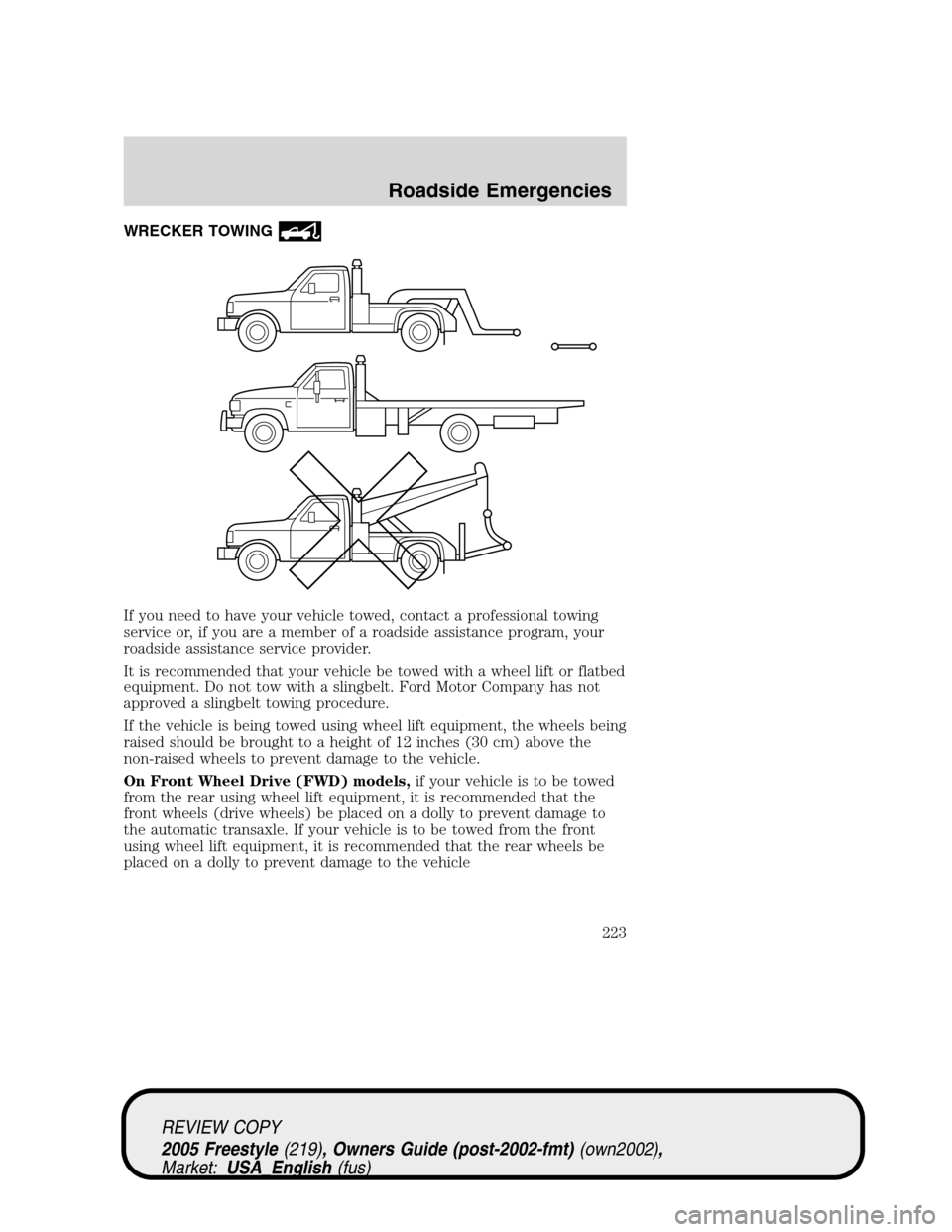
If you need to have your vehicle towed, contact a professional towing
service or, if you are a member of a roadside assistance program, your
roadside assistance service provider.
It is recommended that your vehicle be towed with a wheel lift or flatbed
equipment. Do not tow with a slingbelt. Ford Motor Company has not
approved a slingbelt towing procedure.
If the vehicle is being towed using wheel lift equipment, the wheels being
raised should be brought to a height of 12 inches (30 cm) above the
non-raised wheels to prevent damage to the vehicle.
On Front Wheel Drive (FWD) models,if your vehicle is to be towed
from the rear using wheel lift equipment, it is recommended that the
front wheels (drive wheels) be placed on a dolly to prevent damage to
the automatic transaxle. If your vehicle is to be towed from the front
using wheel lift equipment, it is recommended that the rear wheels be
placed on a dolly to prevent damage to the vehicle
REVIEW COPY
2005 Freestyle(219), Owners Guide (post-2002-fmt)(own2002),
Market:USA_English(fus)
Roadside Emergencies
223
Page 224 of 288
In case of a roadside emergency with a disabled vehicle (without access
to wheel dollies, flatbed transport vehicle or a car hauling trailer) your
vehicle can be flat towed (all wheels on the ground) only under the
following conditions:
•The ambient temperature is above 32°F(0°C)
•Place the automatic transaxle in N (Neutral).
•DO NOT exceed the distance of 31 miles (50 km).
•DO NOT exceed the speed of 31 mph (50 km/h).
On All Wheel Drive (AWD) models,it is not recommended that your
vehicle be towed with any wheels on the ground. It is recommended to
tow your vehicle with all the wheels off the ground using wheel lift
equipment and a wheel dolly, a flatbed transport vehicle or a car-hauling
trailer.
In case of a roadside emergency with a disabled vehicle (without access
to wheel dollies, flatbed transport vehicle or a car hauling trailer) your
vehicle can be flat towed (all wheels on the ground) or wrecker towed
(rear wheels on the ground) only under the following conditions:
•The ambient temperature is above 32°F(0°C).
•Place the transmission in N (Neutral).
•Maximum distance is 31 miles (50 km).
•Maximum speed is 31 mph (50 km/h).
If the vehicle is towed by other means or incorrectly, vehicle
damage may occur.
Ford Motor Company produces a towing manual for all authorized tow
truck operators. Have your tow truck operator refer to this manual for
proper hook-up and towing procedures for your vehicle.
REVIEW COPY
2005 Freestyle(219), Owners Guide (post-2002-fmt)(own2002),
Market:USA_English(fus)
Roadside Emergencies
224
Page 231 of 288
UTILIZING THE MEDIATION/ARBITRATION PROGRAM
(CANADA ONLY)
In those cases where you continue to feel that the efforts by Ford and
the dealer to resolve a factory-related vehicle service concern have been
unsatisfactory, Ford of Canada participates in an impartial third party
mediation/arbitration program administered by the Canadian Motor
Vehicle Arbitration Plan (CAMVAP).
The CAMVAP program is a straight-forward and relatively speedy
alternative to resolve a disagreement when all other efforts to produce a
settlement have failed. This procedure is without cost to you and is
designed to eliminate the need for lengthy and expensive legal
proceedings.
In the CAMVAP program, impartial third-party arbitrators conduct
hearings at mutually convenient times and places in an informal
environment. These impartial arbitrators review the positions of the
parties, make decisions and, when appropriate, render awards to resolve
disputes. CAMVAP decisions are fast, fair, and final; the arbitrator’s
award is binding both to you and Ford of Canada.
CAMVAP services are available in all territories and provinces. For more
information, without charge or obligation, call your CAMVAP Provincial
Administrator directly at 1-800-207-0685.
FORD EXTENDED SERVICE PLAN
You can get more protection for your new car or light truck by
purchasing Ford Extended Service Plan (Ford ESP) coverage. It provides
the following:
•Benefits during the warranty period depending on the plan you
purchase (such as: reimbursement for rentals; coverage for certain
maintenance and wear items).
•Protection against covered repair costs after your Bumper-to-Bumper
Warranty expires.
You may purchase Ford ESP from any participating Ford and Lincoln
Mercury and Ford of Canada dealer. There are several plans available in
various time, distance and deductible combinations which can be tailored
to fit your own driving needs. Ford ESP also offers reimbursement
benefits for towing and rental coverage.
When you buy Ford ESP, you receive Peace-of-Mind protection
throughout the United States and Canada, provided by a network of
more than 5,000 participating Ford or Lincoln Mercury and Ford of
Canada dealers.
REVIEW COPY
2005 Freestyle(219), Owners Guide (post-2002-fmt)(own2002),
Market:USA_English(fus)
Customer Assistance
231
Page 262 of 288
Habits
•Smooth, moderate operation can yield up to 10% savings in fuel.
•Steady speeds without stopping will usually give the best fuel
economy.
•Idling for long periods of time (greater than one minute) may waste
fuel.
•Anticipate stopping; slowing down may eliminate the need to stop.
•Sudden or hard accelerations may reduce fuel economy.
•Slow down gradually.
•Driving at reasonable speeds (traveling at 55 mph [88 km/h] uses 15%
less fuel than traveling at 65 mph [105 km/h]).
•Revving the engine before turning it off may reduce fuel economy.
•Using the air conditioner or defroster may reduce fuel economy.
•You may want to turn off the speed control in hilly terrain if
unnecessary shifting between third and fourth gear occurs.
Unnecessary shifting of this type could result in reduced fuel
economy.
•Warming up a vehicle on cold mornings is not required and may
reduce fuel economy.
•Resting your foot on the brake pedal while driving may reduce fuel
economy.
•Combine errands and minimize stop-and-go driving.
Maintenance
•Keep tires properly inflated and use only recommended size.
•Operating a vehicle with the wheels out of alignment will reduce fuel
economy.
•Use recommended engine oil. Refer toLubricant specificationsin
this chapter.
•Perform all regularly scheduled maintenance items. Follow the
recommended maintenance schedule and owner maintenance checks
found in your vehicle scheduled maintenance guide.
Conditions
•Heavily loading a vehicle or towing a trailer may reduce fuel economy
at any speed.
•Carrying unnecessary weight may reduce fuel economy (approximately
1 mpg [0.4 km/L] is lost for every 400 lb [180 kg] of weight carried).
REVIEW COPY
2005 Freestyle(219), Owners Guide (post-2002-fmt)(own2002),
Market:USA_English(fus)
Maintenance and Specifications
262
Page 283 of 288
Roadside assistance ..................209
Roof rack .....................................90
S
Safety Belt Maintenance ..........130
Safety belts (see
Safety restraints) ......118, 121–125
Safety Canopy ...........................141
Safety defects, reporting ..........233
Safety restraints ........118, 121–125
belt minder .............................126
extension assembly ................130
for adults .........................122–124
for children .....................144–145
Occupant Classification
Sensor ......................................119
safety belt maintenance .........130
warning light and chime ........125
Safety seats for children ..........148
Seat belts
(see Safety restraints) .............118
Seats ..........................................106
child safety seats ....................148
front seats .......................106, 109
heated ............................43, 45, 47
memory seat .....................94, 110
second row seats ............111, 114
third row seats ................114–116
Servicing your vehicle ..............240
Setting the clock
AM/FM/In-dash 6 CD ................21
Spare tire (see
Changing the Tire) ...........163, 165
Spark plugs,
specifications .....................267, 272
Specification chart,
lubricants ...........................270, 272Speed control ..............................68
Starting your
vehicle ........................190–191, 193
jump starting ..........................218
Steering wheel
controls ......................................71
tilting .........................................63
T
Tilt steering wheel ......................63
Tires ...........................158–159, 163
alignment ................................177
care ..........................................176
changing ..................163, 165–166
checking the pressure ............161
inspecting and inflating .........160
label .........................................175
replacing ..................................163
rotating ....................................178
safety practices .......................177
sidewall information ...............170
snow tires and chains ............179
spare tire .................................164
terminology .............................159
tire grades ...............................159
treadwear ........................158, 176
Towing .......................................186
recreational towing .................189
trailer towing ..........................186
wrecker ....................................223
Traction control ........................196
Transaxle
fluid, refill capacities ..............268
lubricant specifications ..........272
Transmission .............................197
brake-shift interlock (BSI) ....197
fluid, checking and adding
(automatic) .............................267
lubricant specifications ..........270
REVIEW COPY
2005 Freestyle(219), Owners Guide (post-2002-fmt)(own2002),
Market:USA_English(fus)
Index
283