tow FORD FUSION 2018 Owners Manual
[x] Cancel search | Manufacturer: FORD, Model Year: 2018, Model line: FUSION, Model: FORD FUSION 2018Pages: 539, PDF Size: 6.42 MB
Page 5 of 539
Adjusting the Steering Wheel - Vehicles
With: Manual Adjustable Steering
Column ...........................................................71
Audio Control ...................................................
71
Voice Control ...................................................
72
Cruise Control .................................................
72
Information Display Control ......................
73
Heated Steering Wheel ...............................
73
Wipers and Washers
Windshield Wipers ........................................
74
Autowipers .......................................................
74
Windshield Washers .....................................
75
Lighting
General Information .....................................
76
Lighting Control .............................................
76
Autolamps ........................................................
77
Instrument Lighting Dimmer .....................
77
Daytime Running Lamps ............................
78
Automatic High Beam Control .................
79
Front Fog Lamps ...........................................
80
Direction Indicators ......................................
80
Interior Lamps ................................................
80
Ambient Lighting ...........................................
82
Windows and Mirrors
Power Windows .............................................
83
Global Opening and Closing .....................
84
Exterior Mirrors ...............................................
84
Interior Mirror ..................................................
86
Sun Visors ........................................................
87
Moonroof ..........................................................
87
Instrument Cluster
Gauges ..............................................................
89
Warning Lamps and Indicators .................
91
Audible Warnings and Indicators ............
95Information Displays
General Information
....................................
96
Information Messages ...............................
105
Climate Control
Manual Climate Control ...........................
120
Automatic Climate Control - Vehicles With: Sony Audio System ......................
121
Automatic Climate Control - Vehicles Without: Sony Audio System ..............
124
Hints on Controlling the Interior Climate ........................................................................\
.
126
Heated Windows and Mirrors .................
128
Cabin Air Filter ...............................................
128
Remote Start .................................................
129
Seats
Sitting in the Correct Position .................
130
Head Restraints ...........................................
130
Manual Seats ................................................
132
Power Seats ...................................................
132
Memory Function ........................................
134
Rear Seats ......................................................
136
Heated Seats .................................................
137
Climate Controlled Seats ..........................
137
Rear Seat Armrest .......................................
138
Universal Garage Door Opener
Universal Garage Door Opener ..............
139
Auxiliary Power Points
Auxiliary Power Points ...............................
144
Storage Compartments
Center Console .............................................
146
Overhead Console ......................................
146
2
Fusion (CC7) Canada/United States of America, enUSA, Edition date: 201705, Second Printing Table of Contents
Page 6 of 539
Starting and Stopping the
Engine
General Information ...................................147
Keyless Starting ............................................
147
Starting a Gasoline Engine ......................
148
Engine Block Heater ...................................
150
Unique Driving Characteristics
Auto-Start-Stop ...........................................
152
Fuel and Refueling
Safety Precautions .....................................
154
Fuel Quality ....................................................
154
Fuel Filler Funnel Location .......................
155
Running Out of Fuel ...................................
156
Refueling .........................................................
157
Fuel Consumption ......................................
160
Engine Emission Control
Emission Law .................................................
161
Catalytic Converter .....................................
162
Transmission
Automatic Transmission ..........................
165
All-Wheel Drive
Using All-Wheel Drive ................................
170
Brakes
General Information ....................................
175
Hints on Driving With Anti-Lock Brakes ........................................................................\
.
175
Electric Parking Brake ................................
176
Hill Start Assist .............................................
178
Traction Control
Principle of Operation ...............................
180
Using Traction Control ..............................
180Stability Control
Principle of Operation
.................................
181
Using Stability Control ...............................
182
Parking Aids
Principle of Operation ................................
183
Rear Parking Aid ...........................................
183
Front Parking Aid .........................................
184
Side Sensing System .................................
185
Active Park Assist ........................................
187
Rear View Camera ......................................
193
Cruise Control
Principle of Operation ...............................
196
Using Cruise Control ..................................
196
Using Adaptive Cruise Control ................
197
Driving Aids
Driver Alert ....................................................
204
Lane Keeping System ...............................
205
Blind Spot Information System .............
210
Cross Traffic Alert .........................................
211
Steering ...........................................................
214
Pre-Collision Assist .....................................
215
Load Carrying
Load Limit .......................................................
218
Towing
Towing a Trailer ............................................
223
Recommended Towing Weights ...........
224
Essential Towing Checks .........................
225
Towing the Vehicle on Four Wheels ......
227
Driving Hints
Breaking-In ....................................................
229
Economical Driving ....................................
229
Driving Through Water ..............................
229
Floor Mats .....................................................
230
3
Fusion (CC7) Canada/United States of America, enUSA, Edition date: 201705, Second Printing Table of Contents
Page 7 of 539
Roadside Emergencies
Roadside Assistance
..................................231
Hazard Flashers ...........................................
232
Fuel Shutoff ..................................................
232
Jump Starting the Vehicle .......................
233
Post-Crash Alert System .........................
235
Transporting the Vehicle ..........................
235
Towing Points ...............................................
236
Customer Assistance
Getting the Services You Need ..............
237
In California (U.S. Only) ...........................
238
The Better Business Bureau (BBB) Auto Line Program (U.S. Only) ....................
239
Utilizing the Mediation/Arbitration Program (Canada Only) ......................
240
Getting Assistance Outside the U.S. and Canada .......................................................
240
Ordering Additional Owner's Literature ........................................................................\
.
241
Reporting Safety Defects (U.S. Only) ........................................................................\
242
Reporting Safety Defects (Canada Only) ........................................................................\
242
Fuses
Fuse Specification Chart .........................
244
Changing a Fuse ..........................................
253
Maintenance
General Information ..................................
255
Opening and Closing the Hood .............
255
Under Hood Overview - 1.5L EcoBoost™ ........................................................................\
256
Under Hood Overview - 2.0L EcoBoost™ ........................................................................\
257
Under Hood Overview - 2.5L ..................
258
Under Hood Overview - 2.7L EcoBoost™ ........................................................................\
259
Engine Oil Dipstick - 1.5L EcoBoost™ .......................................................................
260 Engine Oil Dipstick - 2.0L EcoBoost™/
2.5L/2.7L EcoBoost™ ...........................
260
Engine Oil Check ........................................
260
Oil Change Indicator Reset ......................
261
Engine Coolant Check ..............................
262
Automatic Transmission Fluid Check - 1.5L EcoBoost™/2.0L EcoBoost™/
2.5L ..............................................................
266
Automatic Transmission Fluid Check - 2.7L EcoBoost™ .....................................
266
Brake Fluid Check .......................................
268
Washer Fluid Check ...................................
269
Fuel Filter .......................................................
269
Changing the 12V Battery ........................
269
Checking the Wiper Blades ......................
271
Changing the Wiper Blades ......................
271
Adjusting the Headlamps ........................
272
Changing a Bulb ..........................................
273
Changing the Engine Air Filter ................
275
Vehicle Care
General Information ...................................
277
Cleaning Products .......................................
277
Cleaning the Exterior ..................................
277
Waxing ............................................................
278
Cleaning the Engine ...................................
279
Cleaning the Windows and Wiper Blades ........................................................................\
279
Cleaning the Interior ..................................
280
Cleaning the Instrument Panel and Instrument Cluster Lens ......................
280
Cleaning Leather Seats .............................
281
Repairing Minor Paint Damage ..............
281
Cleaning the Wheels ..................................
281
Vehicle Storage ...........................................
282
Body Styling Kits .........................................
283
Wheels and Tires
General Information ..................................
284
Tire Care .........................................................
284
Using Summer Tires ..................................
299
4
Fusion (CC7) Canada/United States of America, enUSA, Edition date: 201705, Second Printing Table of Contents
Page 18 of 539
PROTECTING THE
ENVIRONMENT
You should play your part in protecting the
environment. Correct vehicle usage and
the authorized disposal of waste, cleaning
and lubrication materials are significant
steps toward this aim.
For details about Ford Motor
Company's sustainability progress and
initiatives visit:
Web Address
www.sustainability.ford.com
15
Fusion (CC7) Canada/United States of America, enUSA, Edition date: 201705, Second Printing Environment
Page 25 of 539
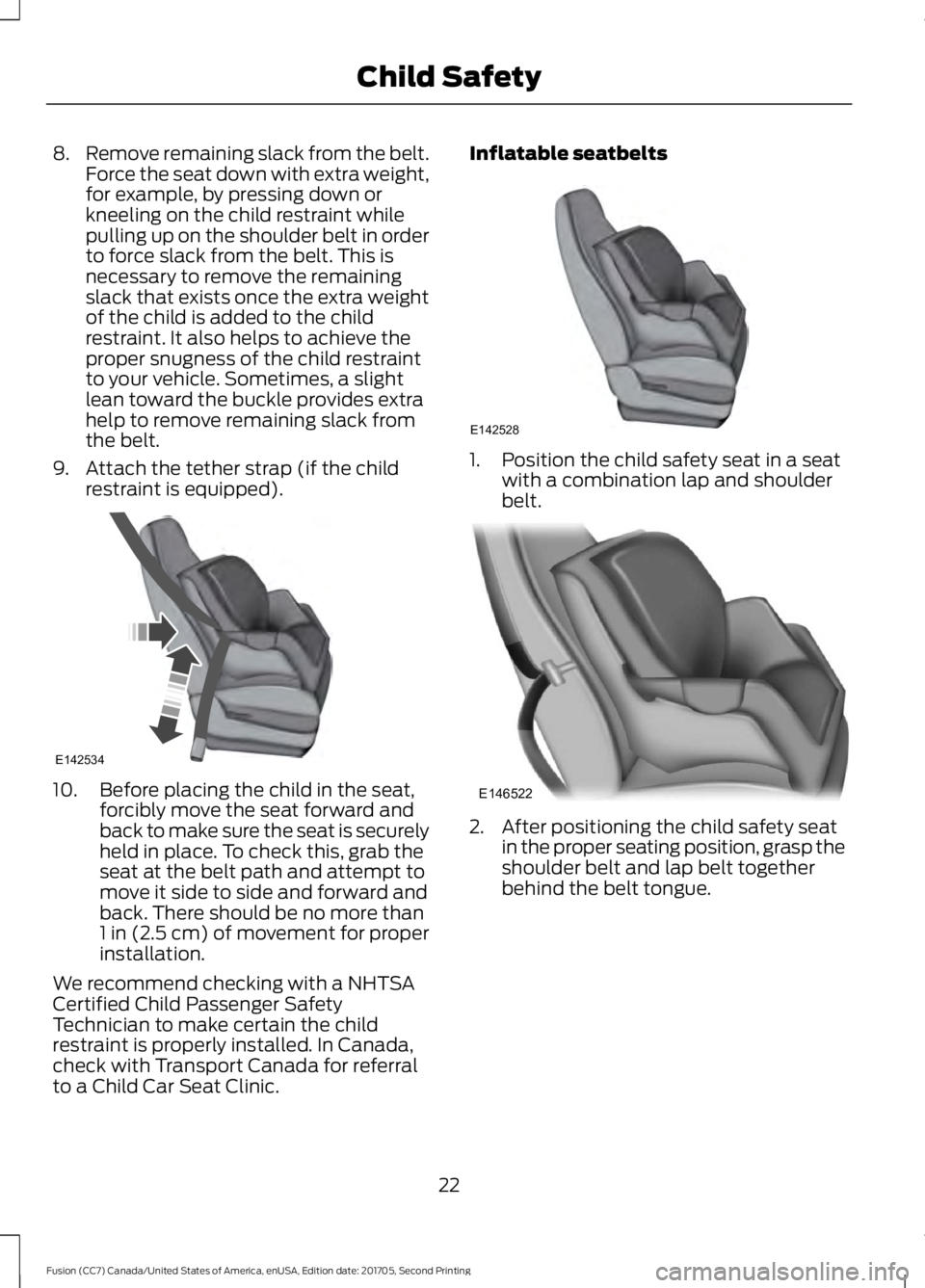
8.
Remove remaining slack from the belt.
Force the seat down with extra weight,
for example, by pressing down or
kneeling on the child restraint while
pulling up on the shoulder belt in order
to force slack from the belt. This is
necessary to remove the remaining
slack that exists once the extra weight
of the child is added to the child
restraint. It also helps to achieve the
proper snugness of the child restraint
to your vehicle. Sometimes, a slight
lean toward the buckle provides extra
help to remove remaining slack from
the belt.
9. Attach the tether strap (if the child restraint is equipped). 10. Before placing the child in the seat,
forcibly move the seat forward and
back to make sure the seat is securely
held in place. To check this, grab the
seat at the belt path and attempt to
move it side to side and forward and
back. There should be no more than
1 in (2.5 cm) of movement for proper
installation.
We recommend checking with a NHTSA
Certified Child Passenger Safety
Technician to make certain the child
restraint is properly installed. In Canada,
check with Transport Canada for referral
to a Child Car Seat Clinic. Inflatable seatbelts
1. Position the child safety seat in a seat
with a combination lap and shoulder
belt. 2. After positioning the child safety seat
in the proper seating position, grasp the
shoulder belt and lap belt together
behind the belt tongue.
22
Fusion (CC7) Canada/United States of America, enUSA, Edition date: 201705, Second Printing Child SafetyE142534 E142528 E146522
Page 27 of 539
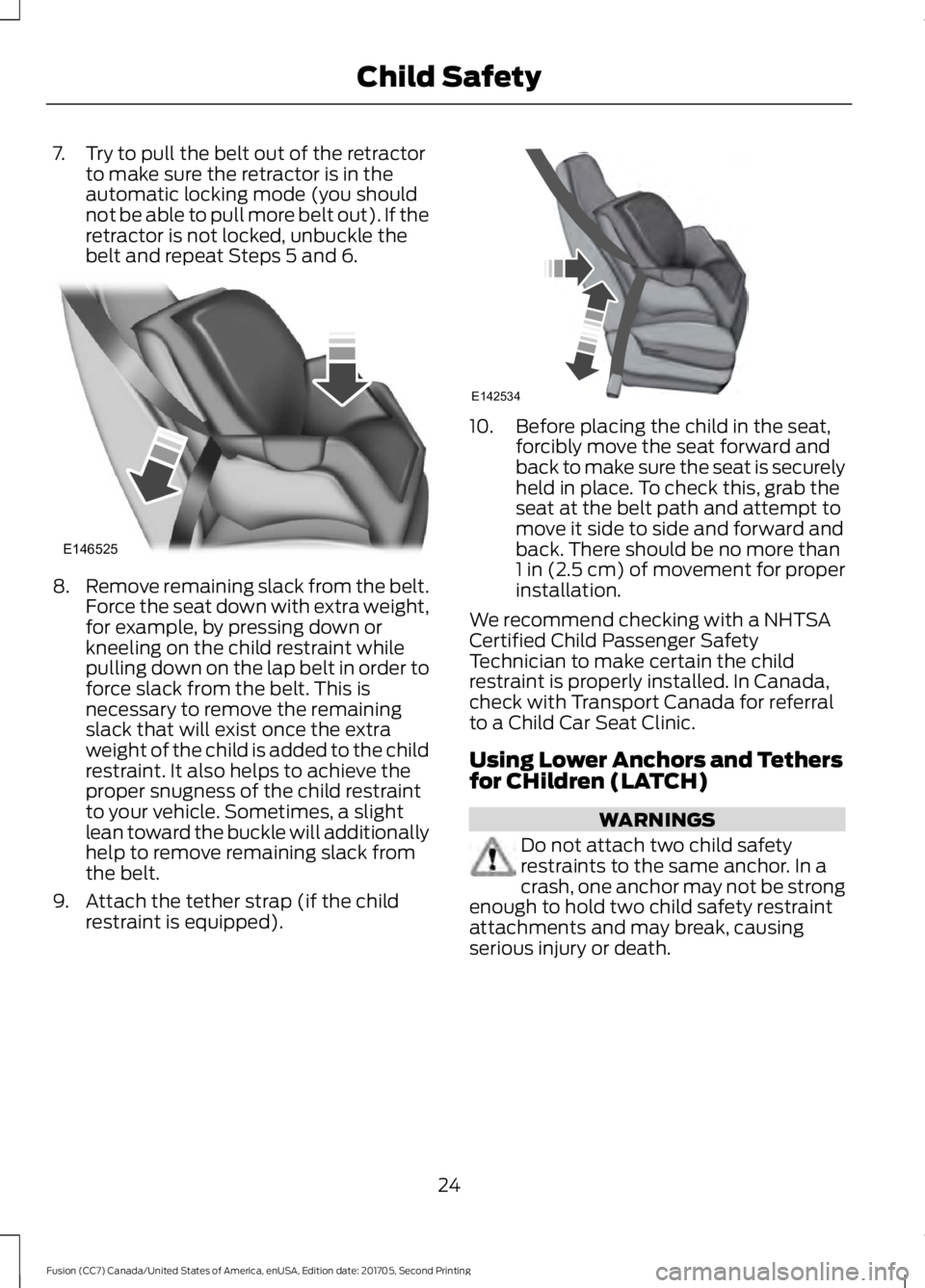
7. Try to pull the belt out of the retractor
to make sure the retractor is in the
automatic locking mode (you should
not be able to pull more belt out). If the
retractor is not locked, unbuckle the
belt and repeat Steps 5 and 6. 8.
Remove remaining slack from the belt.
Force the seat down with extra weight,
for example, by pressing down or
kneeling on the child restraint while
pulling down on the lap belt in order to
force slack from the belt. This is
necessary to remove the remaining
slack that will exist once the extra
weight of the child is added to the child
restraint. It also helps to achieve the
proper snugness of the child restraint
to your vehicle. Sometimes, a slight
lean toward the buckle will additionally
help to remove remaining slack from
the belt.
9. Attach the tether strap (if the child restraint is equipped). 10. Before placing the child in the seat,
forcibly move the seat forward and
back to make sure the seat is securely
held in place. To check this, grab the
seat at the belt path and attempt to
move it side to side and forward and
back. There should be no more than
1 in (2.5 cm) of movement for proper
installation.
We recommend checking with a NHTSA
Certified Child Passenger Safety
Technician to make certain the child
restraint is properly installed. In Canada,
check with Transport Canada for referral
to a Child Car Seat Clinic.
Using Lower Anchors and Tethers
for CHildren (LATCH) WARNINGS
Do not attach two child safety
restraints to the same anchor. In a
crash, one anchor may not be strong
enough to hold two child safety restraint
attachments and may break, causing
serious injury or death.
24
Fusion (CC7) Canada/United States of America, enUSA, Edition date: 201705, Second Printing Child SafetyE146525 E142534
Page 33 of 539
WARNINGS
manufacturer. A safety seat that is
improperly installed or utilized, is
inappropriate for your child's height, age,
or weight or does not properly fit the child
may increase the risk of serious injury or
death. Never let a passenger hold a child on
his or her lap while your vehicle is
moving. The passenger cannot
protect the child from injury in a crash,
which may result in serious injury or death. Never use pillows, books, or towels
to boost a child. They can slide
around and increase the likelihood
of injury or death in a crash. WARNINGS
Always restrain an unoccupied child
seat or booster seat. These objects
may become projectiles in a crash or
sudden stop, which may increase the risk
of serious injury. Never place, or allow a child to place,
the shoulder belt under a child's arm
or behind the back because it
reduces the protection for the upper part
of the body and may increase the risk of
injury or death in a crash. To avoid risk of injury, do not leave
children or pets unattended in your
vehicle.
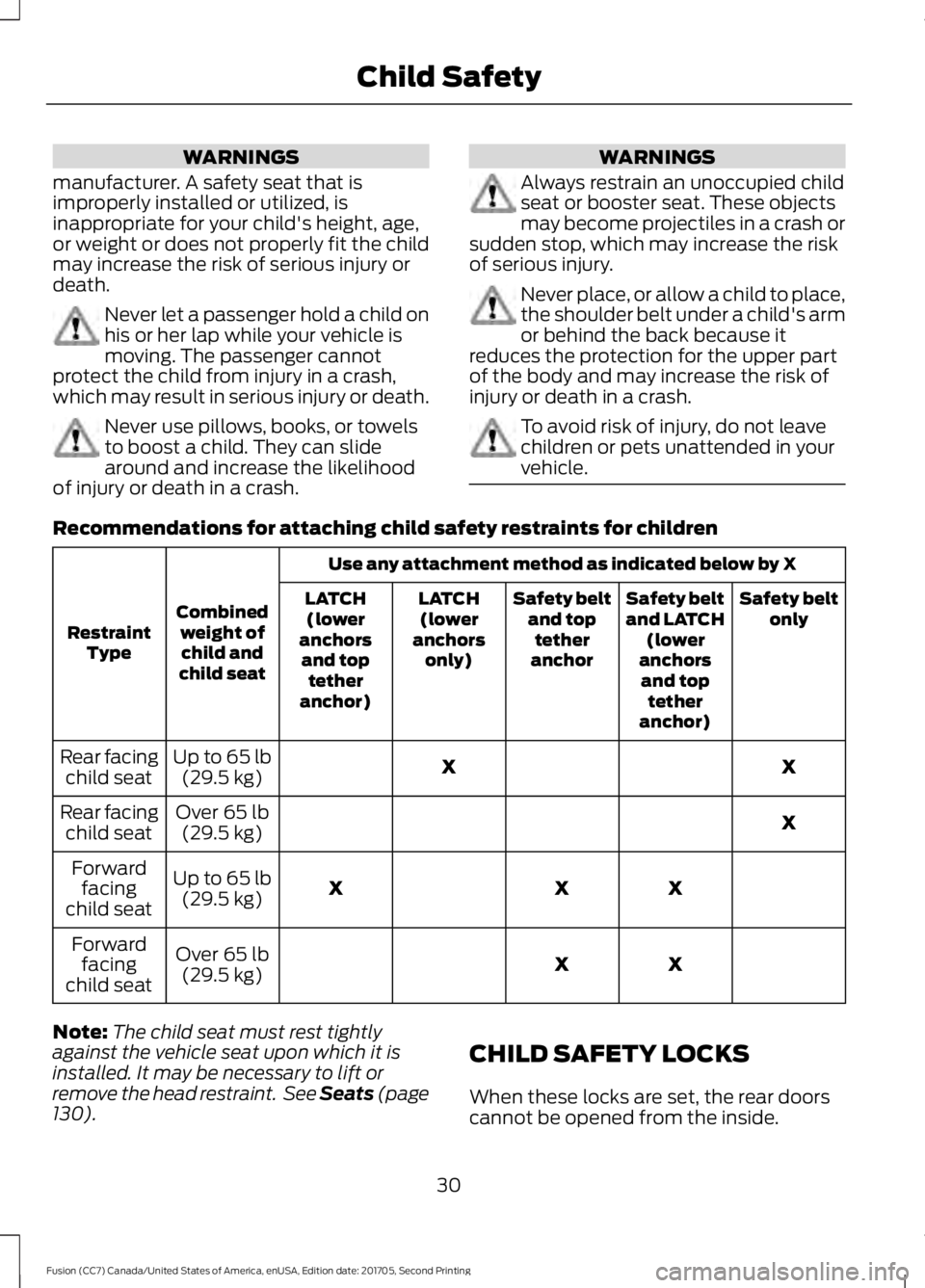
Recommendations for attaching child safety restraints for children
Use any attachment method as indicated below by X
Combined weight ofchild and
child seat
Restraint
Type Safety belt
only
Safety belt
and LATCH
(lower
anchors and top tether
anchor)
Safety belt
and toptether
anchor
LATCH
(lower
anchors only)
LATCH
(lower
anchors and top tether
anchor)
X
X
Up to 65 lb
(29.5 kg)
Rear facing
child seat
X
Over
65 lb
(29.5 kg)
Rear facing
child seat
X
X
X
Up to
65 lb
(29.5 kg)
Forward
facing
child seat
X
X
Over
65 lb
(29.5 kg)
Forward
facing
child seat
Note: The child seat must rest tightly
against the vehicle seat upon which it is
installed. It may be necessary to lift or
remove the head restraint. See Seats (page
130
). CHILD SAFETY LOCKS
When these locks are set, the rear doors
cannot be opened from the inside.
30
Fusion (CC7) Canada/United States of America, enUSA, Edition date: 201705, Second Printing Child Safety
Page 37 of 539
Pregnant women should always wear their
seatbelt. Position the lap belt portion of a
combination lap and shoulder belt low
across the hips below the belly and worn
as tight as comfort allows. Position the
shoulder belt to cross the middle of the
shoulder and the center of the chest.
Seatbelt Locking Modes
WARNING
If your vehicle is involved in a crash,
have the seatbelts and associated
components inspected as soon as
possible. Failure to follow this instruction
could result in personal injury or death. All safety restraints in the vehicle are
combination lap and shoulder belts. The
driver seatbelt has the vehicle sensitive
locking mode. The front outboard
passenger and rear seatbelts have both
the vehicle sensitive locking mode and the
automatic locking mode.
Vehicle Sensitive Mode
This is the normal retractor mode, which
allows free shoulder belt length
adjustment to your movements and
locking in response to vehicle movement.
For example, if the driver brakes suddenly
or turns a corner sharply, or the vehicle
receives an impact of about 5 mph
(8 km/h) or more, the combination
seatbelts lock to help reduce forward
movement of the driver and passengers.
In addition, the retractor is designed to lock
if you pull the webbing out too quickly. If
the seatbelt retractor locks, slowly lower
the height adjuster to allow the seatbelt
to retract. If the retractor does not unlock,
pull the seatbelt out slowly then feed a small length of webbing back toward the
stowed position. For rear seatbelts, recline
the rear seat backrest or push the seat
backrest cushion away from the seatbelt.
Feed a small length of webbing back
toward the stowed position.
Automatic Locking Mode
In this mode, the shoulder belt
automatically pre-locks. The belt retracts
to remove any slack in the shoulder belt.
The automatic locking mode is not
available on the driver seatbelt.
When to Use the Automatic Locking
Mode
Use this mode any time a child safety seat,
except a booster, is installed in passenger
front or rear seating positions. Properly
restrain children 12 years old and under in
a rear seating position whenever possible.
See
Child Safety (page 18).
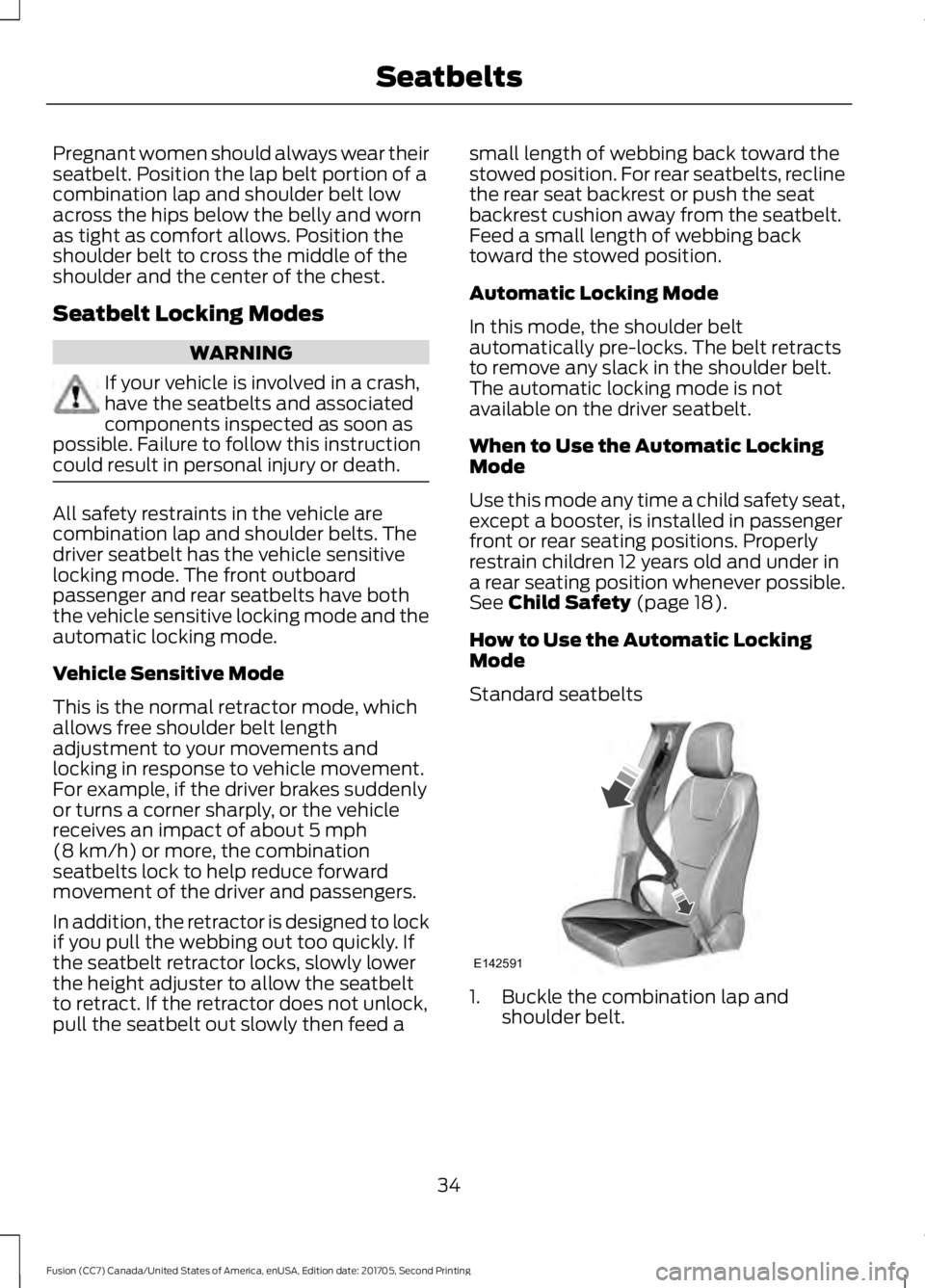
How to Use the Automatic Locking
Mode
Standard seatbelts 1. Buckle the combination lap and
shoulder belt.
34
Fusion (CC7) Canada/United States of America, enUSA, Edition date: 201705, Second Printing SeatbeltsE142591
Page 46 of 539

After all occupants have adjusted their
seats and put on seatbelts, it is very
important that they continue to sit
properly. A properly seated occupant sits
upright, leaning against the seatback, and
centered on the seat cushion, with their
feet comfortably extended on the floor.
Sitting improperly can increase the chance
of injury in a crash event. For example, if
an occupant slouches, lies down, turns
sideways, sits forward, leans forward or
sideways, or puts one or both feet up, the
chance of injury during a crash is greatly
increased.
Children and Airbags
WARNING
Airbags can kill or injure a child in a
child restraint. Never place a
rear-facing child restraint in front of
an active airbag. If you must use a
forward-facing child restraint in the front
seat, move the seat upon which the child
restraint is installed all the way back. Children must always be properly
restrained. Accident statistics suggest that
children are safer when properly restrained
in the rear seating positions than in the
front seating position. Failure to follow
these instructions may increase the risk of
injury in a crash. FRONT PASSENGER SENSING
SYSTEM WARNINGS
Even with advanced restraints
systems, properly restrain children
12 and under in a rear seating
position. Failure to follow this could
seriously increase the risk of injury or death. Sitting improperly, out of position or
with the seatback reclined too far
can take weight off the seat cushion
and affect the decision of the passenger
sensing system, resulting in serious injury
or death in the event of a crash. Always sit
upright against your seat back, with your
feet on the floor. Do not stow objects in the seatback
map pocket or hang objects off a
seatback if a child is in the front
passenger seat. Do not place objects under
the front passenger seat or between the
seat and the center console. Check the
passenger airbag indicator lamp for proper
airbag status. Failure to follow these
instructions may interfere with the front
passenger seat sensing system and
increase the risk of serious injury. Any alteration or modification to the
front passenger seat may affect the
performance of the front passenger
sensing system. This could seriously
increase the risk of injury or death. This system works with sensors that are
part of the front passenger seat and
seatbelt to detect the presence of a
properly-seated occupant and determine
if the front passenger frontal airbag should
be enabled (may inflate) or not.
43
Fusion (CC7) Canada/United States of America, enUSA, Edition date: 201705, Second Printing Supplementary Restraints SystemE142846
Page 51 of 539
The design and development of the Safety
Canopy included recommended testing
procedures that were developed by a
group of automotive safety experts known
as the Side Airbag Technical Working
Group. These recommended testing
procedures help reduce the risk of injuries
related to the deployment of side airbags
(including the Safety Canopy).
CRASH SENSORS AND
AIRBAG INDICATOR
WARNING
Modifying or adding equipment to
the front end of the vehicle (including
frame, bumper, front end body
structure and tow hooks) may affect the
performance of the airbag system,
increasing the risk of injury. Do not modify
the front end of the vehicle. Your vehicle has a collection of crash and
occupant sensors which provide
information to the restraints control
module. The restraints control module
deploys (activates) the front seatbelt
system, the adaptive collapsible steering
column, driver airbag, passenger airbag,
knee airbag(s), seat mounted side airbags,
Safety Canopy and optional rear inflatable
seatbelts. Based on the type of crash, the
restraints control module will deploy the
appropriate safety devices.
The restraints control module also
monitors the readiness of the above safety
devices plus the crash and occupant
sensors. The readiness of the safety
system is indicated by a warning indicator
light in the instrument cluster or a backup
tone (if equipped). Routine maintenance
of the airbag is not required.
A difficulty with the system is indicated by
one or more of the following: The readiness light will not
illuminate immediately after the
ignition is turned on.
• The readiness light will either flash or
stay lit.
• A series of five beeps will be heard (If
equipped). The tone pattern will repeat
periodically until the problem, the light
or both are repaired.
If any of these things happen, even
intermittently, have the supplemental
restraint system serviced at an authorized
dealer immediately. Unless serviced, the
system may not function properly in the
event of a crash.
The seatbelt pretensioners and the front
airbag supplemental restraint system are
designed to activate when the vehicle
sustains frontal deceleration sufficient to
cause the restraints control module to
deploy a safety device.
The fact that the seatbelt pretensioners
or front airbags did not activate for both
front seat occupants in a crash does not
mean that something is wrong with the
system. Rather, it means the restraints
control module determined the accident
conditions (crash severity, belt usage)
were not appropriate to activate these
safety devices.
• The design of the front airbags is to
activate only in frontal and near-frontal
crashes (not rollovers, side impacts or
rear impacts) unless the crash causes
sufficient frontal deceleration.
• The seatbelt pretensioners and rear
inflatable seatbelts are designed to
activate in frontal, near-frontal and
side crashes and rollovers.
• The knee airbag(s) may deploy based
on crash severity and occupant
conditions.
48
Fusion (CC7) Canada/United States of America, enUSA, Edition date: 201705, Second Printing Supplementary Restraints SystemE67017