light FORD FUSION HYBRID 2014 Workshop Manual
[x] Cancel search | Manufacturer: FORD, Model Year: 2014, Model line: FUSION HYBRID, Model: FORD FUSION HYBRID 2014Pages: 473, PDF Size: 5.93 MB
Page 165 of 473
E145429
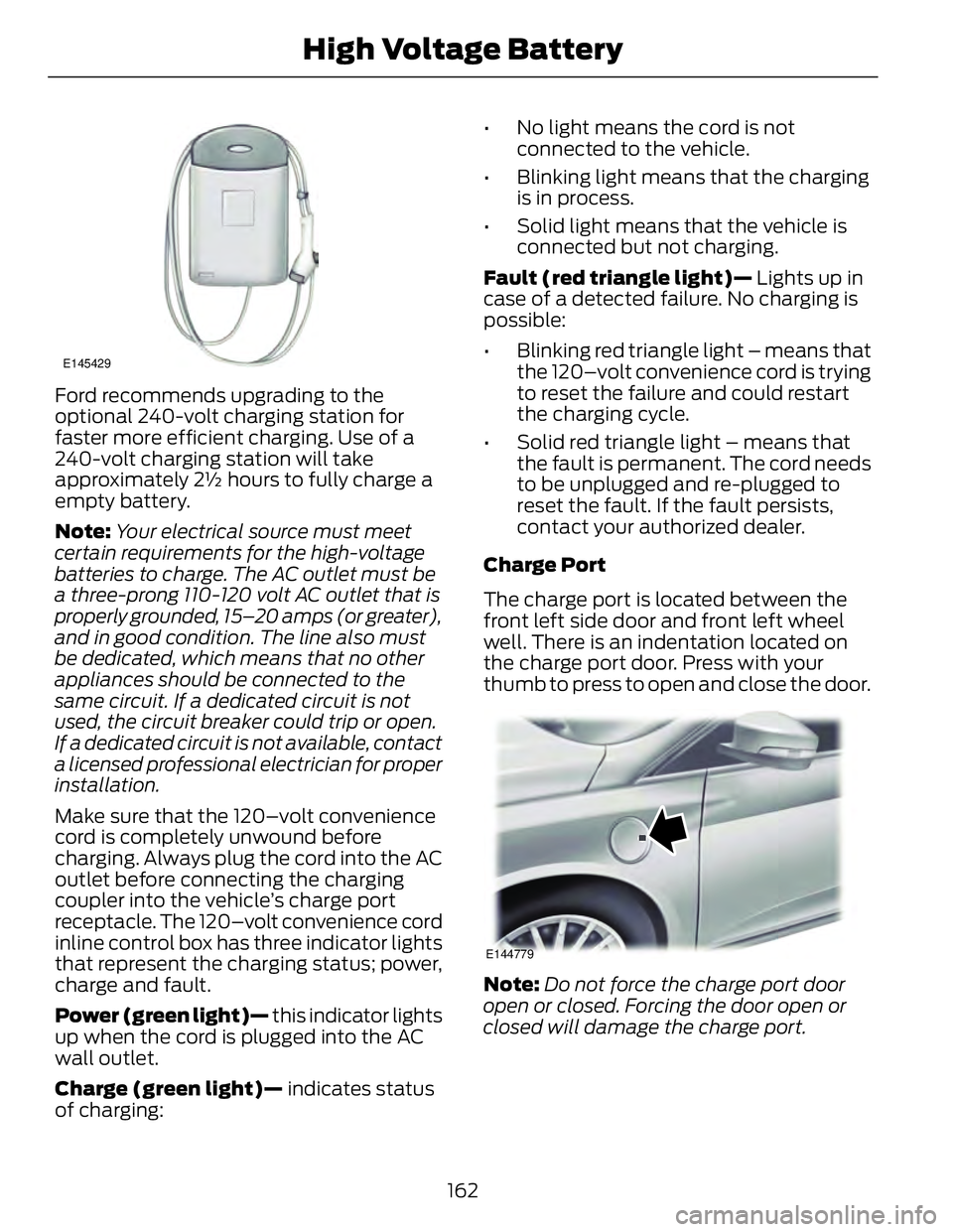
Ford recommends upgrading to the
optional 240-volt charging station for
faster more efficient charging. Use of a
240-volt charging station will take
approximately 2½ hours to fully charge a
empty battery.
Note: Your electrical source must meet
certain requirements for the high-voltage
batteries to charge. The AC outlet must be
a three-prong 110-120 volt AC outlet that is
properly grounded, 15–20 amps (or greater),
and in good condition. The line also must
be dedicated, which means that no other
appliances should be connected to the
same circuit. If a dedicated circuit is not
used, the circuit breaker could trip or open.
If a dedicated circuit is not available, contact
a licensed professional electrician for proper
installation.
Make sure that the 120–volt convenience
cord is completely unwound before
charging. Always plug the cord into the AC
outlet before connecting the charging
coupler into the vehicle’s charge port
receptacle. The 120–volt convenience cord
inline control box has three indicator lights
that represent the charging status; power,
charge and fault.
Power (green light)— this indicator lights
up when the cord is plugged into the AC
wall outlet.
Charge (green light)— indicates status
of charging: • No light means the cord is not
connected to the vehicle.
• Blinking light means that the charging
is in process.
• Solid light means that the vehicle is
connected but not charging.
Fault (red triangle light)— Lights up in
case of a detected failure. No charging is
possible:
• Blinking red triangle light – means that
the 120–volt convenience cord is trying
to reset the failure and could restart
the charging cycle.
• Solid red triangle light – means that
the fault is permanent. The cord needs
to be unplugged and re-plugged to
reset the fault. If the fault persists,
contact your authorized dealer.
Charge Port
The charge port is located between the
front left side door and front left wheel
well. There is an indentation located on
the charge port door. Press with your
thumb to press to open and close the door.
E144779
Note: Do not force the charge port door
open or closed. Forcing the door open or
closed will damage the charge port.
162High Voltage Battery
Page 166 of 473
The light ring located around the charge
port indicates the charge status of your
vehicle's high-voltage battery. The charge
port light ring is divided into four quadrants
which display state of charge in 25 percent
increments.
There is a cord acknowledgment feature
that will be activated when a charge cycle
is initiated. The four light quadrants will
each individually flash clockwise starting
with the top right light and ending with the
top left, two full times confirming a
charging coupler has been detected.
You can use your keyfob to view the
vehicles charge status at any time by
pressing the unlock button. The light ring
will light up the corresponding quadrant(s)
so that the current state of charge can be
determined. If the charge is below 25
percent the light ring will not illuminate.
Don’t forget to press the lock button on
your keyfob to re-lock the vehicle.
The light ring will also display the current
state of charge when opening the doors.
Charging
Note: The vehicle must be in P (Park) to
charge.
To charge your high-voltage battery:
1. Put the vehicle in P (Park) and power
down the vehicle.
2. With your thumb, press the indentation
located on the charge port door and
the door will rotate open.
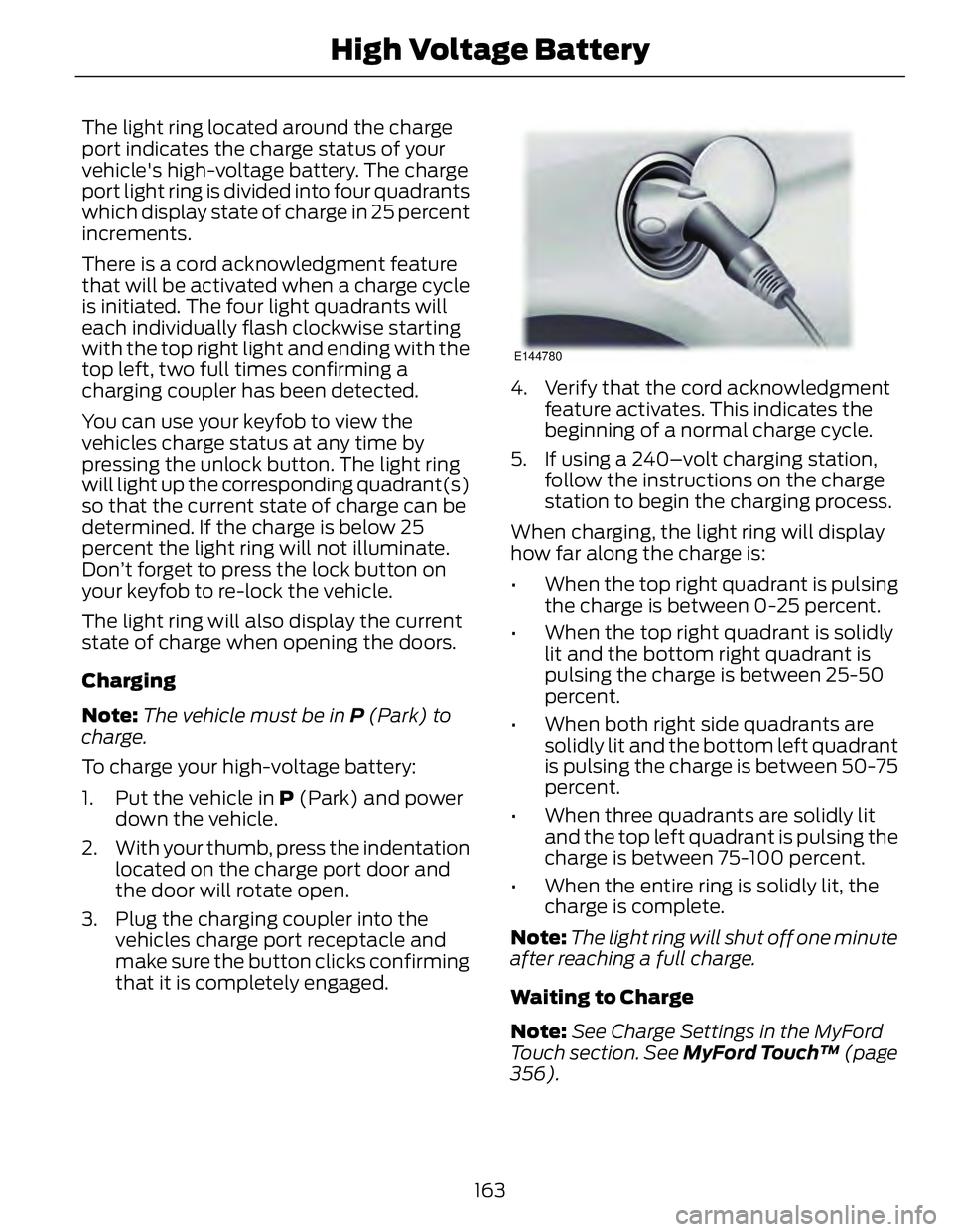
3. Plug the charging coupler into the
vehicles charge port receptacle and
make sure the button clicks confirming
that it is completely engaged. E144780
4. Verify that the cord acknowledgment
feature activates. This indicates the
beginning of a normal charge cycle.
5. If using a 240–volt charging station,
follow the instructions on the charge
station to begin the charging process.
When charging, the light ring will display
how far along the charge is:
• When the top right quadrant is pulsing
the charge is between 0-25 percent.
• When the top right quadrant is solidly
lit and the bottom right quadrant is
pulsing the charge is between 25-50
percent.
• When both right side quadrants are
solidly lit and the bottom left quadrant
is pulsing the charge is between 50-75
percent.
• When three quadrants are solidly lit
and the top left quadrant is pulsing the
charge is between 75-100 percent.
• When the entire ring is solidly lit, the
charge is complete.
Note: The light ring will shut off one minute
after reaching a full charge.
Waiting to Charge
Note: See Charge Settings in the MyFord
Touch section. See MyFord Touch™ (page
356).
163High Voltage Battery
Page 167 of 473
When Value Charge has been selected
charging may not begin upon plugging in.
The vehicle may delay charging to take
advantage of off-peak electricity rates. The
vehicle will optimize the charge schedule
to be complete by the next GO Time.
When waiting to charge (not actively
charging), the light ring will indicate the
present state of charge of the high voltage
battery as follows:
• When the top right quadrant is shut off
the charge is between 0–25 percent.
• When the top right quadrant is solidly
lit and the bottom right quadrant is
shut off the charge is between 25–50
percent.
• When both right side quadrants are
solidly lit and the bottom left quadrant
is shut off the charge is between 50–75
percent.
• When three quadrants are solidly lit
and the top left quadrant is shut off the
charge is between 75–100 percent.
• When the entire ring is solidly lit, the
charge is 100 percent.
Note: When the vehicle is Waiting to
Charge the light ring will shut off one minute
after displaying the present state of charge.
When the vehicle automatically begins
charging the light ring will turn on and
display how far along the charge is per the
section above.
Note: If a vehicle charging system fault is
detected at any point in a charge cycle the
entire light ring will flash continuously for
one minute and then shut off. If this
happens unplug, and then re-plug the
charging coupler into the charge port
receptacle. If the problem persists contact
your authorized dealer.
The light ring illumination conditions can
be modified. See Charge Port Light Ring
Settings in the MyFord Touch section. See
MyFord Touch™ (page 356). Disconnecting the Charging Coupler
Note: Do not pull the wall plug from the
wall while the vehicle is charging. Doing so
may damage the outlet and the cord.
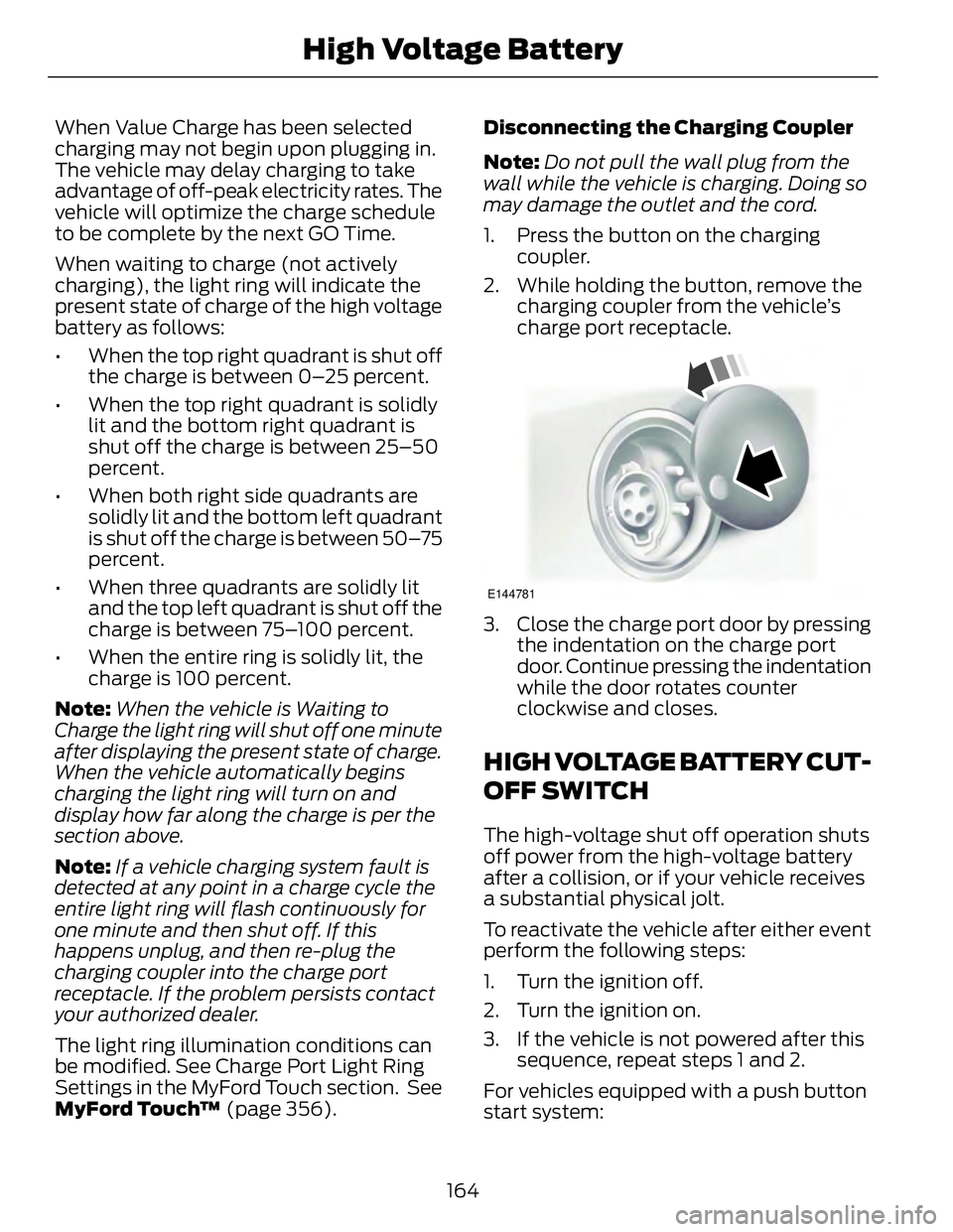
1. Press the button on the charging
coupler.
2. While holding the button, remove the
charging coupler from the vehicle’s
charge port receptacle. E144781
3. Close the charge port door by pressing
the indentation on the charge port
door. Continue pressing the indentation
while the door rotates counter
clockwise and closes.
HIGH VOLTAGE BATTERY CUT-
OFF SWITCH The high-voltage shut off operation shuts
off power from the high-voltage battery
after a collision, or if your vehicle receives
a substantial physical jolt.
To reactivate the vehicle after either event
perform the following steps:
1. Turn the ignition off.
2. Turn the ignition on.
3. If the vehicle is not powered after this
sequence, repeat steps 1 and 2.
For vehicles equipped with a push button
start system:
164High Voltage Battery
Page 171 of 473
E155983
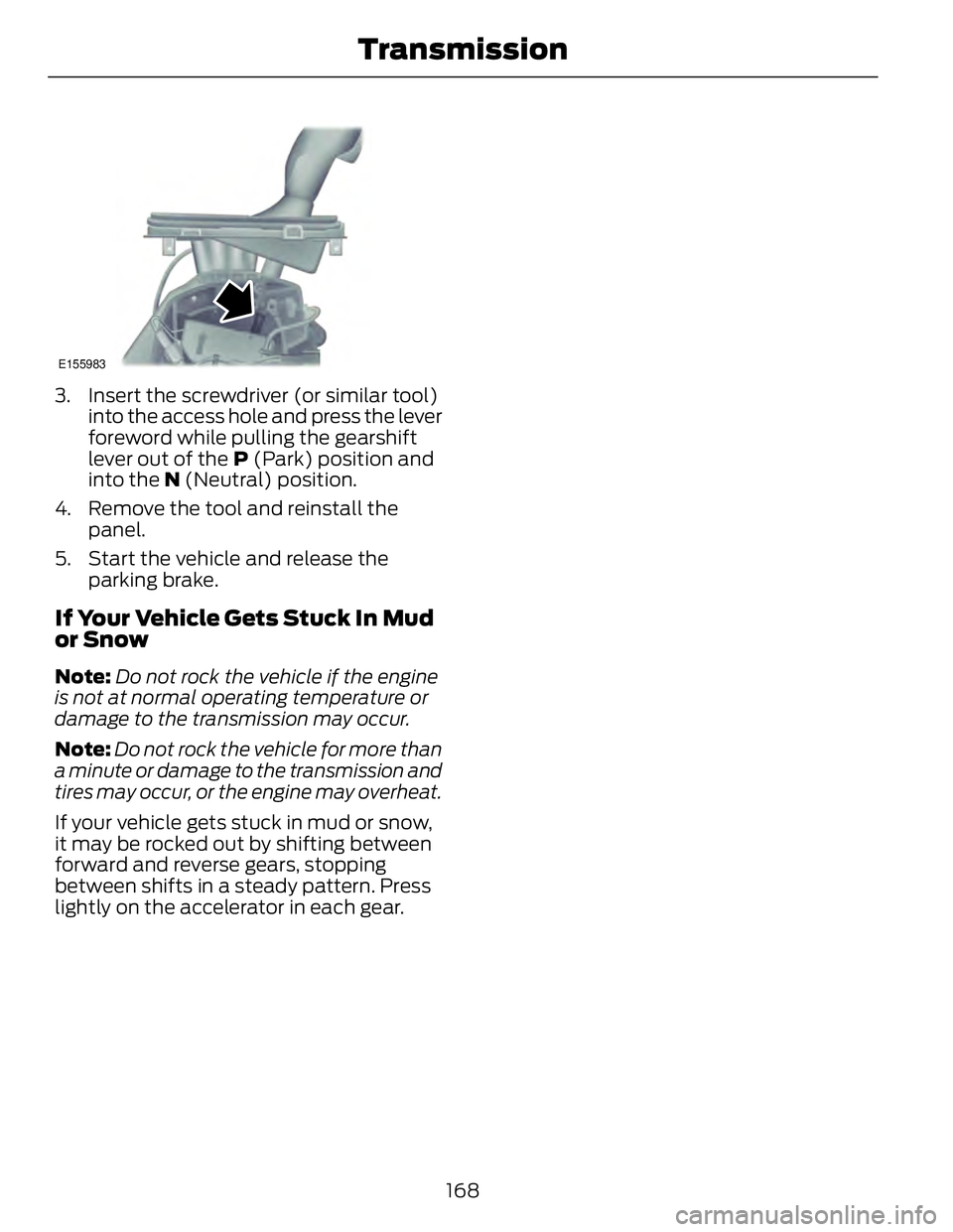
3. Insert the screwdriver (or similar tool)
into the access hole and press the lever
foreword while pulling the gearshift
lever out of the P (Park) position and
into the N (Neutral) position.
4. Remove the tool and reinstall the
panel.
5. Start the vehicle and release the
parking brake.
If Your Vehicle Gets Stuck In Mud
or Snow Note: Do not rock the vehicle if the engine
is not at normal operating temperature or
damage to the transmission may occur.
Note: Do not rock the vehicle for more than
a minute or damage to the transmission and
tires may occur, or the engine may overheat.
If your vehicle gets stuck in mud or snow,
it may be rocked out by shifting between
forward and reverse gears, stopping
between shifts in a steady pattern. Press
lightly on the accelerator in each gear.
168Transmission
Page 172 of 473
GENERAL INFORMATION Note: Occasional brake noise is normal. If
a metal-to-metal, continuous grinding or
continuous squeal sound is present, the
brake linings may be worn-out. Have the
system checked by an authorized dealer. If
the vehicle has continuous vibration or
shudder in the steering wheel while braking,
have it checked by an authorized dealer.
Note: Brake dust may accumulate on the
wheels, even under normal driving
conditions. Some dust is inevitable as the
brakes wear and does not contribute to
brake noise. See Cleaning the Alloy
Wheels (page 264).E144522
See Warning Lamps and
Indicators (page 81).
Wet brakes result in reduced braking
efficiency. Gently press the brake pedal a
few times when driving from a car wash or
standing water to dry the brakes.
Brake Over Accelerator In the event the accelerator pedal
becomes stuck or entrapped, apply steady
and firm pressure to the brake pedal to
slow the vehicle and reduce engine power.
If you experience this condition, apply the
brakes and bring your vehicle to a safe
stop. Move the transmission selector lever
to position P, switch the engine off and
apply the parking brake. Inspect the
accelerator pedal for any interference. If
none are found and the condition persists,
have your vehicle towed to the nearest
authorized dealer. Brake Assist Brake assist detects when you brake
heavily by measuring the rate at which you
press the brake pedal. It provides
maximum braking efficiency as long as you
press the pedal. Brake assist can reduce
stopping distances in critical situations.
Anti-lock Brake System This system helps you maintain steering
control during emergency stops by keeping
the brakes from locking.
This lamp momentarily
illuminates when you turn the
ignition on. If the light does not
illuminate during start up, remains on or
flashes, the anti-lock braking system may
be disabled. Have the system checked by
an authorized dealer. E144522
If the system is disabled, normal
braking is still effective. If the
brake warning lamp illuminates
when you release the parking brake, have
your system checked by an authorized
dealer.
Regenerative Braking System This feature is used to simulate the engine
braking of an internal combustion engine
and assist the standard brake system while
recovering some of the energy of motion
and storing it in the battery to improve fuel
economy. The standard brake system is
designed to fully stop the car if
regenerative braking is not available.
During regenerative braking, the motor is
spun as a generator to create electrical
current. This recharges the battery and
slows the vehicle. In effect, once the
accelerator pedal is released, the motor
changes from an energy user to an energy
producer.
169Brakes
Page 174 of 473
E147230
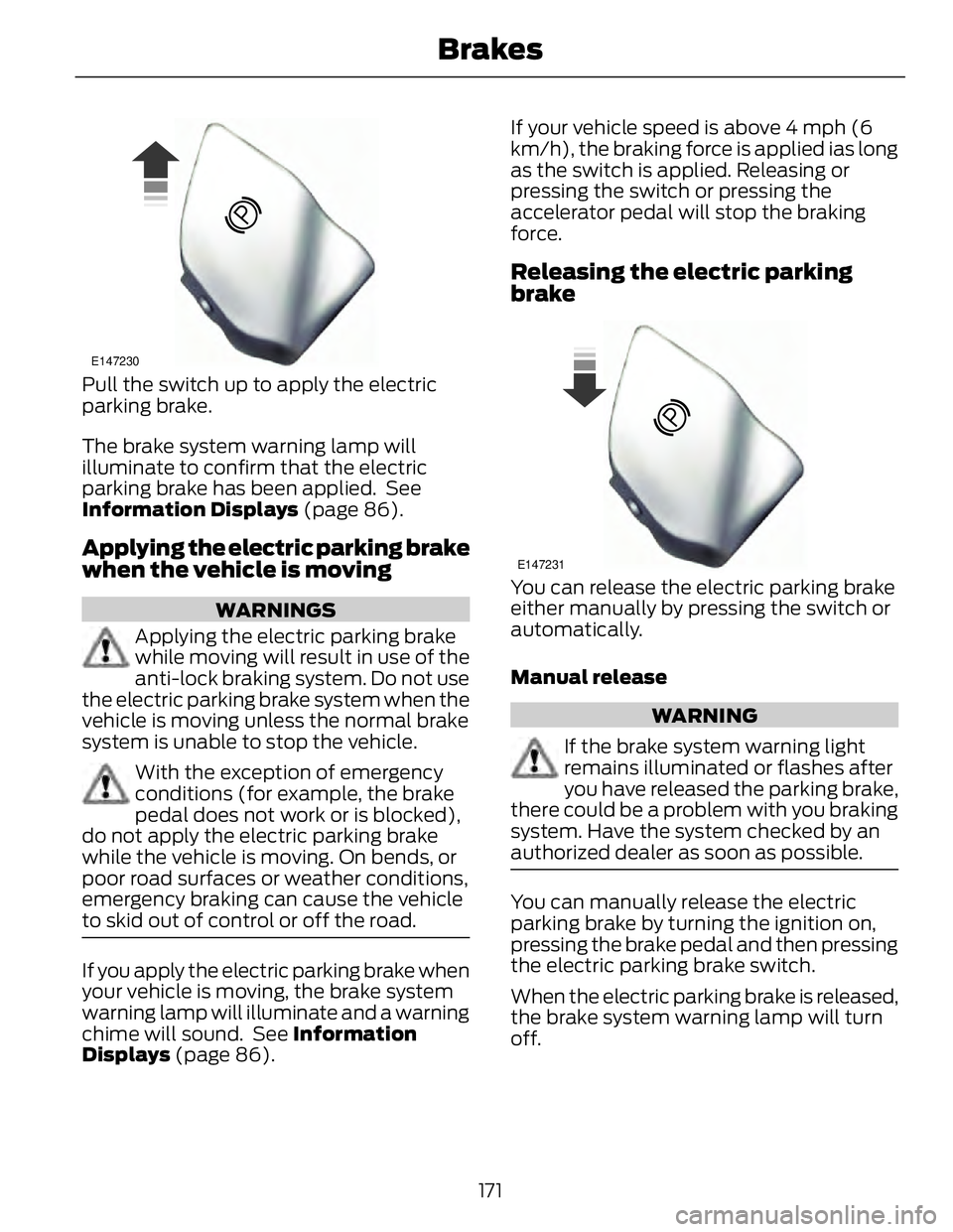
Pull the switch up to apply the electric
parking brake.
The brake system warning lamp will
illuminate to confirm that the electric
parking brake has been applied. See
Information Displays (page 86).
Applying the electric parking brake
when the vehicle is moving WARNINGS
Applying the electric parking brake
while moving will result in use of the
anti-lock braking system. Do not use
the electric parking brake system when the
vehicle is moving unless the normal brake
system is unable to stop the vehicle.
With the exception of emergency
conditions (for example, the brake
pedal does not work or is blocked),
do not apply the electric parking brake
while the vehicle is moving. On bends, or
poor road surfaces or weather conditions,
emergency braking can cause the vehicle
to skid out of control or off the road.
If you apply the electric parking brake when
your vehicle is moving, the brake system
warning lamp will illuminate and a warning
chime will sound. See Information
Displays (page 86). If your vehicle speed is above 4 mph (6
km/h), the braking force is applied ias long
as the switch is applied. Releasing or
pressing the switch or pressing the
accelerator pedal will stop the braking
force.
Releasing the electric parking
brake E147231
You can release the electric parking brake
either manually by pressing the switch or
automatically.
Manual release
WARNING
If the brake system warning light
remains illuminated or flashes after
you have released the parking brake,
there could be a problem with you braking
system. Have the system checked by an
authorized dealer as soon as possible.
You can manually release the electric
parking brake by turning the ignition on,
pressing the brake pedal and then pressing
the electric parking brake switch.
When the electric parking brake is released,
the brake system warning lamp will turn
off.
171Brakes
Page 175 of 473
Automatic release - drive away release
Note: The driver's door must be closed and
the driver's safety belt must be fastened
before this feature will operate.
Note: If the electric parking brake warning
lamp stays illuminated, the electric parking
brake will not automatically release. You
must release the electric parking brake using
the electric parking brake switch.
Note: The engine must be running and the
accelerator pedal must be pressed before
the drive away release feature will operate.
Note: On hybrid vehicles, the vehicle must
be Ready-to-Drive as indicated by the green
Ready indicator light.
The brake system warning lamp will go off
to confirm that the electric parking brake
has been released.
Note: The electric parking brake drive away
release makes starting on a hill easier. This
feature will release the parking brake
automatically when the vehicle has
sufficient drive force to move up the hill. To
assure drive away release when starting
uphill, press the accelerator pedal quickly.
Battery With No Charge WARNING
You will not be able to apply or
release the electric parking brake if
the battery is low or has no charge.
If the battery is low or has no charge, use
jumper cables and a booster battery.
HILL START ASSIST WARNINGS
The system does not replace the
parking brake. When you leave your
vehicle, always apply the parking
brake and put the vehicle in position P. WARNINGS
You must remain in your vehicle once
you have activated the system.
During all times, you are responsible
for controlling your vehicle,
supervising the system and
intervening, if required.
If the engine is revved excessively, or
if a malfunction is detected, the
system will be deactivated.
The system makes it easier to pull away
when your vehicle is on a slope without the
need to use the parking brake.
When the system is active, your vehicle will
remain stationary on the slope for two to
three seconds after you release the brake
pedal. This allows you time to move your
foot from the brake to the accelerator
pedal. The brakes are released
automatically once the engine has
developed sufficient drive to prevent your
vehicle from rolling down the slope. This
is an advantage when pulling away on a
slope, (for example from a car park ramp,
traffic lights or when reversing uphill into
a parking space).
The system will activate automatically on
any slope that will cause significant vehicle
rollback.
Using Hill Start Assist 1. Press the brake pedal to bring your
vehicle to a complete standstill. Keep
the brake pedal pressed.
2. If the sensors detect that your vehicle
is on a slope, the system will activate
automatically.
172Brakes
Page 177 of 473
PRINCIPLE OF OPERATION The traction control system helps avoid
drive wheel spin and loss of traction.
If your vehicle begins to slide, the system
applies the brakes to individual wheels
and, when needed, reduces engine power
at the same time. If the wheels spin when
accelerating on slippery or loose surfaces,
the system reduces engine power in order
to increase traction.
USING TRACTION CONTROL In certain situations (for example, stuck in
snow or mud), turning the traction control
off may be beneficial as this allows the
wheels to spin with full engine power. Turn
off the traction control system through the
information display. See General
Information (page 86).
System Indicator Lights and
Messages WARNING
If a failure has been detected within
the AdvanceTrac system, the
stability control light will illuminate
steadily. Verify that the AdvanceTrac
system was not manually disabled through
the information display. If the stability
control light still illuminates steadily, have
the system serviced by an authorized
dealer immediately. Operating your vehicle
with AdvanceTrac disabled could lead to
an increased risk of loss of vehicle control,
vehicle rollover, personal injury and death. E138639
The stability control light
temporarily illuminates on
engine start-up and flashes
when a driving condition activates the
stability system. The stability control off light
temporarily illuminates on
engine start-up and stays on
when you turn the traction control system
off.
When you turn the traction control system
off or on, a message appears in the
information display showing system status.
174Traction Control
Page 186 of 473
A B C D
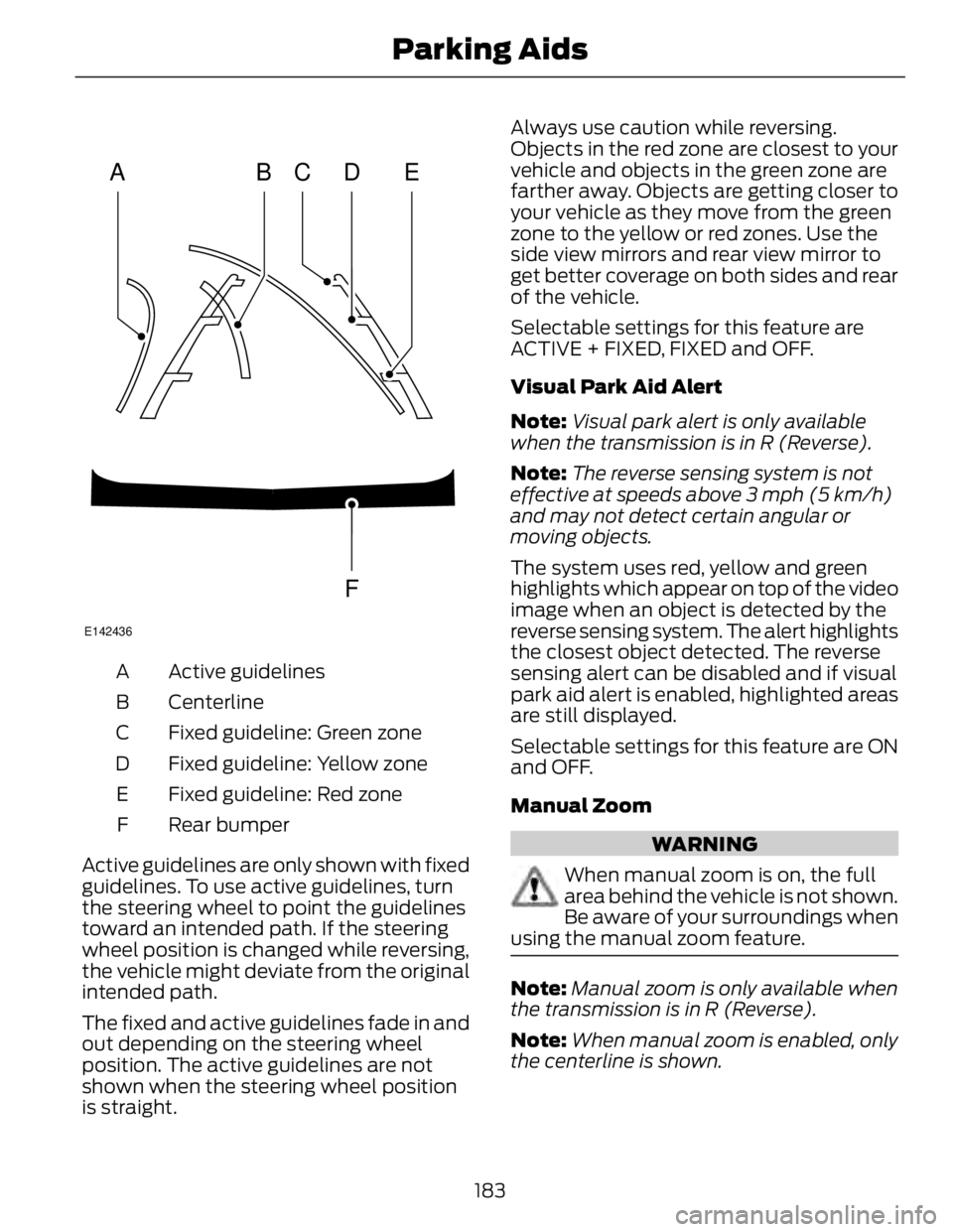
F EE142436
Active guidelinesA
CenterlineB
Fixed guideline: Green zoneC
Fixed guideline: Yellow zoneD
Fixed guideline: Red zoneE
Rear bumperF
Active guidelines are only shown with fixed
guidelines. To use active guidelines, turn
the steering wheel to point the guidelines
toward an intended path. If the steering
wheel position is changed while reversing,
the vehicle might deviate from the original
intended path.
The fixed and active guidelines fade in and
out depending on the steering wheel
position. The active guidelines are not
shown when the steering wheel position
is straight. Always use caution while reversing.
Objects in the red zone are closest to your
vehicle and objects in the green zone are
farther away. Objects are getting closer to
your vehicle as they move from the green
zone to the yellow or red zones. Use the
side view mirrors and rear view mirror to
get better coverage on both sides and rear
of the vehicle.
Selectable settings for this feature are
ACTIVE + FIXED, FIXED and OFF.
Visual Park Aid Alert
Note: Visual park alert is only available
when the transmission is in R (Reverse).
Note: The reverse sensing system is not
effective at speeds above 3 mph (5 km/h)
and may not detect certain angular or
moving objects.
The system uses red, yellow and green
highlights which appear on top of the video
image when an object is detected by the
reverse sensing system. The alert highlights
the closest object detected. The reverse
sensing alert can be disabled and if visual
park aid alert is enabled, highlighted areas
are still displayed.
Selectable settings for this feature are ON
and OFF.
Manual Zoom
WARNING
When manual zoom is on, the full
area behind the vehicle is not shown.
Be aware of your surroundings when
using the manual zoom feature.
Note: Manual zoom is only available when
the transmission is in R (Reverse).
Note: When manual zoom is enabled, only
the centerline is shown.
183Parking Aids
Page 189 of 473
ECO Cruise Control This feature saves vehicle energy by
relaxing acceleration compared to
standard cruise control. For example, your
vehicle may temporarily lose speed when
going uphill. ECO will appear in the
information display when ECO cruise
control is activated. It can be switched on
or off in the information display. See
General Information (page 86).
USING ADAPTIVE CRUISE
CONTROL (IF EQUIPPED)
WARNINGS
Always pay close attention to
changing road conditions, especially
when using adaptive cruise control.
Adaptive cruise control cannot replace
attentive driving. Failing to follow any of
the warnings below or failing to pay
attention to the road may result in a crash,
serious injury or death.
Adaptive cruise control is not a crash
warning or avoidance system.
Adaptive cruise control will not
detect stationary or slow moving
vehicles below 6 mph (10 km/h).
Adaptive cruise control will not
detect pedestrians or objects in the
roadway.
Adaptive cruise control will not
detect oncoming vehicles in the
same lane.
Do not use the adaptive cruise
control when entering or leaving a
highway, in heavy traffic or on roads
that are winding, slippery or unpaved.
Do not use in poor visibility,
specifically fog, rain, spray or snow. Note: It is your responsibility to stay alert,
drive safely and be in control of the vehicle
at all times.
The system adjusts your speed to maintain
a proper distance between you and the
vehicle in front of you in the same lane. You
can select from one of four gap settings. E144501
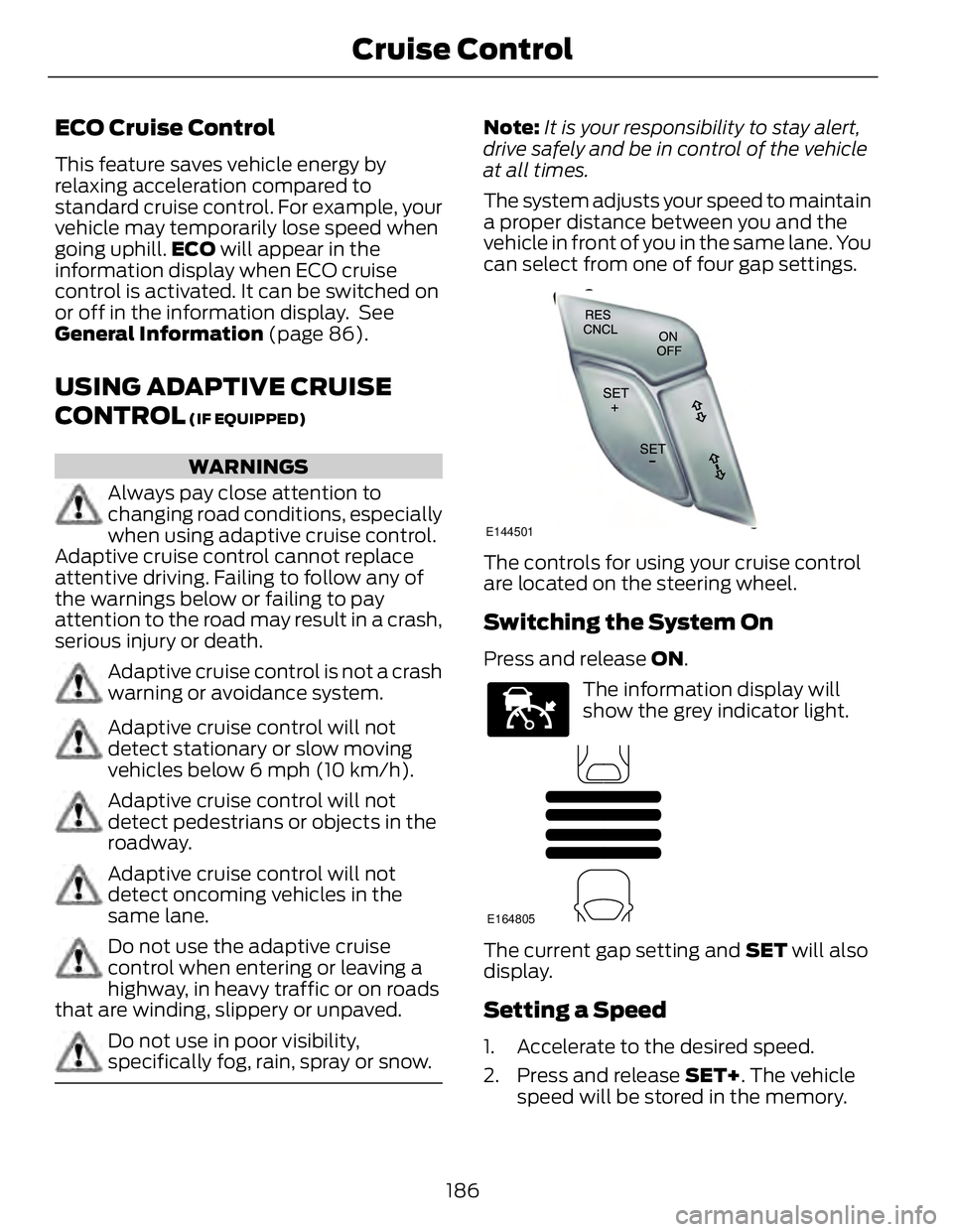
The controls for using your cruise control
are located on the steering wheel.
Switching the System On Press and release ON . E144529
The information display will
show the grey indicator light.
E164805
The current gap setting and SET will also
display.
Setting a Speed
1. Accelerate to the desired speed.
2. Press and release SET+ . The vehicle
speed will be stored in the memory.
186Cruise Control