brakes FORD GRANADA 1985 Service Repair Manual
[x] Cancel search | Manufacturer: FORD, Model Year: 1985, Model line: GRANADA, Model: FORD GRANADA 1985Pages: 255, PDF Size: 14.98 MB
Page 21 of 255
12Place a piece of wood in the caliper jaws
to limit piston travel. Keep your fingers clear of
the piston. Have the assistant depress the
brake pedal gentlyin order to move the
caliper piston out.
13With the pedal held depressed, slacken
the bleed screw on the right-hand caliper and
again depress the piston. Tighten the bleed
screw when the piston is retracted. The pedal
can now be released.
14Disconnect the bleed tube. Refit the right-hand brake pad and caliper.
15Remove the left-hand caliper and inboard
pad again. Carry out the operations described
in paragraphs 10 to 14 on the left-hand
caliper.
16Bleed the rear brakes as described in
Chapter 10.
17Refit the front wheels, lower the vehicle
and tighten the wheel nuts.
18Pump the brake pedal to bring the pads
up to the discs, then make a final check of thehydraulic fluid level. Top-up and refit the
reservoir cap.
Camshaft drivebelt renewal is
recommended as a precautionary measure.
Refer to Chapter 2, Part A, Sections 13 and 45
for the full renewal procedure.
45Camshaft drivebelt renewal -
SOHC engines
1Before proceeding, note the precautions
given in Chapter 3, Section 1.
2Disconnect the battery negative lead.
3Remove the expansion tank cap. Take
precautions against scalding if the system is
hot.
4Place a drain pan of adequate capacity
beneath the radiator drain plug. Unscrew the
plug, without removing it, and allow the
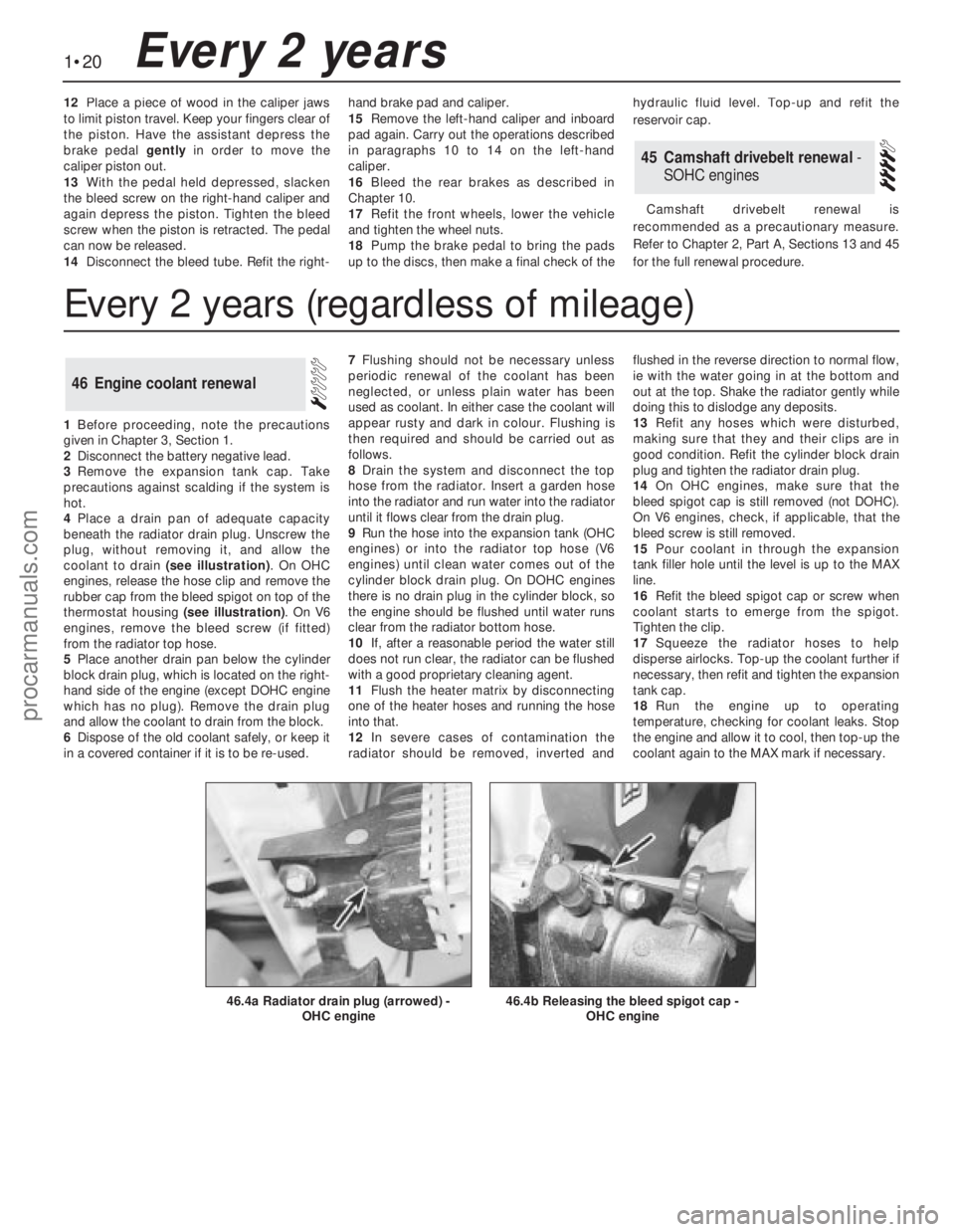
coolant to drain (see illustration). On OHC
engines, release the hose clip and remove the
rubber cap from the bleed spigot on top of the
thermostat housing (see illustration). On V6
engines, remove the bleed screw (if fitted)
from the radiator top hose.
5Place another drain pan below the cylinder
block drain plug, which is located on the right-
hand side of the engine (except DOHC engine
which has no plug). Remove the drain plug
and allow the coolant to drain from the block.
6Dispose of the old coolant safely, or keep it
in a covered container if it is to be re-used.7Flushing should not be necessary unless
periodic renewal of the coolant has been
neglected, or unless plain water has been
used as coolant. In either case the coolant will
appear rusty and dark in colour. Flushing is
then required and should be carried out as
follows.
8Drain the system and disconnect the top
hose from the radiator. Insert a garden hose
into the radiator and run water into the radiator
until it flows clear from the drain plug.
9Run the hose into the expansion tank (OHC
engines) or into the radiator top hose (V6
engines) until clean water comes out of the
cylinder block drain plug. On DOHC engines
there is no drain plug in the cylinder block, so
the engine should be flushed until water runs
clear from the radiator bottom hose.
10If, after a reasonable period the water still
does not run clear, the radiator can be flushed
with a good proprietary cleaning agent.
11Flush the heater matrix by disconnecting
one of the heater hoses and running the hose
into that.
12In severe cases of contamination the
radiator should be removed, inverted andflushed in the reverse direction to normal flow,
ie with the water going in at the bottom and
out at the top. Shake the radiator gently while
doing this to dislodge any deposits.
13Refit any hoses which were disturbed,
making sure that they and their clips are in
good condition. Refit the cylinder block drain
plug and tighten the radiator drain plug.
14On OHC engines, make sure that the
bleed spigot cap is still removed (not DOHC).
On V6 engines, check, if applicable, that the
bleed screw is still removed.
15Pour coolant in through the expansion
tank filler hole until the level is up to the MAX
line.
16Refit the bleed spigot cap or screw when
coolant starts to emerge from the spigot.
Tighten the clip.
17Squeeze the radiator hoses to help
disperse airlocks. Top-up the coolant further if
necessary, then refit and tighten the expansion
tank cap.
18Run the engine up to operating
temperature, checking for coolant leaks. Stop
the engine and allow it to cool, then top-up the
coolant again to the MAX mark if necessary.
46Engine coolant renewal
1•20Every 2 years
46.4b Releasing the bleed spigot cap -
OHC engine46.4a Radiator drain plug (arrowed) -
OHC engine
Every 2 years (regardless of mileage)
procarmanuals.com
Page 22 of 255
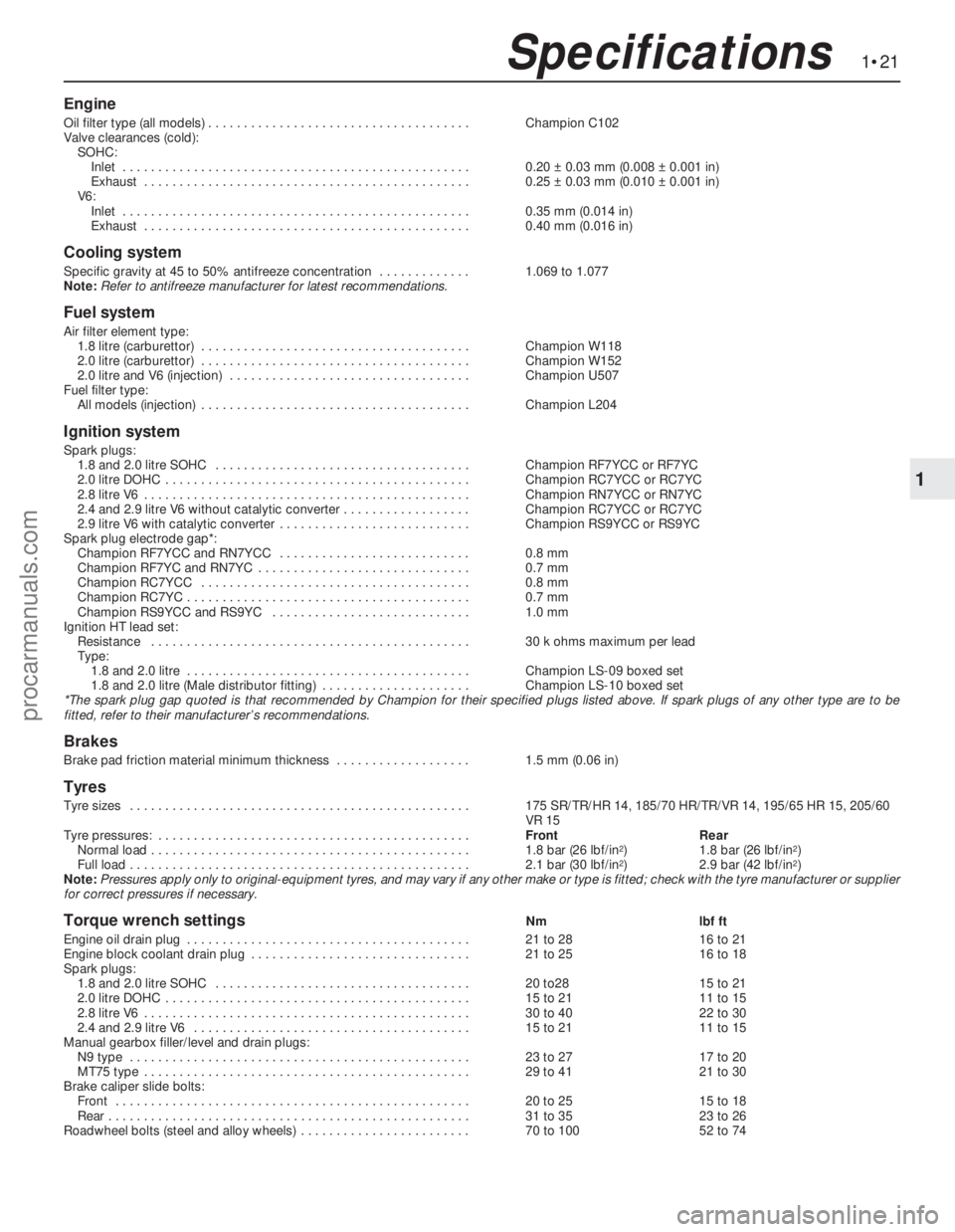
Engine
Oil filter type (all models) . . . . . . . . . . . . . . . . . . . . . . . . . . . . . . . . . . . . .Champion C102
Valve clearances (cold):
SOHC:
Inlet . . . . . . . . . . . . . . . . . . . . . . . . . . . . . . . . . . . . . . . . . . . . . . . . .0.20 ±0.03 mm (0.008 ±0.001 in)
Exhaust . . . . . . . . . . . . . . . . . . . . . . . . . . . . . . . . . . . . . . . . . . . . . .0.25 ±0.03 mm (0.010 ±0.001 in)
V6:
Inlet . . . . . . . . . . . . . . . . . . . . . . . . . . . . . . . . . . . . . . . . . . . . . . . . .0.35 mm (0.014 in)
Exhaust . . . . . . . . . . . . . . . . . . . . . . . . . . . . . . . . . . . . . . . . . . . . . .0.40 mm (0.016 in)
Cooling system
Specific gravity at 45 to 50% antifreeze concentration . . . . . . . . . . . . .1.069 to 1.077
Note:Refer to antifreeze manufacturer for latest recommendations.
Fuel system
Air filter element type:
1.8 litre (carburettor) . . . . . . . . . . . . . . . . . . . . . . . . . . . . . . . . . . . . . .Champion W118
2.0 litre (carburettor) . . . . . . . . . . . . . . . . . . . . . . . . . . . . . . . . . . . . . .Champion W152
2.0 litre and V6 (injection) . . . . . . . . . . . . . . . . . . . . . . . . . . . . . . . . . .Champion U507
Fuel filter type:
All models (injection) . . . . . . . . . . . . . . . . . . . . . . . . . . . . . . . . . . . . . .Champion L204
Ignition system
Spark plugs:
1.8 and 2.0 litre SOHC . . . . . . . . . . . . . . . . . . . . . . . . . . . . . . . . . . . .Champion RF7YCC or RF7YC
2.0 litre DOHC . . . . . . . . . . . . . . . . . . . . . . . . . . . . . . . . . . . . . . . . . . .Champion RC7YCC or RC7YC
2.8 litre V6 . . . . . . . . . . . . . . . . . . . . . . . . . . . . . . . . . . . . . . . . . . . . . .Champion RN7YCC or RN7YC
2.4 and 2.9 litre V6 without catalytic converter . . . . . . . . . . . . . . . . . .Champion RC7YCC or RC7YC
2.9 litre V6 with catalytic converter . . . . . . . . . . . . . . . . . . . . . . . . . . .Champion RS9YCC or RS9YC
Spark plug electrode gap*:
Champion RF7YCC and RN7YCC . . . . . . . . . . . . . . . . . . . . . . . . . . .0.8 mm
Champion RF7YC and RN7YC . . . . . . . . . . . . . . . . . . . . . . . . . . . . . .0.7 mm
Champion RC7YCC . . . . . . . . . . . . . . . . . . . . . . . . . . . . . . . . . . . . . .0.8 mm
Champion RC7YC . . . . . . . . . . . . . . . . . . . . . . . . . . . . . . . . . . . . . . . .0.7 mm
Champion RS9YCC and RS9YC . . . . . . . . . . . . . . . . . . . . . . . . . . . .1.0 mm
Ignition HT lead set:
Resistance . . . . . . . . . . . . . . . . . . . . . . . . . . . . . . . . . . . . . . . . . . . . .30 k ohms maximum per lead
Type:
1.8 and 2.0 litre . . . . . . . . . . . . . . . . . . . . . . . . . . . . . . . . . . . . . . . .Champion LS-09 boxed set
1.8 and 2.0 litre (Male distributor fitting) . . . . . . . . . . . . . . . . . . . . .Champion LS-10 boxed set
*The spark plug gap quoted is that recommended by Champion for their specified plugs listed above. If spark plugs of any other type are to be
fitted, refer to their manufacturer’s recommendations.
Brakes
Brake pad friction material minimum thickness . . . . . . . . . . . . . . . . . . .1.5 mm (0.06 in)
Tyres
Tyre sizes . . . . . . . . . . . . . . . . . . . . . . . . . . . . . . . . . . . . . . . . . . . . . . . .175 SR/TR/HR 14, 185/70 HR/TR/VR 14,195/65 HR 15, 205/60
VR 15
Tyre pressures: . . . . . . . . . . . . . . . . . . . . . . . . . . . . . . . . . . . . . . . . . . . .FrontRear
Normal load . . . . . . . . . . . . . . . . . . . . . . . . . . . . . . . . . . . . . . . . . . . . .1.8 bar (26 lbf/in
2)1.8 bar (26 lbf/in2)
Full load . . . . . . . . . . . . . . . . . . . . . . . . . . . . . . . . . . . . . . . . . . . . . . . .2.1 bar (30 lbf/in2)2.9 bar (42 lbf/in2)
Note:Pressures apply only to original-equipment tyres, and may vary if any other make or type is fitted; check with the tyre manufacturer or supplier
for correct pressures if necessary.
Torque wrench settingsNmlbf ft
Engine oil drain plug . . . . . . . . . . . . . . . . . . . . . . . . . . . . . . . . . . . . . . . .21 to 2816 to 21
Engine block coolant drain plug . . . . . . . . . . . . . . . . . . . . . . . . . . . . . . .21 to 2516 to 18
Spark plugs:
1.8 and 2.0 litre SOHC . . . . . . . . . . . . . . . . . . . . . . . . . . . . . . . . . . . .20 to2815 to 21
2.0 litre DOHC . . . . . . . . . . . . . . . . . . . . . . . . . . . . . . . . . . . . . . . . . . .15 to 2111 to 15
2.8 litre V6 . . . . . . . . . . . . . . . . . . . . . . . . . . . . . . . . . . . . . . . . . . . . . .30 to 4022 to 30
2.4 and 2.9 litre V6 . . . . . . . . . . . . . . . . . . . . . . . . . . . . . . . . . . . . . . .15 to 2111 to 15
Manual gearbox filler/level and drain plugs:
N9 type . . . . . . . . . . . . . . . . . . . . . . . . . . . . . . . . . . . . . . . . . . . . . . . .23 to 2717 to 20
MT75 type . . . . . . . . . . . . . . . . . . . . . . . . . . . . . . . . . . . . . . . . . . . . . .29 to 4121 to 30
Brake caliper slide bolts:
Front . . . . . . . . . . . . . . . . . . . . . . . . . . . . . . . . . . . . . . . . . . . . . . . . . .20 to 2515 to 18
Rear . . . . . . . . . . . . . . . . . . . . . . . . . . . . . . . . . . . . . . . . . . . . . . . . . . .31 to 3523 to 26
Roadwheel bolts (steel and alloy wheels) . . . . . . . . . . . . . . . . . . . . . . . .70 to 10052 to 74
1•21
1
Specifications
procarmanuals.com
Page 131 of 255
Models covered in this Manual have disc
brakes fitted all round. The footbrake operates
hydraulically on all four wheels, and the
handbrake operates mechanically on the rear
wheels. Both footbrake and handbrake are
self-adjusting in use.
Ford’s anti-lock braking system (ABS) is
fitted to all models. The system monitors the
rotational speed of each roadwheel. When a
wheel begins to lock under heavy braking, the
ABS reduces the hydraulic pressure to that
wheel, so preventing it from locking. When this
happens a pulsating effect will be noticed at
the brake pedal. On some road surfaces the
tyres may squeal when braking hard even
though the wheels are not locked.
The main components of the system are the
hydraulic unit, the calipers, pads and discs,
the wheel sensors and the “brain” or control
module. The hydraulic unit contains the
elements of a traditional master cylinder, plus
an electric motor and pump, a pressure
accumulator and control valves. The pump is
the source of pressure for the system and
does away with the need for a vacuum servo.
The hydraulic circuit is split front and rear,
as is normal practice with rear-wheel drive
vehicles. In the event that the hydraulic pump
fails, unassisted braking effort is still available
on the front calipers only.
Warning lights inform the driver of low brake
fluid level, ABS failure and (on some models)
brake pad wear. The low fluid level light
doubles as a “handbrake on” light; if it
illuminates at the same time as the ABS
warning light, it warns of low hydraulic
pressure.
ABS cannot overturn the laws of physics:
stopping distances will inevitably be greater on
loose or slippery surfaces. However, the system
should allow even inexperienced drivers to
retain directional control under panic braking.
From August 1986 the following
modifications were made to the braking
system.
a)The relays differ from earlier versions.b)The hydraulic pump is constructed of iron
rather than alloy.
c)A new pressure warning switch is used.
d)The earlier high pressure rubber hose is
replaced by a steel pipe.
To overcome the problem of excessive rear
brake pad wear, Ford introduced a differential
valve which is screwed into the ABS valve
block.The valve limits the pressure applied to
the rear brake calipers and so reduces brake
pad wear. From 1988 onwards, the valve has
been fitted during production. The differential
valve can also be fitted to earlier models. Refer
to your Ford dealer for further information.
From April 1992 onwards, the models
covered in this Manual were equipped with a
new Teves MK IV anti-lock braking system
instead of the Teves MK II system fitted to the
earlier models.
The Teves MK IV system differs from the
earlier MK II system in the following ways.
a)The source of hydraulic pressure for the
system is a conventional master cylinder
and vacuum servo assembly.
b)A valve block and pump assembly is used
instead of the hydraulic control unit. The
block contains the inlet and outlet
solenoid valves that control the hydraulic
system. There are three pairs of valves,
one for each brake circuit (paragraph c).
c)The hydraulic braking system consists of
three separate circuits; one for each front
brake (which are totally independent of
each other), and a joint circuit which
operates both rear brakes.
d)A G (gravity) switch is incorporated in the
system. This is an inertia type switch and
informs the control module when the
vehicle is decelerating rapidly.
e)A Pedal Travel Sensor (PTS) is fitted to the
vacuum servo unit. The PTS informs the
control module of the position of the brake
pedal when the anti-lock sequence starts
and ensures that a constant pedal height
is maintained during the sequence.
The MK IV system operates as follows.
During normal operation the system
functions in the same way as a non-ABS
system would. During this time the three inlet
valves in the valve block are open and theoutlet valves are closed, allowing full hydraulic
pressure present in the master cylinder to act
on the main braking circuit. If the control
module receives a signal from one of the
wheel sensors and senses that a wheel is
about to lock, it closes the relevant inlet valve
in the valve block which then isolates the
brake caliper on the wheel which is about to
lock from the master cylinder, effectively
sealing in the hydraulic pressure. If the speed
of rotation of the wheel continues to decrease
at an abnormal rate, the control module will
then open the relevant outlet valve in the valve
block; this allows the fluid from the relevant
hydraulic circuit to return to the master
cylinder reservoir, releasing pressure on the
brake caliper so that the brake is released. The
pump in the valve block also operates to assist
in the quick release of pressure. Once the
speed of rotation of the wheel returns to an
acceptable rate the pump stops, the outlet
valve closes and the inlet valve is opened,
allowing the hydraulic master cylinder
pressure to return to the caliper which then
reapplies the brake. This cycle can be carried
many times a second. The solenoid valves
connected to the front calipers operate
independently, but the valve connected to the
rear calipers operates both calipers
simultaneously.
The operation of the ABS system is entirely
dependent on electrical signals. To prevent
the system responding to any inaccurate
signals, a built-in safety circuit monitors all
signals received by the control module. If an
inaccurate signal or low battery voltage is
detected, the ABS system is automatically
shut down and the warning lamp on the
instrument cluster is illuminated to inform the
driver that the ABS system is not operational.
Whilst in this state the system functions in the
same way as a non-ABS system would. If a
fault does develop in the ABS system, the car
must be taken to a Ford dealer for fault
diagnosis and repair. The system is equipped
with a diagnostic plug into which a special
diagnostic (STAR) tester can be plugged. This
allows faults to be easily traced.
1General information
10•2Braking system
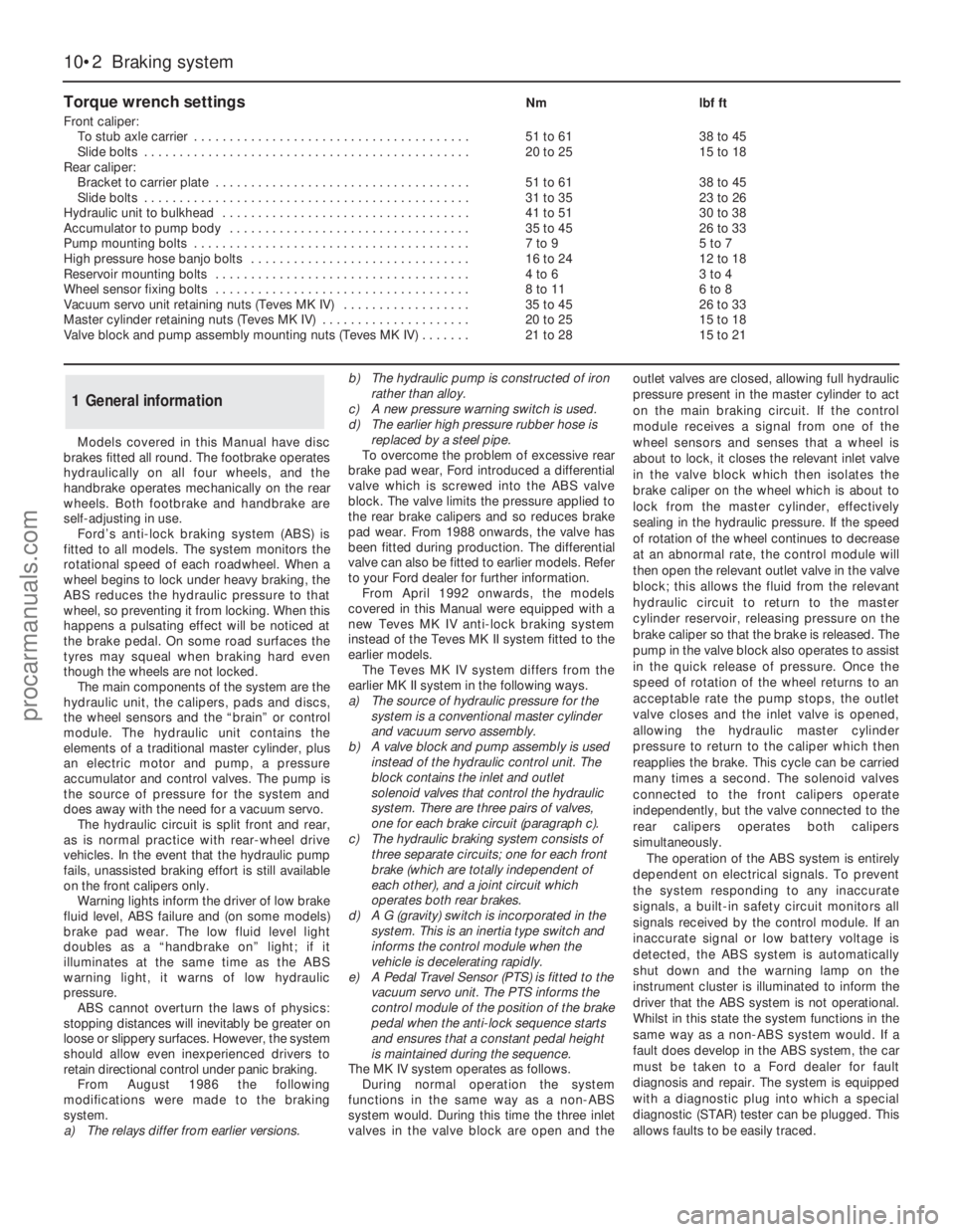
Torque wrench settingsNmlbf ft
Front caliper:
To stub axle carrier . . . . . . . . . . . . . . . . . . . . . . . . . . . . . . . . . . . . . . .51 to 6138 to 45
Slide bolts . . . . . . . . . . . . . . . . . . . . . . . . . . . . . . . . . . . . . . . . . . . . . .20 to 2515 to 18
Rear caliper:
Bracket to carrier plate . . . . . . . . . . . . . . . . . . . . . . . . . . . . . . . . . . . .51 to 6138 to 45
Slide bolts . . . . . . . . . . . . . . . . . . . . . . . . . . . . . . . . . . . . . . . . . . . . . .31 to 3523 to 26
Hydraulic unit to bulkhead . . . . . . . . . . . . . . . . . . . . . . . . . . . . . . . . . . .41 to 5130 to 38
Accumulator to pump body . . . . . . . . . . . . . . . . . . . . . . . . . . . . . . . . . .35 to 4526 to 33
Pump mounting bolts . . . . . . . . . . . . . . . . . . . . . . . . . . . . . . . . . . . . . . .7 to 95 to 7
High pressure hose banjo bolts . . . . . . . . . . . . . . . . . . . . . . . . . . . . . . .16 to 2412 to 18
Reservoir mounting bolts . . . . . . . . . . . . . . . . . . . . . . . . . . . . . . . . . . . .4 to 63 to 4
Wheel sensor fixing bolts . . . . . . . . . . . . . . . . . . . . . . . . . . . . . . . . . . . .8 to 116 to 8
Vacuum servo unit retaining nuts (Teves MK IV) . . . . . . . . . . . . . . . . . .35 to 4526 to 33
Master cylinder retaining nuts (Teves MK IV) . . . . . . . . . . . . . . . . . . . . .20 to 2515 to 18
Valve block and pump assembly mounting nuts (Teves MK IV) . . . . . . .21 to 2815 to 21
procarmanuals.com
Page 132 of 255
Note: Hydraulic fluid is poisonous; wash off
immediately and thoroughly in the case of skin
contact and seek immediate medical advice if
any fluid is swallowed or gets into the eyes.
Certain types of hydraulic fluid are inflammable
and may ignite when allowed into contact with
hot components; when servicing any hydraulic
system it is safest to assume that the fluid is
inflammable and to take precautions against
the risk of fire as though it is petrol that is
being handled. Finally, it is hygroscopic (it
absorbs moisture from the air) old fluid may be
contaminated and unfit for further use. When
topping-up or renewing the fluid, always use
the recommended type and ensure that it
comes from a freshly-opened sealed container
1Bleeding is necessary whenever air has
entered the hydraulic system - for instance
after component renewal. Because the
hydraulic circuits are split, if only the front or
rear circuit has been disturbed it will normally
only be necessary to bleed the front or rear
calipers. If the hydraulic unit has been
disturbed or the fluid level has been allowed to
fall so low that air has entered the system,
both front and rear circuits must be bled,
starting with the front
2The services of an assistant will be required.
As far as is known, pressure bleeding or other
“one-man” equipment cannot be used. In
addition a supply of fresh brake fluid of the
correct type will be needed, together with a
length of flexible tube to fit the bleed screws
and a clean glass or plastic container.
3Do not allow the hydraulic unit pump motor
to run for more than two minutes at a time. The
motor must be allowed to cool (with the
ignition off) for at least ten minutes after each
two minute spell of running.
4Remember that brake fluid is poisonous and
that the rear brake hydraulic system may be
under considerable pressure. Take care not to
allow hydraulic fluid to spray into the face or
eyes.
5Keep the reservoir topped up to the MAX
mark during bleeding.
6Discard the fluid bled out of the system as it
is unfit for re-use.
Models before April 1992
Front brakes
7Remove the dust cap (if fitted) from the left-
hand caliper bleed screw. Slacken the bleed
screw, then nip it up again. Make sure that the
ignition is off.8Fit the bleed tube over the bleed screw.
Place the other end of the tube in the bleed jar
(glass or plastic container). Pour sufficient
brake fluid into the jar to cover the end of the
tube.
9Open the bleed screw one full turn. Have
the assistant depress the brake pedal as far as
it will go, and hold it depressed. Tighten the
bleed screw, then tell the assistant to release
the pedal.
10Repeat paragraph 9 until clean fluid, free
of air bubbles, flows from the bleed screw
during the downstrokes. Remember to keep
the fluid reservoir topped up.
11Repeat the operations on the right-hand
caliper. Refit the bleed screw dust caps (if
applicable) on completion.
Rear brakes
12Remove the dust cap (if fitted) from the
rear left-hand caliper bleed screw. Open the
bleed screw one full turn.
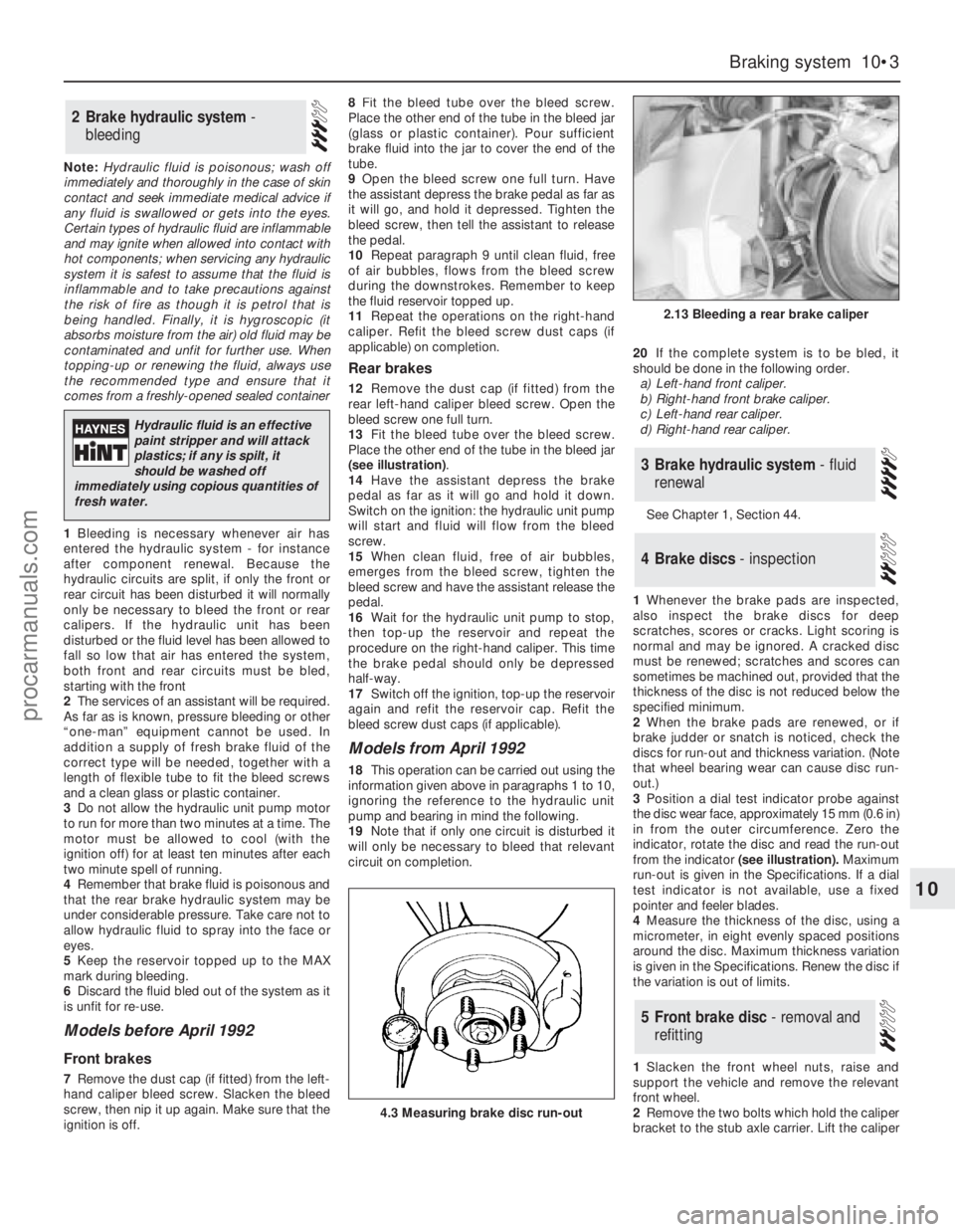
13Fit the bleed tube over the bleed screw.
Place the other end of the tube in the bleed jar
(see illustration).
14Have the assistant depress the brake
pedal as far as it will go and hold it down.
Switch on the ignition: the hydraulic unit pump
will start and fluid will flow from the bleed
screw.
15When clean fluid, free of air bubbles,
emerges from the bleed screw, tighten the
bleed screw and have the assistant release the
pedal.
16Wait for the hydraulic unit pump to stop,
then top-up the reservoir and repeat the
procedure on the right-hand caliper. This time
the brake pedal should only be depressed
half-way.
17Switch off the ignition, top-up the reservoir
again and refit the reservoir cap. Refit the
bleed screw dust caps (if applicable).
Models from April 1992
18This operation can be carried out using the
information given above inparagraphs 1 to 10,
ignoring the reference to the hydraulic unit
pump and bearing in mind the following.
19Note that if only one circuit is disturbed it
will only be necessary to bleed that relevant
circuit on completion.20If the complete system is to be bled, it
should be done in the following order.
a)Left-hand front caliper.
b)Right-hand front brake caliper.
c)Left-hand rear caliper.
d)Right-hand rear caliper.
See Chapter 1, Section 44.
1Whenever the brake pads are inspected,
also inspect the brake discs for deep
scratches, scores or cracks. Light scoring is
normal and may be ignored. A cracked disc
must be renewed; scratches and scores can
sometimes be machined out, provided that the
thickness of the disc is not reduced below the
specified minimum.
2When the brake pads are renewed, or if
brake judder or snatch is noticed, check the
discs for run-out and thickness variation. (Note
that wheel bearing wear can cause disc run-
out.)
3Position a dial test indicator probe against
the disc wear face, approximately 15 mm (0.6 in)
in from the outer circumference. Zero the
indicator, rotate the disc and read the run-out
from the indicator(see illustration).Maximum
run-out is given in the Specifications. If a dial
test indicator is not available, use a fixed
pointer and feeler blades.
4Measure the thickness of the disc, using a
micrometer, in eight evenly spaced positions
around the disc. Maximum thickness variation
is given in the Specifications. Renew the disc if
the variation is out of limits.
1Slacken the front wheel nuts, raise and
support the vehicle and remove the relevant
front wheel.
2Remove the two bolts which hold the caliper
bracket to the stub axle carrier. Lift the caliper
5Front brake disc - removal and
refitting
4Brake discs - inspection
3Brake hydraulic system - fluid
renewal
2Brake hydraulic system -
bleeding
Braking system 10•3
10
2.13 Bleeding a rear brake caliper
4.3 Measuring brake disc run-out
Hydraulic fluid is an effective
paint stripper and will attack
plastics; if any is spilt, it
should be washed off
immediately using copious quantities of
fresh water.
procarmanuals.com
Page 240 of 255
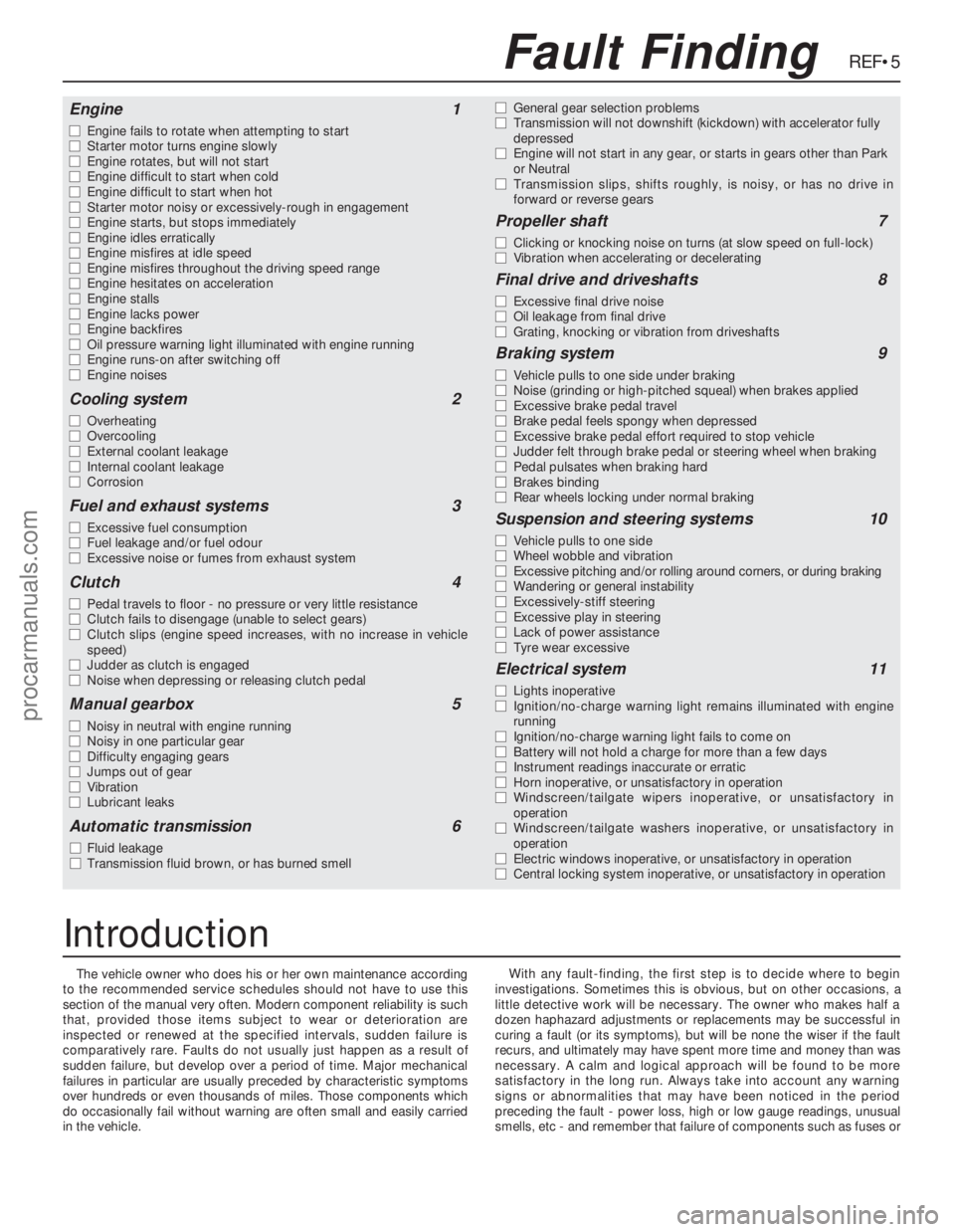
The vehicle owner who does his or her own maintenance according
to the recommended service schedules should not have to use this
section of the manual very often. Modern component reliability is such
that, provided those items subject to wear or deterioration are
inspected or renewed at the specified intervals, sudden failure is
comparatively rare. Faults do not usually just happen as a result of
sudden failure, but develop over a period of time. Major mechanical
failures in particular are usually preceded by characteristic symptoms
over hundreds or even thousands of miles. Those components which
do occasionally fail without warning are often small and easily carried
in the vehicle.With any fault-finding, the first step is to decide where to begin
investigations. Sometimes this is obvious, but on other occasions, a
little detective work will be necessary. The owner who makes half a
dozen haphazard adjustments or replacements may be successful in
curing a fault (or its symptoms), but will be none the wiser if the fault
recurs, and ultimately may have spent more time and money than was
necessary. A calm and logical approach will be found to be more
satisfactory in the long run. Always take into account any warning
signs or abnormalities that may have been noticed in the period
preceding the fault - power loss, high or low gauge readings, unusual
smells, etc - and remember that failure of components such as fuses or
REF•5Fault Finding
Engine1
m mEngine fails to rotate when attempting to start
m mStarter motor turns engine slowly
m mEngine rotates, but will not start
m mEngine difficult to start when cold
m mEngine difficult to start when hot
m mStarter motor noisy or excessively-rough in engagement
m mEngine starts, but stops immediately
m mEngine idles erratically
m mEngine misfires at idle speed
m mEngine misfires throughout the driving speed range
m mEngine hesitates on acceleration
m mEngine stalls
m mEngine lacks power
m mEngine backfires
m mOil pressure warning light illuminated with engine running
m mEngine runs-on after switching off
m mEngine noises
Cooling system2
m
mOverheating
m mOvercooling
m mExternal coolant leakage
m mInternal coolant leakage
m mCorrosion
Fuel and exhaust systems3
m
mExcessive fuel consumption
m mFuel leakage and/or fuel odour
m mExcessive noise or fumes from exhaust system
Clutch4
m
mPedal travels to floor - no pressure or very little resistance
m mClutch fails to disengage (unable to select gears)
m mClutch slips (engine speed increases, with no increase in vehicle
speed)
m mJudder as clutch is engaged
m mNoise when depressing or releasing clutch pedal
Manual gearbox5
m
mNoisy in neutral with engine running
m mNoisy in one particular gear
m mDifficulty engaging gears
m mJumps out of gear
m mVibration
m mLubricant leaks
Automatic transmission6
m
mFluid leakage
m mTransmission fluid brown, or has burned smellm mGeneral gear selection problems
m mTransmission will not downshift (kickdown) with accelerator fully
depressed
m mEngine will not start in any gear, or starts in gears other than Park
or Neutral
m mTransmission slips, shifts roughly, is noisy, or has no drive in
forward or reverse gears
Propeller shaft7
m
mClicking or knocking noise on turns (at slow speed on full-lock)
m mVibration when accelerating or decelerating
Final drive and driveshafts8
m
mExcessive final drive noise
m mOil leakage from final drive
m mGrating, knocking or vibration from driveshafts
Braking system9
m
mVehicle pulls to one side under braking
m mNoise (grinding or high-pitched squeal) when brakes applied
m mExcessive brake pedal travel
m mBrake pedal feels spongy when depressed
m mExcessive brake pedal effort required to stop vehicle
m mJudder felt through brake pedal or steering wheel when braking
m mPedal pulsates when braking hard
m mBrakes binding
m mRear wheels locking under normal braking
Suspension and steering systems10
m
mVehicle pulls to one side
m mWheel wobble and vibration
m mExcessive pitching and/or rolling around corners, or during braking
m mWandering or general instability
m mExcessively-stiff steering
m mExcessive play in steering
m mLack of power assistance
m mTyre wear excessive
Electrical system11
m
mLights inoperative
m mIgnition/no-charge warning light remains illuminated with engine
running
m mIgnition/no-charge warning light fails to come on
m mBattery will not hold a charge for more than a few days
m mInstrument readings inaccurate or erratic
m mHorn inoperative, or unsatisfactory in operation
m mWindscreen/tailgate wipers inoperative, or unsatisfactory in
operation
m mWindscreen/tailgate washers inoperative, or unsatisfactory in
operation
m mElectric windows inoperative, or unsatisfactory in operation
m mCentral locking system inoperative, or unsatisfactory in operation
Introduction
procarmanuals.com
Page 242 of 255
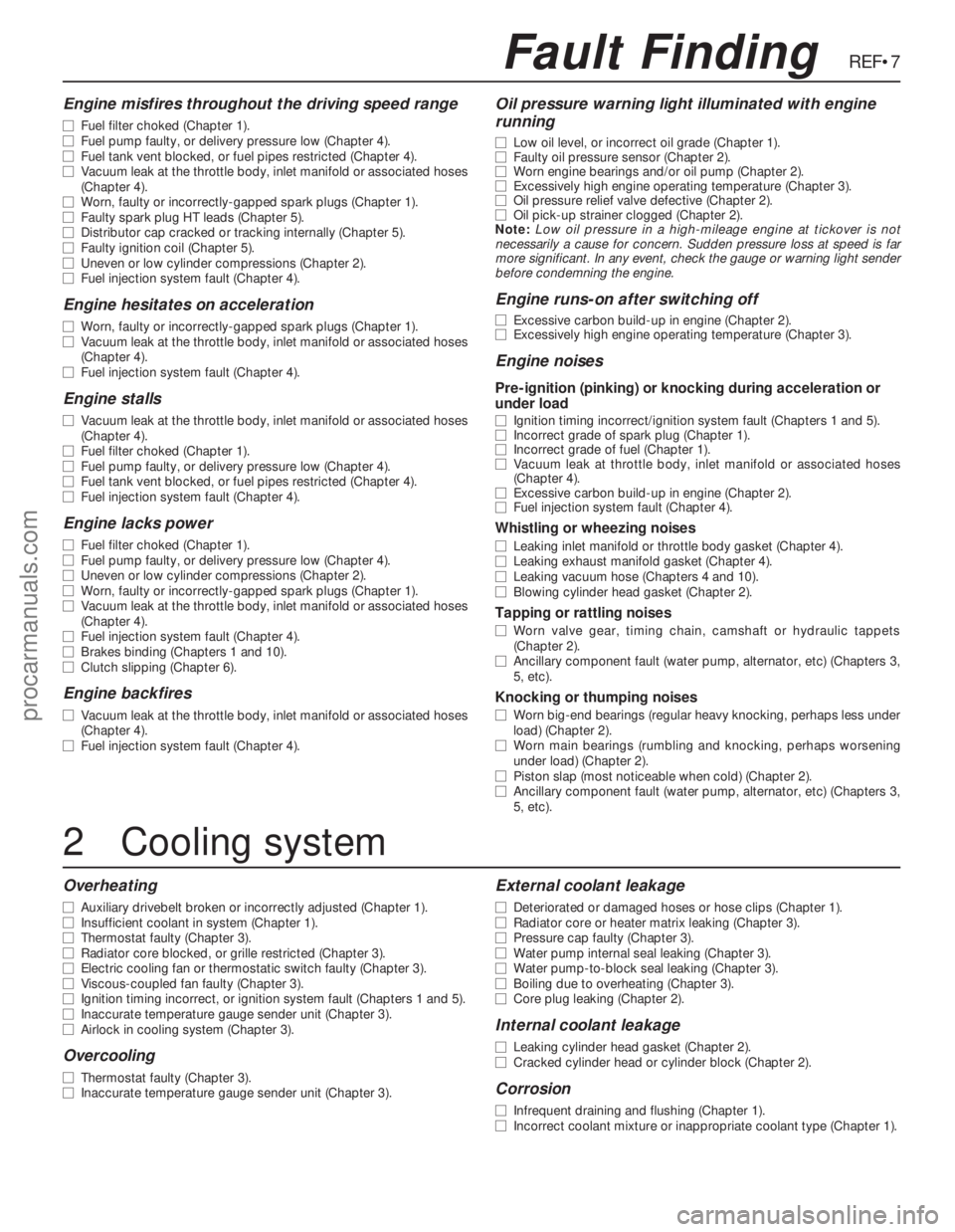
Engine misfires throughout the driving speed range
m mFuel filter choked (Chapter 1).
m mFuel pump faulty, or delivery pressure low (Chapter 4).
m mFuel tank vent blocked, or fuel pipes restricted (Chapter 4).
m mVacuum leak at the throttle body, inlet manifold or associated hoses
(Chapter 4).
m mWorn, faulty or incorrectly-gapped spark plugs (Chapter 1).
m mFaulty spark plug HT leads (Chapter 5).
m mDistributor cap cracked or tracking internally (Chapter 5).
m mFaulty ignition coil (Chapter 5).
m mUneven or low cylinder compressions (Chapter 2).
m mFuel injection system fault (Chapter 4).
Engine hesitates on acceleration
m
mWorn, faulty or incorrectly-gapped spark plugs (Chapter 1).
m mVacuum leak at the throttle body, inlet manifold or associated hoses
(Chapter 4).
m mFuel injection system fault (Chapter 4).
Engine stalls
m
mVacuum leak at the throttle body, inlet manifold or associated hoses
(Chapter 4).
m mFuel filter choked (Chapter 1).
m mFuel pump faulty, or delivery pressure low (Chapter 4).
m mFuel tank vent blocked, or fuel pipes restricted (Chapter 4).
m mFuel injection system fault (Chapter 4).
Engine lacks power
m
mFuel filter choked (Chapter 1).
m mFuel pump faulty, or delivery pressure low (Chapter 4).
m mUneven or low cylinder compressions (Chapter 2).
m mWorn, faulty or incorrectly-gapped spark plugs (Chapter 1).
m mVacuum leak at the throttle body, inlet manifold or associated hoses
(Chapter 4).
m mFuel injection system fault (Chapter 4).
m mBrakes binding (Chapters 1 and 10).
m mClutch slipping (Chapter 6).
Engine backfires
m
mVacuum leak at the throttle body, inlet manifold or associated hoses
(Chapter 4).
m mFuel injection system fault (Chapter 4).
Oil pressure warning light illuminated with engine
running
m mLow oil level, or incorrect oil grade (Chapter 1).
m mFaulty oil pressure sensor (Chapter 2).
m mWorn engine bearings and/or oil pump (Chapter 2).
m mExcessively high engine operating temperature (Chapter 3).
m mOil pressure relief valve defective (Chapter 2).
m mOil pick-up strainer clogged (Chapter 2).
Note:Low oil pressure in a high-mileage engine at tickover is not
necessarily a cause for concern. Sudden pressure loss at speed is far
more significant. In any event, check the gauge or warning light sender
before condemning the engine.
Engine runs-on after switching off
m mExcessive carbon build-up in engine (Chapter 2).
m mExcessively high engine operating temperature (Chapter 3).
Engine noises
Pre-ignition (pinking) or knocking during acceleration or
under load
m mIgnition timing incorrect/ignition system fault (Chapters 1 and 5).
m mIncorrect grade of spark plug (Chapter 1).
m mIncorrect grade of fuel (Chapter 1).
m mVacuum leak at throttle body, inlet manifold or associated hoses
(Chapter 4).
m mExcessive carbon build-up in engine (Chapter 2).
m mFuel injection system fault (Chapter 4).
Whistling or wheezing noises
m
mLeaking inlet manifold or throttle body gasket (Chapter 4).
m mLeaking exhaust manifold gasket (Chapter 4).
m mLeaking vacuum hose (Chapters 4 and 10).
m mBlowing cylinder head gasket (Chapter 2).
Tapping or rattling noises
m
mWorn valve gear, timing chain, camshaft or hydraulic tappets
(Chapter 2).
m mAncillary component fault (water pump, alternator, etc) (Chapters 3,
5, etc).
Knocking or thumping noises
m mWorn big-end bearings (regular heavy knocking, perhaps less under
load) (Chapter 2).
m mWorn main bearings (rumbling and knocking, perhaps worsening
under load) (Chapter 2).
m mPiston slap (most noticeable when cold) (Chapter 2).
m mAncillary component fault (water pump, alternator, etc) (Chapters 3,
5, etc).
REF•7Fault Finding
2Cooling system
Overheating
m
mAuxiliary drivebelt broken or incorrectly adjusted (Chapter 1).
m mInsufficient coolant in system (Chapter 1).
m mThermostat faulty (Chapter 3).
m mRadiator core blocked, or grille restricted (Chapter 3).
m mElectric cooling fan or thermostatic switch faulty (Chapter 3).
m mViscous-coupled fan faulty (Chapter 3).
m mIgnition timing incorrect, or ignition system fault (Chapters 1 and 5).
m mInaccurate temperature gauge sender unit (Chapter 3).
m mAirlock in cooling system (Chapter 3).
Overcooling
m
mThermostat faulty (Chapter 3).
m mInaccurate temperature gauge sender unit (Chapter 3).
External coolant leakage
m
mDeteriorated or damaged hoses or hose clips (Chapter 1).
m mRadiator core or heater matrix leaking (Chapter 3).
m mPressure cap faulty (Chapter 3).
m mWater pump internal seal leaking (Chapter 3).
m mWater pump-to-block seal leaking (Chapter 3).
m mBoiling due to overheating (Chapter 3).
m mCore plug leaking (Chapter 2).
Internal coolant leakage
m
mLeaking cylinder head gasket (Chapter 2).
m mCracked cylinder head or cylinder block (Chapter 2).
Corrosion
m
mInfrequent draining and flushing (Chapter 1).
m mIncorrect coolant mixture or inappropriate coolant type (Chapter 1).
procarmanuals.com
Page 243 of 255
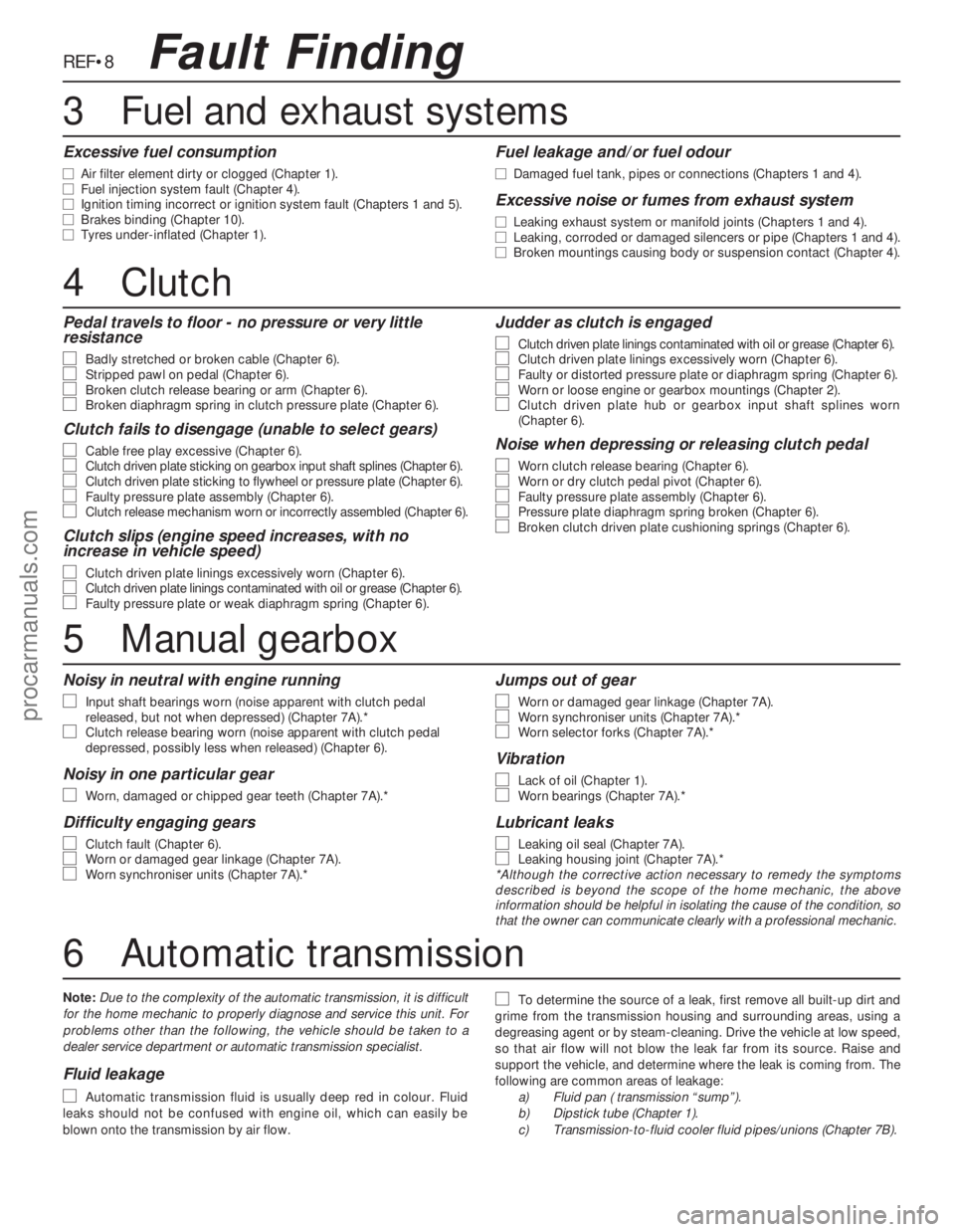
REF•8
Pedal travels to floor - no pressure or very little
resistance
m m
Badly stretched or broken cable (Chapter 6).m
mStripped pawl on pedal (Chapter 6).m
mBroken clutch release bearing or arm (Chapter 6).m
mBroken diaphragm spring in clutch pressure plate (Chapter 6).
Clutch fails to disengage (unable to select gears)
m m
Cable free play excessive (Chapter 6).m
mClutch driven plate sticking on gearbox input shaft splines (Chapter 6).m
mClutch driven plate sticking to flywheel or pressure plate (Chapter 6).m
mFaulty pressure plate assembly (Chapter 6).m
mClutch release mechanism worn or incorrectly assembled (Chapter 6).
Clutch slips (engine speed increases, with no
increase in vehicle speed)
m m
Clutch driven plate linings excessively worn (Chapter 6).m
mClutch driven plate linings contaminated with oil or grease (Chapter 6).m
mFaulty pressure plate or weak diaphragm spring (Chapter 6).
Judder as clutch is engaged
m m
Clutch driven plate linings contaminated with oil or grease (Chapter 6).m
mClutch driven plate linings excessively worn (Chapter 6).m
mFaulty or distorted pressure plate or diaphragm spring (Chapter 6).m
mWorn or loose engine or gearbox mountings (Chapter 2).m
mClutch driven plate hub or gearbox input shaft splines worn
(Chapter 6).
Noise when depressing or releasing clutch pedal
m m
Worn clutch release bearing (Chapter 6).m
mWorn or dry clutch pedal pivot (Chapter 6).m
mFaulty pressure plate assembly (Chapter 6).m
mPressure plate diaphragm spring broken (Chapter 6).m
mBroken clutch driven plate cushioning springs (Chapter 6).
Excessive fuel consumption
m
mAir filter element dirty or clogged (Chapter 1).
m mFuel injection system fault (Chapter 4).
m mIgnition timing incorrect or ignition system fault (Chapters 1 and 5).
m mBrakes binding (Chapter 10).
m mTyres under-inflated (Chapter 1).
Fuel leakage and/or fuel odour
m
mDamaged fuel tank, pipes or connections (Chapters 1 and 4).
Excessive noise or fumes from exhaust system
m
mLeaking exhaust system or manifold joints (Chapters 1 and 4).
m mLeaking, corroded or damaged silencers or pipe (Chapters 1 and 4).
m mBroken mountings causing body or suspension contact (Chapter 4).
Fault Finding
4Clutch
5Manual gearbox
Noisy in neutral with engine running
m m
Input shaft bearings worn (noise apparent with clutch pedal
released, but not when depressed) (Chapter 7A).*
m mClutch release bearing worn (noise apparent with clutch pedal
depressed, possibly less when released) (Chapter 6).
Noisy in one particular gear
m m
Worn, damaged or chipped gear teeth (Chapter 7A).*
Difficulty engaging gears
m m
Clutch fault (Chapter 6).m
mWorn or damaged gear linkage (Chapter 7A).m
mWorn synchroniser units (Chapter 7A).*
Jumps out of gear
m m
Worn or damaged gear linkage (Chapter 7A).m
mWorn synchroniser units (Chapter 7A).*m
mWorn selector forks (Chapter 7A).*
Vibration
m m
Lack of oil (Chapter 1).m
mWorn bearings (Chapter 7A).*
Lubricant leaks
m m
Leaking oil seal (Chapter 7A).m
mLeaking housing joint (Chapter 7A).*
*Although the corrective action necessary to remedy the symptoms
described is beyond the scope of the home mechanic, the above
information should be helpful in isolating the cause of the condition, so
that the owner can communicate clearly with a professional mechanic.
6Automatic transmission
Note:Due to the complexity of the automatic transmission, it is difficult
for the home mechanic to properly diagnose and service this unit. For
problems other than the following, the vehicle should be taken to a
dealer service department or automatic transmission specialist.
Fluid leakage
m m
Automatic transmission fluid is usually deep red in colour. Fluid
leaks should not be confused with engine oil, which can easily be
blown onto the transmission by air flow.
m mTo determine the source of a leak, first remove all built-up dirt and
grime from the transmission housing and surrounding areas, using a
degreasing agent or by steam-cleaning. Drive the vehicle at low speed,
so that air flow will not blow the leak far from its source. Raise and
support the vehicle, and determine where the leak is coming from. The
following are common areas of leakage:
a)Fluid pan ( transmission “sump”).
b)Dipstick tube (Chapter 1).
c)Transmission-to-fluid cooler fluid pipes/unions (Chapter 7B).
3Fuel and exhaust systems
procarmanuals.com
Page 244 of 255
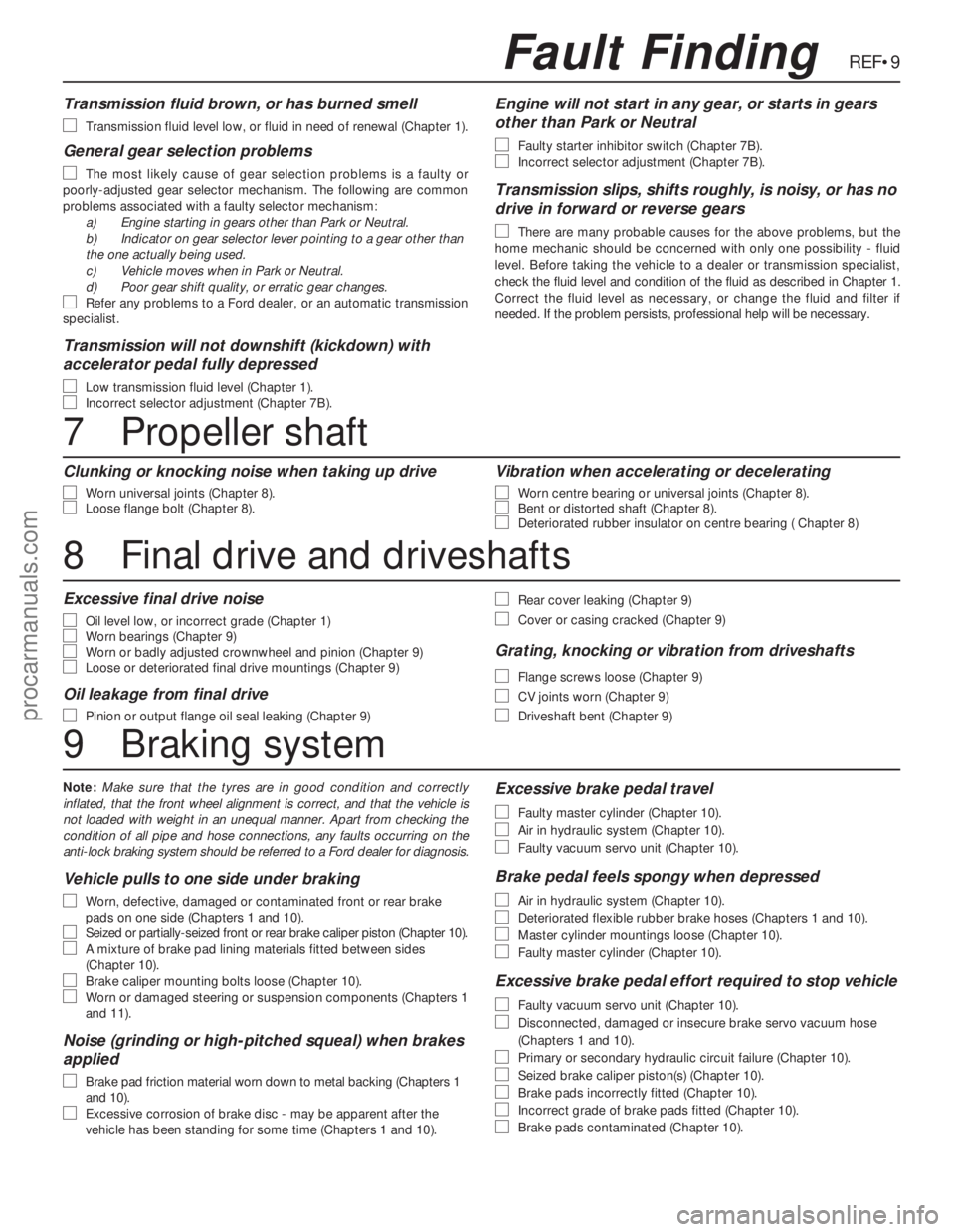
Transmission fluid brown, or has burned smell
m m
Transmission fluid level low, or fluid in need of renewal (Chapter 1).
General gear selection problems
m m
The most likely cause of gear selection problems is a faulty or
poorly-adjusted gear selector mechanism. The following are common
problems associated with a faulty selector mechanism:
a)Engine starting in gears other than Park or Neutral.
b)Indicator on gear selector lever pointing to a gear other than
the one actually being used.
c)Vehicle moves when in Park or Neutral.
d)Poor gear shift quality, or erratic gear changes.
m
mRefer any problems to a Ford dealer, or an automatic transmission
specialist.
Transmission will not downshift (kickdown) with
accelerator pedal fully depressed
m m
Low transmission fluid level (Chapter 1).
m
mIncorrect selector adjustment (Chapter 7B).
Engine will not start in any gear, or starts in gears
other than Park or Neutral
m m
Faulty starter inhibitor switch (Chapter 7B).
m
mIncorrect selector adjustment (Chapter 7B).
Transmission slips, shifts roughly, is noisy, or has no
drive in forward or reverse gears
m m
There are many probable causes for the above problems, but the
home mechanic should be concerned with only one possibility - fluid
level. Before taking the vehicle to a dealer or transmission specialist,
check the fluid level and condition of the fluid as described in Chapter 1.
Correct the fluid level as necessary, or change the fluid and filter if
needed. If the problem persists, professional help will be necessary.
REF•9Fault Finding
7Propeller shaft
Clunking or knocking noise when taking up drive
m m
Worn universal joints (Chapter 8).m
mLoose flange bolt (Chapter 8).
Vibration when accelerating or decelerating
m m
Worn centre bearing or universal joints (Chapter 8).m
mBent or distorted shaft (Chapter 8).m
mDeteriorated rubber insulator on centre bearing ( Chapter 8)
8Final drive and driveshafts
Excessive final drive noise
m m
Oil level low, or incorrect grade (Chapter 1)m
mWorn bearings (Chapter 9)m
mWorn or badly adjusted crownwheel and pinion (Chapter 9)m
mLoose or deteriorated final drive mountings (Chapter 9)
Oil leakage from final drive
m m
Pinion or output flange oil seal leaking (Chapter 9)
m
mRear cover leaking (Chapter 9)
m
mCover or casing cracked (Chapter 9)
Grating, knocking or vibration from driveshafts
m m
Flange screws loose (Chapter 9)
m
mCV joints worn (Chapter 9)
m
mDriveshaft bent (Chapter 9)
9Braking system
Note:Make sure that the tyres are in good condition and correctly
inflated, that the front wheel alignment is correct, and that the vehicle is
not loaded with weight in an unequal manner. Apart from checking the
condition of all pipe and hose connections, any faults occurring on the
anti-lock braking system should be referred to a Ford dealer for diagnosis.
Vehicle pulls to one side under braking
m m
Worn, defective, damaged or contaminated front or rear brake
pads on one side (Chapters 1 and 10).
m mSeized or partially-seized front or rear brake caliper piston (Chapter 10).m
mA mixture of brake pad lining materials fitted between sides
(Chapter 10).
m mBrake caliper mounting bolts loose (Chapter 10).m
mWorn or damaged steering or suspension components (Chapters 1
and 11).
Noise (grinding or high-pitched squeal) when brakes
applied
m m
Brake pad friction material worn down to metal backing (Chapters 1
and 10).
m mExcessive corrosion of brake disc - may be apparent after the
vehicle has been standing for some time (Chapters 1 and 10).
Excessive brake pedal travel
m m
Faulty master cylinder (Chapter 10).
m
mAir in hydraulic system (Chapter 10).
m
mFaulty vacuum servo unit (Chapter 10).
Brake pedal feels spongy when depressed
m m
Air in hydraulic system (Chapter 10).
m
mDeteriorated flexible rubber brake hoses (Chapters 1 and 10).
m
mMaster cylinder mountings loose (Chapter 10).
m
mFaulty master cylinder (Chapter 10).
Excessive brake pedal effort required to stop vehicle
m m
Faulty vacuum servo unit (Chapter 10).
m
mDisconnected, damaged or insecure brake servo vacuum hose
(Chapters 1 and 10).
m mPrimary or secondary hydraulic circuit failure (Chapter 10).
m
mSeized brake caliper piston(s) (Chapter 10).
m
mBrake pads incorrectly fitted (Chapter 10).
m
mIncorrect grade of brake pads fitted (Chapter 10).
m
mBrake pads contaminated (Chapter 10).
procarmanuals.com
Page 245 of 255
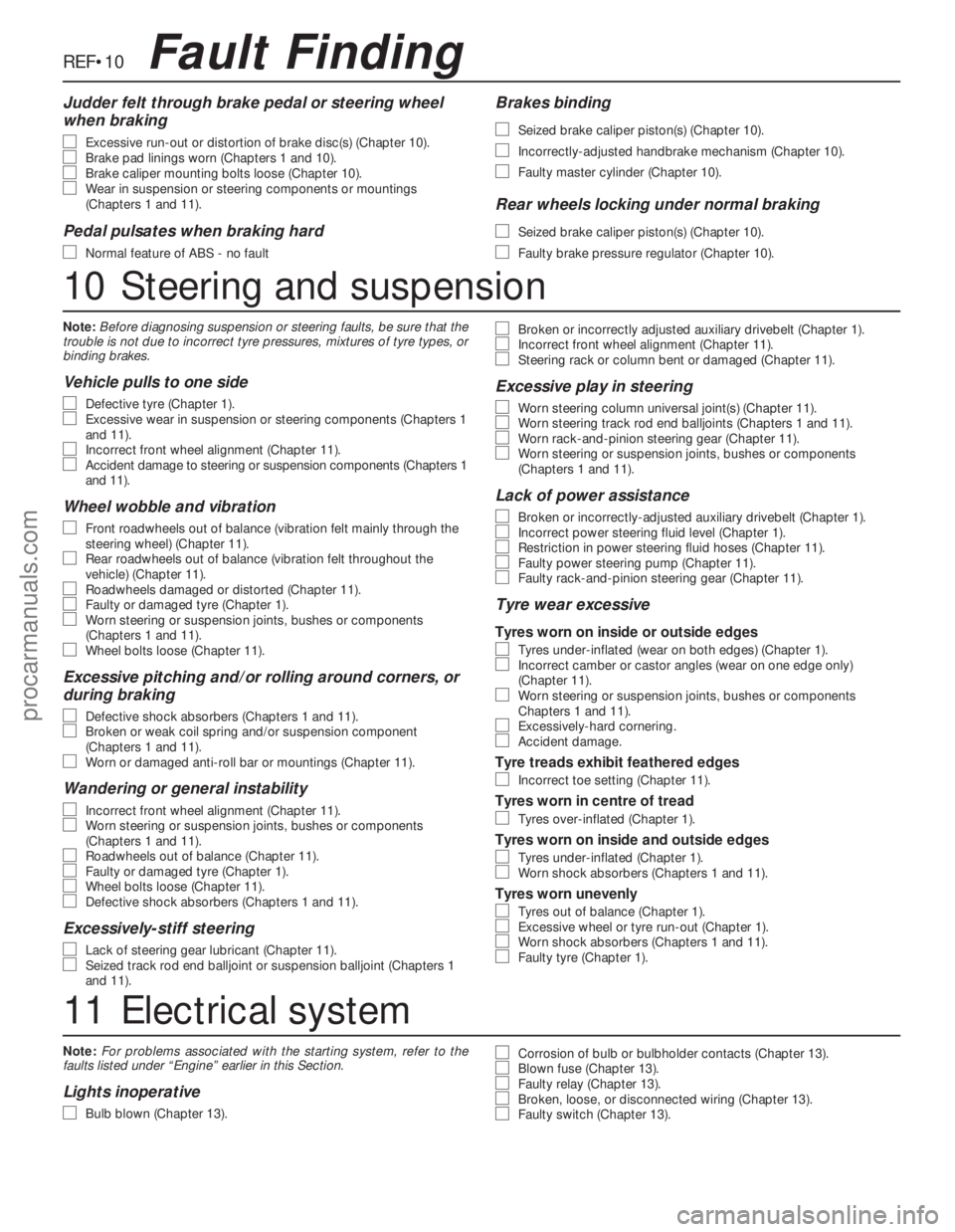
Note:For problems associated with the starting system, refer to the
faults listed under “Engine” earlier in this Section.
Lights inoperative
m m
Bulb blown (Chapter 13).
m
mCorrosion of bulb or bulbholder contacts (Chapter 13).m
mBlown fuse (Chapter 13).m
mFaulty relay (Chapter 13).m
mBroken, loose, or disconnected wiring (Chapter 13).m
mFaulty switch (Chapter 13).
REF•10Fault Finding
Judder felt through brake pedal or steering wheel
when braking
m m
Excessive run-out or distortion of brake disc(s) (Chapter 10).m
mBrake pad linings worn (Chapters 1 and 10).m
mBrake caliper mounting bolts loose (Chapter 10).m
mWear in suspension or steering components or mountings
(Chapters 1 and 11).
Pedal pulsates when braking hard
m m
Normal feature of ABS - no fault
Brakes binding
m m
Seized brake caliper piston(s) (Chapter 10).
m
mIncorrectly-adjusted handbrake mechanism (Chapter 10).
m
mFaulty master cylinder (Chapter 10).
Rear wheels locking under normal braking
m m
Seized brake caliper piston(s) (Chapter 10).
m
mFaulty brake pressure regulator (Chapter 10).
10Steering and suspension
Note:Before diagnosing suspension or steering faults, be sure that the
trouble is not due to incorrect tyre pressures, mixtures of tyre types, or
binding brakes.
Vehicle pulls to one side
m m
Defective tyre (Chapter 1).m
mExcessive wear in suspension or steering components (Chapters 1
and 11).
m mIncorrect front wheel alignment (Chapter 11).m
mAccident damage to steering or suspension components (Chapters 1
and 11).
Wheel wobble and vibration
m m
Front roadwheels out of balance (vibration felt mainly through the
steering wheel) (Chapter 11).
m mRear roadwheels out of balance (vibration felt throughout the
vehicle) (Chapter 11).
m mRoadwheels damaged or distorted (Chapter 11).m
mFaulty or damaged tyre (Chapter 1).m
mWorn steering or suspension joints, bushes or components
(Chapters 1 and 11).
m mWheel bolts loose (Chapter 11).
Excessive pitching and/or rolling around corners, or
during braking
m m
Defective shock absorbers (Chapters 1 and 11).m
mBroken or weak coil spring and/or suspension component
(Chapters 1 and 11).
m mWorn or damaged anti-roll bar or mountings (Chapter 11).
Wandering or general instability
m m
Incorrect front wheel alignment (Chapter 11).m
mWorn steering or suspension joints, bushes or components
(Chapters 1 and 11).
m mRoadwheels out of balance (Chapter 11).m
mFaulty or damaged tyre (Chapter 1).m
mWheel bolts loose (Chapter 11).m
mDefective shock absorbers (Chapters 1 and 11).
Excessively-stiff steering
m m
Lack of steering gear lubricant (Chapter 11).m
mSeized track rod end balljoint or suspension balljoint (Chapters 1
and 11).
m mBroken or incorrectly adjusted auxiliary drivebelt (Chapter 1).m
mIncorrect front wheel alignment (Chapter 11).m
mSteering rack or column bent or damaged (Chapter 11).
Excessive play in steering
m m
Worn steering column universal joint(s) (Chapter 11).m
mWorn steering track rod end balljoints (Chapters 1 and 11).m
mWorn rack-and-pinion steering gear (Chapter 11).m
mWorn steering or suspension joints, bushes or components
(Chapters 1 and 11).
Lack of power assistance
m m
Broken or incorrectly-adjusted auxiliary drivebelt (Chapter 1).m
mIncorrect power steering fluid level (Chapter 1).m
mRestriction in power steering fluid hoses (Chapter 11).m
mFaulty power steering pump (Chapter 11).m
mFaulty rack-and-pinion steering gear (Chapter 11).
Tyre wear excessive
Tyres worn on inside or outside edges
m
mTyres under-inflated (wear on both edges) (Chapter 1).m
mIncorrect camber or castor angles (wear on one edge only)
(Chapter 11).
m mWorn steering or suspension joints, bushes or components
Chapters 1 and 11).
m mExcessively-hard cornering.m
mAccident damage.
Tyre treads exhibit feathered edges
m
mIncorrect toe setting (Chapter 11).
Tyres worn in centre of tread
m
mTyres over-inflated (Chapter 1).
Tyres worn on inside and outside edges
m
mTyres under-inflated (Chapter 1).m
mWorn shock absorbers (Chapters 1 and 11).
Tyres worn unevenly
m
mTyres out of balance (Chapter 1).m
mExcessive wheel or tyre run-out (Chapter 1).m
mWorn shock absorbers (Chapters 1 and 11).m
mFaulty tyre (Chapter 1).
11Electrical system
procarmanuals.com
Page 247 of 255
REF•12Glossary of Technical Terms
A
ABS (Anti-lock brake system)A system,
usually electronically controlled, that senses
incipient wheel lockup during braking and
relieves hydraulic pressure at wheels that are
about to skid.
Air bag An inflatable bag hidden in the
steering wheel (driver’s side) or the dash or
glovebox (passenger side). In a head-on
collision, the bags inflate, preventing the
driver and front passenger from being thrown
forward into the steering wheel or windscreen.
Air cleanerA metal or plastic housing,
containing a filter element, which removes
dust and dirt from the air being drawn into the
engine.
Air filter elementThe actual filter in an air
cleaner system, usually manufactured from
pleated paper and requiring renewal at regular
intervals.
Allen keyA hexagonal wrench which fits into
a recessed hexagonal hole.
Alligator clipA long-nosed spring-loaded
metal clip with meshing teeth. Used to make
temporary electrical connections.
AlternatorA component in the electrical
system which converts mechanical energy
from a drivebelt into electrical energy to
charge the battery and to operate the starting
system, ignition system and electrical
accessories.
Ampere (amp)A unit of measurement for the
flow of electric current. One amp is the
amount of current produced by one volt
acting through a resistance of one ohm.
Anaerobic sealerA substance used to
prevent bolts and screws from loosening.
Anaerobic means that it does not require
oxygen for activation. The Loctite brand is
widely used.
AntifreezeA substance (usually ethylene
glycol) mixed with water, and added to a
vehicle’s cooling system, to prevent freezing
of the coolant in winter. Antifreeze also
contains chemicals to inhibit corrosion and
the formation of rust and other deposits that
would tend to clog the radiator and coolant
passages and reduce cooling efficiency.
Anti-seize compoundA coating that
reduces the risk of seizing on fasteners that
are subjected to high temperatures, such as
exhaust manifold bolts and nuts.
AsbestosA natural fibrous mineral with great
heat resistance, commonly used in the
composition of brake friction materials.Asbestos is a health hazard and the dust
created by brake systems should never be
inhaled or ingested.
AxleA shaft on which a wheel revolves, or
which revolves with a wheel. Also, a solid
beam that connects the two wheels at one
end of the vehicle. An axle which also
transmits power to the wheels is known as a
live axle.
AxleshaftA single rotating shaft, on either
side of the differential, which delivers power
from the final drive assembly to the drive
wheels. Also called a driveshaft or a halfshaft.
BBall bearingAn anti-friction bearing
consisting of a hardened inner and outer race
with hardened steel balls between two races.
BearingThe curved surface on a shaft or in a
bore, or the part assembled into either, that
permits relative motion between them with
minimum wear and friction.
Big-end bearingThe bearing in the end of
the connecting rod that’s attached to the
crankshaft.
Bleed nippleA valve on a brake wheel
cylinder, caliper or other hydraulic component
that is opened to purge the hydraulic system
of air. Also called a bleed screw.
Brake bleedingProcedure for removing air
from lines of a hydraulic brake system.
Brake discThe component of a disc brake
that rotates with the wheels.Brake drumThe component of a drum brake
that rotates with the wheels.
Brake liningsThe friction material which
contacts the brake disc or drum to retard the
vehicle’s speed. The linings are bonded or
riveted to the brake pads or shoes.
Brake padsThe replaceable friction pads
that pinch the brake disc when the brakes are
applied. Brake pads consist of a friction
material bonded or riveted to a rigid backing
plate.
Brake shoeThe crescent-shaped carrier to
which the brake linings are mounted and
which forces the lining against the rotating
drum during braking.
Braking systemsFor more information on
braking systems, consult the Haynes
Automotive Brake Manual.
Breaker barA long socket wrench handle
providing greater leverage.
BulkheadThe insulated partition between
the engine and the passenger compartment.
CCaliperThe non-rotating part of a disc-brake
assembly that straddles the disc and carries
the brake pads. The caliper also contains the
hydraulic components that cause the pads to
pinch the disc when the brakes are applied. A
caliper is also a measuring tool that can be set
to measure inside or outside dimensions of an
object.
CamshaftA rotating shaft on which a series
of cam lobes operate the valve mechanisms.
The camshaft may be driven by gears, by
sprockets and chain or by sprockets and a
belt.
CanisterA container in an evaporative
emission control system; contains activated
charcoal granules to trap vapours from the
fuel system.
CarburettorA device which mixes fuel with
air in the proper proportions to provide a
desired power output from a spark ignition
internal combustion engine.
CastellatedResembling the parapets along
the top of a castle wall. For example, a
castellated balljoint stud nut.
CastorIn wheel alignment, the backward or
forward tilt of the steering axis. Castor is
positive when the steering axis is inclined
rearward at the top.
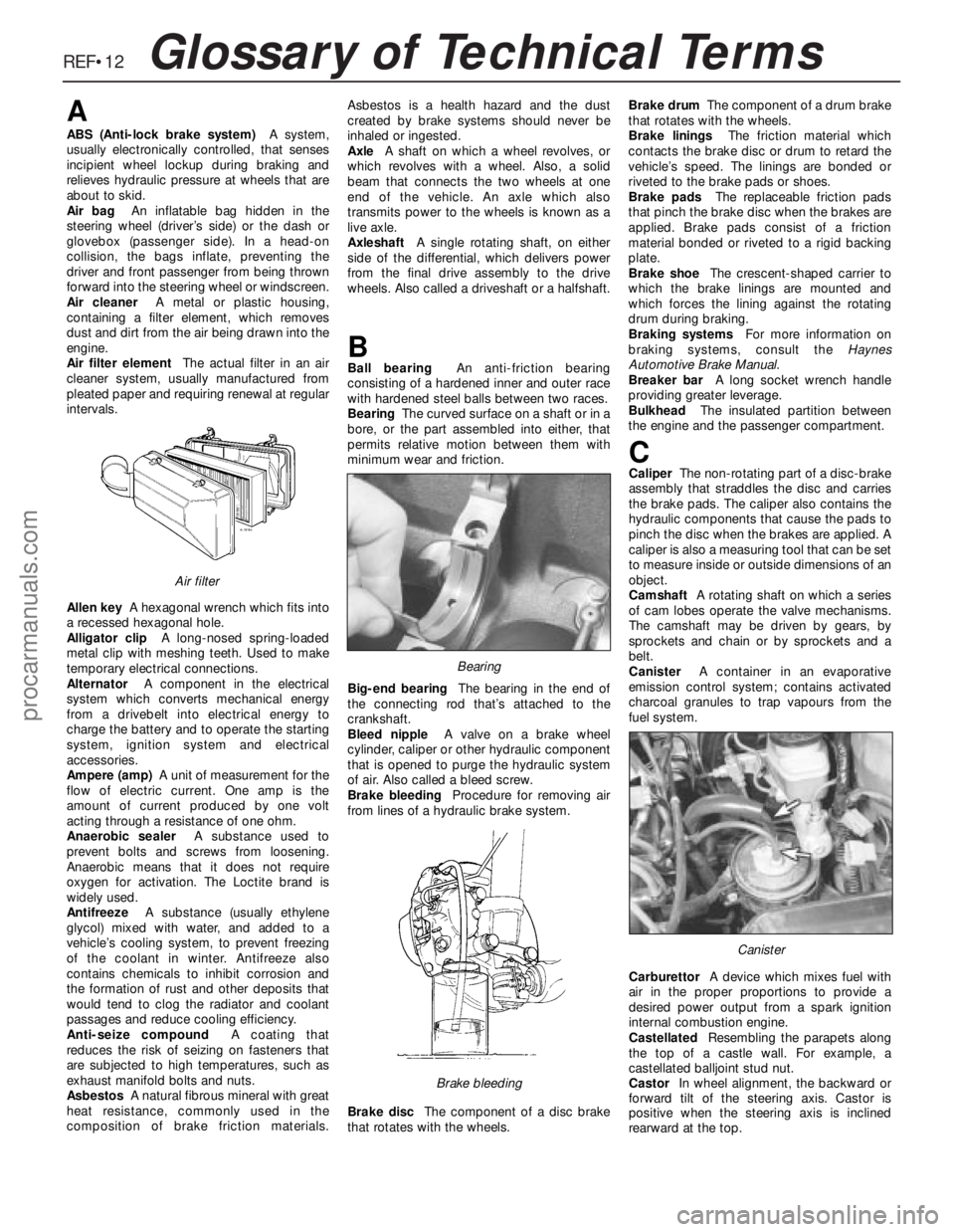
Canister
Brake bleeding
Bearing
Air filter
procarmanuals.com