driving FORD GT 2005 1.G User Guide
[x] Cancel search | Manufacturer: FORD, Model Year: 2005, Model line: GT, Model: FORD GT 2005 1.GPages: 200, PDF Size: 17.38 MB
Page 72 of 200
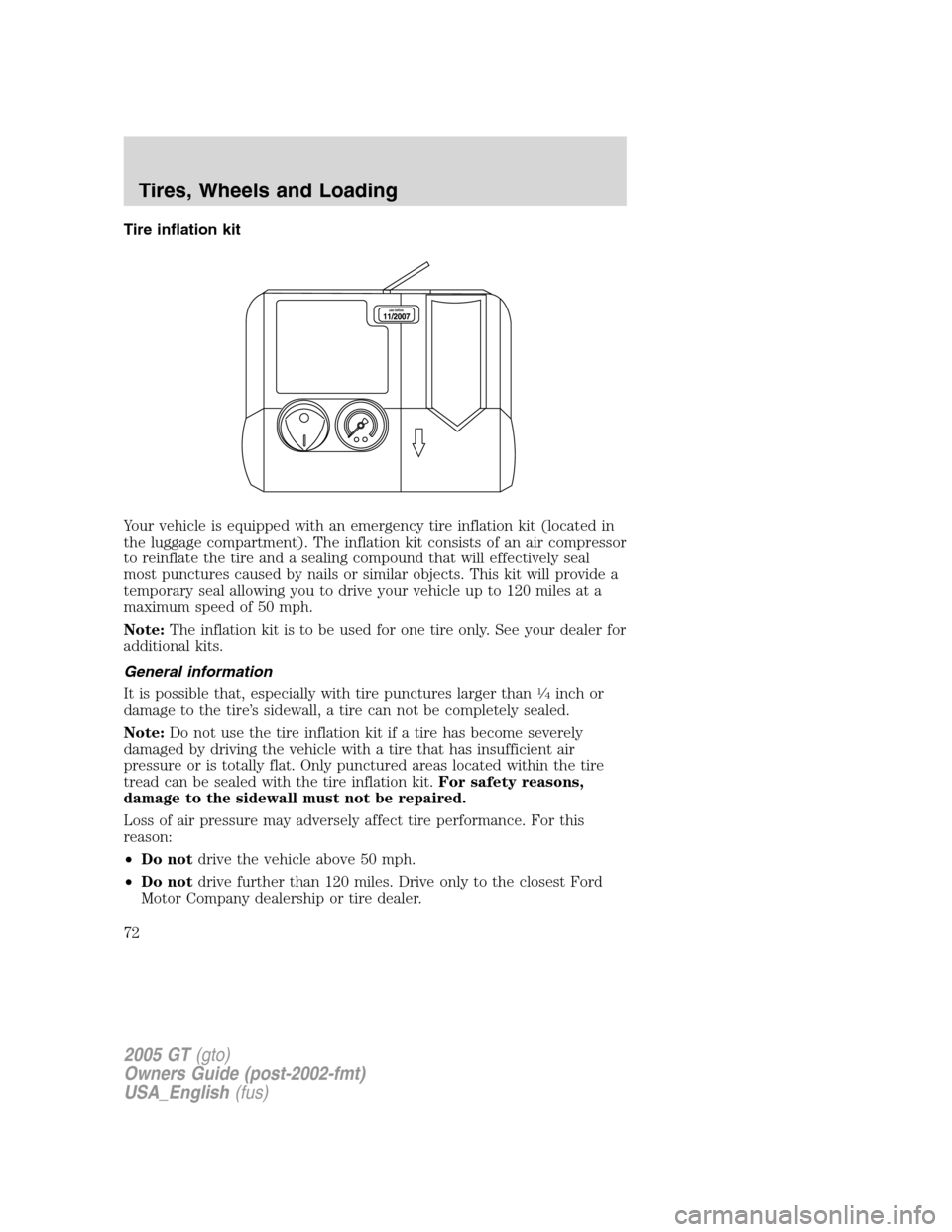
Tire inflation kit
Your vehicle is equipped with an emergency tire inflation kit (located in
the luggage compartment). The inflation kit consists of an air compressor
to reinflate the tire and a sealing compound that will effectively seal
most punctures caused by nails or similar objects. This kit will provide a
temporary seal allowing you to drive your vehicle up to 120 miles at a
maximum speed of 50 mph.
Note:The inflation kit is to be used for one tire only. See your dealer for
additional kits.
General information
It is possible that, especially with tire punctures larger than
1⁄4inch or
damage to the tire’s sidewall, a tire can not be completely sealed.
Note: Do not use the tire inflation kit if a tire has become severely
damaged by driving the vehicle with a tire that has insufficient air
pressure or is totally flat. Only punctured areas located within the tire
tread can be sealed with the tire inflation kit. For safety reasons,
damage to the sidewall must not be repaired.
Loss of air pressure may adversely affect tire performance. For this
reason:
• Do not drive the vehicle above 50 mph.
• Do not drive further than 120 miles. Drive only to the closest Ford
Motor Company dealership or tire dealer.
2005 GT(gto)
Owners Guide (post-2002-fmt)
USA_English (fus)
Tires, Wheels and Loading
72
Page 76 of 200
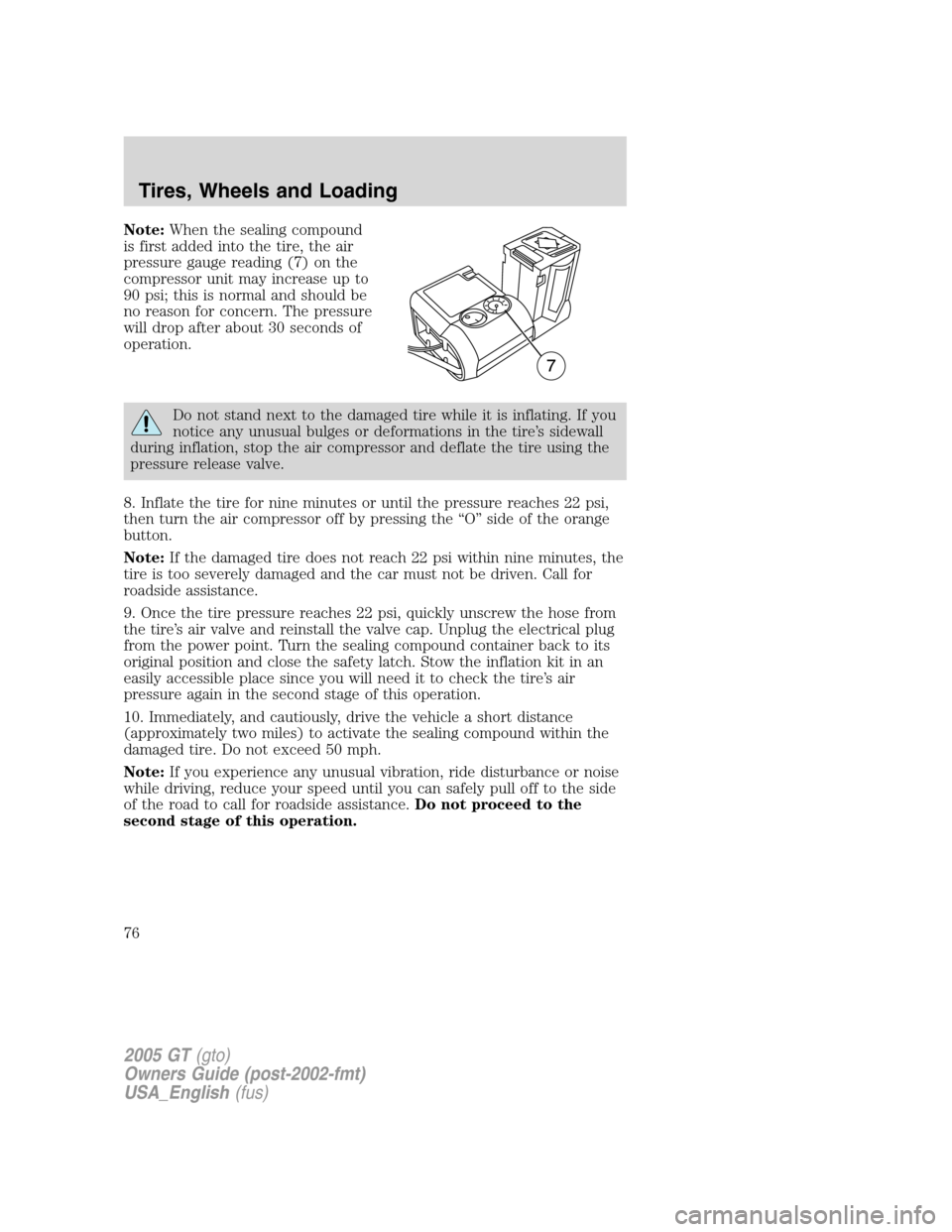
Note:When the sealing compound
is first added into the tire, the air
pressure gauge reading (7) on the
compressor unit may increase up to
90 psi; this is normal and should be
no reason for concern. The pressure
will drop after about 30 seconds of
operation.
Do not stand next to the damaged tire while it is inflating. If you
notice any unusual bulges or deformations in the tire ’s sidewall
during inflation, stop the air compressor and deflate the tire using the
pressure release valve.
8. Inflate the tire for nine minutes or until the pressure reaches 22 psi,
then turn the air compressor off by pressing the “O ” side of the orange
button.
Note: If the damaged tire does not reach 22 psi within nine minutes, the
tire is too severely damaged and the car must not be driven. Call for
roadside assistance.
9. Once the tire pressure reaches 22 psi, quickly unscrew the hose from
the tire ’s air valve and reinstall the valve cap. Unplug the electrical plug
from the power point. Turn the sealing compound container back to its
original position and close the safety latch. Stow the inflation kit in an
easily accessible place since you will need it to check the tire ’s air
pressure again in the second stage of this operation.
10. Immediately, and cautiously, drive the vehicle a short distance
(approximately two miles) to activate the sealing compound within the
damaged tire. Do not exceed 50 mph.
Note: If you experience any unusual vibration, ride disturbance or noise
while driving, reduce your speed until you can safely pull off to the side
of the road to call for roadside assistance. Do not proceed to the
second stage of this operation.
2005 GT(gto)
Owners Guide (post-2002-fmt)
USA_English (fus)
Tires, Wheels and Loading
76
Page 77 of 200
Second stage: Checking tire pressure
1. Stop driving after approximately two miles. Refer to theTips for use
of the tire inflation kit for safe operation of the tire inflation kit. Then
check the air pressure of the damaged tire as follows:
• Ensure the compressor is turned off by pressing the “O ” side of the
orange button.
• Remove the hose and the cable with the electrical plug from the kit ’s
storage compartment.
• Remove the valve cap from the sealed tire, then screw the hose firmly
onto the tire ’s air valve.
• Start the engine (only if the vehicle is outdoors or in a
well-ventilated area) to prevent the vehicle’s battery from draining.
• Insert the electrical plug into the vehicle ’s power point.
• Read the air pressure gauge on the inflation kit.
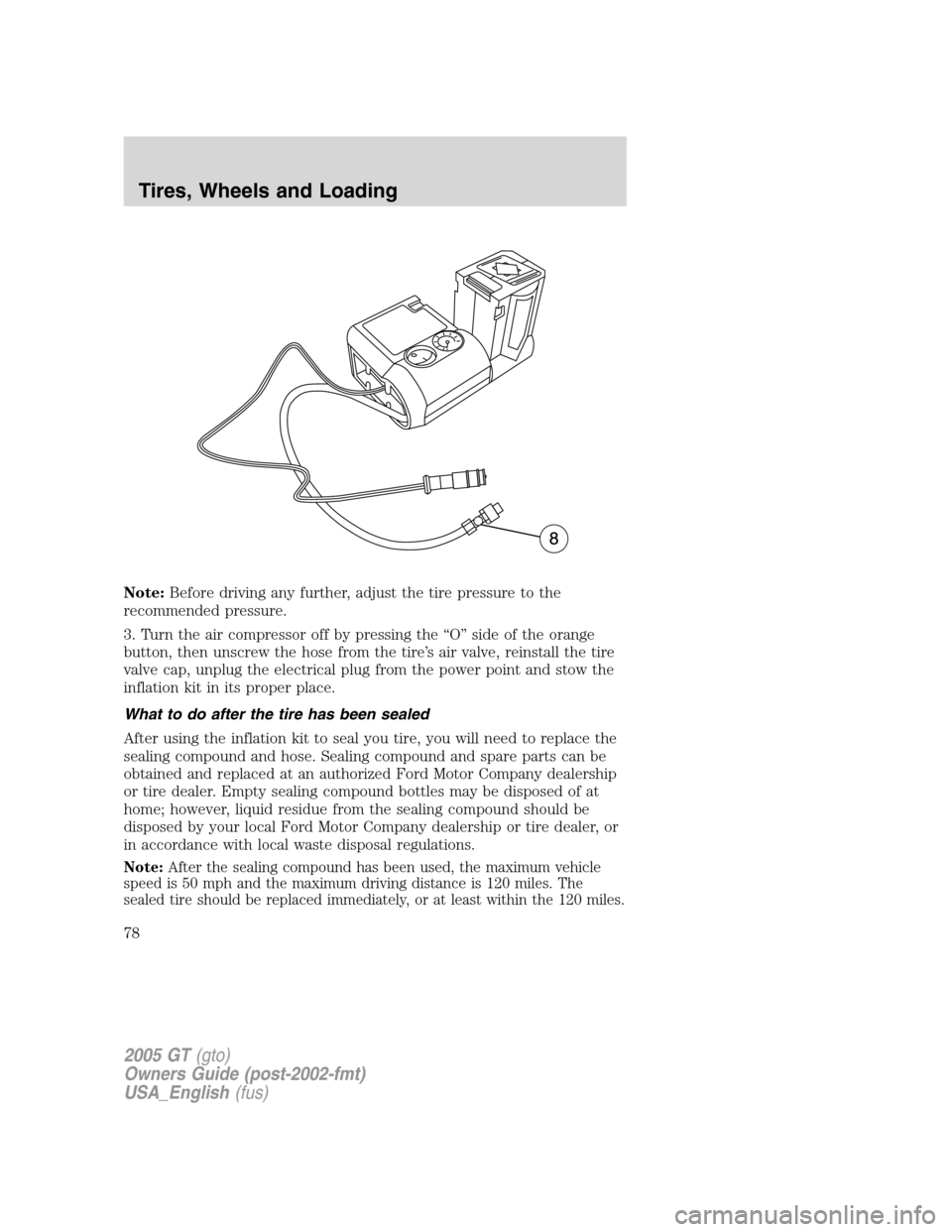
2. If the air pressure reads 19 psi or higher, switch the air compressor on
by pressing the “I” side of the orange button and adjust the air pressure
to the recommended pressure. This pressure can be found on a label
affixed to the B-Pillar. If the air pressure is higher than the label states,
reduce the excess pressure by pressing down on the pressure release
valve (8).
2005 GT(gto)
Owners Guide (post-2002-fmt)
USA_English (fus)
Tires, Wheels and Loading
77
Page 78 of 200
Note:Before driving any further, adjust the tire pressure to the
recommended pressure.
3. Turn the air compressor off by pressing the “O ” side of the orange
button, then unscrew the hose from the tire ’s air valve, reinstall the tire
valve cap, unplug the electrical plug from the power point and stow the
inflation kit in its proper place.
What to do after the tire has been sealed
After using the inflation kit to seal you tire, you will need to replace the
sealing compound and hose. Sealing compound and spare parts can be
obtained and replaced at an authorized Ford Motor Company dealership
or tire dealer. Empty sealing compound bottles may be disposed of at
home; however, liquid residue from the sealing compound should be
disposed by your local Ford Motor Company dealership or tire dealer, or
in accordance with local waste disposal regulations.
Note: After the sealing compound has been used, the maximum vehicle
speed is 50 mph and the maximum driving distance is 120 miles. The
sealed tire should be replaced immediately, or at least within the 120 miles.
2005 GT(gto)
Owners Guide (post-2002-fmt)
USA_English (fus)
Tires, Wheels and Loading
78
Page 79 of 200
Note:If you experience any unusual vibration, ride disturbance or noise
while driving, reduce your speed until you can safely pull off to the side
of the road to call for roadside assistance.
You can check the tire pressure any time within the 120 miles by
performing the following:
1. Ensure the compressor is turned off by pressing the “O ” side of the
orange button.
2. Remove the hose and the cable with the electrical plug from the kit ’s
storage compartment.
3. Remove the valve cap from the sealed tire, then screw the hose firmly
onto the tire ’s air valve.
4. Insert the electrical plug into the vehicle ’s power point.
5. Start the engine (only if the vehicle is outdoors or in a
well-ventilated area) to prevent the vehicle’s battery from draining.
6. Read the air pressure gauge on the inflation kit.
If the tire pressure needs to be increased, operate the air compressor
and inflate the tire to the recommended pressure as indicated on the
label on the B-Pillar.
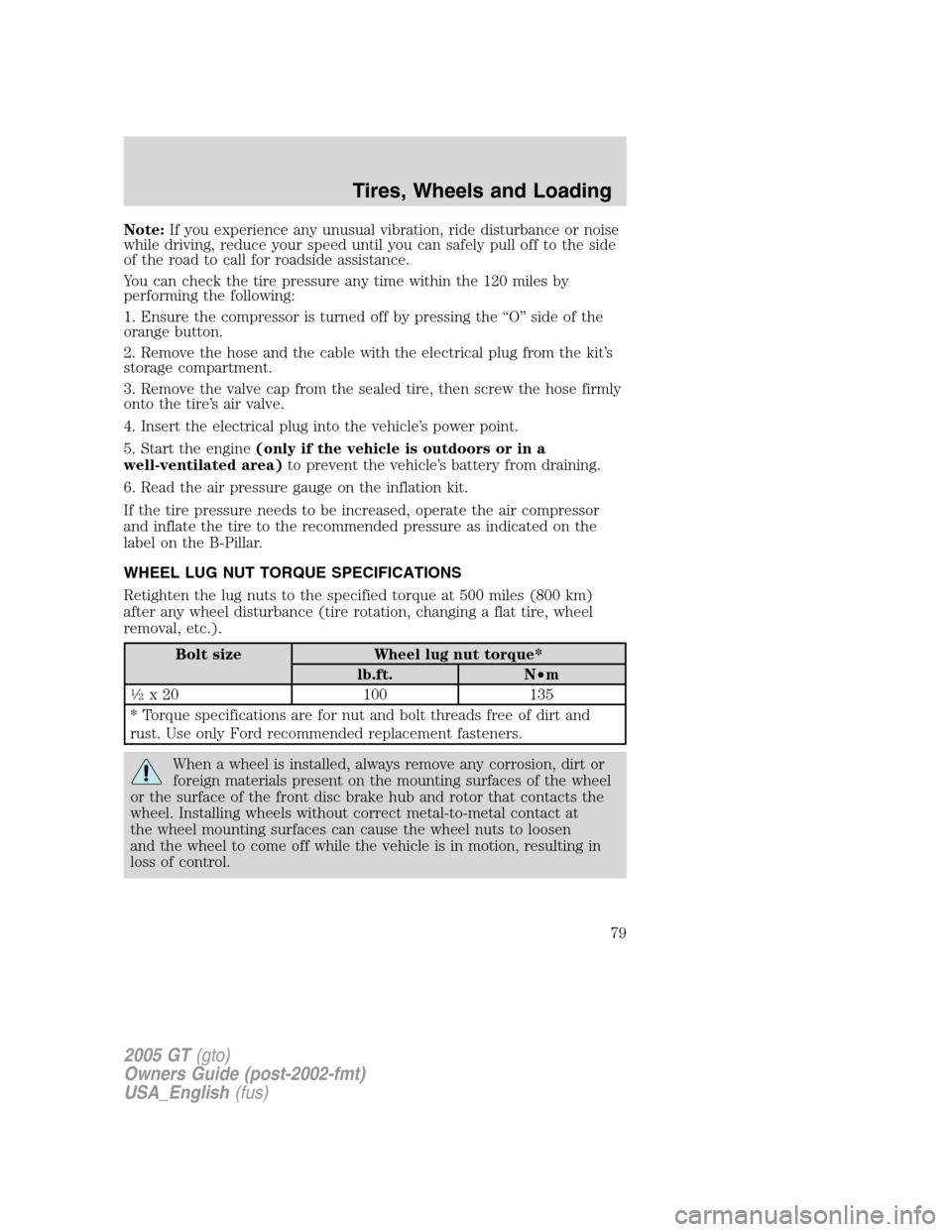
WHEEL LUG NUT TORQUE SPECIFICATIONS
Retighten the lug nuts to the specified torque at 500 miles (800 km)
after any wheel disturbance (tire rotation, changing a flat tire, wheel
removal, etc.).
Bolt size Wheel lug nut torque* lb.ft. N•m
1⁄2x 20 100 135
* Torque specifications are for nut and bolt threads free of dirt and
rust. Use only Ford recommended replacement fasteners.
When a wheel is installed, always remove any corrosion, dirt or
foreign materials present on the mounting surfaces of the wheel
or the surface of the front disc brake hub and rotor that contacts the
wheel. Installing wheels without correct metal-to-metal contact at
the wheel mounting surfaces can cause the wheel nuts to loosen
and the wheel to come off while the vehicle is in motion, resulting in
loss of control.
2005 GT(gto)
Owners Guide (post-2002-fmt)
USA_English (fus)
Tires, Wheels and Loading
79
Page 87 of 200
Wheels
Your Ford GT is equipped with unique wheels matched to the tires.
These wheels are more susceptible to damage due to their diameter,
width and low profile tires. To avoid damage to your wheels:
•Maintain proper tire pressure (see “Tires ”previously listed).
• When installing wheels, always torque lug nuts to specification with a
torque wrench.
• Inspect your wheels for damage on a regular basis. If a wheel is
damaged, replace it immediately.
• In the event that you encounter an abnormally harsh impact, inspect
the outer diameter of your wheels, both inside and out, for damage
Operating a performance vehicle at higher than normal speeds
Your Ford GT is capable of operating at higher than normal speeds and is
equipped with tires rated for the vehicles ’maximum speed. However, it
is important to remember to always drive safely, obey all traffic laws and
only operate your Ford GT at higher than normal speeds at locations and
under conditions where such can be done safely. Also, before operating
your vehicle at higher than normal speeds:
• Maintain your tire pressures according to the tire information and high
speed warning labels located on the B-pillar or the edge of the driver ’s
door.
• Inspect wheels and tires for wear and damage. Replace any damaged
wheels or tires.
Winter driving
The original equipment tires on your Ford GT are designed for maximum
performance in dry and wet conditions. They are not designed for winter
use on ice or snow and cannot be used with snow chains or other tire
mounted traction aids.
Tire and wheel alignment
A bad jolt from hitting a curb or pothole can cause the front end of your
vehicle to become misaligned or cause damage to your tires. If your
vehicle seems to pull to one side when you ’re driving, the wheels may be
out of alignment. Have a qualified technician at a Ford or
Lincoln/Mercury dealer check the wheel alignment periodically.
2005 GT(gto)
Owners Guide (post-2002-fmt)
USA_English (fus)
Tires, Wheels and Loading
87
Page 95 of 200
STARTING
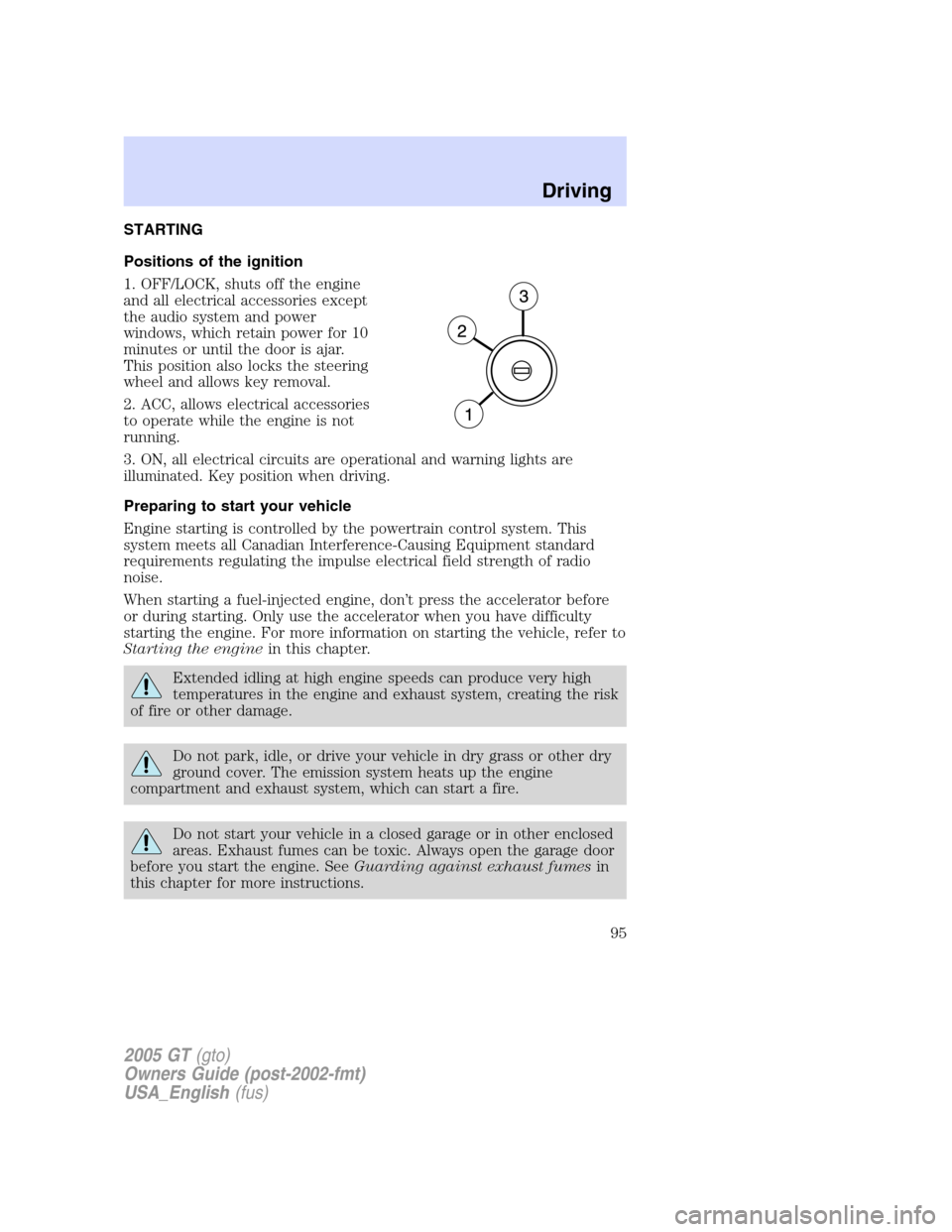
Positions of the ignition
1. OFF/LOCK, shuts off the engine
and all electrical accessories except
the audio system and power
windows, which retain power for 10
minutes or until the door is ajar.
This position also locks the steering
wheel and allows key removal.
2. ACC, allows electrical accessories
to operate while the engine is not
running.
3. ON, all electrical circuits are operational and warning lights are
illuminated. Key position when driving.
Preparing to start your vehicle
Engine starting is controlled by the powertrain control system. This
system meets all Canadian Interference-Causing Equipment standard
requirements regulating the impulse electrical field strength of radio
noise.
When starting a fuel-injected engine, don’t press the accelerator before
or during starting. Only use the accelerator when you have difficulty
starting the engine. For more information on starting the vehicle, refer to
Starting the engine in this chapter.
Extended idling at high engine speeds can produce very high
temperatures in the engine and exhaust system, creating the risk
of fire or other damage.
Do not park, idle, or drive your vehicle in dry grass or other dry
ground cover. The emission system heats up the engine
compartment and exhaust system, which can start a fire.
Do not start your vehicle in a closed garage or in other enclosed
areas. Exhaust fumes can be toxic. Always open the garage door
before you start the engine. See Guarding against exhaust fumes in
this chapter for more instructions.
2005 GT(gto)
Owners Guide (post-2002-fmt)
USA_English (fus)
Driving
Driving
95
Page 96 of 200
If you smell exhaust fumes inside your vehicle, have your dealer
inspect your vehicle immediately. Do not drive if you smell
exhaust fumes.
Important safety precautions
When the engine starts, the idle RPM runs faster to warm the engine. If
the engine idle speed does not slow down automatically, have the vehicle
checked.
Before starting the vehicle:
1. Make sure all occupants buckle their safety belts. For more
information on safety belts and their proper usage, refer to the Seating
and Safety Restraints chapter.
2. Make sure the headlamps and electrical accessories are off.
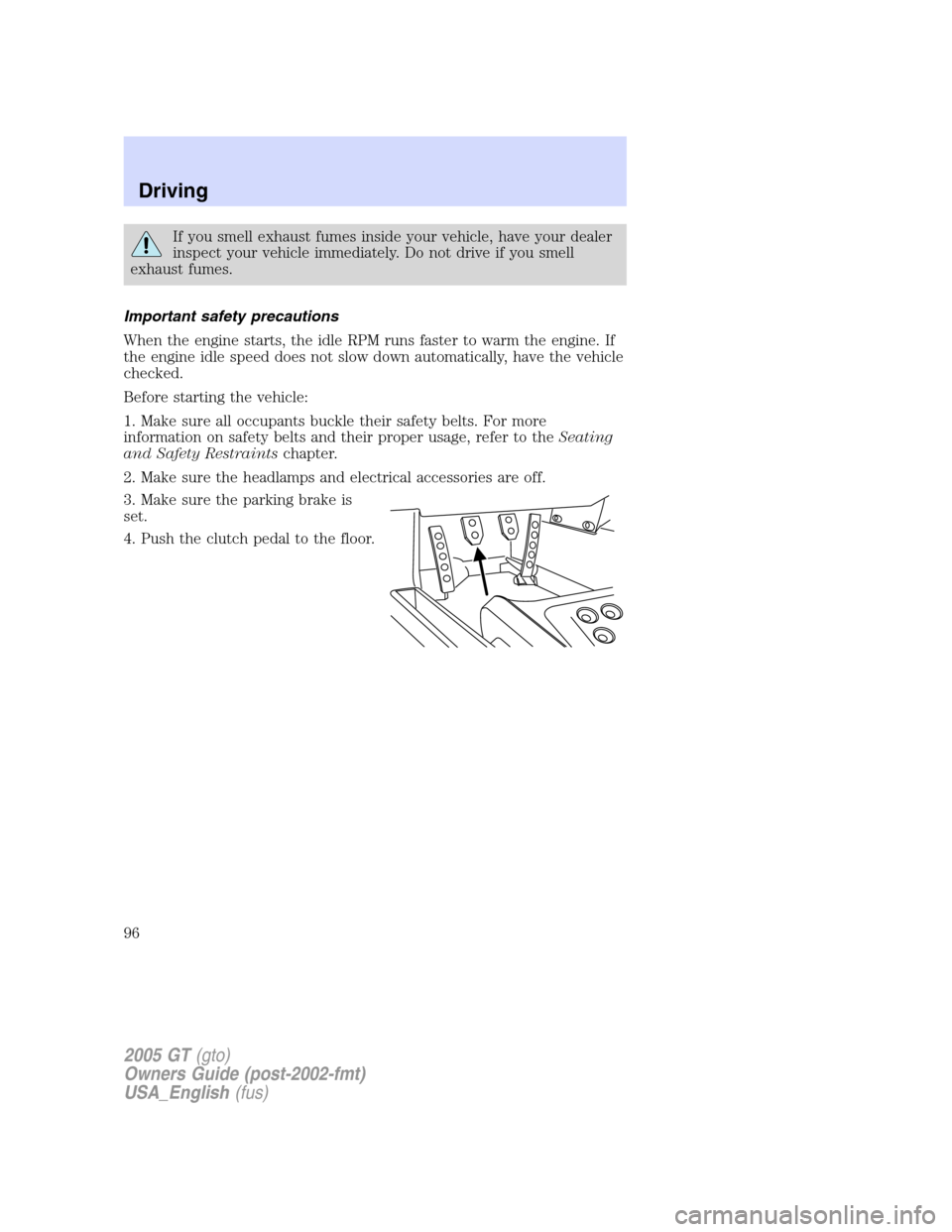
3. Make sure the parking brake is
set.
4. Push the clutch pedal to the floor.
2005 GT(gto)
Owners Guide (post-2002-fmt)
USA_English (fus)
Driving
96
Page 97 of 200
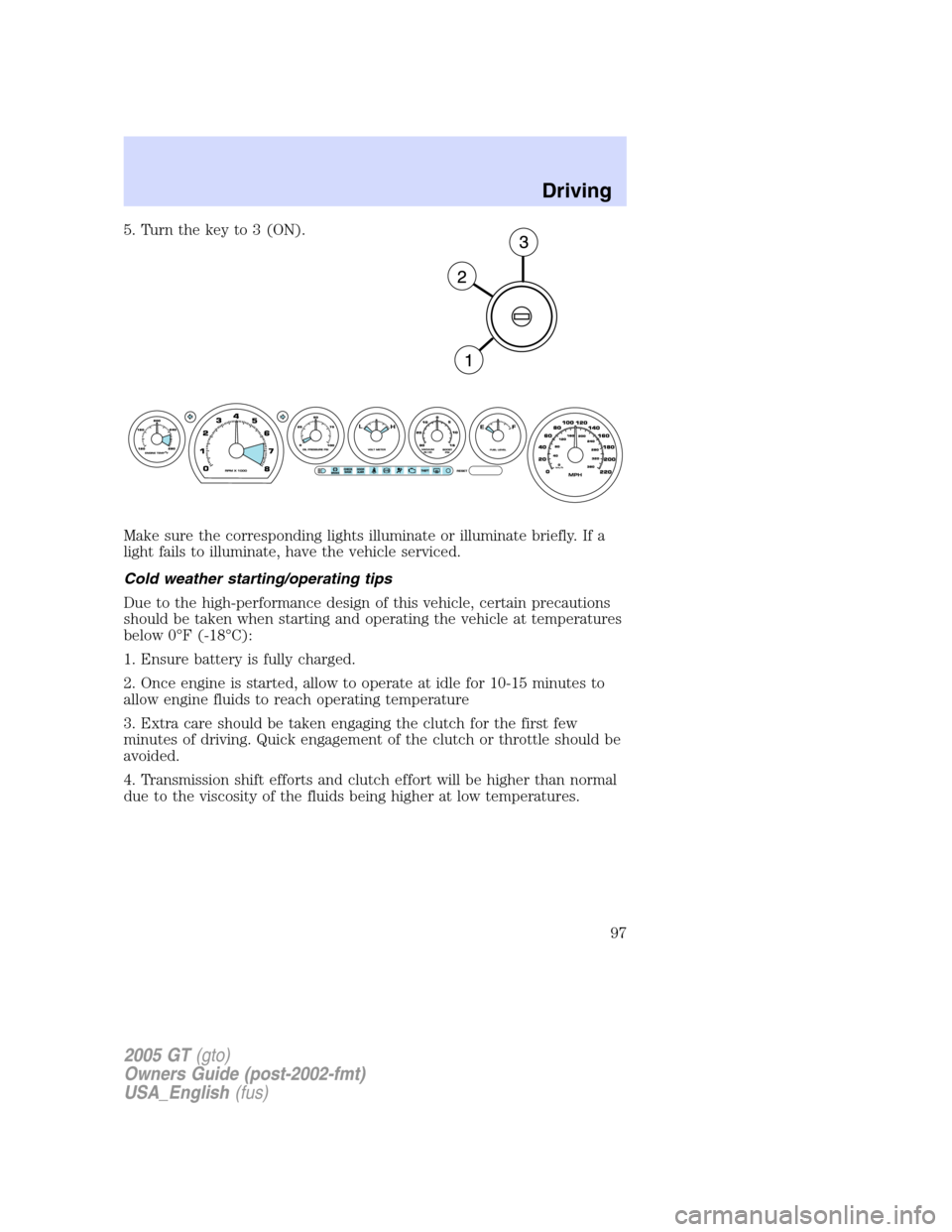
5. Turn the key to 3 (ON).
Make sure the corresponding lights illuminate or illuminate briefly. If a
light fails to illuminate, have the vehicle serviced.
Cold weather starting/operating tips
Due to the high-performance design of this vehicle, certain precautions
should be taken when starting and operating the vehicle at temperatures
below 0°F (-18 °C):
1. Ensure battery is fully charged.
2. Once engine is started, allow to operate at idle for 10-15 minutes to
allow engine fluids to reach operating temperature
3. Extra care should be taken engaging the clutch for the first few
minutes of driving. Quick engagement of the clutch or throttle should be
avoided.
4. Transmission shift efforts and clutch effort will be higher than normal
due to the viscosity of the fluids being higher at low temperatures.
2005 GT(gto)
Owners Guide (post-2002-fmt)
USA_English (fus)
Driving
97
Page 98 of 200
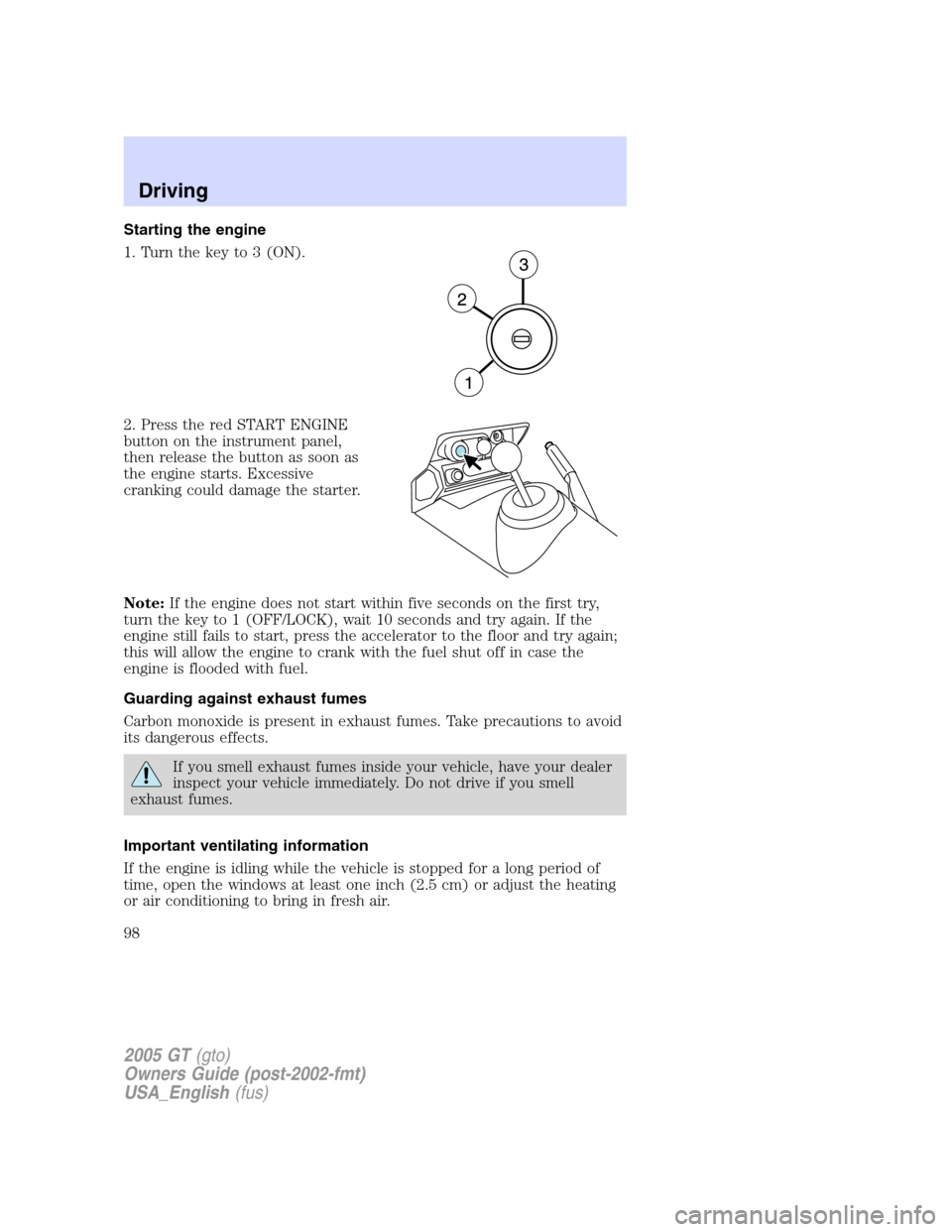
Starting the engine
1. Turn the key to 3 (ON).
2. Press the red START ENGINE
button on the instrument panel,
then release the button as soon as
the engine starts. Excessive
cranking could damage the starter.
Note:If the engine does not start within five seconds on the first try,
turn the key to 1 (OFF/LOCK), wait 10 seconds and try again. If the
engine still fails to start, press the accelerator to the floor and try again;
this will allow the engine to crank with the fuel shut off in case the
engine is flooded with fuel.
Guarding against exhaust fumes
Carbon monoxide is present in exhaust fumes. Take precautions to avoid
its dangerous effects.
If you smell exhaust fumes inside your vehicle, have your dealer
inspect your vehicle immediately. Do not drive if you smell
exhaust fumes.
Important ventilating information
If the engine is idling while the vehicle is stopped for a long period of
time, open the windows at least one inch (2.5 cm) or adjust the heating
or air conditioning to bring in fresh air.
2005 GT(gto)
Owners Guide (post-2002-fmt)
USA_English (fus)
Driving
98