tow FORD GT 2006 1.G User Guide
[x] Cancel search | Manufacturer: FORD, Model Year: 2006, Model line: GT, Model: FORD GT 2006 1.GPages: 200, PDF Size: 1.86 MB
Page 62 of 200
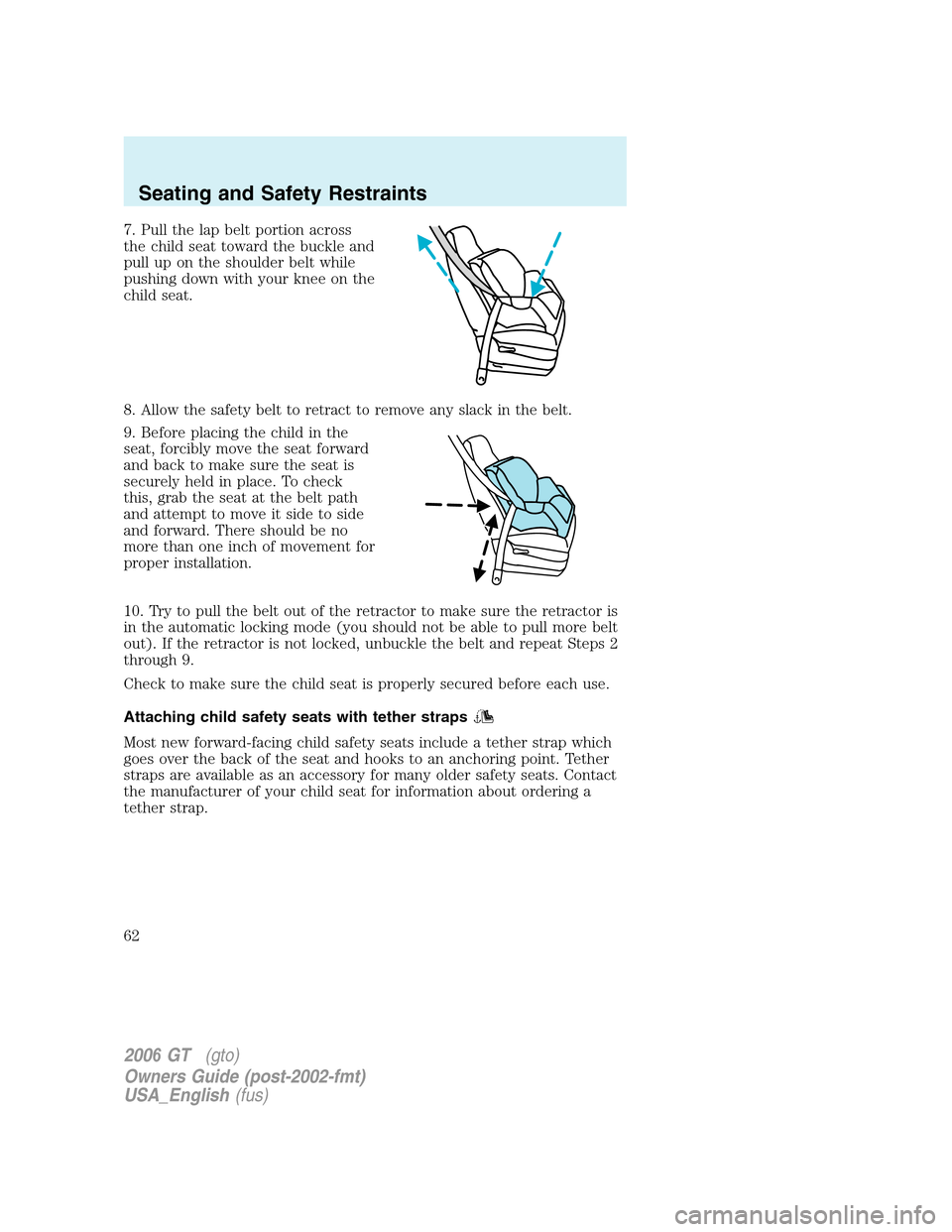
7. Pull the lap belt portion across
the child seat toward the buckle and
pull up on the shoulder belt while
pushing down with your knee on the
child seat.
8. Allow the safety belt to retract to remove any slack in the belt.
9. Before placing the child in the
seat, forcibly move the seat forward
and back to make sure the seat is
securely held in place. To check
this, grab the seat at the belt path
and attempt to move it side to side
and forward. There should be no
more than one inch of movement for
proper installation.
10. Try to pull the belt out of the retractor to make sure the retractor is
in the automatic locking mode (you should not be able to pull more belt
out). If the retractor is not locked, unbuckle the belt and repeat Steps 2
through 9.
Check to make sure the child seat is properly secured before each use.
Attaching child safety seats with tether straps
Most new forward-facing child safety seats include a tether strap which
goes over the back of the seat and hooks to an anchoring point. Tether
straps are available as an accessory for many older safety seats. Contact
the manufacturer of your child seat for information about ordering a
tether strap.
2006GT (gto)
Owners Guide (post-2002-fmt)
USA_English (fus)
Seating and Safety Restraints
62
Page 73 of 200
•Drive carefully and avoid abrupt steering maneuvers.
• Periodically monitor tire inflation pressure in the affected tire; if the
tire is losing pressure, have the vehicle towed.
• Read the information in the Tips for use of the tire inflation kit
section to ensure safe operation of the tire inflation kit and your
vehicle.
Tips for use of the tire inflation kit
Read the following list of tips to ensure safe operation of the tire
inflation kit:
• Before operating the inflation kit, make sure your vehicle is safely off
the road and away from moving traffic.
• Always set the parking brake to ensure the vehicle doesn’t move
unexpectedly.
• Do not remove any foreign objects, such as nails or screws, from the
tire.
• When using the inflation kit, leave the engine running (only if the
vehicle is outdoors or in a well-ventilated area) so the
compressor doesn’t drain the vehicle’s battery.
• Do not allow the compressor to operate continuously for more than 10
minutes; this will help prevent the compressor from overheating.
• Never leave the inflation kit unattended when it is operating.
• Keep the inflation kit away from children.
• Only use the inflation kit when the ambient temperature is above
–20°F.
• Only use the inflation kit for sealing/inflating the tires on your vehicle.
Do not use the kit for inflating tires on motorcycles, bicycles or any
other type of tire.
• Only use the sealing compound before the expiration date. The
expiration date is labeled on the unit.
• Do not store the inflation kit inside the passenger compartment of the
vehicle as it may cause injury during a sudden stop or collision. Store
the kit in its proper location.
2006GT (gto)
Owners Guide (post-2002-fmt)
USA_English (fus)
Tires, Wheels and Loading
73
Page 76 of 200
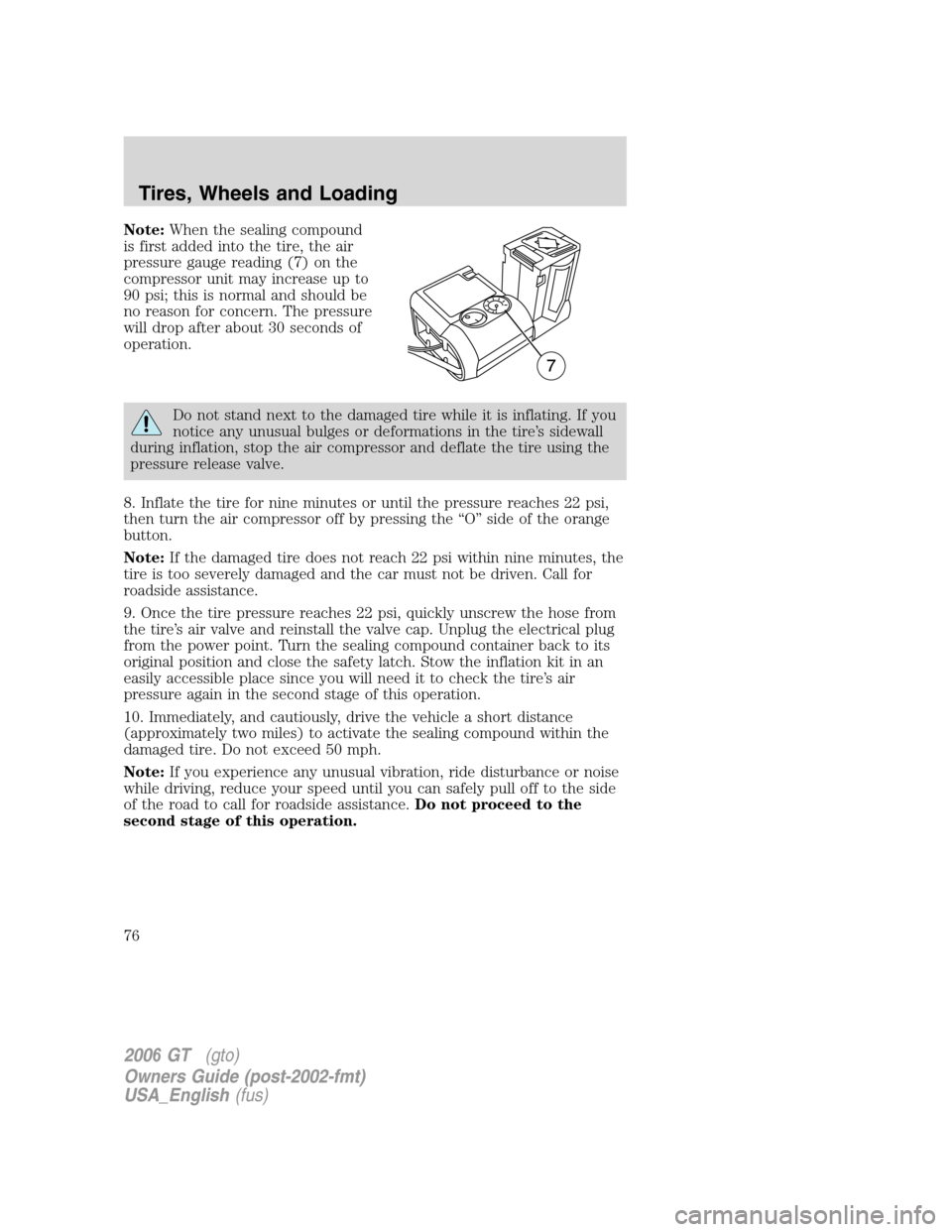
Note:When the sealing compound
is first added into the tire, the air
pressure gauge reading (7) on the
compressor unit may increase up to
90 psi; this is normal and should be
no reason for concern. The pressure
will drop after about 30 seconds of
operation.
Do not stand next to the damaged tire while it is inflating. If you
notice any unusual bulges or deformations in the tire’s sidewall
during inflation, stop the air compressor and deflate the tire using the
pressure release valve.
8. Inflate the tire for nine minutes or until the pressure reaches 22 psi,
then turn the air compressor off by pressing the “O” side of the orange
button.
Note: If the damaged tire does not reach 22 psi within nine minutes, the
tire is too severely damaged and the car must not be driven. Call for
roadside assistance.
9. Once the tire pressure reaches 22 psi, quickly unscrew the hose from
the tire’s air valve and reinstall the valve cap. Unplug the electrical plug
from the power point. Turn the sealing compound container back to its
original position and close the safety latch. Stow the inflation kit in an
easily accessible place since you will need it to check the tire’s air
pressure again in the second stage of this operation.
10. Immediately, and cautiously, drive the vehicle a short distance
(approximately two miles) to activate the sealing compound within the
damaged tire. Do not exceed 50 mph.
Note: If you experience any unusual vibration, ride disturbance or noise
while driving, reduce your speed until you can safely pull off to the side
of the road to call for roadside assistance. Do not proceed to the
second stage of this operation.
2006 GT (gto)
Owners Guide (post-2002-fmt)
USA_English (fus)
Tires, Wheels and Loading
76
Page 78 of 200
Note:Before driving any further, adjust the tire pressure to the
recommended pressure.
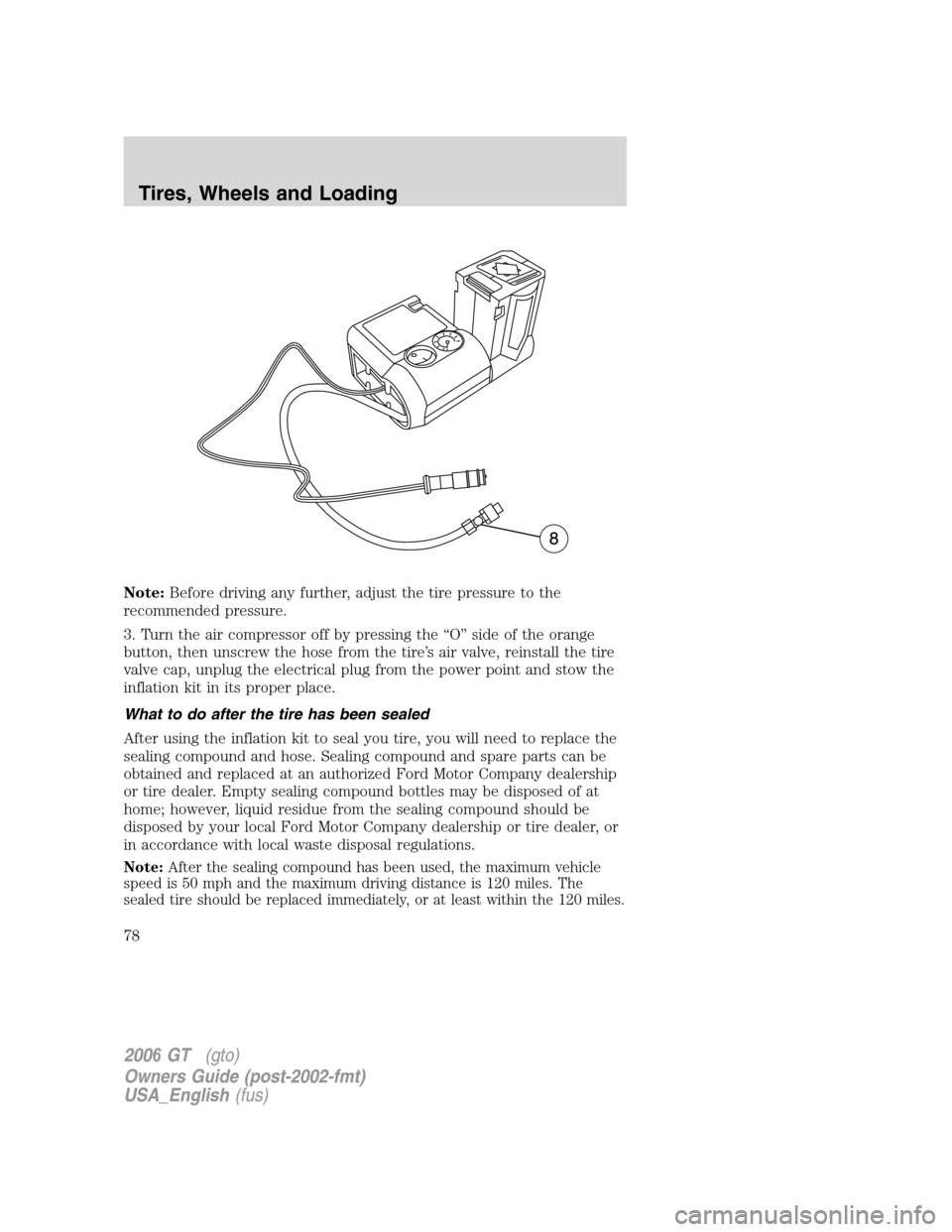
3. Turn the air compressor off by pressing the “O” side of the orange
button, then unscrew the hose from the tire’s air valve, reinstall the tire
valve cap, unplug the electrical plug from the power point and stow the
inflation kit in its proper place.
What to do after the tire has been sealed
After using the inflation kit to seal you tire, you will need to replace the
sealing compound and hose. Sealing compound and spare parts can be
obtained and replaced at an authorized Ford Motor Company dealership
or tire dealer. Empty sealing compound bottles may be disposed of at
home; however, liquid residue from the sealing compound should be
disposed by your local Ford Motor Company dealership or tire dealer, or
in accordance with local waste disposal regulations.
Note: After the sealing compound has been used, the maximum vehicle
speed is 50 mph and the maximum driving distance is 120 miles. The
sealed tire should be replaced immediately, or at least within the 120 miles.
2006 GT (gto)
Owners Guide (post-2002-fmt)
USA_English (fus)
Tires, Wheels and Loading
78
Page 89 of 200
SNOW TIRES
The original equipment tires on your Ford GT are designed for maximum
performance in dry and wet conditions. They are not designed for winter
use on ice or snow and cannot be used with snow chains or other tire
mounted traction aid devices.
TRAILER TOWING
Your vehicle is not equipped to tow. No towing packages are available
through Ford or Lincoln/Mercury dealers.
VEHICLE LOADING
This section will guide you in the proper loading of your vehicle and/or
trailer, to keep your loaded vehicle weight within its design rating
capability. Properly loading your vehicle will provide maximum return of
vehicle design performance. Before loading your vehicle, familiarize
yourself with the following terms for determining your vehicle’s weight
ratings from the vehicle’s Safety Certification Label and Tire Label:
Base Curb Weight– is the weight of the vehicle including a full tank of
fuel and all standard equipment. It does not include passengers, cargo, or
optional equipment.
Vehicle Curb Weight – is the weight of your new vehicle when you
picked it up from your dealer plus any aftermarket equipment.
2006 GT (gto)
Owners Guide (post-2002-fmt)
USA_English (fus)
Tires, Wheels and Loading
89
Page 93 of 200
Exceeding the Safety Certification Label vehicle weight rating
limits could result in substandard vehicle handling or
performance, engine, transmission and/or structural damage, serious
damage to the vehicle, loss of control and personal injury.
Do not exceed the GVWR or the GAWR specified on the
certification label.
Do not use replacement tires with lower load carrying capacities
than the originals because they may lower the vehicle’s GVWR
and GAWR limitations. Replacement tires with a higher limit than the
originals do not increase the GVWR and GAWR limitations.
Exceeding any vehicle weight rating limitation could result in
serious damage to the vehicle and/or personal injury.
Steps for determining the correct load limit:
1. Locate the statement “The combined weight of occupants and cargo
should never exceed XXX pounds” on your vehicle’s placard.
2. Determine the combined weight of the driver and passengers that will
be riding in your vehicle.
3. Subtract the combined weight of the driver and passengers from XXX
kilograms or XXX pounds.
4. The resulting figure equals the available amount of cargo and luggage
load capacity. For example, if the “XXX” amount equals 1,400 lb. and
there will be five 150 lb. passengers in your vehicle, the amount of
available cargo and luggage load capacity is 650 lb. (1400–750 (5 x 150)
= 650 lb.).
5. Determine the combined weight of luggage and cargo being loaded on
the vehicle. That weight may not safely exceed the available cargo and
luggage load capacity calculated in Step 4.
6. If your vehicle will be towing a trailer, load from your trailer will be
transferred to your vehicle. Consult this manual to determine how this
reduces the available cargo and luggage load capacity of your vehicle.
2006 GT (gto)
Owners Guide (post-2002-fmt)
USA_English (fus)
Tires, Wheels and Loading
93
Page 94 of 200
The following gives you a few examples on how to calculate the available
amount of cargo and luggage load capacity:
•An example for your vehicle with 1400 lb. (636 kg) of cargo and
luggage capacity. You decide to go golfing. You and your friends
average 220 lb. (100 kg) each and the golf bags weigh approximately
30 lb. (14 kg) each. Is there enough load capacity to carry you, 4 of
your friends and all the golf bags? The calculation would be: 1400 – (5
x 220) – (5 x 30) = 1400 – 1100 – 150 = 150 lb. Metric conversion;
636 kg – (5 x 100) – (5 x 14) = 636 – 570 = 66 kg. Yes, you have
enough load capacity in your vehicle to transport 4 of your friends and
golf bags.
• Another example for your vehicle with 1400 lb. (636 kg) of cargo and
luggage capacity. You and one of your friends decide to pick up
cement from the local home improvement store to finish that patio
you have been planning for the past 2 years. Measuring the inside of
the vehicle with the rear seat folded down, you have room for 12-100
lb. (45 kg) bags of cement. Do you have enough load capacity to
transport the cement to your home? If you and your friend each
weighed 220 lb. (100 kg), the calculation would be: 1400 – (2 x 220) –
(12 x 100) = 1400 – 440 – 1200 = – 240 lb. Metric conversion; 636 kg
– (2 x 100) – (12 x 45) = 636 – 200 – 540 = –104 kg. No, you do not
have enough cargo capacity to carry that much weight. You will need
to reduce the load weight by at least 240 lb. (104 kg). If you remove
3-100 lb. (45 kg) cement bags, then the load calculation would be:
1400 – (2 x 220) – (9 x 100) = 1400 – 440 – 900 = 60 lb. Metric
conversion; 636 kg – (2 x 100) – (9 x 45) = 636 – 200 – 405 = 31 kg.
Now you have the load capacity to transport the cement and your friend
home.
The above calculations also assume that the loads are positioned in your
vehicle in a manner that does not overload the Front or the Rear Gross
Axle Weight Rating specified for your vehicle on the Certification label
found on the driver’s door.
TRAILER TOWING
Your vehicle is not equipped to tow. No towing packages are available
through Ford or Lincoln/Mercury dealers.
RECREATIONAL TOWING (ALL WHEELS ON THE GROUND)
Recreational towing is not approved for this vehicle.
2006 GT (gto)
Owners Guide (post-2002-fmt)
USA_English (fus)
Tires, Wheels and Loading
94
Page 105 of 200
GETTING ROADSIDE ASSISTANCE
To fully assist you should you have a vehicle concern, Ford Motor
Company offers a complimentary roadside assistance program. This
program is separate from the New Vehicle Limited Warranty. The service
is available:
•24–hours, seven days a week
• for the New Vehicle Limited Warranty period of three years or 36,000
miles (60,000 km), whichever occurs first on Ford and Mercury
vehicles, and four years or 50,000 miles (80,000 km) on Lincoln
vehicles.
Roadside assistance will cover:
• a flat tire change with a good spare (except Ford GT which has a tire
inflation kit)
• battery jump start
• lock-out assistance (key replacement cost is the customer’s
responsibility)
• fuel delivery (2.0 gallons [7.5L], maximum two occurrences within 12
month period)
• towing of your disabled vehicle to the nearest Ford Motor Company
dealership, or your selling dealer if within 35 miles (56.3 km) of the
nearest Ford Motor Company dealership (one tow per disablement).
Even non-warranty related tows, like accidents, are covered (some
exclusions apply, such as impound towing or repossession).
Canadian customers refer to your Owner Information Guide for
information on:
• coverage period
• exact fuel amounts
• towing of your disabled vehicle
• emergency travel expense reimbursement
• travel planning benefits
USING ROADSIDE ASSISTANCE
Complete the roadside assistance identification card and place it in your
wallet for quick reference. In the United States, this card is found in the
Owner Guide portfolio in the glove compartment. In Canada, the card is
found in the Owner Information Guide in the glove compartment.
U.S. Ford or Mercury vehicle customers who require roadside assistance,
call 1–800–241–3673; Lincoln vehicle customers call 1–800–521–4140.
2006 GT (gto)
Owners Guide (post-2002-fmt)
USA_English (fus)
Roadside Emergencies
Roadside Emergencies
105
Page 106 of 200
Canadian customers who require roadside assistance, call
1–800–665–2006.
If you need to arrange roadside assistance for yourself, Ford Motor
Company will reimburse a reasonable amount. To obtain reimbursement
information, U.S. Ford or Mercury vehicles customers call
1-800-241-3673; Lincoln vehicle customers call 1–800–521–4140.
Canadian customers who need to obtain reimbursement information, call
1–800–665–2006.
ROADSIDE COVERAGE BEYOND BASIC WARRANTY
In the United States, you may purchase additional roadside assistance
coverage beyond this period through the Ford Auto Club by contacting
your Ford or Lincoln/Mercury dealer.
Similarly in Canada, for uninterrupted Roadside Assistance coverage, you
may purchase extended coverage prior to your Basic Warranty’s Roadside
Assistance expiring. For more information and enrollment, contact
1–877–294–2582 or visit our website at www.ford.ca.
HAZARD FLASHER
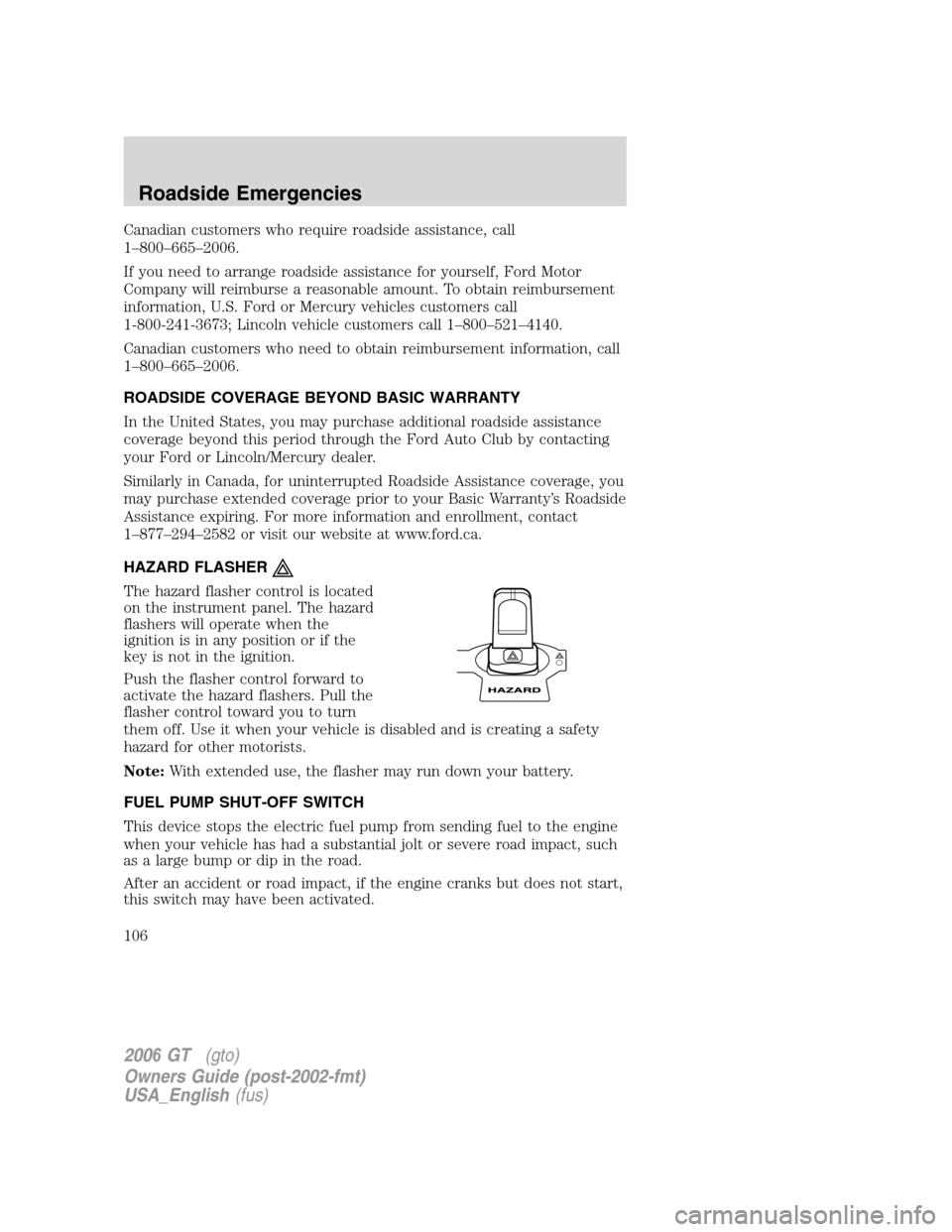
The hazard flasher control is located
on the instrument panel. The hazard
flashers will operate when the
ignition is in any position or if the
key is not in the ignition.
Push the flasher control forward to
activate the hazard flashers. Pull the
flasher control toward you to turn
them off. Use it when your vehicle is disabled and is creating a safety
hazard for other motorists.
Note:With extended use, the flasher may run down your battery.
FUEL PUMP SHUT-OFF SWITCH
This device stops the electric fuel pump from sending fuel to the engine
when your vehicle has had a substantial jolt or severe road impact, such
as a large bump or dip in the road.
After an accident or road impact, if the engine cranks but does not start,
this switch may have been activated.
2006 GT (gto)
Owners Guide (post-2002-fmt)
USA_English (fus)
Roadside Emergencies
106
Page 120 of 200
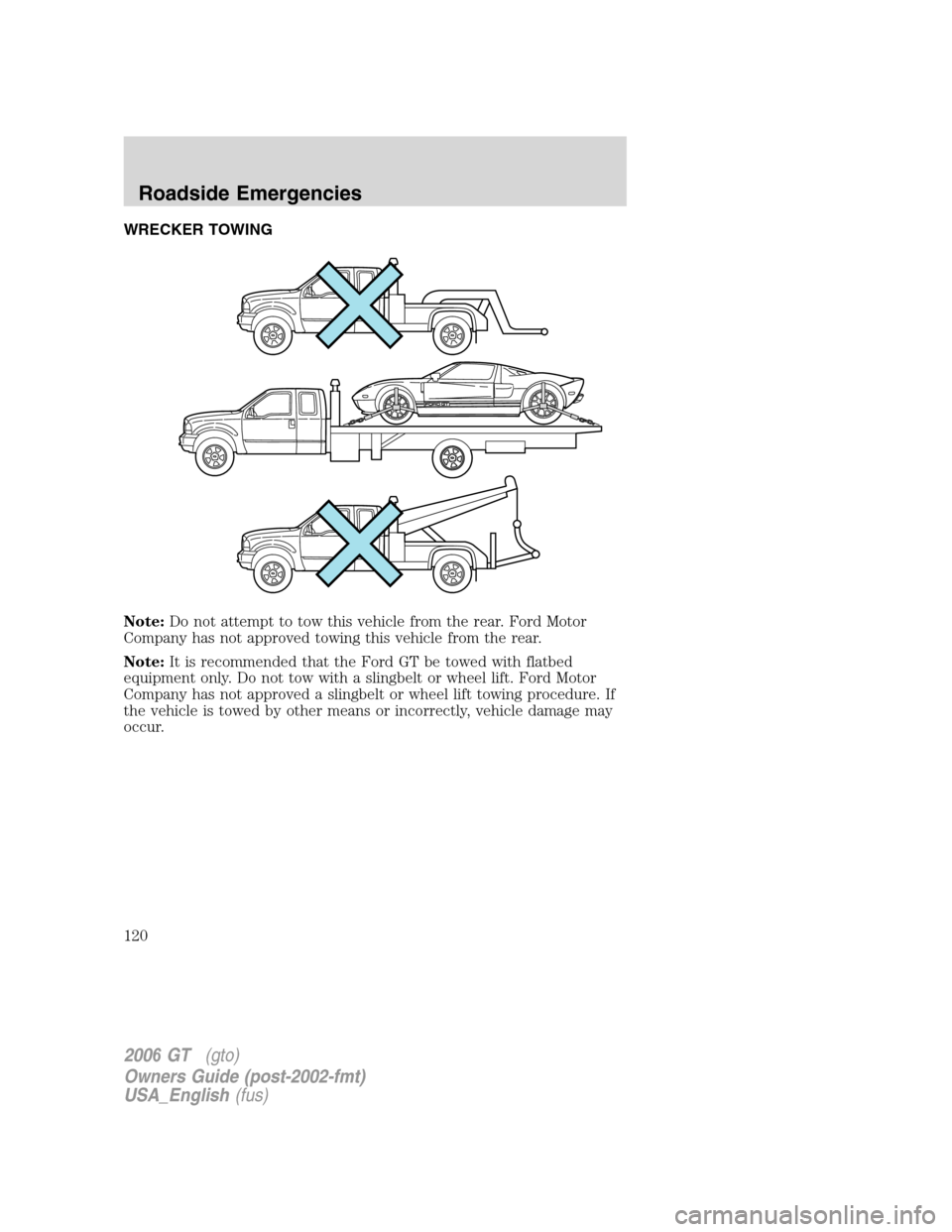
WRECKER TOWING
Note:Do not attempt to tow this vehicle from the rear. Ford Motor
Company has not approved towing this vehicle from the rear.
Note: It is recommended that the Ford GT be towed with flatbed
equipment only. Do not tow with a slingbelt or wheel lift. Ford Motor
Company has not approved a slingbelt or wheel lift towing procedure. If
the vehicle is towed by other means or incorrectly, vehicle damage may
occur.
2006 GT (gto)
Owners Guide (post-2002-fmt)
USA_English (fus)
Roadside Emergencies
120