ignition FORD GT 2006 1.G Owner's Manual
[x] Cancel search | Manufacturer: FORD, Model Year: 2006, Model line: GT, Model: FORD GT 2006 1.GPages: 200, PDF Size: 1.86 MB
Page 99 of 200
BRAKES
Occasional brake noise is normal. If a metal-to-metal, continuous grinding
or continuous squeal sound is present, the brake linings may be worn-out
and should be inspected by a qualified service technician. If the vehicle
has continuous vibration or shudder in the steering wheel while braking,
the vehicle should be inspected by a qualified service technician.
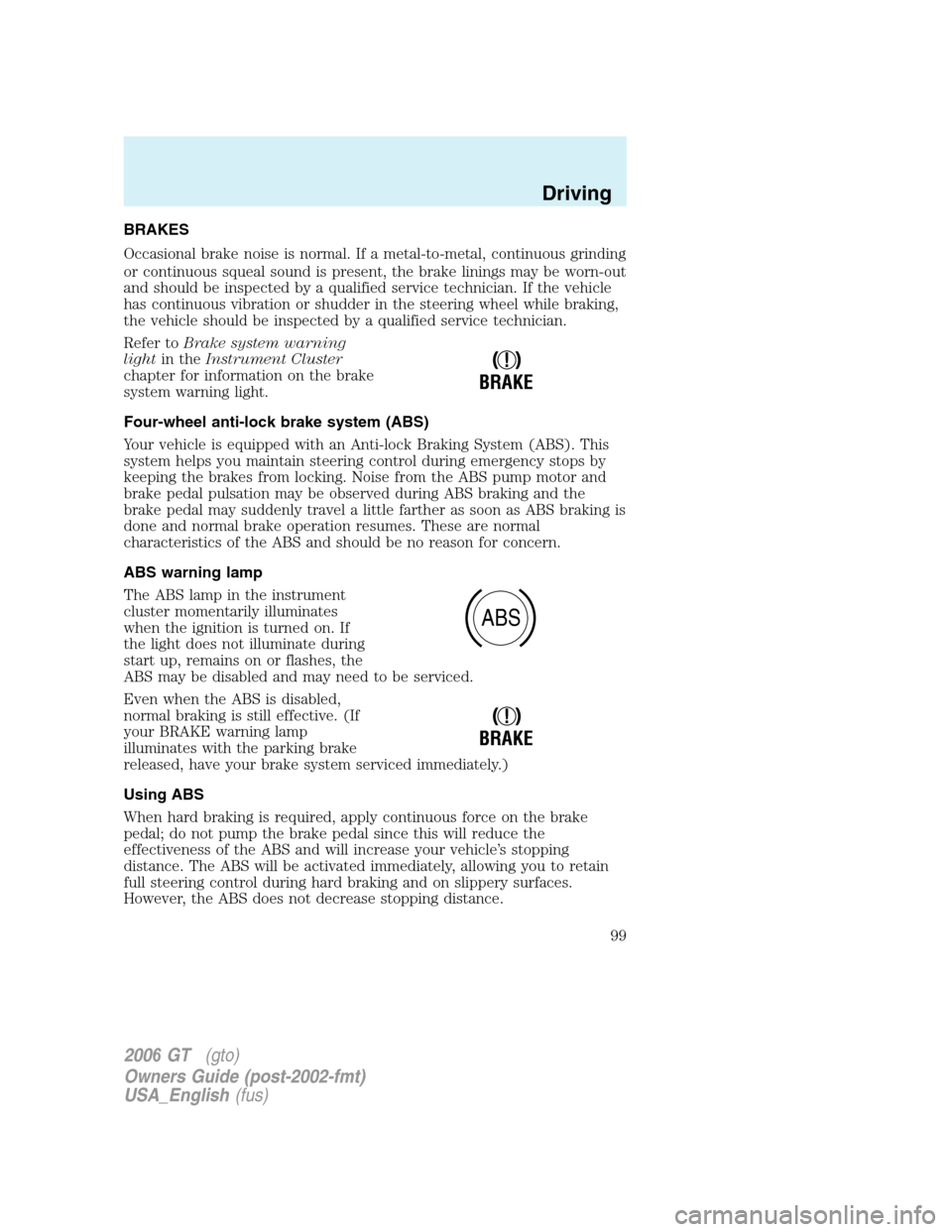
Refer toBrake system warning
light in the Instrument Cluster
chapter for information on the brake
system warning light.
Four-wheel anti-lock brake system (ABS)
Your vehicle is equipped with an Anti-lock Braking System (ABS). This
system helps you maintain steering control during emergency stops by
keeping the brakes from locking. Noise from the ABS pump motor and
brake pedal pulsation may be observed during ABS braking and the
brake pedal may suddenly travel a little farther as soon as ABS braking is
done and normal brake operation resumes. These are normal
characteristics of the ABS and should be no reason for concern.
ABS warning lamp
The ABS lamp in the instrument
cluster momentarily illuminates
when the ignition is turned on. If
the light does not illuminate during
start up, remains on or flashes, the
ABS may be disabled and may need to be serviced.
Even when the ABS is disabled,
normal braking is still effective. (If
your BRAKE warning lamp
illuminates with the parking brake
released, have your brake system serviced immediately.)
Using ABS
When hard braking is required, apply continuous force on the brake
pedal; do not pump the brake pedal since this will reduce the
effectiveness of the ABS and will increase your vehicle’s stopping
distance. The ABS will be activated immediately, allowing you to retain
full steering control during hard braking and on slippery surfaces.
However, the ABS does not decrease stopping distance.
!
BRAKE
ABS
!
BRAKE
2006 GT (gto)
Owners Guide (post-2002-fmt)
USA_English (fus)
Driving
99
Page 103 of 200
Upshift according to the following chart:
Upshifts when accelerating (recommended for best fueleconomy)
Shift from:
1 - 2 15 mph (24 km/h)
2 - 3 25 mph (40 km/h)
3 - 4 40 mph (64 km/h)
4 - 5 45 mph (72 km/h)
5 - 6 50 mph (80 km/h)
Reverse
1. Make sure that your vehicle is at a complete stop before you shift into
R (Reverse). Failure to do so may damage the transmission.
2. Move the gearshift lever into the neutral position and wait at least
three seconds before shifting into R (Reverse).
3. Shift into R (Reverse) by pulling the gearshift lever fully to the left
through the detent, then forward. The detent force is high to prevent
inadvertently shifting into R (Reverse).
Parking your vehicle
1. Apply the brake and shift into the neutral position.
2. Fully apply the parking brake, then shift into 1 (First).
3. Turn the ignition off.
Do not park your vehicle in Neutral, it may move unexpectedly
and injure someone. Use 1 (First) gear and set the parking brake
fully.
DRIVING THROUGH WATER
Do not drive quickly through standing water, especially if the depth is
unknown. Traction or brake capability may be limited and if the ignition
system gets wet, your engine may stall. Water may also enter your
engine’s air intake and severely damage your engine.
If driving through deep or standing water is unavoidable, proceed very
slowly. Never drive through water that is higher than the bottom of the
hubs (for trucks) or the bottom of the wheel rims (for cars).
2006 GT (gto)
Owners Guide (post-2002-fmt)
USA_English (fus)
Driving
103
Page 106 of 200
Canadian customers who require roadside assistance, call
1–800–665–2006.
If you need to arrange roadside assistance for yourself, Ford Motor
Company will reimburse a reasonable amount. To obtain reimbursement
information, U.S. Ford or Mercury vehicles customers call
1-800-241-3673; Lincoln vehicle customers call 1–800–521–4140.
Canadian customers who need to obtain reimbursement information, call
1–800–665–2006.
ROADSIDE COVERAGE BEYOND BASIC WARRANTY
In the United States, you may purchase additional roadside assistance
coverage beyond this period through the Ford Auto Club by contacting
your Ford or Lincoln/Mercury dealer.
Similarly in Canada, for uninterrupted Roadside Assistance coverage, you
may purchase extended coverage prior to your Basic Warranty’s Roadside
Assistance expiring. For more information and enrollment, contact
1–877–294–2582 or visit our website at www.ford.ca.
HAZARD FLASHER
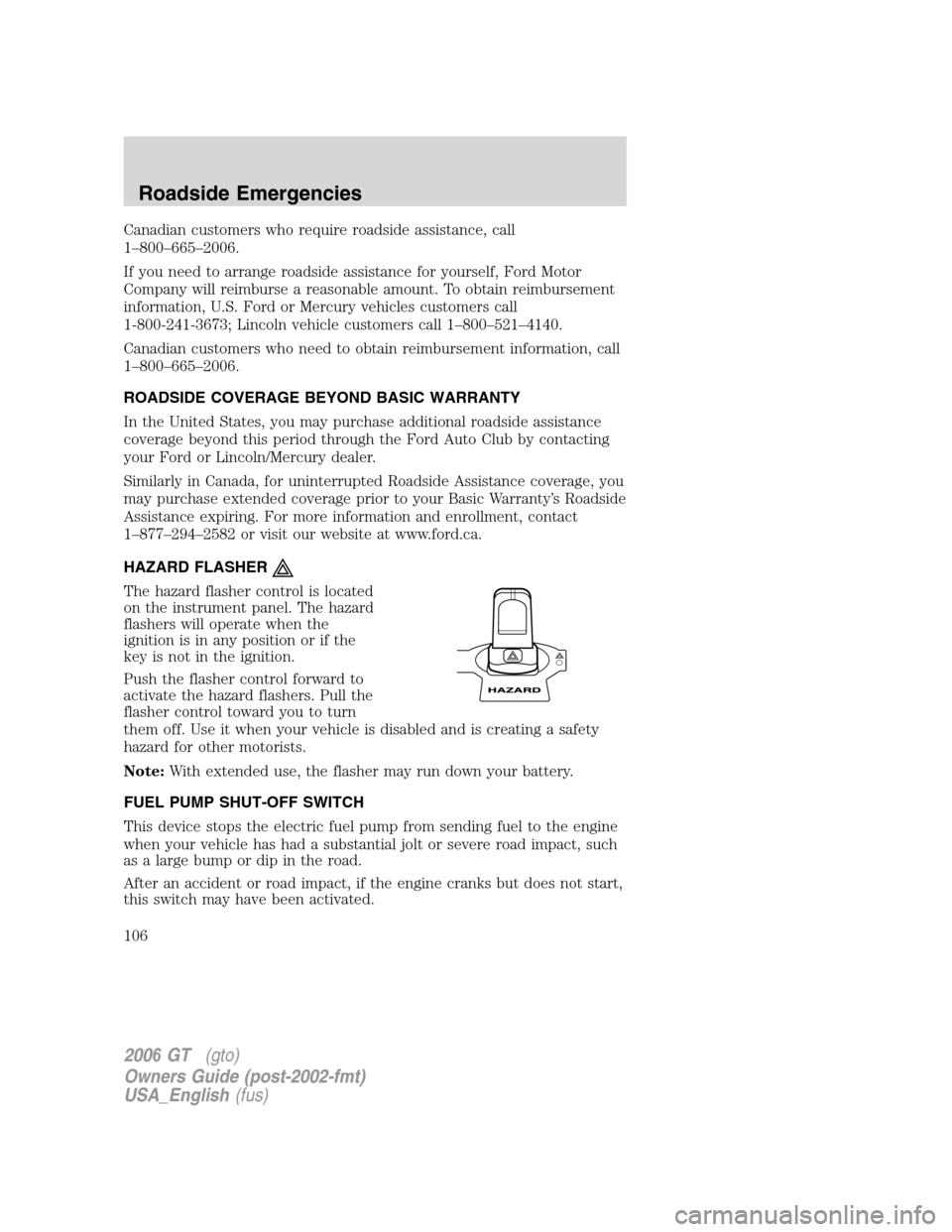
The hazard flasher control is located
on the instrument panel. The hazard
flashers will operate when the
ignition is in any position or if the
key is not in the ignition.
Push the flasher control forward to
activate the hazard flashers. Pull the
flasher control toward you to turn
them off. Use it when your vehicle is disabled and is creating a safety
hazard for other motorists.
Note:With extended use, the flasher may run down your battery.
FUEL PUMP SHUT-OFF SWITCH
This device stops the electric fuel pump from sending fuel to the engine
when your vehicle has had a substantial jolt or severe road impact, such
as a large bump or dip in the road.
After an accident or road impact, if the engine cranks but does not start,
this switch may have been activated.
2006 GT (gto)
Owners Guide (post-2002-fmt)
USA_English (fus)
Roadside Emergencies
106
Page 107 of 200
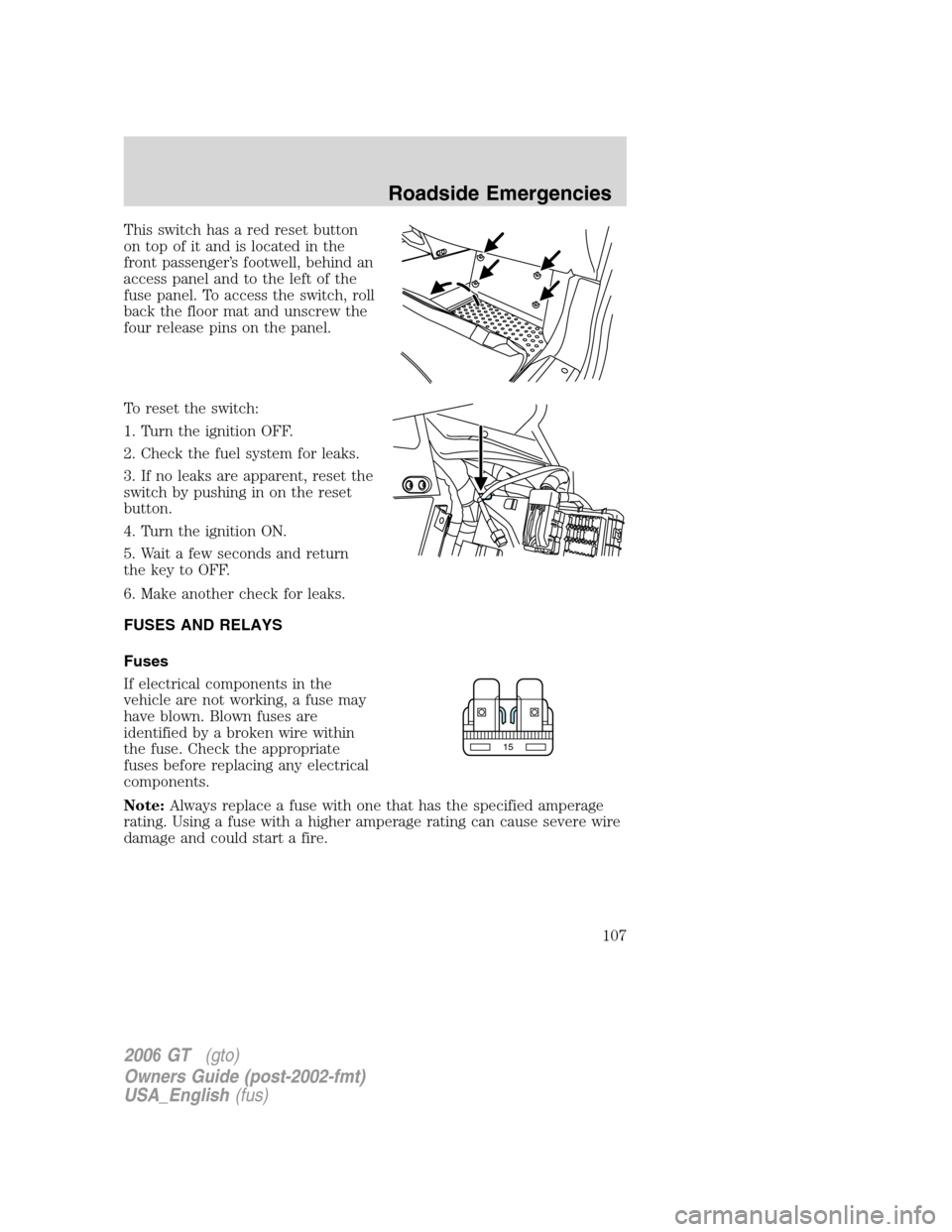
This switch has a red reset button
on top of it and is located in the
front passenger’s footwell, behind an
access panel and to the left of the
fuse panel. To access the switch, roll
back the floor mat and unscrew the
four release pins on the panel.
To reset the switch:
1. Turn the ignition OFF.
2. Check the fuel system for leaks.
3. If no leaks are apparent, reset the
switch by pushing in on the reset
button.
4. Turn the ignition ON.
5. Wait a few seconds and return
the key to OFF.
6. Make another check for leaks.
FUSES AND RELAYS
Fuses
If electrical components in the
vehicle are not working, a fuse may
have blown. Blown fuses are
identified by a broken wire within
the fuse. Check the appropriate
fuses before replacing any electrical
components.
Note:Always replace a fuse with one that has the specified amperage
rating. Using a fuse with a higher amperage rating can cause severe wire
damage and could start a fire.
15
2006 GT (gto)
Owners Guide (post-2002-fmt)
USA_English (fus)
Roadside Emergencies
107
Page 109 of 200
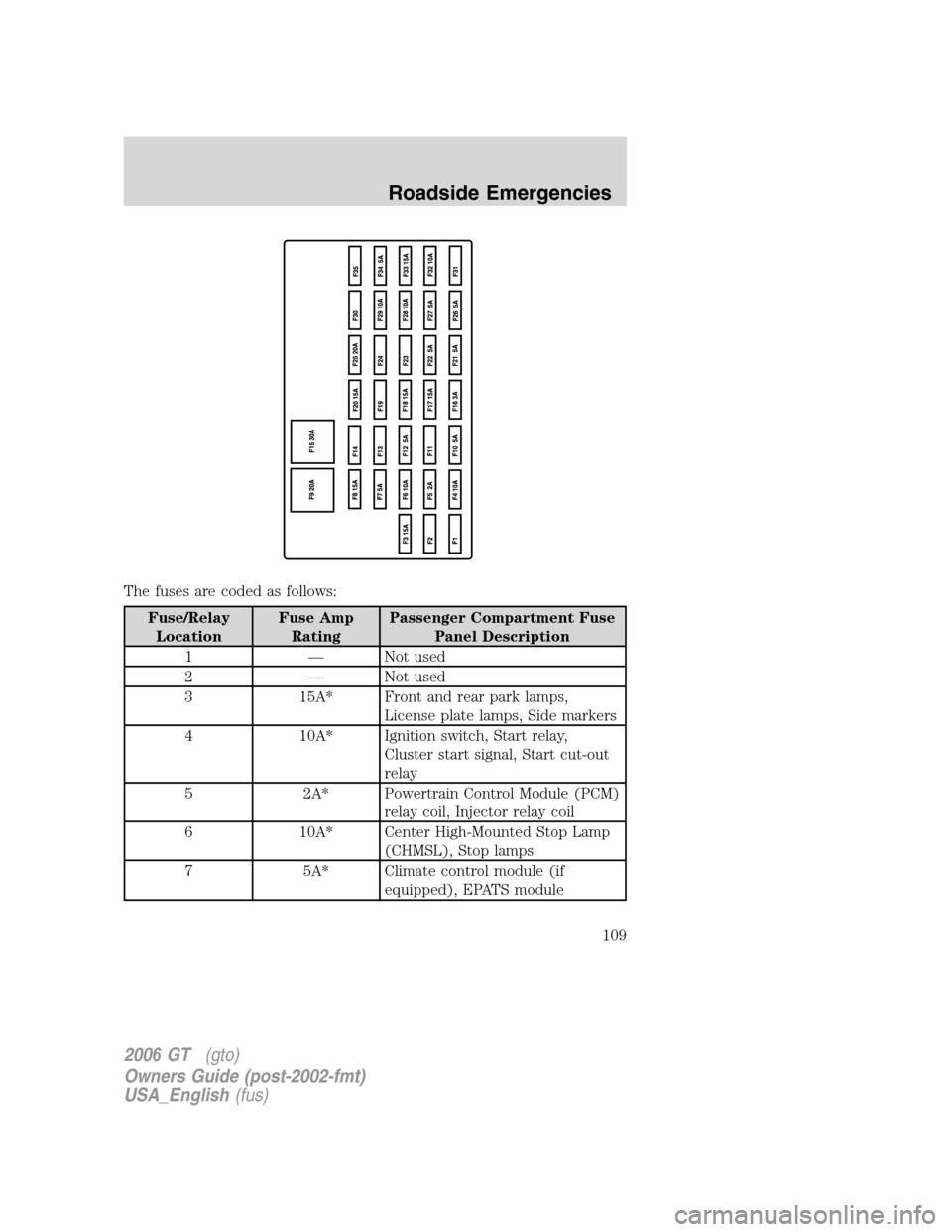
The fuses are coded as follows:
Fuse/RelayLocation Fuse Amp
Rating Passenger Compartment Fuse
Panel Description
1 — Not used
2 — Not used
3 15A* Front and rear park lamps, License plate lamps, Side markers
4 10A* Ignition switch, Start relay, Cluster start signal, Start cut-out
relay
5 2A* Powertrain Control Module (PCM) relay coil, Injector relay coil
6 10A* Center High-Mounted Stop Lamp (CHMSL), Stop lamps
7 5A* Climate control module (if equipped), EPATS module
2006GT (gto)
Owners Guide (post-2002-fmt)
USA_English (fus)
Roadside Emergencies
109
Page 112 of 200
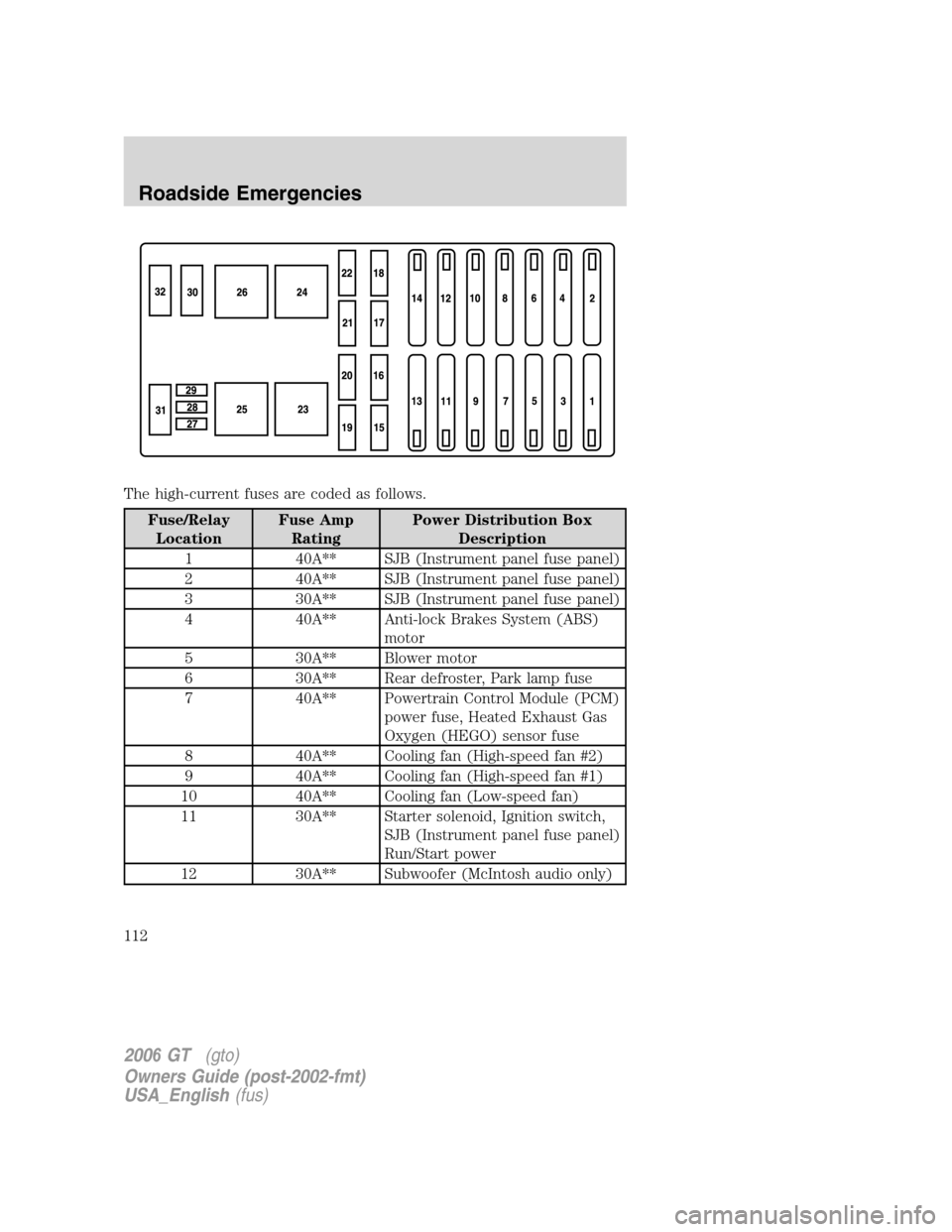
The high-current fuses are coded as follows.
Fuse/RelayLocation Fuse Amp
Rating Power Distribution Box
Description
1 40A** SJB (Instrument panel fuse panel)
2 40A** SJB (Instrument panel fuse panel)
3 30A** SJB (Instrument panel fuse panel)
4 40A** Anti-lock Brakes System (ABS) motor
5 30A** Blower motor
6 30A** Rear defroster, Park lamp fuse
7 40A** Powertrain Control Module (PCM) power fuse, Heated Exhaust Gas
Oxygen (HEGO) sensor fuse
8 40A** Cooling fan (High-speed fan #2)
9 40A** Cooling fan (High-speed fan #1)
10 40A** Cooling fan (Low-speed fan)
11 30A** Starter solenoid, Ignition switch, SJB (Instrument panel fuse panel)
Run/Start power
12 30A** Subwoofer (McIntosh audio only)
2006 GT (gto)
Owners Guide (post-2002-fmt)
USA_English (fus)
Roadside Emergencies
112
Page 160 of 200
Cleaner air
Ford endorses the use of reformulated “cleaner-burning” gasolines to
improve air quality.
Running out of fuel
Avoid running out of fuel because this situation may have an adverse
affect on powertrain components.
If you have run out of fuel:
•You may need to cycle the ignition from OFF to ON several times after
refueling, to allow the fuel system to pump the fuel from the tank to
the engine.
• Your Service engine soon indicator may come on. For more
information on the Service engine soon indicator, refer to the
Instrument cluster chapter.
Fuel Filter
For fuel filter replacement, see your dealer or a qualified service
technician. Refer to the scheduled maintenance guide chapter for the
appropriate intervals for changing the fuel filter.
Replace the fuel filter with an authorized Motorcraft part. The
customer warranty may be void for any damage to the fuel system
if an authorized Motorcraft fuel filter is not used.
ESSENTIALS OF GOOD FUEL ECONOMY
Measuring techniques
Your best source of information about actual fuel economy is you, the
driver. You must gather information as accurately and consistently as
possible. Fuel expense, frequency of fill-ups or fuel gauge readings are
NOT accurate as a measure of fuel economy. We do not recommend
taking fuel economy measurements during the first 1,000 miles (1,600
km) of driving (engine break-in period). You will get a more accurate
measurement after 2,000 miles-3,000 miles (3,000 km–5,000 km).
Filling the tank
The advertised fuel capacity of the fuel tank on your vehicle is equal to
the rated refill capacity of the fuel tank as listed in the Refill capacities
section of this chapter.
The advertised capacity is the amount of the indicated capacity and the
empty reserve combined. Indicated capacity is the difference in the
2006 GT (gto)
Owners Guide (post-2002-fmt)
USA_English (fus)
Maintenance and Specifications
160
Page 161 of 200
amount of fuel in a full tank and a tank when the fuel gauge indicates
empty. Empty reserve is the small amount of fuel remaining in the fuel
tank after the fuel gauge indicates empty.
The amount of usable fuel in the empty reserve varies and should
not be relied upon to increase driving range. When refueling your
vehicle after the fuel gauge indicates empty, you might not be
able to refuel the full amount of the advertised capacity of the
fuel tank due to the empty reserve still present in the tank.
For consistent results when filling the fuel tank:
•Turn the engine/ignition switch to the off position prior to refueling,
an error in the reading will result if the engine is left running.
• Use the same filling rate setting (low — medium — high) each time
the tank is filled.
• Allow no more than 2 automatic click-offs when filling.
• Always use fuel with the recommended octane rating.
• Use a known quality gasoline, preferably a national brand.
• Use the same side of the same pump and have the vehicle facing the
same direction each time you fill up.
• Have the vehicle loading and distribution the same every time.
Your results will be most accurate if your filling method is consistent.
Calculating fuel economy
1. Fill the fuel tank completely and record the initial odometer reading
(in miles or kilometers).
2. Each time you fill the tank, record the amount of fuel added (in
gallons or liters).
3. After at least three to five tank fill-ups, fill the fuel tank and record
the current odometer reading.
4. Subtract your initial odometer reading from the current odometer
reading.
5. Follow one of the simple calculations in order to determine fuel
economy: Calculation 1: Divide total miles traveled by total gallons used.
Calculation 2: Multiply liters used by 100, then divide by total
kilometers traveled.
2006 GT (gto)
Owners Guide (post-2002-fmt)
USA_English (fus)
Maintenance and Specifications
161
Page 163 of 200
![FORD GT 2006 1.G Owners Manual
Conditions
•Heavily loading a vehicle or towing a trailer may reduce fuel economy
at any speed.
• Carrying unnecessary weight may reduce fuel economy (approximately
1 mpg [0.4 km/L] is lost for e](/img/11/5201/w960_5201-162.png "FORD GT 2006 1.G Owners Manual
Conditions
•Heavily loading a vehicle or towing a trailer may reduce fuel economy
at any speed.
• Carrying unnecessary weight may reduce fuel economy (approximately
1 mpg [0.4 km/L] is lost for e")
Conditions
•Heavily loading a vehicle or towing a trailer may reduce fuel economy
at any speed.
• Carrying unnecessary weight may reduce fuel economy (approximately
1 mpg [0.4 km/L] is lost for every 400 lb [180 kg] of weight carried).
• Adding certain accessories to your vehicle (for example bug
deflectors, rollbars/light bars, running boards, ski/luggage racks) may
reduce fuel economy.
• Using fuel blended with alcohol may lower fuel economy.
• Fuel economy may decrease with lower temperatures during the first
8–10 miles (12–16 km) of driving.
• Driving on flat terrain offers improved fuel economy as compared to
driving on hilly terrain.
• Transmissions give their best fuel economy when operated in the top
cruise gear and with steady pressure on the gas pedal.
• Close windows for high speed driving.
EPA window sticker
Every new vehicle should have the EPA window sticker. Contact your
dealer if the window sticker is not supplied with your vehicle. The EPA
window sticker should be your guide for the fuel economy comparisons
with other vehicles.
It is important to note the box in the lower left corner of the window
sticker. These numbers represent the Range of MPG (L/100 km)
expected on the vehicle under optimum conditions. Your fuel economy
may vary depending upon the method of operation and conditions.
EMISSION CONTROL SYSTEM
Your vehicle is equipped with various emission control components and a
catalytic converter which will enable your vehicle to comply with
applicable exhaust emission standards. To make sure that the catalytic
converter and other emission control components continue to work
properly:
• Use only the specified fuel listed.
• Avoid running out of fuel.
• Do not turn off the ignition while your vehicle is moving, especially at
high speeds.
2006GT (gto)
Owners Guide (post-2002-fmt)
USA_English (fus)
Maintenance and Specifications
163
Page 171 of 200

ENGINE DATA
Engine 5.4L DOHC Supercharged V8engine
Displacement (cubic inches) 330
Required fuel 91 octane
Firing order 1-3-7-2-6-5-4-8
Spark plug gap 1.1–1.2mm (0.042–0.046 inch)
Ignition system Coil on plug
Compression ratio 8.4:1
VEHICLE DIMENSIONS
Vehicle dimensions Inches (mm)
(1) Overall length 182.8 (4644)
(2) Overall width 76.9 (1952.5)
(3) Overall height 44.3 (1124.8)
(4) Wheelbase 106.7 (2709.9)
(5) Tread - Front 63.0 (1599.4)
(5) Tread - Rear 63.6 (1617.6)
2006 GT (gto)
Owners Guide (post-2002-fmt)
USA_English (fus)
Maintenance and Specifications
171