inflation pressure FORD GT 2017 2.G User Guide
[x] Cancel search | Manufacturer: FORD, Model Year: 2017, Model line: GT, Model: FORD GT 2017 2.GPages: 313, PDF Size: 6.41 MB
Page 188 of 313
Age
WARNINGS
Tires degrade over time
depending on many factors
such as weather, storage
conditions, and conditions of use
(load, speed, inflation pressure)
the tires experience throughout
their lives. In general, tires should be
replaced after six years
regardless of tread wear.
However, heat caused by hot
climates or frequent high loading
conditions can accelerate the
aging process and may require
tires to be replaced more
frequently. U.S. DOT Tire Identification
Number
Both United States and Canada
Federal regulations require tire
manufacturers to place
standardized information on the
sidewall of all tires. This
information identifies and
describes the fundamental
characteristics of the tire and also
provides a U.S. DOT Tire
Identification Number for safety
standard certification and in case
of a recall. This begins with the letters DOT
and indicates that the tire meets
all federal standards. The next
two numbers or letters are the
plant code designating where it
was manufactured, the next two
are the tire size code and the last
four numbers represent the week
and year the tire was built. For
example, 2501 means the 25th
week of 2001. The numbers in
between are identification codes
used for traceability. This
information is used to contact
customers if a tire defect requires
a recall.
Tire Replacement
Requirements
Your vehicle is equipped with tires
designed to provide a safe ride
and handling capability.
WARNINGS
Only use replacement tires
and wheels that are the same
size, load index, speed rating and
type (such as P-metric versus
LT-metric or all-season versus
all-terrain) as those originally
provided by Ford. The
recommended tire and wheel size
may be found on either the Safety
Compliance Certification Label
(affixed to either the door hinge
pillar, door-latch post, or the door
edge that meets the door-latch
post, next to the driver's seating
position), or the Tire Label which
is located on the B-Pillar or edge
of the driver's door. If this
information is not found on these
185
Ford GT (CGX) Canada/United States of America, enUSA, First Printing Wheels and Tires
Page 190 of 313
The use of wheels or tires not
recommended by Ford Motor
Company may affect the
operation of your tire pressure
monitoring system.
If the tire pressure monitoring
system indicator is flashing, your
system is malfunctioning. Your
replacement tire might be
incompatible with your tire
pressure monitoring system, or
some component of the system
may be damaged.
Safety Practices
WARNINGS
If your vehicle is stuck in
snow, mud or sand, do not
rapidly spin the tires; spinning the
tires can tear the tire and cause
an explosion. A tire can explode in
as little as three to five seconds. Do not spin the wheels at
over 34 mph (55 km/h). The
tires may fail and injure a
passenger or bystander. Driving habits have a great deal
to do with your tire mileage and
safety.
*Observe posted speed limits.
*Avoid fast starts, stops and turns.
*Avoid potholes and objects on
the road.
*Do not run over curbs or hit the
tire against a curb when parking. Highway Hazards
No matter how carefully you drive
there
’s always the possibility that
you may eventually have a flat tire
on the highway. Drive slowly to the
closest safe area out of traffic.
This may further damage the flat
tire, but your safety is more
important.
If you feel a sudden vibration or
ride disturbance while driving, or
you suspect your tire or vehicle
has been damaged, immediately
reduce your speed. Drive with
caution until you can safely pull
off the road. Stop and inspect the
tires for damage. If a tire is
under-inflated or damaged, see
the instructions on use of the tire
sealant and inflater kit at the
beginning of this section. If the kit
cannot provide a temporary tire
inflation, contact an authorized
dealer.
Tire and Wheel Alignment
A bad jolt from hitting a curb or
pothole can cause the front end
of your vehicle to become
misaligned or cause damage to
your tires. If your vehicle seems to
pull to one side when you’re
driving, the wheels may be out of
alignment. Have an authorized
dealer check the wheel alignment
periodically.
187
Ford GT (CGX) Canada/United States of America, enUSA, First Printing Wheels and Tires
Page 191 of 313
Wheel misalignment in the front
or the rear can cause uneven and
rapid treadwear of your tires and
should be corrected by an
authorized dealer. Front-wheel
drive vehicles and those with an
independent rear suspension (if
equipped) may require alignment
of all four wheels.
The tires should also be balanced
periodically. An unbalanced tire
and wheel assembly may result in
irregular tire wear.
USING SUMMER TIRES
Your Ford GT was built with Michelin Pilot
Sport Cup 2 tires which are a summer tire.
Summer tires provide superior
performance on wet and dry roads.
Summer tires do not have the Mud and
Snow (M+S or M/S) tire traction rating on
the tire side wall. Since summer tires do
not have the same traction performance
as All-season or Snow tires, we do not
recommend using summer tires when
temperatures drop to about 45°F (7°C) or
below (depending on tire wear and
environmental conditions) or in snow and
ice conditions. Like any tire, summer tire
performance is affected by tire wear and
environmental conditions. If you must drive
in those conditions, we recommend using
Mud and Snow (M+S, M/S), All-season or
Snow tires.
Always store your summer tires indoors at
temperatures above 19°F (-7°C). The
rubber compounds used in these tires lose
flexibility and may develop surface cracks
in the tread area at temperatures below
19°F (-7°C)
. If the tires have been
subjected to 19°F (-7°C) or less, warm
them in a heated space to at least 41°F
(5°C) for at least 24 hours before installing
them on a vehicle, or moving the vehicle with the tires installed, or checking tire
inflation. Do not place tires near heaters
or heating devices used to warm the room
where the tires are stored. Do not apply
heat or blow heated air directly on the tires.
Always inspect the tires after storage
periods and before use.
USING SNOW CHAINS
WARNINGS
If you choose to install snow tires on
your vehicle, they must be the same
size, construction, and load range as
the original tires listed on the tire placard,
and they must be installed on all four
wheels. Mixing tires of different size or
construction on your vehicle can adversely
affect your vehicle's handling and braking,
and may lead to loss of vehicle control. Do not use snow chains or cables on
this vehicle as they may cause
damage to your vehicle which may
lead to loss of vehicle control. Snow chains have not been approved for
use on your vehicle.
TIRE PRESSURE MONITORING
SYSTEM
WARNINGS
The tire pressure monitoring system
is not a substitute for manually
checking tire pressures. You should
periodically check tire pressures using a
pressure gauge. Failure to correctly
maintain tire pressures could increase the
risk of tire failure, loss of control, vehicle
rollover and personal injury. Do not use tire sealants as they may
damage the tire pressure monitoring
system.
188
Ford GT (CGX) Canada/United States of America, enUSA, First Printing Wheels and Tires
Page 192 of 313
WARNINGS
If the tire pressure monitor sensor
becomes damaged it may not
function.
Each tire, including the spare (if
provided), should be checked
monthly when cold and inflated
to the inflation pressure recommended by
the vehicle manufacturer on the vehicle
placard or tire inflation pressure label. (If
your vehicle has tires of a different size
than the size indicated on the vehicle
placard or tire inflation pressure label, you
should determine the proper tire inflation
pressure for those tires.)
As an added safety feature, your vehicle
has been equipped with a Tire Pressure
Monitoring System (TPMS) that
illuminates a low tire pressure telltale
when one or more of your tires is
significantly under-inflated. Accordingly,
when the low tire pressure telltale
illuminates, you should stop and check
your tires as soon as possible, and inflate
them to the proper pressure. Driving on a
significantly under-inflated tire causes the
tire to overheat and can lead to tire failure.
Under-inflation also reduces fuel efficiency
and tire tread life, and may affect the
vehicle ’s handling and stopping ability.
Please note that the TPMS is not a
substitute for proper tire maintenance, and
it is the driver ’s responsibility to maintain
correct tire pressure, even if under-inflation
has not reached the level to trigger
illumination of the TPMS low tire pressure
telltale. Your vehicle has also been equipped with
a TPMS malfunction indicator to indicate
when the system is not operating properly.
The TPMS malfunction indicator is
combined with the low tire pressure
telltale. When the system detects a
malfunction, the telltale will flash for
approximately one minute and then remain
continuously illuminated. This sequence
will continue upon subsequent vehicle
start-ups as long as the malfunction exists.
When the malfunction indicator is
illuminated, the system may not be able
to detect or signal low tire pressure as
intended. TPMS malfunctions may occur
for a variety of reasons, including the
installation of replacement or alternate
tires or wheels on the vehicle that prevent
the TPMS from functioning properly.
Always check the TPMS malfunction
telltale after replacing one or more tires or
wheels on your vehicle to ensure that the
replacement or alternate tires and wheels
allow the TPMS to continue to function
properly.
This device complies with Part 15 of the
FCC Rules and with Licence exempt RSS
Standards of Industry Canada. Operation
is subject to the following two conditions:
•
This device may not cause harmful
interference, and
• This device must accept any
interference received, including
interference that may cause undesired
operation. WARNING
Changes or modifications not
expressively approved by the party
responsible for compliance could
void the user's authority to operate the
equipment. The term "IC:" before the radio
certification number only signifies that
Industry Canada technical specifications
were met. 189
Ford GT (CGX) Canada/United States of America, enUSA, First Printing Wheels and Tires
Page 194 of 313
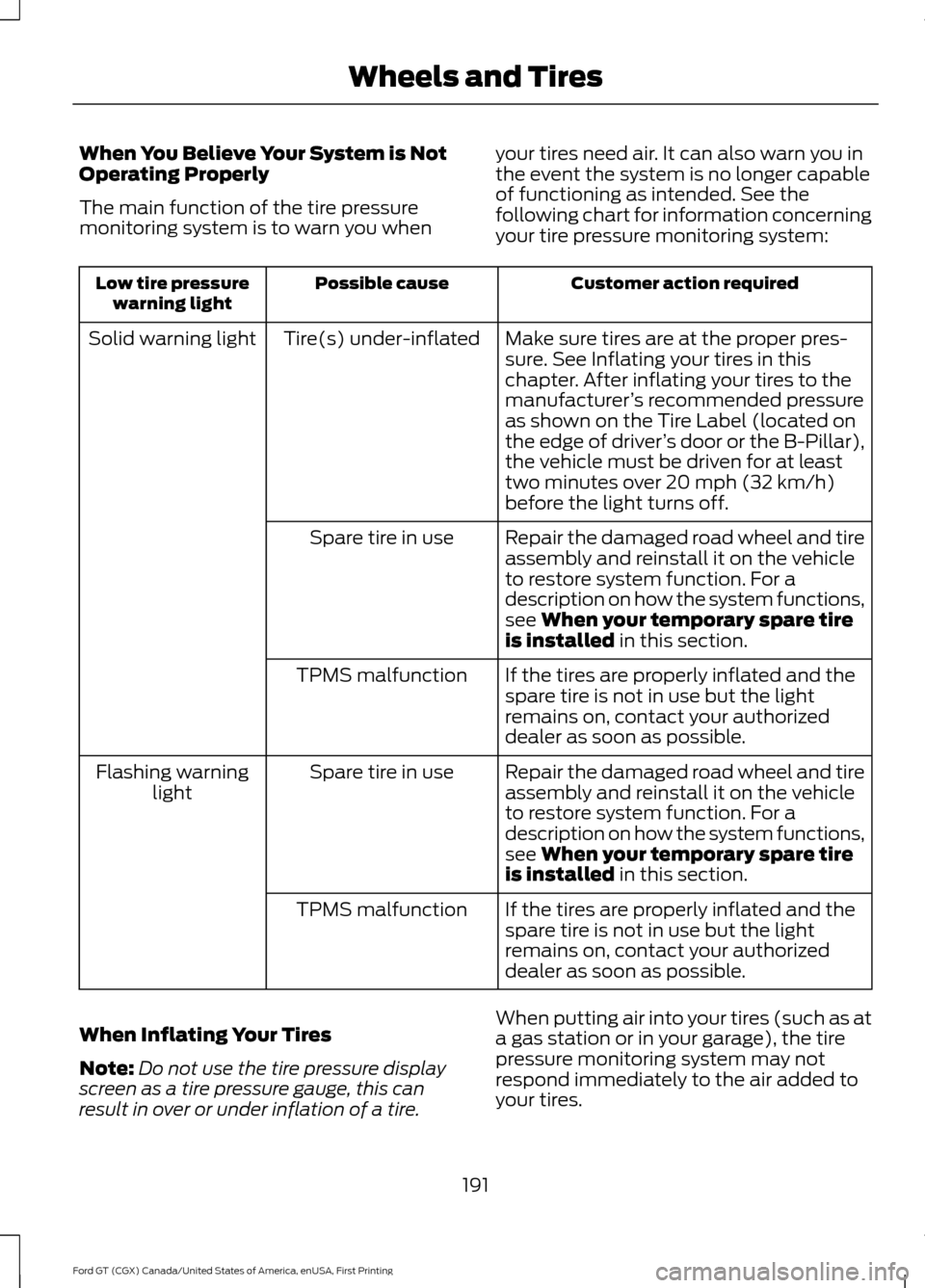
When You Believe Your System is Not
Operating Properly
The main function of the tire pressure
monitoring system is to warn you when
your tires need air. It can also warn you in
the event the system is no longer capable
of functioning as intended. See the
following chart for information concerning
your tire pressure monitoring system: Customer action required
Possible cause
Low tire pressure
warning light
Make sure tires are at the proper pres-
sure. See Inflating your tires in this
chapter. After inflating your tires to the
manufacturer’s recommended pressure
as shown on the Tire Label (located on
the edge of driver ’s door or the B-Pillar),
the vehicle must be driven for at least
two minutes over 20 mph (32 km/h)
before the light turns off.
Tire(s) under-inflated
Solid warning light
Repair the damaged road wheel and tire
assembly and reinstall it on the vehicle
to restore system function. For a
description on how the system functions,
see
When your temporary spare tire
is installed in this section.
Spare tire in use
If the tires are properly inflated and the
spare tire is not in use but the light
remains on, contact your authorized
dealer as soon as possible.
TPMS malfunction
Repair the damaged road wheel and tire
assembly and reinstall it on the vehicle
to restore system function. For a
description on how the system functions,
see
When your temporary spare tire
is installed in this section.
Spare tire in use
Flashing warning
light
If the tires are properly inflated and the
spare tire is not in use but the light
remains on, contact your authorized
dealer as soon as possible.
TPMS malfunction
When Inflating Your Tires
Note: Do not use the tire pressure display
screen as a tire pressure gauge, this can
result in over or under inflation of a tire. When putting air into your tires (such as at
a gas station or in your garage), the tire
pressure monitoring system may not
respond immediately to the air added to
your tires.
191
Ford GT (CGX) Canada/United States of America, enUSA, First Printing Wheels and Tires
Page 195 of 313
It may take up to two minutes of driving
over 20 mph (32 km/h) for the light to turn
off after you have filled your tires to the
recommended inflation pressure.
How Temperature Affects Your Tire
Pressure
The tire pressure monitoring system
monitors tire pressure in each pneumatic
tire. While driving in a normal manner, a
typical passenger tire inflation pressure
may increase about 2
–4 psi (14– 28 kPa)
from a cold start situation. If the vehicle is
stationary overnight with the outside
temperature significantly lower than the
daytime temperature, the tire pressure may
decrease about 3 psi (21 kPa) for a drop of
30°F (17°C) in ambient temperature. This
lower pressure value may be detected by
the tire pressure monitoring system as
being significantly lower than the
recommended inflation pressure and
activate the system warning light for low
tire pressure. If the low tire pressure
warning light is on, visually check each tire
to verify that no tire is flat. If one or more
tires are flat, repair as necessary. Check
the air pressure in the road tires. If any tire
is under-inflated, carefully drive the vehicle
to the nearest location where air can be
added to the tires. Inflate all the tires to
the recommended inflation pressure.
CHANGING A ROAD WHEEL
Important Information for Lifting
or Jacking
A vehicle jack is not included with your
vehicle. If you are on the road and need to
change a wheel, it is recommended that
you contact the Ford GT Concierge to
obtain roadside assistance. See
Special
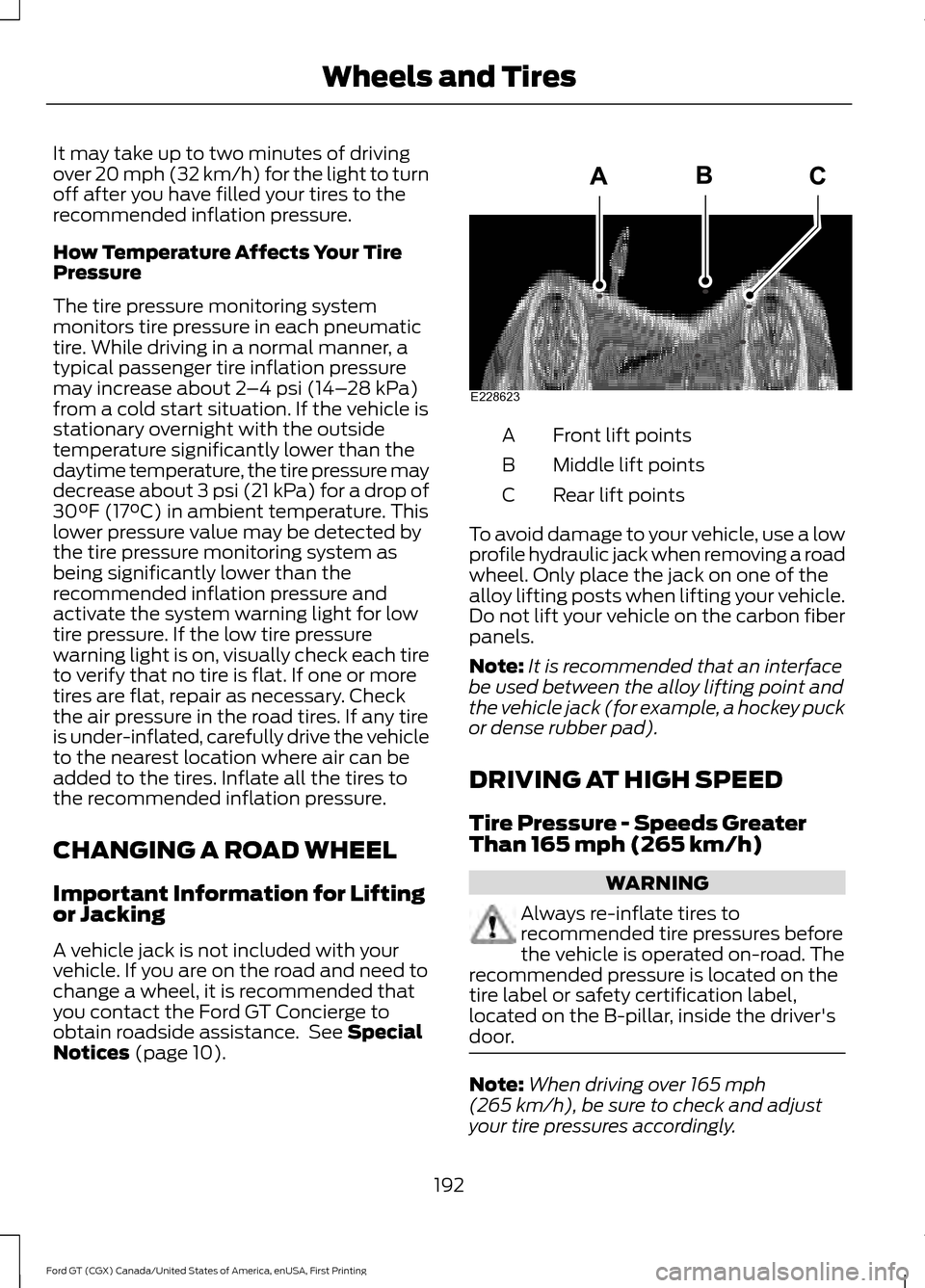
Notices (page 10). Front lift points
A
Middle lift points
B
Rear lift points
C
To avoid damage to your vehicle, use a low
profile hydraulic jack when removing a road
wheel. Only place the jack on one of the
alloy lifting posts when lifting your vehicle.
Do not lift your vehicle on the carbon fiber
panels.
Note: It is recommended that an interface
be used between the alloy lifting point and
the vehicle jack (for example, a hockey puck
or dense rubber pad).
DRIVING AT HIGH SPEED
Tire Pressure - Speeds Greater
Than
165 mph (265 km/h) WARNING
Always re-inflate tires to
recommended tire pressures before
the vehicle is operated on-road. The
recommended pressure is located on the
tire label or safety certification label,
located on the B-pillar, inside the driver's
door. Note:
When driving over
165 mph
(265 km/h), be sure to check and adjust
your tire pressures accordingly.
192
Ford GT (CGX) Canada/United States of America, enUSA, First Printing Wheels and TiresE228623
Page 196 of 313
Note:
If you are not sure about the proper
tire inflation pressures, contact an
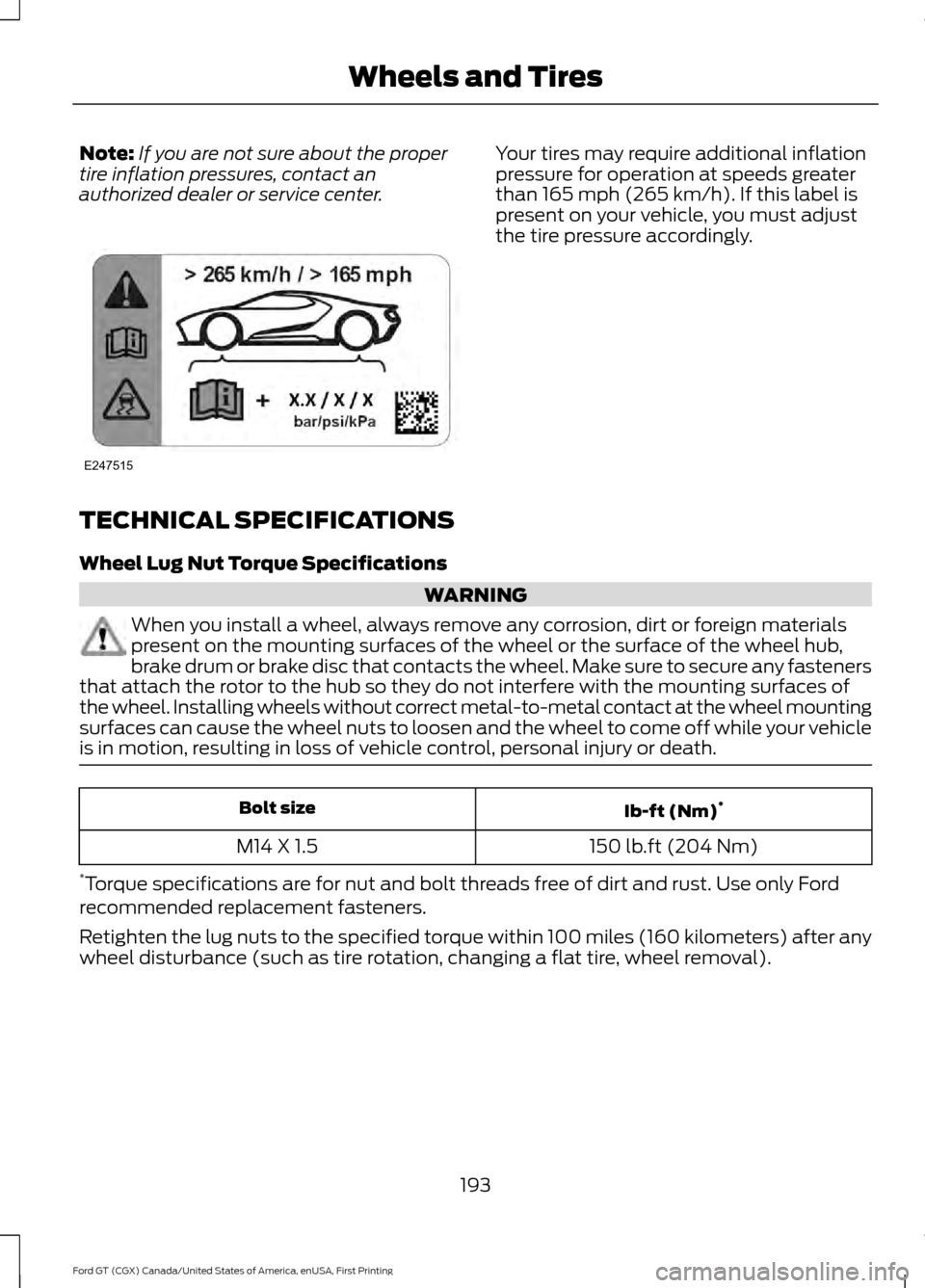
authorized dealer or service center. Your tires may require additional inflation
pressure for operation at speeds greater
than 165 mph (265 km/h). If this label is
present on your vehicle, you must adjust
the tire pressure accordingly.
TECHNICAL SPECIFICATIONS
Wheel Lug Nut Torque Specifications WARNING
When you install a wheel, always remove any corrosion, dirt or foreign materials
present on the mounting surfaces of the wheel or the surface of the wheel hub,
brake drum or brake disc that contacts the wheel. Make sure to secure any fasteners
that attach the rotor to the hub so they do not interfere with the mounting surfaces of
the wheel. Installing wheels without correct metal-to-metal contact at the wheel mounting
surfaces can cause the wheel nuts to loosen and the wheel to come off while your vehicle
is in motion, resulting in loss of vehicle control, personal injury or death. Ib-ft (Nm)
*
Bolt size
150 lb.ft (204 Nm)
M14 X 1.5
* Torque specifications are for nut and bolt threads free of dirt and rust. Use only Ford
recommended replacement fasteners.
Retighten the lug nuts to the specified torque within 100 miles (160 kilometers) after any
wheel disturbance (such as tire rotation, changing a flat tire, wheel removal).
193
Ford GT (CGX) Canada/United States of America, enUSA, First Printing Wheels and TiresE247515
Page 308 of 313
Event Data Recording
See: Data Recording............................................... 7
Exterior Mirrors.................................................61 Fold-Away Exterior Mirrors................................ 61
Power Exterior Mirrors......................................... 61
F
Fastening the Seatbelts..............................26 Seatbelt Locking Modes.................................... 27
Using Seatbelts During Pregnancy................27
Flat Tire Inflation See: Tire Sealant and Inflator Kit.................. 170
Floor Mats........................................................127
Foot Pedals See: Adjusting the Pedals................................. 55
Ford Performance...........................................12
Front Passenger Sensing System............35
Fuel and Refueling..........................................91
Fuel Consumption.........................................95 Calculating Fuel Economy................................ 95
Filling the Fuel Tank............................................ 95
Fuel Filler Funnel Location.........................92
Fuel Filter
..........................................................157
Fuel Quality......................................................92
Choosing the Right Fuel.................................... 92
Fuel Shutoff....................................................128
Fuses.................................................................138
Fuse Specification Chart...........................138 Front Power Distribution Box......................... 138
Passenger Compartment Fuse Panel.........142
Rear Power Distribution Box.......................... 140
G
Gauges...............................................................62 Engine Coolant Temperature Gauge............64
Engine Oil Pressure Gauge............................... 64
Engine Oil Temperature Gauge...................... 64
Fuel Gauge.............................................................. 63
Information Display............................................. 62
Gearbox See: Transmission............................................... 99
General Information on Radio Frequencies..................................................40
Intelligent Access................................................. 40
General Maintenance Information........263 Protecting Your Investment........................... 263Road Course Maintenance.............................
263
Why Maintain Your Vehicle?.......................... 263
Why Maintain Your Vehicle at Your Certified Ford GT Service Dealership?.................... 263
Getting Assistance Outside the U.S. and Canada..........................................................135
Getting the Services You Need................132 Away From Home............................................... 132
Global Opening..............................................60 Remote Control Front Windows..................... 61
H
Hazard Flashers............................................128
Headlamp Adjusting See: Adjusting the Headlamps..................... 160
Heating See: Climate Control............................................ 77
Hill Start Assist.............................................106 Using Hill Start Assist....................................... 106
Hints on Controlling the Interior Climate...........................................................80
Defogging the Side Windows in Cold Weather............................................................... 81
General Hints........................................................ 80
Quickly Heating the Interior............................. 80
Recommended Settings for Cooling.............81
Recommended Settings for Heating.............81
Hints on Driving With Anti-Lock Brakes............................................................103
Home Screen
..................................................213
Hood Lock See: Opening and Closing the Hood............147
I
In California (U.S. Only)
..............................133
Information Display Control.......................53
Information Displays
....................................68
General Information........................................... 68
Information Messages
..................................70
AdvanceTrac ™....................................................... 71
Alarm........................................................................\
.. 71
Battery and Charging System........................... 71
Doors and Locks.................................................... 72
Engine........................................................................\
72
Fuel........................................................................\
..... 72
Hill Start Assist ..................................................... 72
305
Ford GT (CGX) Canada/United States of America, enUSA, First Printing Index
Page 311 of 313
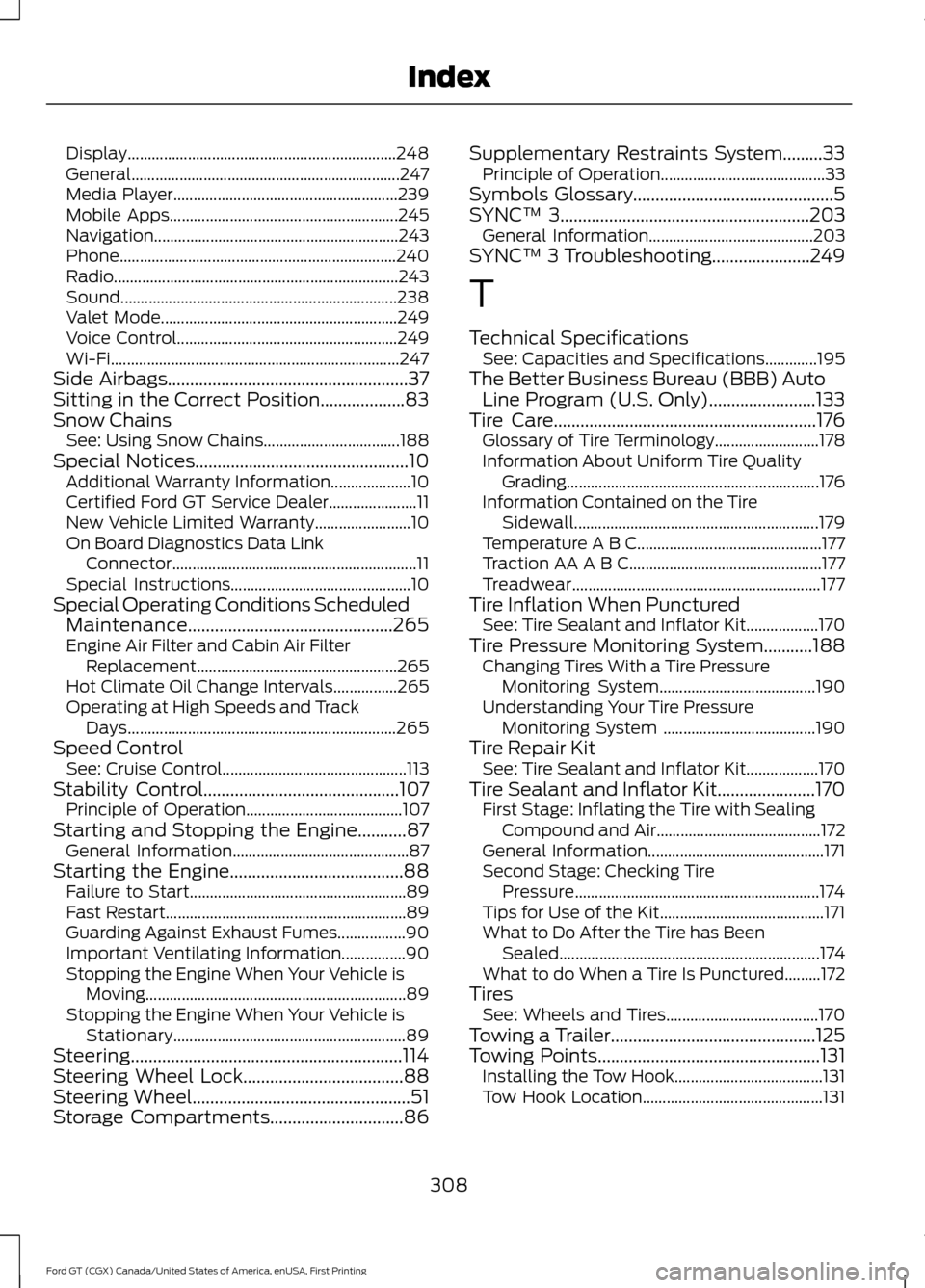
Display...................................................................
248
General................................................................... 247
Media Player........................................................ 239
Mobile Apps......................................................... 245
Navigation............................................................. 243
Phone..................................................................... 240
Radio ....................................................................... 243
Sound..................................................................... 238
Valet Mode........................................................... 249
Voice Control....................................................... 249
Wi-Fi........................................................................\
247
Side Airbags......................................................37
Sitting in the Correct Position...................83
Snow Chains See: Using Snow Chains.................................. 188
Special Notices................................................10
Additional Warranty Information.................... 10
Certified Ford GT Service Dealer...................... 11
New Vehicle Limited Warranty........................ 10
On Board Diagnostics Data Link Connector
............................................................. 11
Special Instructions............................................. 10
Special Operating Conditions Scheduled Maintenance..............................................265
Engine Air Filter and Cabin Air Filter Replacement.................................................. 265
Hot Climate Oil Change Intervals................265
Operating at High Speeds and Track Days................................................................... 265
Speed Control See: Cruise Control.............................................. 113
Stability Control
............................................107
Principle of Operation....................................... 107
Starting and Stopping the Engine...........87 General Information............................................ 87
Starting the Engine.......................................88 Failure to Start...................................................... 89
Fast Restart............................................................ 89
Guarding Against Exhaust Fumes.................90
Important Ventilating Information................90
Stopping the Engine When Your Vehicle is Moving................................................................. 89
Stopping the Engine When Your Vehicle is Stationary.......................................................... 89
Steering
.............................................................114
Steering Wheel Lock....................................88
Steering Wheel.................................................51
Storage Compartments..............................86 Supplementary Restraints System.........33
Principle of Operation......................................... 33
Symbols Glossary.............................................5
SYNC™ 3
........................................................203
General Information......................................... 203
SYNC™ 3 Troubleshooting
......................249
T
Technical Specifications See: Capacities and Specifications.............195
The Better Business Bureau (BBB) Auto Line Program (U.S. Only)........................133
Tire Care...........................................................176 Glossary of Tire Terminology.......................... 178
Information About Uniform Tire Quality Grading............................................................... 176
Information Contained on the Tire Sidewall............................................................. 179
Temperature A B C.............................................. 177
Traction AA A B C................................................ 177
Treadwear.............................................................. 177
Tire Inflation When Punctured See: Tire Sealant and Inflator Kit.................. 170
Tire Pressure Monitoring System...........188 Changing Tires With a Tire Pressure
Monitoring System....................................... 190
Understanding Your Tire Pressure Monitoring System ...................................... 190
Tire Repair Kit See: Tire Sealant and Inflator Kit.................. 170
Tire Sealant and Inflator Kit......................170 First Stage: Inflating the Tire with Sealing
Compound and Air......................................... 172
General Information............................................ 171
Second Stage: Checking Tire Pressure............................................................. 174
Tips for Use of the Kit......................................... 171
What to Do After the Tire has Been Sealed................................................................. 174
What to do When a Tire Is Punctured.........172
Tires See: Wheels and Tires...................................... 170
Towing a Trailer..............................................125
Towing Points
..................................................131
Installing the Tow Hook..................................... 131
Tow Hook Location............................................. 131
308
Ford GT (CGX) Canada/United States of America, enUSA, First Printing Index