air condition FORD GT 2018 User Guide
[x] Cancel search | Manufacturer: FORD, Model Year: 2018, Model line: GT, Model: FORD GT 2018Pages: 325, PDF Size: 6.61 MB
Page 61 of 325
GENERAL INFORMATION
Condensation in the Exterior Front
Lamps and Rear Lamps
Exterior front lamps and rear lamps have
vents to accommodate normal changes
in air pressure.
Condensation can be a natural by-product
of this design. When moist air enters the
lamp assembly through the vents, there is
a possibility that condensation can occur
when the temperature is cold. When
normal condensation occurs, a fine mist
can form on the interior of the lens. The
fine mist eventually clears and exits
through the vents during normal operation.
Clearing time may take as long as 48 hours
under dry weather conditions.
Examples of acceptable condensation are:
•
The presence of a fine mist (no streaks,
drip marks or large droplets).
• A fine mist covers less than 50% of the
lens.
Examples of unacceptable condensation
are:
• A water puddle inside the lamp.
• Streaks, drip marks or large droplets
present on the interior of the lens.
If you see any unacceptable condensation,
have your vehicle checked by an authorized
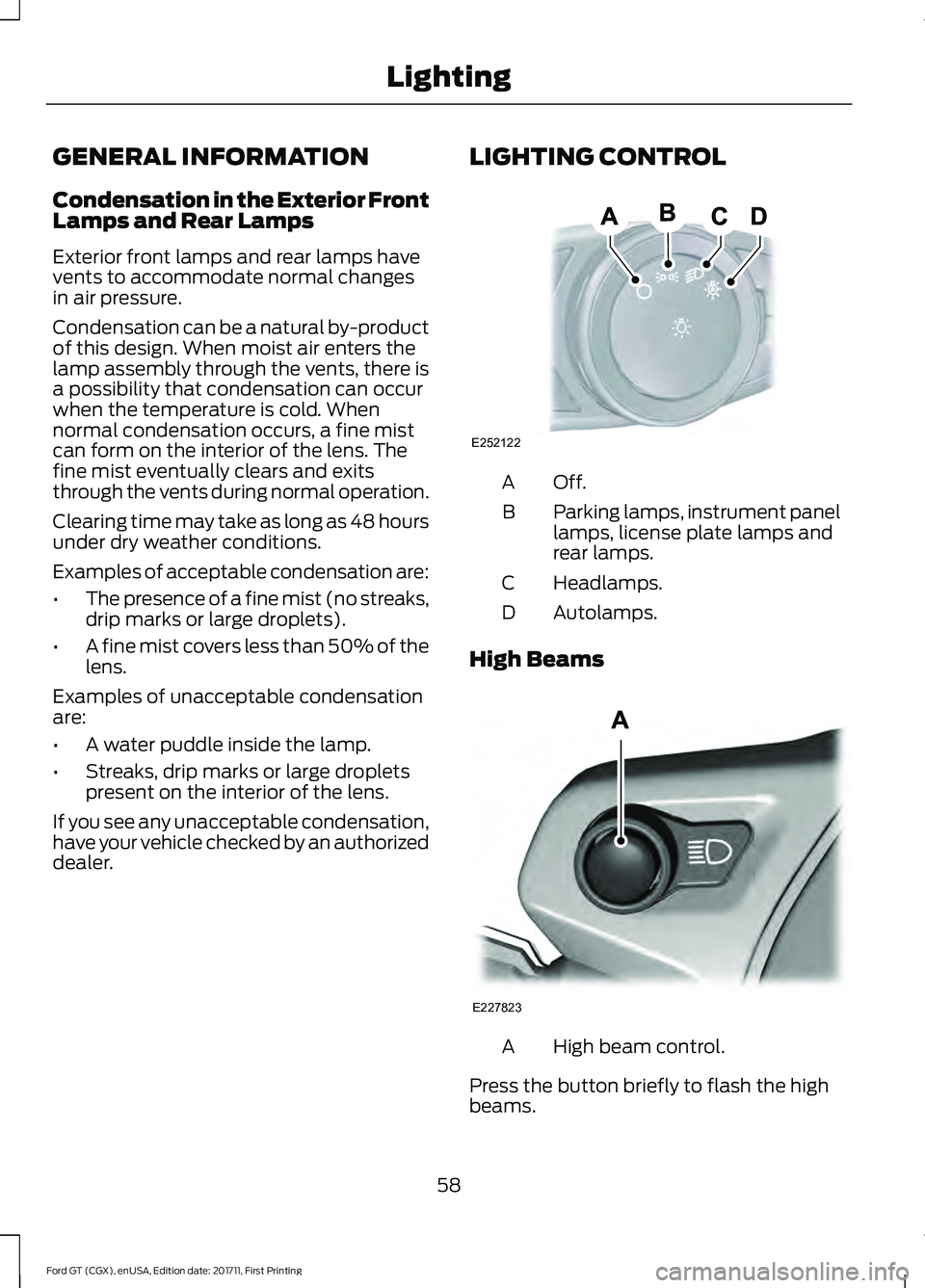
dealer. LIGHTING CONTROL Off.A
Parking lamps, instrument panel
lamps, license plate lamps and
rear lamps.
B
Headlamps.
C
Autolamps.
D
High Beams High beam control.
A
Press the button briefly to flash the high
beams.
58
Ford GT (CGX), enUSA, Edition date: 201711, First Printing LightingE252122 E227823
Page 85 of 325
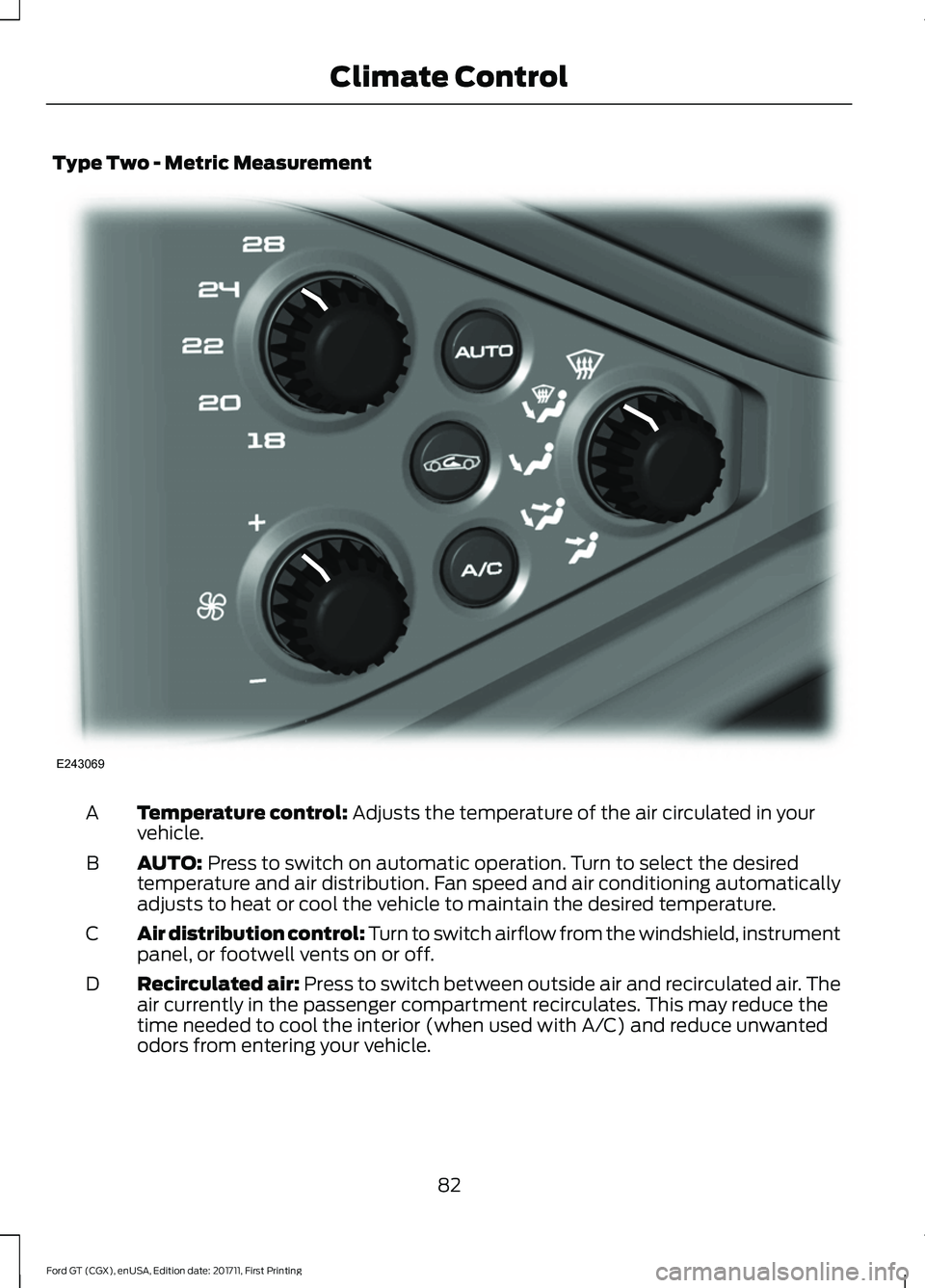
Type Two - Metric Measurement
Temperature control: Adjusts the temperature of the air circulated in your
vehicle.
A
AUTO:
Press to switch on automatic operation. Turn to select the desired
temperature and air distribution. Fan speed and air conditioning automatically
adjusts to heat or cool the vehicle to maintain the desired temperature.
B
Air distribution control: Turn to switch airflow from the windshield, instrument
panel, or footwell vents on or off.
C
Recirculated air:
Press to switch between outside air and recirculated air. The
air currently in the passenger compartment recirculates. This may reduce the
time needed to cool the interior (when used with A/C) and reduce unwanted
odors from entering your vehicle.
D
82
Ford GT (CGX), enUSA, Edition date: 201711, First Printing Climate ControlE243069
Page 86 of 325
A/C: Press to switch the air conditioning on or off. Use A/C with recirculated
air to improve performance and efficiency.
E
Fan speed control:
Adjusts the volume of air circulated in the vehicle.
F
HINTS ON CONTROLLING THE
INTERIOR CLIMATE
General Hints
Note: Prolonged use of recirculated air may
cause the windows to fog up.
Note: You may feel a small amount of air
from the footwell air vents regardless of the
air distribution setting.
Note: To reduce humidity build-up inside
your vehicle, do not drive with the system
switched off or with recirculated air always
switched on.
Note: To improve the time to reach a
comfortable temperature in hot weather,
drive with the windows open until you feel
cold air through the air vents. Manual Climate Control
Note:
To reduce fogging of the windshield
during humid weather, adjust the air
distribution control to the windshield air
vents position.
Automatic Climate Control
Note: Adjusting the settings when your
vehicle interior is extremely hot or cold is
not necessary.
Note: The system adjusts to heat or cool
the interior to the temperature you select
as quickly as possible.
Note: For the system to function efficiently,
the instrument panel and side air vents
should be fully open.
Note: If you select
AUTO during cold
outside temperatures, the fan may run at a
slower speed until the engine warms up.
Quickly Heating the Interior Automatic climate control
Manual climate control
Press
AUTO.
Adjust the fan speed to the highest
setting.
1
Adjust the temperature control to the
desired setting.
Adjust the temperature control to the
full heat setting.
2
Direct air to the position you desire.
Direct air to the footwell using the air
distribution buttons.
3
83
Ford GT (CGX), enUSA, Edition date: 201711, First Printing Climate Control
Page 98 of 325
The use of the correct fuel is an important
part of the proper maintenance of your
vehicle, and a condition of the vehicle
Warranty. For this vehicle, the use of
gasoline with an octane level of 91 or
higher is required. The use of gasoline with
an octane rating lower than 91 will
invalidate the vehicle Warranty. It can
degrade vehicle performance and lead to
severe mechanical damage.
Note:
Use of any fuel other than those
recommended can impair the emission
control system and cause a loss of vehicle
performance.
Do not use:
• Diesel fuel.
• Fuels containing kerosene or paraffin.
• Fuel containing more than 15% ethanol
or E85 fuel.
• Fuels containing methanol.
• Fuels containing metallic-based
additives, including manganese-based
compounds.
• Fuels containing the octane booster
additive, methylcyclopentadienyl
manganese tricarbonyl (MMT).
• Leaded fuel (using leaded fuel is
prohibited by law).
The use of fuels with metallic compounds
such as methylcyclopentadienyl
manganese tricarbonyl (commonly known
as MMT), which is a manganese-based
fuel additive, will impair engine
performance and affect the emission
control system.
Do not be concerned if the engine
sometimes knocks lightly. However, if it
knocks heavily under most driving
conditions while you are using fuel with the
recommended octane rating, contact an
authorized dealer to prevent any engine
damage. FUEL FILLER FUNNEL
LOCATION
The fuel filler funnel is located in the
storage compartment under the rear hatch.
RUNNING OUT OF FUEL
Running out of fuel can cause damage not
covered by the vehicle Warranty.
If your vehicle runs out of fuel:
•
Add a minimum of 1.3 gal (5 L) of fuel
to restart the engine.
• You may need to switch the ignition
from off to on several times after
refueling to allow the fuel system to
pump the fuel from the tank to the
engine. When restarting, cranking time
takes a few seconds longer than
normal.
Note: If your vehicle is on a steep slope,
more fuel may be required.
Filling a Portable Fuel Container WARNING
Flow of fuel through a fuel pump
nozzle can produce static electricity.
This can cause a fire if you are filling
an ungrounded fuel container. Use the following guidelines to avoid
electrostatic charge build-up, which can
produce a spark, when filling an
ungrounded fuel container:
•
Only use an approved fuel container to
transfer fuel to your vehicle. Place the
container on the ground when filling it.
• Do not fill a fuel container when it is
inside your vehicle (including the cargo
area).
95
Ford GT (CGX), enUSA, Edition date: 201711, First Printing Fuel and Refueling
Page 106 of 325
•
Incorrect fuel for climatic conditions.
• Incorrect engine oil viscosity for
climactic conditions.
Note: Some vehicles have a lifetime fuel
filter that is integrated with the fuel tank.
Regular maintenance or replacement is not
needed.
Note: If these checks do not help you
correct the concern, have your vehicle
checked as soon as possible.
Noise Emissions Warranty,
Prohibited Tampering Acts and
Maintenance
On January 1, 1978, Federal regulation
became effective governing the noise
emission on trucks over 10,000 lb
(4,536 kg) Gross Vehicle Weight Rating
(GVWR). The preceding statements
concerning prohibited tampering acts and
maintenance, and the noise warranty
found in the Warranty Guide, are
applicable to complete chassis cabs over
10,000 lb (4,536 kg)
GVWR.
CATALYTIC CONVERTER WARNINGS
Do not park, idle or drive your vehicle
on dry grass or other dry ground
cover. The emission system heats up
the engine compartment and exhaust
system, creating the risk of fire. The normal operating temperature
of the exhaust system is very high.
Never work around or attempt to
repair any part of the exhaust system until
it has cooled. Use special care when
working around the catalytic converter.
The catalytic converter heats up to a very
high temperature after only a short period
of engine operation and stays hot after the
engine is switched off. WARNINGS
Exhaust leaks may result in entry of
harmful and potentially lethal fumes
into the passenger compartment. If
you smell exhaust fumes inside your
vehicle, have your vehicle inspected
immediately. Do not drive if you smell
exhaust fumes. Your vehicle has various emission control
components and a catalytic converter that
enables it to comply with applicable
exhaust emission standards.
To make sure that the catalytic converter
and other emission control components
continue to work properly:
•
Do not crank the engine for more than
10 seconds at a time.
• Do not run the engine with a spark plug
lead disconnected.
• Do not push-start or tow-start your
vehicle. Use booster cables. See Jump
Starting the Vehicle (page 137).
• Use only the specified fuel listed.
• Do not switch the ignition off when your
vehicle is moving.
• Avoid running out of fuel.
• Have the items listed in scheduled
maintenance information performed
according to the specified schedule.
Note: Resulting component damage may
not be covered by the vehicle Warranty.
The scheduled maintenance items listed
in scheduled maintenance information are
essential to the life and performance of
your vehicle and to its emissions system.
If you use anything other than Ford,
Motorcraft or Ford-authorized parts for
maintenance replacements or for service
of components affecting emission control,
such non-Ford parts should be equivalent
to genuine Ford Motor Company parts in
performance and durability.
103
Ford GT (CGX), enUSA, Edition date: 201711, First Printing Engine Emission Control
Page 126 of 325
Modes:
•
Normal (N) – Use for normal driving in
dry conditions.
•AdvanceTrac Stability Control is
active and cannot be adjusted.
• Ride height is set to High and
suspension damping is set to
Normal.
• Comfort damping can be selected
with the console switch.
• Launch control is available.
• Transmission automatic shift
calibration is set to Normal.
• Rear wing deploys at speeds above
90 mph (145 km/h) and retracts
when the speed drops below
81 mph (130 km/h)
.
• Air brake activates at speeds above
75 mph (121 km/h) when the brakes
are applied with moderate force.
• Sport (S) – Use for sport driving in dry
conditions.
•AdvanceTrac Stability Control is
active but can be adjusted by use
of the Stability Control button on
the console.
• Ride height is set to High and
suspension damping is set to Sport.
• Comfort damping cannot be
selected.
• Launch control is available.
• Transmission automatic shift
calibration is set to Sport.
• Turbocharger anti-lag calibration
is active.
• Rear wing deploys at speeds above
70 mph (113 km/h)
and retracts
when the speed drops below
45 mph (72 km/h)
.
• Air brake activates at speeds above
75 mph (121 km/h) when the brakes
are applied with moderate force. •
Wet (W) – Use for driving in wet
conditions.
•AdvanceTrac Stability Control is
active and cannot be adjusted.
• Ride height is set to High and
suspension damping is set to
Normal.
• Comfort damping can be selected
with the console switch.
• Launch control is not available.
• Transmission automatic shift
calibration is set to Normal.
• Rear wing deploys at speeds above
90 mph (145 km/h)
and retracts
when the speed drops below
81 mph (130 km/h)
.
• Air brake activates at speeds above
75 mph (121 km/h) when the brakes
are applied with moderate force.
123
Ford GT (CGX), enUSA, Edition date: 201711, First Printing Driving Aids
Page 128 of 325
V-Max
Track
Sport
Normal
Wet
Drive Mode
Optimized
settings for achieving
maximum
velocity (not for street
use). Must be
in park (P) to select this mode
Optimized
settings for
track use (not for street
use). Must be in park (P) to select this mode
Sport driving
in dry condi- tions
Normal
driving in dry conditions
Driving in
wet condi- tions
Use
Active,
cannot be adjusted
Active, but
can be
adjusted
Active, but
can be
adjusted
Active, cannot
be adjusted
Active,
cannot be adjusted
Advan-
ceTrac
Stability Control
Available
Not
Launch
control Available
Low withtrack
damping
Low with
track damping
High with
sport
damping
High with
normal
damping
High with
normal
damping
Ride height
and suspen- sion
damping
Not Available
Not Available
Not Available
Available
Available
Comfort
damping
Sport
Sport
Sport
Normal
Normal
Automatic
transmission
Inactive
Active
Active
Inactive
Inactive
Turbocharger
anti-lag
Does notdeploy
Always
deployed
Active above
70 mph
(113 km/h)
Active above
90 mph
(145 km/h)
Active
above
90 mph
(145 km/h)
Rear wing
Activates above 75 mph (121 km/h) with moderate braking
Air brake
Note: Selectable driving modes has
diagnostic checks that continuously monitor
the system to ensure proper operation. If a
selected mode is unavailable due to a
system fault or change in gear shifter
position, the selected mode defaults to
Normal.
125
Ford GT (CGX), enUSA, Edition date: 201711, First Printing Driving Aids
Page 137 of 325
BREAKING-IN
You need to break in new tires for
approximately 300 mi (480 km). During
this time, your vehicle may exhibit some
unusual driving characteristics.
You should not drive your Ford GT
aggressively for the first
600 mi
(1,000 km) of vehicle operation. This will
allow for proper break in of the powertrain
and braking systems.
For the first 600 miles (1,000 km):
• Do not apply high load at low engine
speed.
• Do not drive the vehicle at a sustained
high-speed, high load.
• Avoid driving the vehicle at full throttle.
• Drive the vehicle at varying road and
engine speeds.
• Do not drive in competition and race
track conditions.
• Do not use launch control.
• If you are going to use the vehicle on
the race track right after break in,
change the oil after break in.
Cold Engine Operation
The design of your Ford GT restricts engine
power and RPM when the engine is cold.
The engine RPM and power output will be
reduced until the engine reaches full
operating temperature.
Hot Engine Shut down
You should allow your Ford GT engine to
cool down for a few minutes prior to shut
down after high speed or high performance
driving. Allowing the engine to run at light
loads and or idle for a few minutes will
reduce overall engine oil and coolant
temperatures. DRIVING THROUGH WATER WARNING
Do not drive through flowing or deep
water as you may lose control of your
vehicle.
Note:
Driving through standing water can
cause vehicle damage.
Note: Engine damage can occur if water
enters the air filter.
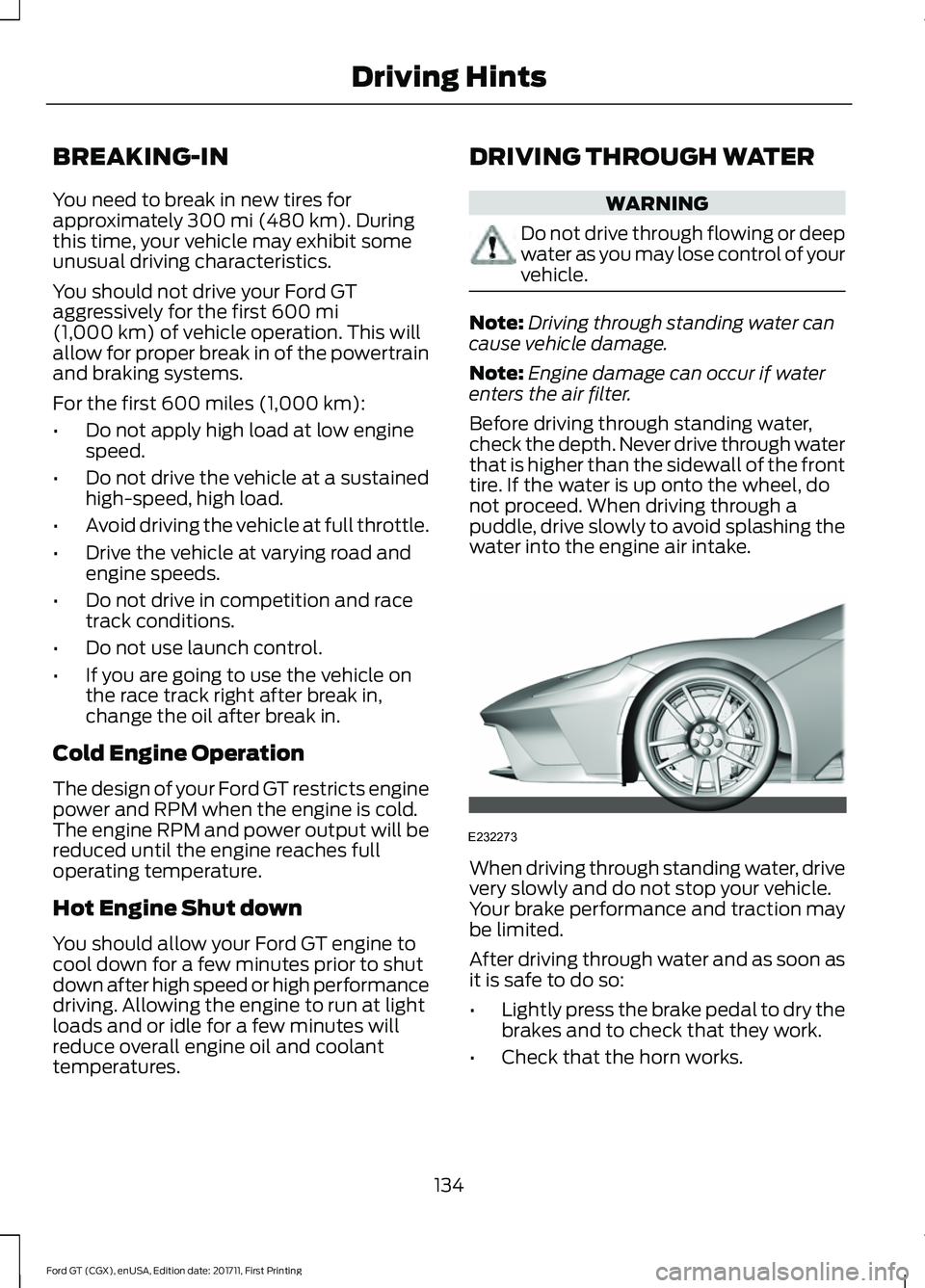
Before driving through standing water,
check the depth. Never drive through water
that is higher than the sidewall of the front
tire. If the water is up onto the wheel, do
not proceed. When driving through a
puddle, drive slowly to avoid splashing the
water into the engine air intake. When driving through standing water, drive
very slowly and do not stop your vehicle.
Your brake performance and traction may
be limited.
After driving through water and as soon as
it is safe to do so:
•
Lightly press the brake pedal to dry the
brakes and to check that they work.
• Check that the horn works.
134
Ford GT (CGX), enUSA, Edition date: 201711, First Printing Driving HintsE232273
Page 144 of 325
remedies provided by certain state laws.
This dispute handling procedure is not
required prior to enforcing state created
rights or other rights which are independent
of the Magnuson-Moss Warranty Act or
state replacement or repurchase laws.
IN CALIFORNIA (U.S. ONLY)
California Civil Code Section 1793.2(d)
requires that, if a manufacturer or its
representative is unable to repair a motor
vehicle to conform to the vehicle
’s
applicable express warranty after a
reasonable number of attempts, the
manufacturer shall be required to either
replace the vehicle with one substantially
identical or repurchase the vehicle and
reimburse the buyer in an amount equal to
the actual price paid or payable by the
consumer (less a reasonable allowance
for consumer use). The consumer has the
right to choose whether to receive a refund
or replacement vehicle.
California Civil Code Section 1793.22(b)
presumes that the manufacturer has had
a reasonable number of attempts to
conform the vehicle to its applicable
express warranties if, within the first 18
months of ownership of a new vehicle or
the first 18,000 mi (29,000 km), whichever
occurs first:
1. Two or more repair attempts are made
on the same non-conformity likely to
cause death or serious bodily injury OR
2. Four or more repair attempts are made
on the same nonconformity (a defect
or condition that substantially impairs
the use, value or safety of the vehicle)
OR
3. The vehicle is out of service for repair of nonconformities for a total of more
than 30 calendar days (not necessarily
all at one time). In the case of 1 or 2 above, the consumer
must also notify the manufacturer of the
need for the repair of the nonconformity
at the following address:
Ford Motor Company
16800 Executive Plaza Drive
Mail Drop 3NE-B
Dearborn, MI 48126
You are required to submit your warranty
dispute to BBB AUTO LINE before asserting
in court any rights or remedies conferred
by California Civil Code Section 1793.22(b).
You are also required to use BBB AUTO
LINE before exercising rights or seeking
remedies created by the Federal
Magnuson-Moss Warranty Act, 15 U.S.C.
sec. 2301 et seq. If you choose to seek
redress by pursuing rights and remedies
not created by California Civil Code Section
1793.22(b) or the Magnuson-Moss
Warranty Act, resort to BBB AUTO LINE is
not required by those statutes.
THE BETTER BUSINESS
BUREAU (BBB) AUTO LINE
PROGRAM (U.S. ONLY)
Your satisfaction is important to Ford
Motor Company and to your dealer. If a
warranty concern has not been resolved
using the three-step procedure outlined
earlier in this chapter in the Getting the
Services you need section, you may be
eligible to participate in the BBB AUTO
LINE program.
The BBB AUTO LINE program consists of
two parts – mediation and arbitration.
During mediation, a representative of the
BBB will contact both you and Ford Motor
Company to explore options for settlement
of the claim. If an agreement is not reached
during mediation or you do not want to
participate in mediation, and if your claim
is eligible, you may participate in the
141
Ford GT (CGX), enUSA, Edition date: 201711, First Printing Customer Assistance
Page 152 of 325
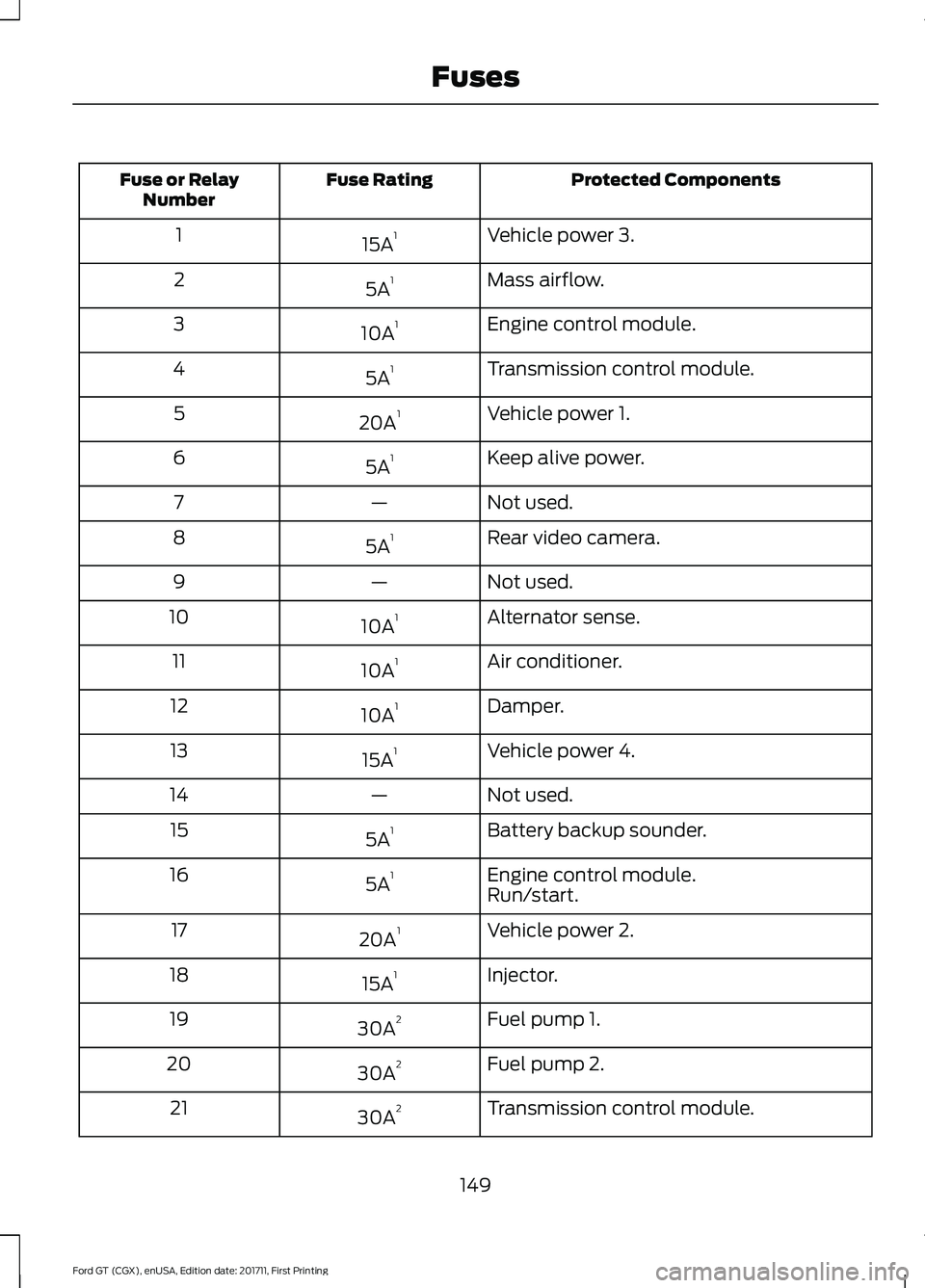
Protected Components
Fuse Rating
Fuse or Relay
Number
Vehicle power 3.
15A 1
1
Mass airflow.
5A 1
2
Engine control module.
10A 1
3
Transmission control module.
5A 1
4
Vehicle power 1.
20A 1
5
Keep alive power.
5A 1
6
Not used.
—
7
Rear video camera.
5A 1
8
Not used.
—
9
Alternator sense.
10A 1
10
Air conditioner.
10A 1
11
Damper.
10A 1
12
Vehicle power 4.
15A 1
13
Not used.
—
14
Battery backup sounder.
5A 1
15
Engine control module.
5A 1
16
Run/start.
Vehicle power 2.
20A 1
17
Injector.
15A 1
18
Fuel pump 1.
30A 2
19
Fuel pump 2.
30A 2
20
Transmission control module.
30A 2
21
149
Ford GT (CGX), enUSA, Edition date: 201711, First Printing Fuses