change wheel FORD GT 2018 User Guide
[x] Cancel search | Manufacturer: FORD, Model Year: 2018, Model line: GT, Model: FORD GT 2018Pages: 325, PDF Size: 6.61 MB
Page 192 of 325
Information Contained on the
Tire Sidewall
Both United States and Canada
Federal regulations require tire
manufacturers to place
standardized information on the
sidewall of all tires. This
information identifies and
describes the fundamental
characteristics of the tire and also
provides a U.S. DOT Tire
Identification Number for safety
standard certification and in case
of a recall.
Information on P Type Tires
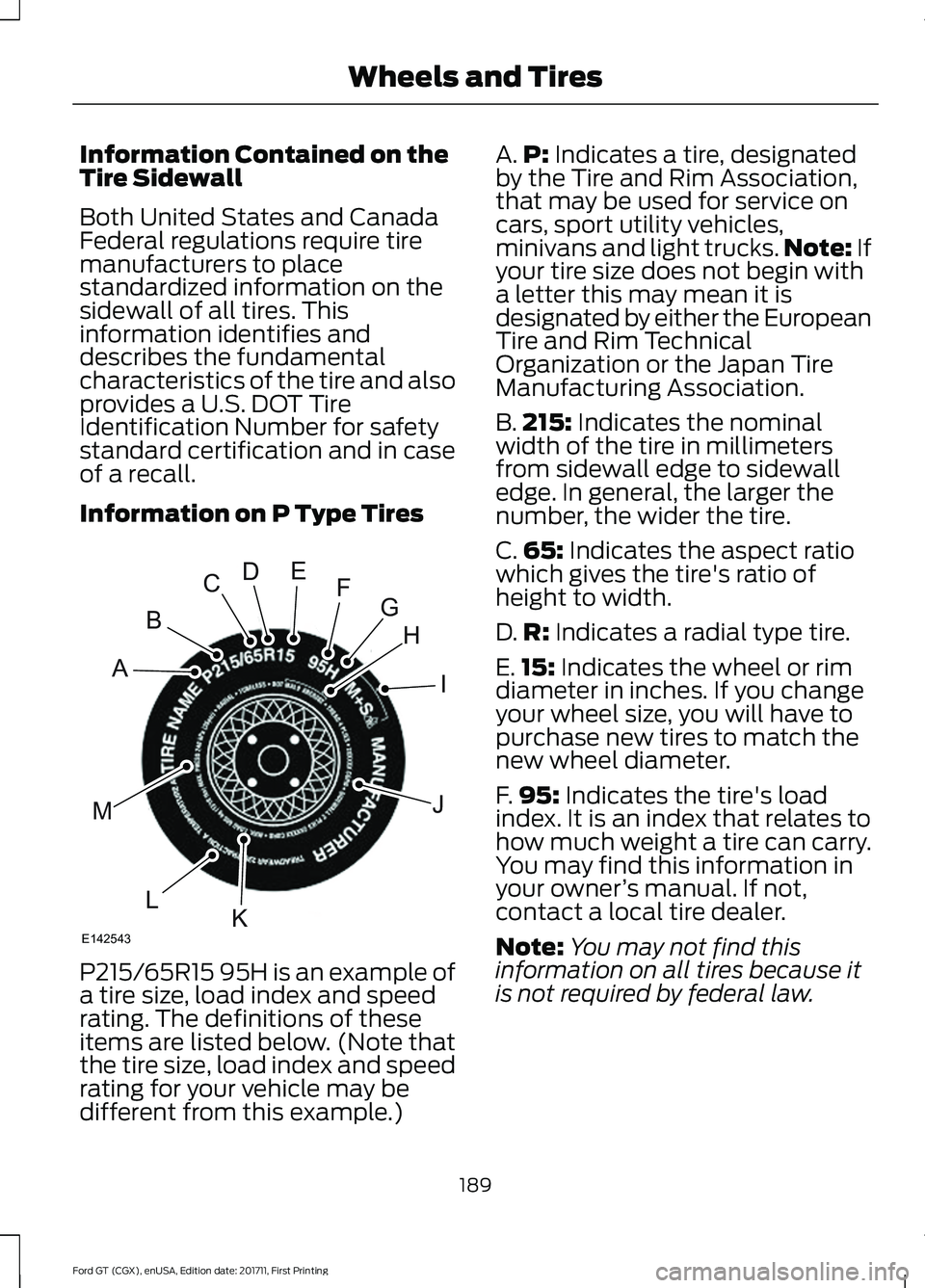
P215/65R15 95H is an example of
a tire size, load index and speed
rating. The definitions of these
items are listed below. (Note that
the tire size, load index and speed
rating for your vehicle may be
different from this example.) A.
P: Indicates a tire, designated
by the Tire and Rim Association,
that may be used for service on
cars, sport utility vehicles,
minivans and light trucks. Note:
If
your tire size does not begin with
a letter this may mean it is
designated by either the European
Tire and Rim Technical
Organization or the Japan Tire
Manufacturing Association.
B. 215:
Indicates the nominal
width of the tire in millimeters
from sidewall edge to sidewall
edge. In general, the larger the
number, the wider the tire.
C. 65:
Indicates the aspect ratio
which gives the tire's ratio of
height to width.
D. R:
Indicates a radial type tire.
E. 15:
Indicates the wheel or rim
diameter in inches. If you change
your wheel size, you will have to
purchase new tires to match the
new wheel diameter.
F. 95:
Indicates the tire's load
index. It is an index that relates to
how much weight a tire can carry.
You may find this information in
your owner ’s manual. If not,
contact a local tire dealer.
Note: You may not find this
information on all tires because it
is not required by federal law.
189
Ford GT (CGX), enUSA, Edition date: 201711, First Printing Wheels and TiresH
I
J
KL
M
A
B
CDEFG
E142543
Page 196 of 325
of the driver
’s door. Failure to
follow the tire pressure
recommendations can cause
uneven treadwear patterns and
adversely affect the way your
vehicle handles.
Maximum Inflation Pressure is
the tire manufacturer's maximum
permissible pressure and the
pressure at which the maximum
load can be carried by the tire. This
pressure is normally higher than
the manufacturer ’s recommended
cold inflation pressure which can
be found on the Safety
Compliance Certification Label
(affixed to either the door hinge
pillar, door-latch post, or the door
edge that meets the door-latch
post, next to the driver's seating
position), or Tire Label which is
located on the B-Pillar or the edge
of the driver ’s door. The cold
inflation pressure should never be
set lower than the recommended
pressure on the Safety
Compliance Certification Label or
Tire Label.
When weather temperature
changes occur, tire inflation
pressures also change. A
43°F
(6°C) temperature drop can
cause a corresponding drop of
1 psi (7 kPa)
in inflation pressure.
Check your tire pressures
frequently and adjust them to the
proper pressure which can be
found on the Safety Compliance
Certification Label or Tire Label.
To check the pressure in your
tire(s): 1. Make sure the tires are cool,
meaning they are not hot from
driving even a mile.
Note: If you are checking tire
pressure when the tire is hot, (for
example, driven more than
1 mi
(1.6 km)), never bleed or reduce air
pressure. The tires are hot from
driving and it is normal for
pressures to increase above
recommended cold pressures. A
hot tire at or below recommended
cold inflation pressure could be
significantly under-inflated.
Note: If you have to drive a
distance to get air for your tire(s),
check and record the tire pressure
first and add the appropriate air
pressure when you get to the
pump. It is normal for tires to heat
up and the air pressure inside to go
up as you drive.
2. Remove the cap from the valve
on one tire, then firmly press
the tire gauge onto the valve
and measure the pressure.
3. Add enough air to reach the
recommended air pressure.
Note: If you overfill the tire, release
air by pressing on the metal stem
in the center of the valve. Then
recheck the pressure with your tire
gauge.
4. Replace the valve cap.
5. Repeat this procedure for each
tire, including the spare.
193
Ford GT (CGX), enUSA, Edition date: 201711, First Printing Wheels and Tires
Page 202 of 325
WARNINGS
If the tire pressure monitor sensor
becomes damaged it may not
function.
Each tire should be checked
monthly when cold and inflated
to the inflation pressure
recommended by the vehicle manufacturer
on the vehicle placard or tire inflation
pressure label. (If your vehicle has tires of
a different size than the size indicated on
the vehicle placard or tire inflation pressure
label, you should determine the proper tire
inflation pressure for those tires.)
As an added safety feature, your vehicle
has been equipped with a Tire Pressure
Monitoring System (TPMS) that
illuminates a low tire pressure telltale
when one or more of your tires is
significantly under-inflated. Accordingly,
when the low tire pressure telltale
illuminates, you should stop and check
your tires as soon as possible, and inflate
them to the proper pressure. Driving on a
significantly under-inflated tire causes the
tire to overheat and can lead to tire failure.
Under-inflation also reduces fuel efficiency
and tire tread life, and may affect the
vehicle ’s handling and stopping ability.
Please note that the TPMS is not a
substitute for proper tire maintenance, and
it is the driver ’s responsibility to maintain
correct tire pressure, even if under-inflation
has not reached the level to trigger
illumination of the TPMS low tire pressure
telltale. Your vehicle has also been equipped with
a TPMS malfunction indicator to indicate
when the system is not operating properly.
The TPMS malfunction indicator is
combined with the low tire pressure
telltale. When the system detects a
malfunction, the telltale flashes for
approximately one minute and then
remains illuminated. This sequence
continues upon subsequent vehicle
start-ups as long as the malfunction exists.
When the malfunction indicator is
illuminated, the system may not be able
to detect or signal low tire pressure as
intended. TPMS malfunctions may occur
for a variety of reasons, including the
installation of replacement or alternate
tires or wheels on the vehicle that prevent
the TPMS from functioning properly.
Always check the TPMS malfunction
telltale after replacing one or more tires or
wheels on your vehicle to ensure that the
replacement or alternate tires and wheels
allow the TPMS to continue to function
properly.
This device complies with Part 15 of the
FCC Rules and with Licence exempt RSS
Standards of Industry Canada. Operation
is subject to the following two conditions:
•
This device may not cause harmful
interference, and
• This device must accept any
interference received, including
interference that may cause undesired
operation. WARNING
Changes or modifications not
expressively approved by the party
responsible for compliance could
void the user's authority to operate the
equipment. The term "IC:" before the radio
certification number only signifies that
Industry Canada technical specifications
were met. 199
Ford GT (CGX), enUSA, Edition date: 201711, First Printing Wheels and Tires
Page 205 of 325
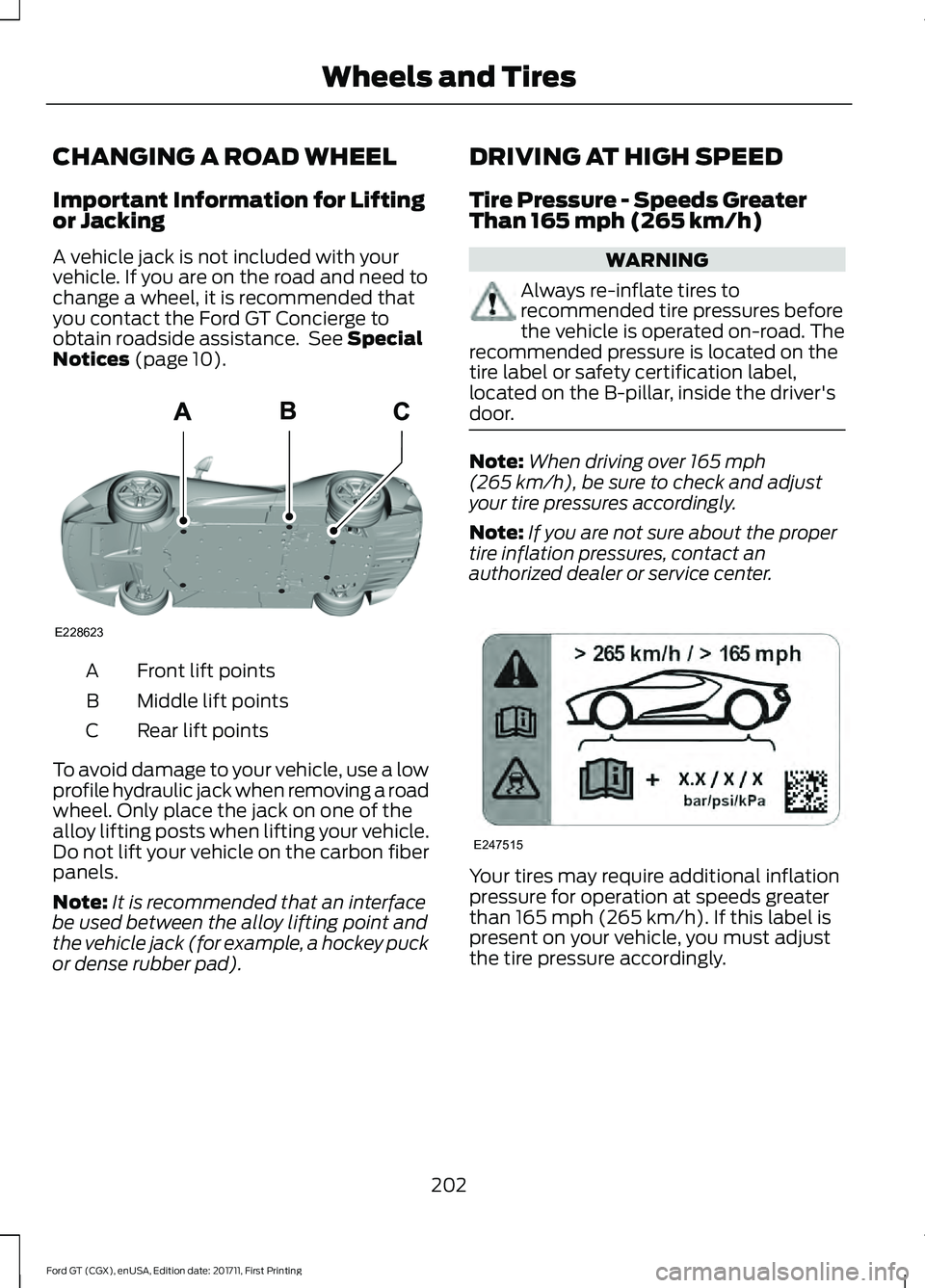
CHANGING A ROAD WHEEL
Important Information for Lifting
or Jacking
A vehicle jack is not included with your
vehicle. If you are on the road and need to
change a wheel, it is recommended that
you contact the Ford GT Concierge to
obtain roadside assistance. See Special
Notices (page 10). Front lift points
A
Middle lift points
B
Rear lift points
C
To avoid damage to your vehicle, use a low
profile hydraulic jack when removing a road
wheel. Only place the jack on one of the
alloy lifting posts when lifting your vehicle.
Do not lift your vehicle on the carbon fiber
panels.
Note: It is recommended that an interface
be used between the alloy lifting point and
the vehicle jack (for example, a hockey puck
or dense rubber pad). DRIVING AT HIGH SPEED
Tire Pressure - Speeds Greater
Than
165 mph (265 km/h) WARNING
Always re-inflate tires to
recommended tire pressures before
the vehicle is operated on-road. The
recommended pressure is located on the
tire label or safety certification label,
located on the B-pillar, inside the driver's
door. Note:
When driving over
165 mph
(265 km/h), be sure to check and adjust
your tire pressures accordingly.
Note: If you are not sure about the proper
tire inflation pressures, contact an
authorized dealer or service center. Your tires may require additional inflation
pressure for operation at speeds greater
than
165 mph (265 km/h). If this label is
present on your vehicle, you must adjust
the tire pressure accordingly.
202
Ford GT (CGX), enUSA, Edition date: 201711, First Printing Wheels and TiresE228623 E247515
Page 206 of 325
TECHNICAL SPECIFICATIONS
Wheel Lug Nut Torque Specifications
WARNING
When you install a wheel, always remove any corrosion, dirt or foreign materials
present on the mounting surfaces of the wheel or the surface of the wheel hub,
brake drum or brake disc that contacts the wheel. Make sure to secure any fasteners
that attach the rotor to the hub so they do not interfere with the mounting surfaces of
the wheel. Installing wheels without correct metal-to-metal contact at the wheel mounting
surfaces can cause the wheel nuts to loosen and the wheel to come off while your vehicle
is in motion, resulting in loss of vehicle control, personal injury or death. Ib-ft (Nm)
*
Bolt size
150 lb.ft (204 Nm)
M14 X 1.5
* Torque specifications are for nut and bolt threads free of dirt and rust. Use only Ford
recommended replacement fasteners.
Retighten the lug nuts to the specified torque within 100 miles (160 kilometers) after any
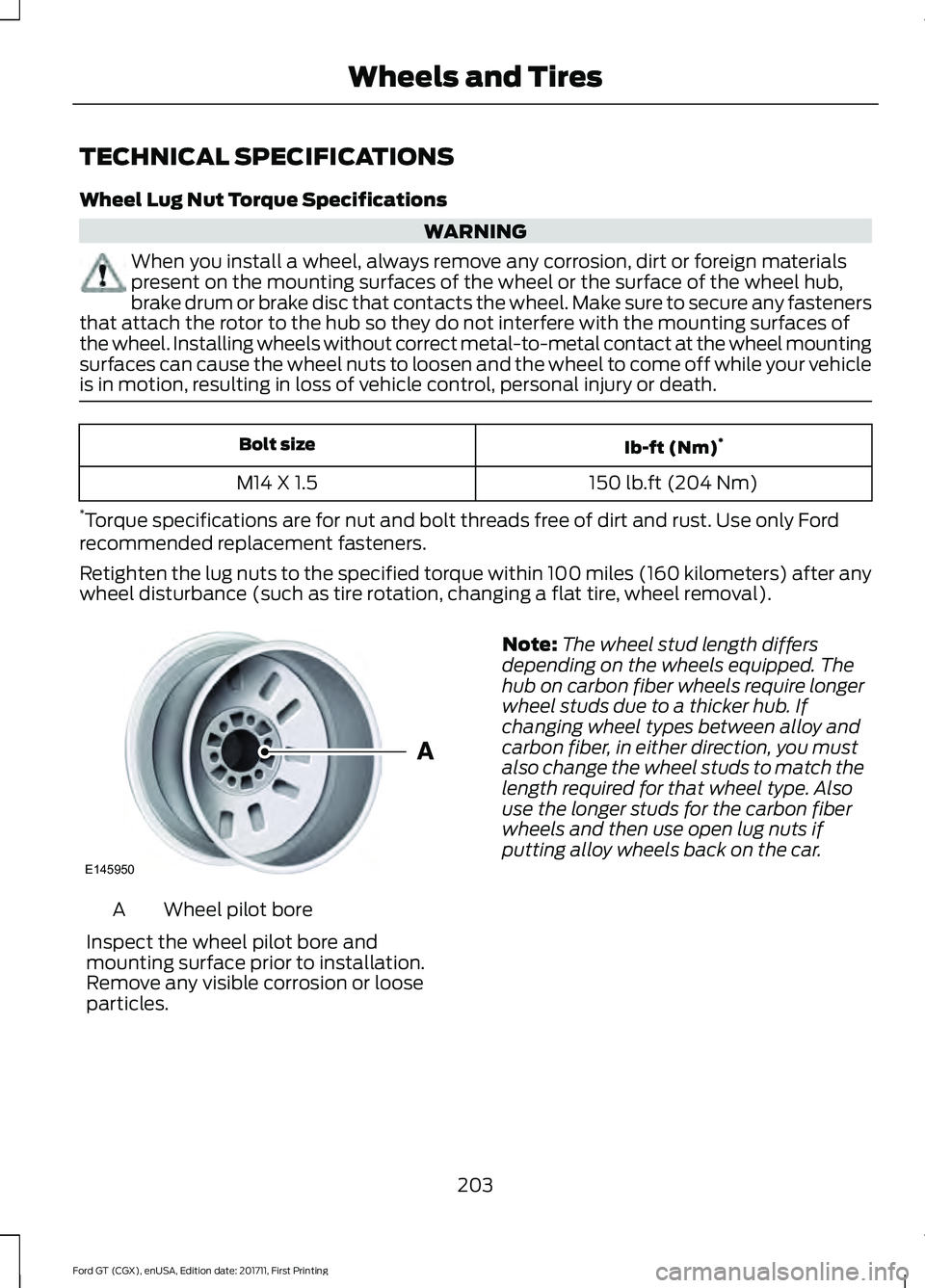
wheel disturbance (such as tire rotation, changing a flat tire, wheel removal). Wheel pilot bore
A
Inspect the wheel pilot bore and
mounting surface prior to installation.
Remove any visible corrosion or loose
particles. Note:
The wheel stud length differs
depending on the wheels equipped. The
hub on carbon fiber wheels require longer
wheel studs due to a thicker hub. If
changing wheel types between alloy and
carbon fiber, in either direction, you must
also change the wheel studs to match the
length required for that wheel type. Also
use the longer studs for the carbon fiber
wheels and then use open lug nuts if
putting alloy wheels back on the car.
203
Ford GT (CGX), enUSA, Edition date: 201711, First Printing Wheels and TiresE145950
Page 239 of 325
Action and Description
Menu Item
Item
You can also sort the calls by selecting the drop down
menu at the top of the screen. You can choose: Missed
Outgoing
Incoming
All
All of your contacts from your phone display in alphabet-
ical order.
Contacts
B
Selecting this button allows
you to choose a specific letter
to view.
A-Z Jump
Displays the name of your phone and takes you to the
phone settings options.
Phone
Settings
C
From this menu, you can pair subsequent devices, set ring
tones and alerts.
Gives you access to the list of paired or connected
Bluetooth devices allowing you to change or select a
device.
Change
Device
D
Displays all recent text messages.
Text
Messages
E
Use this keypad to dial in a phone number.
Phone
Keypad
F
Use the backspace button to delete numbers.
Press this button to begin a
call.
Call
Touch this button to reject all incoming calls automatic-
ally. Text message notifications do not display on the
screen. All ringtones and alerts are set to silent.
Do Not
Disturb
G
Users with phones having voice services
may see a button to access the feature.
For example, iPhone users see a Siri button.
A press and hold of the voice button on the
steering wheel also accesses this feature.
Making Calls
There are many ways to make calls from
the SYNC 3 system, including using voice
commands. See Using Voice
Recognition (page 224). You can use the
touchscreen to place calls as well.
236
Ford GT (CGX), enUSA, Edition date: 201711, First Printing SYNC™ 3
(If Equipped)
Page 280 of 325
Before Operating Your Vehicle at High
Speeds:
•
Verify your tires have the correct
pressures See Technical
Specifications (page 203).
• Inspect wheels and tires for wear and
damage. Replace any damaged wheels
and tires.
• Check and set lug nut torque. See
Technical Specifications (page 203).
• Verify fluid levels for oil, coolant, brake,
and hydraulic fluid. See Maintenance
(page
157).
• Change the oil and filter prior to use on
the track. After Operating Your vehicle at High
Speeds and Track Day Driving, Do the
Following:
•
Set tire pressures to specification.
• Check and set lug nut torque. See
Technical Specifications (page 203).
• Check all fluid levels.
• If you drive your car for an extended
period of time at high speed or on the
track for an extended time, change the
oil and filter.
SCHEDULED MAINTENANCE RECORD 277
Ford GT (CGX), enUSA, Edition date: 201711, First Printing Scheduled MaintenanceE146852
Repair Order #:Distance:
Engine hours (optional): Multi-point inspection (recommended): Signature:
Dealer stamp
Page 319 of 325
Child Restraint and Seatbelt
Maintenance..................................................31
Child Restraint Positioning.........................24
Child Safety........................................................17
General Information............................................. 17
Cleaning Leather Seats
...............................176
Cleaning Products.........................................172
Materials................................................................. 172
Cleaning the Engine.....................................174
Cleaning the Exterior....................................172 Exterior Plastic Parts.......................................... 174
Matte Paint Finish............................................... 173
Raising the Rear Wing....................................... 174
Standard Paint Finish........................................ 173
Under Hood........................................................... 174
Cleaning the Instrument Panel and Instrument Cluster Lens..........................176
Cleaning the Interior.....................................175 Cleaning Alcantara Microfiber Cloth............175
Cleaning the Wheels....................................177
Cleaning the Windows and Wiper Blades
.............................................................175
Climate Control..............................................80
Coolant Check See: Engine Coolant Check............................. 162
Crash Sensors and Airbag Indicator.......38
Cruise Control
..................................................53
Principle of Operation........................................ 121
Cruise control See: Using Cruise Control................................. 121
Cup Holders
.....................................................89
Customer Assistance.................................140
D
Data Recording
..................................................7
Event Data Recording........................................... 8
Service Data Recording......................................... 7
Daytime Running Lamps
.............................59
Direction Indicators.......................................60
Doors and Locks.............................................46
Drive Mode Control.......................................54 Active Aerodynamics ....................................... 126
Damper Comfort Mode.................................... 126
Drive Mode Selection......................................... 122
Front Lift................................................................. 126
Driver and Passenger Airbags...................34 Children and Airbags........................................... 34Proper Driver and Front Passenger Seating
Adjustment........................................................ 34
Driver and Passenger Knee Airbags
.........37
Driving Aids......................................................122
Driving at High Speed................................202 Tire Pressure - Speeds Greater Than
........................................................................\
..... 202
Driving Hints
...................................................134
Driving Through Water................................134
DRL See: Daytime Running Lamps......................... 59
E
Electric Parking Brake
...................................112
Applying the Electric Parking brake..............112
Battery With No Charge.................................... 113
Releasing the Electric Parking Brake............113
Emergency Door Release............................49
Emission Control System...........................99 On-Board Diagnostics (OBD-II)................... 100
Readiness for Inspection and Maintenance (I/M) Testing................................................... 100
Emission Law
.................................................102
Noise Emissions Warranty, Prohibited
Tampering Acts and Maintenance..........103
Tampering With a Noise Control System............................................................... 102
End User License Agreement.................288 VEHICLE SOFTWARE END USER LICENSE
AGREEMENT (EULA) ................................ 288
Engine Coolant Check
................................162
Adding Coolant.................................................... 162
Coolant Change.................................................. 164
Engine Coolant Temperature Management................................................... 165
Fail-Safe Cooling................................................ 164
Recycled Coolant................................................ 163
Severe Climates.................................................. 164
Engine Emission Control
............................102
Engine Immobilizer See: Passive Anti-Theft System..................... 50
Engine Oil Check............................................161 Adding Engine Oil................................................ 161
Engine Oil Dipstick........................................161
Engine Specifications................................204
Entertainment..............................................230 AM/FM Radio....................................................... 231
316
Ford GT (CGX), enUSA, Edition date: 201711, First Printing Index
Page 323 of 325
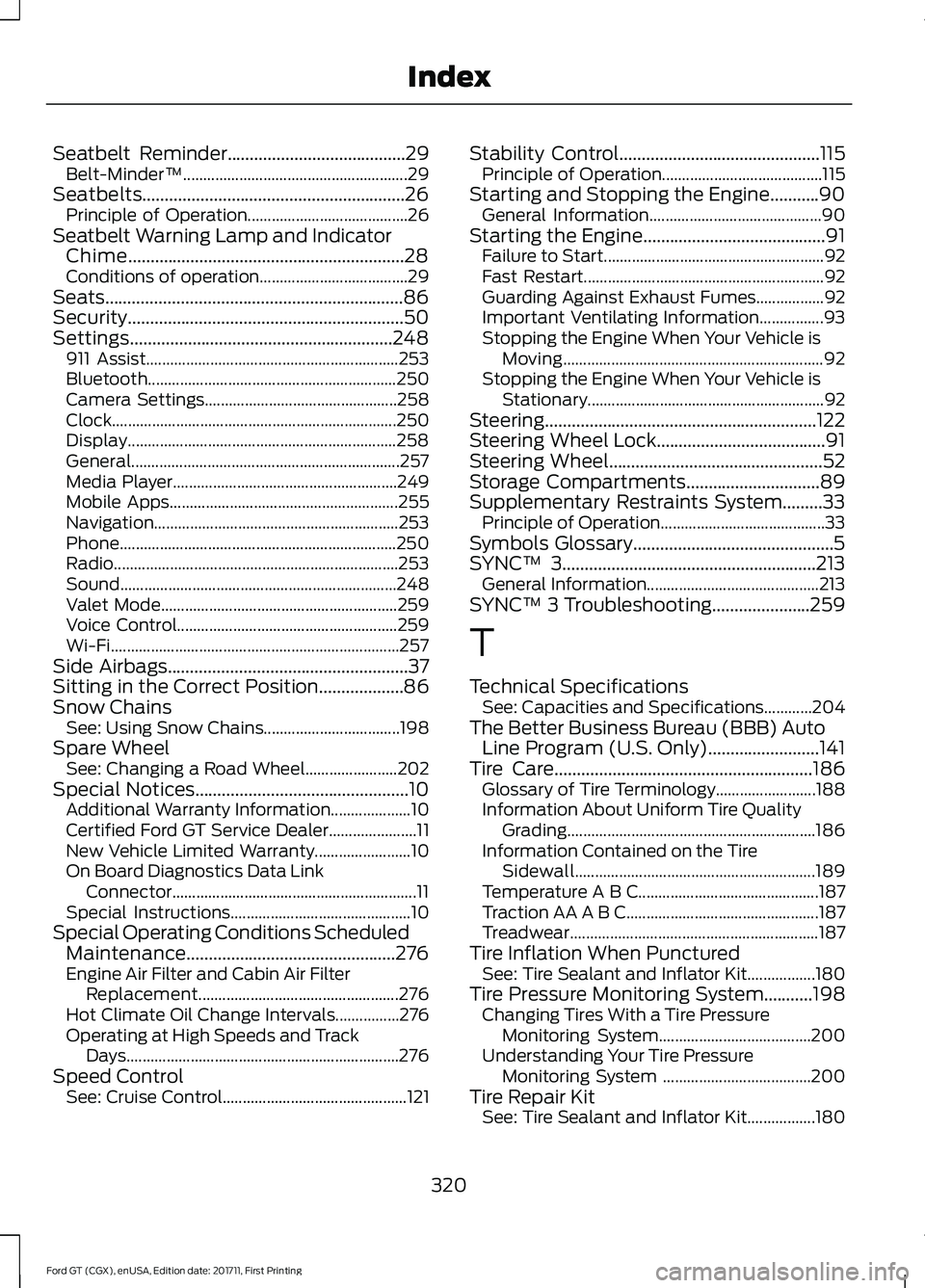
Seatbelt Reminder........................................29
Belt-Minder™........................................................ 29
Seatbelts...........................................................26 Principle of Operation........................................ 26
Seatbelt Warning Lamp and Indicator Chime..............................................................28
Conditions of operation..................................... 29
Seats...................................................................86
Security..............................................................50
Settings...........................................................248 911 Assist............................................................... 253
Bluetooth.............................................................. 250
Camera Settings................................................ 258
Clock....................................................................... 250
Display................................................................... 258
General................................................................... 257
Media Player........................................................ 249
Mobile Apps......................................................... 255
Navigation............................................................. 253
Phone..................................................................... 250
Radio....................................................................... 253
Sound..................................................................... 248
Valet Mode........................................................... 259
Voice Control....................................................... 259
Wi-Fi........................................................................\
257
Side Airbags......................................................37
Sitting in the Correct Position...................86
Snow Chains See: Using Snow Chains.................................. 198
Spare Wheel See: Changing a Road Wheel....................... 202
Special Notices
................................................10
Additional Warranty Information.................... 10
Certified Ford GT Service Dealer...................... 11
New Vehicle Limited Warranty........................ 10
On Board Diagnostics Data Link Connector
............................................................. 11
Special Instructions............................................. 10
Special Operating Conditions Scheduled Maintenance...............................................276
Engine Air Filter and Cabin Air Filter Replacement.................................................. 276
Hot Climate Oil Change Intervals................276
Operating at High Speeds and Track Days.................................................................... 276
Speed Control See: Cruise Control.............................................. 121Stability Control
.............................................115
Principle of Operation........................................ 115
Starting and Stopping the Engine...........90 General Information........................................... 90
Starting the Engine.........................................91 Failure to Start....................................................... 92
Fast Restart............................................................ 92
Guarding Against Exhaust Fumes.................92
Important Ventilating Information................93
Stopping the Engine When Your Vehicle is Moving................................................................. 92
Stopping the Engine When Your Vehicle is Stationary........................................................... 92
Steering.............................................................122
Steering Wheel Lock......................................91
Steering Wheel
................................................52
Storage Compartments..............................89
Supplementary Restraints System.........33 Principle of Operation......................................... 33
Symbols Glossary.............................................5
SYNC™ 3.........................................................213 General Information........................................... 213
SYNC™ 3 Troubleshooting
......................259
T
Technical Specifications See: Capacities and Specifications............204
The Better Business Bureau (BBB) Auto Line Program (U.S. Only).........................141
Tire Care
..........................................................186
Glossary of Tire Terminology......................... 188
Information About Uniform Tire Quality Grading.............................................................. 186
Information Contained on the Tire Sidewall............................................................ 189
Temperature A B C............................................. 187
Traction AA A B C................................................ 187
Treadwear.............................................................. 187
Tire Inflation When Punctured See: Tire Sealant and Inflator Kit.................180
Tire Pressure Monitoring System...........198 Changing Tires With a Tire Pressure
Monitoring System...................................... 200
Understanding Your Tire Pressure Monitoring System ..................................... 200
Tire Repair Kit See: Tire Sealant and Inflator Kit.................180
320
Ford GT (CGX), enUSA, Edition date: 201711, First Printing Index