battery FORD GT 2018 Owner's Manual
[x] Cancel search | Manufacturer: FORD, Model Year: 2018, Model line: GT, Model: FORD GT 2018Pages: 325, PDF Size: 6.61 MB
Page 112 of 325
If you cannot move the selector out of park
(P) position with the ignition in the on
position and the brake pedal pressed, a
malfunction may have occurred. It is
possible that a fuse has blown or your
vehicle
’s brake lamps are not operating
properly. See Fuse Specification Chart
(page 146).
If the fuse is good and the brake lamps are
functioning, then there may be a fault in
the system. To roll the car or to allow the
vehicle to be transported for repair, use the
following procedure to place the
transmission into neutral (N) manually. To
place the transmission into neutral (N) in
the event of a battery failure, or other
electrical fault that prevents the shifter
from working, use this procedure.
Manually Placing the Transmission in
Park Override
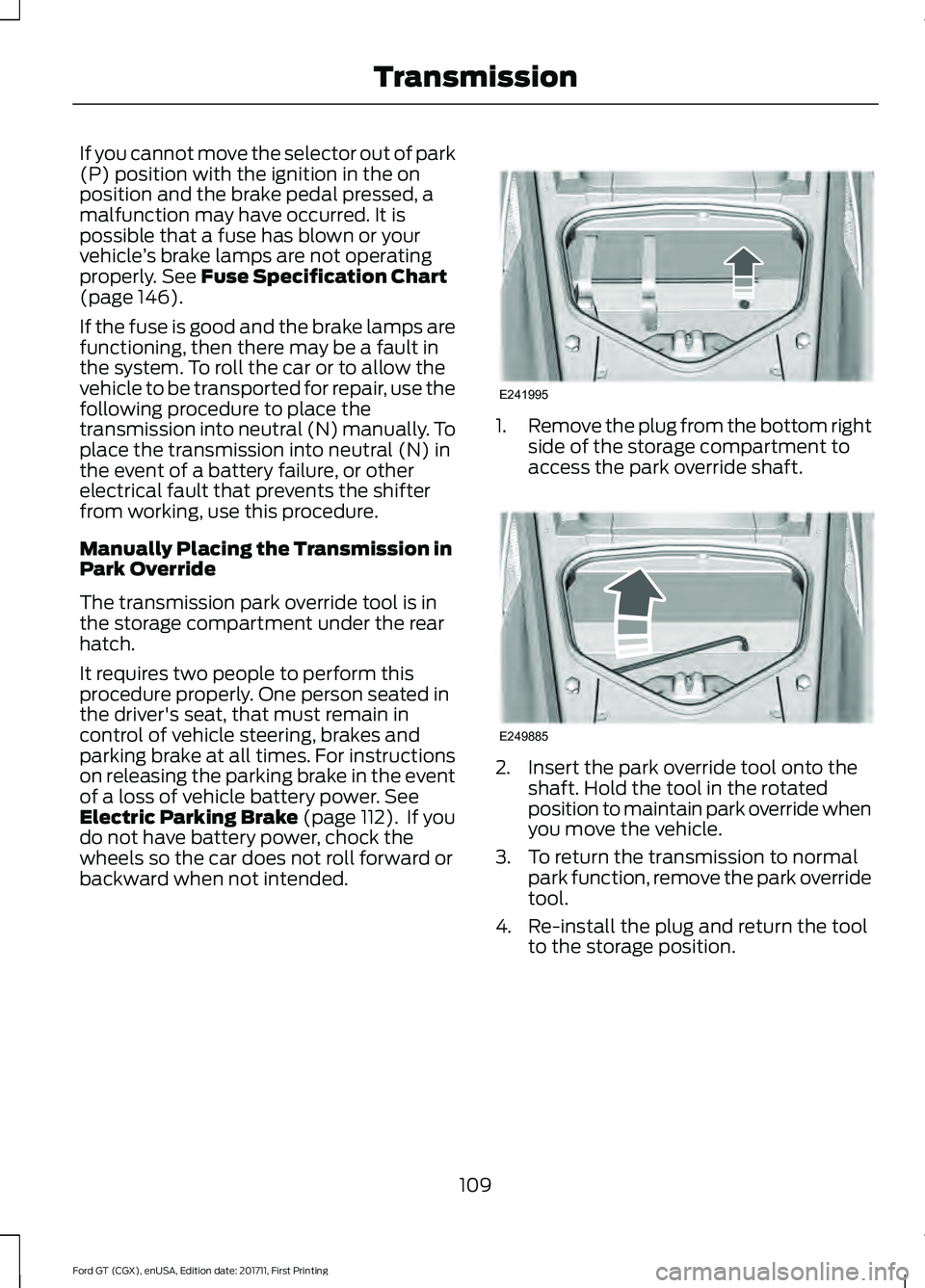
The transmission park override tool is in
the storage compartment under the rear
hatch.
It requires two people to perform this
procedure properly. One person seated in
the driver's seat, that must remain in
control of vehicle steering, brakes and
parking brake at all times. For instructions
on releasing the parking brake in the event
of a loss of vehicle battery power.
See
Electric Parking Brake (page 112). If you
do not have battery power, chock the
wheels so the car does not roll forward or
backward when not intended. 1.
Remove the plug from the bottom right
side of the storage compartment to
access the park override shaft. 2. Insert the park override tool onto the
shaft. Hold the tool in the rotated
position to maintain park override when
you move the vehicle.
3. To return the transmission to normal park function, remove the park override
tool.
4. Re-install the plug and return the tool to the storage position.
109
Ford GT (CGX), enUSA, Edition date: 201711, First Printing TransmissionE241995 E249885
Page 116 of 325
Releasing the Electric Parking
Brake
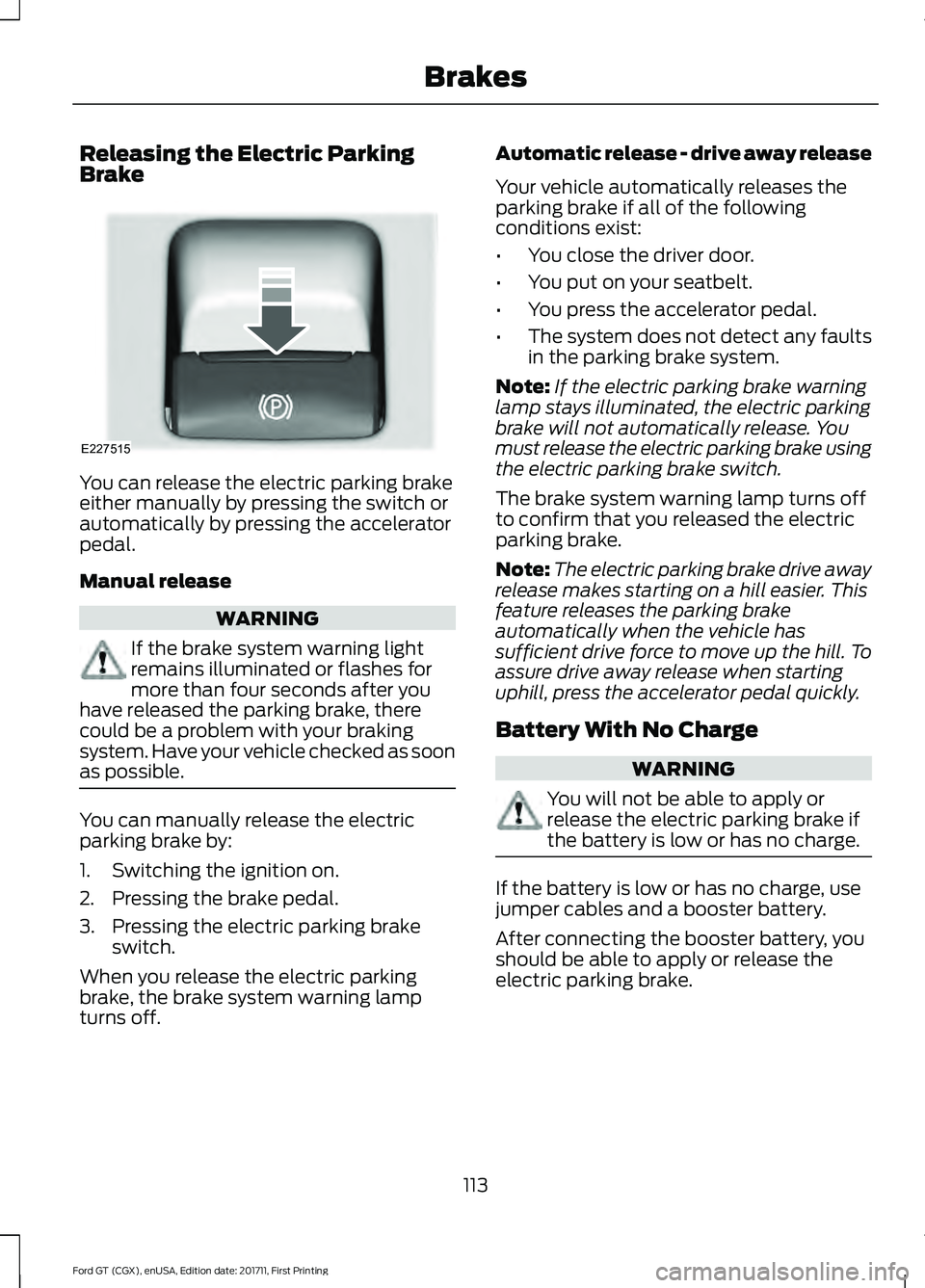
You can release the electric parking brake
either manually by pressing the switch or
automatically by pressing the accelerator
pedal.
Manual release
WARNING
If the brake system warning light
remains illuminated or flashes for
more than four seconds after you
have released the parking brake, there
could be a problem with your braking
system. Have your vehicle checked as soon
as possible. You can manually release the electric
parking brake by:
1. Switching the ignition on.
2. Pressing the brake pedal.
3. Pressing the electric parking brake
switch.
When you release the electric parking
brake, the brake system warning lamp
turns off. Automatic release - drive away release
Your vehicle automatically releases the
parking brake if all of the following
conditions exist:
•
You close the driver door.
• You put on your seatbelt.
• You press the accelerator pedal.
• The system does not detect any faults
in the parking brake system.
Note: If the electric parking brake warning
lamp stays illuminated, the electric parking
brake will not automatically release. You
must release the electric parking brake using
the electric parking brake switch.
The brake system warning lamp turns off
to confirm that you released the electric
parking brake.
Note: The electric parking brake drive away
release makes starting on a hill easier. This
feature releases the parking brake
automatically when the vehicle has
sufficient drive force to move up the hill. To
assure drive away release when starting
uphill, press the accelerator pedal quickly.
Battery With No Charge WARNING
You will not be able to apply or
release the electric parking brake if
the battery is low or has no charge.
If the battery is low or has no charge, use
jumper cables and a booster battery.
After connecting the booster battery, you
should be able to apply or release the
electric parking brake.
113
Ford GT (CGX), enUSA, Edition date: 201711, First Printing BrakesE227515
Page 139 of 325
ROADSIDE ASSISTANCE
Vehicles Sold in the United States:
Getting Roadside Assistance
To fully assist you should you have a
vehicle concern, Ford Motor Company
offers a complimentary roadside
assistance program. This program is
separate from the New Vehicle Limited
Warranty.
The service is available:
•
24 hours a day, seven days a week.
• The coverage period is three years from
the date of purchase.
Roadside Assistance covers:
• Assistance with a flat tire.
• Battery jump start.
• Lock-out assistance (key replacement
cost is the customer's responsibility).
• Assistance if your vehicle runs out of
fuel.
• Winch out — available if your vehicle is
stuck.
• Towing — Ford dealership or
independent service contractors, if not
prohibited by state, local or municipal
law, shall tow your vehicle to the
nearest Certified Ford GT Dealership.
Vehicles Sold in the United States:
Using Roadside Assistance
United States Ford GT customers who
require Roadside Assistance, call the Ford
GT Concierge at 800-210-5795.
If you need to arrange roadside assistance
for yourself, Ford Motor Company
reimburses a reasonable amount for
towing to the nearest authorized
dealership. To obtain reimbursement
information, contact the Ford GT Concierge
at 800-210-5795. For assistance outside of the United
States, refer to the complete list of Ford
GT Concierge phone numbers. See About
This Manual (page 5).
HAZARD FLASHERS
Note: The hazard flashers operate when
the ignition is in any position. If used when
the vehicle is not running, the battery loses
charge. As a result, there may be insufficient
power to restart your vehicle. The hazard flasher control is on
the floor console. Use your
hazard flashers when your
vehicle is creating a safety hazard for other
motorists.
• Press the flasher control and all front
and rear direction indicators flash.
• Press the button again to switch them
off.
FUEL SHUTOFF WARNING
If your vehicle has been involved in a
crash, have the fuel system checked.
Failure to follow this instruction
could result in fire, personal injury or death. Note:
When you try to restart your vehicle
after a fuel shutoff, the vehicle makes sure
that various systems are safe to restart.
Once the vehicle determines the systems
are safe, then the vehicle allows you to
restart.
Note: In the event that your vehicle does
not restart after your third attempt, contact
a qualified technician.
The fuel pump shutoff stops the flow of
fuel to the engine in the event of a
moderate to severe crash. Not every
impact causes a shutoff.
136
Ford GT (CGX), enUSA, Edition date: 201711, First Printing Roadside EmergenciesE142663
Page 140 of 325
Should your vehicle shut off after a crash,
you may restart your vehicle.
1. Press START/STOP to switch off your
vehicle.
2. Press the brake pedal and START/STOP
to switch on your
vehicle.
3. Remove your foot from the brake pedal
and press
START/STOP to switch off
your vehicle.
4. You can attempt to start the vehicle by pressing the brake pedal and
START/STOP
, or press START/STOP
without pressing the brake pedal.
Note: Both methods re-enable the fuel
system.
JUMP STARTING THE VEHICLE WARNINGS
Do not use fuel lines, engine valve
covers, windshield wiper arms, the
intake manifold, or hood latch as
ground points. Use only adequately sized cables
with insulated clamps.
Preparing Your Vehicle
Note:
Attempting to push-start a vehicle
with an automatic transmission may cause
transmission damage.
Note: Use only a 12-volt supply to start your
vehicle.
Note: Do not disconnect the battery of the
disabled vehicle as this could damage the
vehicle's electrical system.
Park the booster vehicle close to the hood
of the disabled vehicle, making sure the
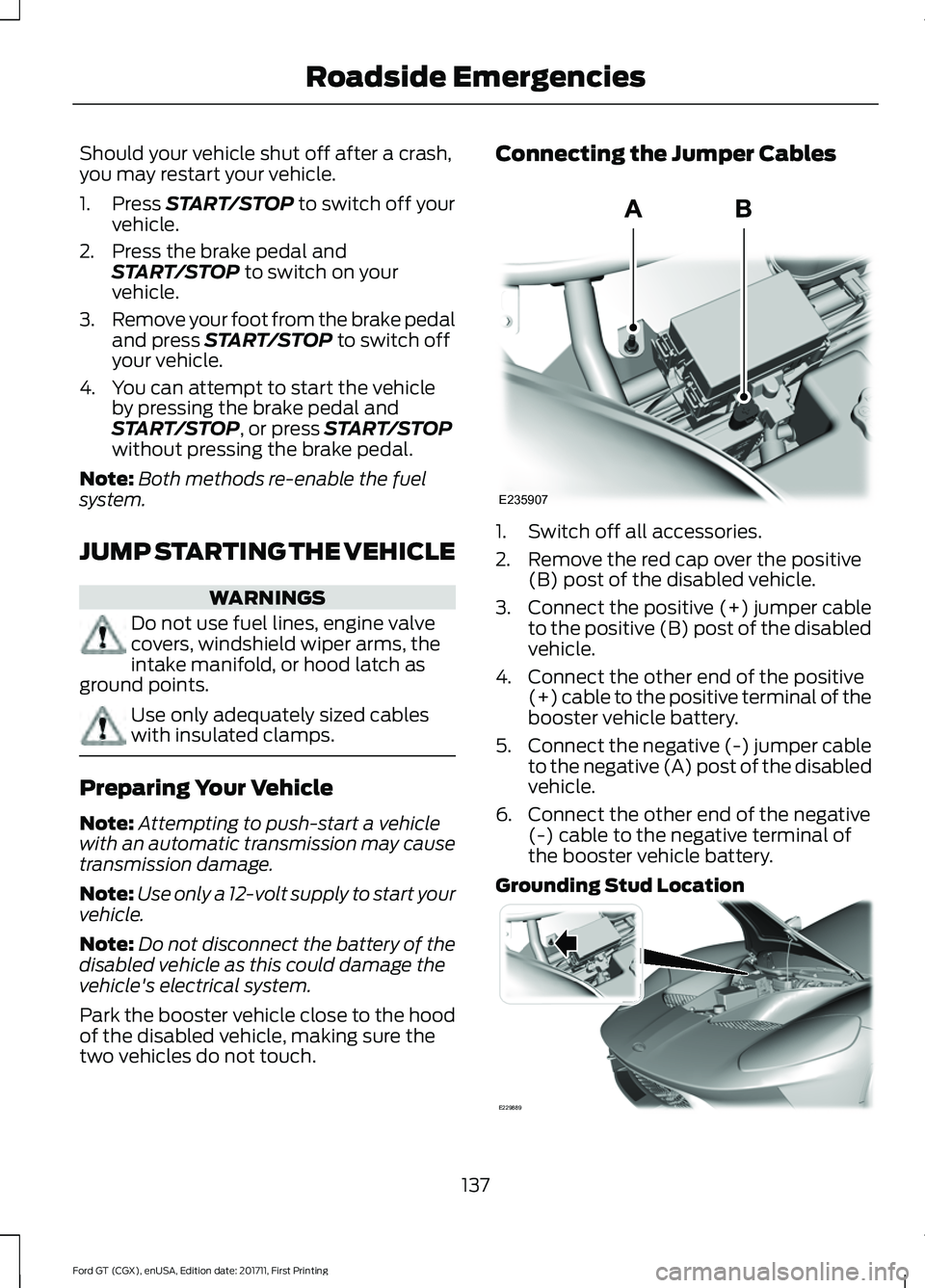
two vehicles do not touch. Connecting the Jumper Cables
1. Switch off all accessories.
2. Remove the red cap over the positive
(B) post of the disabled vehicle.
3. Connect the positive (+) jumper cable
to the positive (B) post of the disabled
vehicle.
4. Connect the other end of the positive (+) cable to the positive terminal of the
booster vehicle battery.
5. Connect the negative (-) jumper cable
to the negative (A) post of the disabled
vehicle.
6. Connect the other end of the negative (-) cable to the negative terminal of
the booster vehicle battery.
Grounding Stud Location 137
Ford GT (CGX), enUSA, Edition date: 201711, First Printing Roadside EmergenciesE235907 E229889
Page 141 of 325
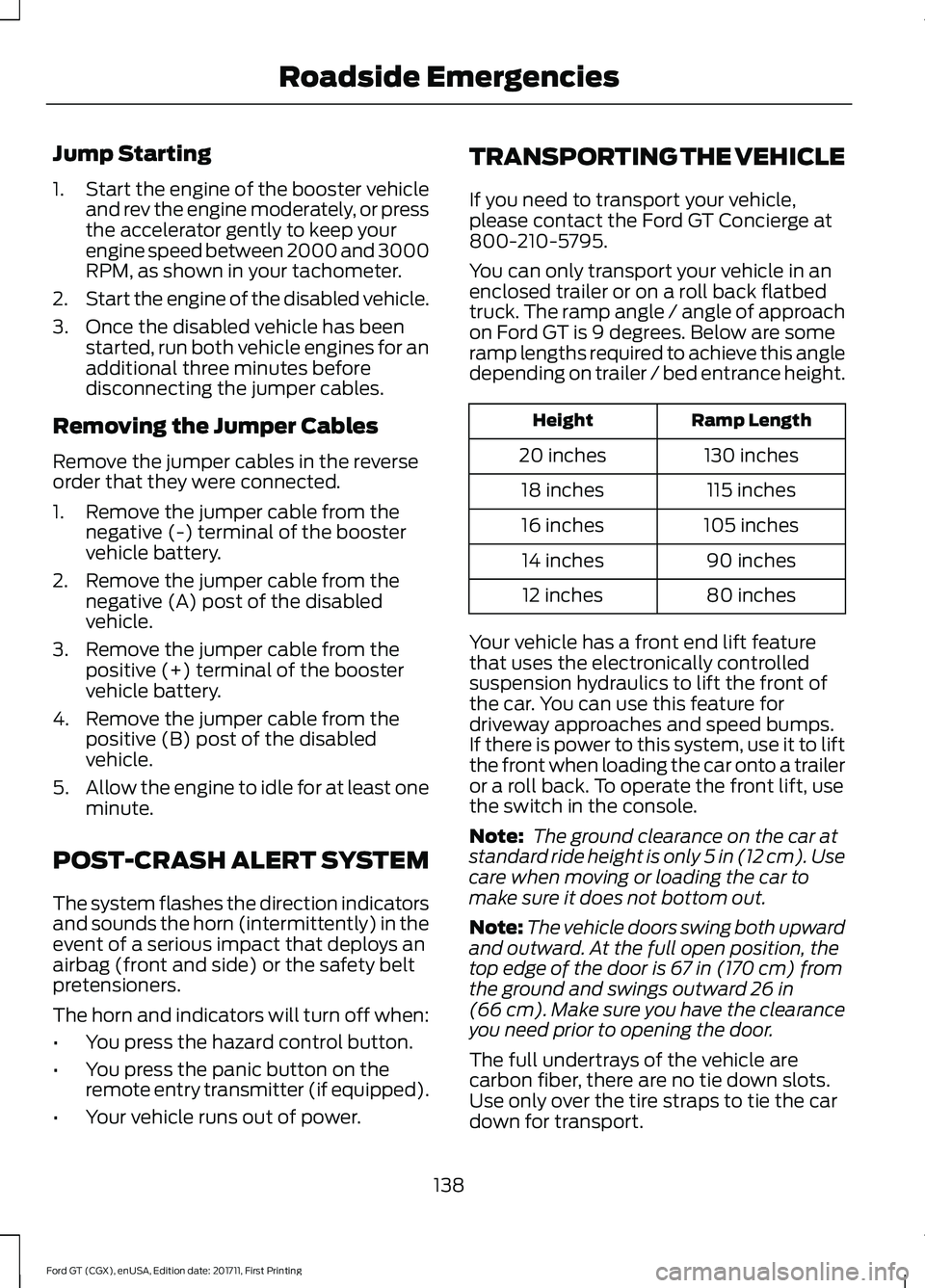
Jump Starting
1.
Start the engine of the booster vehicle
and rev the engine moderately, or press
the accelerator gently to keep your
engine speed between 2000 and 3000
RPM, as shown in your tachometer.
2. Start the engine of the disabled vehicle.
3. Once the disabled vehicle has been started, run both vehicle engines for an
additional three minutes before
disconnecting the jumper cables.
Removing the Jumper Cables
Remove the jumper cables in the reverse
order that they were connected.
1. Remove the jumper cable from the negative (-) terminal of the booster
vehicle battery.
2. Remove the jumper cable from the negative (A) post of the disabled
vehicle.
3. Remove the jumper cable from the positive (+) terminal of the booster
vehicle battery.
4. Remove the jumper cable from the positive (B) post of the disabled
vehicle.
5. Allow the engine to idle for at least one
minute.
POST-CRASH ALERT SYSTEM
The system flashes the direction indicators
and sounds the horn (intermittently) in the
event of a serious impact that deploys an
airbag (front and side) or the safety belt
pretensioners.
The horn and indicators will turn off when:
• You press the hazard control button.
• You press the panic button on the
remote entry transmitter (if equipped).
• Your vehicle runs out of power. TRANSPORTING THE VEHICLE
If you need to transport your vehicle,
please contact the Ford GT Concierge at
800-210-5795.
You can only transport your vehicle in an
enclosed trailer or on a roll back flatbed
truck. The ramp angle / angle of approach
on Ford GT is 9 degrees. Below are some
ramp lengths required to achieve this angle
depending on trailer / bed entrance height.
Ramp Length
Height
130 inches
20 inches
115 inches
18 inches
105 inches
16 inches
90 inches
14 inches
80 inches
12 inches
Your vehicle has a front end lift feature
that uses the electronically controlled
suspension hydraulics to lift the front of
the car. You can use this feature for
driveway approaches and speed bumps.
If there is power to this system, use it to lift
the front when loading the car onto a trailer
or a roll back. To operate the front lift, use
the switch in the console.
Note: The ground clearance on the car at
standard ride height is only 5 in (12 cm). Use
care when moving or loading the car to
make sure it does not bottom out.
Note: The vehicle doors swing both upward
and outward. At the full open position, the
top edge of the door is 67 in (170 cm) from
the ground and swings outward 26 in
(66 cm). Make sure you have the clearance
you need prior to opening the door.
The full undertrays of the vehicle are
carbon fiber, there are no tie down slots.
Use only over the tire straps to tie the car
down for transport.
138
Ford GT (CGX), enUSA, Edition date: 201711, First Printing Roadside Emergencies
Page 142 of 325
Getting the Transmission in
Neutral
If the battery loses charge, the
transmission will be in park (P). You can
use the transmission tool to place the car
into Neutral (N). See Automatic
Transmission (page 106).
TOWING POINTS
Recovery Hook Location
Your vehicle comes with a screw-in
recovery hook, it is in the storage
compartment under the rear hatch.
Installing the Recovery Hook
Note: The screw-in recovery hook has a
left-hand thread. Turn it counterclockwise
to install it. Make sure that the recovery
hook is fully tightened.
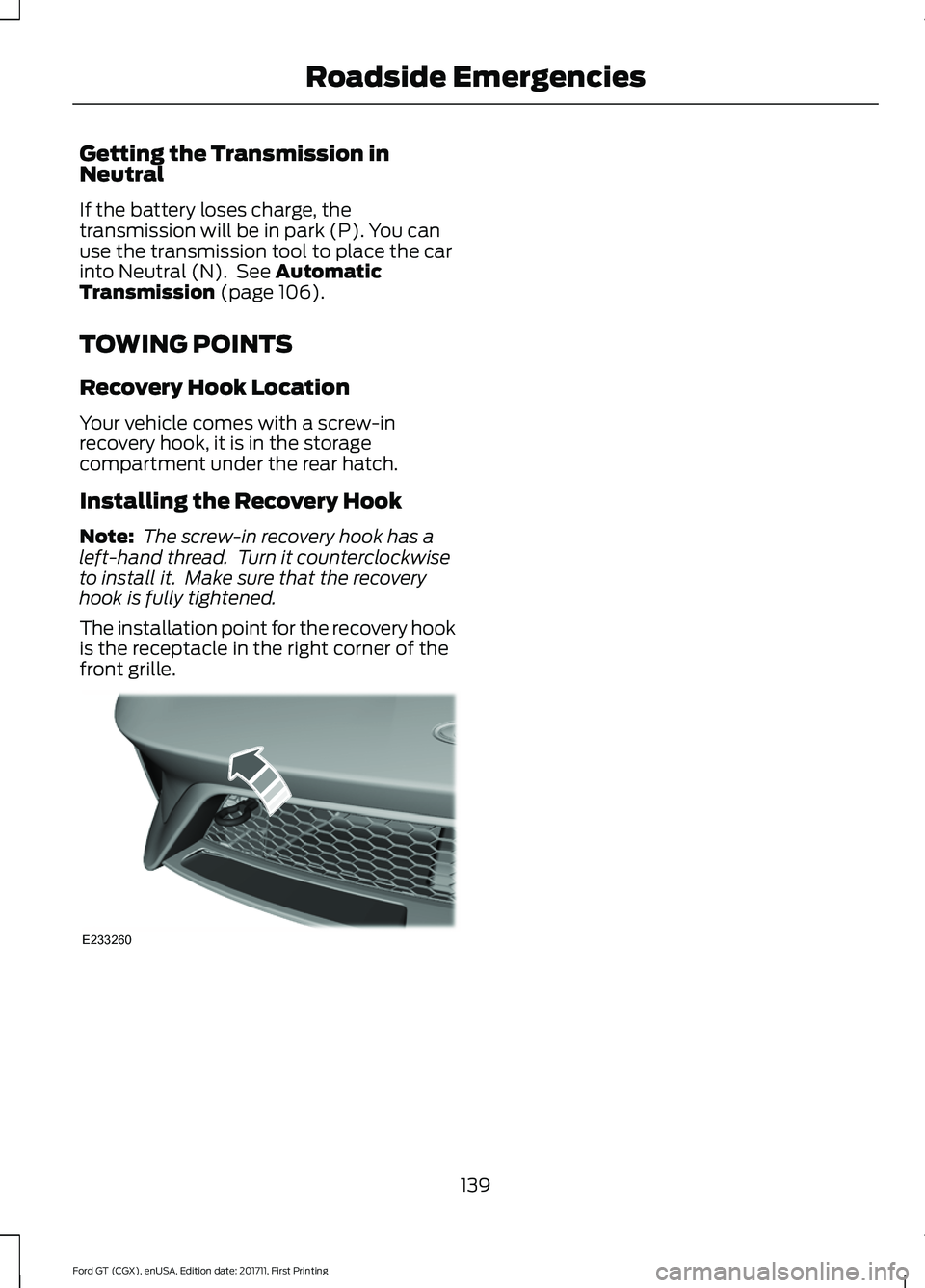
The installation point for the recovery hook
is the receptacle in the right corner of the
front grille. 139
Ford GT (CGX), enUSA, Edition date: 201711, First Printing Roadside EmergenciesE233260
Page 149 of 325
FUSE SPECIFICATION CHART
Front Power Distribution Box
WARNINGS
Always disconnect the battery before
servicing high current fuses.
To reduce risk of electrical shock,
always replace the cover to the
power distribution box before
reconnecting the battery or refilling fluid
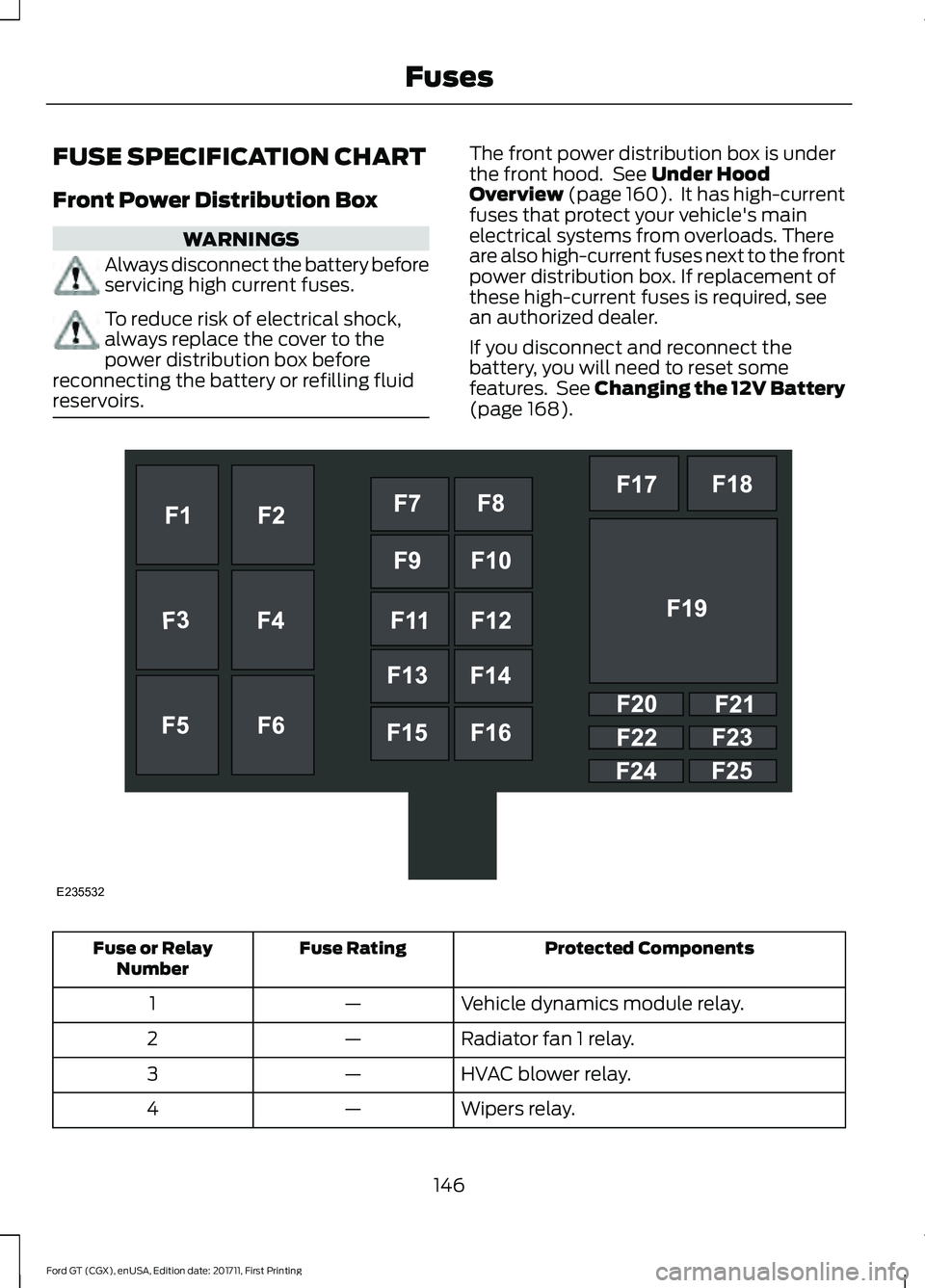
reservoirs. The front power distribution box is under
the front hood. See Under Hood
Overview (page 160). It has high-current
fuses that protect your vehicle's main
electrical systems from overloads. There
are also high-current fuses next to the front
power distribution box. If replacement of
these high-current fuses is required, see
an authorized dealer.
If you disconnect and reconnect the
battery, you will need to reset some
features. See Changing the 12V Battery
(page
168). Protected Components
Fuse Rating
Fuse or Relay
Number
Vehicle dynamics module relay.
—
1
Radiator fan 1 relay.
—
2
HVAC blower relay.
—
3
Wipers relay.
—
4
146
Ford GT (CGX), enUSA, Edition date: 201711, First Printing FusesE235532
Page 151 of 325
Protected Components
Fuse Rating
Fuse or Relay
Number
Electronic door system.
20A 2
24
Right headlamp.
20A 2
25
1 J-case low profile fuse.
2 Mini fuse.
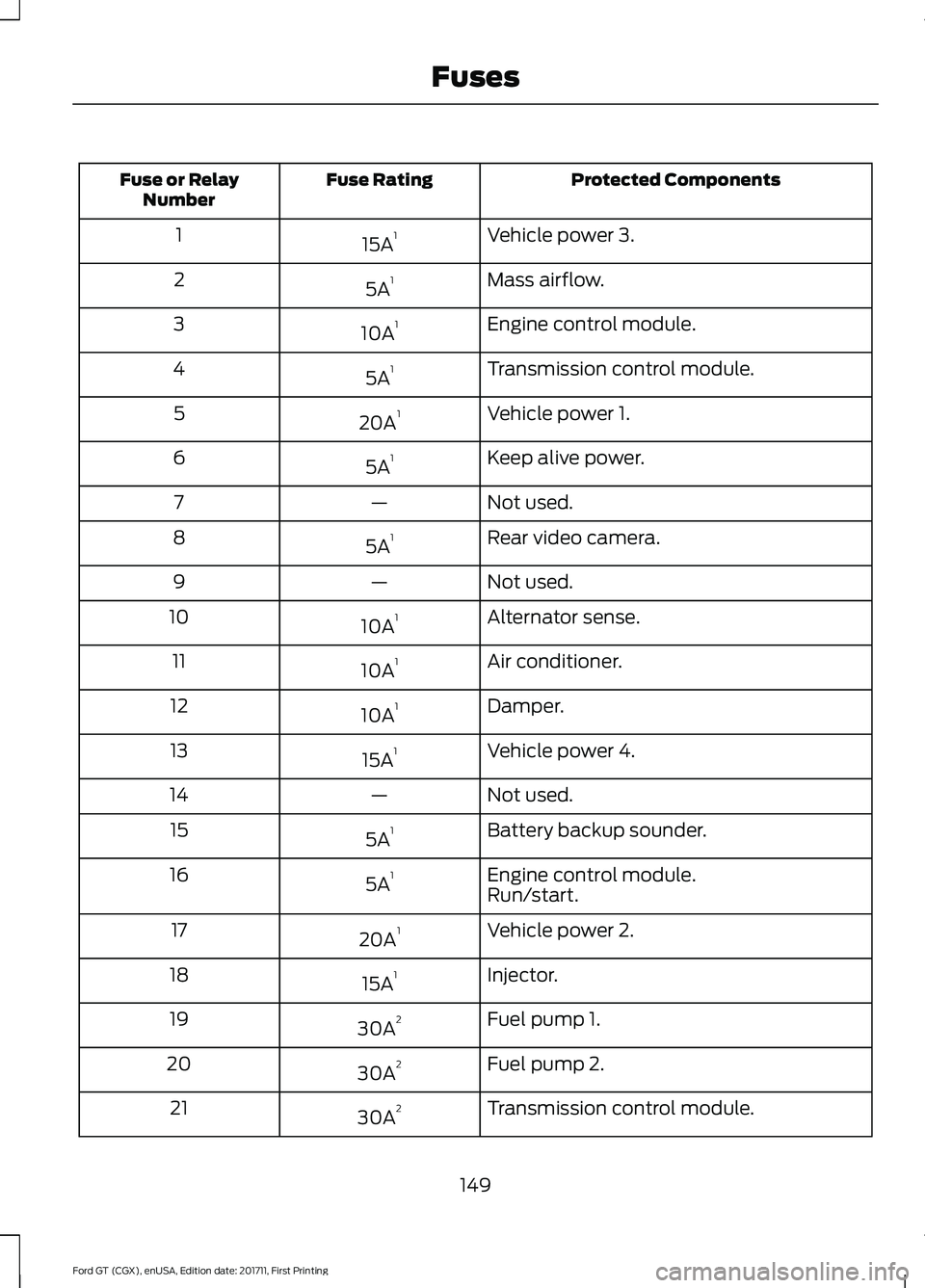
Rear Power Distribution Box 1
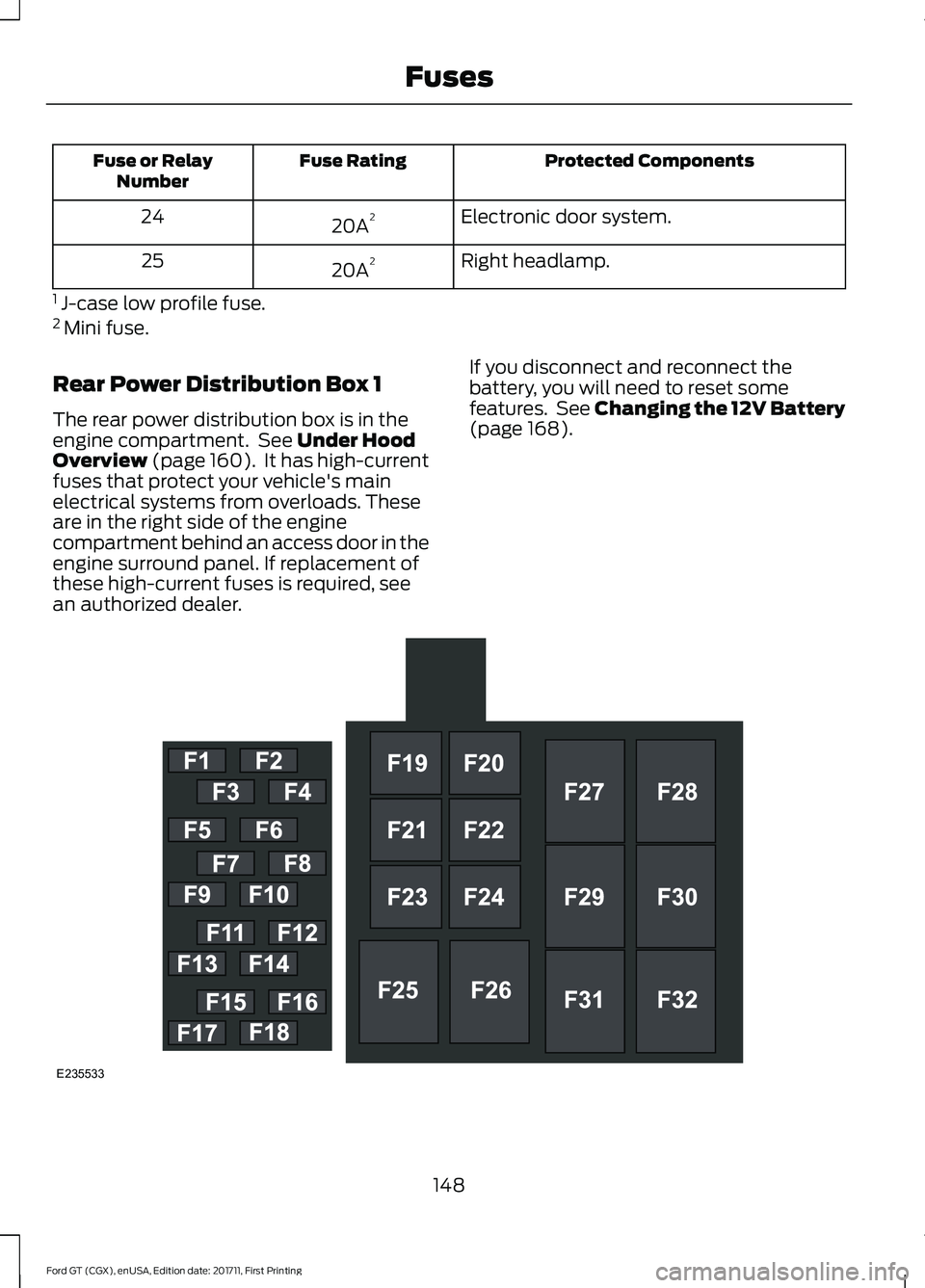
The rear power distribution box is in the
engine compartment. See Under Hood
Overview (page 160). It has high-current
fuses that protect your vehicle's main
electrical systems from overloads. These
are in the right side of the engine
compartment behind an access door in the
engine surround panel. If replacement of
these high-current fuses is required, see
an authorized dealer. If you disconnect and reconnect the
battery, you will need to reset some
features. See Changing the 12V Battery
(page
168).
148
Ford GT (CGX), enUSA, Edition date: 201711, First Printing FusesE235533
Page 152 of 325
Protected Components
Fuse Rating
Fuse or Relay
Number
Vehicle power 3.
15A 1
1
Mass airflow.
5A 1
2
Engine control module.
10A 1
3
Transmission control module.
5A 1
4
Vehicle power 1.
20A 1
5
Keep alive power.
5A 1
6
Not used.
—
7
Rear video camera.
5A 1
8
Not used.
—
9
Alternator sense.
10A 1
10
Air conditioner.
10A 1
11
Damper.
10A 1
12
Vehicle power 4.
15A 1
13
Not used.
—
14
Battery backup sounder.
5A 1
15
Engine control module.
5A 1
16
Run/start.
Vehicle power 2.
20A 1
17
Injector.
15A 1
18
Fuel pump 1.
30A 2
19
Fuel pump 2.
30A 2
20
Transmission control module.
30A 2
21
149
Ford GT (CGX), enUSA, Edition date: 201711, First Printing Fuses
Page 153 of 325
Protected Components
Fuse Rating
Fuse or Relay
Number
Starter.
30A 2
22
Charge air cooler fan.
30A 2
23
Shunt.
—
24
Charge air cooler fan relay.
—
25
Not used.
—
26
Fuel pump 1 relay.
—
27
AC clutch relay.
—
28
Starter relay.
—
29
Fuel injection relay.
—
30
Fuel pump 2 relay.
—
31
Engine control module relay.
—
32
1 Mini fuse.
2 J-case low profile fuse.
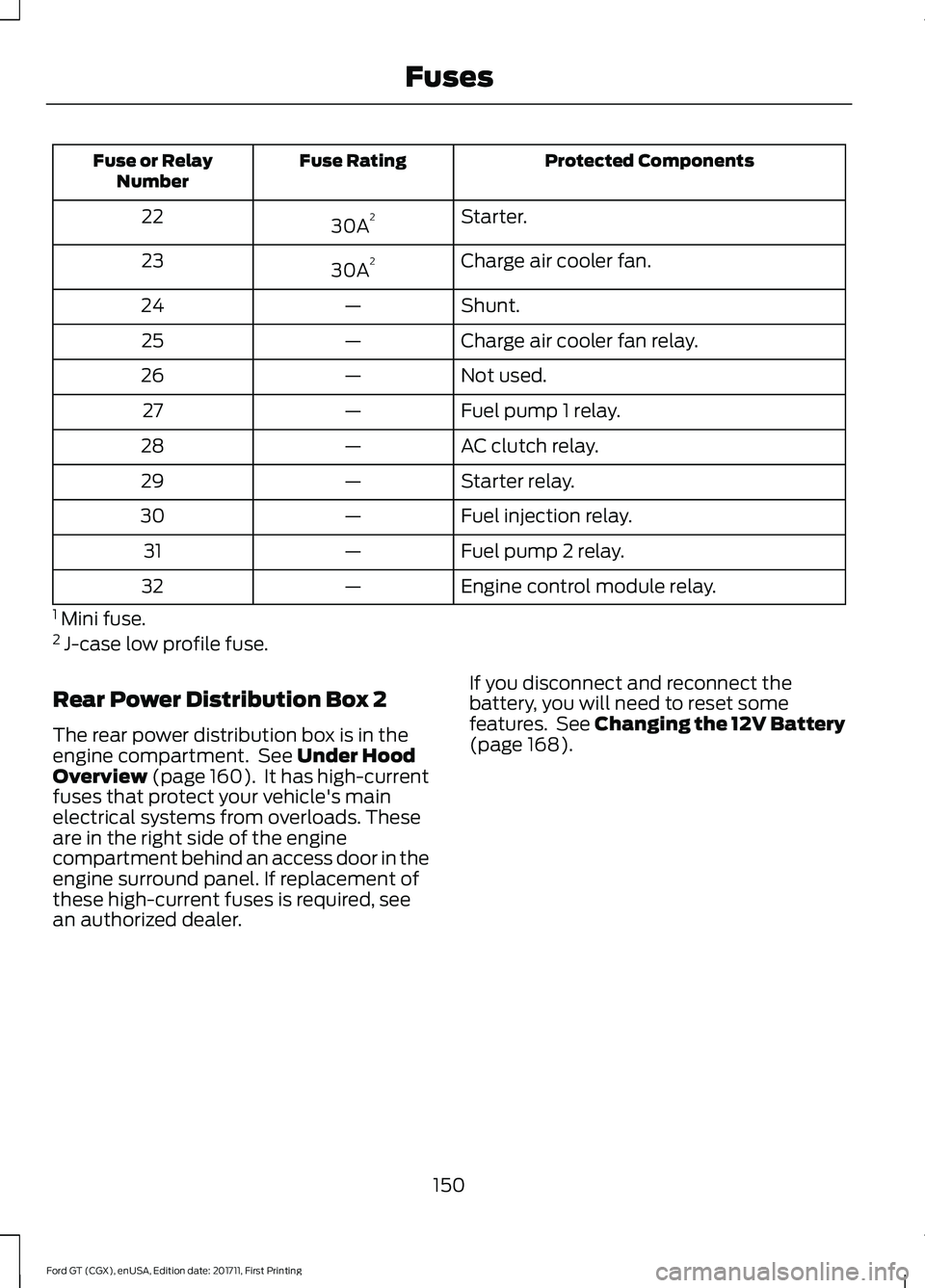
Rear Power Distribution Box 2
The rear power distribution box is in the
engine compartment. See Under Hood
Overview (page 160). It has high-current
fuses that protect your vehicle's main
electrical systems from overloads. These
are in the right side of the engine
compartment behind an access door in the
engine surround panel. If replacement of
these high-current fuses is required, see
an authorized dealer. If you disconnect and reconnect the
battery, you will need to reset some
features. See Changing the 12V Battery
(page
168).
150
Ford GT (CGX), enUSA, Edition date: 201711, First Printing Fuses