height FORD GT 2020 User Guide
[x] Cancel search | Manufacturer: FORD, Model Year: 2020, Model line: GT, Model: FORD GT 2020Pages: 316, PDF Size: 6.25 MB
Page 82 of 316
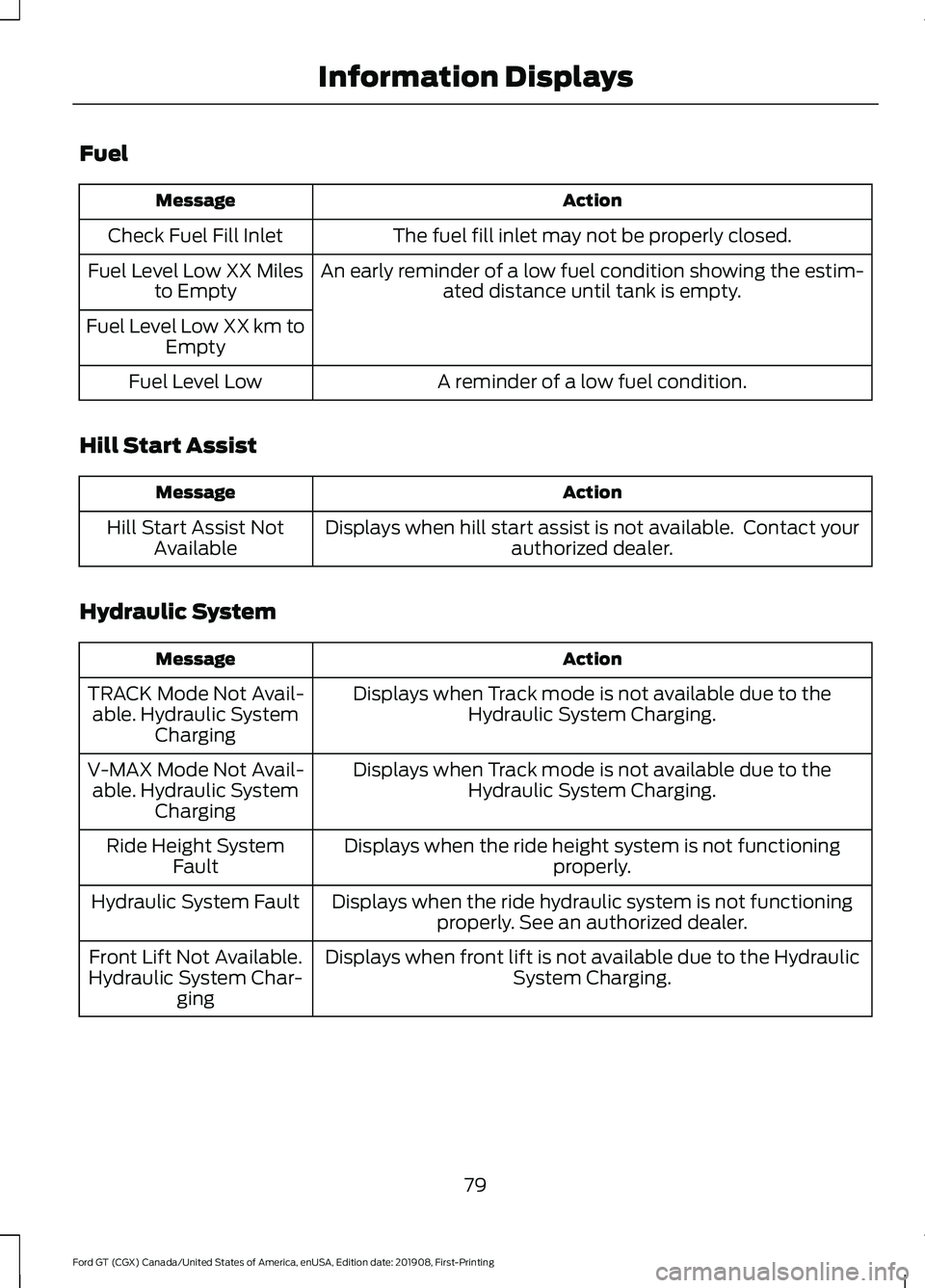
Fuel
Action
Message
The fuel fill inlet may not be properly closed.
Check Fuel Fill Inlet
An early reminder of a low fuel condition showing the estim-ated distance until tank is empty.
Fuel Level Low XX Miles
to Empty
Fuel Level Low XX km to Empty
A reminder of a low fuel condition.
Fuel Level Low
Hill Start Assist Action
Message
Displays when hill start assist is not available. Contact your authorized dealer.
Hill Start Assist Not
Available
Hydraulic System Action
Message
Displays when Track mode is not available due to theHydraulic System Charging.
TRACK Mode Not Avail-
able. Hydraulic System Charging
Displays when Track mode is not available due to theHydraulic System Charging.
V-MAX Mode Not Avail-
able. Hydraulic System Charging
Displays when the ride height system is not functioning properly.
Ride Height System
Fault
Displays when the ride hydraulic system is not functioningproperly. See an authorized dealer.
Hydraulic System Fault
Displays when front lift is not available due to the HydraulicSystem Charging.
Front Lift Not Available.
Hydraulic System Char- ging
79
Ford GT (CGX) Canada/United States of America, enUSA, Edition date: 201908, First-Printing Information Displays
Page 124 of 316
STEERING
To help prevent damage to the power
steering system:
•
Never hold the steering wheel at its
furthest turning points (until it stops)
for more than three to five seconds
when the engine is running.
• Do not operate the vehicle with a low
hydraulic fluid level. See Power
Steering Fluid Check (page 166).
• Some noise is normal during operation.
If excessive, check for low hydraulic
fluid level before seeking service by
your dealer.
• Heavy or uneven efforts may be caused
by low hydraulic fluid. Check for low
hydraulic fluid level before seeking
service by your dealer.
• Do not over fill the hydraulic fluid as
this may result in leaks from the
reservoir. See
Power Steering Fluid
Check (page 166).
If the power steering system breaks down
(or if the engine is off), you can manually
steer the vehicle, but it takes more effort.
If the steering wanders or pulls, check for:
• An improperly inflated tire.
• Uneven tire wear.
• Loose or worn suspension
components.
• Loose or worn steering components.
• Improper vehicle alignment.
A high crown in the road or high crosswinds
may also make the steering seem to
wander or pull. DRIVE MODE CONTROL
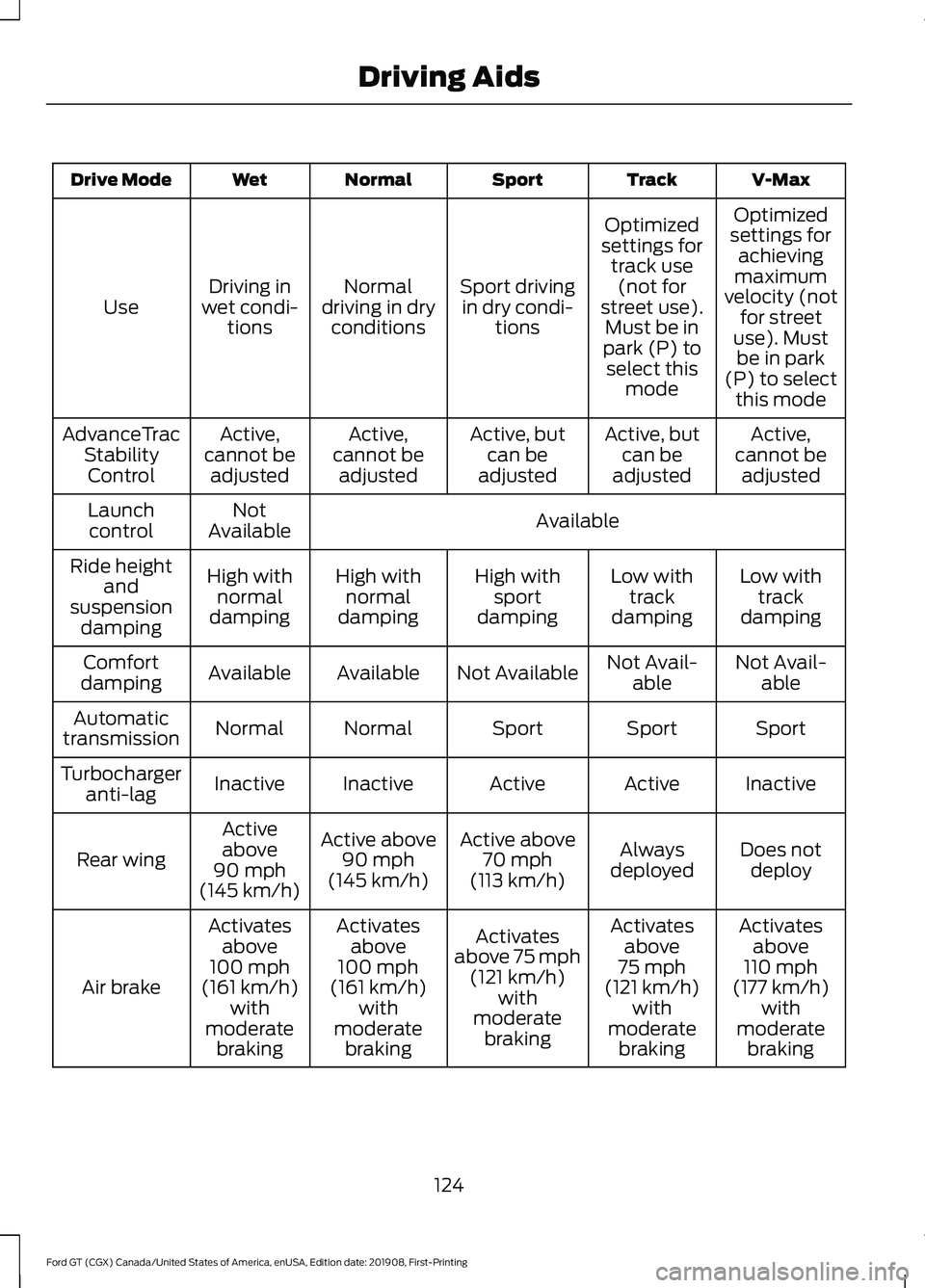
Drive Mode Selection
Your vehicle has five selectable drive
modes that deliver an enhanced driving
experience through a suite of sophisticated
electronic vehicle systems. In response to
vehicle use and driving conditions, the
selection of the drive mode optimizes
handling and powertrain response. This
provides a single location to control
multiple systems performance settings.
Using Selectable Drive Modes
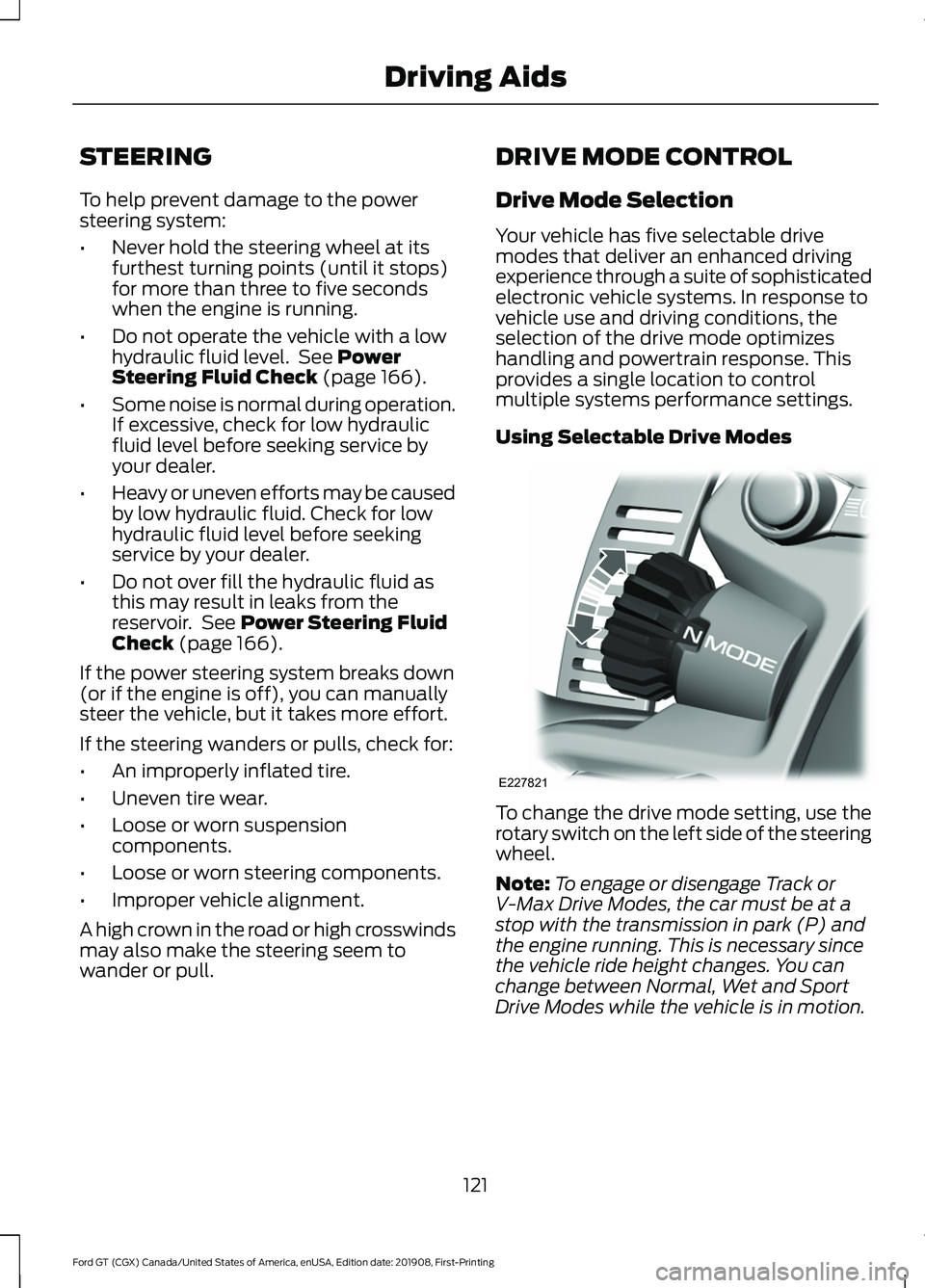
To change the drive mode setting, use the
rotary switch on the left side of the steering
wheel.
Note:
To engage or disengage Track or
V-Max Drive Modes, the car must be at a
stop with the transmission in park (P) and
the engine running. This is necessary since
the vehicle ride height changes. You can
change between Normal, Wet and Sport
Drive Modes while the vehicle is in motion.
121
Ford GT (CGX) Canada/United States of America, enUSA, Edition date: 201908, First-Printing Driving AidsE227821
Page 125 of 316
Modes:
•
Normal (N) – Use for normal driving in
dry conditions.
•AdvanceTrac Stability Control is
active and cannot be adjusted.
• Ride height is set to High and
suspension damping is set to
Normal.
• Comfort damping can be selected
with the console switch.
• Launch control is available.
• Transmission automatic shift
calibration is set to Normal.
• Rear wing deploys at speeds above
90 mph (145 km/h) and retracts
when the speed drops below
81 mph (130 km/h)
.
• Air brake activates at speeds above
100 mph (161 km/h)
when the
brakes are applied with moderate
force. •
Sport (S) – Use for sport driving in dry
conditions.
•AdvanceTrac Stability Control is
active but can be adjusted by use
of the Stability Control button on
the console.
• Ride height is set to High and
suspension damping is set to Sport.
• Comfort damping cannot be
selected.
• Launch control is available.
• Transmission automatic shift
calibration is set to Sport.
• Turbocharger anti-lag calibration
is active.
• Rear wing deploys at speeds above
70 mph (113 km/h)
and retracts
when the speed drops below
45 mph (72 km/h)
.
• Air brake activates at speeds above
75 mph (121 km/h) when the brakes
are applied with moderate force.
• Wet (W) – Use for driving in wet
conditions.
•AdvanceTrac Stability Control is
active and cannot be adjusted.
• Ride height is set to High and
suspension damping is set to
Normal.
• Comfort damping can be selected
with the console switch.
• Launch control is not available.
• Transmission automatic shift
calibration is set to Normal.
• Rear wing deploys at speeds above
90 mph (145 km/h)
and retracts
when the speed drops below
81 mph (130 km/h)
.
• Air brake activates at speeds above
100 mph (161 km/h)
when the
brakes are applied with moderate
force.
122
Ford GT (CGX) Canada/United States of America, enUSA, Edition date: 201908, First-Printing Driving Aids
Page 126 of 316
•
Track (T) – Optimized settings for
track handling performance. The Track
drive mode should only be used in a
track environment, not on the street,
due to the low ride height. This setting
can only be selected while your vehicle
is in park (P) with the engine running,
and you need to confirm the selection.
•AdvanceTrac Stability Control is
active but can be adjusted by use
of the Stability Control button on
the console.
• Ride height is set to Low and
suspension damping is set to Track.
• Comfort damping cannot be
selected due to low ride height.
• Launch control is available.
• Transmission automatic shift
calibration is set to Sport.
• Turbocharger anti-lag calibration
is active.
• Rear wing deploys and remains
deployed while in Track mode.
When you change to another mode,
the wing lowers once you start to
drive your vehicle, not while it is
stopped.
• Air brake activates at speeds above
75 mph (121 km/h) when the brakes
are applied with moderate force.
• V-Max (V) – Optimized settings for achieving maximum velocity (top
speed). The V-Max mode should only
be used in a controlled track
environment, not on the street, due to
the low ride height. This setting can
only be selected while your vehicle is
in park (P) with the engine running, and
you need to confirm the selection.
•
AdvanceTrac Stability Control is
active and cannot be adjusted.
• Ride height is set to Low and
suspension damping is set to Track.
• Comfort damping cannot be
selected due to low ride height.
• Launch control is available.
• Transmission automatic shift
calibration is set to Sport.
• Rear wing does not deploy.
• Air brake activates at speeds above
110 mph (177 km/h) when the
brakes are applied with moderate
force.
Note: When you shut down your vehicle in
V-Max or Track mode, the vehicle returns
to the Normal ride height. When you restart
your vehicle in V-Max or Track mode, you
need to re-acknowledge the drive mode
selection in the information display in order
for the drive mode to reactivate. If you do
not make a selection, the vehicle returns to
the previously selected drive mode.
123
Ford GT (CGX) Canada/United States of America, enUSA, Edition date: 201908, First-Printing Driving Aids
Page 127 of 316
V-Max
Track
Sport
Normal
Wet
Drive Mode
Optimized
settings for achieving
maximum
velocity (not for street
use). Must be in park
(P) to select this mode
Optimized
settings for track use(not for
street use). Must be in
park (P) to select this mode
Sport driving
in dry condi- tions
Normal
driving in dry conditions
Driving in
wet condi- tions
Use
Active,
cannot be adjusted
Active, but
can be
adjusted
Active, but
can be
adjusted
Active,
cannot be adjusted
Active,
cannot be adjusted
AdvanceTrac
StabilityControl
Available
Not
Launch
control Available
Low withtrack
damping
Low with
track
damping
High with
sport
damping
High with
normal
damping
High with
normal
damping
Ride height
and
suspension damping
Not Avail-able
Not Avail-
able
Not Available
Available
Available
Comfort
damping
Sport
Sport
Sport
Normal
Normal
Automatic
transmission
Inactive
Active
Active
Inactive
Inactive
Turbocharger
anti-lag
Does notdeploy
Always
deployed
Active above
70 mph
(113 km/h)
Active above
90 mph
(145 km/h)
Active
above
90 mph
(145 km/h)
Rear wing
Activatesabove
110 mph
(177 km/h) with
moderate braking
Activates
above
75 mph
(121 km/h) with
moderate braking
Activates
above 75 mph
(121 km/h) with
moderate braking
Activates
above
100 mph
(161 km/h) with
moderate braking
Activates
above
100 mph
(161 km/h) with
moderate braking
Air brake
124
Ford GT (CGX) Canada/United States of America, enUSA, Edition date: 201908, First-Printing Driving Aids
Page 128 of 316
Note:
Selectable driving modes has
diagnostic checks that continuously monitor
the system to ensure proper operation. If a
selected mode is unavailable due to a
system fault or change in gear shifter
position, the selected mode defaults to
Normal.
Front Lift WARNING: Before using front
lift, make sure the area around your
vehicle is free from obstruction. Failure
to follow this instruction could result in
personal injury or death.
Your vehicle has a front lift system to
provide additional front end clearance
when approaching a speed bump,
driveway ramp or another similar surface
where front end clearance could be a
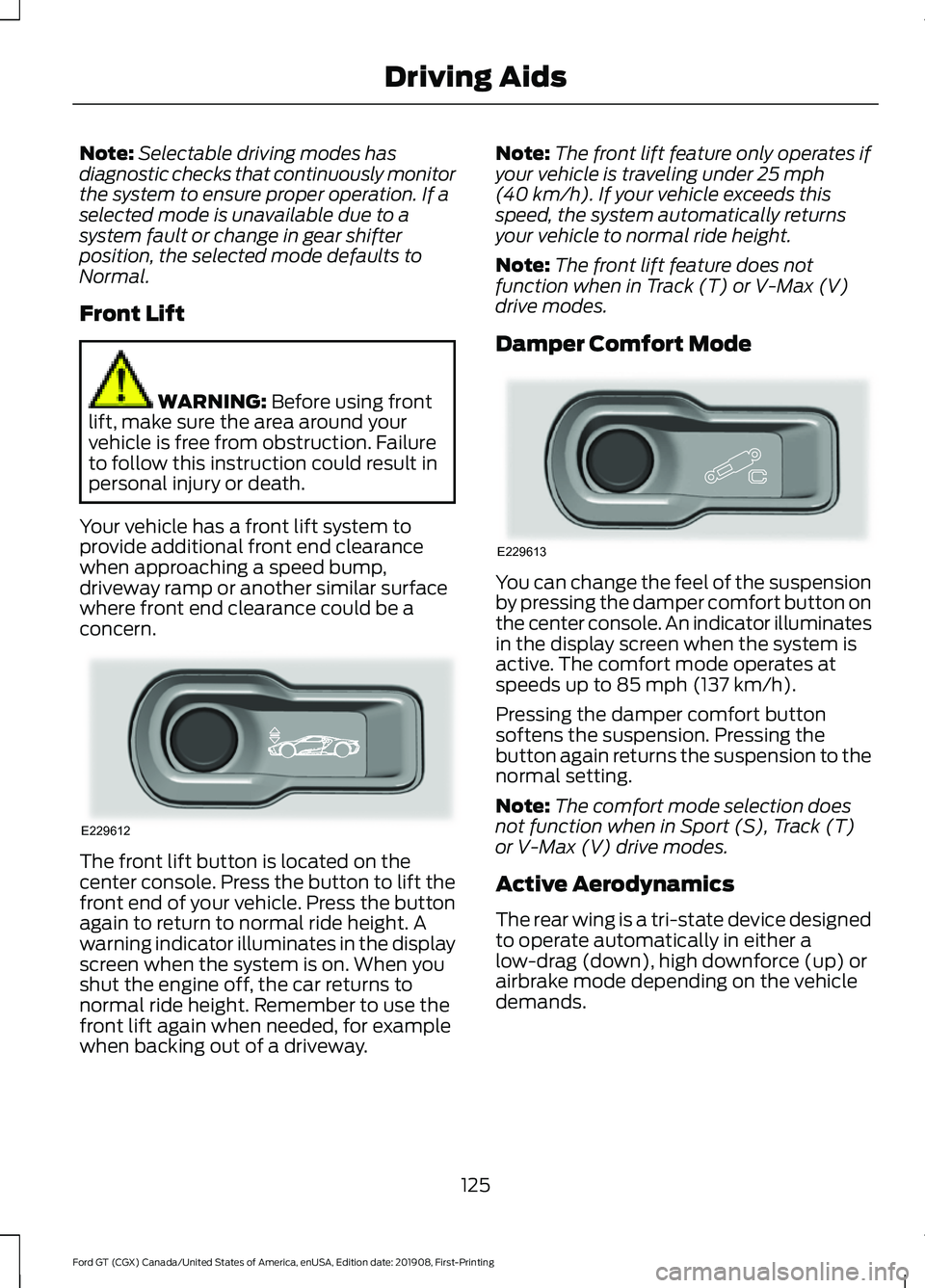
concern. The front lift button is located on the
center console. Press the button to lift the
front end of your vehicle. Press the button
again to return to normal ride height. A
warning indicator illuminates in the display
screen when the system is on. When you
shut the engine off, the car returns to
normal ride height. Remember to use the
front lift again when needed, for example
when backing out of a driveway. Note:
The front lift feature only operates if
your vehicle is traveling under
25 mph
(40 km/h). If your vehicle exceeds this
speed, the system automatically returns
your vehicle to normal ride height.
Note: The front lift feature does not
function when in Track (T) or V-Max (V)
drive modes.
Damper Comfort Mode You can change the feel of the suspension
by pressing the damper comfort button on
the center console. An indicator illuminates
in the display screen when the system is
active. The comfort mode operates at
speeds up to
85 mph (137 km/h).
Pressing the damper comfort button
softens the suspension. Pressing the
button again returns the suspension to the
normal setting.
Note: The comfort mode selection does
not function when in Sport (S), Track (T)
or V-Max (V) drive modes.
Active Aerodynamics
The rear wing is a tri-state device designed
to operate automatically in either a
low-drag (down), high downforce (up) or
airbrake mode depending on the vehicle
demands.
125
Ford GT (CGX) Canada/United States of America, enUSA, Edition date: 201908, First-Printing Driving AidsE229612 E229613
Page 140 of 316
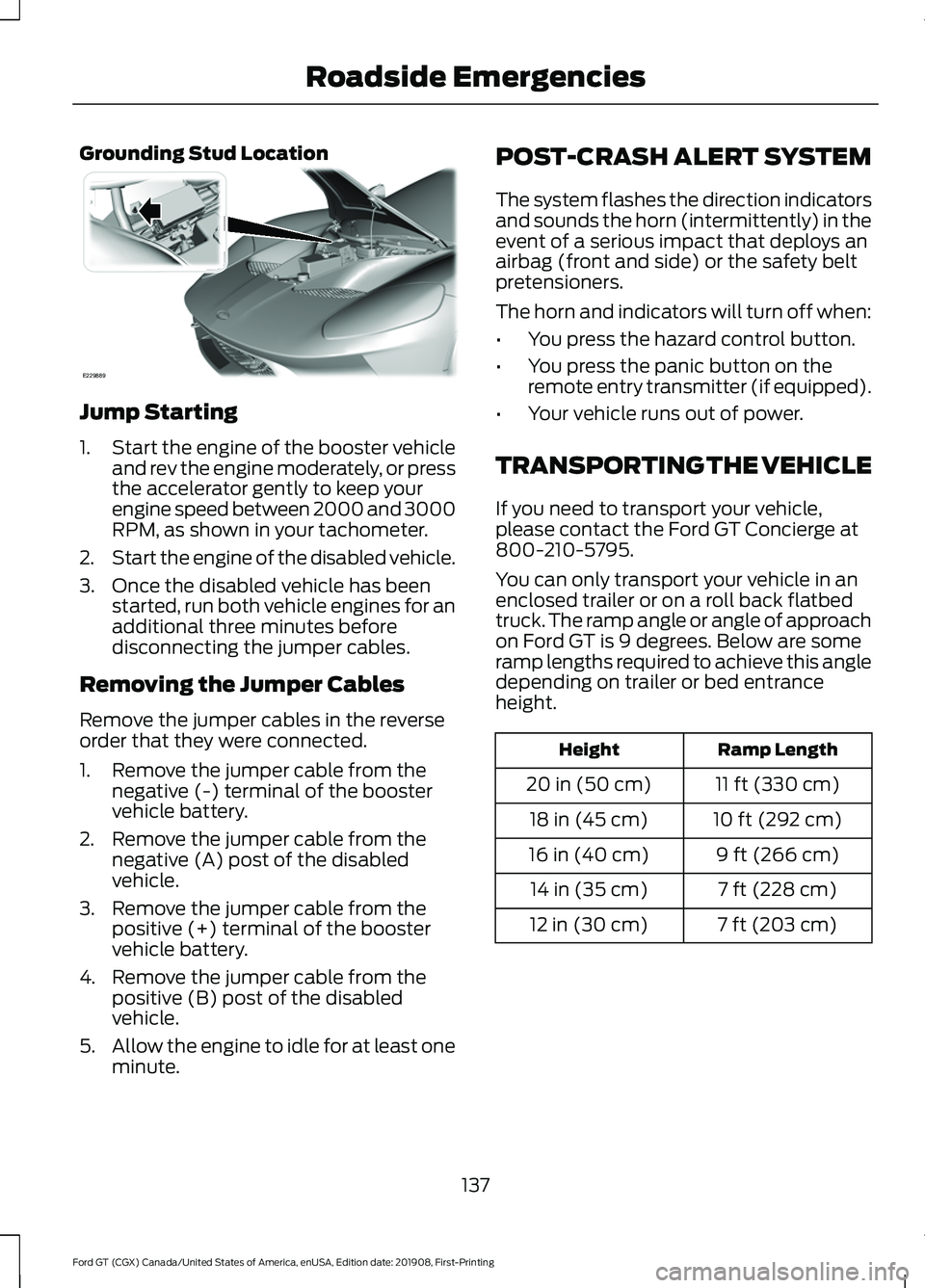
Grounding Stud Location
Jump Starting
1.
Start the engine of the booster vehicle
and rev the engine moderately, or press
the accelerator gently to keep your
engine speed between 2000 and 3000
RPM, as shown in your tachometer.
2. Start the engine of the disabled vehicle.
3. Once the disabled vehicle has been started, run both vehicle engines for an
additional three minutes before
disconnecting the jumper cables.
Removing the Jumper Cables
Remove the jumper cables in the reverse
order that they were connected.
1. Remove the jumper cable from the negative (-) terminal of the booster
vehicle battery.
2. Remove the jumper cable from the negative (A) post of the disabled
vehicle.
3. Remove the jumper cable from the positive (+) terminal of the booster
vehicle battery.
4. Remove the jumper cable from the positive (B) post of the disabled
vehicle.
5. Allow the engine to idle for at least one
minute. POST-CRASH ALERT SYSTEM
The system flashes the direction indicators
and sounds the horn (intermittently) in the
event of a serious impact that deploys an
airbag (front and side) or the safety belt
pretensioners.
The horn and indicators will turn off when:
•
You press the hazard control button.
• You press the panic button on the
remote entry transmitter (if equipped).
• Your vehicle runs out of power.
TRANSPORTING THE VEHICLE
If you need to transport your vehicle,
please contact the Ford GT Concierge at
800-210-5795.
You can only transport your vehicle in an
enclosed trailer or on a roll back flatbed
truck. The ramp angle or angle of approach
on Ford GT is 9 degrees. Below are some
ramp lengths required to achieve this angle
depending on trailer or bed entrance
height. Ramp Length
Height
11 ft (330 cm)
20 in (50 cm)
10 ft (292 cm)
18 in (45 cm)
9 ft (266 cm)
16 in (40 cm)
7 ft (228 cm)
14 in (35 cm)
7 ft (203 cm)
12 in (30 cm)
137
Ford GT (CGX) Canada/United States of America, enUSA, Edition date: 201908, First-Printing Roadside EmergenciesE229889
Page 141 of 316
Your vehicle has a front end lift feature
that uses the electronically controlled
suspension hydraulics to lift the front of
the car. You can use this feature for
driveway approaches and speed bumps.
If there is power to this system, use it to lift
the front when loading the car onto a trailer
or a roll back. To operate the front lift, use
the switch in the console.
Note:
The ground clearance on the car at
standard ride height is only 5 in (12 cm). Use
care when moving or loading the car to
make sure it does not bottom out.
Note: The vehicle doors swing both upward
and outward. At the full open position, the
top edge of the door is 67 in (170 cm) from
the ground and swings outward 26 in
(66 cm). Make sure you have the clearance
you need prior to opening the door.
The full undertrays of the vehicle are
carbon fiber, there are no tie down slots.
Use only over the tire straps to tie the car
down for transport.
Getting the Transmission in
Neutral
If the battery loses charge, the
transmission moves to park (P). You can
use the transmission tool to place the car
into Neutral (N). See
Automatic
Transmission (page 105).
Note: If your battery loses charge with the
electric park brake on, you cannot transport
your vehicle until you restore power to your
vehicle to turn off the electric park brake.
TOWING POINTS
Recovery Hook Location
Your vehicle comes with a screw-in
recovery hook, it is in the storage
compartment under the rear hatch. Installing the Recovery Hook
Note:
The screw-in recovery hook has a
left-hand thread. Turn it counterclockwise
to install it. Make sure that the recovery
hook is fully tightened.
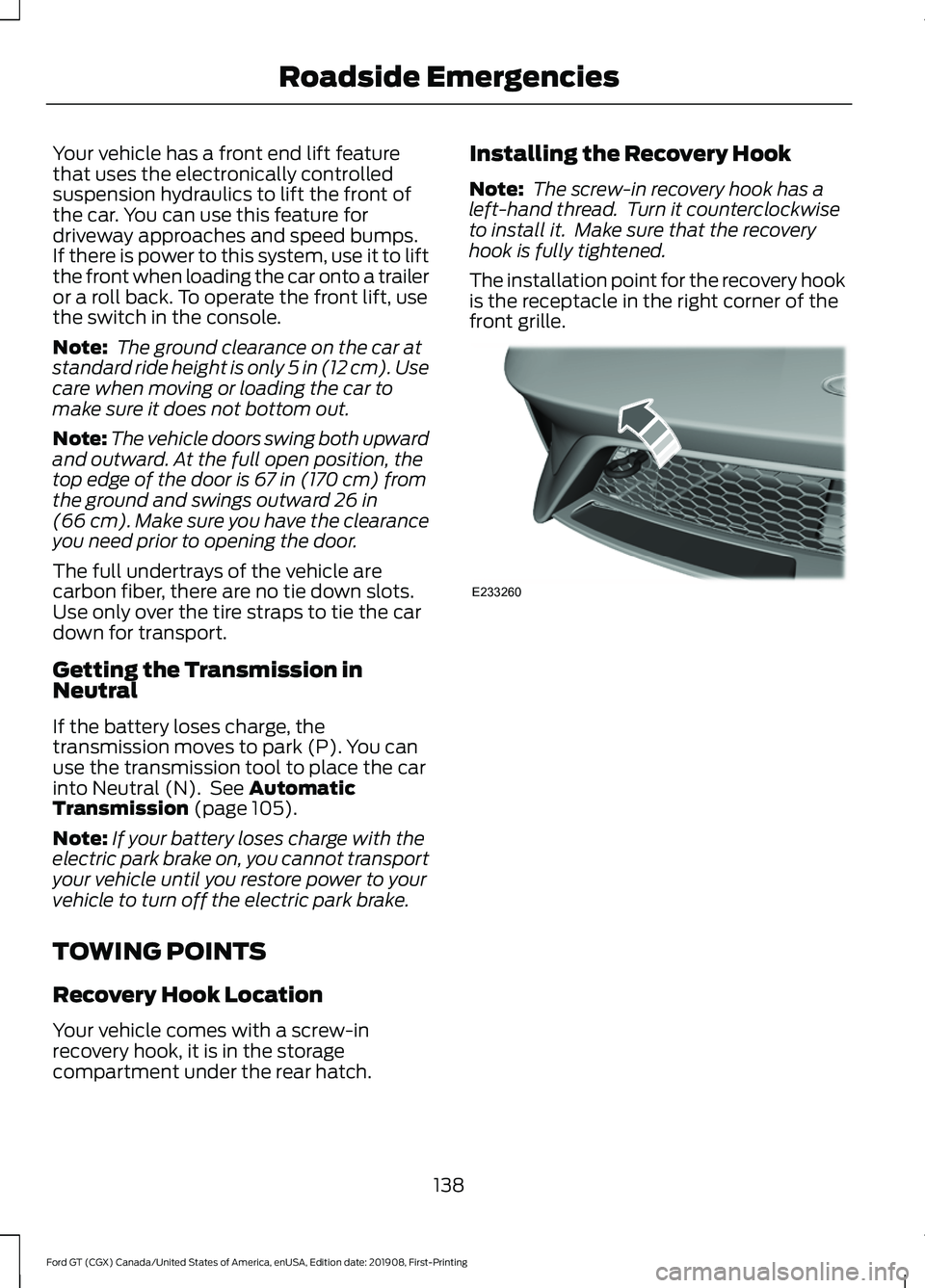
The installation point for the recovery hook
is the receptacle in the right corner of the
front grille. 138
Ford GT (CGX) Canada/United States of America, enUSA, Edition date: 201908, First-Printing Roadside EmergenciesE233260
Page 173 of 316
Run the tip of your fingers over the edge of
the blade to check for roughness.
Clean the wiper blades with washer fluid
or water applied with a soft sponge or
cloth.
CHANGING THE WIPER
BLADES
Replacement blades are available at your
Ford dealer.
Note:
To avoid damaging the windshield,
lift the wiper blade a few inches off the
glass and place a cloth on the windshield
under the blade.
Note: Manually move the wiper blades to
the midway position.
Note: The windshield wiper blades are
different in length. The longer blade is on
the driver's side.
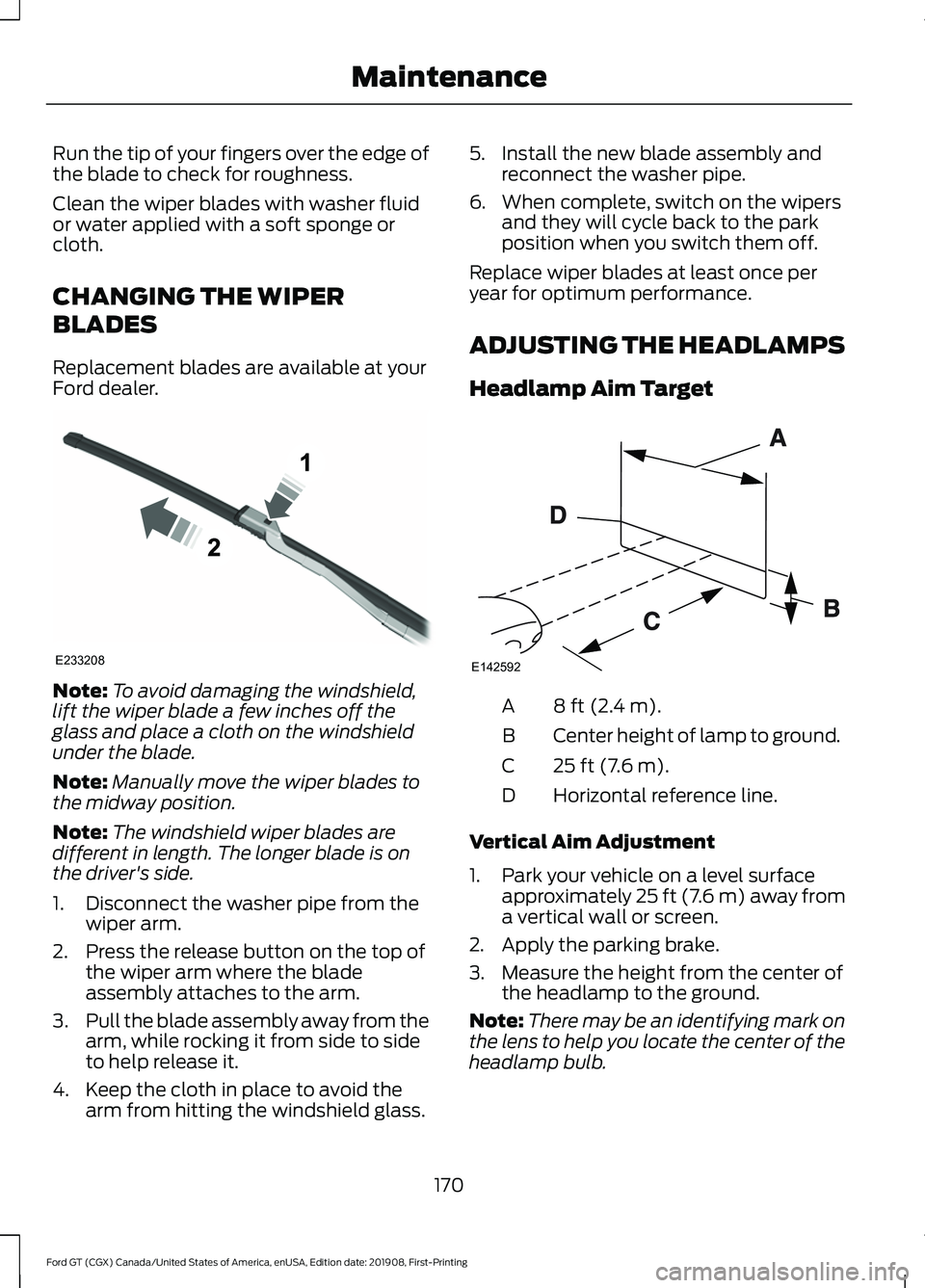
1. Disconnect the washer pipe from the wiper arm.
2. Press the release button on the top of the wiper arm where the blade
assembly attaches to the arm.
3. Pull the blade assembly away from the
arm, while rocking it from side to side
to help release it.
4. Keep the cloth in place to avoid the arm from hitting the windshield glass. 5. Install the new blade assembly and
reconnect the washer pipe.
6. When complete, switch on the wipers and they will cycle back to the park
position when you switch them off.
Replace wiper blades at least once per
year for optimum performance.
ADJUSTING THE HEADLAMPS
Headlamp Aim Target 8 ft (2.4 m).
A
Center height of lamp to ground.
B
25 ft (7.6 m).
C
Horizontal reference line.
D
Vertical Aim Adjustment
1. Park your vehicle on a level surface approximately 25 ft (7.6 m) away from
a vertical wall or screen.
2. Apply the parking brake.
3. Measure the height from the center of the headlamp to the ground.
Note: There may be an identifying mark on
the lens to help you locate the center of the
headlamp bulb.
170
Ford GT (CGX) Canada/United States of America, enUSA, Edition date: 201908, First-Printing MaintenanceE233208 E142592
Page 176 of 316
Road Course Vehicle Preparation
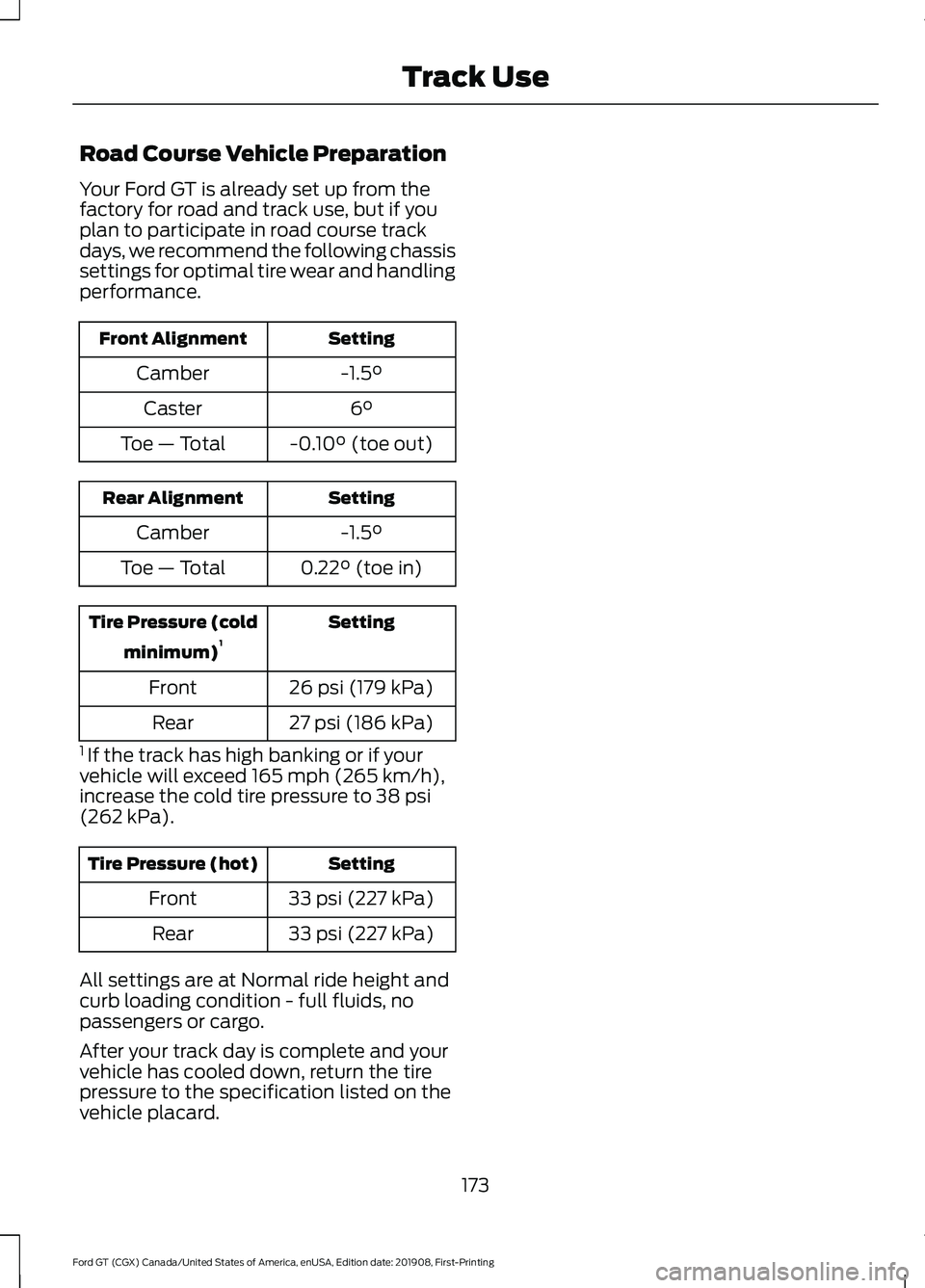
Your Ford GT is already set up from the
factory for road and track use, but if you
plan to participate in road course track
days, we recommend the following chassis
settings for optimal tire wear and handling
performance.
Setting
Front Alignment
-1.5°
Camber
6°
Caster
-0.10° (toe out)
Toe — Total Setting
Rear Alignment
-1.5°
Camber
0.22° (toe in)
Toe — Total Setting
Tire Pressure (cold
minimum) 1
26 psi (179 kPa)
Front
27 psi (186 kPa)
Rear
1 If the track has high banking or if your
vehicle will exceed 165 mph (265 km/h),
increase the cold tire pressure to 38 psi
(262 kPa). Setting
Tire Pressure (hot)
33 psi (227 kPa)
Front
33 psi (227 kPa)
Rear
All settings are at Normal ride height and
curb loading condition - full fluids, no
passengers or cargo.
After your track day is complete and your
vehicle has cooled down, return the tire
pressure to the specification listed on the
vehicle placard.
173
Ford GT (CGX) Canada/United States of America, enUSA, Edition date: 201908, First-Printing Track Use