belt FORD GT 2020 Owner's Manual
[x] Cancel search | Manufacturer: FORD, Model Year: 2020, Model line: GT, Model: FORD GT 2020Pages: 316, PDF Size: 6.25 MB
Page 39 of 316
PRINCIPLE OF OPERATION
WARNING: Airbags do not
inflate slowly or gently, and the risk of
injury from a deploying airbag is the
greatest close to the trim covering the
airbag module. WARNING: All occupants of your
vehicle, including the driver, should
always properly wear their seatbelts,
even when an airbag supplemental
restraint system is provided. Failure to
properly wear your seatbelt could
seriously increase the risk of injury or
death. WARNING:
Always use
appropriate child restraints. Failure to
follow this could seriously increase the
risk of injury or death. WARNING:
Never place your
arm over the airbag module as a
deploying airbag can result in serious arm
fractures or other injuries. WARNING:
Airbags can kill or
injure a child in a child restraint. Never
place a rear-facing child restraint in front
of an active airbag. WARNING:
Do not attempt to
service, repair, or modify the airbag
supplemental restraint systems or its
fuses as you could be seriously injured
or killed. Contact your authorized dealer
as soon as possible. WARNING:
Several airbag
system components get hot after
inflation. To reduce the risk of injury, do
not touch them after inflation. WARNING:
If the airbag has
deployed, the airbag will not function
again and must be replaced
immediately. If the airbag is not replaced,
the unrepaired area will increase the risk
of injury in a crash.
The airbags are a supplemental restraint
system and are designed to work with the
seatbelts to help protect the driver and
right front passenger from certain upper
body injuries. Airbags do not inflate slowly;
there is a risk of injury from a deploying
airbag.
Note: You will hear a loud bang and see a
cloud of harmless powdery residue if an
airbag deploys. This is normal.
The airbags inflate and deflate rapidly
upon activation. After airbag deployment,
it is normal to notice a smoke-like, powdery
residue or smell the burnt propellant. This
may consist of cornstarch, talcum powder
(to lubricate the bag) or sodium
compounds (for example, baking soda)
that result from the combustion process
that inflates the airbag. Small amounts of
sodium hydroxide may be present which
may irritate the skin and eyes, but none of
the residue is toxic.
Though the system is designed to help
reduce serious injuries, contact with a
deploying airbag may also cause abrasions
or swelling. Temporary hearing loss is also
a possibility as a result of the noise
associated with a deploying airbag.
Because airbags must inflate rapidly and
with considerable force, there is the risk of
death or serious injuries such as fractures,
36
Ford GT (CGX) Canada/United States of America, enUSA, Edition date: 201908, First-Printing Supplementary Restraints System
Page 40 of 316
facial and eye injuries or internal injuries,
particularly to occupants who are not
properly restrained or are out of position
at the time of airbag deployment. It is
extremely important that occupants are
properly restrained as far away from the
airbag module as possible while
maintaining vehicle control.
Routine maintenance of the airbags is not
required.
DRIVER AND PASSENGER
AIRBAGS
WARNING: Never place your
arm over the airbag module as a
deploying airbag can result in serious arm
fractures or other injuries. WARNING:
NEVER use a
rearward facing child restraint on a seat
protected by an ACTIVE AIRBAG in front
of it, DEATH or SERIOUS INJURY to the
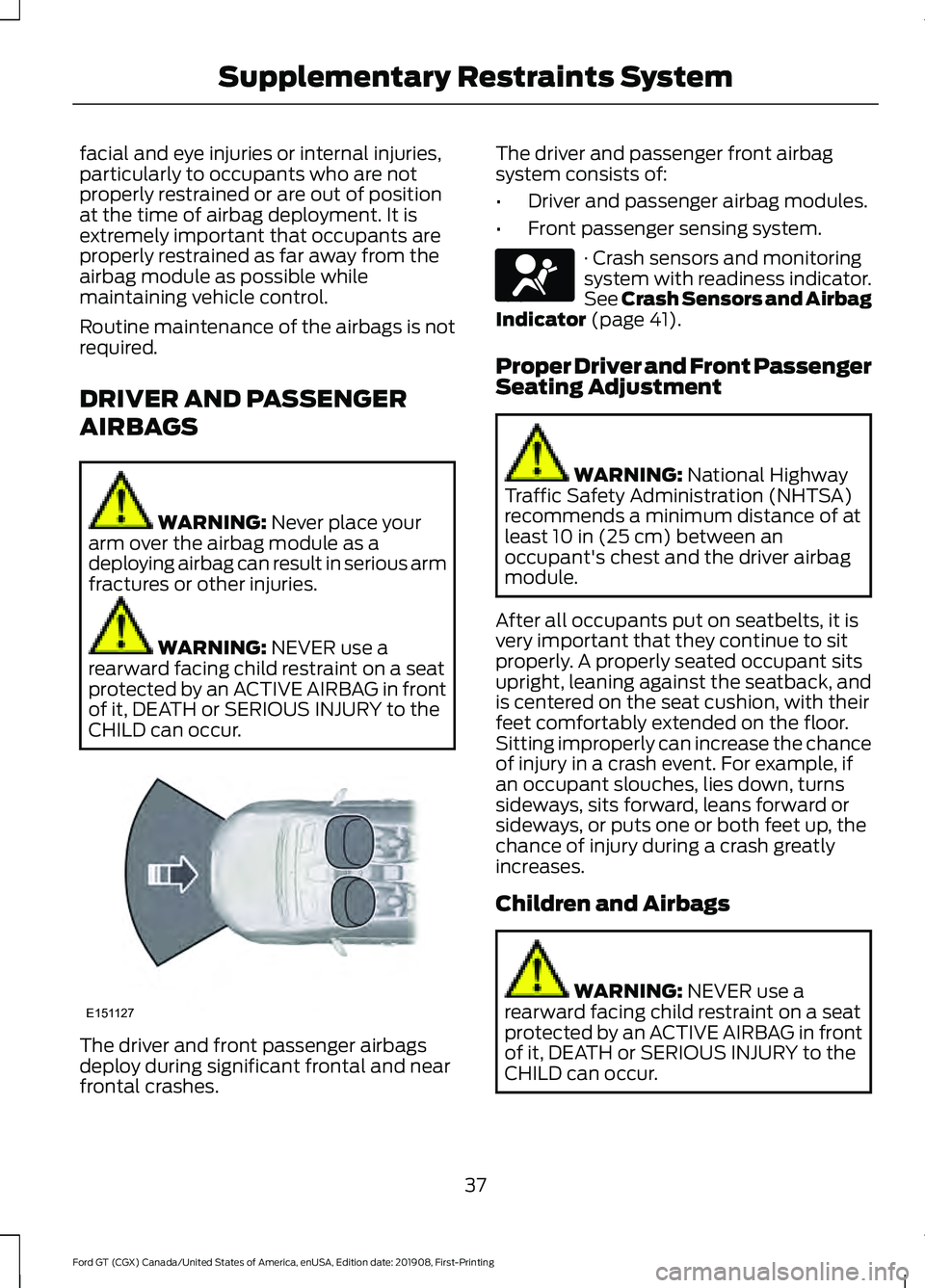
CHILD can occur. The driver and front passenger airbags
deploy during significant frontal and near
frontal crashes. The driver and passenger front airbag
system consists of:
•
Driver and passenger airbag modules.
• Front passenger sensing system. · Crash sensors and monitoring
system with readiness indicator.
See Crash Sensors and Airbag
Indicator
(page 41).
Proper Driver and Front Passenger
Seating Adjustment WARNING:
National Highway
Traffic Safety Administration (NHTSA)
recommends a minimum distance of at
least
10 in (25 cm) between an
occupant's chest and the driver airbag
module.
After all occupants put on seatbelts, it is
very important that they continue to sit
properly. A properly seated occupant sits
upright, leaning against the seatback, and
is centered on the seat cushion, with their
feet comfortably extended on the floor.
Sitting improperly can increase the chance
of injury in a crash event. For example, if
an occupant slouches, lies down, turns
sideways, sits forward, leans forward or
sideways, or puts one or both feet up, the
chance of injury during a crash greatly
increases.
Children and Airbags WARNING:
NEVER use a
rearward facing child restraint on a seat
protected by an ACTIVE AIRBAG in front
of it, DEATH or SERIOUS INJURY to the
CHILD can occur.
37
Ford GT (CGX) Canada/United States of America, enUSA, Edition date: 201908, First-Printing Supplementary Restraints SystemE151127 E67017
Page 41 of 316
FRONT PASSENGER SENSING
SYSTEM
WARNING: Sitting improperly,
out of position or with the seatback
reclined too far can take weight off the
seat cushion and affect the decision of
the passenger sensing system, resulting
in serious injury or death in the event of
a crash. Always sit upright against your
seat back, with your feet on the floor. WARNING:
Any alteration or
modification to the front passenger seat
may affect the performance of the front
passenger sensing system. This could
seriously increase the risk of injury or
death.
This system works with sensors that are
part of the front passenger seat and
seatbelt to detect the presence of a
properly-seated occupant and determine
if the front passenger frontal airbag should
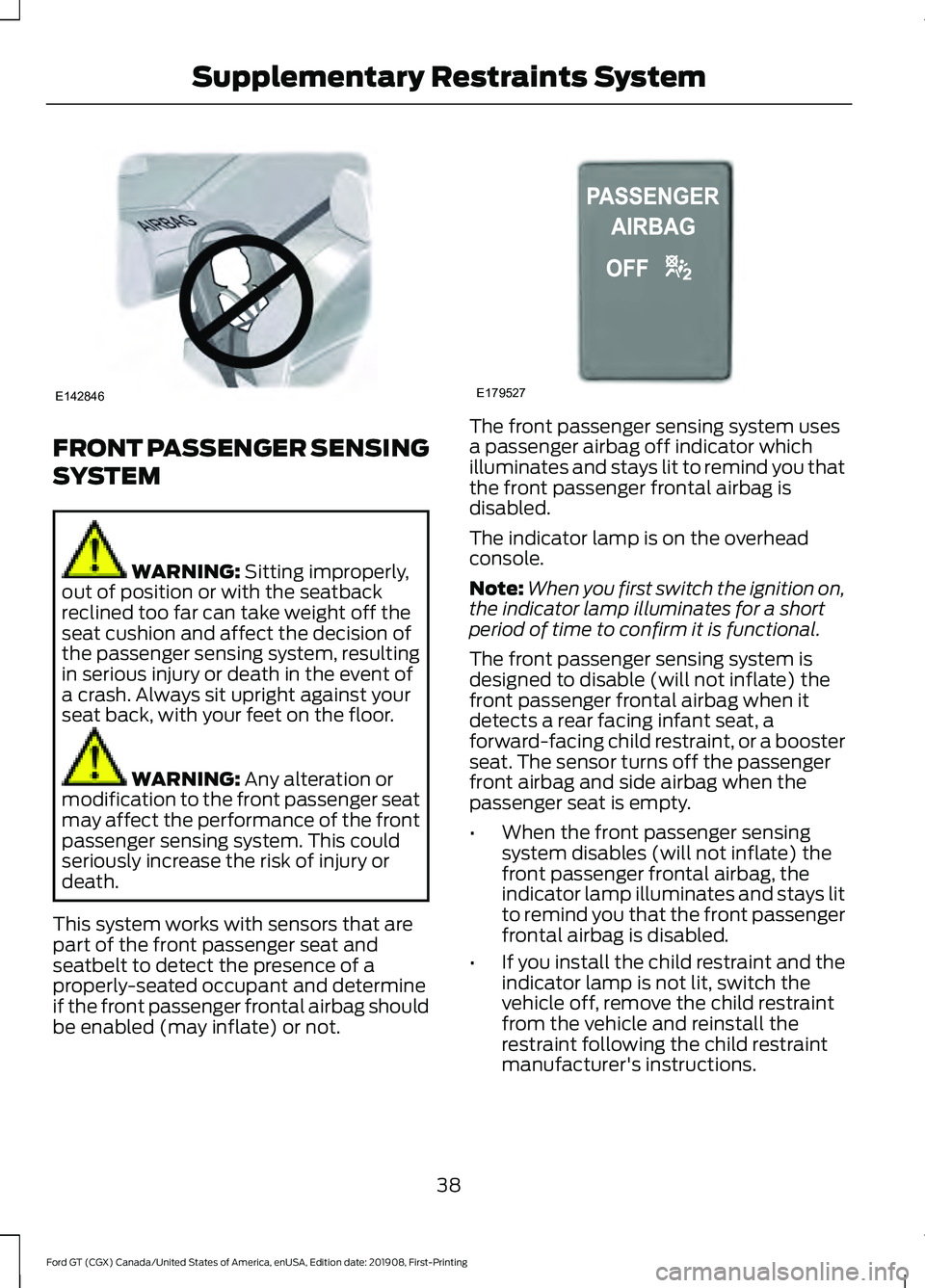
be enabled (may inflate) or not. The front passenger sensing system uses
a passenger airbag off indicator which
illuminates and stays lit to remind you that
the front passenger frontal airbag is
disabled.
The indicator lamp is on the overhead
console.
Note:
When you first switch the ignition on,
the indicator lamp illuminates for a short
period of time to confirm it is functional.
The front passenger sensing system is
designed to disable (will not inflate) the
front passenger frontal airbag when it
detects a rear facing infant seat, a
forward-facing child restraint, or a booster
seat. The sensor turns off the passenger
front airbag and side airbag when the
passenger seat is empty.
• When the front passenger sensing
system disables (will not inflate) the
front passenger frontal airbag, the
indicator lamp illuminates and stays lit
to remind you that the front passenger
frontal airbag is disabled.
• If you install the child restraint and the
indicator lamp is not lit, switch the
vehicle off, remove the child restraint
from the vehicle and reinstall the
restraint following the child restraint
manufacturer's instructions.
38
Ford GT (CGX) Canada/United States of America, enUSA, Edition date: 201908, First-Printing Supplementary Restraints SystemE142846 E179527
Page 42 of 316
The front passenger sensing system is
designed to enable (may inflate) the front
passenger frontal airbag anytime the
system senses that a person of adult size
is sitting properly in the front passenger
seat.
•
When the front passenger sensing
system enables the front passenger
frontal airbag (may inflate), the
indicator lamp will be unlit and stays
unlit. If a person of adult size is sitting in the front
passenger seat, but the airbag off indicator
lamp is lit, it is possible that the person is
not sitting properly in the seat. If this
happens:
•
Switch the vehicle off and ask the
person to place the seatback in the full
upright position.
• Have the person sit upright in the seat,
centered on the seat cushion, with the
person ’s legs comfortably extended.
• Restart the vehicle and have the person
remain in this position for about two
minutes. This allows the system to
detect that person and enable the
passenger front airbag. Passenger Airbag
Passenger Airbag OFF Indic-
ator
Occupant
Disabled
Lit
Empty
Disabled
Lit
Child
Enabled
Unlit
Adult
Note: When the passenger airbag off light
illuminates, the passenger side airbag (near
the B-pillar) may be disabled to avoid the
risk of airbag deployment injuries.
After all occupants put on seatbelts, it is
very important that they continue to sit
properly. A properly seated occupant sits
upright, leaning against the seatback, and
centered on the seat cushion, with their
feet comfortably extended on the floor.
Sitting improperly can increase the chance
of injury in a crash event. For example, if
an occupant slouches, lies down, turns
sideways, sits forward, leans forward or
sideways, or puts one or both feet up, the
chance of injury during a crash greatly
increases. If you think that the status of the passenger
airbag off indicator lamp is incorrect, check
for the following:
•
Objects between the seat cushion and
the center console.
• Objects hanging off the seatback.
• Objects placed on the occupant's lap.
• Cargo interference with the seat.
The conditions listed above may cause the
weight of a properly seated occupant to
be incorrectly interpreted by the front
passenger sensing system. The person in
the front passenger seat may appear
heavier or lighter due to the conditions
described in the list above. Make sure the front passenger
sensing system is operating
properly. See Crash Sensors
and Airbag Indicator (page 41).
39
Ford GT (CGX) Canada/United States of America, enUSA, Edition date: 201908, First-Printing Supplementary Restraints SystemE67017
Page 44 of 316
The design and development of the side
airbag system included recommended
testing procedures that were developed
by a group of automotive safety experts
known as the Side Airbag Technical
Working Group. These recommended
testing procedures help reduce the risk of
injuries related to the deployment of side
airbags.
DRIVER AND PASSENGER
KNEE AIRBAGS
WARNING: To reduce risk of
injury, do not obstruct or place objects
in the deployment path of the knee
airbag.
The knee airbags are under or within the
instrument panel. During a crash, the
restraints control module may activate the
driver and passenger knee airbags based
on crash severity and occupant conditions.
Under certain crash and occupant
conditions, the driver and passenger knee
airbag may deploy, but the driver front
airbag may not activate. As with front and
side airbags, it is important to be properly
seated and restrained to reduce the risk of
death or serious injury. Make sure the knee airbags are
operating properly. See
Crash
Sensors and Airbag Indicator
(page
41). CRASH SENSORS AND
AIRBAG INDICATOR WARNING:
Modifying or adding
equipment to the front end of your
vehicle (including hood, bumper system,
frame, front end body structure, tow
hooks and hood pins) may affect the
performance of the airbag system,
increasing the risk of injury. Do not
modify or add equipment to the front
end of your vehicle.
Your vehicle has a collection of crash and
occupant sensors which provide
information to the restraints control
module. The restraints control module
deploys (activates) the front seatbelt
pretensioners, driver airbag, passenger
airbag, knee airbag(s) and side airbags.
Based on the type of crash, the restraints
control module deploys the appropriate
safety devices.
The restraints control module monitors
the readiness of the safety devices and the
crash and occupant sensors. The readiness
of the safety system is indicated by a
warning indicator light in the instrument
cluster or by a backup tone if the warning
light is not working. Routine maintenance
of the airbag is not required.
A difficulty with the system is indicated by
one or more of the following: The readiness light does not
illuminate immediately after you
switch the ignition on.
• The readiness light either flashes or
stays lit.
• The system has five tones that repeat
periodically until the problem, the light
or both are repaired.
41
Ford GT (CGX) Canada/United States of America, enUSA, Edition date: 201908, First-Printing Supplementary Restraints SystemE67017 E67017
Page 45 of 316
If you experience any of these events, even
intermittently, have a qualified technician
service the supplemental restraint system
immediately. If it is not serviced, the
system may not function properly in a
crash.
The design of the seatbelt pretensioners
and the front airbag supplemental restraint
system is to activate when the vehicle
sustains frontal deceleration sufficient to
cause the restraints control module to
deploy a safety device.
If the seatbelt pretensioners or front
airbags do not activate for both front seat
occupants in a crash, it does not mean that
something is wrong with the system.
Rather, it means the restraints control
module determined the accident
conditions (crash severity, belt usage)
were not appropriate to activate these
safety devices.
•
The design of the front airbags is to
activate only in frontal and near-frontal
crashes (not rollovers, side impacts or
rear impacts unless the crash causes
sufficient frontal deceleration).
• The design of the seatbelt
pretensioners is to activate in frontal,
near-frontal and side crashes.
• The knee airbag(s) may deploy based
on crash severity and occupant
conditions.
• The design of the side airbags is to
inflate in certain side crashes. Side
airbags may activate in other types of
crashes if the vehicle experiences
sufficient sideways motion or
deformation.
AIRBAG DISPOSAL
Contact your authorized dealer as soon as
possible. Airbags must be disposed of by
qualified personnel.
42
Ford GT (CGX) Canada/United States of America, enUSA, Edition date: 201908, First-Printing Supplementary Restraints System
Page 46 of 316
WHAT IS 911 ASSIST
911 Assist is a SYNC system feature that
can call for help if you’re in an accident. If
a crash deploys an airbag (excluding knee
airbags and rear inflatable seatbelts [if
equipped]) or activates the fuel pump
shut-off, your SYNC-equipped vehicle may
be able to contact emergency services by
dialing 911 through a paired and connected
Bluetooth-enabled phone. You can learn
more about the 911 Assist feature, by
visiting:
Website
www.owner.ford.com
www.syncmyride.ca
www.syncmaroute.ca
Not all crashes will deploy an airbag or
activate the fuel pump shut-off (the
triggers for 911 Assist). If a connected cell
phone sustains damage or loses its
connection to SYNC during a crash, SYNC
will search for and try to connect to a
previously paired cell phone; SYNC will
then attempt to call the emergency
services.
Before making the call:
• SYNC provides a short window of time
(about 10 seconds) to cancel the call.
If you fail to cancel the call, SYNC
attempts to dial 911.
• SYNC says the following, or a similar
message: "SYNC will attempt to call
911, to cancel the call, press Cancel on
your screen or press and hold the
phone button on your steering wheel." If you do not cancel the call, and SYNC
makes a successful call, a pre-recorded
message plays for the 911 operator, and
then the occupant(s) in your vehicle is able
to talk with the operator. Be prepared to
provide your name, phone number and
location immediately, because not all 911
systems are capable of receiving this
information electronically.
During an emergency call, the system
transmits vehicle data to the emergency
service. See Data Recording (page 7).
EMERGENCY CALL
REQUIREMENTS WARNING:
Do not wait for 911
Assist to make an emergency call if you
can do it yourself. Dial emergency
services immediately to avoid delayed
response time which could increase the
risk of serious injury or death after a
crash. If you do not hear 911 Assist within
five seconds of the crash, the system or
phone may be damaged or
non-functional. WARNING:
Always place your
phone in a secure location in your vehicle
so it does not become a projectile or get
damaged in a crash. Failure to do so may
cause serious injury to someone or
damage the phone which could prevent
911 Assist from working properly. WARNING: Unless the 911 Assist
setting is set on before a crash, the
system will not dial for help which could
delay response time, potentially
increasing the risk of serious injury or
death after a crash.
43
Ford GT (CGX) Canada/United States of America, enUSA, Edition date: 201908, First-Printing 911 Assist
Page 74 of 316
Note:
Do not resume your journey if it
illuminates despite the level being correct.
Have the system checked by your authorized
dealer immediately.
Fasten Seatbelt It illuminates and a chime
sounds until you fasten the
seatbelts.
Front Airbag If it fails to illuminate when you
start your vehicle, continues to
flash or remains on, it indicates
a malfunction. Have the system checked
by your authorized dealer.
Front Lift Mode Active Illuminates when you switch this
feature on. See Drive Mode
Control (page 121).
Frost Warning Lamp WARNING:
Even if the
temperature rises to above 39°F (4°C)
there is no guarantee that the road is free
of hazards caused by inclement weather. It illuminates when the outside
air temperature is 39°F (4°C) or
below.
Hatch Ajar Displays when the ignition is on
and the hatch is not completely
closed. High Beam It illuminates when you switch
the high beam headlamps on or
use the headlamp flasher.
Hood Ajar Displays when the ignition is on
and the hood is not completely
closed.
Hydraulic System Fault Illuminates when there is an
issue with your vehicle's
hydraulic system. Have the
system checked by your authorized dealer
immediately.
Launch Control Illuminates when you switch this
feature on. See Using Stability
Control
(page 116).
Low Beam Malfunction Warning
Lamp It illuminates when there is a
malfunction with a low beam
headlamp bulb.
Low Fuel Level It will illuminate when the fuel
level is low or the fuel tank is
nearly empty. Refuel as soon as
possible.
Low Tire Pressure Warning It will illuminate when your tire
pressure is low. If the lamp
remains on with the engine
running or when driving, check your tire
pressures as soon as possible.
71
Ford GT (CGX) Canada/United States of America, enUSA, Edition date: 201908, First-Printing Instrument ClusterE71880 E67017 E234582 E236451 E236450 E234584 E234583 E181350
Page 90 of 316
SITTING IN THE CORRECT
POSITION
WARNING: Sitting improperly,
out of position or with the seatback
reclined too far can take weight off the
seat cushion and affect the decision of
the passenger sensing system, resulting
in serious injury or death in the event of
a crash. Always sit upright against your
seat back, with your feet on the floor. WARNING:
Do not place any
objects on a folded seat. Hard objects
may become projectiles in a crash or
sudden stop, which may increase the risk
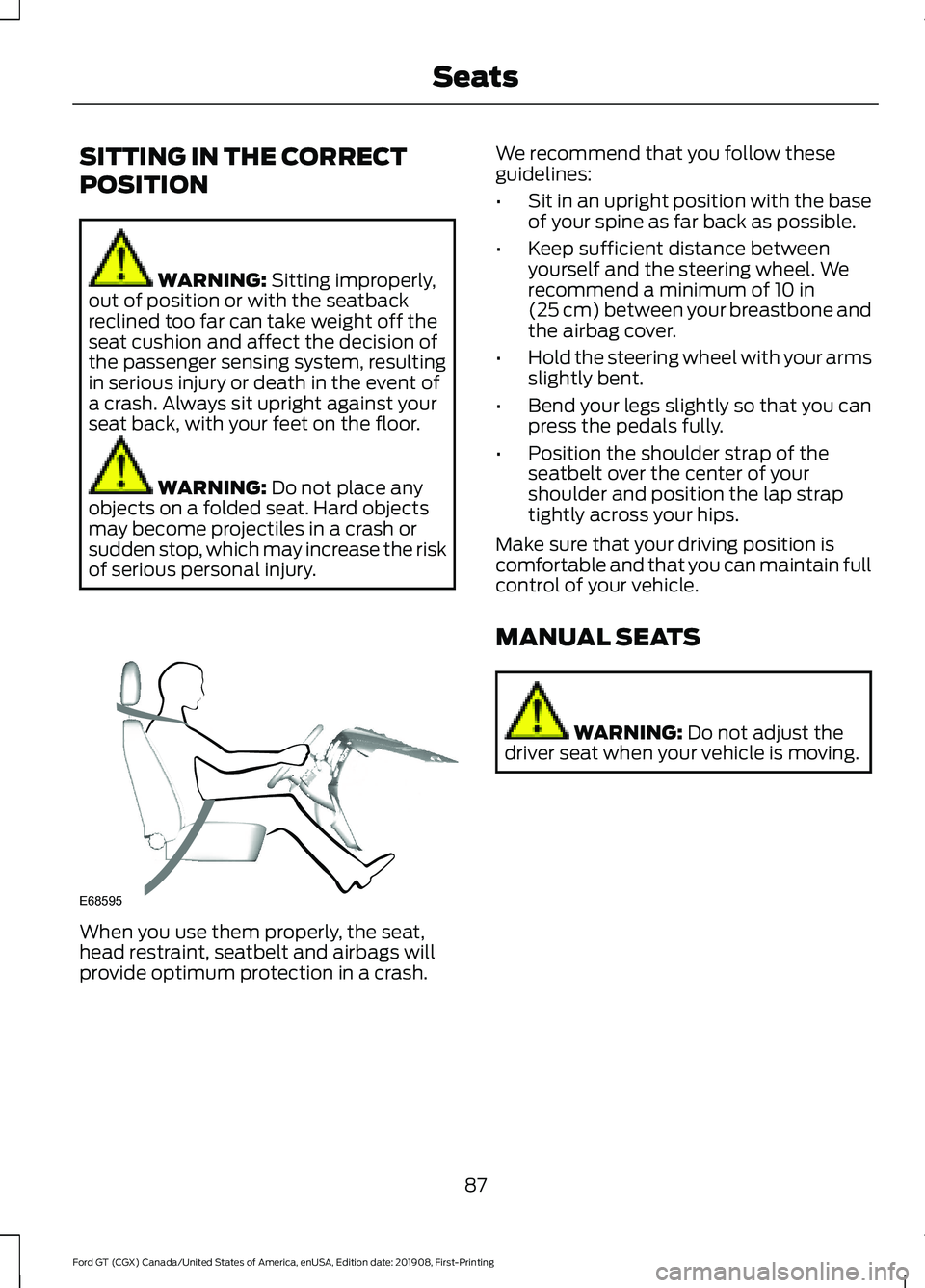
of serious personal injury. When you use them properly, the seat,
head restraint, seatbelt and airbags will
provide optimum protection in a crash. We recommend that you follow these
guidelines:
•
Sit in an upright position with the base
of your spine as far back as possible.
• Keep sufficient distance between
yourself and the steering wheel. We
recommend a minimum of
10 in
(25 cm) between your breastbone and
the airbag cover.
• Hold the steering wheel with your arms
slightly bent.
• Bend your legs slightly so that you can
press the pedals fully.
• Position the shoulder strap of the
seatbelt over the center of your
shoulder and position the lap strap
tightly across your hips.
Make sure that your driving position is
comfortable and that you can maintain full
control of your vehicle.
MANUAL SEATS WARNING:
Do not adjust the
driver seat when your vehicle is moving.
87
Ford GT (CGX) Canada/United States of America, enUSA, Edition date: 201908, First-Printing SeatsE68595
Page 95 of 316
•
Press the brake pedal and then press
the button for any length of time.
STEERING WHEEL LOCK
The steering wheel locks automatically
when you leave your vehicle and take the
intelligent access key with you. The
steering wheel unlocks automatically when
you enter your vehicle with the intelligent
access key.
Note: You may need to turn the steering
wheel left or right if the wheel does not
unlock completely. This may happen in
certain situations, such as parking your
vehicle on a steep grade.
STARTING THE ENGINE
When you start the engine, the idle speed
increases. This helps to warm up the
engine. If the engine idle speed does not
slow down automatically, have your
vehicle checked by an authorized dealer.
Note: You can crank the engine for a total
of 60 seconds, without the engine starting,
before the starting system temporarily
disables. The 60 seconds does not have to
be all at once. For example, you can crank
the engine three times for 20 seconds each,
without the engine starting, to reach the 60
second time limit. If you exceed the
cranking time, you cannot attempt to start
the engine for at least 15 minutes. After 15
minutes, you have a 15 second time limit to
crank the engine. You need to wait 60
minutes before you crank the engine again
for 60 seconds.
Before starting the engine, check the
following:
• Make sure all occupants fasten their
seatbelts.
• Make sure the headlamps and
electrical accessories are off. •
Make sure the parking brake is on.
• Move the transmission selector into
park (P).
Note: Do not touch the accelerator pedal.
Note: You must have your intelligent access
key in the vehicle in order to shift the
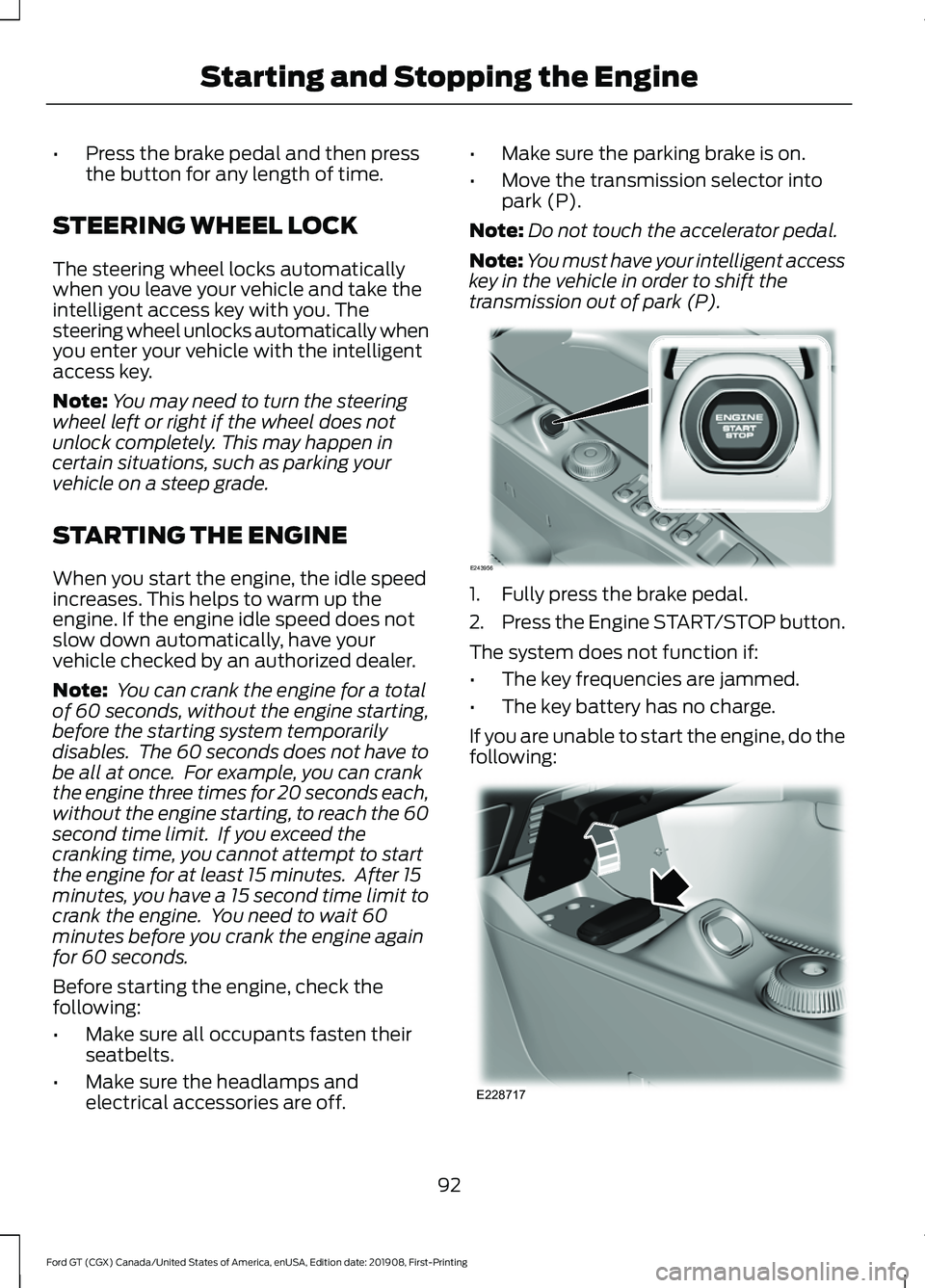
transmission out of park (P). 1. Fully press the brake pedal.
2.
Press the Engine START/STOP button.
The system does not function if:
• The key frequencies are jammed.
• The key battery has no charge.
If you are unable to start the engine, do the
following: 92
Ford GT (CGX) Canada/United States of America, enUSA, Edition date: 201908, First-Printing Starting and Stopping the EngineE243956 E228717