brake FORD GT 2020 Service Manual
[x] Cancel search | Manufacturer: FORD, Model Year: 2020, Model line: GT, Model: FORD GT 2020Pages: 316, PDF Size: 6.25 MB
Page 150 of 316
Protected Components
Fuse
Rating
Fuse or
Relay
Number
Anti-lock brake system.
5 A 2
F22
Horn.
20 A 2
F23
Electronic door system.
20 A 2
F24
Right-hand headlamp.
20 A 2
F25
1 J-case fuse.
2 Mini fuse.
Rear Power Distribution Box 1
The rear power distribution box is in the
engine compartment. See Under Hood
Overview (page 159). It has high-current
fuses that protect your vehicle's main
electrical systems from overloads. These
are in the right-hand side of the engine
compartment behind an access door in the
engine surround panel. If you need to
replace these high-current fuses, see an
authorized dealer. If you disconnect and reconnect the
battery, you need to reset some features.
See Changing the 12V Battery (page 167
).
147
Ford GT (CGX) Canada/United States of America, enUSA, Edition date: 201908, First-Printing Fuses
Page 155 of 316
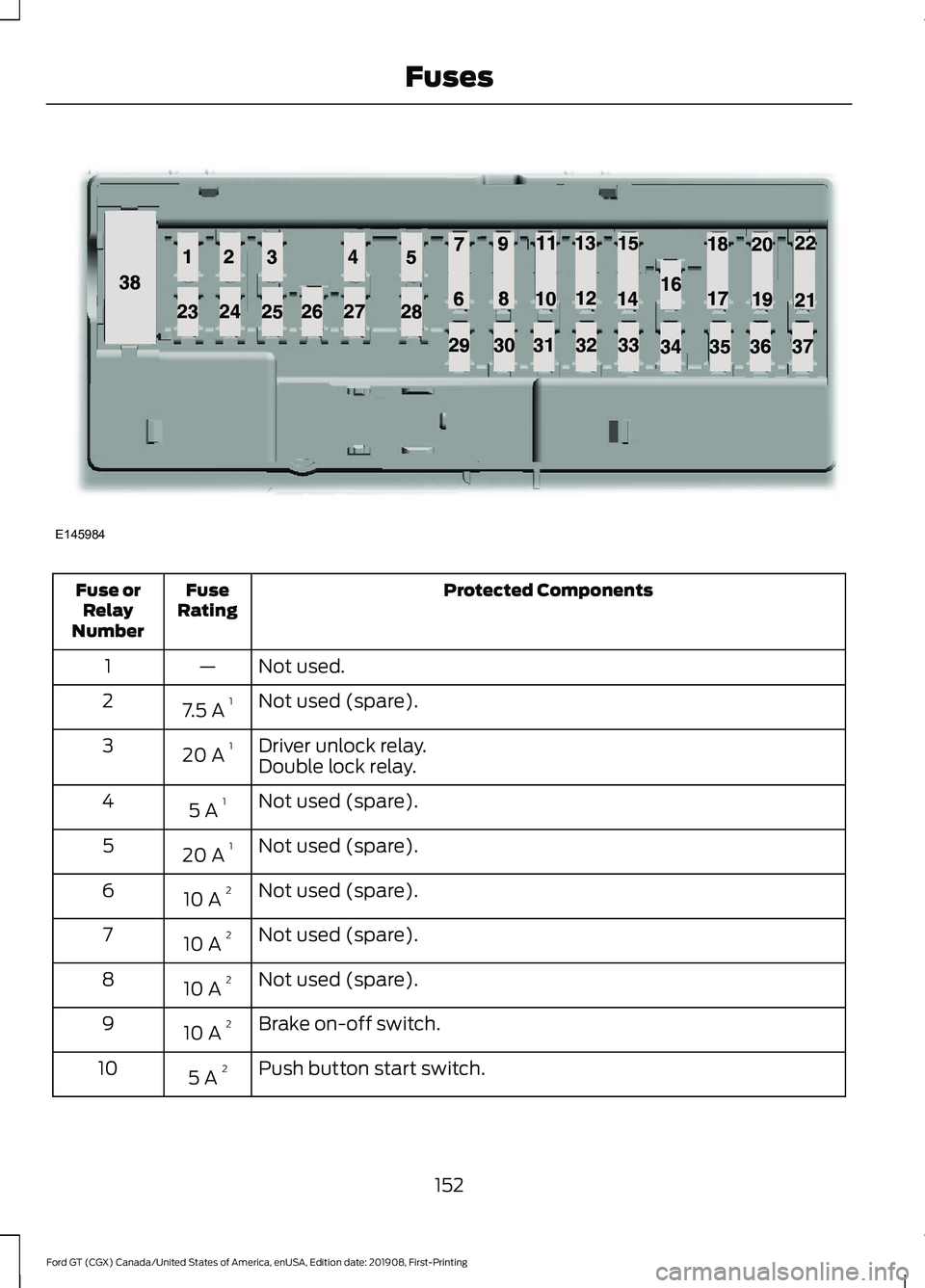
Protected Components
Fuse
Rating
Fuse or
Relay
Number
Not used.
—
1
Not used (spare).
7.5 A 1
2
Driver unlock relay.
20 A 1
3
Double lock relay.
Not used (spare).
5 A 1
4
Not used (spare).
20 A 1
5
Not used (spare).
10 A 2
6
Not used (spare).
10 A 2
7
Not used (spare).
10 A 2
8
Brake on-off switch.
10 A 2
9
Push button start switch.
5 A 2
10
152
Ford GT (CGX) Canada/United States of America, enUSA, Edition date: 201908, First-Printing FusesE145984
Page 160 of 316
GENERAL INFORMATION
Have your Ford GT serviced regularly to
help maintain its roadworthiness and
resale value. There is a network of Ford GT
service dealers that are certified to help
you with their professional servicing
expertise. We believe that their specially
trained technicians are best qualified to
service your vehicle properly and expertly.
They are supported by a range of highly
specialized tools developed specifically
for servicing the Ford GT.
If your vehicle requires professional service,
an authorized dealer can provide the
necessary parts and service. Check your
warranty information to find out which
parts and services are covered.
Use only recommended fuels, lubricants,
fluids and service parts conforming to
specifications. Motorcraft® parts are
designed and built to provide the best
performance in your vehicle.
Precautions
•
Do not work on a hot engine.
• Make sure that nothing gets caught in
moving parts.
• Do not work on a vehicle with the
engine running in an enclosed space,
unless you are sure you have enough
ventilation.
• Keep all open flames and other burning
material (such as cigarettes) away
from the battery and all fuel related
parts.
Working with the Engine Off
1. Set the parking brake and shift to park
(P).
2. Switch off the engine.
3. Block the wheels. Working with the Engine On WARNING: To reduce the risk
of vehicle damage and personal burn
injuries, do not start your engine with the
air cleaner removed and do not remove
it while the engine is running.
1. Set the parking brake and shift to park
(P).
2. Block the wheels.
OPENING AND CLOSING THE
HOOD
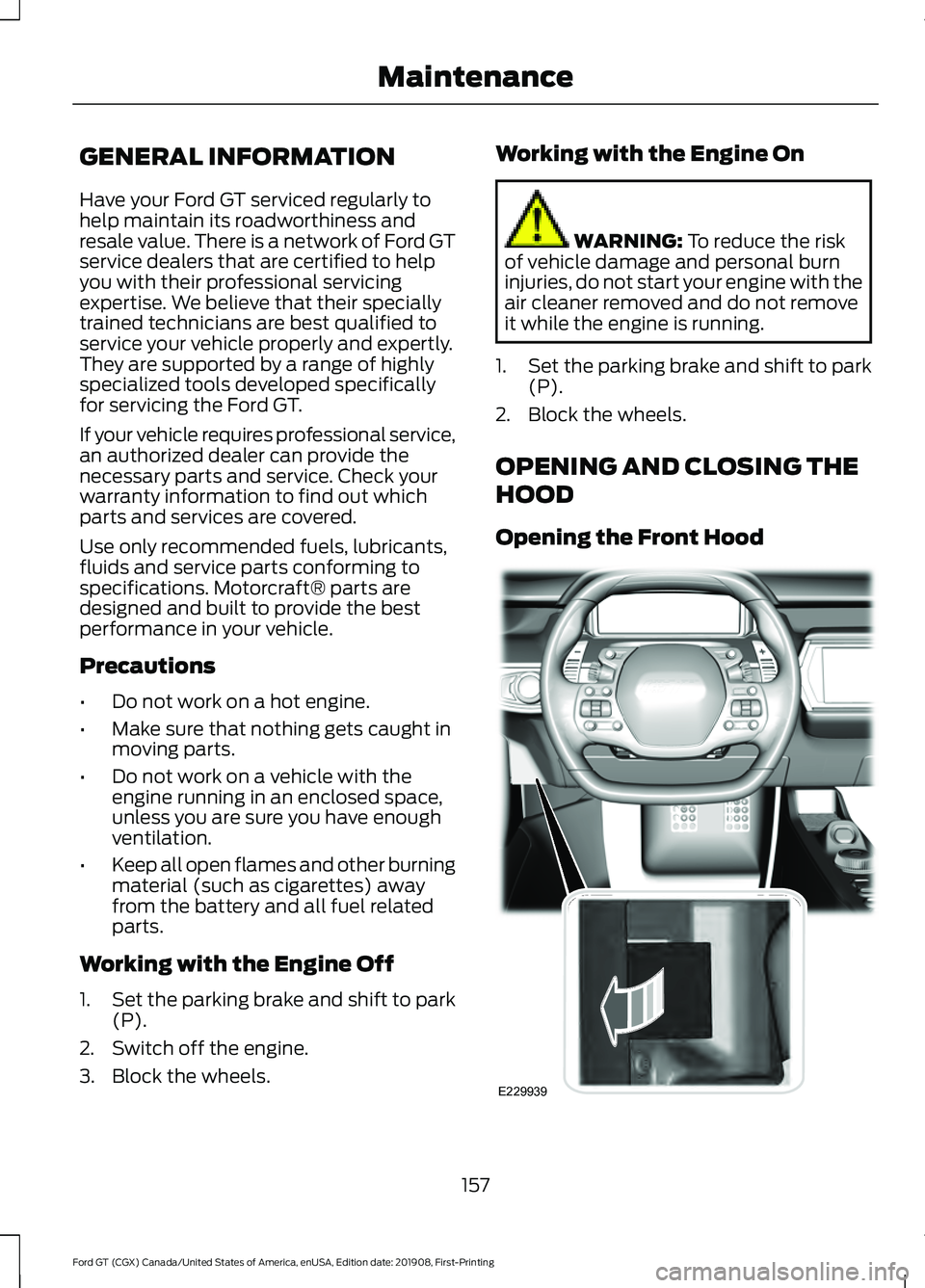
Opening the Front Hood 157
Ford GT (CGX) Canada/United States of America, enUSA, Edition date: 201908, First-Printing MaintenanceE229939
Page 162 of 316
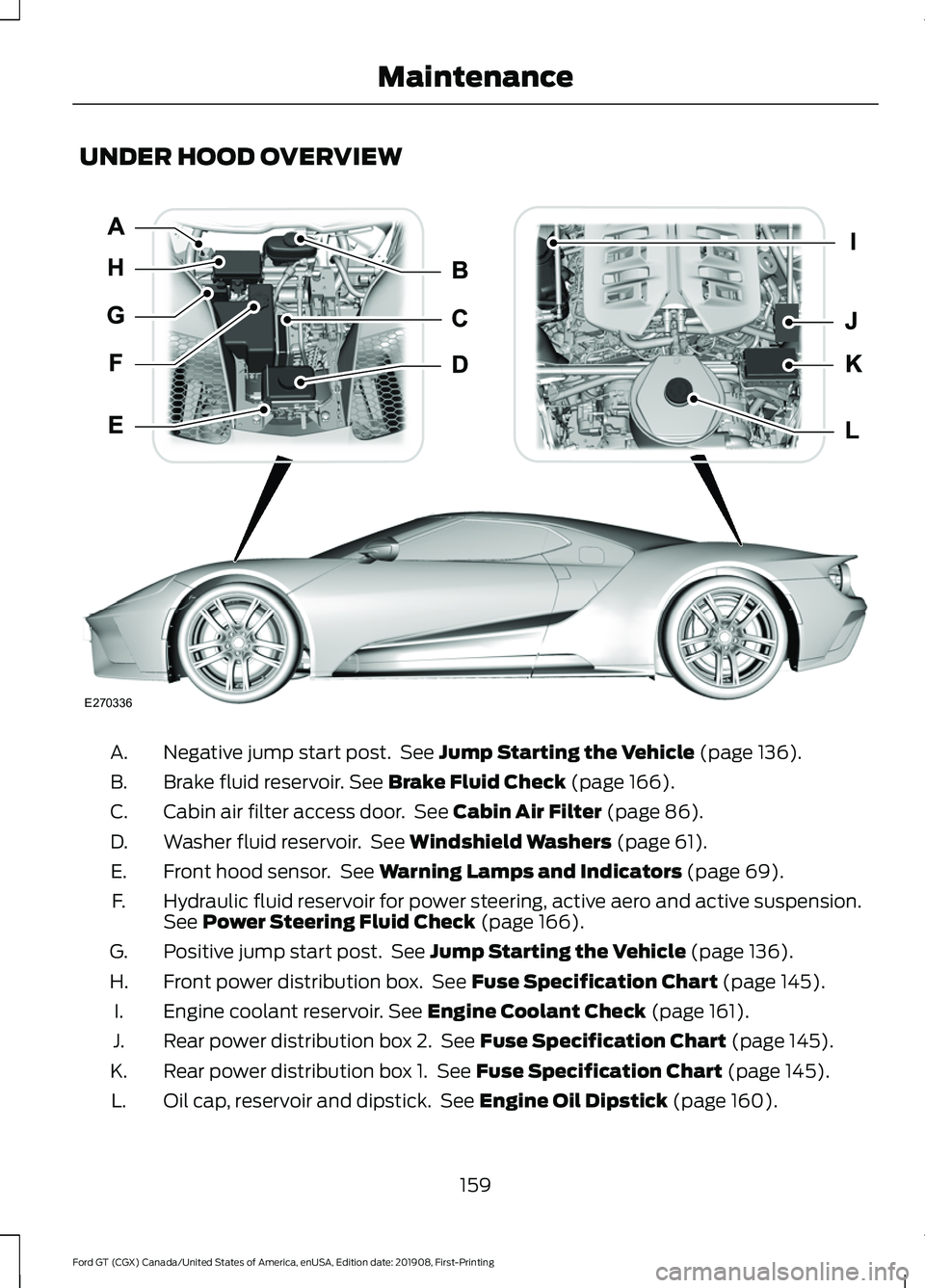
UNDER HOOD OVERVIEW
Negative jump start post. See Jump Starting the Vehicle (page 136).
A.
Brake fluid reservoir.
See Brake Fluid Check (page 166).
B.
Cabin air filter access door. See
Cabin Air Filter (page 86).
C.
Washer fluid reservoir. See
Windshield Washers (page 61).
D.
Front hood sensor. See
Warning Lamps and Indicators (page 69).
E.
Hydraulic fluid reservoir for power steering, active aero and active suspension.
See
Power Steering Fluid Check (page 166).
F.
Positive jump start post. See
Jump Starting the Vehicle (page 136).
G.
Front power distribution box. See
Fuse Specification Chart (page 145).
H.
Engine coolant reservoir.
See Engine Coolant Check (page 161).
I.
Rear power distribution box 2. See
Fuse Specification Chart (page 145).
J.
Rear power distribution box 1. See
Fuse Specification Chart (page 145).
K.
Oil cap, reservoir and dipstick. See
Engine Oil Dipstick (page 160).
L.
159
Ford GT (CGX) Canada/United States of America, enUSA, Edition date: 201908, First-Printing MaintenanceE270336
Page 163 of 316
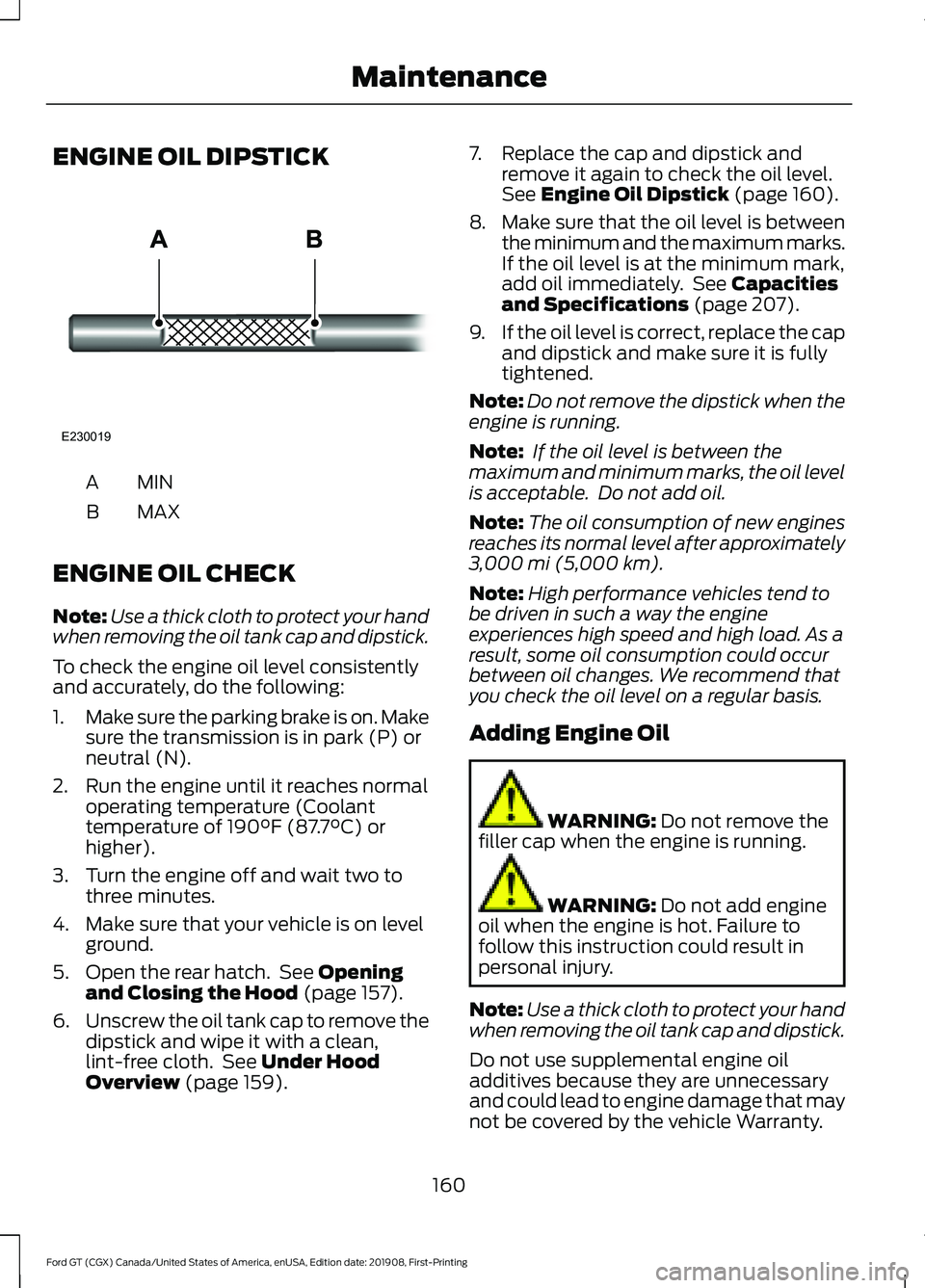
ENGINE OIL DIPSTICK
MINA
MAX
B
ENGINE OIL CHECK
Note: Use a thick cloth to protect your hand
when removing the oil tank cap and dipstick.
To check the engine oil level consistently
and accurately, do the following:
1. Make sure the parking brake is on. Make
sure the transmission is in park (P) or
neutral (N).
2. Run the engine until it reaches normal operating temperature (Coolant
temperature of 190°F (87.7°C) or
higher).
3. Turn the engine off and wait two to three minutes.
4. Make sure that your vehicle is on level ground.
5. Open the rear hatch. See
Opening
and Closing the Hood (page 157).
6. Unscrew the oil tank cap to remove the
dipstick and wipe it with a clean,
lint-free cloth. See
Under Hood
Overview (page 159). 7. Replace the cap and dipstick and
remove it again to check the oil level.
See
Engine Oil Dipstick (page 160).
8. Make sure that the oil level is between
the minimum and the maximum marks.
If the oil level is at the minimum mark,
add oil immediately. See
Capacities
and Specifications (page 207).
9. If the oil level is correct, replace the cap
and dipstick and make sure it is fully
tightened.
Note: Do not remove the dipstick when the
engine is running.
Note: If the oil level is between the
maximum and minimum marks, the oil level
is acceptable. Do not add oil.
Note: The oil consumption of new engines
reaches its normal level after approximately
3,000 mi (5,000 km)
.
Note: High performance vehicles tend to
be driven in such a way the engine
experiences high speed and high load. As a
result, some oil consumption could occur
between oil changes. We recommend that
you check the oil level on a regular basis.
Adding Engine Oil WARNING:
Do not remove the
filler cap when the engine is running. WARNING:
Do not add engine
oil when the engine is hot. Failure to
follow this instruction could result in
personal injury.
Note: Use a thick cloth to protect your hand
when removing the oil tank cap and dipstick.
Do not use supplemental engine oil
additives because they are unnecessary
and could lead to engine damage that may
not be covered by the vehicle Warranty.
160
Ford GT (CGX) Canada/United States of America, enUSA, Edition date: 201908, First-Printing MaintenanceE230019
Page 167 of 316
How Fail-Safe Cooling Works
If the engine begins to overheat, the
coolant temperature gauge moves toward
the red zone:
A warning lamp illuminates and
a message may appear in the
information display.
If the engine reaches a preset
over-temperature condition, the engine
automatically switches to alternating
cylinder operation. Each disabled cylinder
acts as an air pump and cools the engine.
When this occurs, your vehicle still
operates, however:
• Engine power is limited.
• The air conditioning system turns off.
Continued operation increases the engine
temperature, causing the engine to
completely shut down. Your steering and
braking effort increases in this situation.
When the engine temperature cools, you
can re-start the engine. Have your vehicle
checked as soon as possible to minimize
engine damage.
When Fail-Safe Mode Is Activated WARNING: Fail-safe mode is for
use during emergencies only. Operate
your vehicle in fail-safe mode only as
long as necessary to bring your vehicle
to rest in a safe location and seek
immediate repairs. When in fail-safe
mode, your vehicle will have limited
power, will not be able to maintain high-speed operation, and may
completely shut down without warning,
potentially losing engine power, power
steering assist, and power brake assist,
which may increase the possibility of a
crash resulting in serious injury.
WARNING:
Never remove the
coolant reservoir cap when the engine is
running or hot.
Your vehicle has limited engine power
when in the fail-safe mode, drive your
vehicle with caution. Your vehicle does not
maintain high-speed operation and the
engine may operate poorly.
Remember that the engine is capable of
automatically shutting down to prevent
engine damage. In this situation:
1. Pull off the road as soon as safely possible and switch the engine off.
2. Contact the Ford GT Concierge to obtain assistance.
See About This
Manual (page 5).
3. If this is not possible, wait a short period for the engine to cool.
4. Check the coolant level. If the coolant level is at or below the minimum mark,
add prediluted coolant immediately.
5. When the engine temperature cools, you can re-start the engine. Have your
vehicle checked as soon as possible to
minimize engine damage.
Note: Driving your vehicle without repair
increases the chance of engine damage.
164
Ford GT (CGX) Canada/United States of America, enUSA, Edition date: 201908, First-Printing Maintenance
Page 169 of 316
BRAKE FLUID CHECK
WARNING: Do not use any fluid
other than the recommended brake fluid
as this will reduce brake efficiency. Use
of incorrect fluid could result in the loss
of vehicle control, serious personal injury
or death. WARNING: Only use brake fluid
from a sealed container. Contamination
with dirt, water, petroleum products or
other materials may result in brake
system damage or failure. Failure to
adhere to this warning could result in the
loss of vehicle control, serious personal
injury or death. WARNING:
Do not allow the
fluid to touch your skin or eyes. If this
happens, rinse the affected areas
immediately with plenty of water and
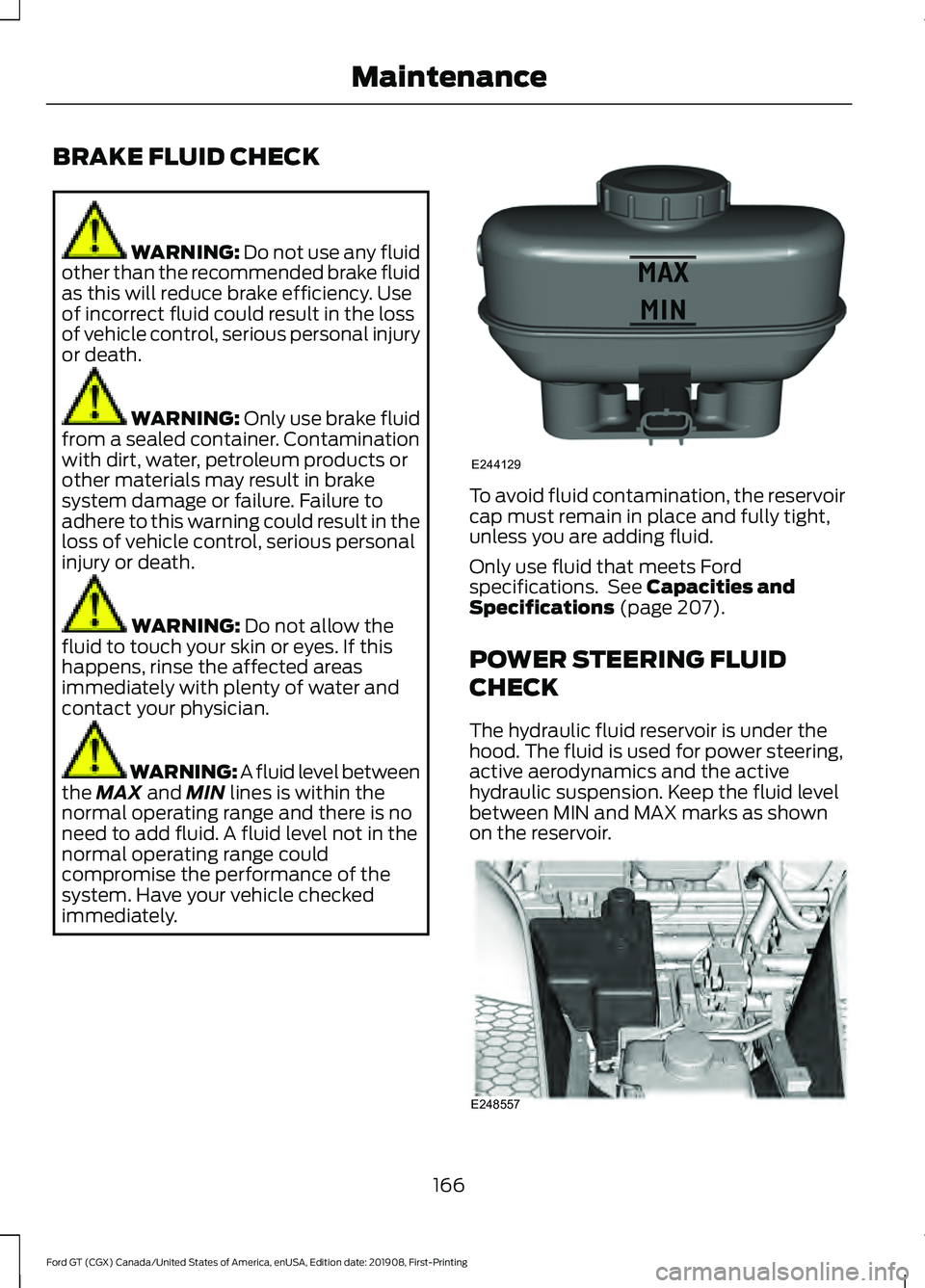
contact your physician. WARNING: A fluid level between
the
MAX and MIN lines is within the
normal operating range and there is no
need to add fluid. A fluid level not in the
normal operating range could
compromise the performance of the
system. Have your vehicle checked
immediately. To avoid fluid contamination, the reservoir
cap must remain in place and fully tight,
unless you are adding fluid.
Only use fluid that meets Ford
specifications. See
Capacities and
Specifications (page 207).
POWER STEERING FLUID
CHECK
The hydraulic fluid reservoir is under the
hood. The fluid is used for power steering,
active aerodynamics and the active
hydraulic suspension. Keep the fluid level
between MIN and MAX marks as shown
on the reservoir. 166
Ford GT (CGX) Canada/United States of America, enUSA, Edition date: 201908, First-Printing MaintenanceE244129 E248557
Page 171 of 316
Because your vehicle
’s engine is
electronically controlled by a computer,
some control conditions are maintained
by power from the battery. When the
battery is disconnected or a new battery
is installed, the engine must relearn its idle
and fuel trim strategy for optimum
driveability and performance.
To restore the settings, do the following:
1. Apply the parking brake.
2. Shift into park (P) or neutral (N).
3. Switch off all accessories.
4. Press the brake pedal and start your vehicle.
5. Run the engine until it reaches normal operating temperature. As the engine
is warming up, complete the following:
Reset the clock. See Audio System
(page 218). Reset the radio station
presets. See Audio System (page 218).
6. Allow the engine to idle for at least one
minute.
7. Drive the vehicle at least 10 mi (16 km)
to completely relearn the idle trim and
fuel trim strategy.
Note: If you do not allow the engine to
relearn the idle and fuel trim strategy, the
idle quality of your vehicle may be adversely
affected until the engine computer
eventually relearns the idle trim and fuel
trim strategy.
Make sure that you dispose of old batteries
in an environmentally friendly way. Seek
advice from your local authority about
recycling old batteries.
Battery Charger and Maintainer
If you plan to have your GT parked or in
storage for more than two weeks without
driving it, connect the Li-Ion compatible
battery charger and maintainer provided.
There are two methods to connect the
charger: Method 1: Rear Hatch Storage
Compartment Power Point
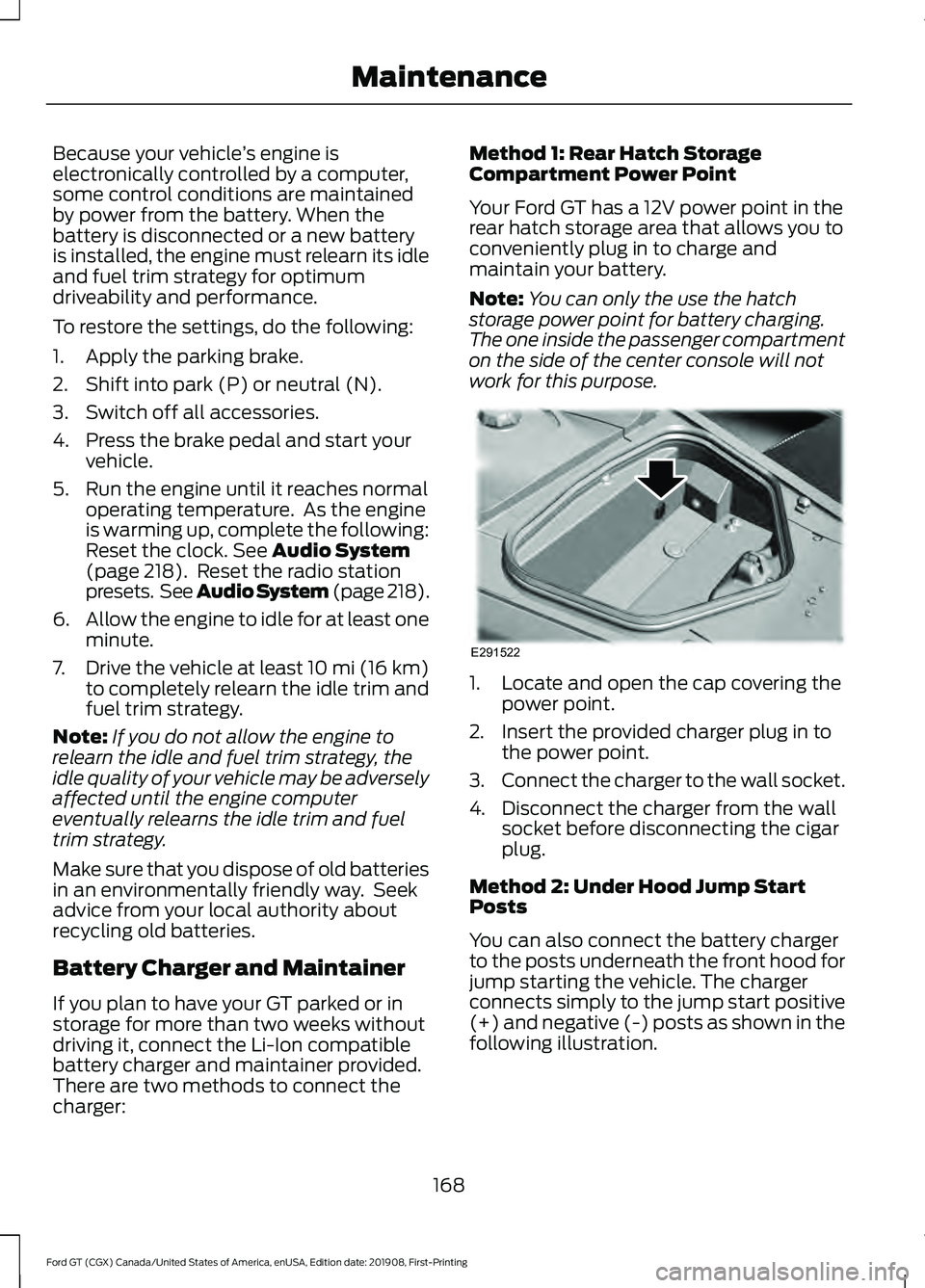
Your Ford GT has a 12V power point in the
rear hatch storage area that allows you to
conveniently plug in to charge and
maintain your battery.
Note:
You can only the use the hatch
storage power point for battery charging.
The one inside the passenger compartment
on the side of the center console will not
work for this purpose. 1. Locate and open the cap covering the
power point.
2. Insert the provided charger plug in to the power point.
3. Connect the charger to the wall socket.
4. Disconnect the charger from the wall socket before disconnecting the cigar
plug.
Method 2: Under Hood Jump Start
Posts
You can also connect the battery charger
to the posts underneath the front hood for
jump starting the vehicle. The charger
connects simply to the jump start positive
(+) and negative (-) posts as shown in the
following illustration.
168
Ford GT (CGX) Canada/United States of America, enUSA, Edition date: 201908, First-Printing MaintenanceE291522
Page 173 of 316
Run the tip of your fingers over the edge of
the blade to check for roughness.
Clean the wiper blades with washer fluid
or water applied with a soft sponge or
cloth.
CHANGING THE WIPER
BLADES
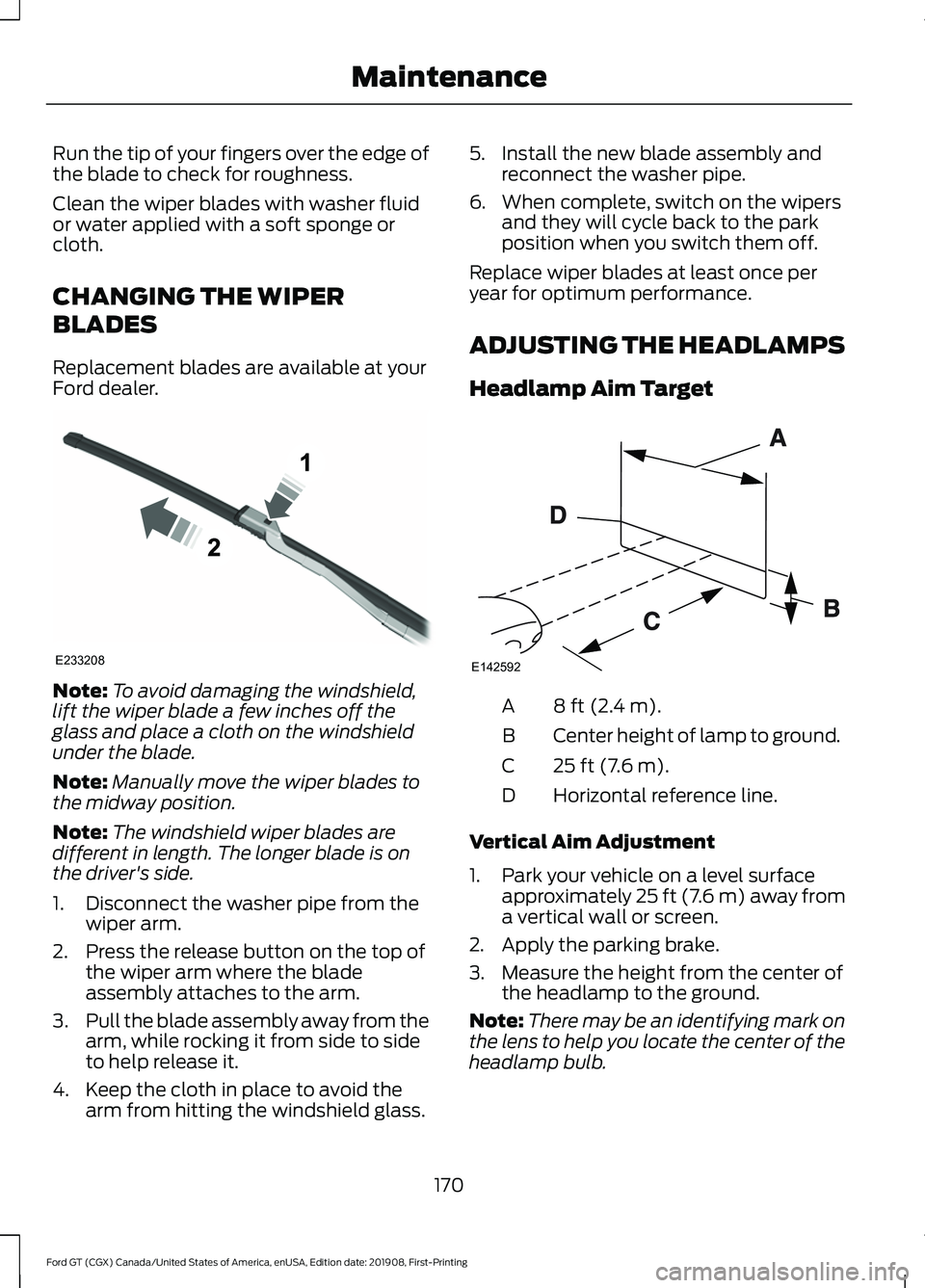
Replacement blades are available at your
Ford dealer.
Note:
To avoid damaging the windshield,
lift the wiper blade a few inches off the
glass and place a cloth on the windshield
under the blade.
Note: Manually move the wiper blades to
the midway position.
Note: The windshield wiper blades are
different in length. The longer blade is on
the driver's side.
1. Disconnect the washer pipe from the wiper arm.
2. Press the release button on the top of the wiper arm where the blade
assembly attaches to the arm.
3. Pull the blade assembly away from the
arm, while rocking it from side to side
to help release it.
4. Keep the cloth in place to avoid the arm from hitting the windshield glass. 5. Install the new blade assembly and
reconnect the washer pipe.
6. When complete, switch on the wipers and they will cycle back to the park
position when you switch them off.
Replace wiper blades at least once per
year for optimum performance.
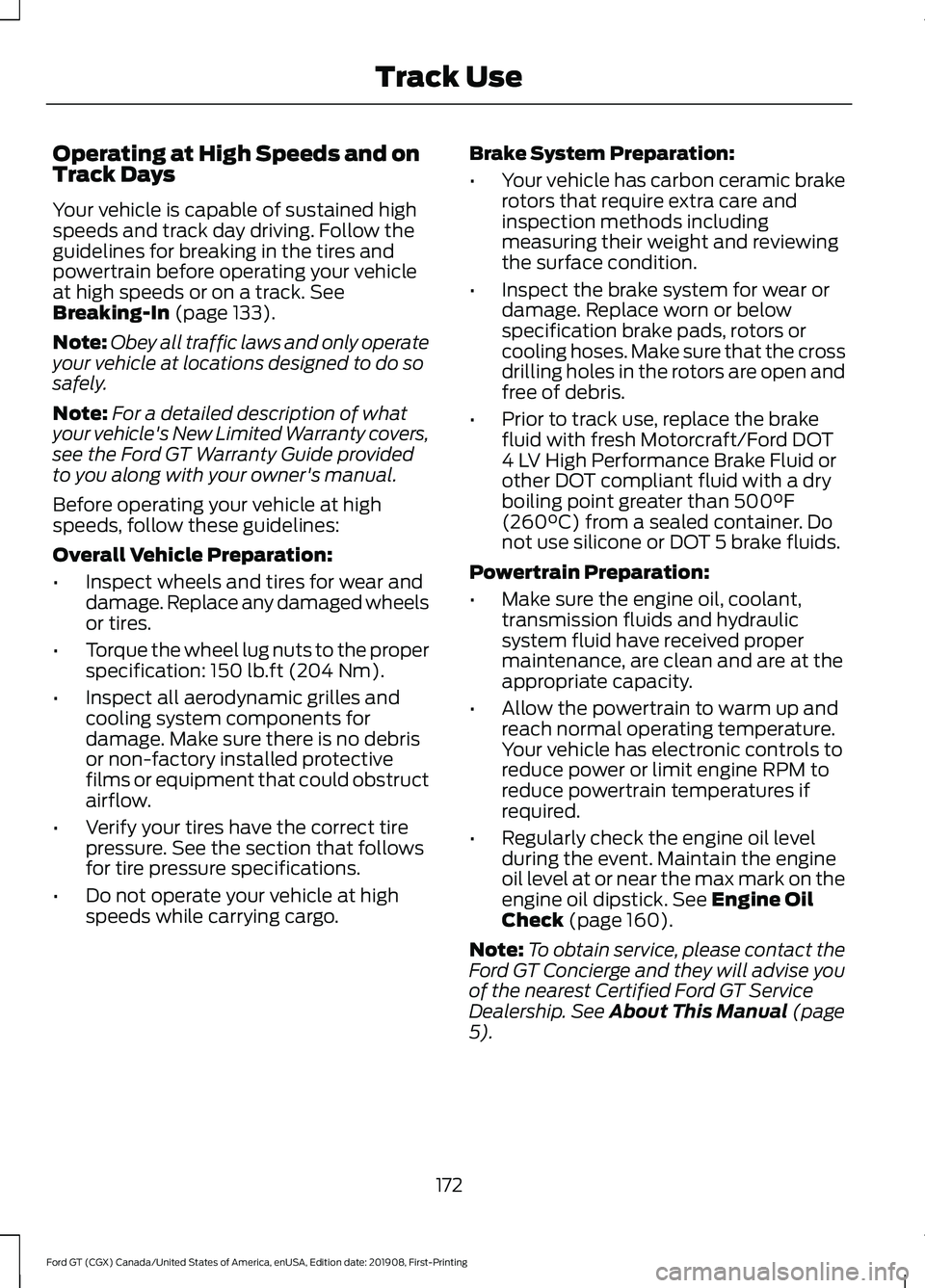
ADJUSTING THE HEADLAMPS
Headlamp Aim Target 8 ft (2.4 m).
A
Center height of lamp to ground.
B
25 ft (7.6 m).
C
Horizontal reference line.
D
Vertical Aim Adjustment
1. Park your vehicle on a level surface approximately 25 ft (7.6 m) away from
a vertical wall or screen.
2. Apply the parking brake.
3. Measure the height from the center of the headlamp to the ground.
Note: There may be an identifying mark on
the lens to help you locate the center of the
headlamp bulb.
170
Ford GT (CGX) Canada/United States of America, enUSA, Edition date: 201908, First-Printing MaintenanceE233208 E142592
Page 175 of 316
Operating at High Speeds and on
Track Days
Your vehicle is capable of sustained high
speeds and track day driving. Follow the
guidelines for breaking in the tires and
powertrain before operating your vehicle
at high speeds or on a track. See
Breaking-In (page 133).
Note: Obey all traffic laws and only operate
your vehicle at locations designed to do so
safely.
Note: For a detailed description of what
your vehicle's New Limited Warranty covers,
see the Ford GT Warranty Guide provided
to you along with your owner's manual.
Before operating your vehicle at high
speeds, follow these guidelines:
Overall Vehicle Preparation:
• Inspect wheels and tires for wear and
damage. Replace any damaged wheels
or tires.
• Torque the wheel lug nuts to the proper
specification:
150 lb.ft (204 Nm).
• Inspect all aerodynamic grilles and
cooling system components for
damage. Make sure there is no debris
or non-factory installed protective
films or equipment that could obstruct
airflow.
• Verify your tires have the correct tire
pressure. See the section that follows
for tire pressure specifications.
• Do not operate your vehicle at high
speeds while carrying cargo. Brake System Preparation:
•
Your vehicle has carbon ceramic brake
rotors that require extra care and
inspection methods including
measuring their weight and reviewing
the surface condition.
• Inspect the brake system for wear or
damage. Replace worn or below
specification brake pads, rotors or
cooling hoses. Make sure that the cross
drilling holes in the rotors are open and
free of debris.
• Prior to track use, replace the brake
fluid with fresh Motorcraft/Ford DOT
4 LV High Performance Brake Fluid or
other DOT compliant fluid with a dry
boiling point greater than
500°F
(260°C) from a sealed container. Do
not use silicone or DOT 5 brake fluids.
Powertrain Preparation:
• Make sure the engine oil, coolant,
transmission fluids and hydraulic
system fluid have received proper
maintenance, are clean and are at the
appropriate capacity.
• Allow the powertrain to warm up and
reach normal operating temperature.
Your vehicle has electronic controls to
reduce power or limit engine RPM to
reduce powertrain temperatures if
required.
• Regularly check the engine oil level
during the event. Maintain the engine
oil level at or near the max mark on the
engine oil dipstick.
See Engine Oil
Check (page 160).
Note: To obtain service, please contact the
Ford GT Concierge and they will advise you
of the nearest Certified Ford GT Service
Dealership.
See About This Manual (page
5).
172
Ford GT (CGX) Canada/United States of America, enUSA, Edition date: 201908, First-Printing Track Use