Battery FORD KUGA 2010 1.G User Guide
[x] Cancel search | Manufacturer: FORD, Model Year: 2010, Model line: KUGA, Model: FORD KUGA 2010 1.GPages: 226, PDF Size: 8.07 MB
Page 88 of 226
HEATED WINDOWS AND
MIRRORS
Heated windows
Use the heated windows to defrost or
demist the windscreen or rear window.
Note:The heated windows operate only
when the engine is running.
Heated windscreen Heated rear window
Heated exterior mirrors
Electric exterior mirrors are fitted with a
heating element that will defrost or demist
the mirror glass. They will switch on
automatically when you switch the heated
rear window on.
AUXILIARY HEATER
Parking heater
WARNINGS
The parking heater must not be
operated at filling stations, near
sources of combustible vapours or
dust or in enclosed spaces. The parking heater should be
switched on for approximately 10
minutes at least once a month all
year round. This prevents the water pump
and heater motor from seizing. Note:
The parking heater will only
operate if there is at least 7.5 litres (1.6 gallons) of fuel in the fuel tank and theambient temperature is below 15°C(59°F). The heater will not operate if thebattery is low.
Note:The heating depends on the
outside air temperature.
Note:When the parking heater is
activated, exhaust fumes may come from under the sides of the vehicle. This isnormal.
Note:On vehicles with manual climate
control the heating of the vehicle interior is dependent on the temperature, airdistribution and blower control settings.
The parking heater operates
independently of the vehicle heater by
heating the engine’s coolant circuit. It is
fed from the vehicle fuel tank. You can
also use it while the vehicle is in motion to
help the vehicle heater warm up the
interior more quickly.
Used properly, the parking heater
provides the following benefits:
• It preheats the interior of the vehicle.
• It keeps the windows clear of ice in
the event of frost and prevents
condensation.
• It avoids cold starts and allows the
engine to reach operating
temperature sooner.
To prevent the battery from discharging:
• Once the parking heater has
performed one heating cycle, the next
programmed heating cycle will only
be carried out if you have started the
vehicle’s engine in between.
• After a heating cycle, drive the vehicle
for at least the period of the heating
cycle.
86
Climate controlE72506 E72507
Page 96 of 226
REAR SEATS
WARNINGS
When folding the seatbacks down,
take care not to get your fingers
caught between the seatback and
seat frame. Make sure that the seats and the
seatbacks are secure and fully
engaged in their catches.
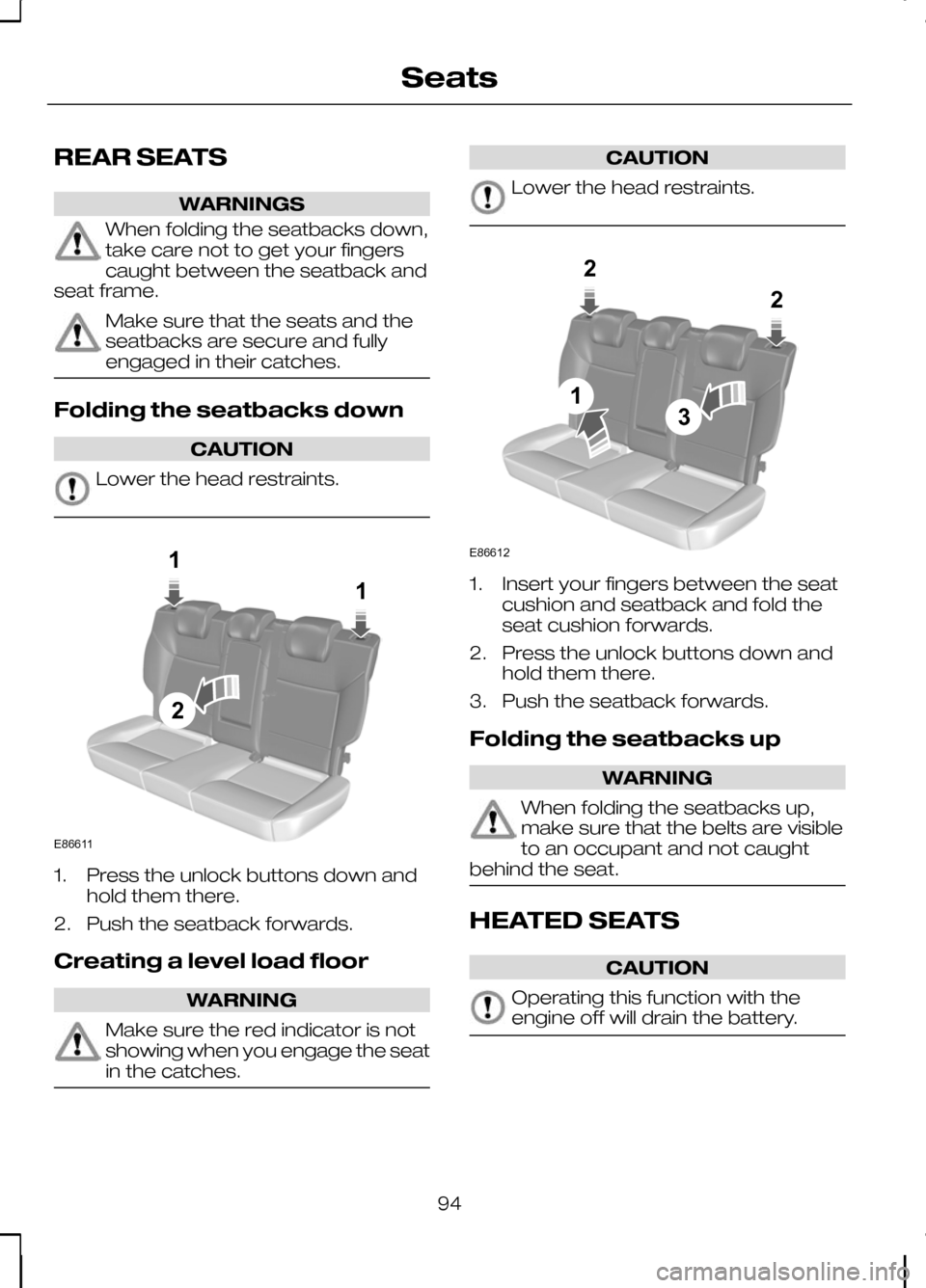
Folding the seatbacks down
CAUTION
Lower the head restraints.
1. Press the unlock buttons down and
hold them there.
2. Push the seatback forwards.
Creating a level load floor WARNING
Make sure the red indicator is not
showing when you engage the seat
in the catches. CAUTION
Lower the head restraints.
1. Insert your fingers between the seat
cushion and seatback and fold the
seat cushion forwards.
2. Press the unlock buttons down and hold them there.
3. Push the seatback forwards.
Folding the seatbacks up WARNING
When folding the seatbacks up,
make sure that the belts are visible
to an occupant and not caught
behind the seat. HEATED SEATS
CAUTION
Operating this function with the
engine off will drain the battery.
94
Seats121E86611 2132E86612
Page 99 of 226
CIGAR LIGHTER
CAUTIONS
If you use the socket when the
engine is not running, the battery
may discharge.
Do not hold the cigar lighter element
pressed in.
Note:Switch the ignition on to use the
cigar lighter. You can also use it for up to 30 minutes after you have switched theignition off.
Note:You can use the socket to power
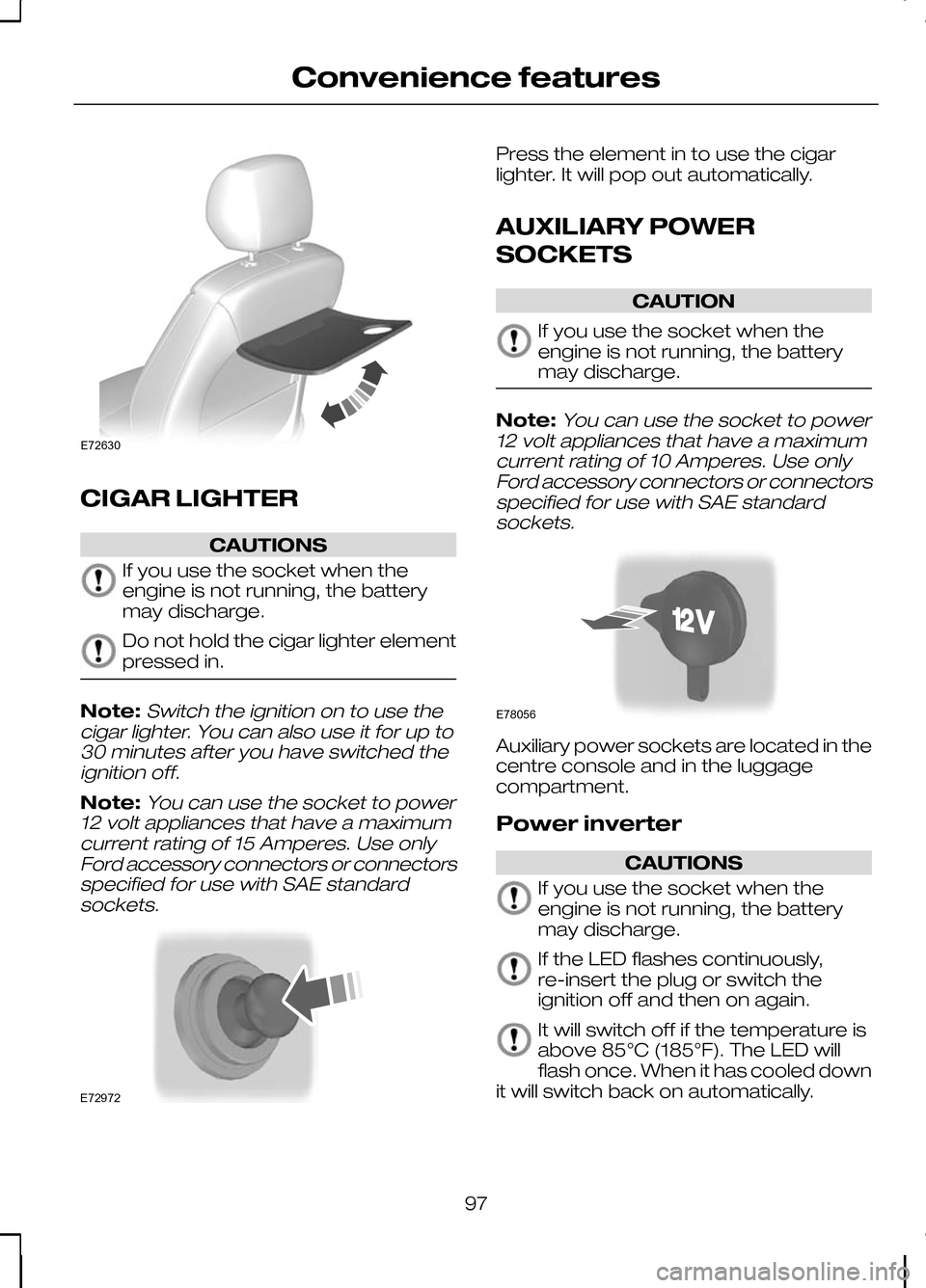
12 volt appliances that have a maximum current rating of 15 Amperes. Use onlyFord accessory connectors or connectorsspecified for use with SAE standardsockets. Press the element in to use the cigar
lighter. It will pop out automatically.
AUXILIARY POWER
SOCKETS
CAUTION
If you use the socket when the
engine is not running, the battery
may discharge.
Note:
You can use the socket to power
12 volt appliances that have a maximum current rating of 10 Amperes. Use onlyFord accessory connectors or connectorsspecified for use with SAE standardsockets. Auxiliary power sockets are located in the
centre console and in the luggage
compartment.
Power inverter
CAUTIONS
If you use the socket when the
engine is not running, the battery
may discharge.
If the LED flashes continuously,
re-insert the plug or switch the
ignition off and then on again.
It will switch off if the temperature is
above 85°C (185°F). The LED will
flash once. When it has cooled down
it will switch back on automatically.
97
Convenience featuresE72630 E72972 E78056
Page 103 of 226
GENERAL INFORMATION
General points on starting
If the battery has been disconnected the
vehicle may exhibit some unusual driving
characteristics for approx. 8 kilometres
(5 miles) after reconnecting the battery.
This is because the engine management
system must realign itself with the engine.
Any unusual driving characteristics during
this period may be disregarded.
Starting the engine by towing
or pushing
WARNING
To prevent damage you must not
push or tow start your vehicle. Use
booster cables and a booster
battery. See Using booster cables
(page 154). KEYLESS STARTING
WARNINGS
The keyless starting system may not
function if the key is close to metal
objects or electronic devices such
as mobile phones. Always check that the steering
wheel lock is deactivated before
attempting to move your vehicle.
Note:A valid passive key must be
located inside the vehicle to switch the ignition on and start the engine.
Note:To start your engine you must also
fully depress the brake or clutch pedal, depending on the transmission fitted. Ignition on
Press the start button once. All electrical
circuits are operational, warning lamps
and indicators illuminate.
Starting with automatic
transmission
Note:
Releasing the brake pedal during
engine start will stop the engine cranking and return to ignition on.
1. Make sure the transmission is in Por
N.
2. Fully depress the brake pedal.
3. Briefly press the start button.
Starting with manual
transmission
Note:
Releasing the clutch pedal during
engine start will stop the engine cranking and return to ignition on.
1. Fully depress the clutch pedal.
2. Briefly press the start button.
Starting a diesel engine
Note:
Engine cranking will not
commence until the engine glow plug cycle has been completed. This may takeseveral seconds in extremely coldconditions.
Note:Continue to press the clutch or
brake pedal until engine cranking begins.
101
Starting the engineE85766
Page 104 of 226
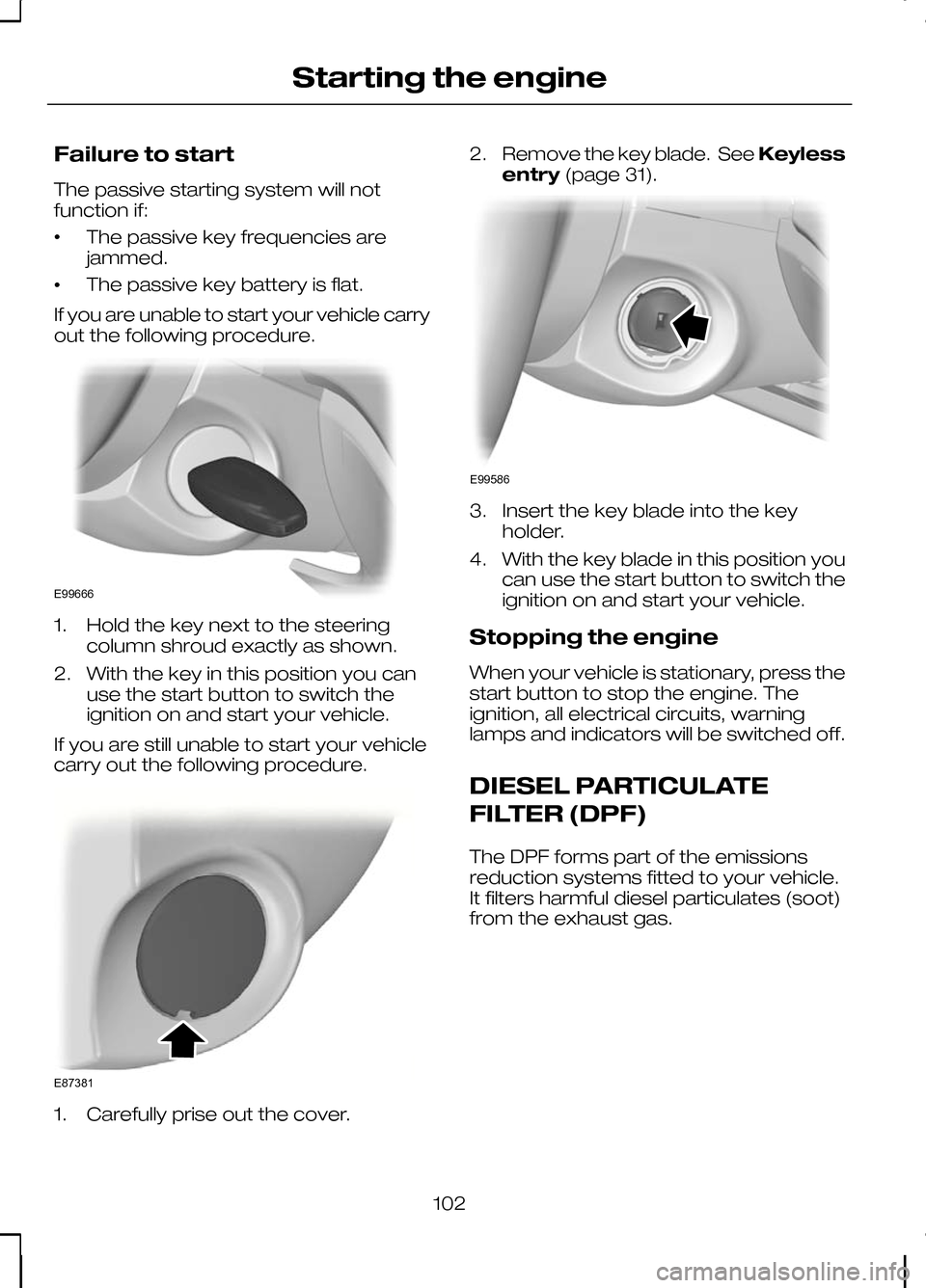
Failure to start
The passive starting system will not
function if:
•
The passive key frequencies are
jammed.
• The passive key battery is flat.
If you are unable to start your vehicle carry
out the following procedure. 1. Hold the key next to the steering
column shroud exactly as shown.
2. With the key in this position you can use the start button to switch the
ignition on and start your vehicle.
If you are still unable to start your vehicle
carry out the following procedure. 1. Carefully prise out the cover. 2.
Remove the key blade. See Keyless
entry (page 31). 3. Insert the key blade into the key
holder.
4. With the key blade in this position you can use the start button to switch the
ignition on and start your vehicle.
Stopping the engine
When your vehicle is stationary, press the
start button to stop the engine. The
ignition, all electrical circuits, warning
lamps and indicators will be switched off.
DIESEL PARTICULATE
FILTER (DPF)
The DPF forms part of the emissions
reduction systems fitted to your vehicle.
It filters harmful diesel particulates (soot)
from the exhaust gas.
102
Starting the engineE99666 E87381 E99586
Page 112 of 226
Hints on driving with an
automatic transmission
Moving off
1. Release the parking brake.
2. Release the brake pedal and press
the accelerator pedal.
Stopping
1. Release the accelerator pedal and press the brake pedal.
2. Apply the parking brake.
Kickdown
Press the accelerator pedal fully with the
selector lever in the drive position to select
the next lowest gear for optimum
performance. Release the accelerator
pedal when you no longer require
kickdown.
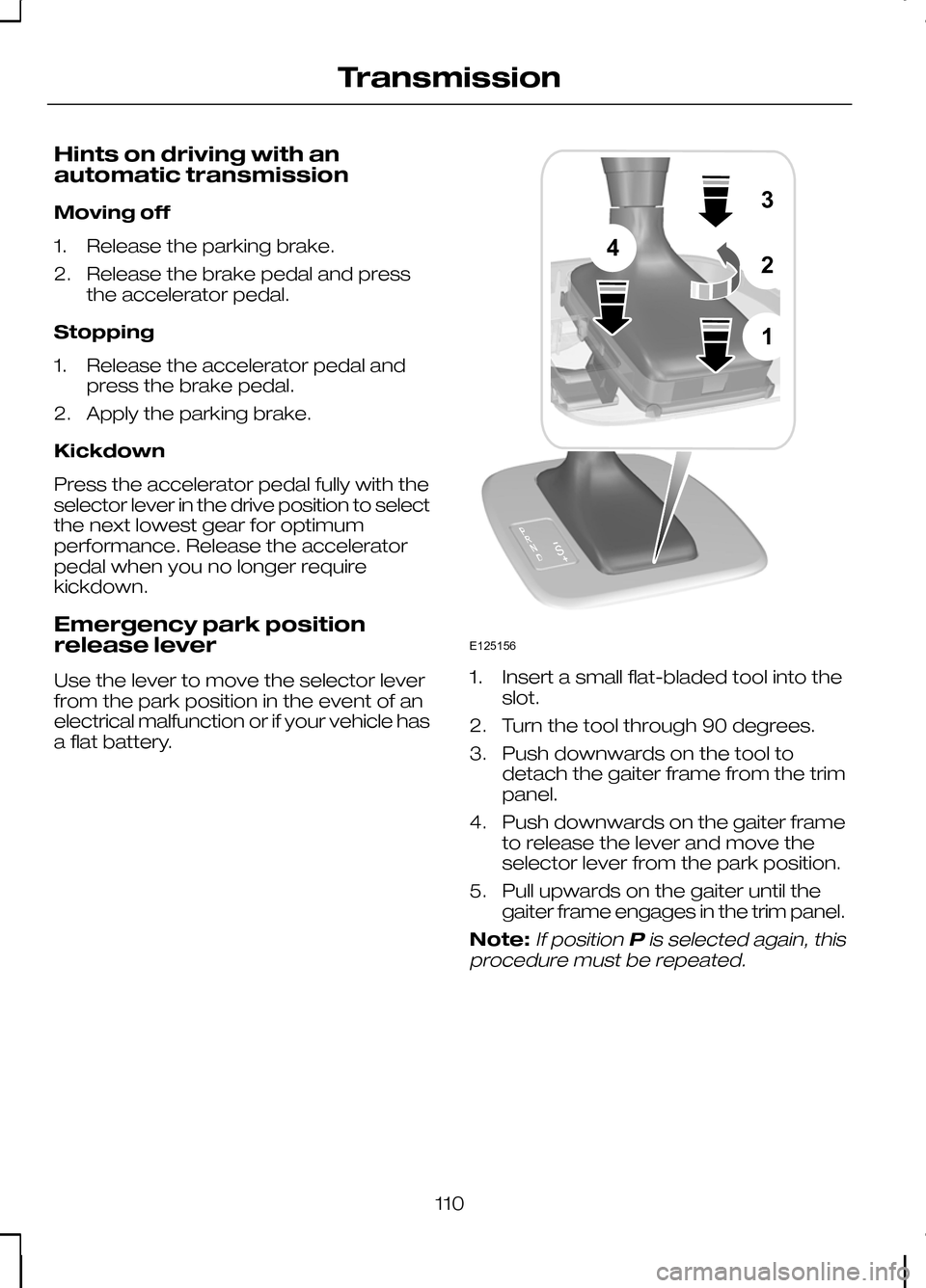
Emergency park position
release lever
Use the lever to move the selector lever
from the park position in the event of an
electrical malfunction or if your vehicle has
a flat battery. 1. Insert a small flat-bladed tool into the
slot.
2. Turn the tool through 90 degrees.
3. Push downwards on the tool to detach the gaiter frame from the trim
panel.
4. Push downwards on the gaiter frame to release the lever and move the
selector lever from the park position.
5. Pull upwards on the gaiter until the gaiter frame engages in the trim panel.
Note:If position Pis selected again, this
procedure must be repeated.
110
Transmission1324SE125156
Page 138 of 226
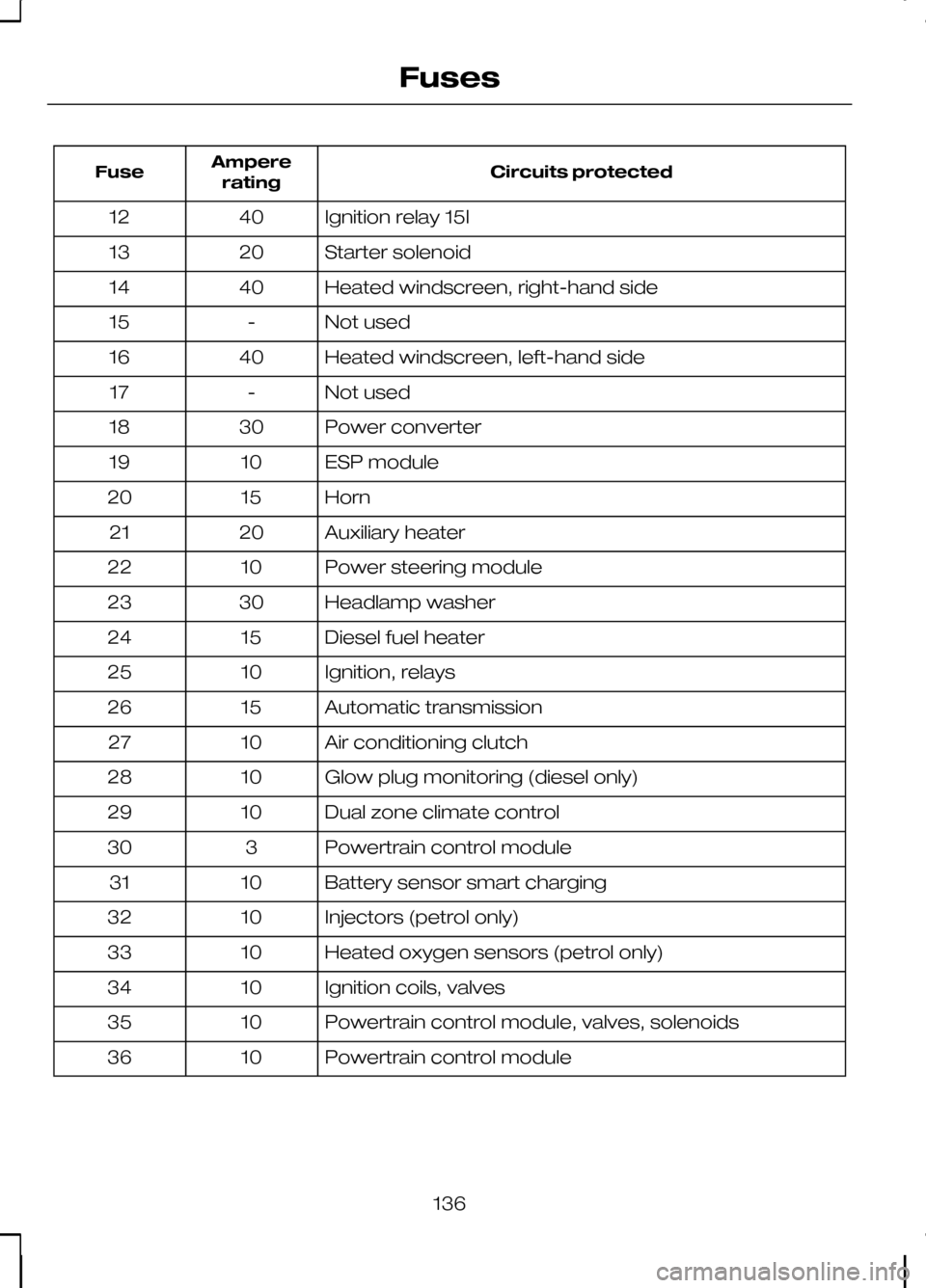
Circuits protected
Ampere
rating
Fuse
Ignition relay 15l
40
12
Starter solenoid
20
13
Heated windscreen, right-hand side
40
14
Not used
-
15
Heated windscreen, left-hand side
40
16
Not used
-
17
Power converter
30
18
ESP module
10
19
Horn
15
20
Auxiliary heater
20
21
Power steering module
10
22
Headlamp washer
30
23
Diesel fuel heater
15
24
Ignition, relays
10
25
Automatic transmission
15
26
Air conditioning clutch
10
27
Glow plug monitoring (diesel only)
10
28
Dual zone climate control
10
29
Powertrain control module
3
30
Battery sensor smart charging
10
31
Injectors (petrol only)
10
32
Heated oxygen sensors (petrol only)
10
33
Ignition coils, valves
10
34
Powertrain control module, valves, solenoids
10
35
Powertrain control module
10
36
136
Fuses
Page 139 of 226
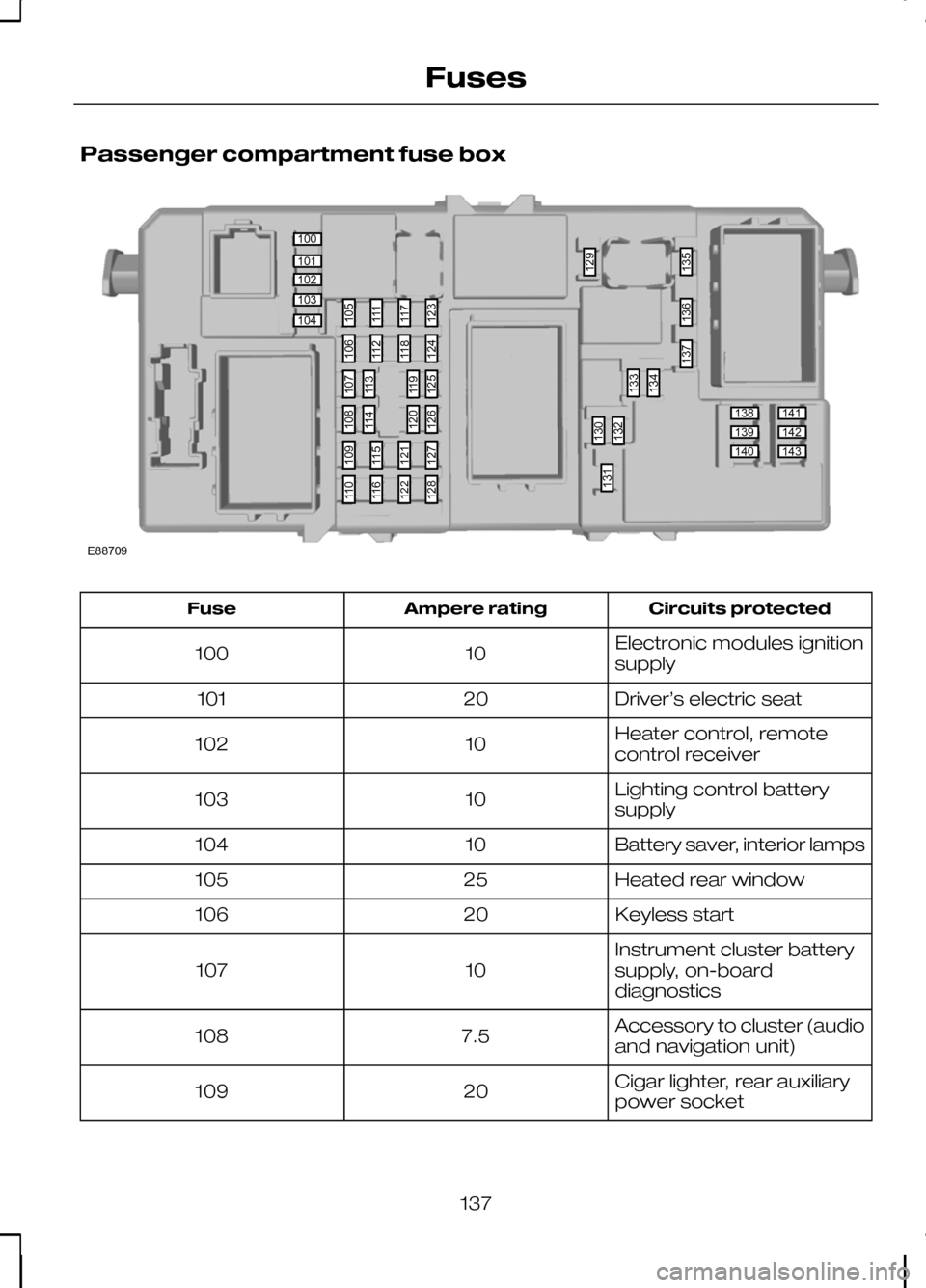
Passenger compartment fuse box
Circuits protected
Ampere rating
Fuse
Electronic modules ignition
supply
10
100
Driver’s electric seat
20
101
Heater control, remote
control receiver
10
102
Lighting control battery
supply
10
103
Battery saver, interior lamps
10
104
Heated rear window
25
105
Keyless start
20
106
Instrument cluster battery
supply, on-board
diagnostics
10
107
Accessory to cluster (audio
and navigation unit)
7.5
108
Cigar lighter, rear auxiliary
power socket
20
109
137
Fuses100101102103104138139140141142143105111117123130132133129134135136137131106112118124109115121127110116122128107113119125108114120126E88709
Page 140 of 226
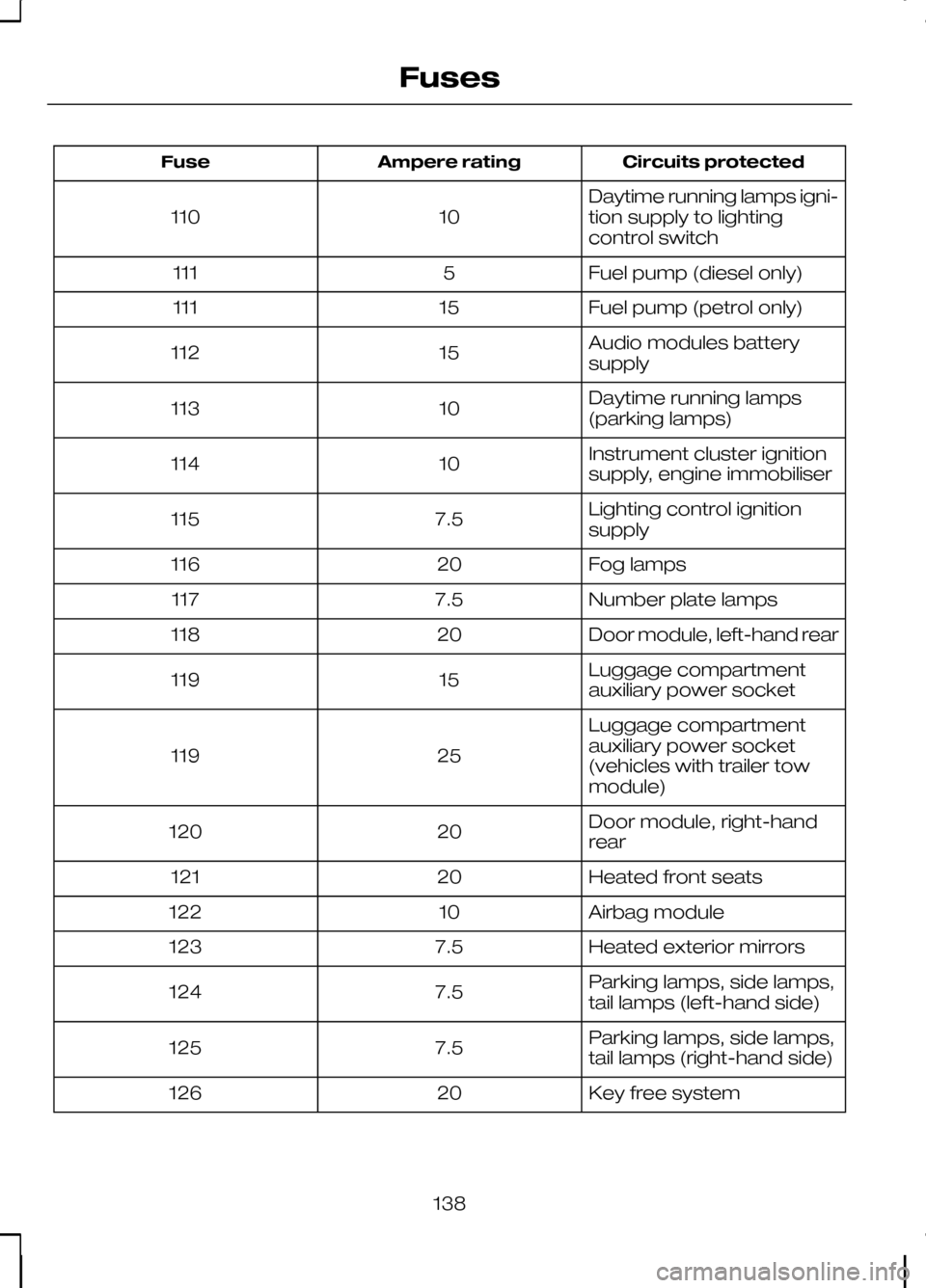
Circuits protected
Ampere rating
Fuse
Daytime running lamps igni-
tion supply to lighting
control switch
10
110
Fuel pump (diesel only)
5
111
Fuel pump (petrol only)
15
111
Audio modules battery
supply
15
112
Daytime running lamps
(parking lamps)
10
113
Instrument cluster ignition
supply, engine immobiliser
10
114
Lighting control ignition
supply
7.5
115
Fog lamps
20
116
Number plate lamps
7.5
117
Door module, left-hand rear
20
118
Luggage compartment
auxiliary power socket
15
119
Luggage compartment
auxiliary power socket
(vehicles with trailer tow
module)
25
119
Door module, right-hand
rear
20
120
Heated front seats
20
121
Airbag module
10
122
Heated exterior mirrors
7.5
123
Parking lamps, side lamps,
tail lamps (left-hand side)
7.5
124
Parking lamps, side lamps,
tail lamps (right-hand side)
7.5
125
Key free system
20
126
138
Fuses
Page 141 of 226
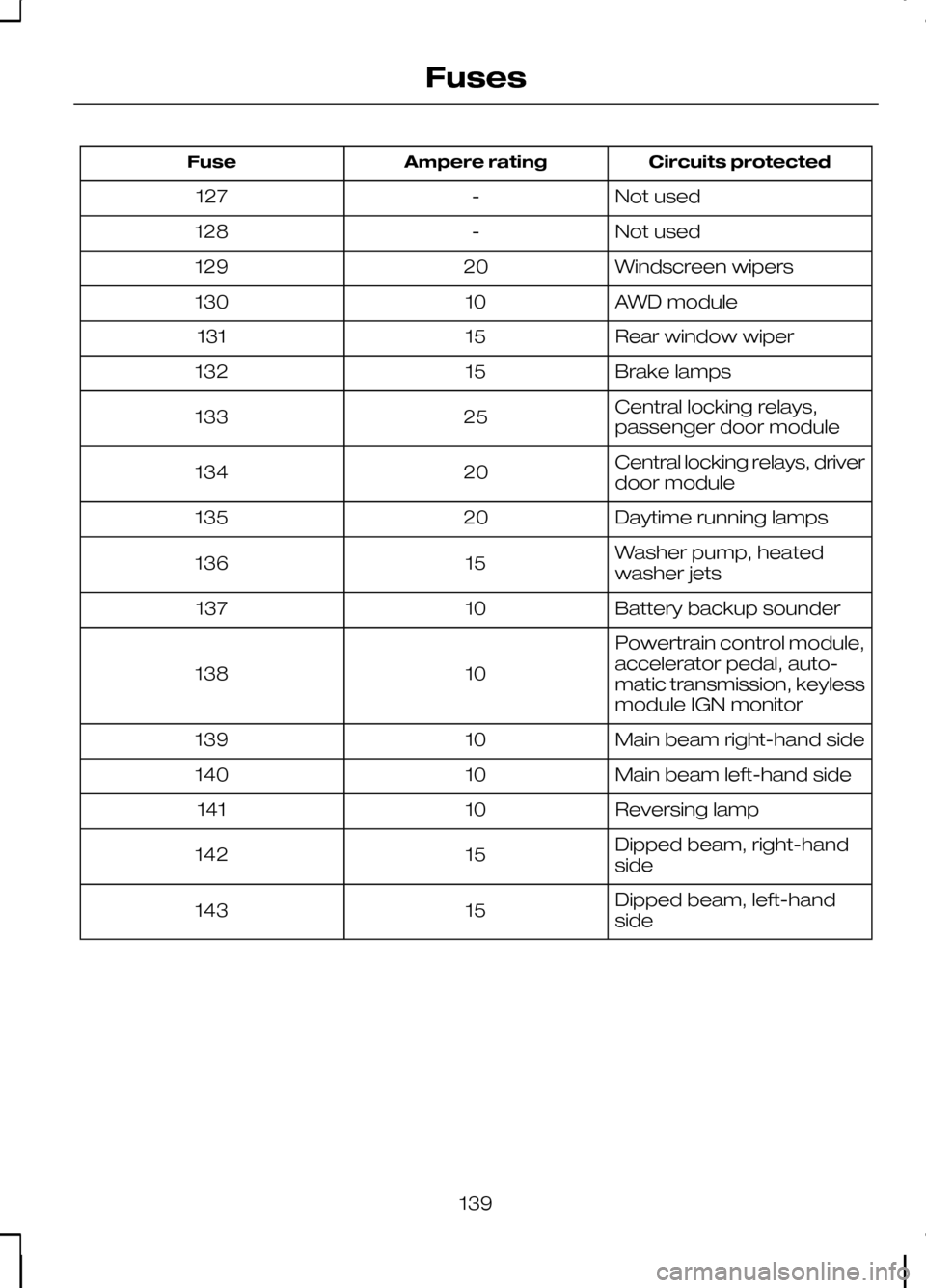
Circuits protected
Ampere rating
Fuse
Not used
-
127
Not used
-
128
Windscreen wipers
20
129
AWD module
10
130
Rear window wiper
15
131
Brake lamps
15
132
Central locking relays,
passenger door module
25
133
Central locking relays, driver
door module
20
134
Daytime running lamps
20
135
Washer pump, heated
washer jets
15
136
Battery backup sounder
10
137
Powertrain control module,
accelerator pedal, auto-
matic transmission, keyless
module IGN monitor
10
138
Main beam right-hand side
10
139
Main beam left-hand side
10
140
Reversing lamp
10
141
Dipped beam, right-hand
side
15
142
Dipped beam, left-hand
side
15
143
139
Fuses