engine FORD KUGA 2010 1.G Owner's Guide
[x] Cancel search | Manufacturer: FORD, Model Year: 2010, Model line: KUGA, Model: FORD KUGA 2010 1.GPages: 226, PDF Size: 8.07 MB
Page 129 of 226
TOWING A TRAILER
WARNINGS
Do not exceed the maximum gross
train weight stated on the vehicle
identification plate. See
Vehicle
identification (page 170).Do not exceed 100 km/h (62 mph).
The rear tyre pressures must be
increased by 0.2 bar (3 psi) above
specification. See
Technical
specifications (page 168). CAUTIONS
Do not exceed the maximum
permissible nose weight, i.e. vertical
weight on the tow ball, of 100
kilogrammes (220 pounds) for vehicles
with a diesel engine, or 105 kilogrammes
(231 pounds) for vehicles with a petrol
engine. We recommend you purchase a
towing kit from your dealer. Failure to
do so may result in damage to the
engine. Note:Not all vehicles are suitable or
approved to have tow bars fitted. Check with your dealer first.
Place loads as low and central to the
axle(s) of the trailer as possible. If you are
towing with an unladen vehicle, the load
in the trailer should be placed toward the
nose, within the maximum nose load, as
this gives the best stability.
The stability of the vehicle to trailer
combination is very much dependant on
the quality of the trailer. In high altitude regions above 1 000
metres (3 281 feet), the stipulated
maximum permitted gross train weight
must be reduced by 10% for every
additional 1 000 metres (3 281 feet).
Steep gradients WARNING
The overrun brake on a trailer is not
controlled by ABS.
Change down a gear before you reach a
steep downhill gradient.
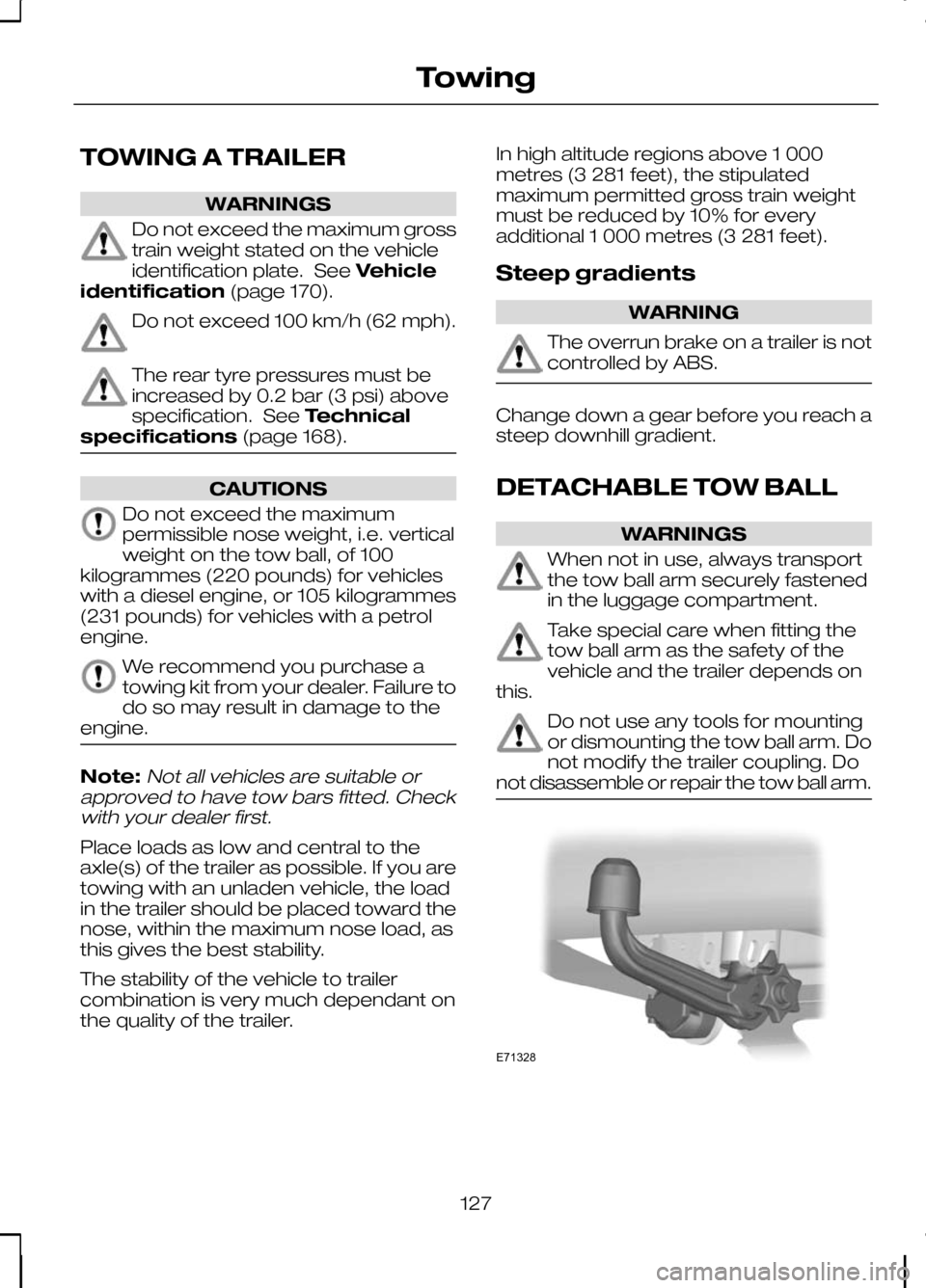
DETACHABLE TOW BALL
WARNINGS
When not in use, always transport
the tow ball arm securely fastened
in the luggage compartment.
Take special care when fitting the
tow ball arm as the safety of the
vehicle and the trailer depends on
this. Do not use any tools for mounting
or dismounting the tow ball arm. Do
not modify the trailer coupling. Do
not disassemble or repair the tow ball arm. 127
TowingE71328
Page 133 of 226
RUNNING-IN
Tyres
WARNING
New tyres need to be run-in for
approximately 500 kilometres (300
miles). During this time, you may
experience different driving
characteristics. Brakes and clutch
WARNING
Avoid heavy use of the brakes and
clutch if possible for the first 150
kilometres (100 miles) in town and
for the first 1 500 kilometres (1 000 miles)
on motorways. Engine
CAUTION
Avoid driving too fast during the first
1 500 kilometres (1 000 miles). Vary
your speed frequently and change
up through the gears early. Do not labour
the engine. COLD WEATHER
PRECAUTIONS
The functional operation of some
components and systems can be
affected at temperatures below -30°C
(-22°F). DRIVING THROUGH WATER
Driving through water CAUTIONS
Drive through water in an emergency
only, and not as part of normal
driving.
Engine damage can occur if water
enters the air filter.
In an emergency, the vehicle can be
driven through water to a maximum depth
of 200 mm and at a maximum speed of
10 km/h (6 mph). Extra caution should be
exercised when driving through flowing
water.
When driving in water, maintain a low
speed and do not stop the vehicle. After
driving through water, and as soon as it
is safe to do so:
•
Depress the brake pedal lightly and
check that full brake function is
achieved.
• Check that the horn works.
• Check that the vehicle's lights are fully
operational.
• Check the power assistance
of the steering system.
131
Driving hints
Page 135 of 226
FUEL CUT-OFF SWITCH
Vehicles with a Duratec engine
The fuel supply may be cut off as a result
of an accident or sudden vibrations (e.g.
collision when parking).
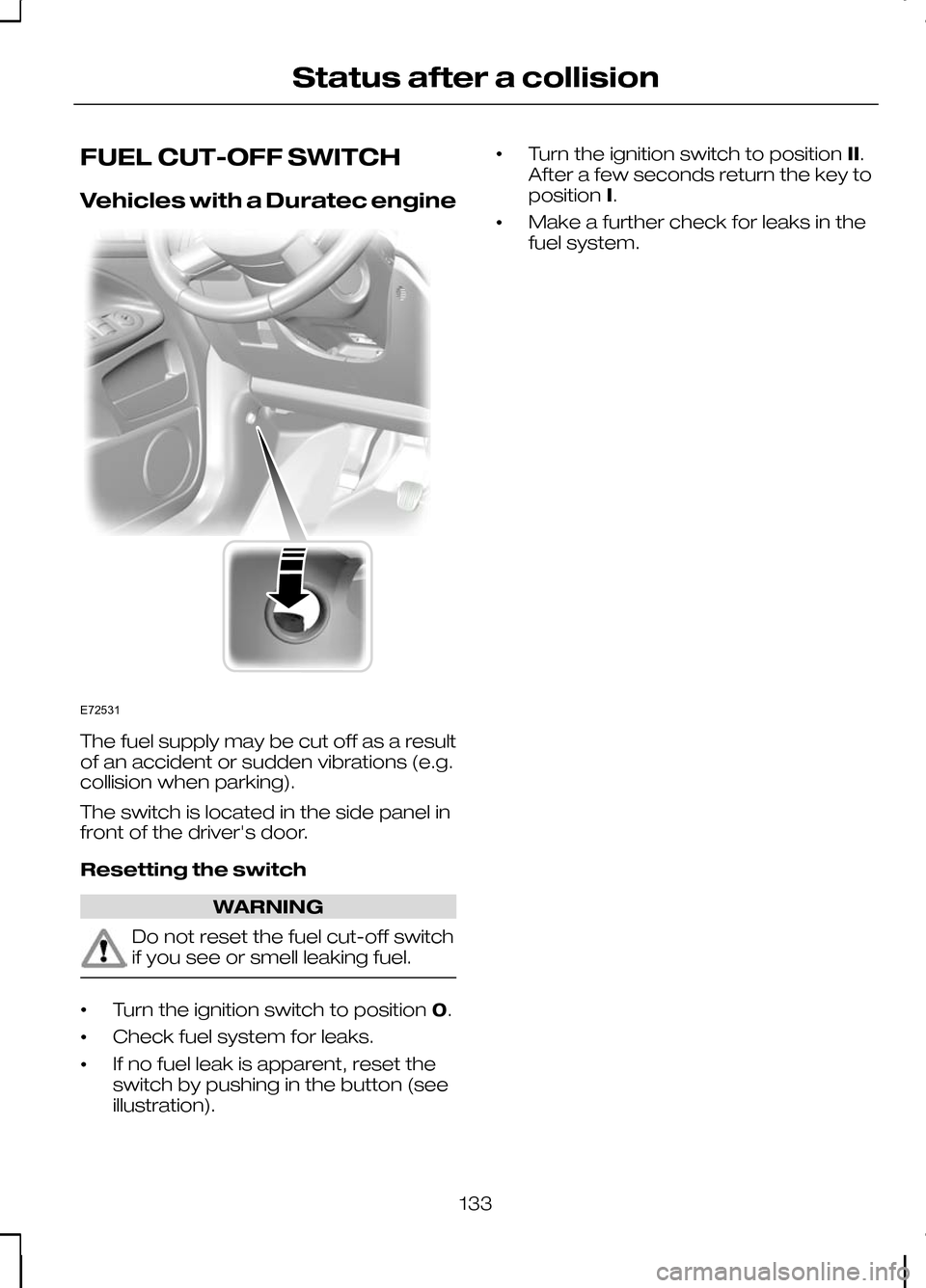
The switch is located in the side panel in
front of the driver's door.
Resetting the switch
WARNING
Do not reset the fuel cut-off switch
if you see or smell leaking fuel.
•
Turn the ignition switch to position
0.
• Check fuel system for leaks.
• If no fuel leak is apparent, reset the
switch by pushing in the button (see
illustration). •
Turn the ignition switch to position
II.
After a few seconds return the key to
position I.
• Make a further check for leaks in the
fuel system.
133
Status after a collisionE72531
Page 136 of 226
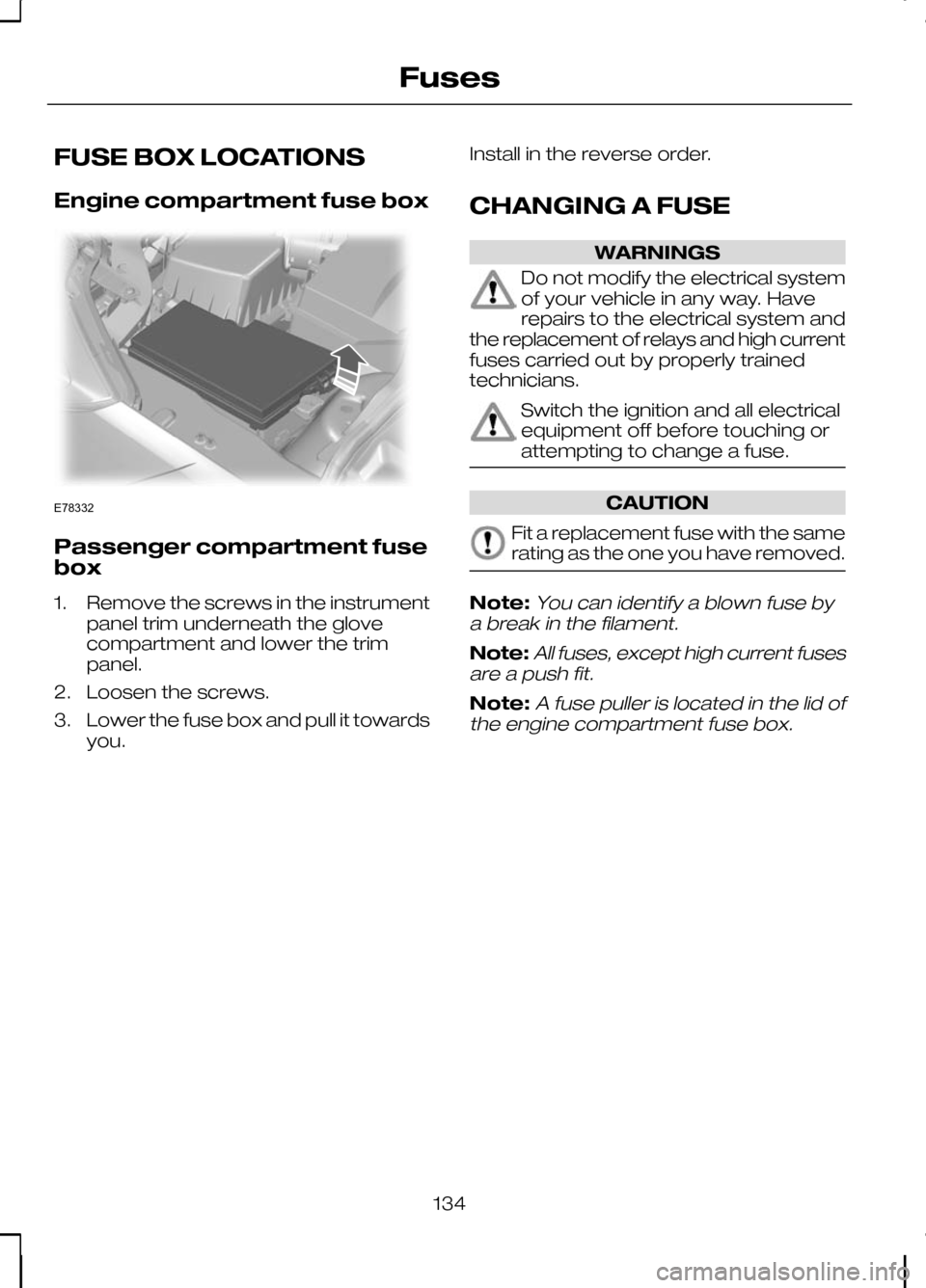
FUSE BOX LOCATIONS
Engine compartment fuse box
Passenger compartment fuse
box
1. Remove the screws in the instrument
panel trim underneath the glove
compartment and lower the trim
panel.
2. Loosen the screws.
3. Lower the fuse box and pull it towards you. Install in the reverse order.
CHANGING A FUSE WARNINGS
Do not modify the electrical system
of your vehicle in any way. Have
repairs to the electrical system and
the replacement of relays and high current
fuses carried out by properly trained
technicians. Switch the ignition and all electrical
equipment off before touching or
attempting to change a fuse.
CAUTION
Fit a replacement fuse with the same
rating as the one you have removed.
Note:You can identify a blown fuse by
a break in the filament.
Note:All fuses, except high current fuses
are a push fit.
Note:A fuse puller is located in the lid of
the engine compartment fuse box.
134
FusesE78332
Page 137 of 226
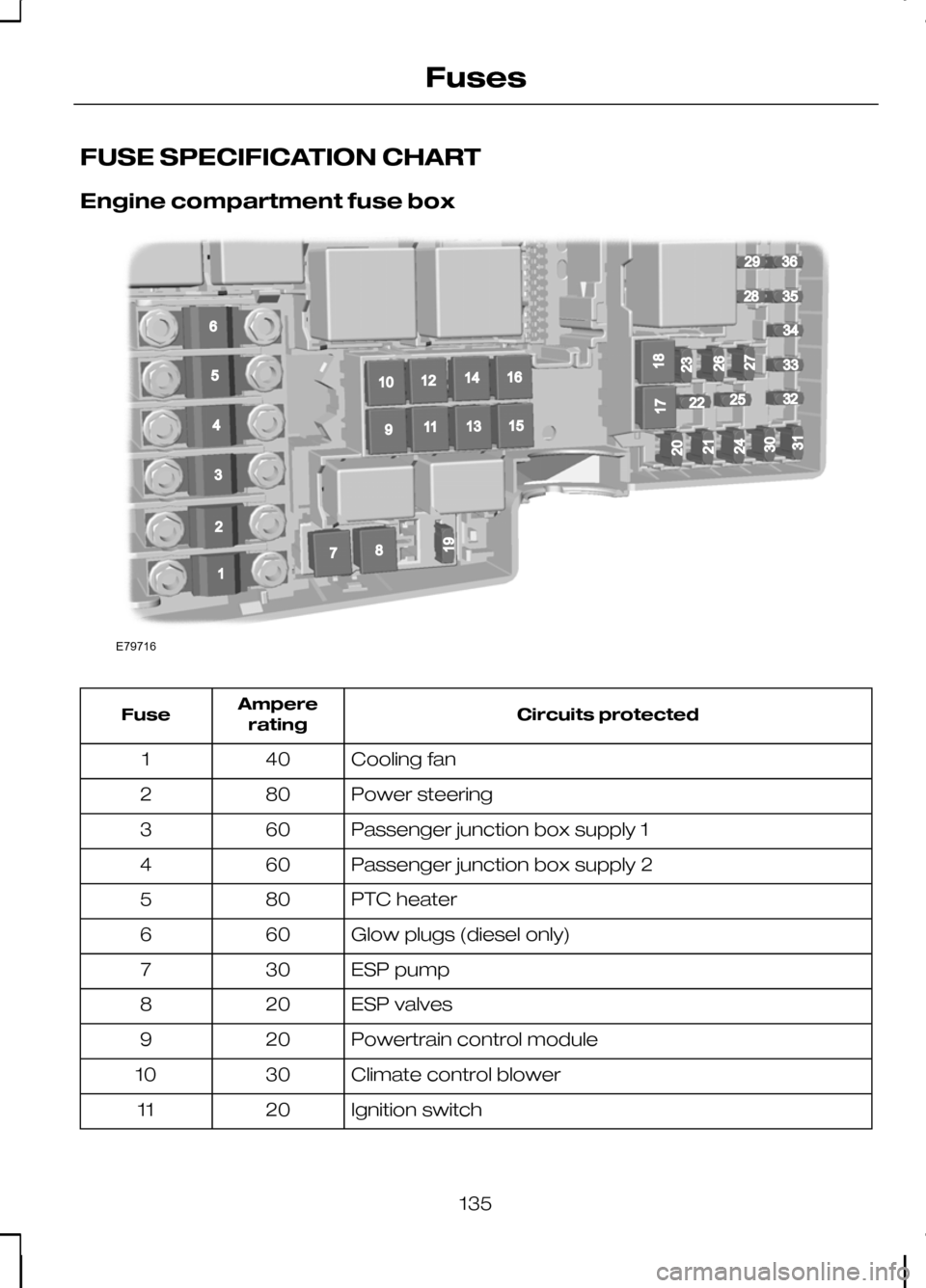
FUSE SPECIFICATION CHART
Engine compartment fuse box
Circuits protected
Ampere
rating
Fuse
Cooling fan
40
1
Power steering
80
2
Passenger junction box supply 1
60
3
Passenger junction box supply 2
60
4
PTC heater
80
5
Glow plugs (diesel only)
60
6
ESP pump
30
7
ESP valves
20
8
Powertrain control module
20
9
Climate control blower
30
10
Ignition switch
20
11
135
FusesE79716196781091211141316152936283435332225325432120171824213031232627
Page 140 of 226
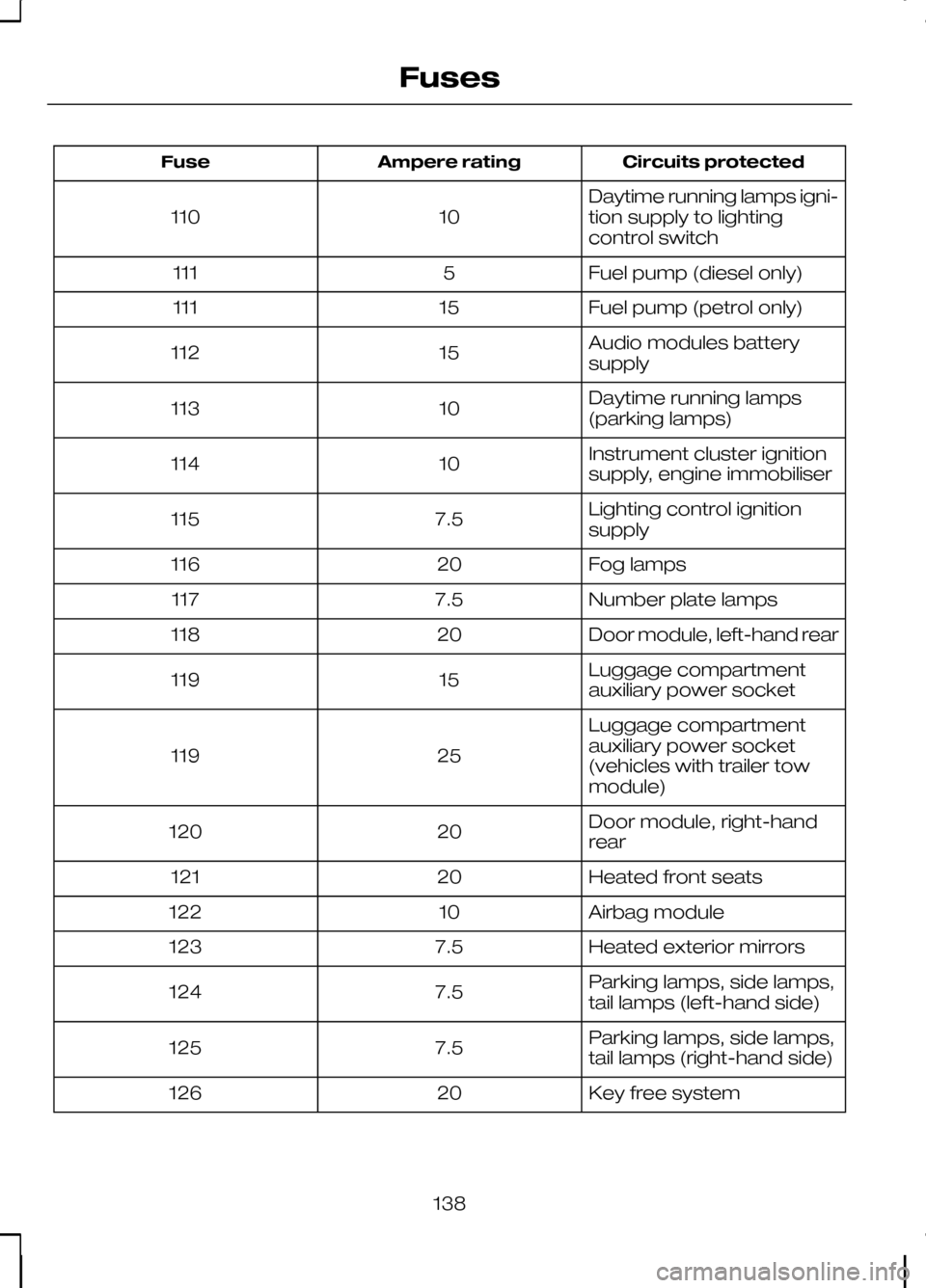
Circuits protected
Ampere rating
Fuse
Daytime running lamps igni-
tion supply to lighting
control switch
10
110
Fuel pump (diesel only)
5
111
Fuel pump (petrol only)
15
111
Audio modules battery
supply
15
112
Daytime running lamps
(parking lamps)
10
113
Instrument cluster ignition
supply, engine immobiliser
10
114
Lighting control ignition
supply
7.5
115
Fog lamps
20
116
Number plate lamps
7.5
117
Door module, left-hand rear
20
118
Luggage compartment
auxiliary power socket
15
119
Luggage compartment
auxiliary power socket
(vehicles with trailer tow
module)
25
119
Door module, right-hand
rear
20
120
Heated front seats
20
121
Airbag module
10
122
Heated exterior mirrors
7.5
123
Parking lamps, side lamps,
tail lamps (left-hand side)
7.5
124
Parking lamps, side lamps,
tail lamps (right-hand side)
7.5
125
Key free system
20
126
138
Fuses
Page 143 of 226
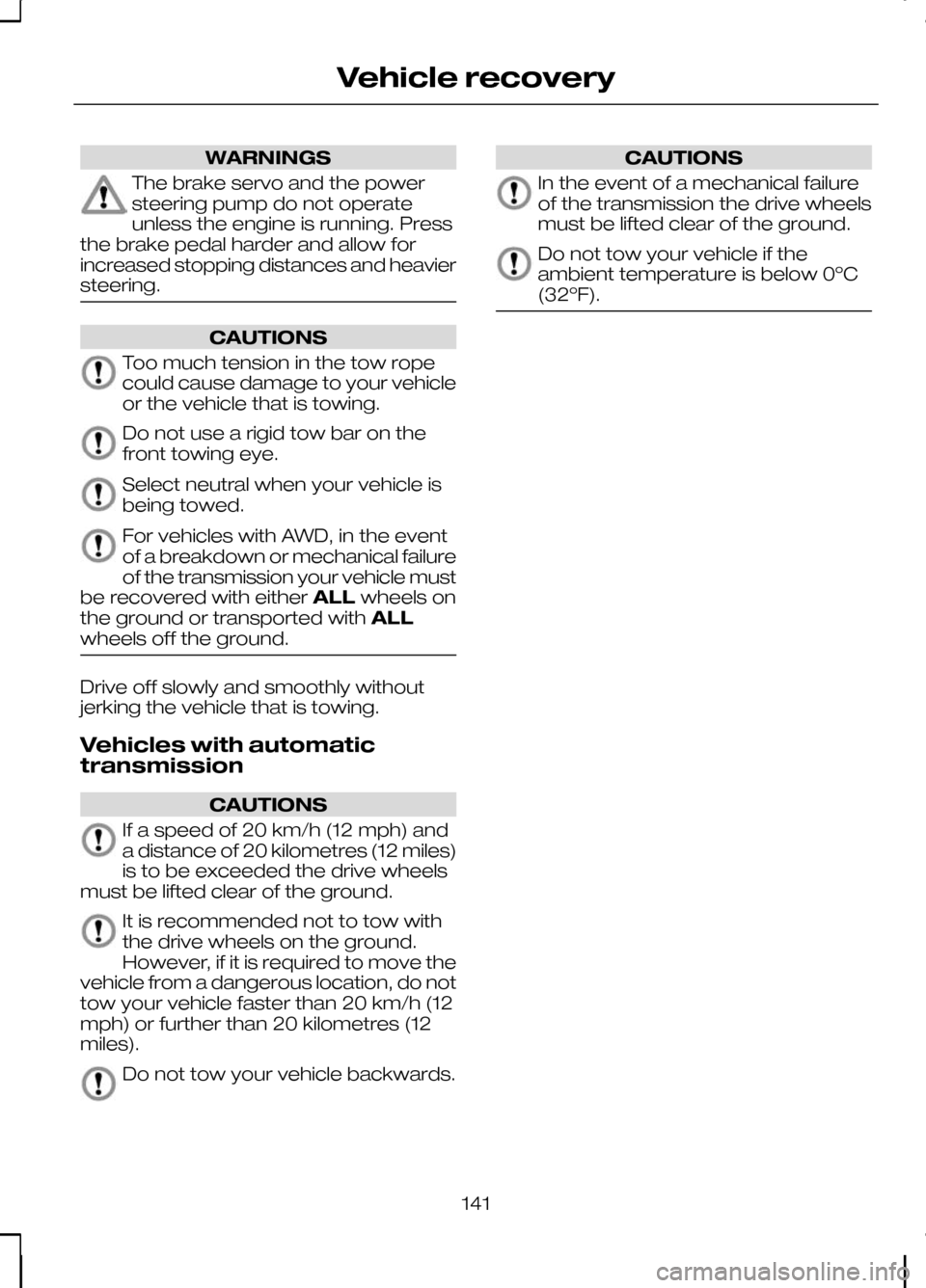
WARNINGS
The brake servo and the power
steering pump do not operate
unless the engine is running. Press
the brake pedal harder and allow for
increased stopping distances and heavier
steering. CAUTIONS
Too much tension in the tow rope
could cause damage to your vehicle
or the vehicle that is towing.
Do not use a rigid tow bar on the
front towing eye.
Select neutral when your vehicle is
being towed.
For vehicles with AWD, in the event
of a breakdown or mechanical failure
of the transmission your vehicle must
be recovered with either ALLwheels on
the ground or transported with ALL
wheels off the ground. Drive off slowly and smoothly without
jerking the vehicle that is towing.
Vehicles with automatic
transmission
CAUTIONS
If a speed of 20 km/h (12 mph) and
a distance of 20 kilometres (12 miles)
is to be exceeded the drive wheels
must be lifted clear of the ground. It is recommended not to tow with
the drive wheels on the ground.
However, if it is required to move the
vehicle from a dangerous location, do not
tow your vehicle faster than 20 km/h (12
mph) or further than 20 kilometres (12
miles). Do not tow your vehicle backwards. CAUTIONS
In the event of a mechanical failure
of the transmission the drive wheels
must be lifted clear of the ground.
Do not tow your vehicle if the
ambient temperature is below 0ºC
(32ºF).
141
Vehicle recovery
Page 144 of 226
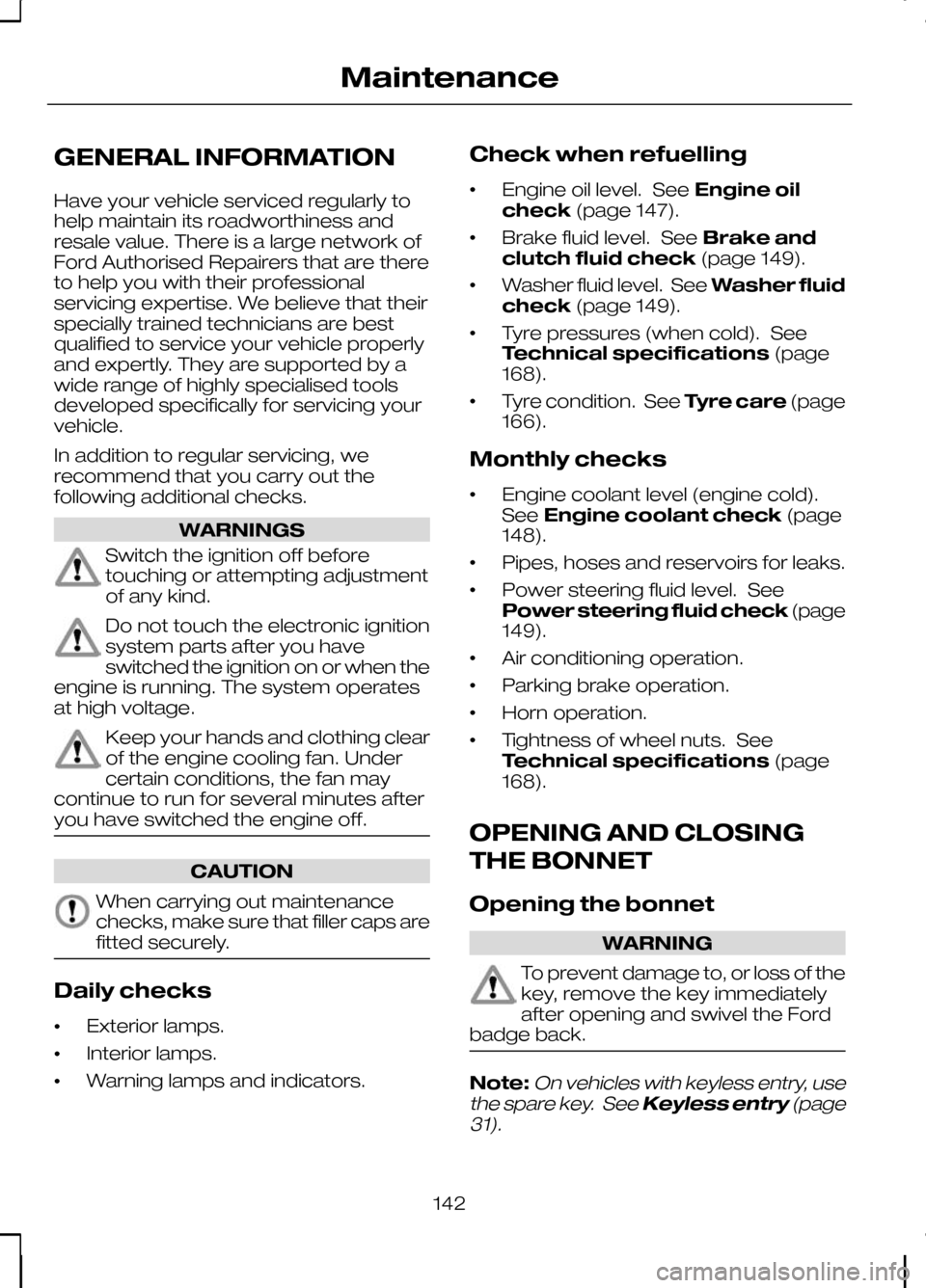
GENERAL INFORMATION
Have your vehicle serviced regularly to
help maintain its roadworthiness and
resale value. There is a large network of
Ford Authorised Repairers that are there
to help you with their professional
servicing expertise. We believe that their
specially trained technicians are best
qualified to service your vehicle properly
and expertly. They are supported by a
wide range of highly specialised tools
developed specifically for servicing your
vehicle.
In addition to regular servicing, we
recommend that you carry out the
following additional checks.
WARNINGS
Switch the ignition off before
touching or attempting adjustment
of any kind.
Do not touch the electronic ignition
system parts after you have
switched the ignition on or when the
engine is running. The system operates
at high voltage. Keep your hands and clothing clear
of the engine cooling fan. Under
certain conditions, the fan may
continue to run for several minutes after
you have switched the engine off. CAUTION
When carrying out maintenance
checks, make sure that filler caps are
fitted securely.
Daily checks
•
Exterior lamps.
• Interior lamps.
• Warning lamps and indicators. Check when refuelling
•
Engine oil level. See
Engine oil
check (page 147).
• Brake fluid level. See
Brake and
clutch fluid check (page 149).
• Washer fluid level. See
Washer fluid
check (page 149).
• Tyre pressures (when cold). See
Technical specifications
(page
168).
• Tyre condition. See
Tyre care(page
166).
Monthly checks
• Engine coolant level (engine cold).
See
Engine coolant check (page
148).
• Pipes, hoses and reservoirs for leaks.
• Power steering fluid level. See
Power steering fluid check
(page
149).
• Air conditioning operation.
• Parking brake operation.
• Horn operation.
• Tightness of wheel nuts. See
Technical specifications
(page
168).
OPENING AND CLOSING
THE BONNET
Opening the bonnet WARNING
To prevent damage to, or loss of the
key, remove the key immediately
after opening and swivel the Ford
badge back. Note:On vehicles with keyless entry, use
the spare key. See Keyless entry(page
31).
142
Maintenance
Page 146 of 226
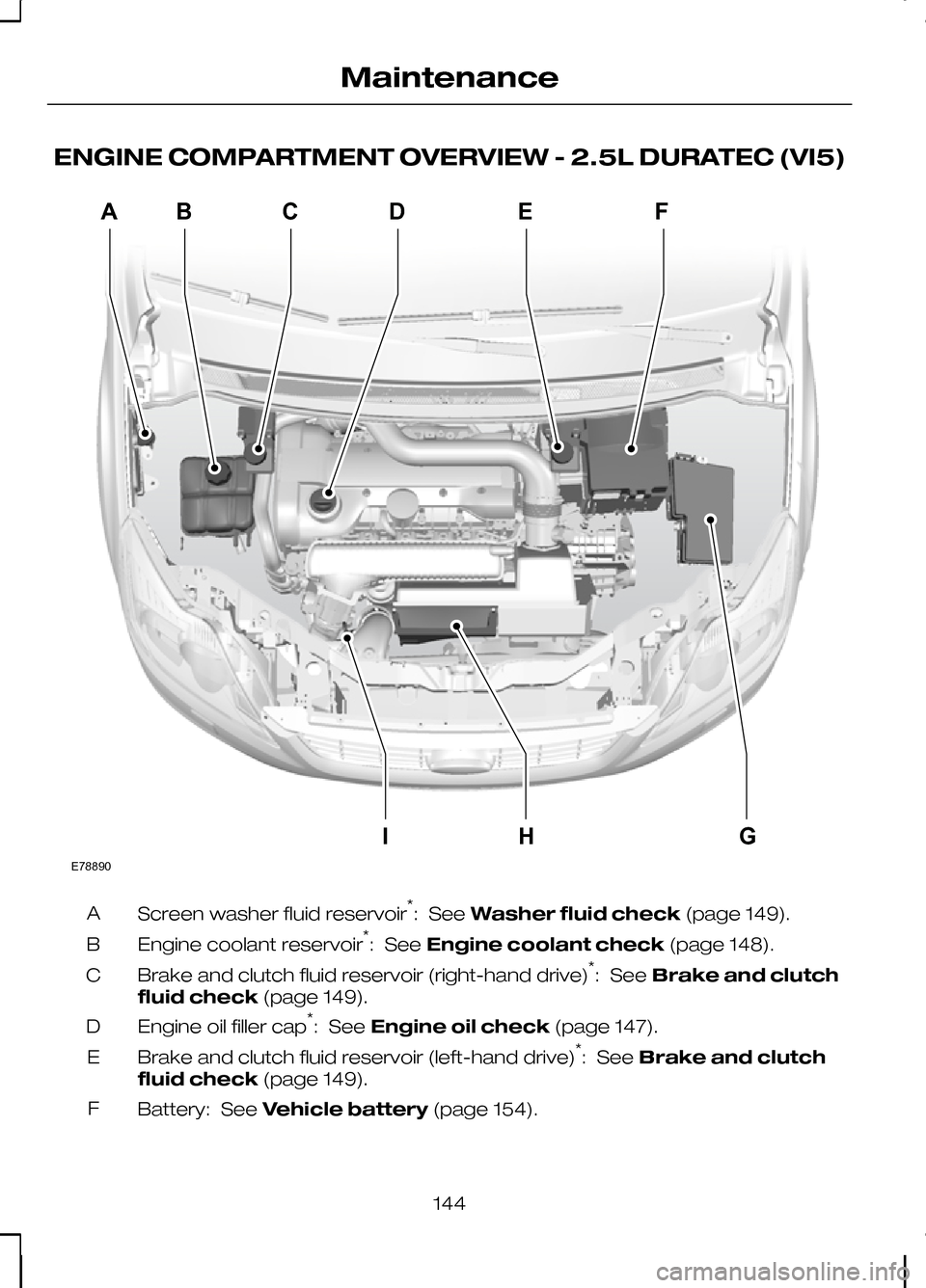
ENGINE COMPARTMENT OVERVIEW - 2.5L DURATEC (VI5)
Screen washer fluid reservoir
*
: See Washer fluid check (page 149).
A
Engine coolant reservoir *
: See Engine coolant check (page 148).
B
Brake and clutch fluid reservoir (right-hand drive) *
: See Brake and clutch
fluid check (page 149).
C
Engine oil filler cap *
: See Engine oil check (page 147).
D
Brake and clutch fluid reservoir (left-hand drive) *
: See Brake and clutch
fluid check (page 149).
E
Battery: See Vehicle battery (page 154).
F
144
MaintenanceE78890IFEDCBAHG
Page 147 of 226
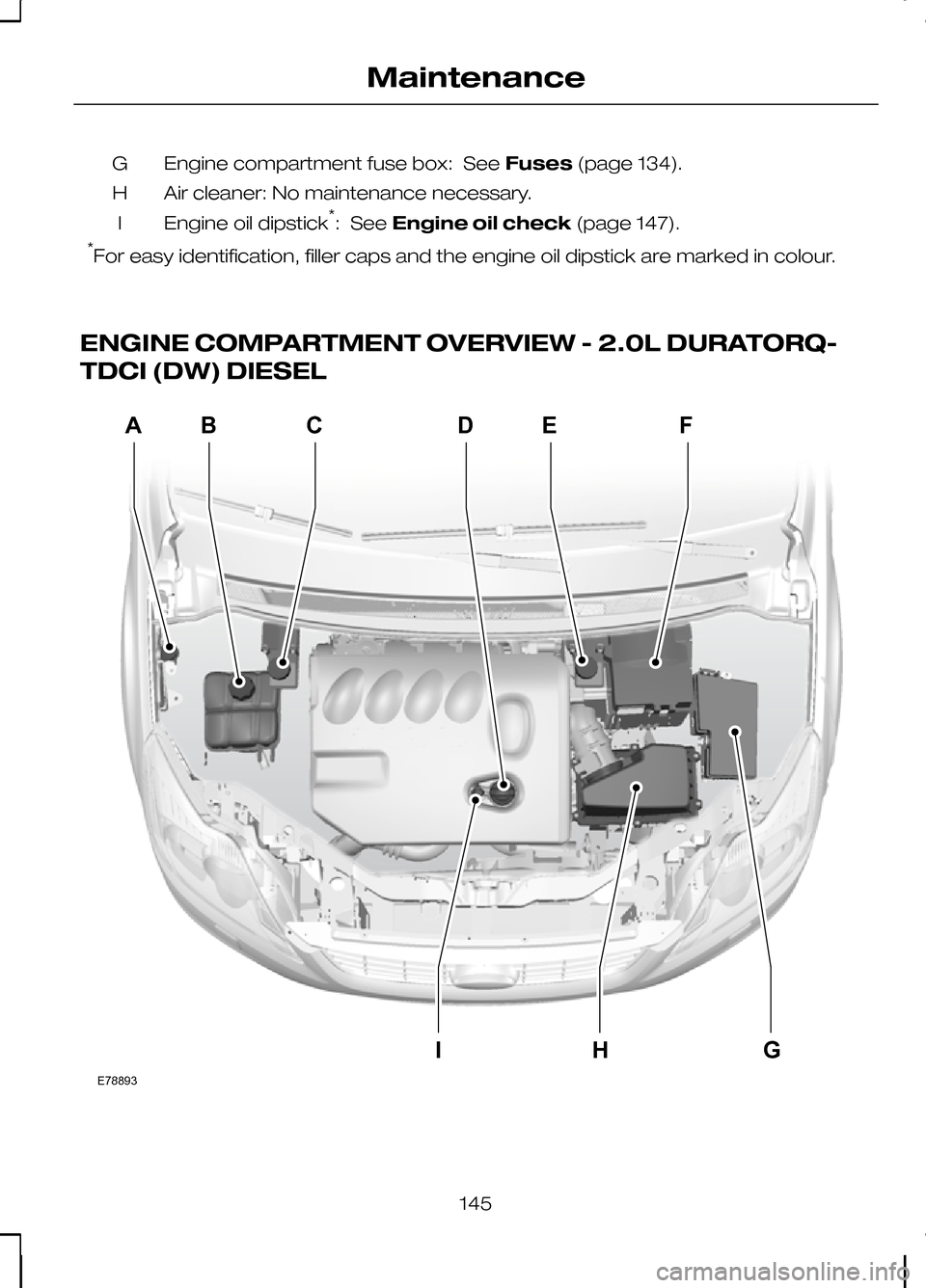
Engine compartment fuse box: See
Fuses(page 134).
G
Air cleaner: No maintenance necessary.
H
Engine oil dipstick *
: See Engine oil check (page 147).
I
* For easy identification, filler caps and the engine oil dipstick are marked in colour.
ENGINE COMPARTMENT OVERVIEW - 2.0L DURATORQ-
TDCI (DW) DIESEL 145
MaintenanceE78893IFEDCBAHG