trailer FORD KUGA 2010 1.G Owners Manual
[x] Cancel search | Manufacturer: FORD, Model Year: 2010, Model line: KUGA, Model: FORD KUGA 2010 1.GPages: 226, PDF Size: 8.07 MB
Page 5 of 226
Using the rear view camera..................117
Cruise control
Principle of operation............................120
Using cruise control..............................120
Load carrying
General information..............................122
Luggage anchor points........................122
Luggage covers....................................122
Rear under floor storage......................123
Roof racks and load carriers...............124
Towing
Towing a trailer.......................................127
Detachable tow ball...............................127
Driving hints
Running-in...............................................131
Cold weather precautions....................131
Driving through water............................131
Emergency equipment
First aid kit...............................................132
Warning triangle.....................................132
Status after a collision
Fuel cut-off switch.................................133
Fuses
Fuse box locations................................134
Changing a fuse....................................134
Fuse specification chart.......................135
Vehicle recovery
Towing points.........................................140
Towing the vehicle on four wheels.....140
Maintenance
General information..............................142
Opening and closing the bonnet........142
Engine compartment overview - 2.5L
Duratec (VI5).......................................144
Engine compartment overview - 2.0L Duratorq-TDCi (DW) Diesel..............145
Engine oil dipstick - 2.5L Duratec (VI5)......................................................147
Engine oil dipstick - 2.0L Duratorq-TDCi (DW) Diesel..........................................147
Engine oil check.....................................147
Engine coolant check...........................148
Brake and clutch fluid check...............149
Power steering fluid check..................149
Washer fluid check................................149
Technical specifications........................150
Vehicle care
Cleaning the exterior............................152
Cleaning the interior..............................152
Repairing minor paint damage............153
Vehicle battery
Using booster cables............................154
Wheels and tyres
General information..............................156
Changing a road wheel........................156
Tyre repair kit...........................................161
Run flat tyres..........................................165
Tyre care.................................................166
Using winter tyres..................................166
Using snow chains................................166
Tyre pressure monitoring system.......167
Technical specifications........................168
Vehicle identification
Vehicle identification plate....................170
Vehicle identification number (VIN).....170
3
Table of contents
Page 115 of 226
PRINCIPLE OF OPERATION
Electronic stability programme
(ESP)
WARNING
ESP does not relieve you of your
responsibility to drive with due care
and attention.
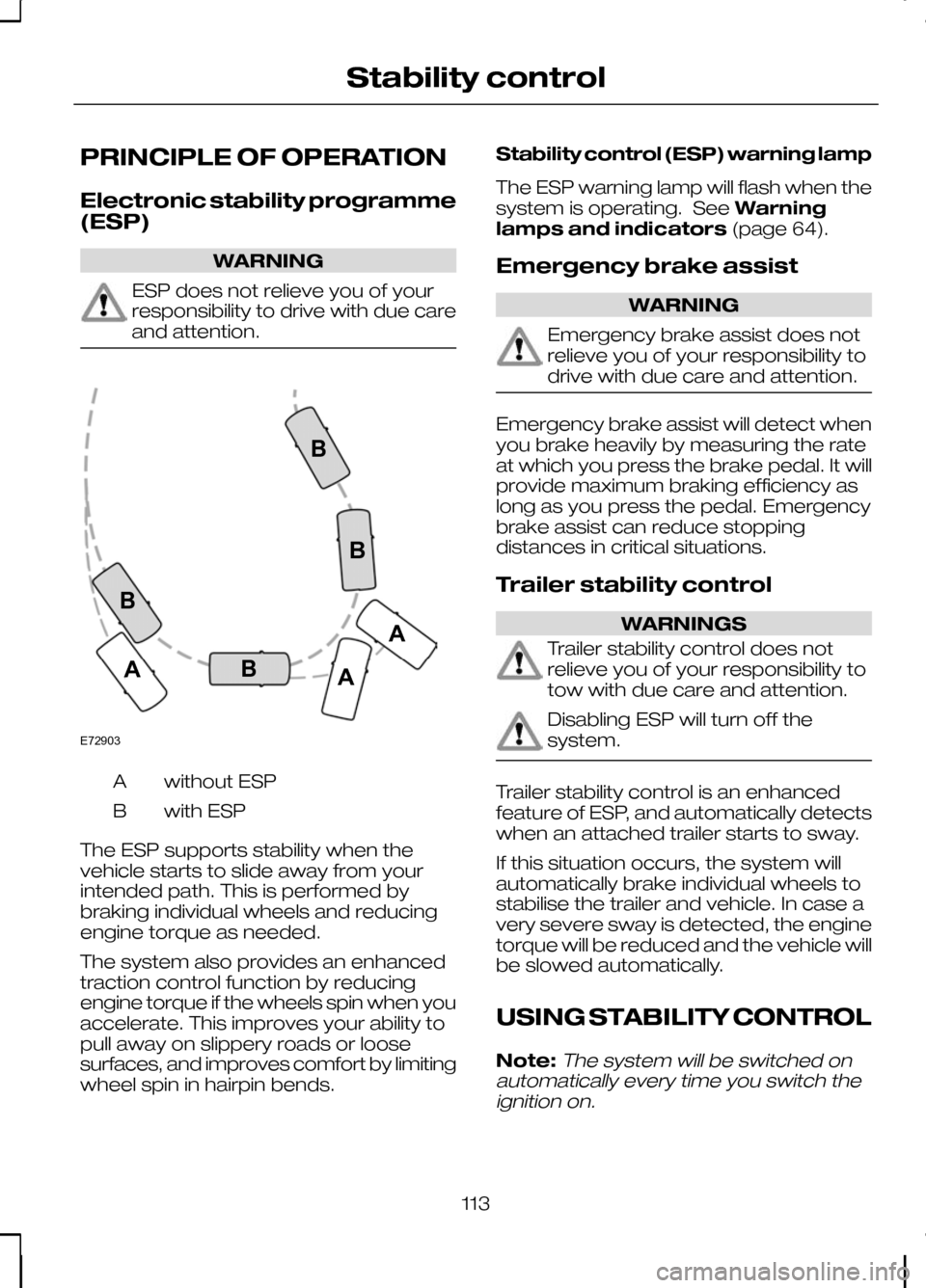
without ESP
A
with ESP
B
The ESP supports stability when the
vehicle starts to slide away from your
intended path. This is performed by
braking individual wheels and reducing
engine torque as needed.
The system also provides an enhanced
traction control function by reducing
engine torque if the wheels spin when you
accelerate. This improves your ability to
pull away on slippery roads or loose
surfaces, and improves comfort by limiting
wheel spin in hairpin bends. Stability control (ESP) warning lamp
The ESP warning lamp will flash when the
system is operating. See
Warning
lamps and indicators (page 64).
Emergency brake assist WARNING
Emergency brake assist does not
relieve you of your responsibility to
drive with due care and attention.
Emergency brake assist will detect when
you brake heavily by measuring the rate
at which you press the brake pedal. It will
provide maximum braking efficiency as
long as you press the pedal. Emergency
brake assist can reduce stopping
distances in critical situations.
Trailer stability control
WARNINGS
Trailer stability control does not
relieve you of your responsibility to
tow with due care and attention.
Disabling ESP will turn off the
system.
Trailer stability control is an enhanced
feature of ESP, and automatically detects
when an attached trailer starts to sway.
If this situation occurs, the system will
automatically brake individual wheels to
stabilise the trailer and vehicle. In case a
very severe sway is detected, the engine
torque will be reduced and the vehicle will
be slowed automatically.
USING STABILITY CONTROL
Note:The system will be switched on
automatically every time you switch the ignition on.
113
Stability controlE72903AAABBBB
Page 117 of 226
PRINCIPLE OF OPERATION
WARNING
The parking aid does not relieve you
of your responsibility to drive with
due care and attention.
CAUTIONS
Vehicles fitted with a trailer tow
module not approved by us may not
correctly detect obstacles.
The sensors may not detect objects
in heavy rain or other conditions that
cause disruptive reflections.
The sensors may not detect objects
with surfaces that absorb ultrasonic
waves.
The parking aid does not detect
obstacles moving away from the
vehicle. They will only be detected
shortly after they start to move towards
the vehicle again. Take particular care when reversing
with a tow ball arm or rear fitted
accessories e.g. a bicycle carrier, as
the rear parking aid will only indicate the
distance from the bumper to the obstacle. If you use a high pressure spray to
wash your vehicle, only spray the
sensors briefly from a distance not
less than 20 centimetres (8 inches). Note:On vehicles fitted with a tow ball
arm, the parking aid is deactivated automatically when any trailer lamps (orlighting boards) are connected to the13-pin socket via a trailer tow module wehave approved.
Note:Keep the sensors free from dirt,
ice and snow. Do not clean with sharp objects.
Note:The parking aid may emit false
tones if it detects a signal using the same frequency as the sensors or if the vehicleis fully laden.
Note:The outer sensors may detect the
side walls of a garage. If the distance between the outer sensor and the sidewall remains constant for three seconds,the tone will switch off. As you continue,the inner sensors will detect rearwardobjects.
USING THE PARKING AID
Switching the parking aid on
and off
Note:
The parking aid switches off
automatically when you start the engine or when you exceed 16 km/h (10 mph).
Note:The front and rear sensors are
always activated or deactivated together.
The parking aid is per default off. To
switch the parking aid on, press the switch
in the instrument panel or select reverse
gear.
The light in the switch illuminates when
the parking aid is activated.
To turn it off, press the switch again.
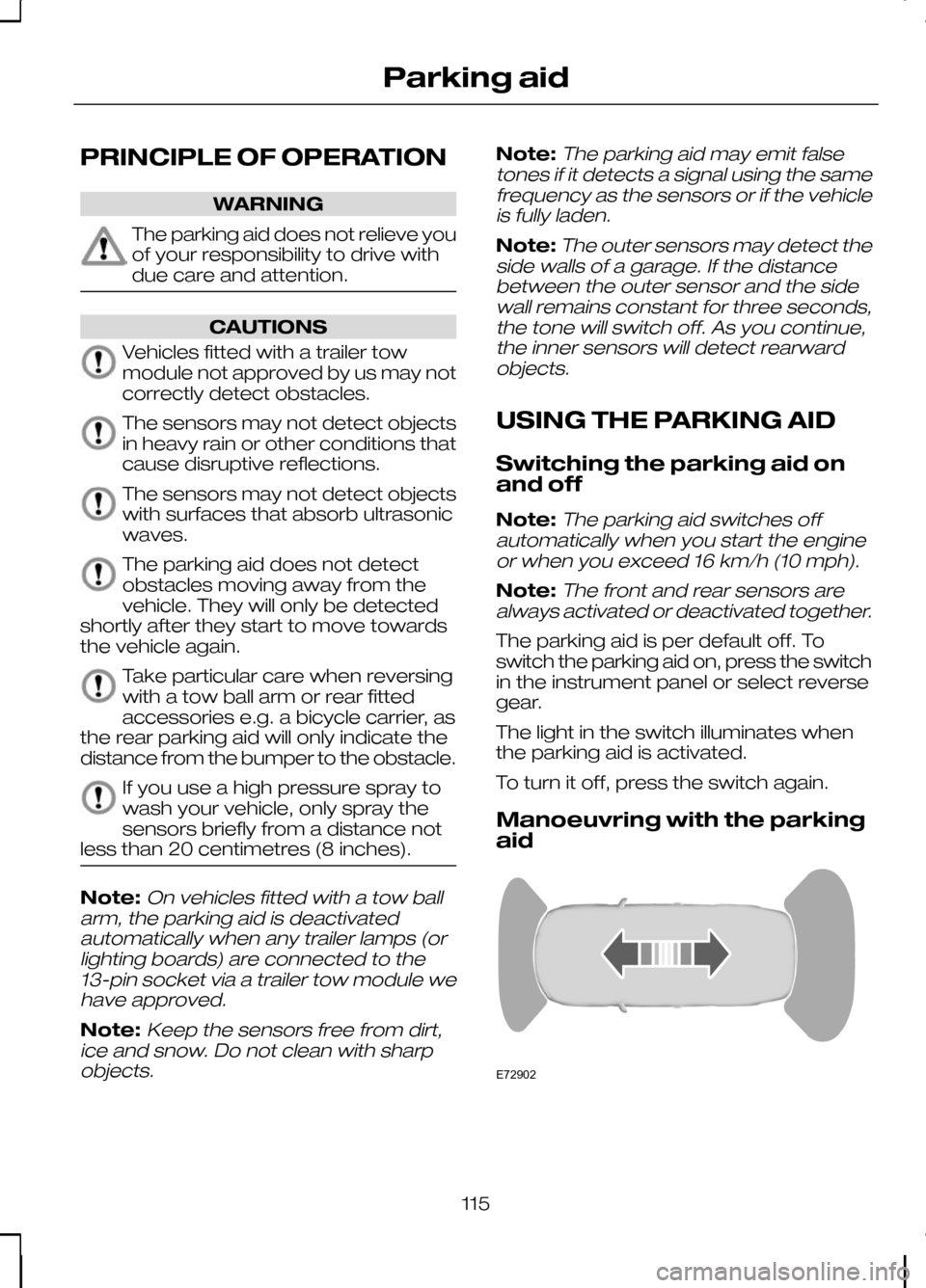
Manoeuvring with the parking
aid 115
Parking aidE72902
Page 121 of 226
Amber - 2 metres (79 inches)
D
Amber - centre line of the
projected vehicle path
E
Note:When reversing with a trailer, the
lines on the screen show the vehicle direction and not the trailer.
Deactivating the rear view
camera
Note:
Disengage reverse gear. The
display will stay on for a short period before switching off.
The system will automatically switch off
once the vehicle speed has reached
approximately 15 km/h (9 mph).
Vehicles with parking aid
The display will additionally show a
coloured distance bar. This guide
indicates the distance from the rear
bumper to the detected obstacle.
These are colour coded as follows:
• Green - 0.8 to 1.5 metres (31 to 59
inches).
• Amber - 0.3 to 0.8 metre (12 to 31
inches).
• Red - 0.3 metre (12 inches) or less.
119
Rear view camera
Page 129 of 226
TOWING A TRAILER
WARNINGS
Do not exceed the maximum gross
train weight stated on the vehicle
identification plate. See
Vehicle
identification (page 170).Do not exceed 100 km/h (62 mph).
The rear tyre pressures must be
increased by 0.2 bar (3 psi) above
specification. See
Technical
specifications (page 168). CAUTIONS
Do not exceed the maximum
permissible nose weight, i.e. vertical
weight on the tow ball, of 100
kilogrammes (220 pounds) for vehicles
with a diesel engine, or 105 kilogrammes
(231 pounds) for vehicles with a petrol
engine. We recommend you purchase a
towing kit from your dealer. Failure to
do so may result in damage to the
engine. Note:Not all vehicles are suitable or
approved to have tow bars fitted. Check with your dealer first.
Place loads as low and central to the
axle(s) of the trailer as possible. If you are
towing with an unladen vehicle, the load
in the trailer should be placed toward the
nose, within the maximum nose load, as
this gives the best stability.
The stability of the vehicle to trailer
combination is very much dependant on
the quality of the trailer. In high altitude regions above 1 000
metres (3 281 feet), the stipulated
maximum permitted gross train weight
must be reduced by 10% for every
additional 1 000 metres (3 281 feet).
Steep gradients WARNING
The overrun brake on a trailer is not
controlled by ABS.
Change down a gear before you reach a
steep downhill gradient.
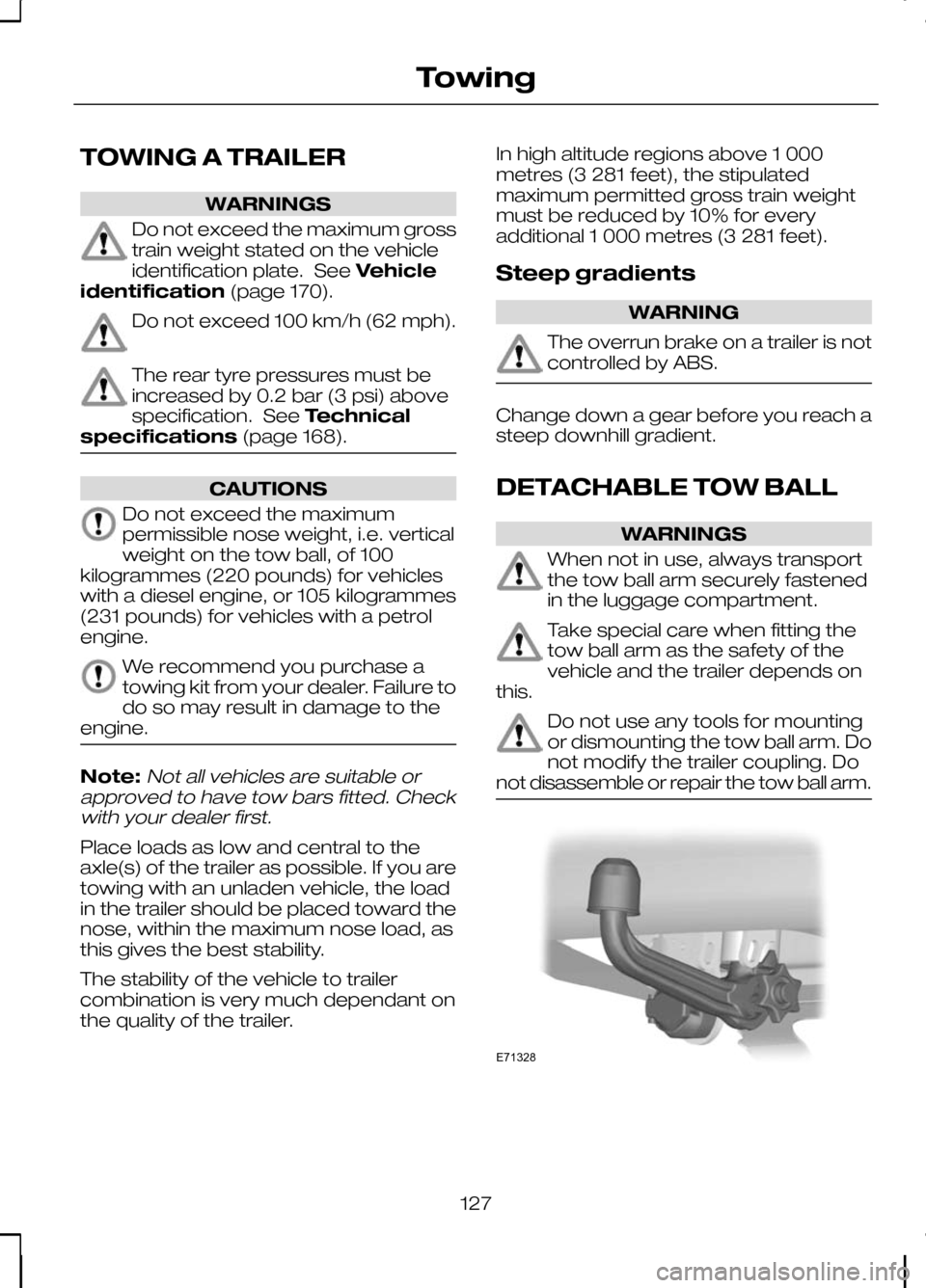
DETACHABLE TOW BALL
WARNINGS
When not in use, always transport
the tow ball arm securely fastened
in the luggage compartment.
Take special care when fitting the
tow ball arm as the safety of the
vehicle and the trailer depends on
this. Do not use any tools for mounting
or dismounting the tow ball arm. Do
not modify the trailer coupling. Do
not disassemble or repair the tow ball arm. 127
TowingE71328
Page 131 of 226
Driving with a trailer
WARNING
If any of the below conditions
cannot be met, do not use the tow
bar and have it checked by a
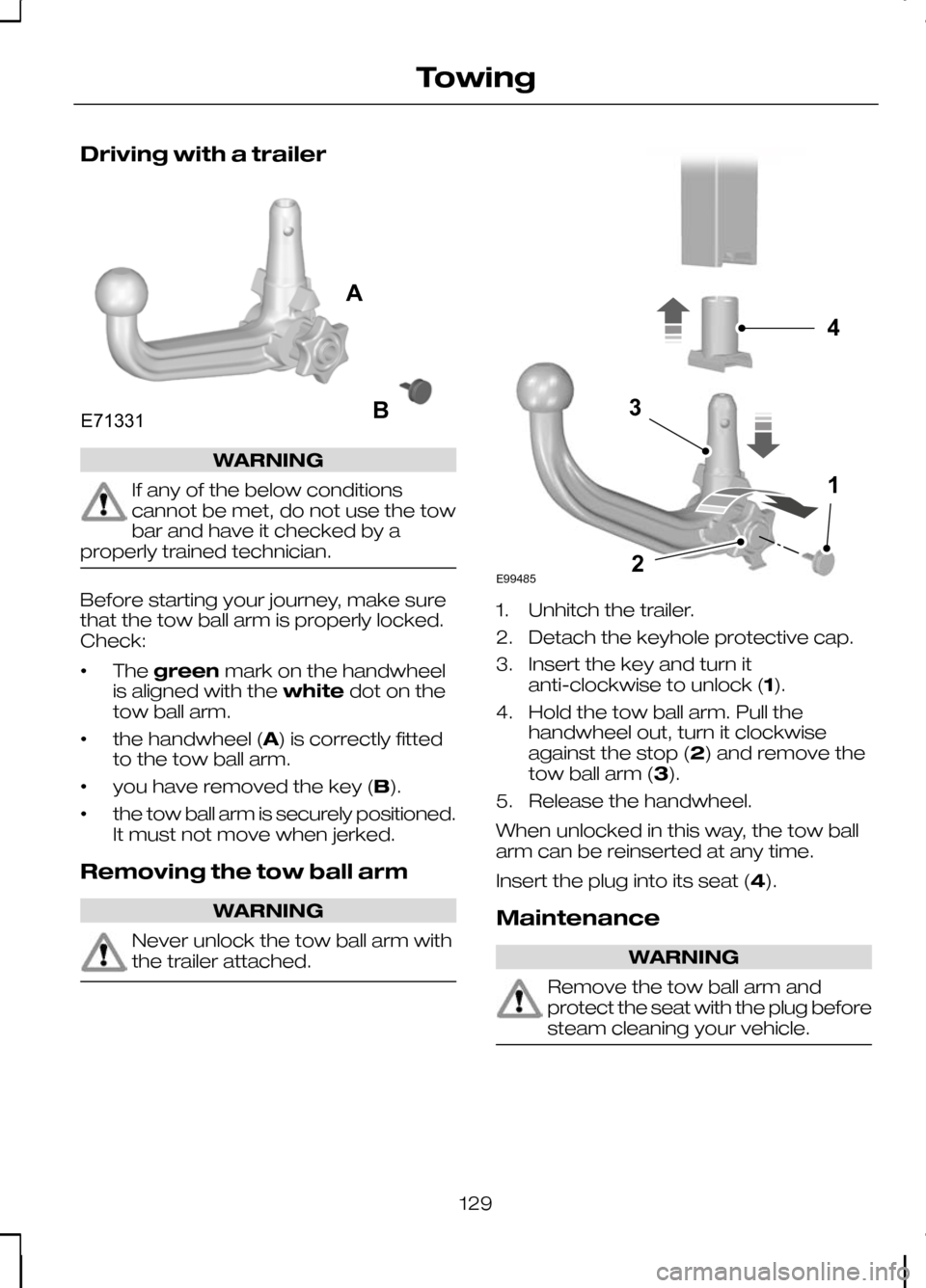
properly trained technician. Before starting your journey, make sure
that the tow ball arm is properly locked.
Check:
•
The
green mark on the handwheel
is aligned with the whitedot on the
tow ball arm.
• the handwheel (A) is correctly fitted
to the tow ball arm.
• you have removed the key (B).
• the tow ball arm is securely positioned.
It must not move when jerked.
Removing the tow ball arm WARNING
Never unlock the tow ball arm with
the trailer attached. 1. Unhitch the trailer.
2. Detach the keyhole protective cap.
3. Insert the key and turn it
anti-clockwise to unlock (1).
4. Hold the tow ball arm. Pull the handwheel out, turn it clockwise
against the stop (2) and remove the
tow ball arm (3).
5. Release the handwheel.
When unlocked in this way, the tow ball
arm can be reinserted at any time.
Insert the plug into its seat (4).
Maintenance WARNING
Remove the tow ball arm and
protect the seat with the plug before
steam cleaning your vehicle.
129
TowingE71331AB E994854132
Page 140 of 226
Circuits protected
Ampere rating
Fuse
Daytime running lamps igni-
tion supply to lighting
control switch
10
110
Fuel pump (diesel only)
5
111
Fuel pump (petrol only)
15
111
Audio modules battery
supply
15
112
Daytime running lamps
(parking lamps)
10
113
Instrument cluster ignition
supply, engine immobiliser
10
114
Lighting control ignition
supply
7.5
115
Fog lamps
20
116
Number plate lamps
7.5
117
Door module, left-hand rear
20
118
Luggage compartment
auxiliary power socket
15
119
Luggage compartment
auxiliary power socket
(vehicles with trailer tow
module)
25
119
Door module, right-hand
rear
20
120
Heated front seats
20
121
Airbag module
10
122
Heated exterior mirrors
7.5
123
Parking lamps, side lamps,
tail lamps (left-hand side)
7.5
124
Parking lamps, side lamps,
tail lamps (right-hand side)
7.5
125
Key free system
20
126
138
Fuses
Page 163 of 226
7. Install the wheel trim using the ball of
your hand. WARNING
Have the wheel nuts checked for
tightness and the tyre pressure
checked as soon as possible.
Note:If the spare wheel is different in size
or construction to the road wheels, have this replaced as soon as possible.
TYRE REPAIR KIT
Your vehicle is not equipped with a spare
tyre, but does include an emergency tyre
repair kit that can be used to repair one
flat tyre.
The tyre repair kit is located in the
underfloor storage compartment. See
Storage compartments (page 98).
General information WARNINGS
Depending on the type and extent
of tyre damage, some tyres can
only be partially sealed or not sealed
at all. Loss of tyre pressure can affect
vehicle handling, leading to loss of vehicle
control. Do not use the tyre repair kit if the
tyre has already been damaged as
a result of being driven under
inflated. Do not use the tyre repair kit on run
flat tyres.
Do not try to seal damage other
than that located within the visible
tread of the tyre.
Do not try to seal damage to the
tyre’s sidewall. The tyre repair kit seals most tyre
punctures [with a diameter of up to six
millimetres (1/4 inch)] to temporarily
restore mobility.
Observe the following rules when using
the kit:
•
Drive with caution and avoid
making sudden steering or
driving manoeuvres, especially if
the vehicle is heavily loaded or you are
towing a trailer.
• The kit will provide you with an
emergency temporary repair, enabling
you to continue your journey to the
next vehicle or tyre dealer, or to drive
a maximum distance of
200 kilometres (125 miles).
• Do not exceed a
maximum speed
of 80 km/h (50 mph).
• Keep the kit out of the reach of
children.
• Only use the kit when the ambient
temperature is between –30°C (-22°F)
and +70°C (+158°F).
Using the tyre repair kit WARNINGS
Compressed air can act as an
explosive or propellant.
Never leave the tyre repair kit
unattended while in use.
CAUTION
Do not keep the compressor
operating for more than 10 minutes.
Note:
Use the tyre repair kit only for the
vehicle with which it was supplied.
161
Wheels and tyres
Page 169 of 226
Vehicles with stability control
(ESP)
Vehicles with stability control (ESP) may
exhibit some unusual driving
characteristics which can be avoided by
switching the system off. See
Using
stability control (page 113).
TYRE PRESSURE
MONITORING SYSTEM WARNINGS
The system does not relieve you of
your responsibility to regularly check
the tyre pressures.
The system will only provide a low
tyre pressure warning. It will not
inflate the tyres.
Do not drive on significantly
under-inflated tyres. This may cause
the tyres to overheat and fail.
Under-inflation reduces fuel efficiency,
tyre tread life and may also affect your
ability to drive the vehicle safely. CAUTIONS
Do not bend or damage the valves
when you are inflating the tyres.
Have tyres installed by properly
trained technicians.
The Deflation Detection System will alert
you if there is a change of air pressure in
any tyre. It does this by using the ABS
sensors to detect the rolling
circumference of the wheels. When the
circumference changes, this indicates low
pressure in a tyre, a warning message is
displayed in the information display and
the message indicator will illuminate. See
Information messages
(page 73).Apart from a too low tyre pressure or a
damaged tyre, the following situations can
affect the rolling circumference:
•
Vehicle load is uneven.
• When using a trailer or travelling up
and down an incline.
• Using snow chains.
• Driving on soft surfaces such as snow
or mud.
Note:The system will still function
correctly, but there may be an increased detection time.
If a low pressure warning message is
displayed in the information display, check
the tyre pressures as soon as possible
and inflate them to the recommended
pressure. See Technical
specifications (page 168).
If this happens frequently, have the cause
determined and rectified as soon as
possible.
System reset
Note:
Do not reset the system when the
vehicle is moving.
Note:You should reset the system
following any adjustment to the tyre pressures or any changing of tyres.
Note:Turn the ignition on.
Type 2 instrument cluster
1. Using the multifunction lever, navigate
to'SET' > T. Pres.
2. Press and hold the SET/RESET
button until the message Tyre
Pressure set appears.
Type 3 instrument cluster
1. Using the multifunction lever, navigate
tohold 'SET' to set Tyre Pres.
167
Wheels and tyres
Page 219 of 226
D
Detachable tow ball...............................127
Driving with a trailer....................................129
Inserting the tow ball arm..........................128
Maintenance............................................... 129
Removing the tow ball arm.......................129
Unlocking the tow ball arm mechanism.............................................. 128
Diesel particulate filter (DPF)................102 Regeneration............................................... 103
Direction indicators.................................50
Disabling the passenger airbag............25 Disabling the passenger airbag.................26
Enabling the passenger airbag..................26
Fitting the passenger airbag deactivation
switch......................................................... 25
Disarming the alarm................................37 Britain and Ireland only................................38
Disarming the engine immobiliser........36
DPF See: Diesel particulate filter (DPF)............102
Driving hints.............................................131
Driving through water............................131 Driving through water ................................131
E
Electric exterior mirrors..........................62 Electric folding mirrors.................................62
Mirror tilting positions...................................62
Electric seats...........................................93 6-way electric seat......................................93
Electric windows.....................................60 Anti-trap function..........................................60
Driver's door switches.................................60
Global opening and closing........................60
Opening and closing the windows
automatically............................................. 60
Resetting the memory of the electric windows..................................................... 61
Safety switch for rear windows.................60
Electromagnetic compatibility.............212
Emergency equipment........................132
Engine compartment overview - 2.0L Duratorq-TDCi (DW) Diesel...............145
Engine compartment overview - 2.5L Duratec (VI5)........................................144 Engine coolant check...........................148
Checking the coolant level........................148
Topping up...................................................148
Engine immobiliser..................................36 Principle of operation...................................36
Engine oil check.....................................147 Checking the oil level..................................147
Topping up...................................................148
Engine oil dipstick - 2.0L Duratorq-TDCi (DW) Diesel...........................................147
Engine oil dipstick - 2.5L Duratec (VI5).......................................................147
Exterior mirrors.........................................61 Manual folding mirrors..................................61
F
Fastening the seat belts........................24
First aid kit...............................................132
Floor mats...............................................100
Fog lamp See: Front fog lamps....................................47
Front fog lamps.......................................47
Fuel and refuelling.................................104 Technical specifications.............................106
Fuel burning heater See: Auxiliary heater....................................86
Fuel consumption..................................106
Fuel consumption See: Technical specifications....................106
Fuel cut-off switch.................................133 Vehicles with a Duratec engine................133
Fuel filler flap...........................................104
Fuel quality - Diesel...............................104 Long-term storage.....................................104
Fuel quality - Petrol................................104
Fuse box locations................................134 Engine compartment fuse box................134
Passenger compartment fuse box.........134
Fuses.......................................................134
Fuse specification chart.......................135 Engine compartment fuse box................135
Passenger compartment fuse box.........137
217
Index