ALL FORD KUGA 2011 1.G User Guide
[x] Cancel search | Manufacturer: FORD, Model Year: 2011, Model line: KUGA, Model: FORD KUGA 2011 1.GPages: 2057
Page 50 of 2057
foams should be conducted with extraction
ventilation. See also the vehicle Body Repair
Manual.
Freon
SeeAir Conditioning Refrigerant.
Fuels
See also, Fire, Legal Aspects, Chemicalsand
Solvents.
Avoid skin contact with fuel where possible. Should
contact occur, wash the affected skin with soap
and water.
Gasoline (Petrol)
Highly flammable - observe No Smoking policy.
For additional information, refer to: Petrol and
Petrol-Ethanol Fuel Systems Health and Safety
Precautions (100-00 General Information,
Description and Operation).
Gas-oil (Diesel Fuel)
Kerosene (Paraffin)
Used also as heating fuel, solvent and cleaning
agent.
Flammable - observe No Smoking policy.
Irritation of the mouth and throat may result from
swallowing. The main hazard from swallowing
arises if liquid aspiration into the lungs occurs.
Liquid contact dries the skin and can cause
irritation or dermatitis. Splashes in the eye may be
slightly irritating.
In normal circumstances the low volatility does not
give rise to harmful vapors. Exposure to mists and
vapors from kerosene at elevated temperature
should be avoided (mists may arise in dewaxing).
Avoid skin and eye contact and make sure there
is adequate ventilation.
Gas Cylinders
See also Fire. Gases such as oxygen, acetylene, argon and
propane are normally stored in cylinders at
pressures of up to 138 bar (2000 psi) and great
care should be taken in handling these cylinders
to avoid mechanical damage to them or to the valve
gear attached. The contents of each cylinder
should be clearly identified by appropriate
markings.
Cylinders should be stored in well-ventilated
enclosures, and protected from ice and snow, or
direct sunlight. Fuel gases, for example acetylene
and propane, should not be stored in close
proximity to oxygen cylinders.
Care should be exercised to prevent leaks from
gas cylinders and lines, and to avoid sources of
ignition.
Only trained personnel should undertake work
involving gas cylinders.
Gases
See
Gas Cylinders.
Gaskets (Fluoroelastomer)
SeeViton.
General Workshop Tools and
Equipment
It is essential that all tools and equipment are
maintained in good condition and that the correct
safety equipment is used where required.
Never use tools or equipment for any purpose other
than that for which they were designed. Never
overload equipment such as hoists, jacks, axle and
chassis stands or lifting slings. Damage caused by
overloading is not always immediately apparent
and may result in a fatal failure the next time that
the equipment is used.
Do not use damaged or defective tools or
equipment, particularly high-speed equipment such
as grinding wheels. A damaged grinding wheel can
disintegrate without warning and cause serious
injury.
Wear suitable eye protection when using grinding,
chiseling or sand blasting equipment.
Wear a suitable breathing mask when using
abrasive blasting equipment, working with
asbestos-based materials or using spraying
equipment.
G566527en2008.50 Kuga8/2011
100-00- 47
General Information
100-00- 47
DESCRIPTION AND OPERATION
TO MODEL INDEX
BACK TO CHAPTER INDEX
FORD KUGA 2011.0MY WORKSHOP REPAIR MANUAL
Page 53 of 2057
Make sure there is adequate ventilation to control
dusts, mists and fumes.
High Pressure Air, Lubrication and Oil
Test Equipment
See alsoLubricants and Greases.
Always keep high-pressure equipment in good
condition, and regularly maintained, particularly at
joints and unions.
Never direct a high-pressure nozzle, for example
diesel injector, at the skin as the fluid may
penetrate to the underlying tissue, and cause
serious injury.
Halon
See CFCs.
Legal Aspects
There are many laws and regulations relating to
health and safety in the use and disposal of
materials and equipment in a workshop.
For a safe working environment and to avoid
environmental pollution, workshops should be
familiar, in detail, with the many health and safety
laws and regulations within their country, published
by both national and local authorities.
Lubricants and Greases
Avoid all prolonged and repeated contact with
mineral oils. All lubricants and greases may be
irritating to the eyes and skin.
Transmission Fluids
Safety instructions
Certain Transmission and Power Steering fluids
supplied to Ford may contain additives which have
the potential to cause skin disease (dermatitis) to
exposed persons. The dermatitis may be irritant
or allergic in nature. Risks are higher where
prolonged or repeated skin contact with a fluid may
occur. These fluids are used for vehicle initial fill
and service purposes. This sub-section is to: • Inform Service personnel who may come into
contact with these vehicle fluids (hazard
communication).
• Summarise appropriate workplace control measures and personal protective equipment
requirements.
• Draw attention to the existence of Material Safety Datasheets (MSDS's) for the fluids
(available from Ford Customer Service Division).
These MSDS's contain detailed information on
hazards and appropriate controls.
Control measures
Workplace risk assessments made under national
chemical control regulations should identify
operations involving the fluids as potentially
hazardous and specify workplace control and
worker awareness measures. In such
circumstances, the relevant Material Safety
Datasheet (see the details specified below) which
specifies hazards and control measures in detail
should be made available for guidance.
Avoid unprotected skin contact with the fluids, and
in particular, avoid prolonged or repeated skin
contact. Work practices should be organised so as
to minimise the potential for skin contact. This may
include the use of drip trays, absorbents, correct
fluid handling equipment (funnels etc), and
workplace housekeeping measures such as the
cleaning of contaminated surfaces.
Personnel engaged in operations where skin
contact could occur (such as fluid draining or filling)
should wear impervious gloves made from nitrile
rubber, certified to a chemical protection standard,
e.g. Europe Standard EN374. This glove type is
widely available from reputable suppliers of gloves
for chemical protection [including the manufacturers
Ansell-Admont (Solvex Range), North Safety
products (North Nitrile Latex Gloves range), and
Marigold Industrial (Blue Nitrile range)]. If gloves
become torn or contaminated on the inside they
should be replaced. Eye protection with safety
glasses is appropriate. Use of an impervious apron
and arm protectors may be necessary if more
extensive exposure is possible. Use of skin barrier
creams suitable for work with mineral oil products
may offer some supplementary protection, but such
barrier creams should not be used in place of
protective clothing.
If accidental skin contact occurs with the fluids,
wash the area thoroughly with soap or skin
cleanser and water.
G566527en2008.50 Kuga8/2011
100-00- 48
General Information
100-00- 48
DESCRIPTION AND OPERATION
TO MODEL INDEX
BACK TO CHAPTER INDEX
FORD KUGA 2011.0MY WORKSHOP REPAIR MANUAL
Page 54 of 2057
Accidental eye contact should be dealt with as per
normal first aid practices, by flushing the eyes with
an eye wash or clean cool water for 10 minutes,
after which medical attention should be obtained.
Remove and launder clothing which becomes
contaminated with the fluids. Do not place rags
contaminated with fluid in clothing pockets.
Wash thoroughly after completing operations where
skin exposure may have occurred.
It is important that personnel do not smoke, eat or
drink whilst handling the fluids or affected
transmissions. These measures are designed to
limit the risk from accidental ingestion.
Label any decanted fluid properly/use an equivalent
label to that on original product containers.
Clean up any spills promptly using an inert
absorbent and wash down contaminated surfaces
with detergent and water.
Dispose of any waste fluids safely as hazardous
waste.
Safety Data Sheets
Safety Data Sheets, which detail specific material
handling instructions and precautions are available
from the respective national sales company, and
via internet www.msds.ford.com.
Used Engine Oil
Prolonged and repeated contact with mineral oil
will result in the removal of natural fats from the
skin, leading to dryness, irritation and dermatitis.
In addition, used engine oil contains potentially
harmful contaminants, which may cause skin
cancer. Adequate means of skin protection and
washing facilities must be provided.
Do not employ used engine oils as lubricants or
for any application where appreciable skin contact
is likely to occur.
Environmental Precautions
Burning used engine oil in small space heaters or
boilers can be recommended only for units of
approved design. If in doubt check with the
appropriate local authority and manufacturer of
approved appliances.
Dispose of used oil and used oil filters through
authorized waste disposal contractors or licensedwaste disposal sites, or to the waste oil reclamation
trade. If in doubt, contact the relevant local
authority for advice on disposal facilities.
It is illegal to pour used oil on to the ground, down
sewers or drains, or into watercourses.
Noise
Some operations may produce high noise levels,
which could, in time, damage hearing. In these
cases, suitable ear protection must be worn.
Noise Insulation Materials
See
Foams, Fibre Insulation.
O-Rings (Fluoroelastomer)
SeeViton.
Paints
See also Solvents, Chemical Materials.
Highly flammable, flammable - observe No
Smoking policy
One Pack
Can contain harmful or toxic pigments, driers and
other components as well as solvents. Spraying
should be carried out only with adequate
ventilation.
Two Pack
Can also contain harmful and toxic unreacted
resins and resin hardening agents. The
manufacturers instructions should be followed. See
also Resin-based Adhesives and Isocyanate
Adhesives and Sealers under Adhesives and
Sealers.
Spraying should preferably be carried out in
exhausted ventilated booths removing vapor and
spray mists from the breathing zone. Individuals
working in booths should wear appropriate
respiratory protection. Those doing small-scale
repair work in the open workshop should wear
air-fed respirators.
G566527en2008.50 Kuga8/2011
100-00- 49
General Information
100-00- 49
DESCRIPTION AND OPERATION
TO MODEL INDEX
BACK TO CHAPTER INDEX
FORD KUGA 2011.0MY WORKSHOP REPAIR MANUAL
Page 55 of 2057
Pressurized Equipment
See HighPressure Air, Lubrication and Oil Test
Equipment.
Solder
Solders are mixtures of metals such that the
melting point of the mixture is below that of the
constituent metals (normally lead and tin). Solder
application does not normally give rise to toxic lead
fumes, provided a gas/air flame is used.
Oxy-acetylene flames should not be used, as they
are much hotter and will cause lead fumes to be
produced.
Some fumes may be produced by the application
of any flame to surfaces coated with grease, and
inhalation of these should be avoided.
Removal of excess solder should be undertaken
with care, to make sure that fine lead dust is not
produced, which can give toxic effects if inhaled.
Respiratory protection may be necessary.
Solder spillage and filings should be collected and
removed promptly to prevent general air
contamination by lead.
High standards of personal hygiene are necessary
in order to avoid ingestion of lead or inhalation of
solder dust from clothing.
Solvents
See also Chemical Materials, Fuels (Kerosene),
Fire.
For example acetone, white spirit, toluene, xylene,
trichloroethane.
Used in cleaning and dewaxing materials, paints,
plastics, resins and thinners.
Some may be highly flammable or flammable.
Skin contact will degrease the skin and may result
in irritation and dermatitis following repeated or
prolonged contact. Some can be absorbed through
the skin in toxic or harmful quantities.
Splashes in the eye may cause severe irritation
and could lead to loss of vision.
Brief exposure of high concentrations of vapors or
mists will cause eye and throat irritation,
drowsiness, dizziness, headaches and, in the worst
circumstances, unconsciousness.
Repeated or prolonged exposure to excessive but
lower concentrations of vapors or mists, for which there might not be adequate warning indications,
can cause more serious toxic or harmful effects.
Aspiration into the lungs, for example through
vomiting, is the most serious consequence of
swallowing.
Avoid splashes to the skin, eyes and clothing. Wear
protective gloves, goggles and clothing if
necessary.
Make sure there is good ventilation when in use,
avoid breathing fumes, vapors and spray mists and
keep containers tightly sealed. Do not use in
confined spaces.
When spraying materials containing solvents, for
example paints, adhesive, coatings, use extraction
ventilation or personal respiratory protection in the
absence of adequate general ventilation.
Do not apply heat or flame except under specific
and detailed manufacturers instructions.
Sound Insulation
See
Fibre Insulation, Foams.
Suspended Loads
CAUTION: Never improvise lifting tackle.
There is always a danger when loads are lifted or
suspended. Never work under an unsupported,
suspended or raised load, for example a
suspended engine.
Always make sure that lifting equipment such as
jacks, hoists, axle stands and slings are adequate
and suitable for the job, in good condition and
regularly maintained.
Transmission Brake Bands
See Asbestos.
Underseal
SeeCorrosion Protection.
Viton
In common with many other manufacturers
vehicles, some components have O-rings, seals
or gaskets, which contain a material known as
`Viton'.
G566527en2008.50 Kuga8/2011
100-00- 50
General Information
100-00- 50
DESCRIPTION AND OPERATION
TO MODEL INDEX
BACK TO CHAPTER INDEX
FORD KUGA 2011.0MY WORKSHOP REPAIR MANUAL
Page 56 of 2057
Viton is a fluoroelastomer, that is a synthetic rubber
type material, which contains Fluorine. It is
commonly used for O-rings, gaskets and seals of
all types. Although Viton is the most well known
fluoroelastomer, there are others, including Fluorel
and Tecmoflon.
When used under design conditions
fluoroelastomers are perfectly safe. If, however,
they are exposed to temperatures in excess of
400°C, the material will not burn, but will
decompose, and one of the products formed is
hydrofluoric acid.
This acid is extremely corrosive and may be
absorbed directly, through contact, into the general
body system.
O-rings, seals or gaskets which have been exposed
to very high temperatures will appear charred or
as a black sticky substance.
DO NOT; under any circumstances touch them or
the attached components.
Enquiries should be made to determine whether
Viton or any other fluoroelastomer has been used
in the affected O-ring, seal or gasket. If they are of
natural rubber or nitrile there is no hazard. If in
doubt, be cautious, as the material may be Viton
or any fluoroelastomer.
If Viton or any other fluoroelastomers have been
used, the affected area should be decontaminated
before the commencement of work.
Disposable heavy duty plastic gloves should be
worn at all times, and the affected area washed
down using wire wool and a limewater (calcium
hydroxide) solution to neutralize the acid before
disposing of the decomposed Viton residue and
final cleaning of the area. After use, the plastic
gloves should be discarded carefully and safely.
Welding
See alsoFire, Electric Shock, Gas Cylinders.
Welding processes include Resistance Welding
(Spot Welding), Arc Welding and Gas Welding.
Resistance Welding
This process may cause particles of molten metal
to be emitted at a high velocity, and the eyes and
skin must be protected.
Arc Welding
This process emits a high level of ultra-violet
radiation, which may cause arc-eye, and skin burns
to the operator and to other persons nearby.
Gas-shielded welding processes are particularly
hazardous in this respect. Personal protection must
be worn, and screens used to shield other people.
CONTACT LENS WEARERS ARE ADVISED TO
REVERT TO ORDINARY SPECTACLES WHEN
ARC WELDING as the arc spectrum is believed to
emit microwaves which dry out the fluid between
the lens and the eye. This may result in blindness
when the lens is removed from the eye.
Metal spatter will also occur, and appropriate eye
and skin protection is necessary.
The heat of the welding arc will produce fumes and
gases from the metals being welded, the rods and
from any applied coatings or contamination on the
surfaces being worked on. These gases and fumes
may be toxic and inhalation of these should be
avoided. The use of extraction ventilation to remove
the fumes from the working area may be necessary
particularly in cases where the general ventilation
is poor, or where considerable welding work is
anticipated. In extreme cases or confined spaces
where adequate ventilation cannot be provided,
air-fed respirators may be necessary.
Gas Welding (and Cutting)
Oxy-acetylene torches may be used for welding
and cutting, and special care must be taken to
prevent leakage of these gases, with consequent
risk of fire and explosion.
The process will produce metal spatter and eye
and skin protection is necessary.
The flame is bright, and eye protection should be
used, but the ultra-violet emission is much less
than that from arc welding, and lighter filters may
be used.
The process itself produces few toxic fumes, but
such fumes and gases may be produced from
coatings on the work, particularly during cutting
away of damaged body parts, and inhalation of the
fumes should be avoided.
In brazing, toxic fumes may be produced from the
metals in the brazing rod, and a severe hazard
may arise if brazing rods containing cadmium are
used. In this event particular care must be taken
to avoid inhalation of fumes and expert advice may
be required.
G566527en2008.50 Kuga8/2011
100-00- 51
General Information
100-00- 51
DESCRIPTION AND OPERATION
TO MODEL INDEX
BACK TO CHAPTER INDEX
FORD KUGA 2011.0MY WORKSHOP REPAIR MANUAL
Page 59 of 2057
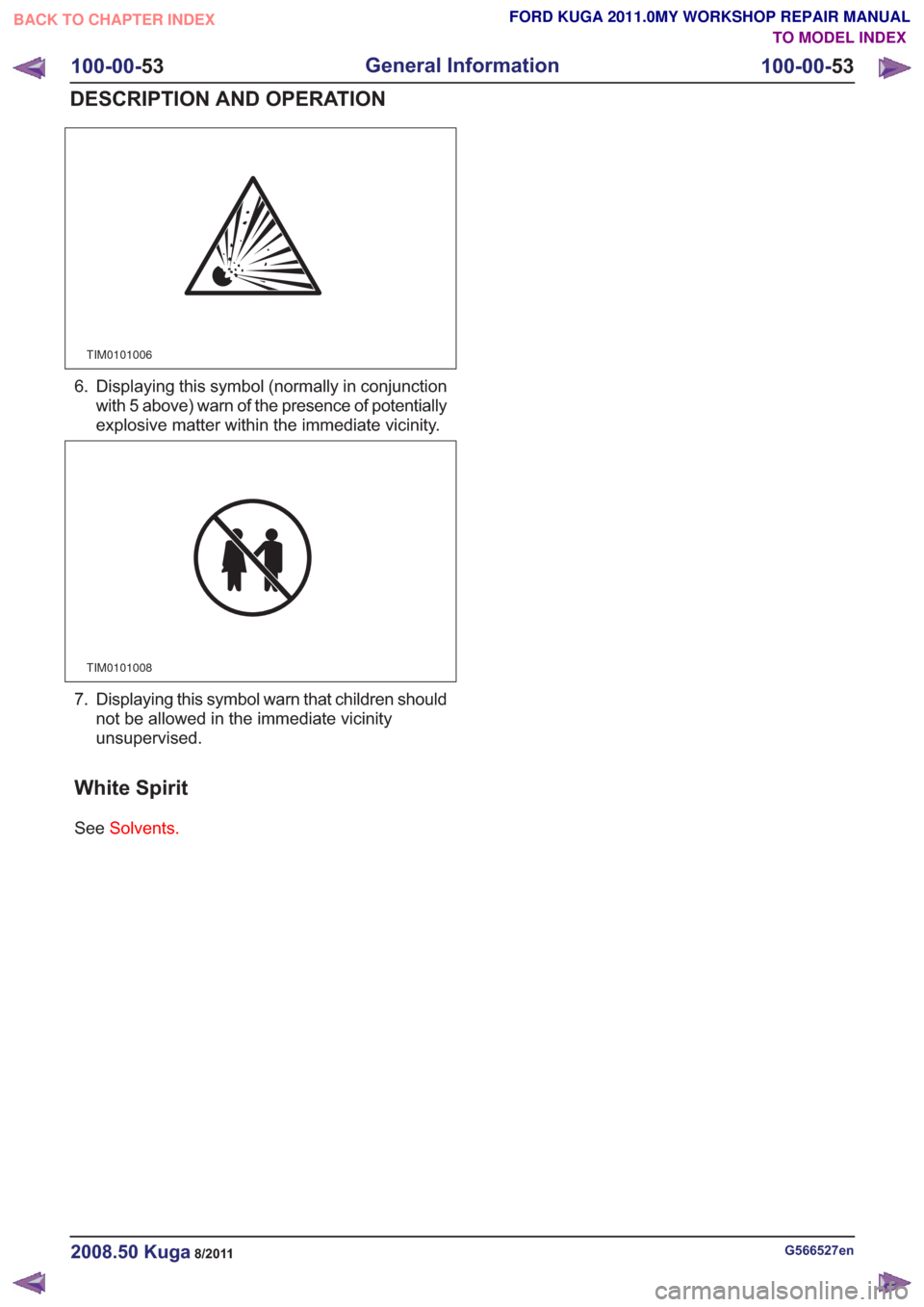
TIM0101006
6. Displaying this symbol (normally in conjunctionwith 5 above) warn of the presence of potentially
explosive matter within the immediate vicinity.
TIM0101008
7. Displaying this symbol warn that children shouldnot be allowed in the immediate vicinity
unsupervised.
White Spirit
See Solvents.
G566527en2008.50 Kuga8/2011
100-00- 53
General Information
100-00- 53
DESCRIPTION AND OPERATION
TO MODEL INDEX
BACK TO CHAPTER INDEX
FORD KUGA 2011.0MY WORKSHOP REPAIR MANUAL
Page 60 of 2057
Standard Workshop Practices
Vehicle in Workshop
When working on a vehicle in the workshop always
make sure that:
– the parking brake is applied or the wheels aresecurely chocked to prevent the vehicle moving
forwards or backwards.
– the key is removed from key operated hood locks before any work is carried out around the
front of the vehicle.
– if the engine is to be run, there is adequate ventilation, or an extraction hose to remove
exhaust fumes.
– there is adequate room to raise the vehicle and remove the wheels, if necessary.
– fender covers are always fitted if any work is to be carried out in the engine compartment.
– the battery is disconnected if working on the engine, underneath the vehicle, or if the vehicle
is raised.
CAUTION: When electric arc welding on a
vehicle, always disconnect the generator
wiring to prevent the possibility of a surge
of current causing damage to the internal
components of the generator.
– if using welding equipment on the vehicle, a suitable fire extinguisher is readily available.
Towing the Vehicle
WARNING: When the vehicle is being
towed, the ignition switch must be in
position II (steering lock released and
warning lamps illuminated). Only then will
the steering, turn signal lamps, horn and
stop lamps be operational. Failure to follow
these instructions may result in personal
injury.
NOTE: The removable towing eye (if equipped),
has a left-hand thread and must be fully tightened
before towing can commence.
When towing is necessary, the vehicle towing eyes
should be used. The rope must be securely
fastened to the towing eyes and must also be
attached to the other vehicle such that the rope will
not foul the bodywork.
When a vehicle with automatic transmission is
towed, the gear selector must be in position N (Neutral). Never tow a vehicle with automatic
transmission at a speed greater than 30 mph (50
km/h) or for a distance greater than 30 miles (50
km). If it is necessary to tow the vehicle a greater
distance, the drive wheels must be lifted clear off
the ground.
Alternatively the vehicle can be transported on a
low loader or a trailer.
Connecting a Slave Battery Using
Jumper Cables
WARNING: If the slave battery has recently
been charged and is gassing, cover the
vent plugs or covers with a damp cloth to
reduce the risk of explosion should arcing
occur when connecting the jumper cables.
Failure to follow these instructions may
result in personal injury.
CAUTIONS:
A discharged battery condition may have
been caused by an electrical short circuit.
If this condition exists there will be an
apparently live circuit on the vehicle even
when all normal circuits are switched off.
This can cause arcing when the jumper
cables are connected.
While it is not recommended that the
vehicle is jump started, it is recognized
that this may occasionally be the only
practical way to mobilize a vehicle. In such
an instance, the discharged battery must
be recharged immediately after jump
starting to avoid permanent damage.
– Always make sure that the jumper cables are adequate for the task. Heavy duty cables must
be used.
– Always make sure that the slave battery is of the same voltage as the vehicle battery. The
batteries must be connected in parallel.
– Always make sure that switched electric circuits are switched off before connecting jumper
cables. This reduces the risk of arcing occurring
when the final connection is made.
G17373en2008.50 Kuga8/2011
100-00- 54
General Information
100-00- 54
DESCRIPTION AND OPERATION
TO MODEL INDEX
BACK TO CHAPTER INDEX
FORD KUGA 2011.0MY WORKSHOP REPAIR MANUAL
Page 61 of 2057
Solvents, Sealants and Adhesives
Introduction
WARNING: Always handle all solvents,
sealers and adhesives with extreme care.
Some contain chemicals or give off fumes
which can be dangerous to health. Always
follow the manufacturers instructions. If in
doubt about any substance, particularly a
solvent, DO NOT use it.
CAUTION: If in doubt about the suitability
of any proprietary solvent or sealer for a
particular application, contact the
manufacturer of the product for
information regarding storage, handling
and application.
The Health and Safety Precautions subsection
refers to some commonly used chemicals and
materials, hazards associated with their use, and
safety measures to be taken.
G17374en2008.50 Kuga8/2011
100-00- 57
General Information
100-00- 57
DESCRIPTION AND OPERATION
TO MODEL INDEX
BACK TO CHAPTER INDEX
FORD KUGA 2011.0MY WORKSHOP REPAIR MANUAL
Page 62 of 2057
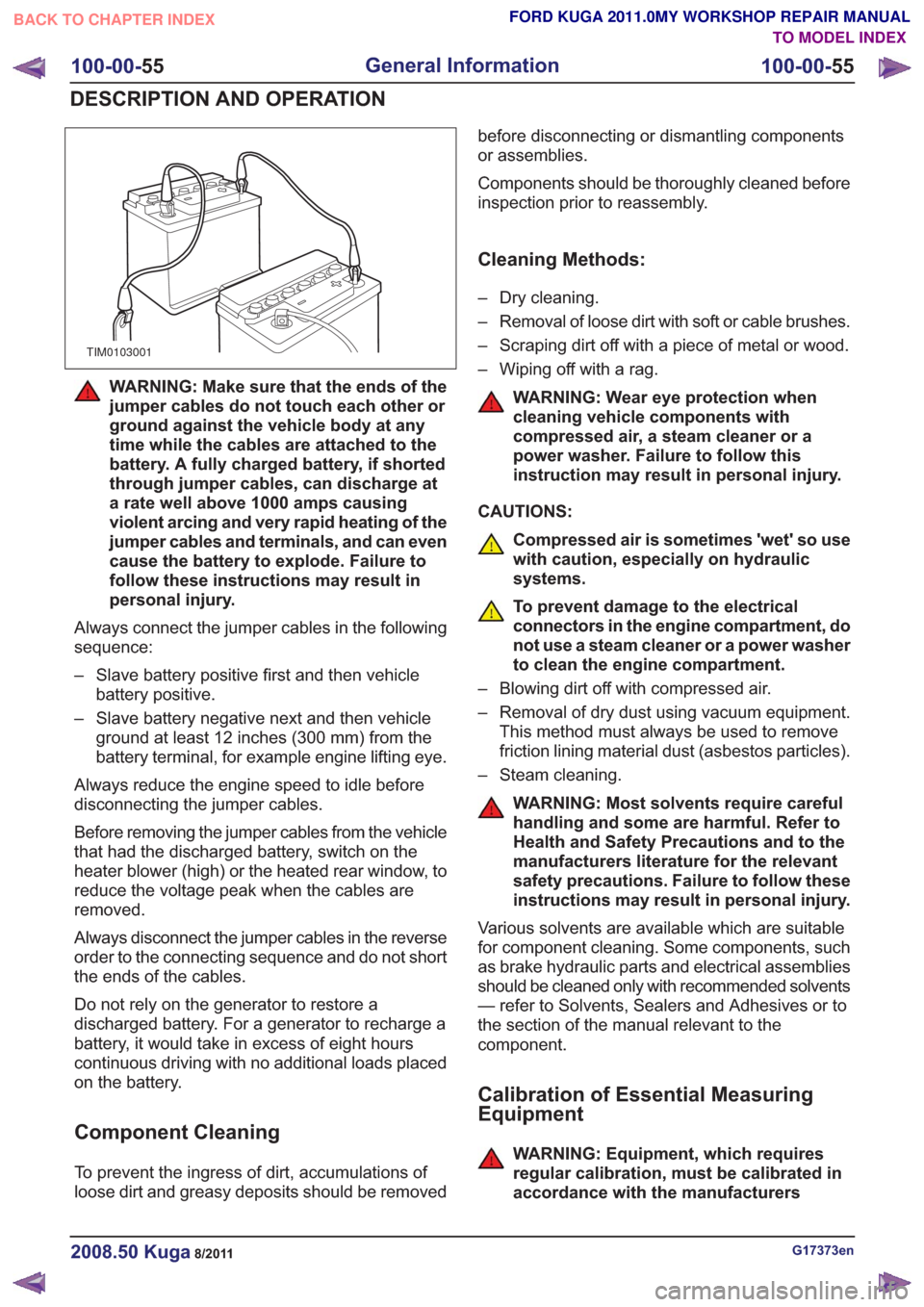
TIM0103001
WARNING: Make sure that the ends of the
jumper cables do not touch each other or
ground against the vehicle body at any
time while the cables are attached to the
battery. A fully charged battery, if shorted
through jumper cables, can discharge at
a rate well above 1000 amps causing
violent arcing and very rapid heating of the
jumper cables and terminals, and can even
cause the battery to explode. Failure to
follow these instructions may result in
personal injury.
Always connect the jumper cables in the following
sequence:
– Slave battery positive first and then vehicle battery positive.
– Slave battery negative next and then vehicle ground at least 12 inches (300 mm) from the
battery terminal, for example engine lifting eye.
Always reduce the engine speed to idle before
disconnecting the jumper cables.
Before removing the jumper cables from the vehicle
that had the discharged battery, switch on the
heater blower (high) or the heated rear window, to
reduce the voltage peak when the cables are
removed.
Always disconnect the jumper cables in the reverse
order to the connecting sequence and do not short
the ends of the cables.
Do not rely on the generator to restore a
discharged battery. For a generator to recharge a
battery, it would take in excess of eight hours
continuous driving with no additional loads placed
on the battery.
Component Cleaning
To prevent the ingress of dirt, accumulations of
loose dirt and greasy deposits should be removed before disconnecting or dismantling components
or assemblies.
Components should be thoroughly cleaned before
inspection prior to reassembly.
Cleaning Methods:
– Dry cleaning.
– Removal of loose dirt with soft or cable brushes.
– Scraping dirt off with a piece of metal or wood.
– Wiping off with a rag.
WARNING: Wear eye protection when
cleaning vehicle components with
compressed air, a steam cleaner or a
power washer. Failure to follow this
instruction may result in personal injury.
CAUTIONS:
Compressed air is sometimes 'wet' so use
with caution, especially on hydraulic
systems.
To prevent damage to the electrical
connectors in the engine compartment, do
not use a steam cleaner or a power washer
to clean the engine compartment.
– Blowing dirt off with compressed air.
– Removal of dry dust using vacuum equipment. This method must always be used to remove
friction lining material dust (asbestos particles).
– Steam cleaning.
WARNING: Most solvents require careful
handling and some are harmful. Refer to
Health and Safety Precautions and to the
manufacturers literature for the relevant
safety precautions. Failure to follow these
instructions may result in personal injury.
Various solvents are available which are suitable
for component cleaning. Some components, such
as brake hydraulic parts and electrical assemblies
should be cleaned only with recommended solvents
— refer to Solvents, Sealers and Adhesives or to
the section of the manual relevant to the
component.
Calibration of Essential Measuring
Equipment
WARNING: Equipment, which requires
regular calibration, must be calibrated in
accordance with the manufacturers
G17373en2008.50 Kuga8/2011
100-00- 55
General Information
100-00- 55
DESCRIPTION AND OPERATION
TO MODEL INDEX
BACK TO CHAPTER INDEX
FORD KUGA 2011.0MY WORKSHOP REPAIR MANUAL
Page 63 of 2057
Road/Roller Testing
Road or roller testing may be carried out for various
reasons and a procedure detailing pre-test checks,
engine starting and stopping, pre-driving checks,
on-test checks and final checks to be completed
on completion of the test is given below.
Unless complete vehicle performance is being
checked, the full road test procedure need not be
carried out. Instead, those items particularly
relevant to the system(s) being checked can be
extracted.
Pre-Test Checks
WARNING: If the brake system hydraulic
fluid level is low, pedal travel is excessive
or a hydraulic leak is found, do not attempt
to road test the vehicle until the reason for
the low fluid level, excessive pedal travel
or hydraulic leak is found and rectified.
It is suggested that pre-test checks and functional
tests of those systems and circuits which affect the
safe and legal operations of the vehicle, such as
brakes, lights and steering, should always be
carried out before the road or roller test.
With the ignition switched off, check:
– the engine oil level.
– the engine coolant level.
– the tires, for correct pressure, compatible types and tread patterns, and wear within limits.
– that there is sufficient fuel in the tank to complete the test.
– all around the engine, transmission and under the vehicle for oil, coolant, hydraulic and fuel
leaks. Make a note of any apparent leaks and
wipe off the surrounding areas to make it easier
to identify the extent of the leak on completion
of the test.
Starting the Engine
NOTE: On initial drive away from cold and within
the first 1.5 km (1 mile), do not depress the
accelerator pedal beyond half travel until the
vehicle has attained a minimum speed of 25 km/h
(15 miles/h). Never operate at high engine speed
or with the accelerator pedal at full travel whilst the
engine is cold.
With the ignition switched off, check: – that the parking brake is applied.
– that the gear lever is in the neutral position.
– that all instrument gauges (except fuel gauge)
read zero.
With the ignition switched on, check:
– that the ignition controlled warning lamps are illuminated.
– that the engine temperature gauge registers a reading compatible with the engine temperature.
– that the fuel gauge registers a reading appropriate to the fuel level in the tank.
– the operation of the parking brake warning lamp and fluid level warning indicator.
Road or Roller Testing
CAUTION: If road testing, check the brake
operation while still traveling at low speed
before continuing with the test. If the
brakes pull to one side, or appear to be
otherwise faulty, do not continue with the
road test until the fault has been found and
rectified.
During the road or roller test, check:
– that the clutch pedal operation is not stiff or heavy.
– that the initial gear engagement is smooth and there is no evidence of clutch drag.
– that the parking brake control operates smoothly and releases quickly and completely.
– that the clutch takes up the drive smoothly, without slip or judder.
– that gear changing is smooth with no abnormal noises or vibrations from the transmission.
– the engine power output is satisfactory, full power is achieved, acceleration is smooth and
pedal operation is not stiff or heavy, and engine
speed returns to idle correctly.
– there is no excessive or abnormally colored smoke from the engine under normal driving,
heavy load or overrun conditions.
– that steering operation, including power steering (if equipped), is smooth, accurate, not
excessively heavy or with excessive free play
or vibration.
– that the steering does not pull to one side and self centers smoothly after cornering.
G17375en2008.50 Kuga8/2011
100-00- 58
General Information
100-00- 58
DESCRIPTION AND OPERATION
TO MODEL INDEX
BACK TO CHAPTER INDEX
FORD KUGA 2011.0MY WORKSHOP REPAIR MANUAL