ECT FORD KUGA 2011 1.G User Guide
[x] Cancel search | Manufacturer: FORD, Model Year: 2011, Model line: KUGA, Model: FORD KUGA 2011 1.GPages: 2057
Page 25 of 2057
Description
Item
Convertible body style
5
Van body style
6
3, 4, 5-door body style - Top View
7
Wagon body style - Top View
8
Underview
9Description
Item
Right-hand drive (RHD) vehicle
10
Left-hand drive (LHD) vehicle
11
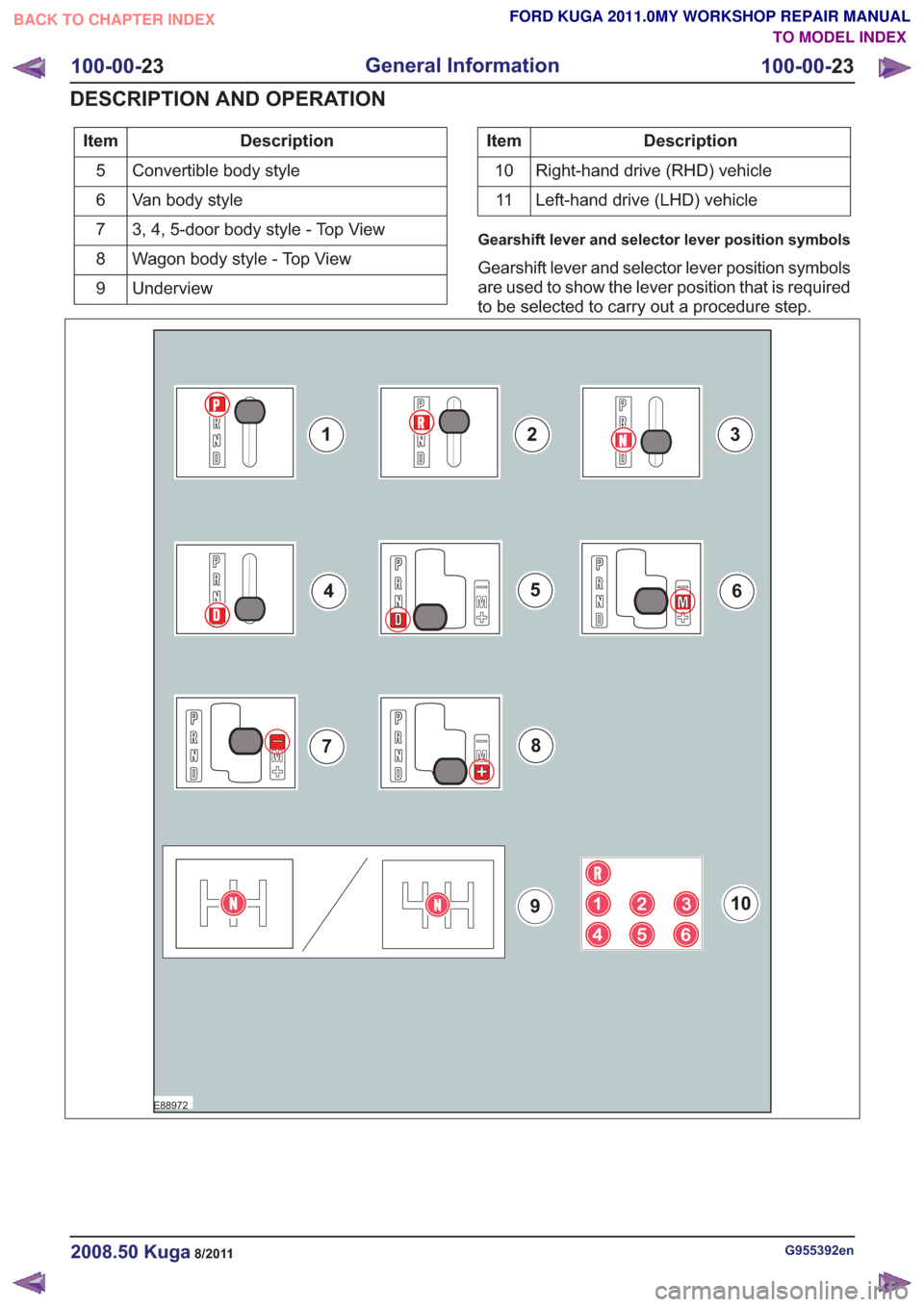
Gearshift lever and selector lever position symbols
Gearshift lever and selector lever position symbols
are used to show the lever position that is required
to be selected to carry out a procedure step.
E88972
12
4
10
3
7
65
8
9
G955392en2008.50 Kuga8/2011
100-00- 23
General Information
100-00- 23
DESCRIPTION AND OPERATION
TO MODEL INDEX
BACK TO CHAPTER INDEX
FORD KUGA 2011.0MY WORKSHOP REPAIR MANUAL
Page 27 of 2057
Description
Item
Minor component movement
clockwise/counterclockwise
1
Major component movement
clockwise/counterclockwise
2
Component movement to the
left/right/up/down
3
Component movement towards/away
4
3 dimensional component movement
5Description
Item
2 dimensional component movement
6
3 dimensional component rotation
7
3 dimensional component cycling
8
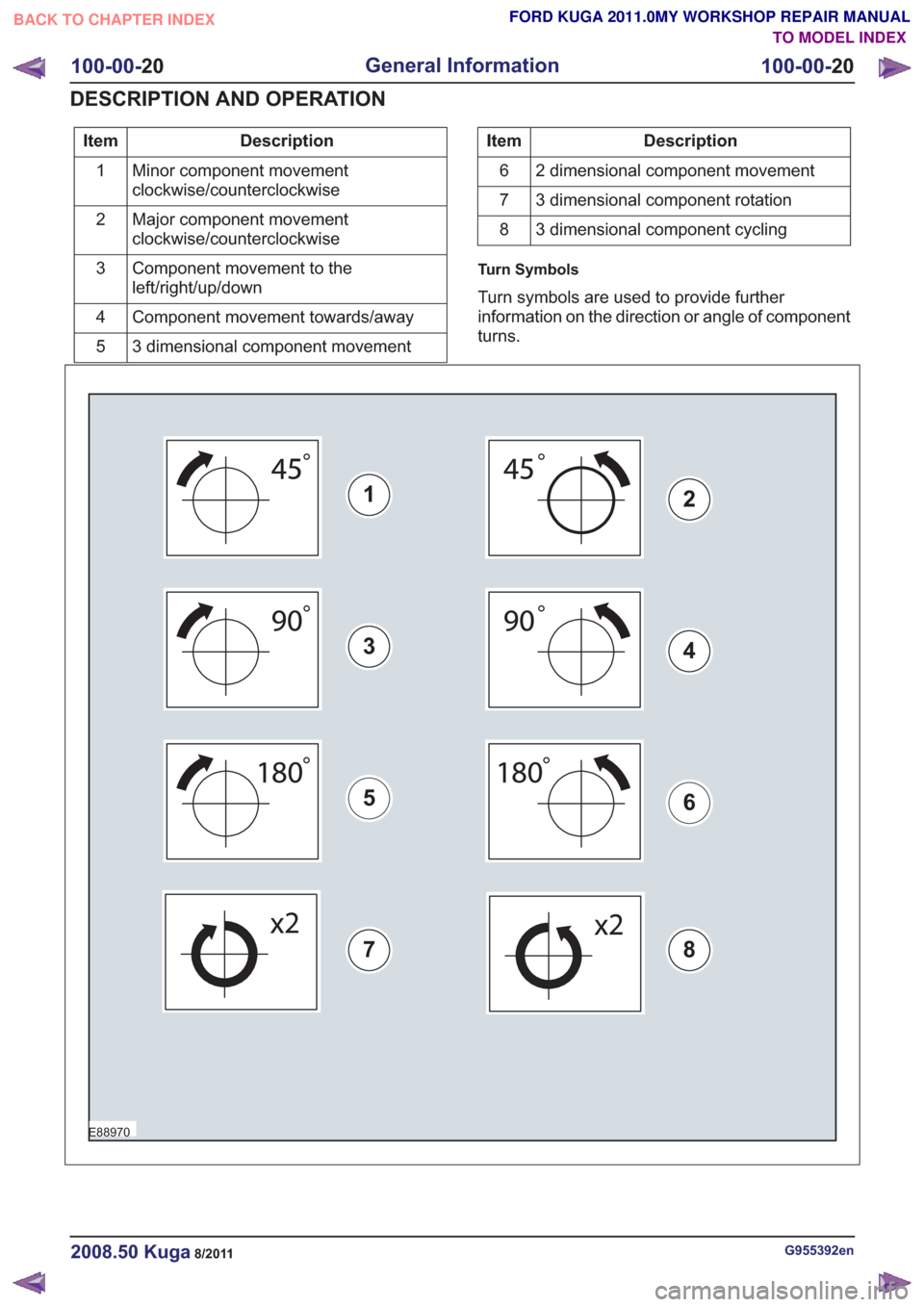
Turn Symbols
Turn symbols are used to provide further
information on the direction or angle of component
turns.
E88970
12
34
6
7
5
8
G955392en2008.50 Kuga8/2011
100-00- 20
General Information
100-00- 20
DESCRIPTION AND OPERATION
TO MODEL INDEX
BACK TO CHAPTER INDEX
FORD KUGA 2011.0MY WORKSHOP REPAIR MANUAL
Page 28 of 2057
Description
Item
Set the selector lever to the park (P)
position
1
Set the selector lever to the reverse ( R )
position
2
Set the selector lever to the neutral (N)
position
3
Set the selector lever to the drive (D)
position
4
Set the selector lever with manual shift
pattern to the park (D) position
5
Set the selector lever with manual shift
pattern to the manual (M) position
6Description
Item
Set the selector lever with manual shift
pattern to the shift down (-) position
7
Set the selector lever with manual shift
pattern to the shift up (+) position
8
Set the gearshift lever to the neutral (N)
position
9
Further gearshift lever positions that may
appear in illustrations
10
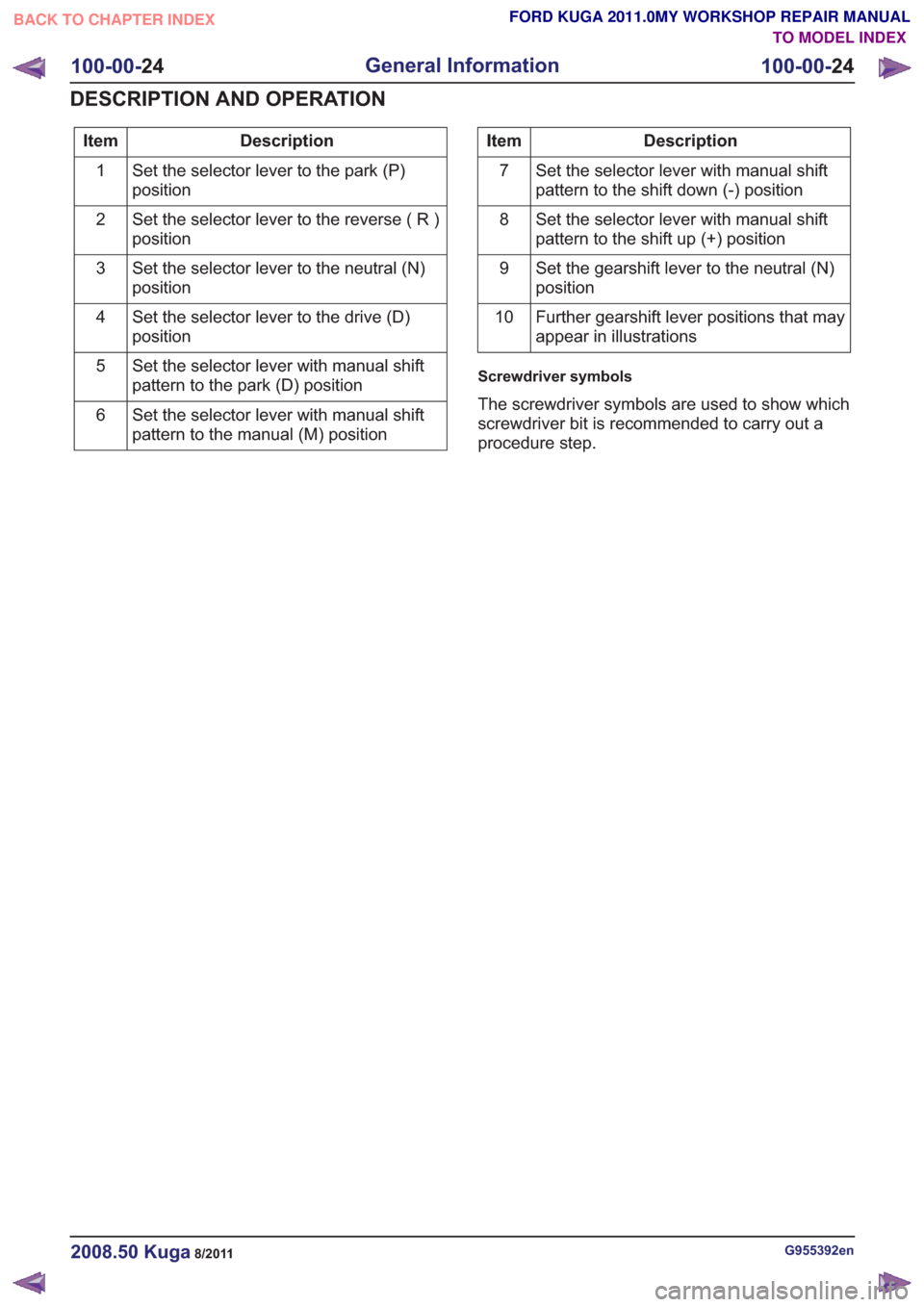
Screwdriver symbols
The screwdriver symbols are used to show which
screwdriver bit is recommended to carry out a
procedure step.
G955392en2008.50 Kuga8/2011
100-00-
24
General Information
100-00- 24
DESCRIPTION AND OPERATION
TO MODEL INDEX
BACK TO CHAPTER INDEX
FORD KUGA 2011.0MY WORKSHOP REPAIR MANUAL
Page 36 of 2057
Description
Item
Self contained breathing apparatus
4
General prohibition used in combination
with another symbol
5
Do not use power tools
6
Visual check
7
Noise check
8
Dispose the specified component
9
Replaced by item 9 (Dispose the specified
component)
10
Set the engine speed to the specified
value
11Description
Item
Fully apply the parking brake lever
12
Fully release the parking brake lever
13
Do not dispose of batteries into the waste
bin
14
Visual check using a mirror
15
Area/component must be dry
16
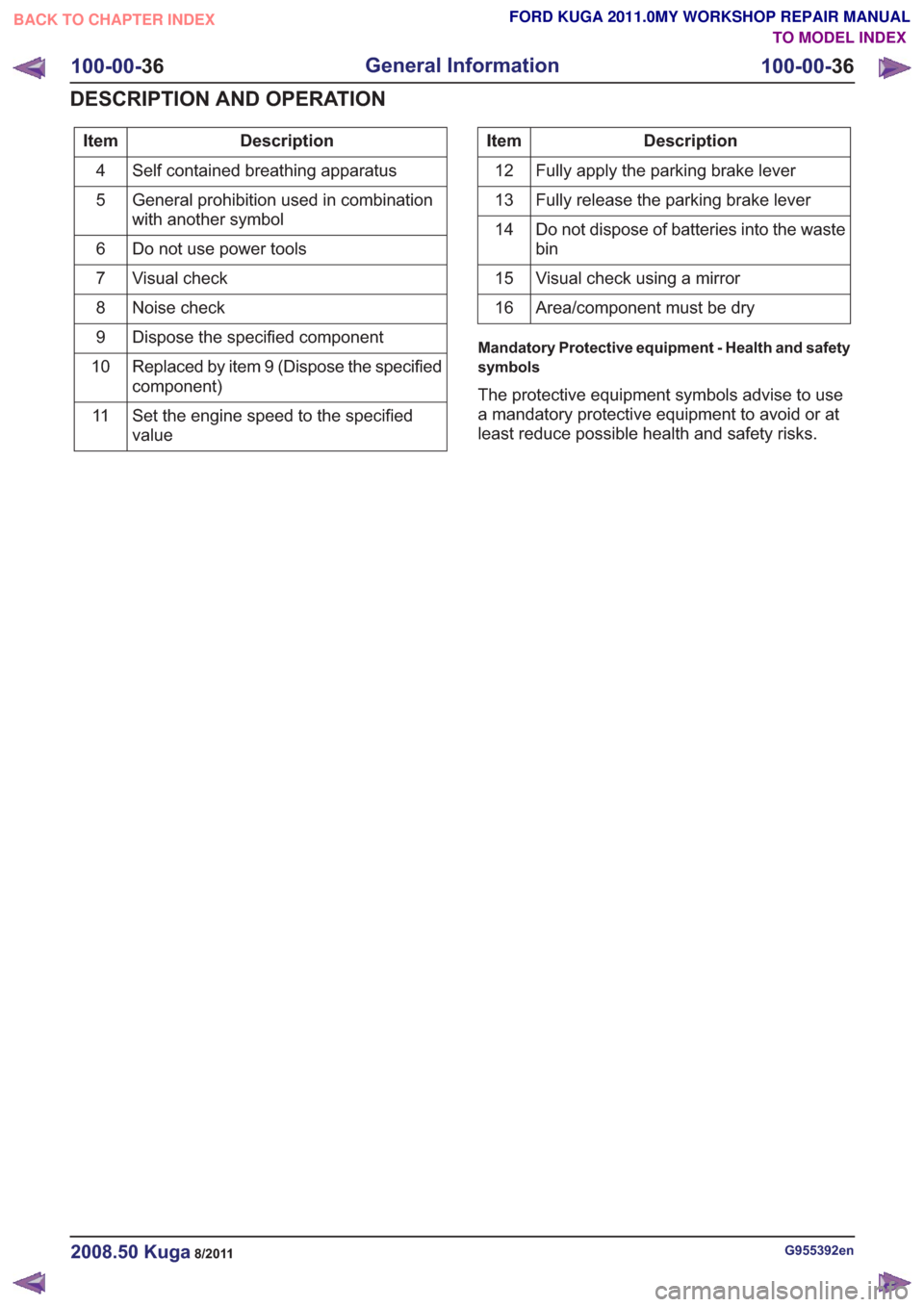
Mandatory Protective equipment - Health and safety
symbols
The protective equipment symbols advise to use
a mandatory protective equipment to avoid or at
least reduce possible health and safety risks.
G955392en2008.50 Kuga8/2011
100-00- 36
General Information
100-00- 36
DESCRIPTION AND OPERATION
TO MODEL INDEX
BACK TO CHAPTER INDEX
FORD KUGA 2011.0MY WORKSHOP REPAIR MANUAL
Page 39 of 2057
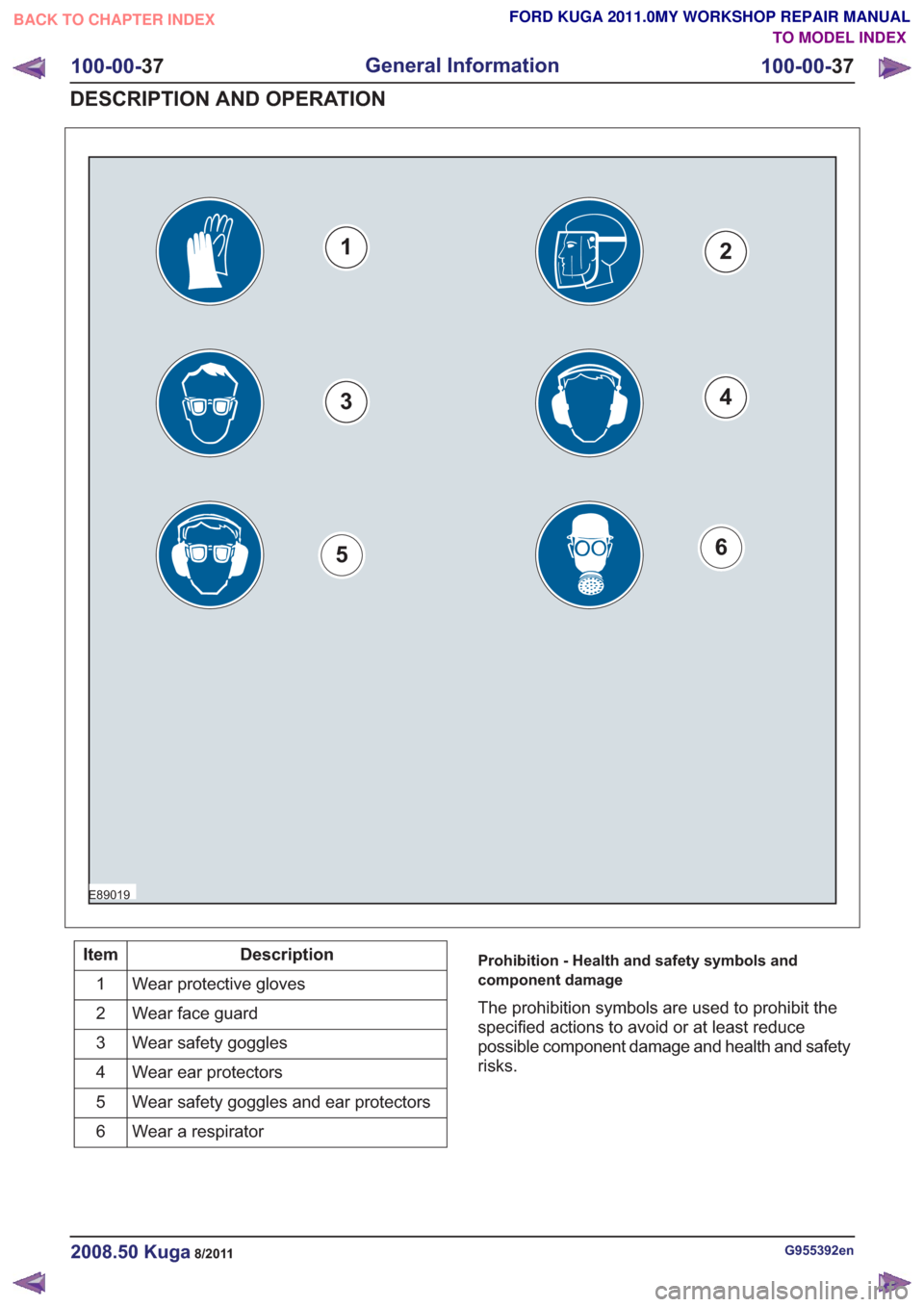
E89019
12
34
56
Description
Item
Wear protective gloves
1
Wear face guard
2
Wear safety goggles
3
Wear ear protectors
4
Wear safety goggles and ear protectors
5
Wear a respirator
6Prohibition - Health and safety symbols and
component damage
The prohibition symbols are used to prohibit the
specified actions to avoid or at least reduce
possible component damage and health and safety
risks.
G955392en2008.50 Kuga8/2011
100-00- 37
General Information
100-00- 37
DESCRIPTION AND OPERATION
TO MODEL INDEX
BACK TO CHAPTER INDEX
FORD KUGA 2011.0MY WORKSHOP REPAIR MANUAL
Page 44 of 2057
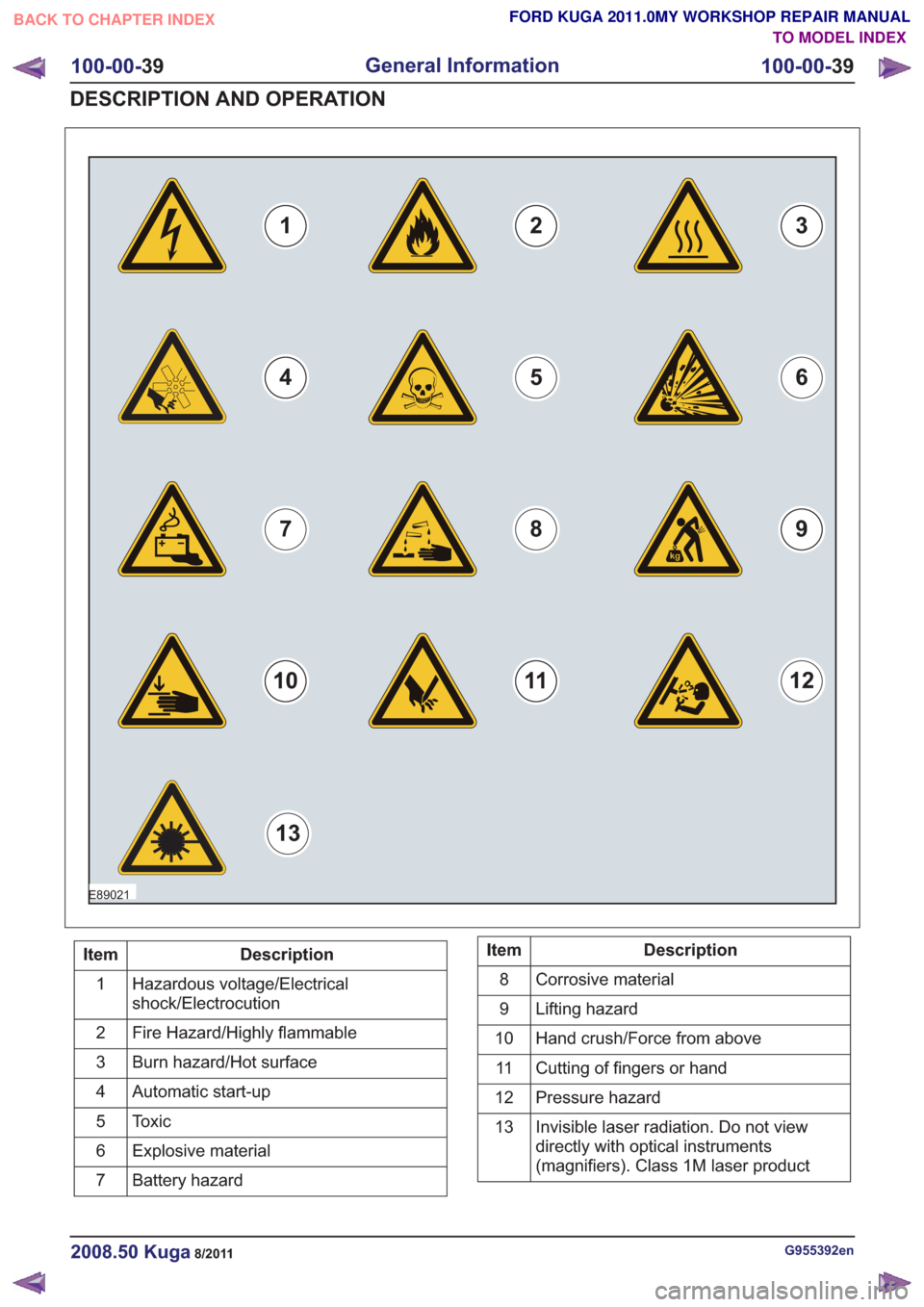
E89021
123
56
798
12
4
13
Description
Item
Hazardous voltage/Electrical
shock/Electrocution
1
Fire Hazard/Highly flammable
2
Burn hazard/Hot surface
3
Automatic start-up
4
Toxic
5
Explosive material
6
Battery hazard
7Description
Item
Corrosive material
8
Lifting hazard
9
Hand crush/Force from above
10
Cutting of fingers or hand
11
Pressure hazard
12
Invisible laser radiation. Do not view
directly with optical instruments
(magnifiers). Class 1M laser product
13
G955392en2008.50 Kuga8/2011
100-00-
39
General Information
100-00- 39
DESCRIPTION AND OPERATION
TO MODEL INDEX
BACK TO CHAPTER INDEX
FORD KUGA 2011.0MY WORKSHOP REPAIR MANUAL
Page 45 of 2057
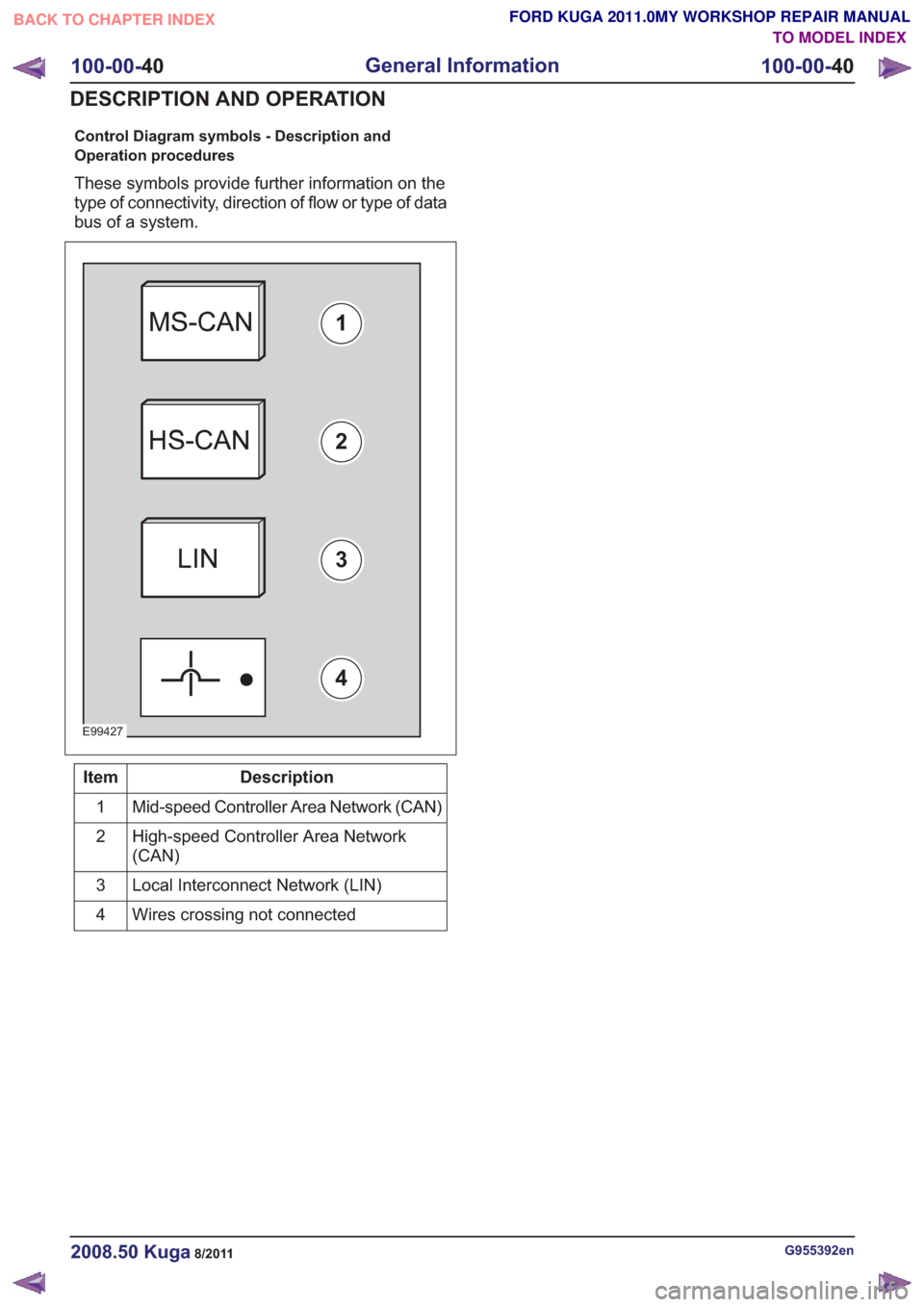
Control Diagram symbols - Description and
Operation procedures
These symbols provide further information on the
type of connectivity, direction of flow or type of data
bus of a system.
E99427
1
2
3
4
Description
Item
Mid-speed Controller Area Network (CAN)
1
High-speed Controller Area Network
(CAN)
2
Local Interconnect Network (LIN)
3
Wires crossing not connected
4
G955392en2008.50 Kuga8/2011
100-00- 40
General Information
100-00- 40
DESCRIPTION AND OPERATION
TO MODEL INDEX
BACK TO CHAPTER INDEX
FORD KUGA 2011.0MY WORKSHOP REPAIR MANUAL
Page 46 of 2057
Steering System Health and Safety Precautions
WARNINGS:
When handling the power steering fluid,
always wear protective goggles and gloves
made of nitril.
EYE CONTACT: Power steering fluid
contains long chain alkyl amine
thiophosphate. Avoid contact with the
eyes. Wash hands thoroughly after
handling. If power steering fluid comes into
contact with the eyes, flush the eyes with
plenty of cold running water for 15
minutes. Seek medical attention for any
persistent eye irritation or abnormality.
SKIN CONTACT: If power steering fluid
comes into contact with the skin, remove
contaminated clothing. Wash affected
areas of skin with soap and water. Seek
medical attention for any persistent skin
irritation or abnormality.
INHALED: If oil mist is inhaled, move a
victim to fresh air. Keep a victim warm and
at rest. Seek immediate medical attention
in cases of throat irritation or coughing.
SWALLOWED: Power steering fluid
contains long chain alkyl amine
thiophosphate. If swallowed, drink plenty
of water. Seek immediate medical attention.
CAUTION: If the power steering fluid is
spilled on the paintwork, the affected area
must be immediately washed down with
cold water.
G1185951en2008.50 Kuga8/2011
100-00-41
General Information
100-00- 41
DESCRIPTION AND OPERATION
TO MODEL INDEX
BACK TO CHAPTER INDEX
FORD KUGA 2011.0MY WORKSHOP REPAIR MANUAL
Page 47 of 2057
Exhaust Fumes
These contain asphyxiating, harmful and toxic
chemicals and particles such as carbon oxides,
nitrogen oxides, aldehydes, lead and aromatic
hydrocarbons. Engines should be run only under
conditions of adequate exhaust extraction or
general ventilation and not in confined spaces.
Gasoline (petrol) engine
There may not be adequate warning of odor or of
irritation before toxic or harmful effects arise. These
may be immediate or delayed.
Diesel engine
Soot, discomfort and irritation usually give
adequate warning of hazardous fume
concentrations.
Fibre Insulation
See alsoDusts.
Used in noise and sound insulation.
The fibrous nature of surfaces and cut edges can
cause skin irritation. This is usually a physical and
not a chemical effect.
Precautions should be taken to avoid excessive
skin contact through careful organization of work
practices and the use of gloves.
Fire
See also Welding,Foams,Legal Aspects.
Many of the materials found on or associated with
the repair of vehicles are highly flammable. Some
give off toxic or harmful fumes if burnt.
Observe strict fire safety when storing and handling
flammable materials or solvents, particularly near
electrical equipment or welding processes.
Make sure, before using electrical or welding
equipment, that there is no fire hazard present.
Have a suitable fire extinguisher available when
using welding or heating equipment.
First Aid
Apart from meeting any legal requirements it is
desirable for someone in the workshop to be
trained in First Aid procedures.
Splashes in the eye should be flushed carefully
with clean water for at least ten minutes.
Soiled skin should be washed with soap and water.
In case of cold burns, from alternative fuels, place
affected area in cool to cold water.
Individuals affected by inhalation of gases and
fumes should be removed to fresh air immediately.
If effects persist, consult a doctor.
If liquids are swallowed inadvertently, consult a
doctor giving him the information on the container
or label. Do not induce vomiting unless this action
is indicated on the label.
Fluoroelastomer
See Viton.
Foams - Polyurethane
See also Fire.
Used in sound and noise insulation. Cured foams
used in seat and trim cushioning.
Follow manufacturers instructions.
Unreacted components are irritating and may be
harmful to the skin and eyes. Wear gloves and
goggles.
Individuals with chronic respiratory diseases,
asthma, bronchial medical problems, or histories
of allergic diseases should not work in or near
uncured materials.
The components, vapors or spray mists can cause
direct irritation, sensitivity reactions and may be
toxic or harmful.
Vapors and spray mists must not be inhaled. These
materials must be applied with adequate ventilation
and respiratory protection. Do not remove the
respirator immediately after spraying; wait until the
vapors/mists have cleared.
Burning of the uncured components and the cured
foams can generate toxic and harmful fumes.
Smoking, naked flames or the use of electrical
equipment during foaming operations and until
vapors/mists have cleared should not be allowed.
Any heat cutting of cured foams or partially cured
G566527en2008.50 Kuga8/2011
100-00- 46
General Information
100-00- 46
DESCRIPTION AND OPERATION
TO MODEL INDEX
BACK TO CHAPTER INDEX
FORD KUGA 2011.0MY WORKSHOP REPAIR MANUAL
Page 48 of 2057
Health and Safety Precautions
Introduction
Many of the procedures associated with vehicle
maintenance and repair involve physical hazards
or other risks to health. This subsection lists,
alphabetically, some of these hazardous operations
and the materials and equipment associated with
them. Precautions necessary to avoid these
hazards are identified.
The list is not exhaustive and all operations and
procedures, and the handling of materials, should
be carried out with health and safety in mind.
Before using any product the Materials Safety Data
Sheet supplied by the manufacturer or supplier
should be consulted.
Acids and Alkalis
See alsoBattery Acids.
For example caustic soda, sulphuric acid.
Used in batteries and cleaning materials.
Irritant and corrosive to the skin, eyes, nose and
throat. Cause burns. Can destroy ordinary
protective clothing.
Avoid splashes to the skin, eyes and clothing. Wear
suitable protective impervious apron, gloves and
goggles. Do not breath mists.
Make sure access to eye wash bottles, shower and
soap are readily available for splashing accidents.
Display Eye Hazard sign.
Air Bags
See also Fire, Chemical Materials.
Highly flammable, explosive – observe No Smoking
policy.
Used as a safety restraint system mounted in the
steering wheel and passenger side of the
instrument panel.
The inflator contains a high-energetic propellant
which, when ignited, produces a VERY HOT GAS
(2500°C).
The gas generant used in air bags is Sodium Azide.
This material is hermetically sealed in the module
and is completely consumed during deployment.
No attempt should be made to open an air bag inflator as this will lead to the risk of exposure to
Sodium Azide. If a gas generator is ruptured, full
protective clothing should be worn when dealing
with the spillage.
After normal deployment, gloves and safety
goggles must be worn during the handling process.
Deployed air bags should be disposed of in a
plastic bag in accordance with local regulations at
an approved chemical waste site.
For additional information, refer to:
Supplemental
Restraint System (SRS) Health and Safety
Precautions (100-00 General Information,
Description and Operation).
Air Conditioning Refrigerant
See also Chlorofluorocarbon, Chemical Materials
Highly flammable, combustible – observe No
Smoking policy.
Skin contact may result in frostbite.
Instructions given by the manufacturer must be
followed. Avoid naked lights, wear suitable
protective gloves and goggles.
If refrigerant comes into contact with the skin or
eyes, immediately rinse the affected areas with
water. Eyes should also be rinsed with an
appropriate irrigation solution and should not be
rubbed. SEEK MEDICAL ASSISTANCE IF
NECESSARY.
For additional information, refer to: Air Conditioning
(A/C) System Health and Safety Precautions
(100-00 General Information, Description and
Operation).
Adhesives and Sealers
See also Fire, Chemical Materials.
Highly flammable, flammable, combustible –
observe No Smoking policy.
Generally should be stored in No Smoking areas.
Cleanliness and tidiness in use should be
observed, for example disposable paper covering
benches; should be dispensed from applicators
where possible; containers, including secondary
containers, should be labeled appropriately.
G566527en2008.50 Kuga8/2011
100-00- 42
General Information
100-00- 42
DESCRIPTION AND OPERATION
TO MODEL INDEX
BACK TO CHAPTER INDEX
FORD KUGA 2011.0MY WORKSHOP REPAIR MANUAL