instrument FORD KUGA 2011 1.G Repair Manual
[x] Cancel search | Manufacturer: FORD, Model Year: 2011, Model line: KUGA, Model: FORD KUGA 2011 1.GPages: 2057
Page 1387 of 2057
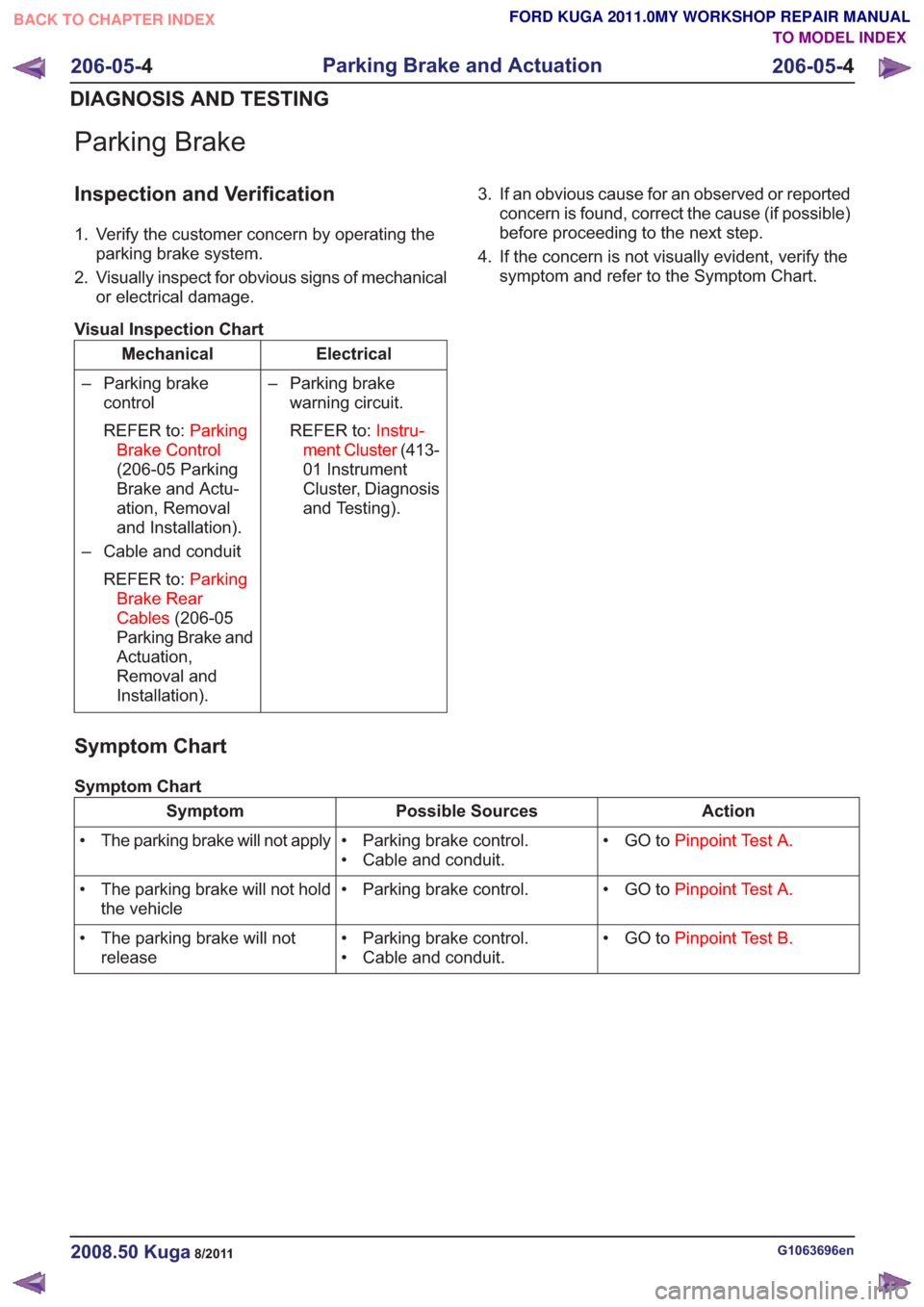
Parking Brake
Inspection and Verification
1. Verify the customer concern by operating theparking brake system.
2. Visually inspect for obvious signs of mechanical or electrical damage.
Visual Inspection Chart
Electrical
Mechanical
– Parking brakewarning circuit.
REFER to: Instru-
ment Cluster (413-
01 Instrument
Cluster, Diagnosis
and Testing).
– Parking brake
control
REFER to: Parking
Brake Control
(206-05 Parking
Brake and Actu-
ation, Removal
and Installation).
– Cable and conduit
REFER to: Parking
Brake Rear
Cables (206-05
Parking Brake and
Actuation,
Removal and
Installation). 3. If an obvious cause for an observed or reported
concern is found, correct the cause (if possible)
before proceeding to the next step.
4. If the concern is not visually evident, verify the symptom and refer to the Symptom Chart.
Symptom Chart
Symptom Chart
Action
Possible Sources
Symptom
• GO toPinpoint Test A.
• Parking brake control.
• Cable and conduit.
• The parking brake will not apply
• GO toPinpoint Test A.
• Parking brake control.
• The parking brake will not hold
the vehicle
• GO toPinpoint Test B.
• Parking brake control.
• Cable and conduit.
• The parking brake will not
release
G1063696en2008.50 Kuga8/2011
206-05- 4
Parking Brake and Actuation
206-05- 4
DIAGNOSIS AND TESTING
TO MODEL INDEX
BACK TO CHAPTER INDEX
FORD KUGA 2011.0MY WORKSHOP REPAIR MANUAL
Page 1394 of 2057
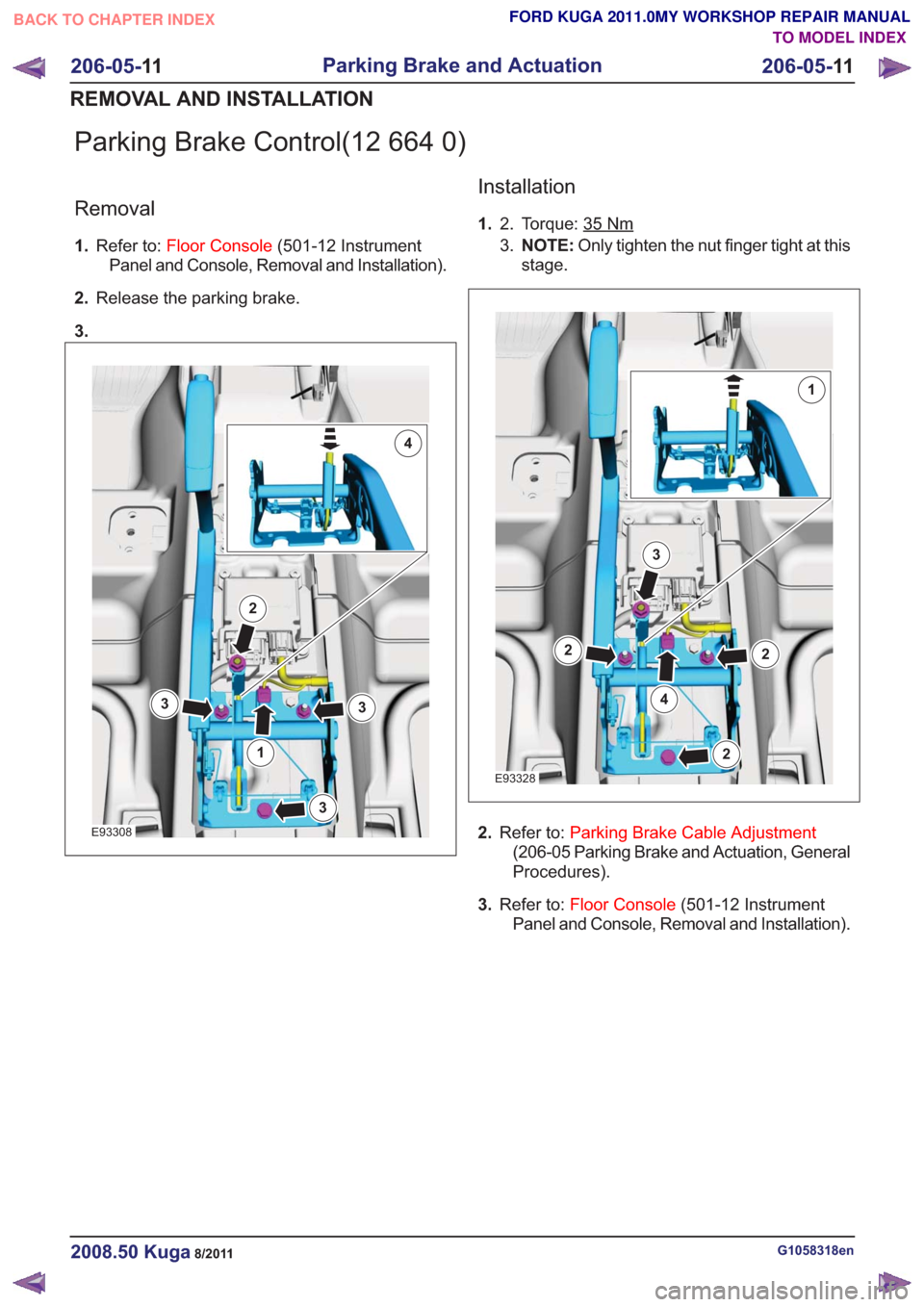
Parking Brake Control(12 664 0)
Removal
1.Refer to: Floor Console (501-12 Instrument
Panel and Console, Removal and Installation).
2. Release the parking brake.
3.
3
33
2
1
4
E93308
Installation
1. Torque: 35Nm2.
3.NOTE: Only tighten the nut finger tight at this
stage.
2
22
3
4
1
E93328
2. Refer to: Parking Brake Cable Adjustment
(206-05 Parking Brake and Actuation, General
Procedures).
3. Refer to: Floor Console (501-12 Instrument
Panel and Console, Removal and Installation).
G1058318en2008.50 Kuga8/2011
206-05- 11
Parking Brake and Actuation
206-05- 11
REMOVAL AND INSTALLATION
TO MODEL INDEX
BACK TO CHAPTER INDEX
FORD KUGA 2011.0MY WORKSHOP REPAIR MANUAL
Page 1399 of 2057
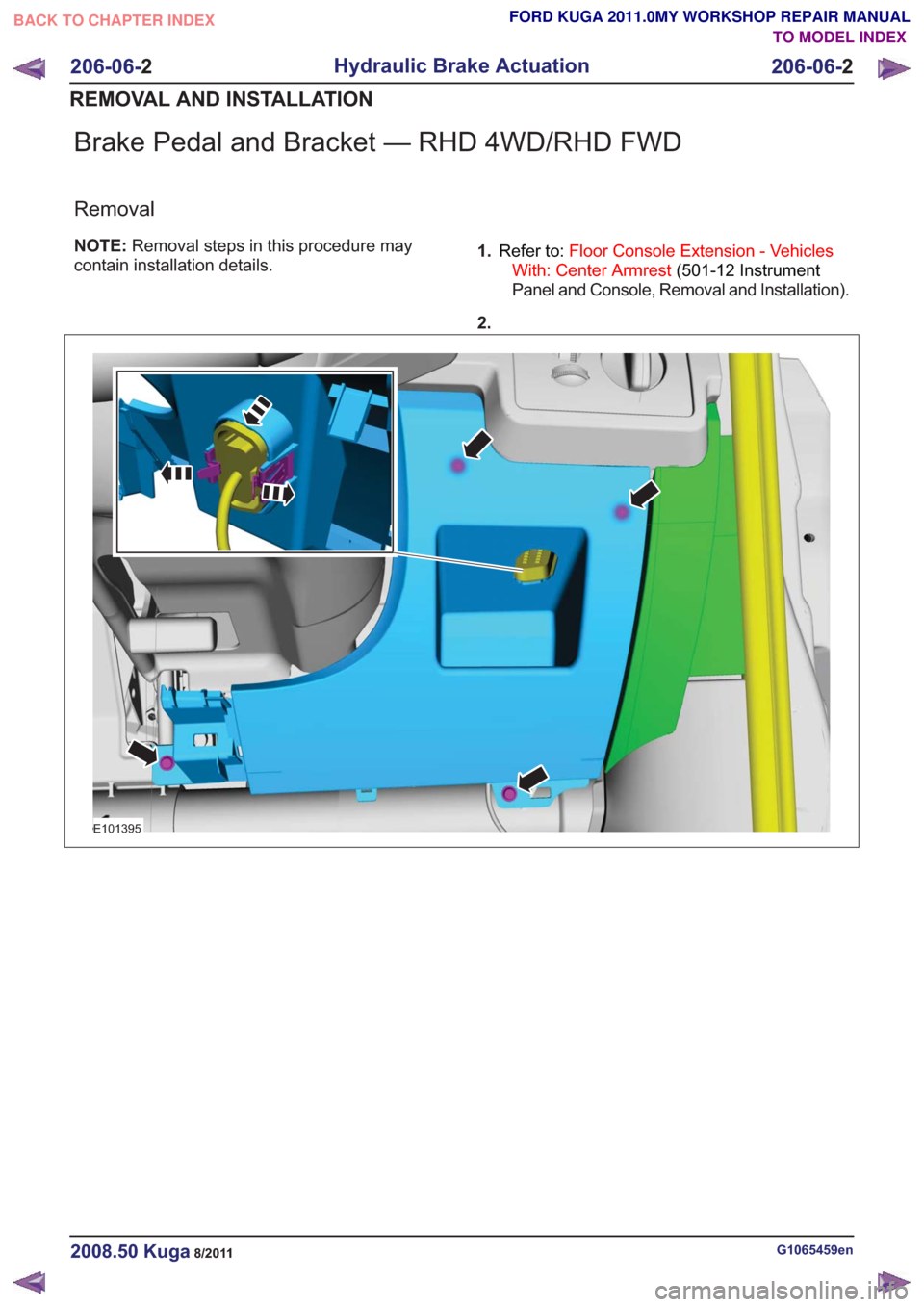
Brake Pedal and Bracket — RHD 4WD/RHD FWD
Removal
NOTE:Removal steps in this procedure may
contain installation details.
Panel and Console, Removal and Installation).
2.
E101395
G1065459en2008.50 Kuga8/2011
206-06- 2
Hydraulic Brake Actuation
206-06- 2
REMOVAL AND INSTALLATION
BACK TO CHAPTER INDEXFORD KUGA 2011.0MY WORKSHOP REPAIR MANUAL
TO MODEL INDEX
1. Refer to: Floor Console Extension - Vehicles
With: Center Armrest (501-12 Instrument
Page 1424 of 2057
Vehicles with ESP are equipped with an
opto-electronic steering wheel rotation sensor as
an integral part of the clockspring.
The following must be taken into account when
removing/installing or replacing the opto-electronic
steering wheel rotation sensor:
• If installing a new clockspring, remove theclockspring locking screw.
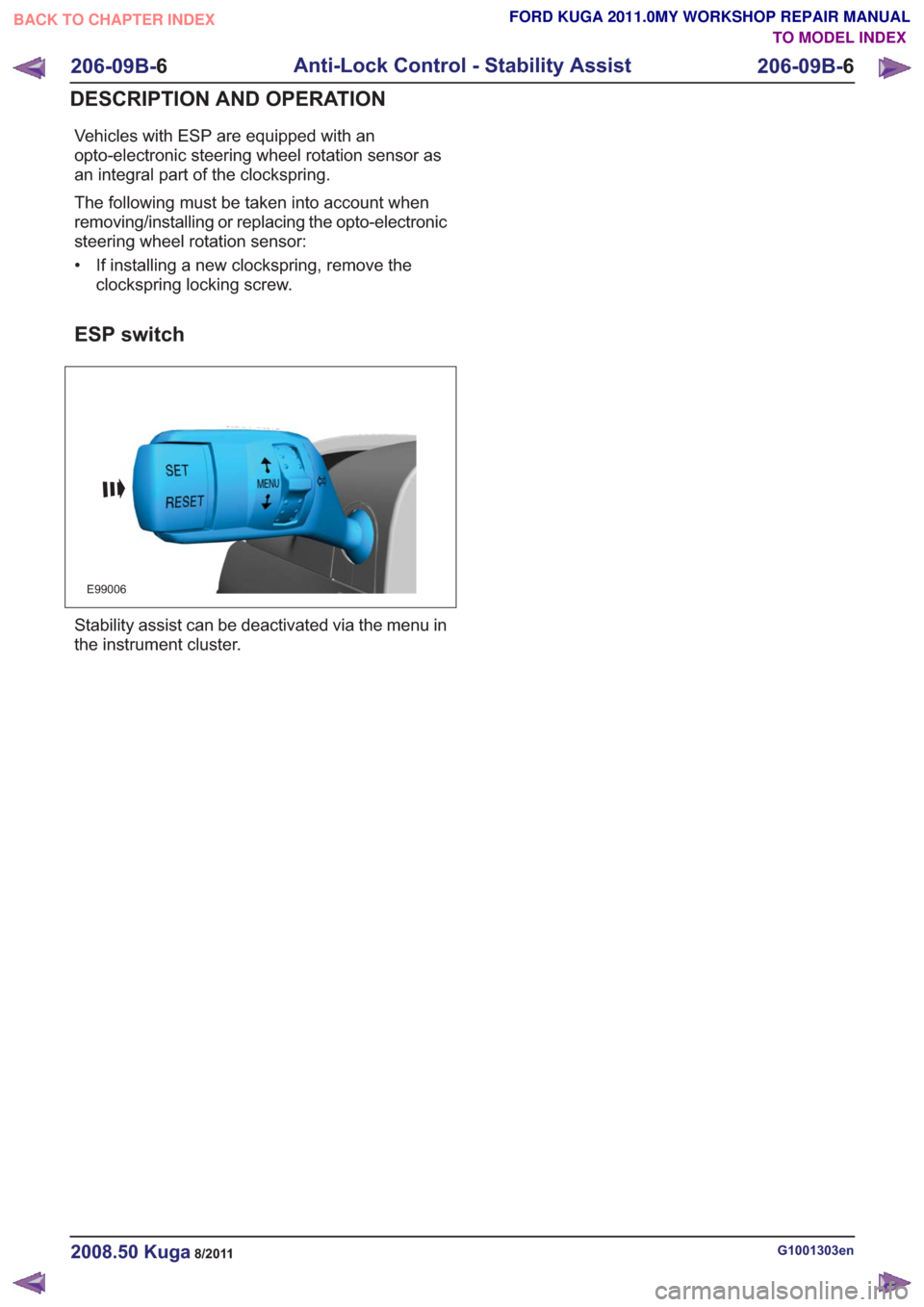
ESP switch
E99006
Stability assist can be deactivated via the menu in
the instrument cluster.
G1001303en2008.50 Kuga8/2011
206-09B- 6
Anti-Lock Control - Stability Assist
206-09B- 6
DESCRIPTION AND OPERATION
TO MODEL INDEX
BACK TO CHAPTER INDEX
FORD KUGA 2011.0MY WORKSHOP REPAIR MANUAL
Page 1428 of 2057
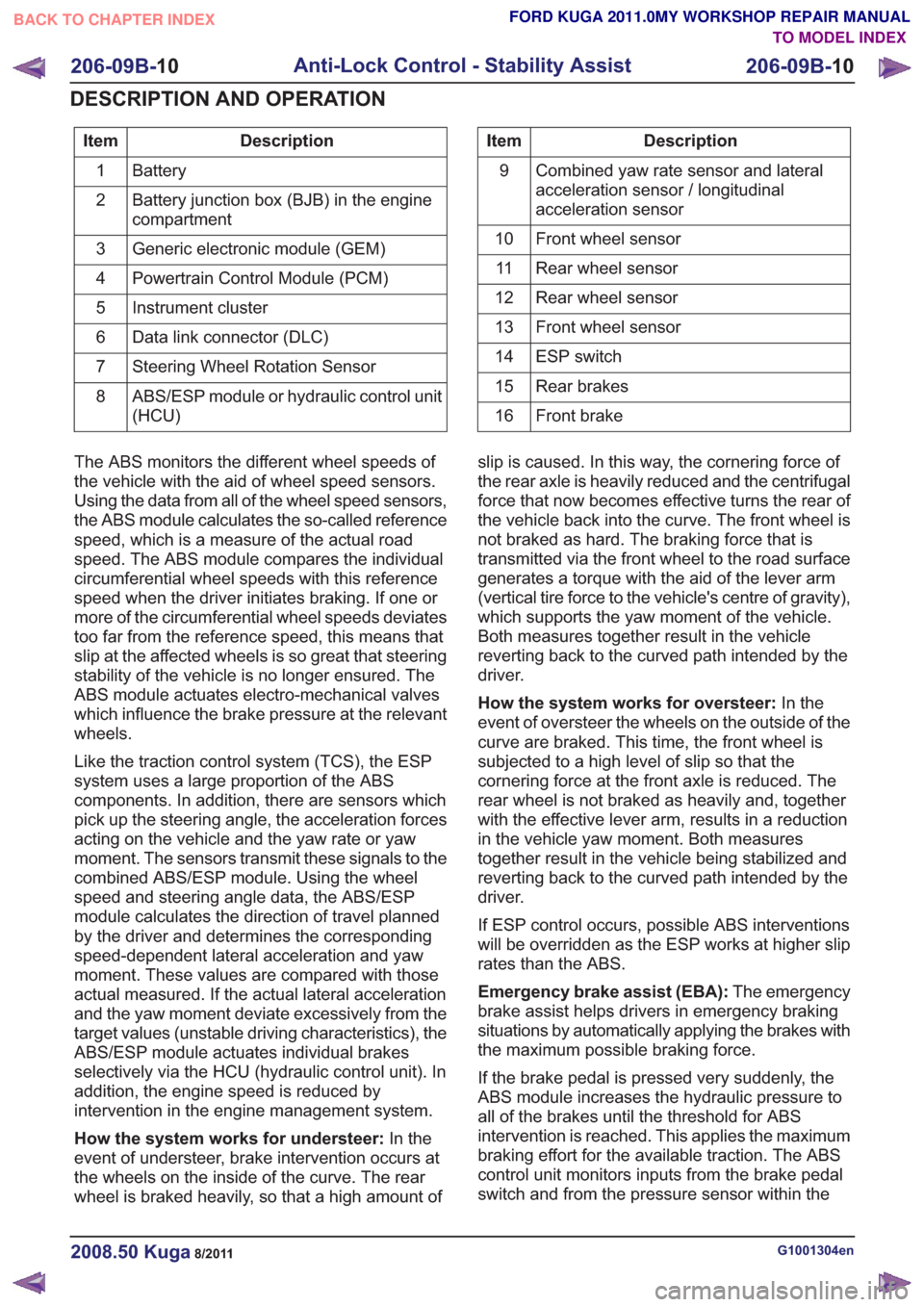
Description
Item
Battery
1
Battery junction box (BJB) in the engine
compartment
2
Generic electronic module (GEM)
3
Powertrain Control Module (PCM)
4
Instrument cluster
5
Data link connector (DLC)
6
Steering Wheel Rotation Sensor
7
ABS/ESP module or hydraulic control unit
(HCU)
8Description
Item
Combined yaw rate sensor and lateral
acceleration sensor / longitudinal
acceleration sensor
9
Front wheel sensor
10
Rear wheel sensor
11
Rear wheel sensor
12
Front wheel sensor
13
ESP switch
14
Rear brakes
15
Front brake
16
The ABS monitors the different wheel speeds of
the vehicle with the aid of wheel speed sensors.
Using the data from all of the wheel speed sensors,
the ABS module calculates the so-called reference
speed, which is a measure of the actual road
speed. The ABS module compares the individual
circumferential wheel speeds with this reference
speed when the driver initiates braking. If one or
more of the circumferential wheel speeds deviates
too far from the reference speed, this means that
slip at the affected wheels is so great that steering
stability of the vehicle is no longer ensured. The
ABS module actuates electro-mechanical valves
which influence the brake pressure at the relevant
wheels.
Like the traction control system (TCS), the ESP
system uses a large proportion of the ABS
components. In addition, there are sensors which
pick up the steering angle, the acceleration forces
acting on the vehicle and the yaw rate or yaw
moment. The sensors transmit these signals to the
combined ABS/ESP module. Using the wheel
speed and steering angle data, the ABS/ESP
module calculates the direction of travel planned
by the driver and determines the corresponding
speed-dependent lateral acceleration and yaw
moment. These values are compared with those
actual measured. If the actual lateral acceleration
and the yaw moment deviate excessively from the
target values (unstable driving characteristics), the
ABS/ESP module actuates individual brakes
selectively via the HCU (hydraulic control unit). In
addition, the engine speed is reduced by
intervention in the engine management system.
How the system works for understeer: In the
event of understeer, brake intervention occurs at
the wheels on the inside of the curve. The rear
wheel is braked heavily, so that a high amount of slip is caused. In this way, the cornering force of
the rear axle is heavily reduced and the centrifugal
force that now becomes effective turns the rear of
the vehicle back into the curve. The front wheel is
not braked as hard. The braking force that is
transmitted via the front wheel to the road surface
generates a torque with the aid of the lever arm
(vertical tire force to the vehicle's centre of gravity),
which supports the yaw moment of the vehicle.
Both measures together result in the vehicle
reverting back to the curved path intended by the
driver.
How the system works for oversteer:
In the
event of oversteer the wheels on the outside of the
curve are braked. This time, the front wheel is
subjected to a high level of slip so that the
cornering force at the front axle is reduced. The
rear wheel is not braked as heavily and, together
with the effective lever arm, results in a reduction
in the vehicle yaw moment. Both measures
together result in the vehicle being stabilized and
reverting back to the curved path intended by the
driver.
If ESP control occurs, possible ABS interventions
will be overridden as the ESP works at higher slip
rates than the ABS.
Emergency brake assist (EBA): The emergency
brake assist helps drivers in emergency braking
situations by automatically applying the brakes with
the maximum possible braking force.
If the brake pedal is pressed very suddenly, the
ABS module increases the hydraulic pressure to
all of the brakes until the threshold for ABS
intervention is reached. This applies the maximum
braking effort for the available traction. The ABS
control unit monitors inputs from the brake pedal
switch and from the pressure sensor within the
G1001304en2008.50 Kuga8/2011
206-09B- 10
Anti-Lock Control - Stability Assist
206-09B- 10
DESCRIPTION AND OPERATION
TO MODEL INDEX
BACK TO CHAPTER INDEX
FORD KUGA 2011.0MY WORKSHOP REPAIR MANUAL
Page 1429 of 2057
HCU to check for sudden actuation of the brakes.
With the brake pedal pressed, the ABS module
triggers emergency braking if the rate of increase
of hydraulic pressure exceeds the predetermined
limit.
If the brake pedal is pressed so hard that the ABS
becomes active on the front wheels then the ABS
control unit increases the pressure to the rear
wheel brakes up to the ABS intervention threshold.
EBA operation continues until the driver releases
the brake pedal sufficiently for the hydraulic
pressure in the HCU to drop below a threshold
value stored in the ABS module.
Trailer stability control:If the vehicle is ordered
with a trailer coupling then the Trailer Stability
Control function is integrated in the ESP. The ESP
detects snaking when driving with a trailer and
reduces the speed of the vehicle and trailer through
adapted braking and, if necessary, by also reducing
the engine output until the snaking movement of
the trailer is corrected.
Roll-over protection: The ESP dynamically
determines the tipping tendency of the vehicle and
works in conjunction with the EBA system to
prevent the vehicle from tipping over during
dynamic maneuvers like lane changing or while
negotiating bends.
Emergency brake light: The emergency brake
light automatically switches on the hazard flasher
system to warn drivers of other vehicles that
emergency braking is being initiated. Based on a
defined delay value, the ABS/ESP module sends
a signal to the generic electronic module (GEM)
via the CAN data bus. The GEM activates the
hazard flasher system, that then flashes 7 times.
Prerequisites for activation of the emergency brake
light are:
• The speed is higher than 50 km/h.
• The brake pedal is being actuated.
• The deceleration is greater than 9 m/s².
To prevent activation on snow or ice, for example,
the following prerequisites must be met:
• The speed is higher than 50 km/h.
• The brake pedal is being actuated.
• ABS regulation takes place.
• The deceleration is greater than 6 m/s².
Tire pressure monitoring system: The tire
pressure monitoring system used in the Kuga is
able to detect loss of air in a tire at an early stage
and warn the driver. Because it can only compare
the behaviour of the tyres with each other, it is not possible to draw conclusions about the absolute
tyre pressure. It is also not possible to monitor the
spare tyre pressure. In order for the system to
operate correctly, the tyre pressures must be
regularly checked and corrected and the system
subsequently initialised (see below).
The tire pressure monitoring system used here,
depending on the equipment level, is built into the
anti-lock braking system (ABS) as an extra function
and therefore does not have its own sensors.
The ABS module measures the loss of pressure
in the tyres by calculation using the wheel speed
sensors of the ABS system. If a tyre loses
pressure, its diameter decreases and the speed of
the wheel therefore increases. If the ABS module
detects such a loss in pressure, it sends a signal
to the instrument cluster via the CAN bus and a
warning message is displayed in the message
centre. The warning threshold depends among
other things on the dimension of the tyres being
used, the vehicle operating conditions and the
status at the last initialisation. Since neither the
absolute tyre pressure nor the position of the tyre
is known, the pressure of all the tyres must be
checked and the system re-initialised after a tyre
pressure warning. If necessary, the cause of the
loss of pressure must be investigated.
Regular tyre pressure checks are still necessary.
The system must be initialised after a tyre is
changed, winter or summer tyres fitted, the
pressures corrected or adjusted to suit the vehicle
load. This can be done by the driver using the
driver information system. For further information,
see: Owner’s Manual.
Component Description
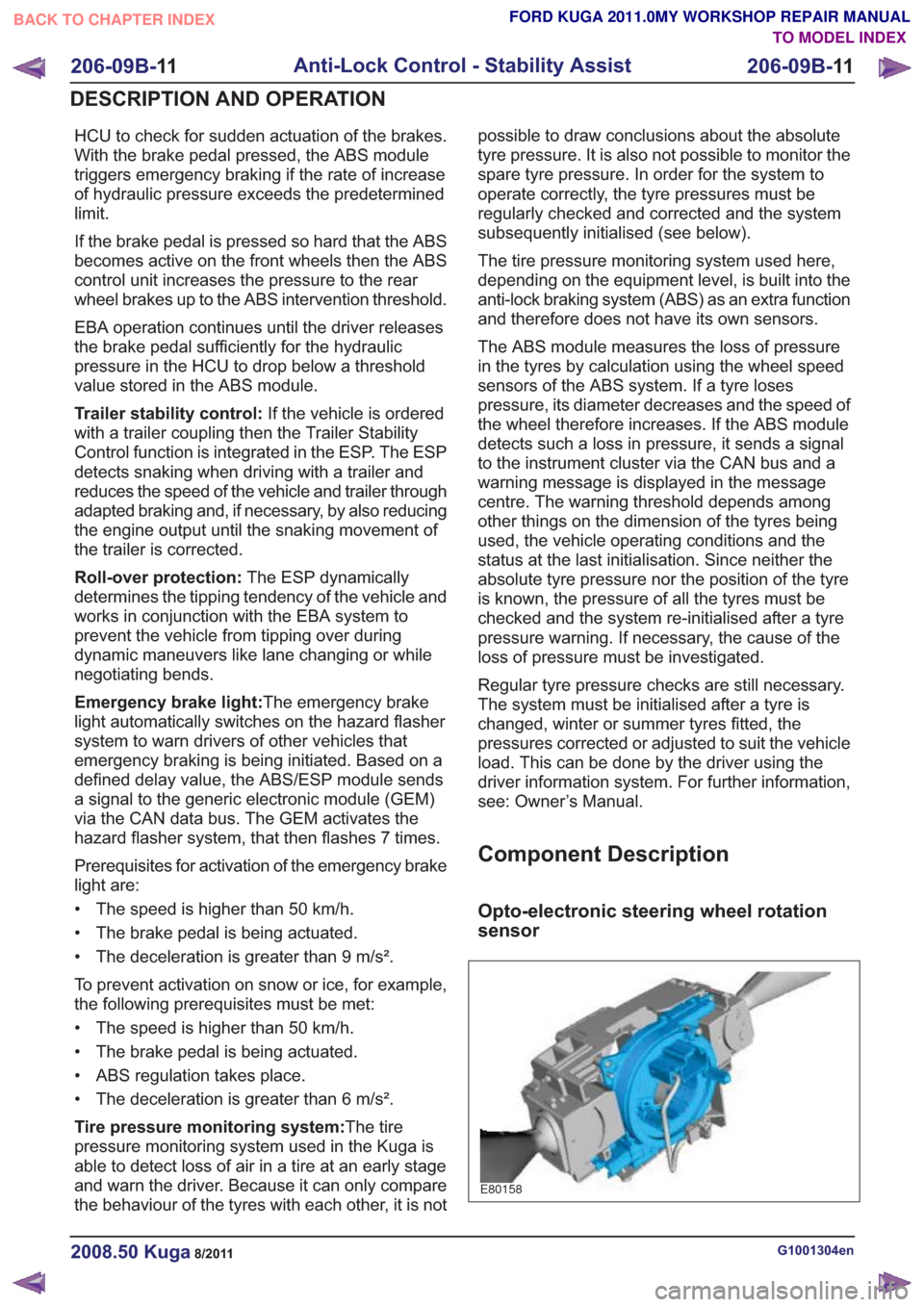
Opto-electronic steering wheel rotation
sensor
E80158
G1001304en2008.50 Kuga8/2011
206-09B-
11
Anti-Lock Control - Stability Assist
206-09B- 11
DESCRIPTION AND OPERATION
TO MODEL INDEX
BACK TO CHAPTER INDEX
FORD KUGA 2011.0MY WORKSHOP REPAIR MANUAL
Page 1431 of 2057
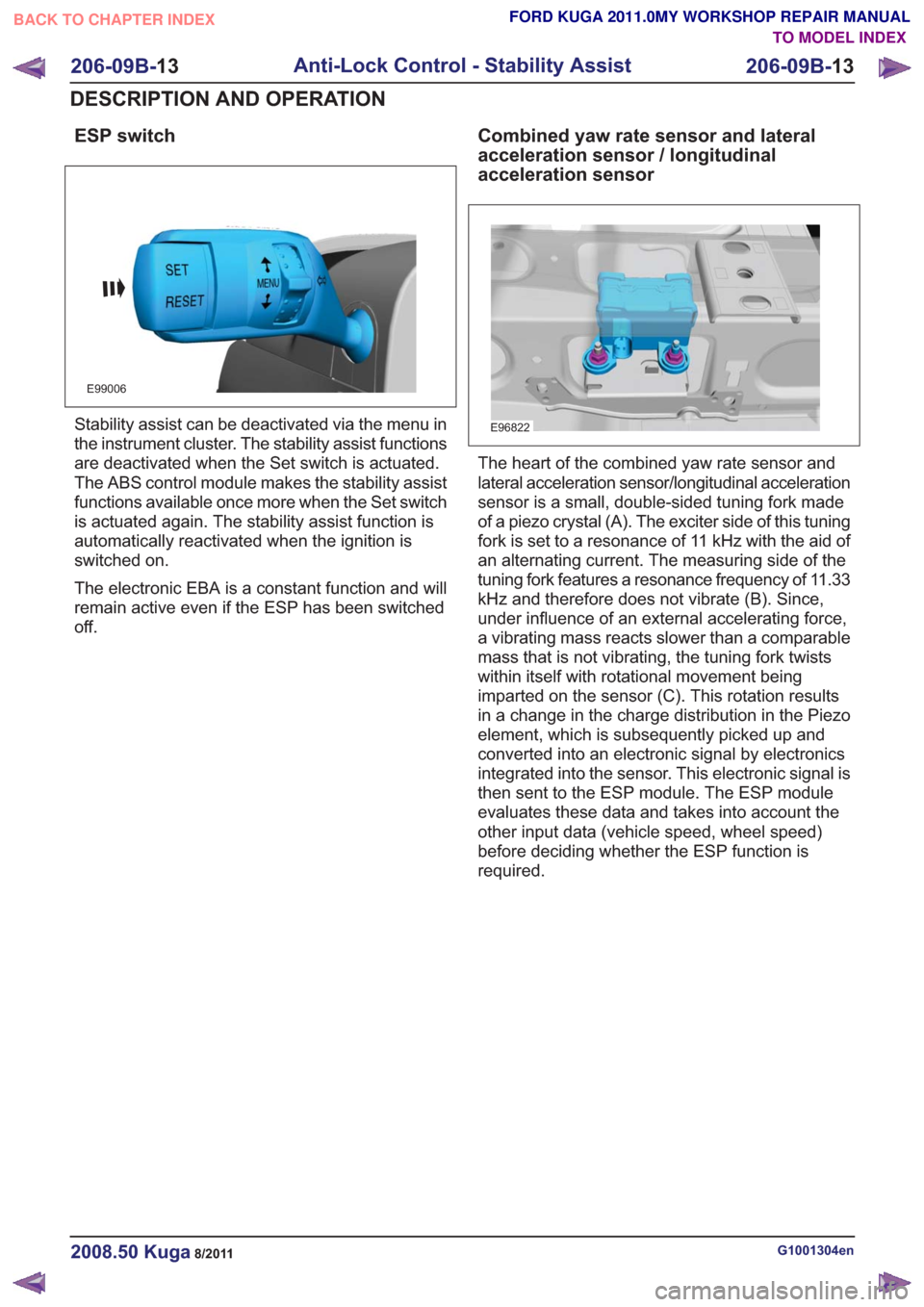
ESP switch
E99006
Stability assist can be deactivated via the menu in
the instrument cluster. The stability assist functions
are deactivated when the Set switch is actuated.
The ABS control module makes the stability assist
functions available once more when the Set switch
is actuated again. The stability assist function is
automatically reactivated when the ignition is
switched on.
The electronic EBA is a constant function and will
remain active even if the ESP has been switched
off.
Combined yaw rate sensor and lateral
acceleration sensor / longitudinal
acceleration sensor
E96822
The heart of the combined yaw rate sensor and
lateral acceleration sensor/longitudinal acceleration
sensor is a small, double-sided tuning fork made
of a piezo crystal (A). The exciter side of this tuning
fork is set to a resonance of 11 kHz with the aid of
an alternating current. The measuring side of the
tuning fork features a resonance frequency of 11.33
kHz and therefore does not vibrate (B). Since,
under influence of an external accelerating force,
a vibrating mass reacts slower than a comparable
mass that is not vibrating, the tuning fork twists
within itself with rotational movement being
imparted on the sensor (C). This rotation results
in a change in the charge distribution in the Piezo
element, which is subsequently picked up and
converted into an electronic signal by electronics
integrated into the sensor. This electronic signal is
then sent to the ESP module. The ESP module
evaluates these data and takes into account the
other input data (vehicle speed, wheel speed)
before deciding whether the ESP function is
required.
G1001304en2008.50 Kuga8/2011
206-09B-13
Anti-Lock Control - Stability Assist
206-09B- 13
DESCRIPTION AND OPERATION
TO MODEL INDEX
BACK TO CHAPTER INDEX
FORD KUGA 2011.0MY WORKSHOP REPAIR MANUAL
Page 1512 of 2057
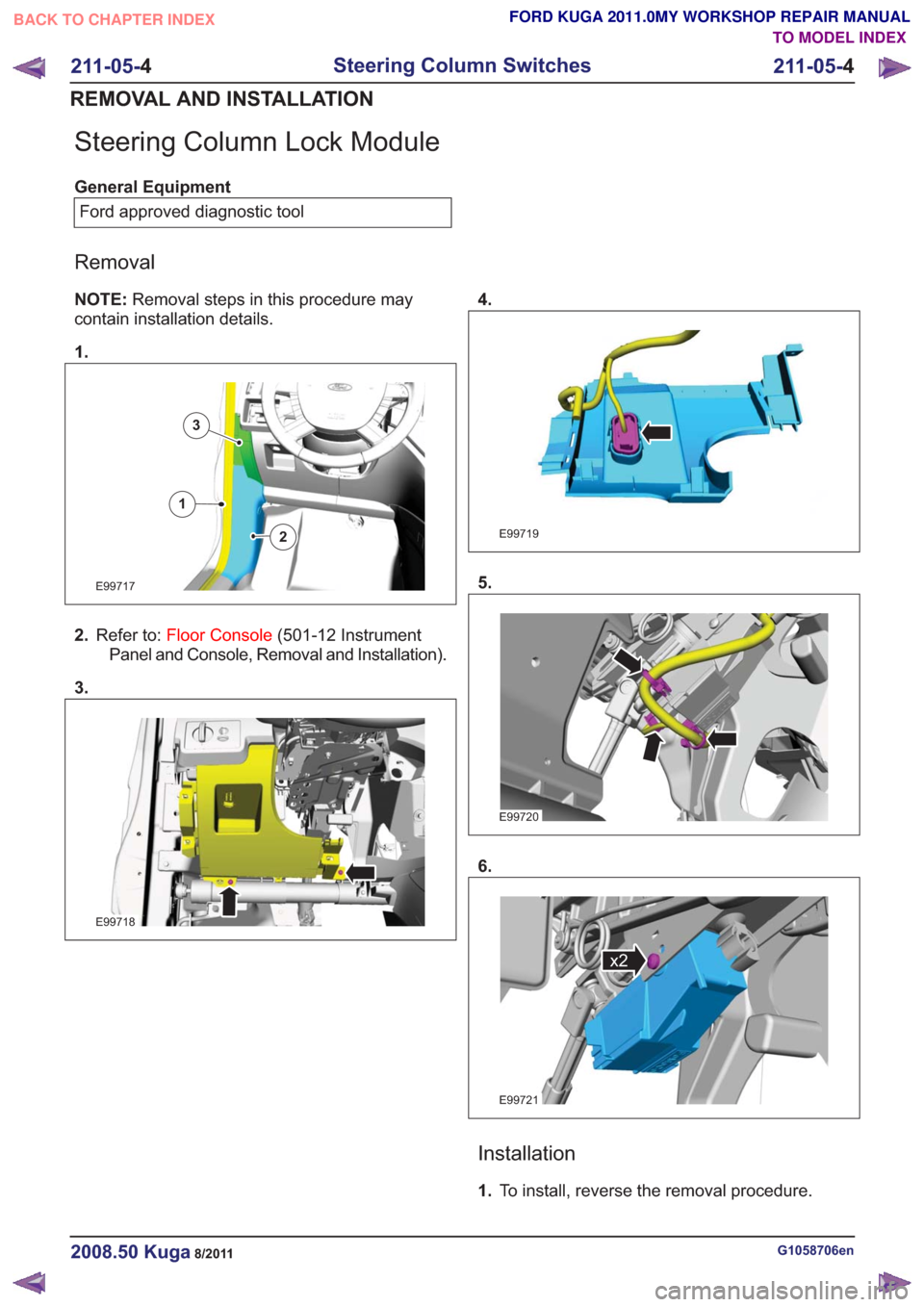
Steering Column Lock Module
General EquipmentFord approved diagnostic tool
Removal
NOTE: Removal steps in this procedure may
contain installation details.
1.
E99717
1
2
3
2. Refer to: Floor Console (501-12 Instrument
Panel and Console, Removal and Installation).
3.
E99718
4.
E99719
5.
E99720
6.
E99721
x2
Installation
1. To install, reverse the removal procedure.
G1058706en2008.50 Kuga8/2011
211-05- 4
Steering Column Switches
211-05- 4
REMOVAL AND INSTALLATION
TO MODEL INDEX
BACK TO CHAPTER INDEX
FORD KUGA 2011.0MY WORKSHOP REPAIR MANUAL
Page 1834 of 2057
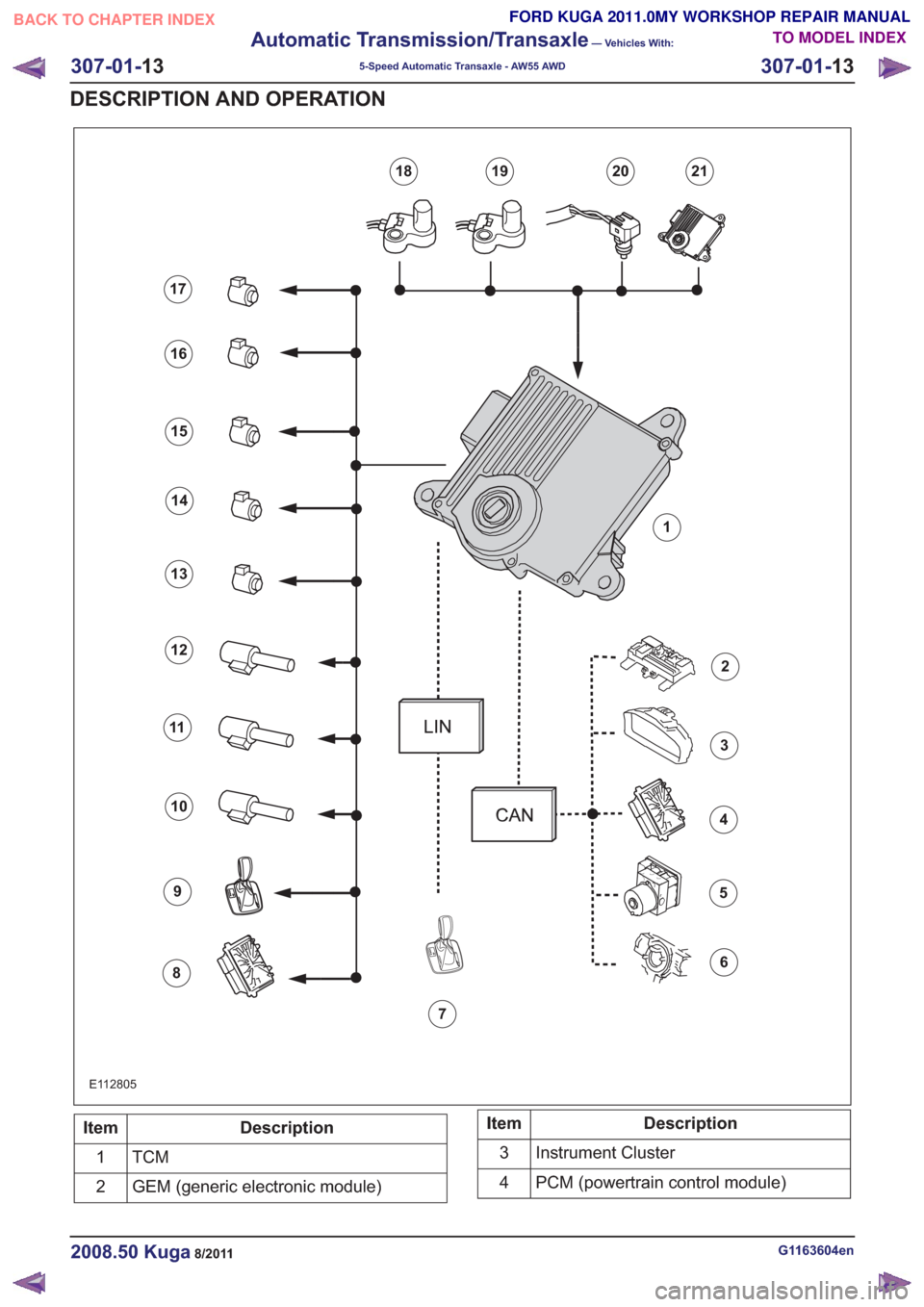
E112805
59
13
2
6
10
14
3
7
11
15
4
8
12
16
17
19202118
1
Description
Item
TCM1
GEM (generic electronic module)
2Description
Item
Instrument Cluster
3
PCM (powertrain control module)
4
G1163604en2008.50 Kuga8/2011
307-01- 13
Automatic Transmission/Transaxle
— Vehicles With:
5-Speed Automatic Transaxle - AW55 AWD
307-01- 13
DESCRIPTION AND OPERATION
TO MODEL INDEX
BACK TO CHAPTER INDEX
FORD KUGA 2011.0MY WORKSHOP REPAIR MANUAL
Page 1843 of 2057
transmission range or gear (in select-shift mode)
is indicated to the driver in the instrument panel.
In selector lever position "S", the driver can
manually select the gears (select-shift mode). Up
(+) and down (-) shifts are made by moving the
selector lever in the appropriate direction.
Hydraulic limp home modes maintain limited
operation in the event of failure of important
electrical components.Under normal conditions, the transmission fluid is
filled for the service life of the transaxle and does
not need to be changed.
A dipstick is used to check the fluid level in the
transmission.
Functionality overview
G1163605en2008.50 Kuga8/2011
307-01-
22
Automatic Transmission/Transaxle
— Vehicles With:
5-Speed Automatic Transaxle - AW55 AWD
307-01- 22
DESCRIPTION AND OPERATION
TO MODEL INDEX
BACK TO CHAPTER INDEX
FORD KUGA 2011.0MY WORKSHOP REPAIR MANUAL