roof FORD KUGA 2011 1.G Workshop Manual
[x] Cancel search | Manufacturer: FORD, Model Year: 2011, Model line: KUGA, Model: FORD KUGA 2011 1.GPages: 2057
Page 74 of 2057
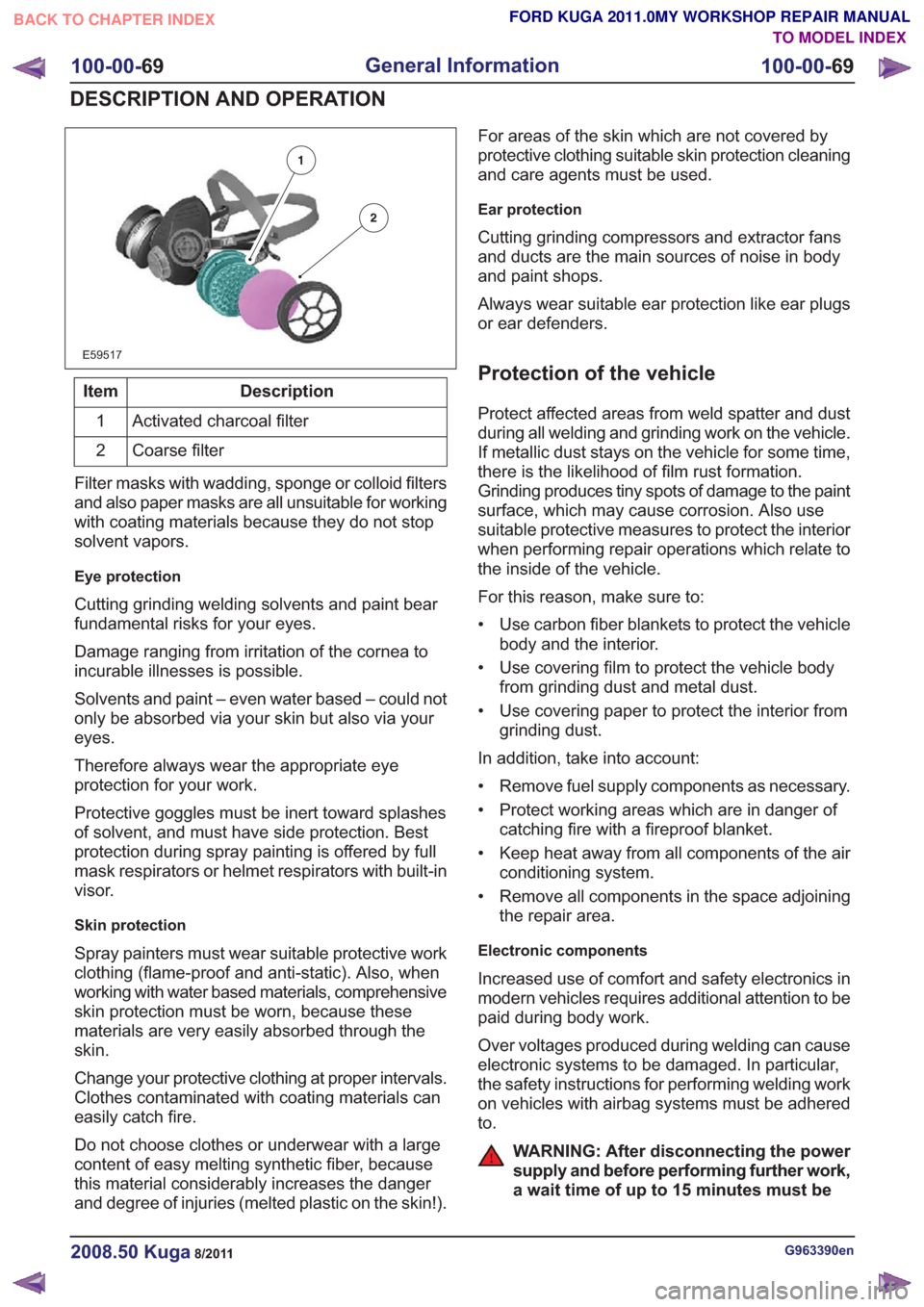
E59517
Description
Item
Activated charcoal filter
1
Coarse filter
2
Filter masks with wadding, sponge or colloid filters
and also paper masks are all unsuitable for working
with coating materials because they do not stop
solvent vapors.
Eye protection
Cutting grinding welding solvents and paint bear
fundamental risks for your eyes.
Damage ranging from irritation of the cornea to
incurable illnesses is possible.
Solvents and paint – even water based – could not
only be absorbed via your skin but also via your
eyes.
Therefore always wear the appropriate eye
protection for your work.
Protective goggles must be inert toward splashes
of solvent, and must have side protection. Best
protection during spray painting is offered by full
mask respirators or helmet respirators with built-in
visor.
Skin protection
Spray painters must wear suitable protective work
clothing (flame-proof and anti-static). Also, when
working with water based materials, comprehensive
skin protection must be worn, because these
materials are very easily absorbed through the
skin.
Change your protective clothing at proper intervals.
Clothes contaminated with coating materials can
easily catch fire.
Do not choose clothes or underwear with a large
content of easy melting synthetic fiber, because
this material considerably increases the danger
and degree of injuries (melted plastic on the skin!). For areas of the skin which are not covered by
protective clothing suitable skin protection cleaning
and care agents must be used.
Ear protection
Cutting grinding compressors and extractor fans
and ducts are the main sources of noise in body
and paint shops.
Always wear suitable ear protection like ear plugs
or ear defenders.
Protection of the vehicle
Protect affected areas from weld spatter and dust
during all welding and grinding work on the vehicle.
If metallic dust stays on the vehicle for some time,
there is the likelihood of film rust formation.
Grinding produces tiny spots of damage to the paint
surface, which may cause corrosion. Also use
suitable protective measures to protect the interior
when performing repair operations which relate to
the inside of the vehicle.
For this reason, make sure to:
• Use carbon fiber blankets to protect the vehicle
body and the interior.
• Use covering film to protect the vehicle body from grinding dust and metal dust.
• Use covering paper to protect the interior from grinding dust.
In addition, take into account:
• Remove fuel supply components as necessary.
• Protect working areas which are in danger of catching fire with a fireproof blanket.
• Keep heat away from all components of the air conditioning system.
• Remove all components in the space adjoining the repair area.
Electronic components
Increased use of comfort and safety electronics in
modern vehicles requires additional attention to be
paid during body work.
Over voltages produced during welding can cause
electronic systems to be damaged. In particular,
the safety instructions for performing welding work
on vehicles with airbag systems must be adhered
to.
WARNING: After disconnecting the power
supply and before performing further work,
a wait time of up to 15 minutes must be
G963390en2008.50 Kuga8/2011
100-00- 69
General Information
100-00- 69
DESCRIPTION AND OPERATION
TO MODEL INDEX
BACK TO CHAPTER INDEX
FORD KUGA 2011.0MY WORKSHOP REPAIR MANUAL
Page 81 of 2057
Noise, Vibration and Harshness (NVH)
Inspection and Verification
1. Verify the customer concern.
2. Visually inspect for obvious signs of mechanicalor electrical damage.
3. If an obvious cause for an observed or reported concern is found, correct the cause (if possible)
before proceeding to the next step.
4. If the concern is not visually evident, verify the symptom and REFER to the Symptom Chart.
How to Use this Diagnostic Procedure
Section
• Noise, vibration and harshness (NVH) concernshave become more important as vehicles have
become more sensitive to these vibrations. This
section is designed to aid in identifying these
concerns.
• The section provides diagnostic procedures based on symptom. If the condition occurs at
high speed, for instance, the most likely place
to start is under Shake and Vibration While
Driving.
• The road test procedure will tell how to sort the conditions into categories and how to tell a
vibration from a shake.
• A series of Road Test Quick Checks are provided to make sure that a cause is either
pinpointed or eliminated.
• Name the condition, proceed to the appropriate section and locate the correct diagnosis. When
the condition is identified, the job is partly done.
• Follow the diagnostic procedure as outlined.
• Quick Checks are described within the step, while more involved tests and adjustments are
outlined in General Procedures.
• Always follow each step exactly and make notes to recall important findings later.
Customer Interview
The road test and customer interview (if available)
provide information that will help identify the
concern and will provide direction to the correct
starting point for diagnosis.
Identify the Condition
NVH usually occur in four areas:
• tires
• engine accessories
• suspension
• driveline
It is important, therefore, that an NVH concern be
isolated into its specific area(s) as soon as
possible. The easiest and quickest way to do this
is to carry out the Road Test as outlined. To assist
in the diagnosis and testing procedure(s), use a
suitable approved NVH diagnosis tester.
Noise Diagnostic Procedure
Non-Axle Noise
The five most common sources of non-axle noise
are exhaust, tires, roof racks, trim panels and
transmission.
Therefore, make sure that none of the following
conditions are the cause of the noise before
proceeding with a driveline teardown and
diagnosis.
• In certain conditions, the pitch of the exhaustmay sound very much like gear noise. At other
times, it can be mistaken for a wheel bearing
rumble.
• Tires, especially snow tires, can have a high pitched tread whine or roar, similar to gear
noise. Radial tires may have this characteristic.
Also, any non-standard tire with an unusual
tread construction may emit a roar or whine
noise.
• Trim panels can also cause whistling or whining noise.
• Clunk may be a metallic noise heard when the automatic transaxle is engaged in "R"
(REVERSE) or "D" (DRIVE) or it may occur
when the throttle is applied or released. It is
caused by backlash somewhere in the driveline.
• Bearing rumble sounds like marbles being tumbled. This condition is usually caused by a
damaged wheel bearing.
G37349en2008.50 Kuga8/2011
100-04- 2
Noise, Vibration and Harshness
100-04- 2
DIAGNOSIS AND TESTING
TO MODEL INDEX
BACK TO CHAPTER INDEX
FORD KUGA 2011.0MY WORKSHOP REPAIR MANUAL
Page 297 of 2057

SECTION 415-01 Information and Entertainment
System
VEHICLE APPLICATION:
2008.50 Kuga
PAGE
CONTENTS
DESCRIPTION AND OPERATION
415-01-2
Audio System (Component Location).................................................................................
415-01-3
Audio System (Overview)...................................................................................................
415-01-3
Keycode entry - vehicle with standard audio system.........................................................
415-01-3
Vehicle Identification Number (VID) - entry - vehicle with standard audio system.............
415-01-3
Self-check routine - vehicles with standard audio system..................................................
415-01-3
Keycode entry - vehicles with upgraded audio system......................................................
415-01-5
Audio System (System Operation and Component Description)........................................
415-01-5
System Diagram.................................................................................................................
415-01-8
System Operation...............................................................................................................
415-01-8
In-car entertainment........................................................................................................
415-01-8
Component Description......................................................................................................
415-01-8
Vehicles with standard audio system..............................................................................
415-01-9
Vehicles with upgraded audio system.............................................................................
415-01-9
DAB radio........................................................................................................................
415-01-9
AUX port.........................................................................................................................
415-01-9
Radio remote control......................................................................................................415-01-10Antenna systems............................................................................................................
415-01-11
Cellular Phone (Component Location)...............................................................................
415-01-12
Cellular Phone (Overview)..................................................................................................
415-01-12
Software update - control module for mobile electronic auxiliary equipment (variant 1)....
415-01-12
Software update - control module for mobile electronic auxiliary equipment (variants 2
and 3)................................................................................................................................ 415-01-13
Cellular Phone (System Operation and Component Description)......................................
415-01-13
System Diagram.................................................................................................................
415-01-17
System Operation...............................................................................................................
415-01-17
Overview .........................................................................................................................
415-01-17
Voice Control...................................................................................................................
415-01-18
Component Description......................................................................................................
415-01-18Control module for mobile electronic auxiliary equipment..............................................
415-01-19Radio remote control......................................................................................................
415-01-19USB port/AUX socket.....................................................................................................
REMOVAL AND INSTALLATION 415-01-20
Audio Unit...........................................................................................................................
415-01-21
Audio Unit Antenna — Vehicles With: Glass Roof Panel...................................................
415-01-22
Audio Unit Antenna — Vehicles Without: Glass Roof Panel..............................................
415-01-23
Audio Unit Antenna to Connector Cable — Vehicles With: Glass Roof Panel...................
415-01-30
Audio Unit Antenna to Connector Cable — Vehicles Without: Glass Roof Panel..............
415-01-32
Connector to Audio Unit Antenna Cable.............................................................................
415-01-35
Compact Disc (CD) Changer..............................................................................................
415-01-37
(33 635 0)
Portable Support Electronics (PSE) Module..................................................
415-01-38
Cellular Phone Microphone................................................................................................ 415-01-1
Information and Entertainment System
415-01-1
.
TO MODEL INDEX
BACK TO CHAPTER INDEX
FORD KUGA 2011.0MY WORKSHOP REPAIR MANUAL
Page 306 of 2057
• Volume adjustment
– To increase the volume, press the top rearbutton on the remote control.
– To lower the volume: Press the bottom rear button on the remote control.
• Search – During radio operation, the station search isstarted upwards or downwards within the
frequency band.
– During CD operation, this skips to the next or previous track.
• Mode –During radio operation, the next saved station
is called up (if pressed briefly).
– During radio operation, to switch wave range
(if pressed and held).
– During CD operation, provided a CD changer
is installed, the next CD is played.
Antenna systems
The antenna systems fitted to the vehicle comprise:
• AM/FM roof antennal
• AM/FM/GPS roof antenna
• Roof antenna for digital radio system (vehicles with DAB radio) G1055647en
2008.50 Kuga 8/2011 415-01-10
Information and Entertainment System
415-01-10
DESCRIPTION AND OPERATIONTO MODEL INDEX
BACK TO CHAPTER INDEX
FORD KUGA 2011.0MY WORKSHOP REPAIR MANUAL
Page 317 of 2057
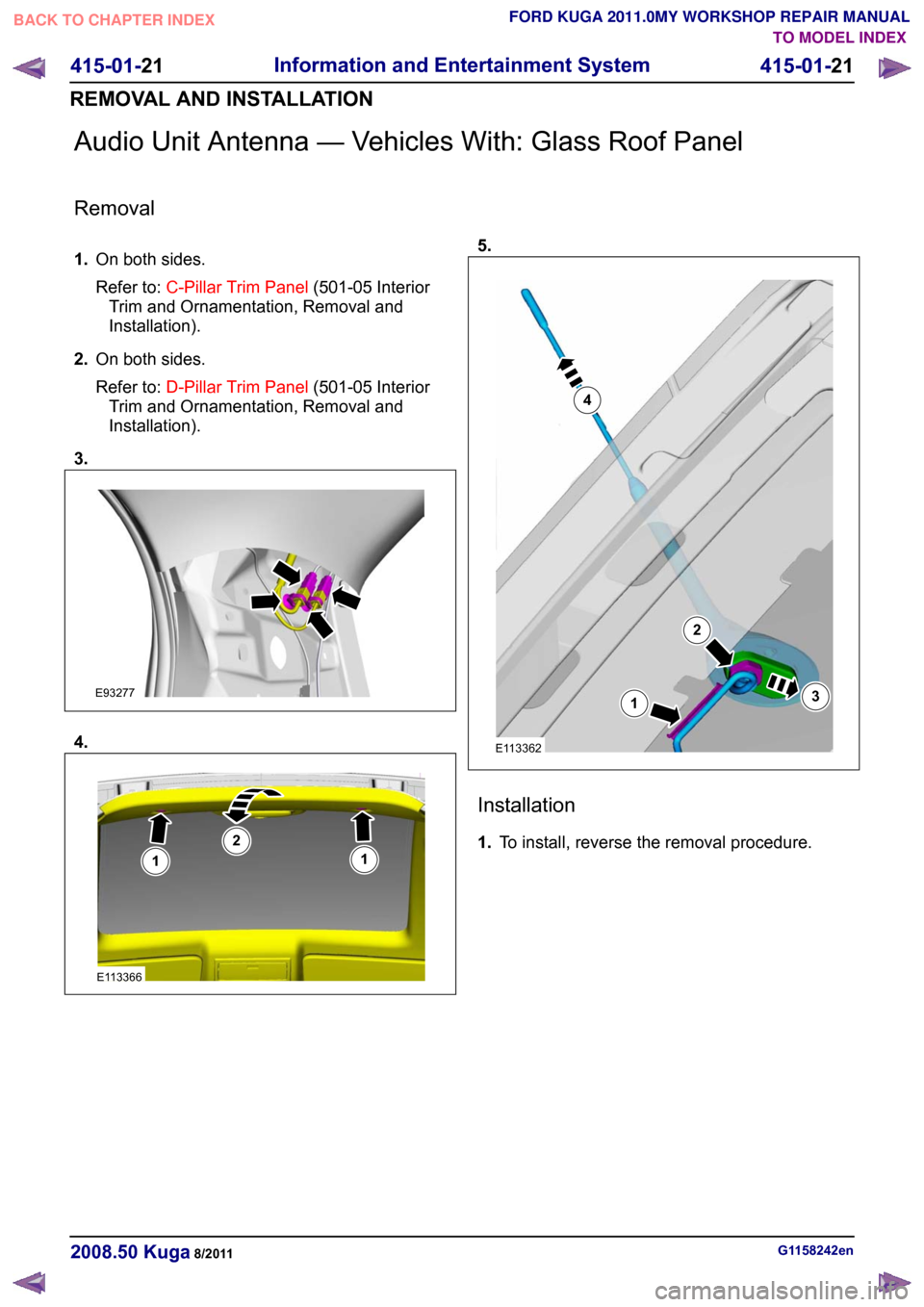
Audio Unit Antenna — Vehicles With: Glass Roof Panel
Removal
1.
On both sides.
Refer to: C-Pillar Trim Panel (501-05 Interior
Trim and Ornamentation, Removal and
Installation).
2. On both sides.
Refer to: D-Pillar Trim Panel (501-05 Interior
Trim and Ornamentation, Removal and
Installation).
3. 4. 5.
Installation
1.
To install, reverse the removal procedure. G1158242en
2008.50 Kuga 8/2011 415-01-21
Information and Entertainment System
415-01-21
REMOVAL AND INSTALLATIONTO MODEL INDEX
BACK TO CHAPTER INDEX
FORD KUGA 2011.0MY WORKSHOP REPAIR MANUALE93277 E113366112 E1133621234
Page 318 of 2057
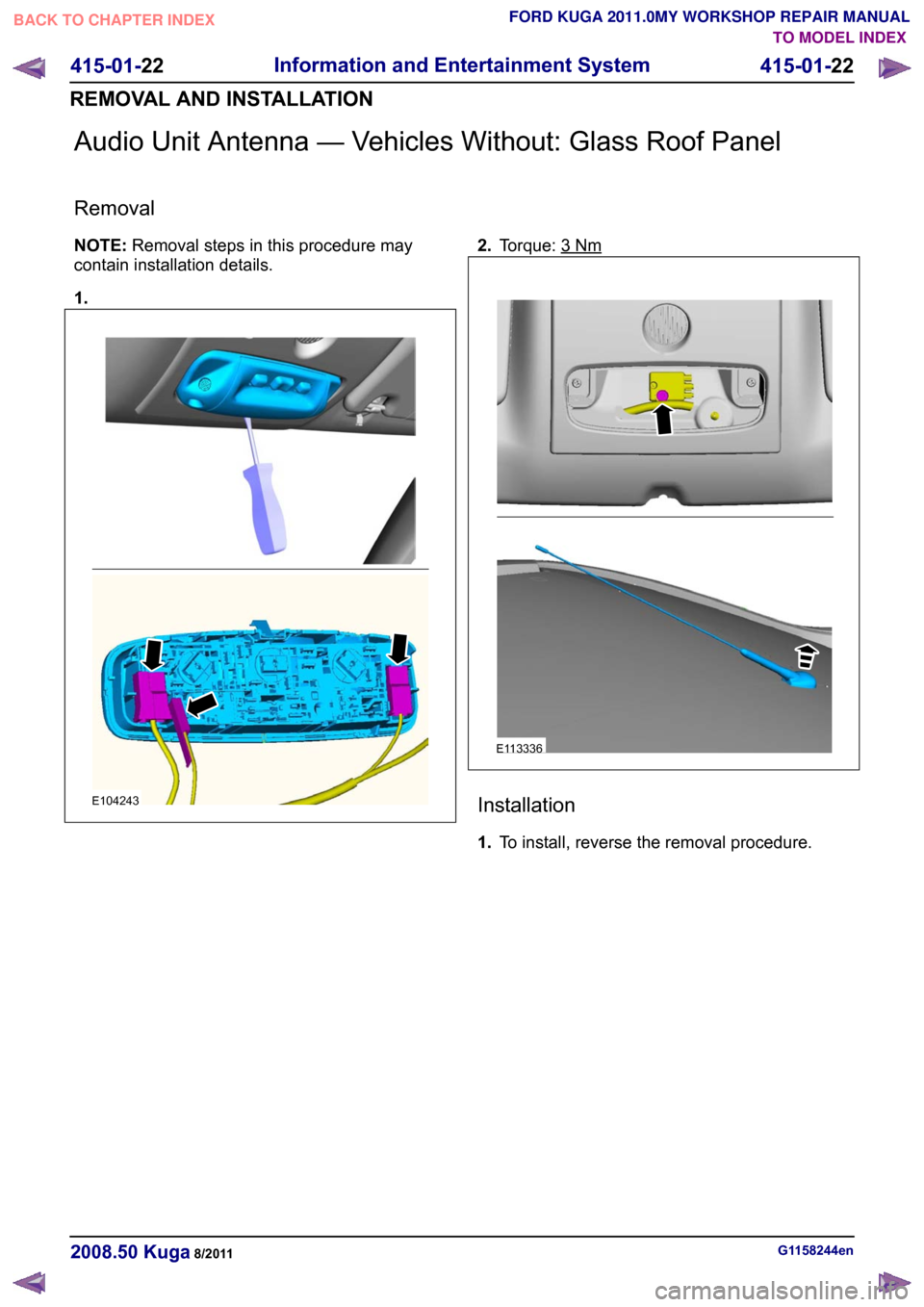
Audio Unit Antenna — Vehicles Without: Glass Roof Panel
Removal
NOTE:
Removal steps in this procedure may
contain installation details.
1. 2.
Torque: 3 Nm
Installation
1.
To install, reverse the removal procedure. G1158244en
2008.50 Kuga 8/2011 415-01-22
Information and Entertainment System
415-01-22
REMOVAL AND INSTALLATIONTO MODEL INDEX
BACK TO CHAPTER INDEX
FORD KUGA 2011.0MY WORKSHOP REPAIR MANUALE104243 E113336
Page 319 of 2057
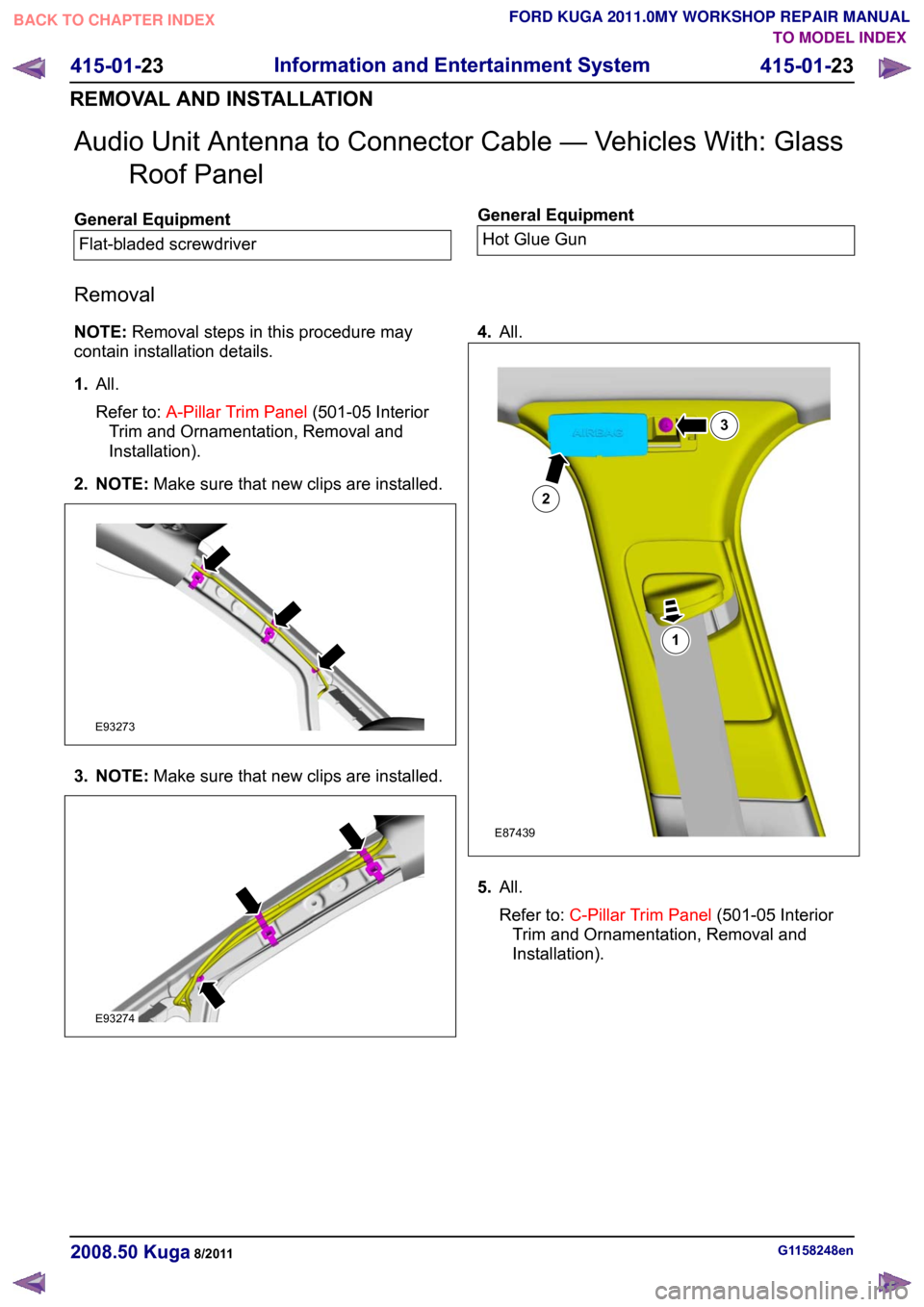
Audio Unit Antenna to Connector Cable — Vehicles With: Glass
Roof Panel General Equipment
Flat-bladed screwdriver General Equipment
Hot Glue Gun
Removal
NOTE: Removal steps in this procedure may
contain installation details.
1. All.
Refer to: A-Pillar Trim Panel (501-05 Interior
Trim and Ornamentation, Removal and
Installation).
2. NOTE: Make sure that new clips are installed.3. NOTE:
Make sure that new clips are installed. 4.
All. 5.
All.
Refer to: C-Pillar Trim Panel (501-05 Interior
Trim and Ornamentation, Removal and
Installation). G1158248en
2008.50 Kuga 8/2011 415-01-23
Information and Entertainment System
415-01-23
REMOVAL AND INSTALLATIONTO MODEL INDEX
BACK TO CHAPTER INDEX
FORD KUGA 2011.0MY WORKSHOP REPAIR MANUALE93273 E93274 123E87439
Page 326 of 2057
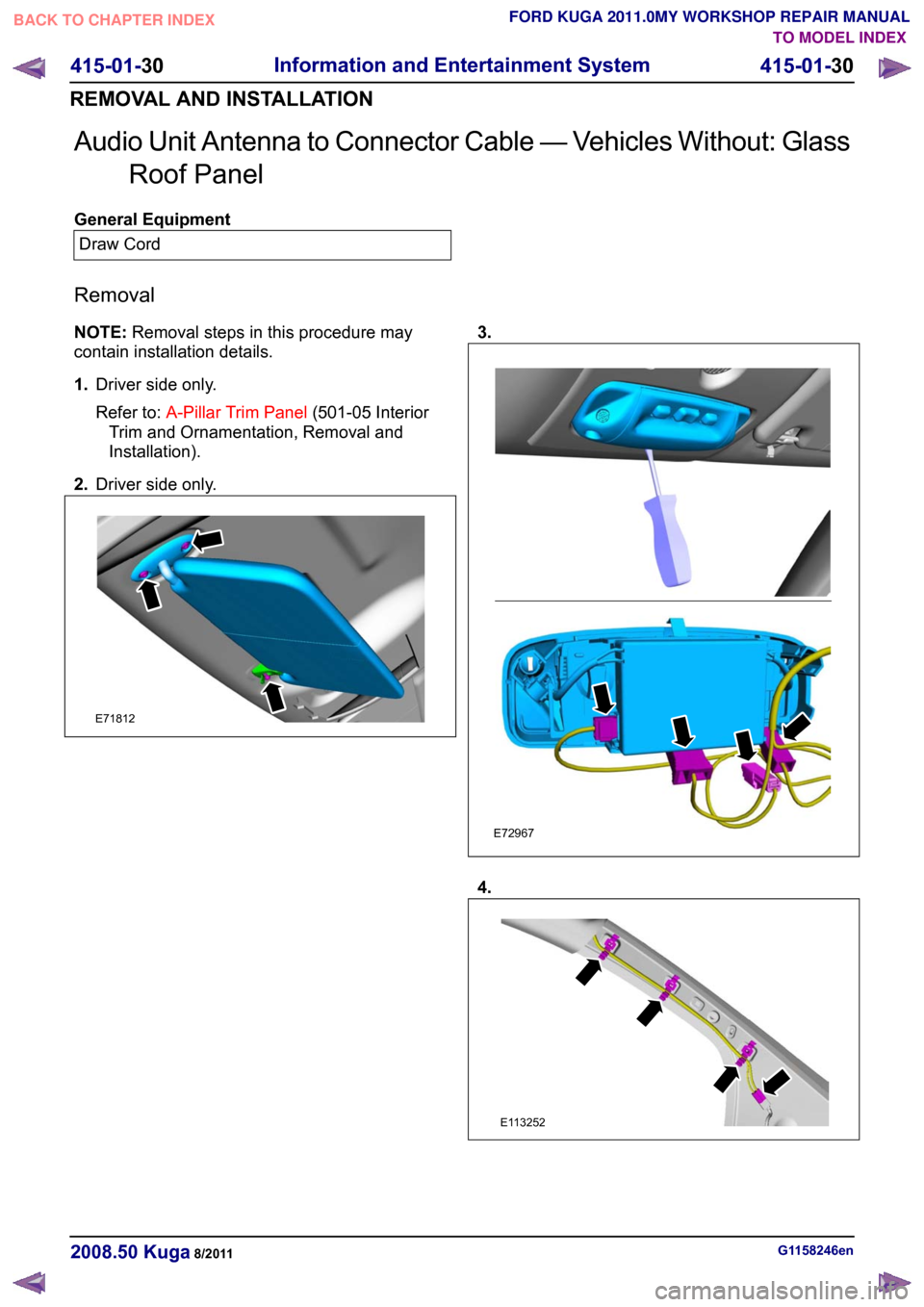
Audio Unit Antenna to Connector Cable — Vehicles Without: Glass
Roof Panel General Equipment
Draw Cord
Removal
NOTE: Removal steps in this procedure may
contain installation details.
1. Driver side only.
Refer to: A-Pillar Trim Panel (501-05 Interior
Trim and Ornamentation, Removal and
Installation).
2. Driver side only. 3.
4.
G1158246en
2008.50 Kuga 8/2011 415-01-30
Information and Entertainment System
415-01-30
REMOVAL AND INSTALLATIONTO MODEL INDEX
BACK TO CHAPTER INDEX
FORD KUGA 2011.0MY WORKSHOP REPAIR MANUALE71812 E72967 E113252
Page 342 of 2057
On some models, the door entry lamps are installed
in the external mirrors.
The door entry lamps should illuminate the ground
in the immediate vicinity of the front doors; they
are equipped with white bulbs, which are installed
in the underside of the mirror.
The door entry illumination is switched on when
one of the doors or the tailgate are opened, or if
an unlocking command is detected and the
following conditions are satisfied:
• Vehicle Ignition is off.
• Reverse gear is not engaged.
• The vehicle speed is below 7 km/h.
The door entry illumination is switched off if one of
the following conditions is satisfied:
• The ignition is selected on.
• Reverse gear is engaged.
• The vehicle speed exceeds 7 km/h.
• More than 25 seconds have elapsed since the
tailgate was closed or a central locking
command was determined.
• The time set for the battery protection function for the interior lighting has elapsed.
• More than 5 seconds have elapsed since the doors and the tailgate were closed.
• More than 5 seconds have elapsed since a central locking command was received and the
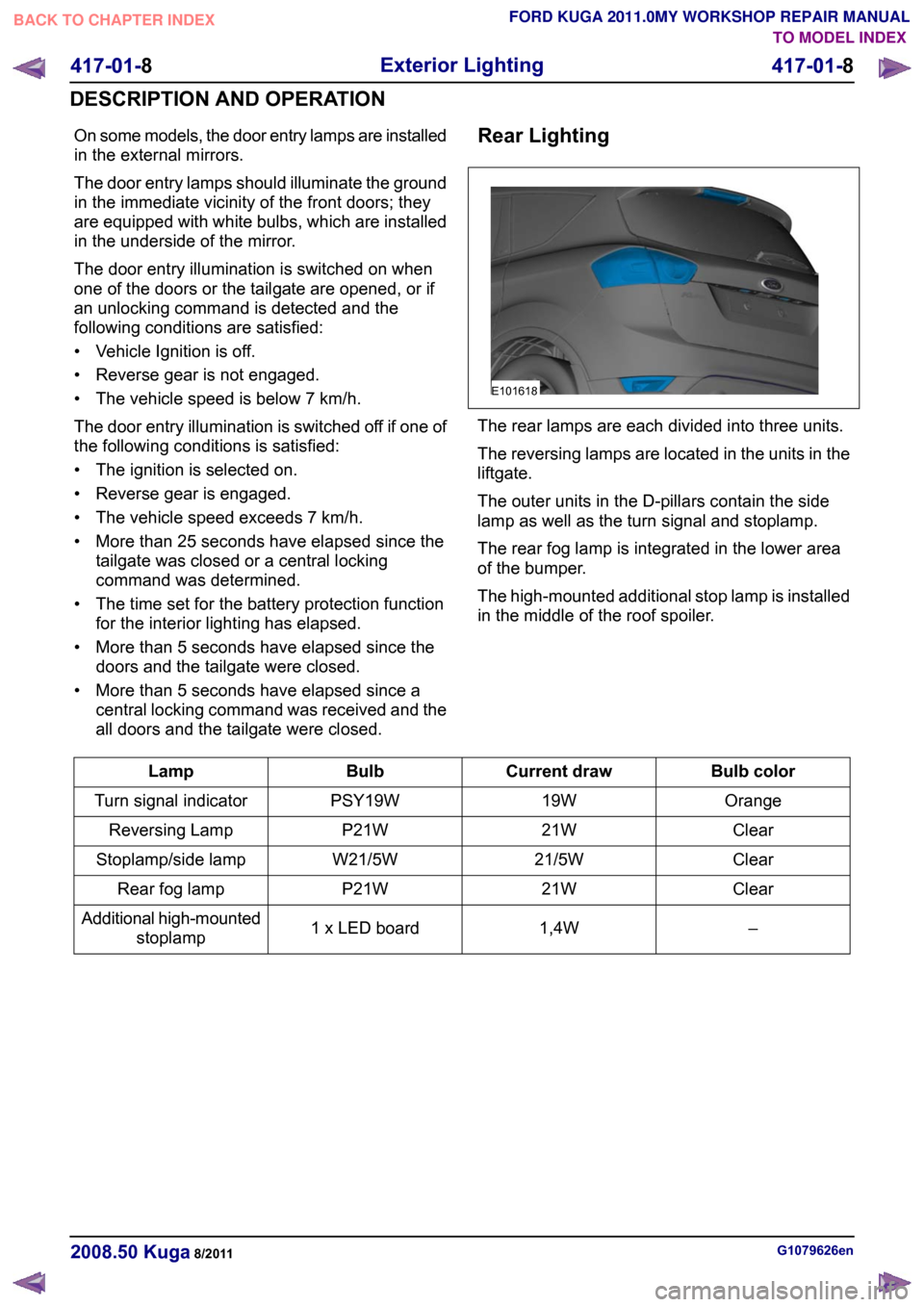
all doors and the tailgate were closed. Rear Lighting The rear lamps are each divided into three units.
The reversing lamps are located in the units in the
liftgate.
The outer units in the D-pillars contain the side
lamp as well as the turn signal and stoplamp.
The rear fog lamp is integrated in the lower area
of the bumper.
The high-mounted additional stop lamp is installed
in the middle of the roof spoiler.
Bulb color
Current draw
Bulb
Lamp
Orange
19W
PSY19W
Turn signal indicator
Clear
21W
P21W
Reversing Lamp
Clear
21/5W
W21/5W
Stoplamp/side lamp
Clear
21W
P21W
Rear fog lamp
–
1,4W
1 x LED board
Additional high-mounted
stoplamp G1079626en
2008.50 Kuga 8/2011 417-01-8
Exterior Lighting
417-01-8
DESCRIPTION AND OPERATIONTO MODEL INDEX
BACK TO CHAPTER INDEX
FORD KUGA 2011.0MY WORKSHOP REPAIR MANUALE101618
Page 384 of 2057
must use the same language. This language is
called a protocol.
At present, Ford uses three different data bus
systems. Depending upon model and equipment
level, all three data bus systems are used. Each
of these data bus systems has its own protocol.
Data bus systems
ISO 9141 bus
The International Organisation for Standardisation
ISO 9141 bus. This consists of a single wire and
is used exclusively for communication between the
modules and the Ford diagnostic unit. The fault
memories of the various modules are read out via
the ISO 9141 bus.
Local Interconnect Network (LIN) bus
The LIN bus is a standard specifically designed for
cost-effective communication between intelligent
sensors and actuators in vehicles. The LIN control
unit subnet is used in every situation where the
bandwidth and versatility of CAN is not needed.
The LIN specification comprises the LIN protocol,
a standard format for describing a complete LIN
and the interface between an LIN and the
application. An LIN comprises a LIN master and
one or more LIN slaves. The LIN utilizes the
master/slave principle for the purpose of bus
access control. This has the significant advantage
that few resources (CPU performance, ROM, RAM)
are required for bus management in the slave
module. The master is implemented in a control
module or a gateway which has the necessary
resources. All communication is initiated by the
master. Consequently, a message always consists
of a header, which is generated by the master, and
a response from the slave. The data transfer rate
is in the region of up to 20 Kbit/s. The LIN master
knows the time sequence of all data which are to
be transmitted. These data are transmitted by the
corresponding LIN slaves (e.g. ultrasonic sensors)
if they are requested to do so by the LIN master.
LIN is a single-wire bus, i.e. the data are
transmitted in the cable via one wire. Usually the
same cable is also used to provide the supply
voltage. The ground connection of the supply
voltage also acts as the ground connection of the
data transmission. An LIN does not use a
terminating resistor.
Controller Area Network (CAN) bus
This consists of two twisted wires and operates
serially (data is transmitted sequentially). It is used
for communication between the modules
themselves and between the modules and the Ford
diagnostic unit. The modules are connected to the
data bus in parallel. New modules can be
incorporated easily, without modifying the other
wiring or modules. The transmitted data is received
by every module connected to the control unit
network (CAN). As each data packet has an
identifier (label), in which the priority of the
message is determined as well as the content
identification, each module can detect whether or
not the data is relevant for its own information
processing. This enables several modules to be
addressed with a particular data packet and
supplied with data simultaneously. For this
purpose, it is ensured that important data (for
example from the ABS) is transmitted first. The
other modules are only able to submit their data to
the data bus after the high-priority messages have
been received.
The advantages of the CAN bus are:
• Minimization of wiring requirements
•
High degree of error protection (fault / fail-proof)
• Robustness
• Good extendibility
• Prioritization of messages
• Inexpensive
• Automatic repetition of faulty messages
• Independent system monitoring and the ability to disconnect faulty modules from the data bus
automatically
Due to the increased number of modules and the
resulting continued increase in data transfer, two
different CAN bus systems are used. Essentially,
they only differ in terms of their data transmission
rates and application areas.
To be able to distinguish between the individual
CAN bus systems, the CAN bus system with the
high transfer speed is called the high speed CAN
bus (HS-CAN). The data are transmitted at a baud
rate of 500 kB/s.
The CAN bus system with the medium transfer
speed is called the medium speed CAN bus
(MS-CAN) and is mainly used for communication
in the comfort electronics or the multimedia system.
The data are transmitted at a baud rate of 125 kB/s.
An interface (gateway) is used to exchange data
between the HS-CAN and the MS-CAN. This
provides the connection between the three CAN
databus systems and is installed in the GEM and
in the electronic instrument cluster. The number of
modules which are connected to the three databus G1030779en
2008.50 Kuga 8/2011 418-00-7
Module Communications Network
418-00-7
DESCRIPTION AND OPERATIONTO MODEL INDEX
BACK TO CHAPTER INDEX
FORD KUGA 2011.0MY WORKSHOP REPAIR MANUAL