automatic transmission FORD MONDEO 2006 2.G User Guide
[x] Cancel search | Manufacturer: FORD, Model Year: 2006, Model line: MONDEO, Model: FORD MONDEO 2006 2.GPages: 198, PDF Size: 4.69 MB
Page 116 of 198
Downloaded from www.Manualslib.com manuals search engine Depress the overdrive button againto reactivate. When the engine isswitched on, the overdrive functionis automatically selected.
If the indicator flashes a problem hasbeen detected in the automatictransmission. Have your vehiclechecked by an expert as soon aspossible.
Driving with an automatictransmission
Moving off
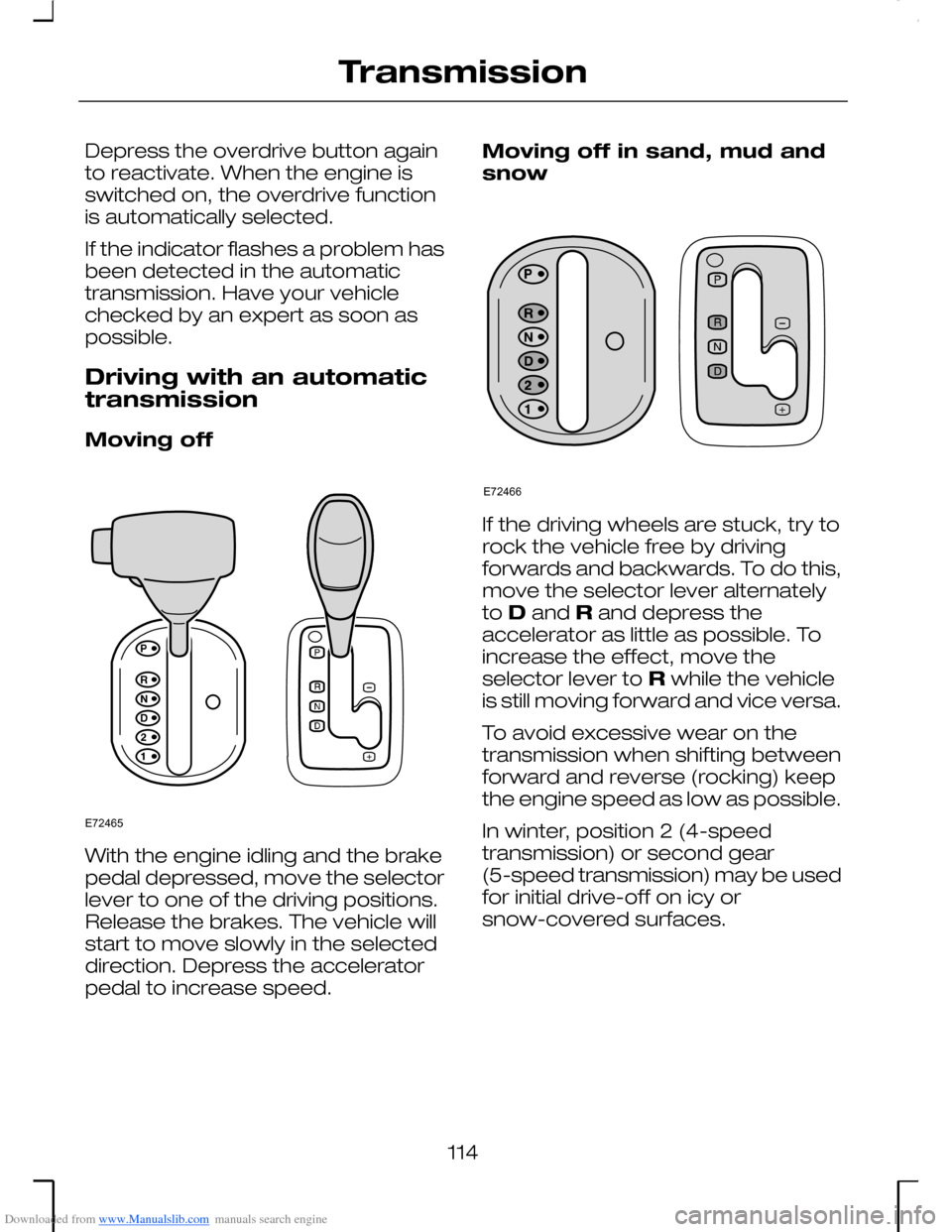
With the engine idling and the brakepedal depressed, move the selectorlever to one of the driving positions.Release the brakes. The vehicle willstart to move slowly in the selecteddirection. Depress the acceleratorpedal to increase speed.
Moving off in sand, mud andsnow
If the driving wheels are stuck, try torock the vehicle free by drivingforwards and backwards. To do this,move the selector lever alternatelyto D and R and depress theaccelerator as little as possible. Toincrease the effect, move theselector lever to R while the vehicleis still moving forward and vice versa.
To avoid excessive wear on thetransmission when shifting betweenforward and reverse (rocking) keepthe engine speed as low as possible.
In winter, position 2 (4-speedtransmission) or second gear(5-speed transmission) may be usedfor initial drive-off on icy orsnow-covered surfaces.
114
TransmissionE72465 E72466
Page 117 of 198
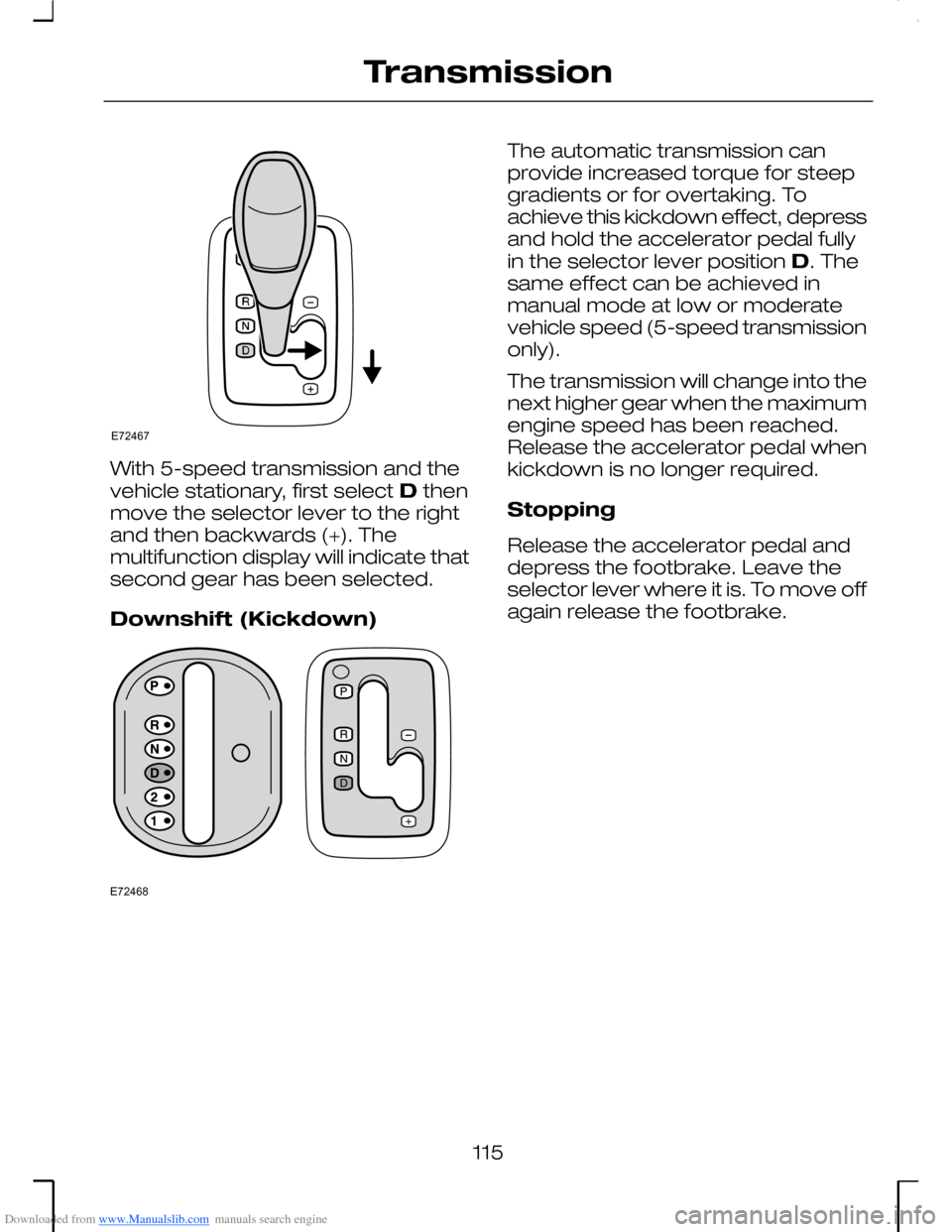
Downloaded from www.Manualslib.com manuals search engine With 5-speed transmission and thevehicle stationary, first select D thenmove the selector lever to the rightand then backwards (+). Themultifunction display will indicate thatsecond gear has been selected.
Downshift (Kickdown)
The automatic transmission canprovide increased torque for steepgradients or for overtaking. Toachieve this kickdown effect, depressand hold the accelerator pedal fullyin the selector lever position D. Thesame effect can be achieved inmanual mode at low or moderatevehicle speed (5-speed transmissiononly).
The transmission will change into thenext higher gear when the maximumengine speed has been reached.Release the accelerator pedal whenkickdown is no longer required.
Stopping
Release the accelerator pedal anddepress the footbrake. Leave theselector lever where it is. To move offagain release the footbrake.
115
TransmissionE72467 E72468
Page 121 of 198
Downloaded from www.Manualslib.com manuals search engine The ABS operates only when thewheels are about to lock. Itsoperation is indicated by a pulsing ofthe brake pedal and full steeringcontrol is retained. Do not releasethe pedal whilst braking.
PARKING BRAKE
All vehicles
WARNING
Vehicles with an automatictransmission should always beleft with the selector lever in positionP.
•Press the foot brake pedal firmly.
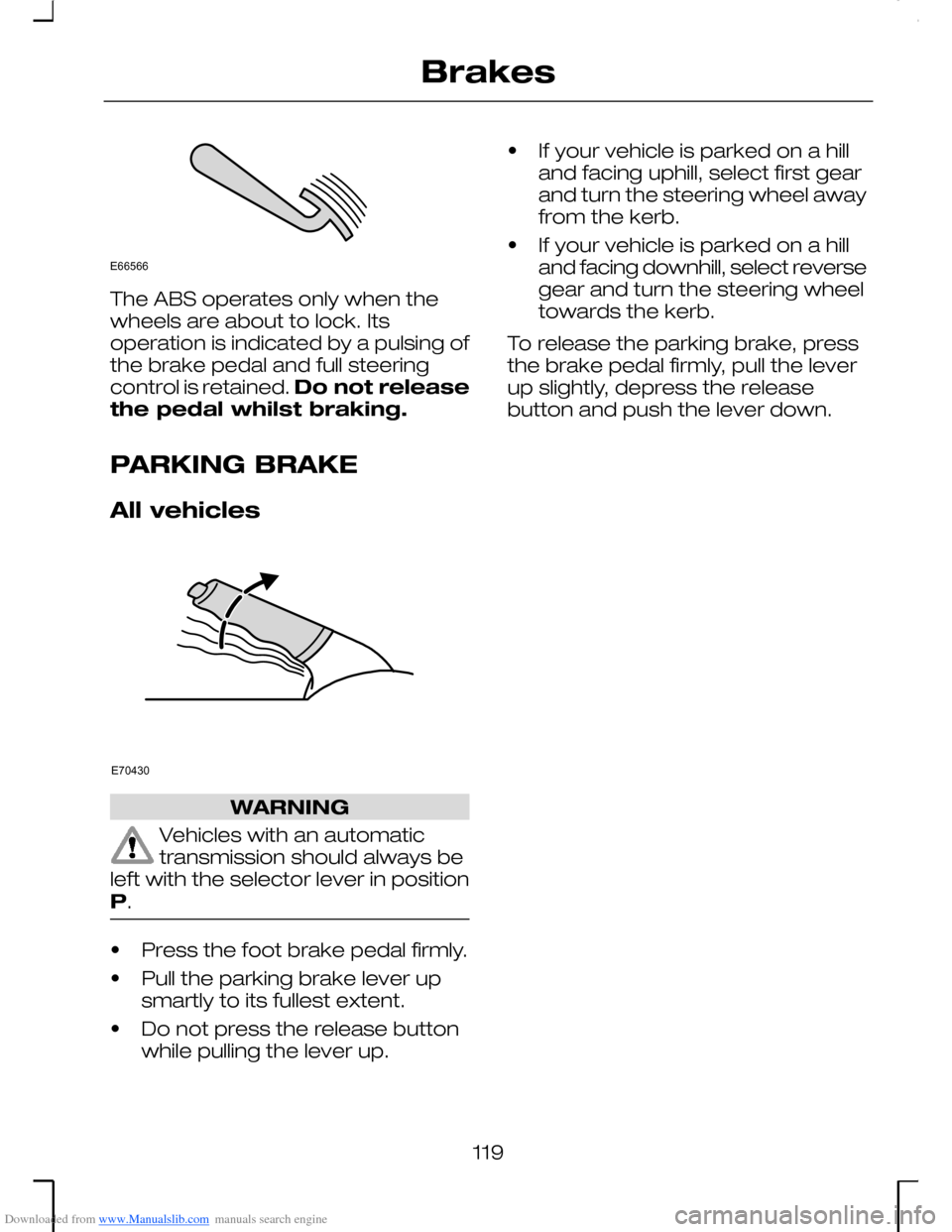
•Pull the parking brake lever upsmartly to its fullest extent.
•Do not press the release buttonwhile pulling the lever up.
•If your vehicle is parked on a hilland facing uphill, select first gearand turn the steering wheel awayfrom the kerb.
•If your vehicle is parked on a hilland facing downhill, select reversegear and turn the steering wheeltowards the kerb.
To release the parking brake, pressthe brake pedal firmly, pull the leverup slightly, depress the releasebutton and push the lever down.
119
BrakesE66566 E70430
Page 131 of 198
Downloaded from www.Manualslib.com manuals search engine TOWING A TRAILER
Note: Mondeo ST vehicles are notapproved for trailer towing.
The maximum vehicle and trailerpayloads represent technicallybinding values for gradients up to 12% and at an altitude of 1 000 metresabove sea level. In high altituderegions, thinner atmosphere canreduce engine performance so thefollowing restrictions will apply:
Above 1 000 metres, the stipulatedmaximum permitted gross trainweight must be reduced by 10 % forevery 1 000 metres in altitude.
Steep gradients
WARNING
The overrun brake on a trailer isnot controlled by the anti-lockbraking system.
Change down in plenty of timebefore downhill gradients.
For vehicles with an automatictransmission, if downhill modeprovides insufficient braking thenselect manual mode and second orfirst gear as necessary.
ESSENTIAL TOWING
CHECKS
WARNING
If any of the following conditionscannot be met, do not use thetow bar and have it inspected by anexpert.
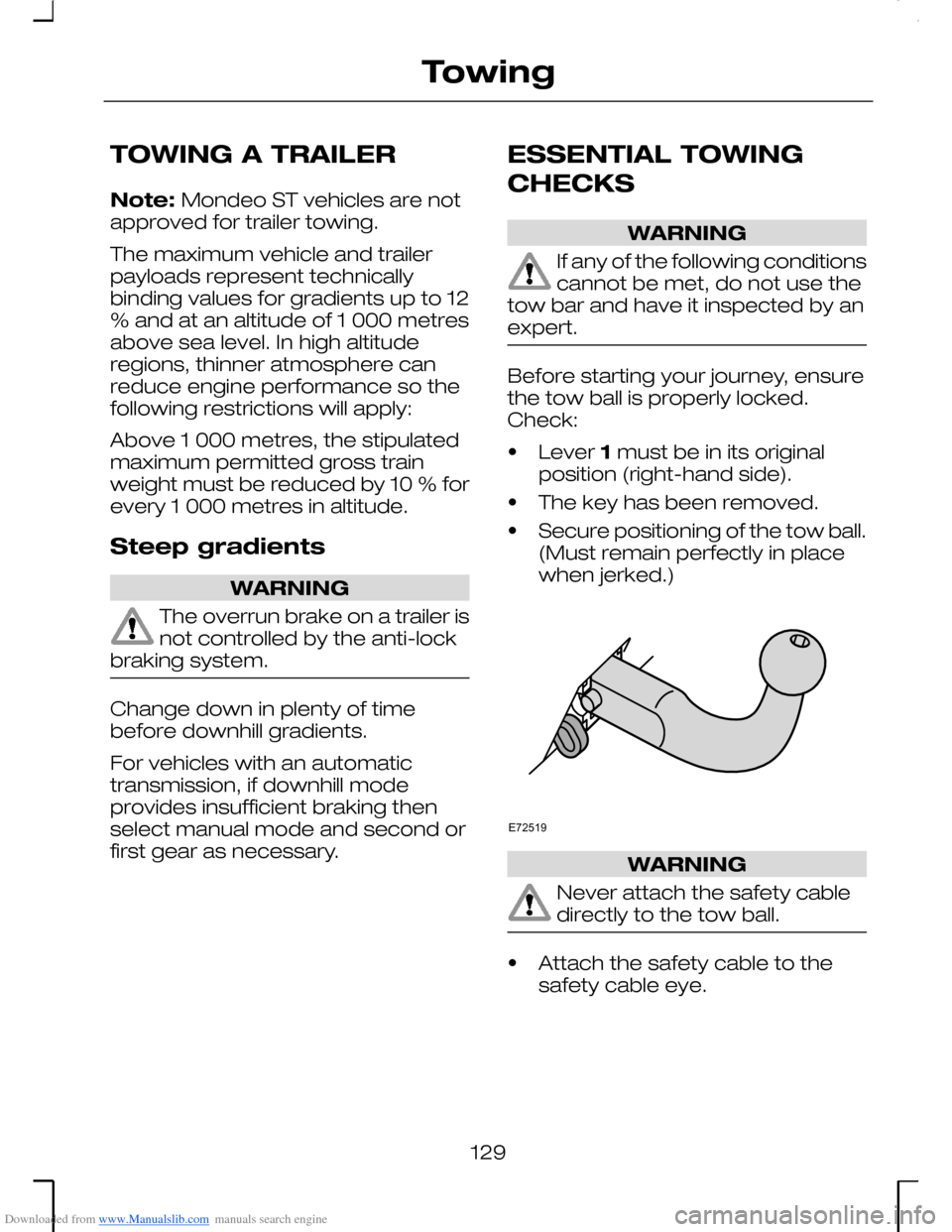
Before starting your journey, ensurethe tow ball is properly locked.Check:
•Lever 1 must be in its originalposition (right-hand side).
•The key has been removed.
•Secure positioning of the tow ball.(Must remain perfectly in placewhen jerked.)
WARNING
Never attach the safety cabledirectly to the tow ball.
•Attach the safety cable to thesafety cable eye.
129
TowingE72519
Page 140 of 198
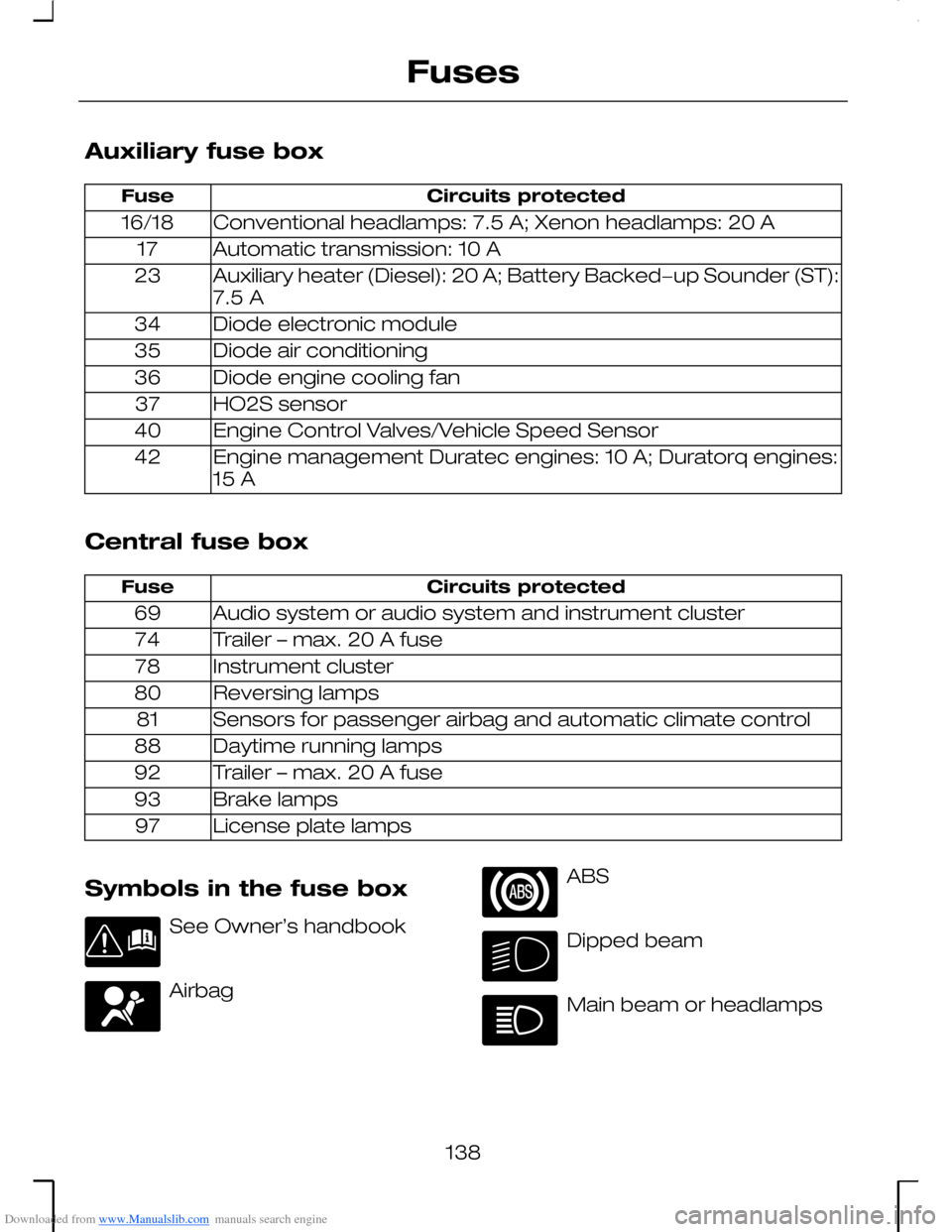
Downloaded from www.Manualslib.com manuals search engine Auxiliary fuse box
Circuits protectedFuse
Conventional headlamps: 7.5 A; Xenon headlamps: 20 A16/18
Automatic transmission: 10 A17
Auxiliary heater (Diesel): 20 A; Battery Backed−up Sounder (ST):7.5 A23
Diode electronic module34
Diode air conditioning35
Diode engine cooling fan36
HO2S sensor37
Engine Control Valves/Vehicle Speed Sensor40
Engine management Duratec engines: 10 A; Duratorq engines:15 A42
Central fuse box
Circuits protectedFuse
Audio system or audio system and instrument cluster69
Trailer – max. 20 A fuse74
Instrument cluster78
Reversing lamps80
Sensors for passenger airbag and automatic climate control81
Daytime running lamps88
Trailer – max. 20 A fuse92
Brake lamps93
License plate lamps97
Symbols in the fuse box
See Owner’s handbook
Airbag
ABS
Dipped beam
Main beam or headlamps
138
Fuses
Page 142 of 198
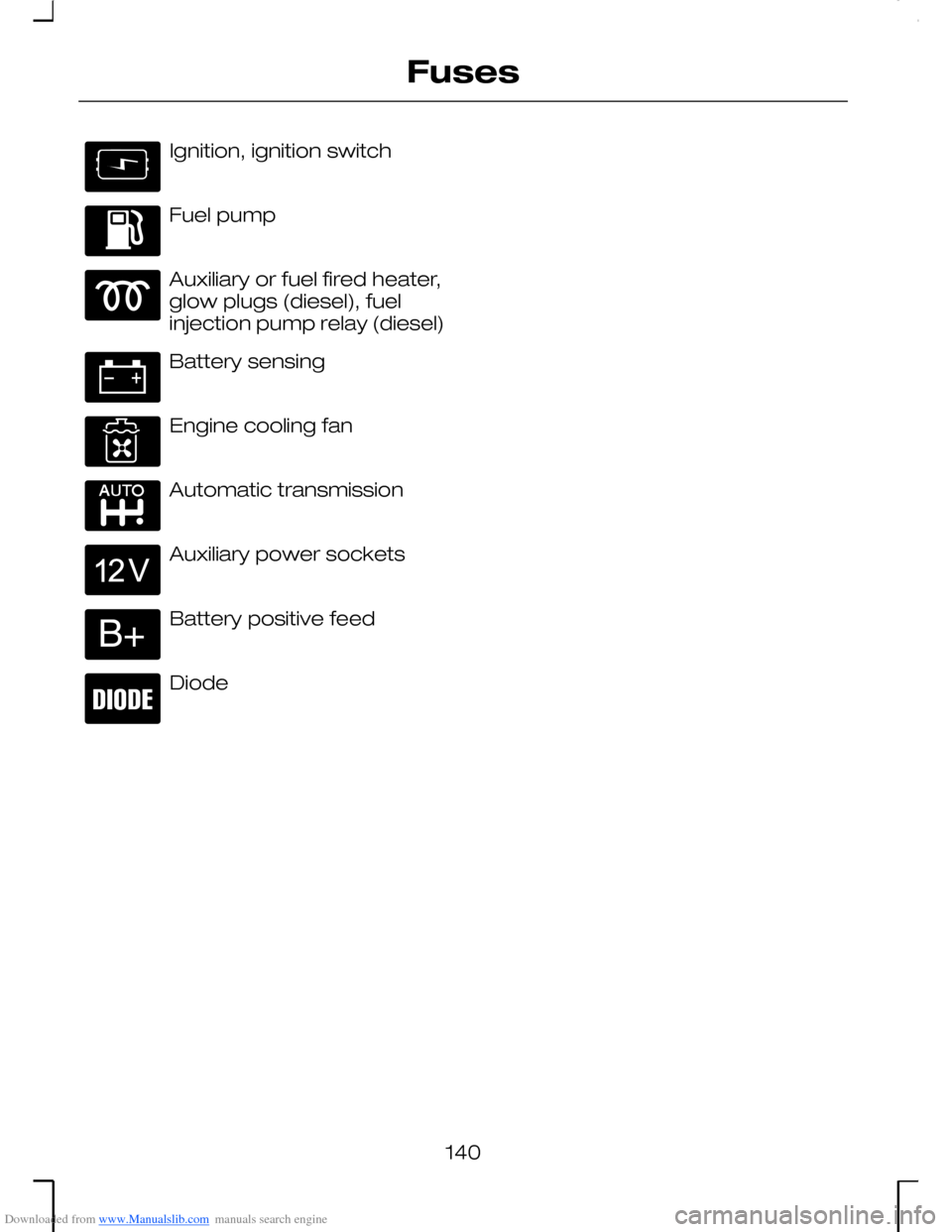
Downloaded from www.Manualslib.com manuals search engine Ignition, ignition switch
Fuel pump
Auxiliary or fuel fired heater,glow plugs (diesel), fuelinjection pump relay (diesel)
Battery sensing
Engine cooling fan
Automatic transmission
Auxiliary power sockets
Battery positive feed
Diode
140
Fuses
Page 144 of 198
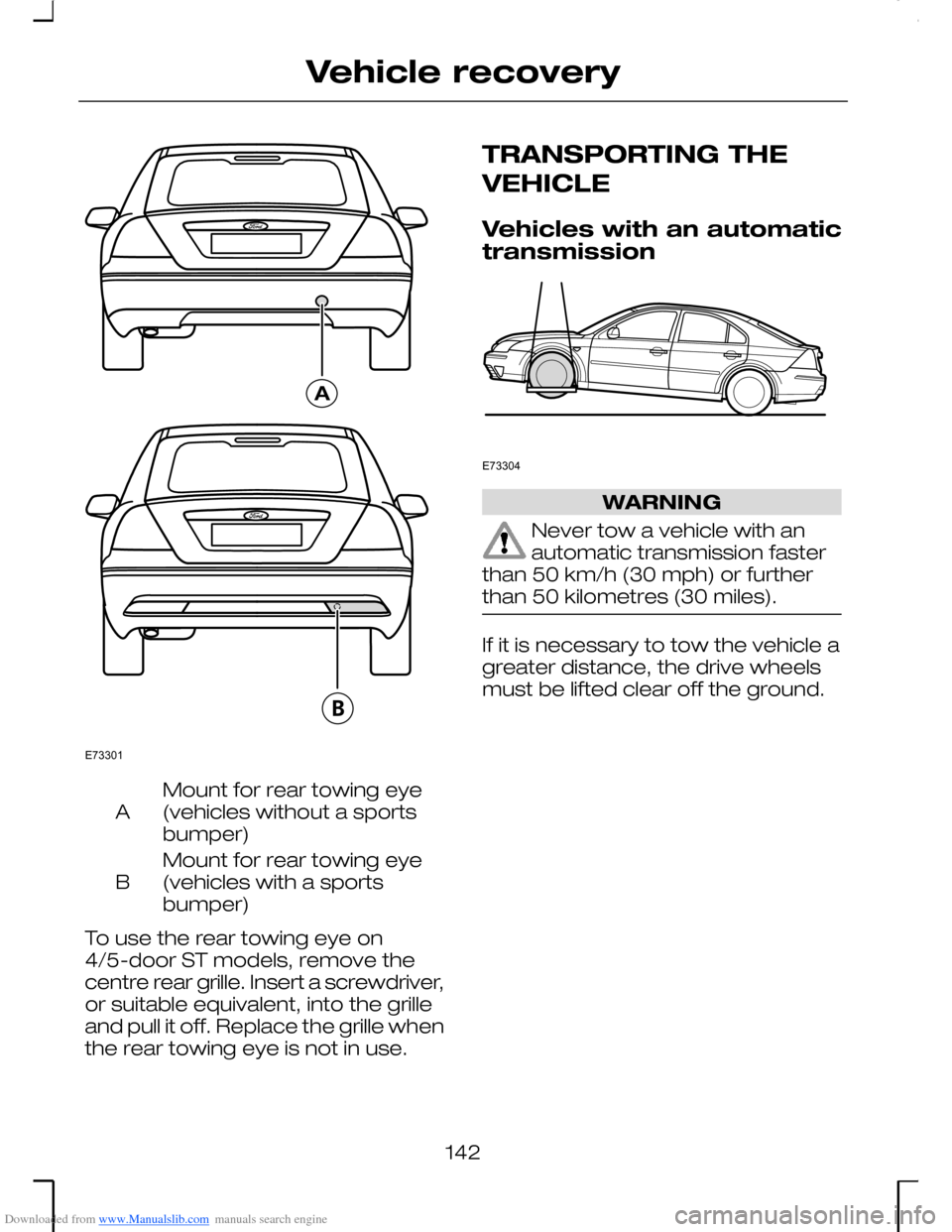
Downloaded from www.Manualslib.com manuals search engine Mount for rear towing eye(vehicles without a sportsbumper)A
Mount for rear towing eye(vehicles with a sportsbumper)B
To use the rear towing eye on4/5-door ST models, remove thecentre rear grille. Insert a screwdriver,or suitable equivalent, into the grilleand pull it off. Replace the grille whenthe rear towing eye is not in use.
TRANSPORTING THE
VEHICLE
Vehicles with an automatictransmission
WARNING
Never tow a vehicle with anautomatic transmission fasterthan 50 km/h (30 mph) or furtherthan 50 kilometres (30 miles).
If it is necessary to tow the vehicle agreater distance, the drive wheelsmust be lifted clear off the ground.
142
Vehicle recoveryE73301 E73304
Page 145 of 198
Downloaded from www.Manualslib.com manuals search engine TOWING THE VEHICLE
ON FOUR WHEELS
All vehicles
WARNING
The ignition key must be set toposition II when the vehicle isbeing towed so that the steering,direction indicator lamps and brakelamps are fully operational. Since thebrake servo and the power steeringdo not operate with the engineswitched off, you will need to exertgreater force to the brake pedal andsteering wheel. Make allowances forthe increased braking distance andheavier steering.
Note: Observe the safetyregulations that are valid for towinga vehicle depending on country.
When towing always drive off slowlyand smoothly without jerking thetowing vehicle. Excessive tow ropetension could result in damage toeither vehicle.
Vehicles with an automatictransmission
WARNINGS
Never tow a vehicle with anautomatic transmission fasterthan 50 km/h (30 mph) or furtherthan 50 kilometres (30 miles). SeeTransporting the vehicle (page 142).
Never tow a vehicle backwardswith the drive wheels turning. Ifthis instruction is not adhered to, itcould cause damage to theautomatic transmission.
When a vehicle with an automatictransmission is towed, the selectorlever must be in position N (neutral).
143
Vehicle recovery
Page 154 of 198
Downloaded from www.Manualslib.com manuals search engine WARNING
To avoid scalding, never removethe cap from the coolantreservoir when the engine is hot. Donot restart the engine until theproblem has been eliminated.
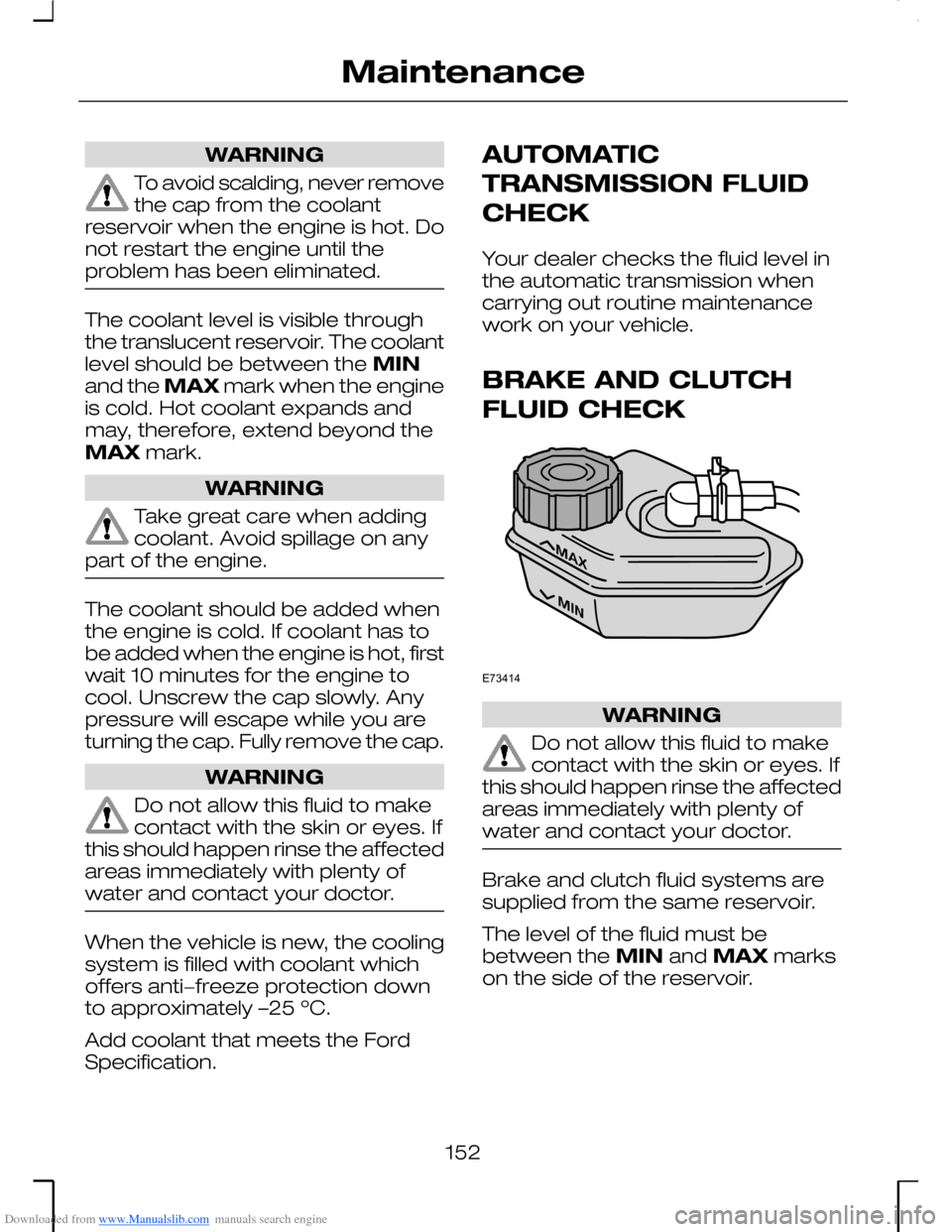
The coolant level is visible throughthe translucent reservoir. The coolantlevel should be between the MINand the MAX mark when the engineis cold. Hot coolant expands andmay, therefore, extend beyond theMAX mark.
WARNING
Take great care when addingcoolant. Avoid spillage on anypart of the engine.
The coolant should be added whenthe engine is cold. If coolant has tobe added when the engine is hot, firstwait 10 minutes for the engine tocool. Unscrew the cap slowly. Anypressure will escape while you areturning the cap. Fully remove the cap.
WARNING
Do not allow this fluid to makecontact with the skin or eyes. Ifthis should happen rinse the affectedareas immediately with plenty ofwater and contact your doctor.
When the vehicle is new, the coolingsystem is filled with coolant whichoffers anti−freeze protection downto approximately –25 ºC.
Add coolant that meets the FordSpecification.
AUTOMATIC
TRANSMISSION FLUID
CHECK
Your dealer checks the fluid level inthe automatic transmission whencarrying out routine maintenancework on your vehicle.
BRAKE AND CLUTCH
FLUID CHECK
WARNING
Do not allow this fluid to makecontact with the skin or eyes. Ifthis should happen rinse the affectedareas immediately with plenty ofwater and contact your doctor.
Brake and clutch fluid systems aresupplied from the same reservoir.
The level of the fluid must bebetween the MIN and MAX markson the side of the reservoir.
152
MaintenanceE73414
Page 165 of 198
Downloaded from www.Manualslib.com manuals search engine Removing a wheel
All vehicles
WARNINGS
Park your vehicle in such aposition that neither the trafficnor you are hindered or endangeredwhen changing a wheel.
Set up a warning triangle.
Ensure that the vehicle is onfirm, level ground.
If necessary, secure the vehiclewith suitable chocks.
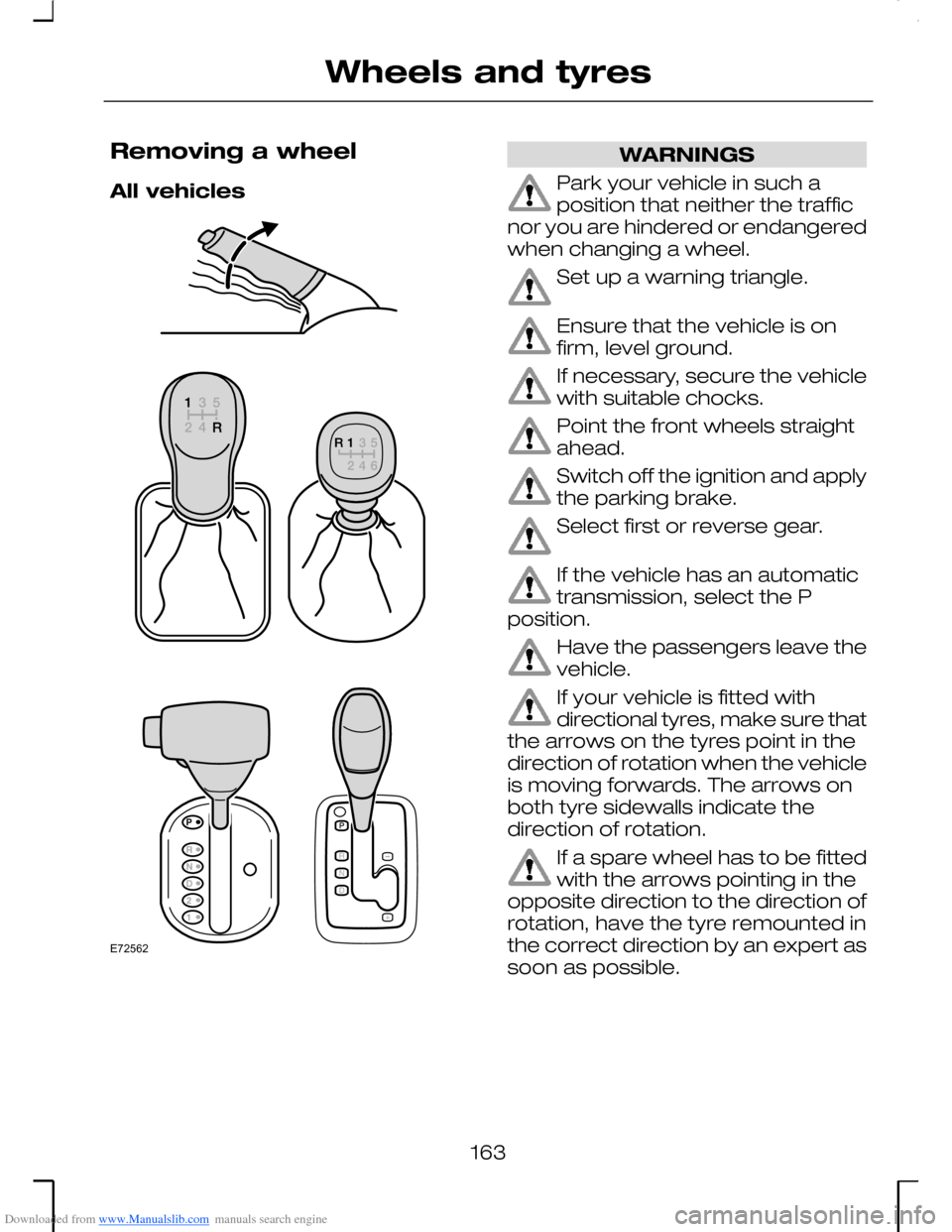
Point the front wheels straightahead.
Switch off the ignition and applythe parking brake.
Select first or reverse gear.
If the vehicle has an automatictransmission, select the Pposition.
Have the passengers leave thevehicle.
If your vehicle is fitted withdirectional tyres, make sure thatthe arrows on the tyres point in thedirection of rotation when the vehicleis moving forwards. The arrows onboth tyre sidewalls indicate thedirection of rotation.
If a spare wheel has to be fittedwith the arrows pointing in theopposite direction to the direction ofrotation, have the tyre remounted inthe correct direction by an expert assoon as possible.
163
Wheels and tyresE72562