brake FORD MONDEO 2006 2.G User Guide
[x] Cancel search | Manufacturer: FORD, Model Year: 2006, Model line: MONDEO, Model: FORD MONDEO 2006 2.GPages: 198, PDF Size: 4.69 MB
Page 117 of 198
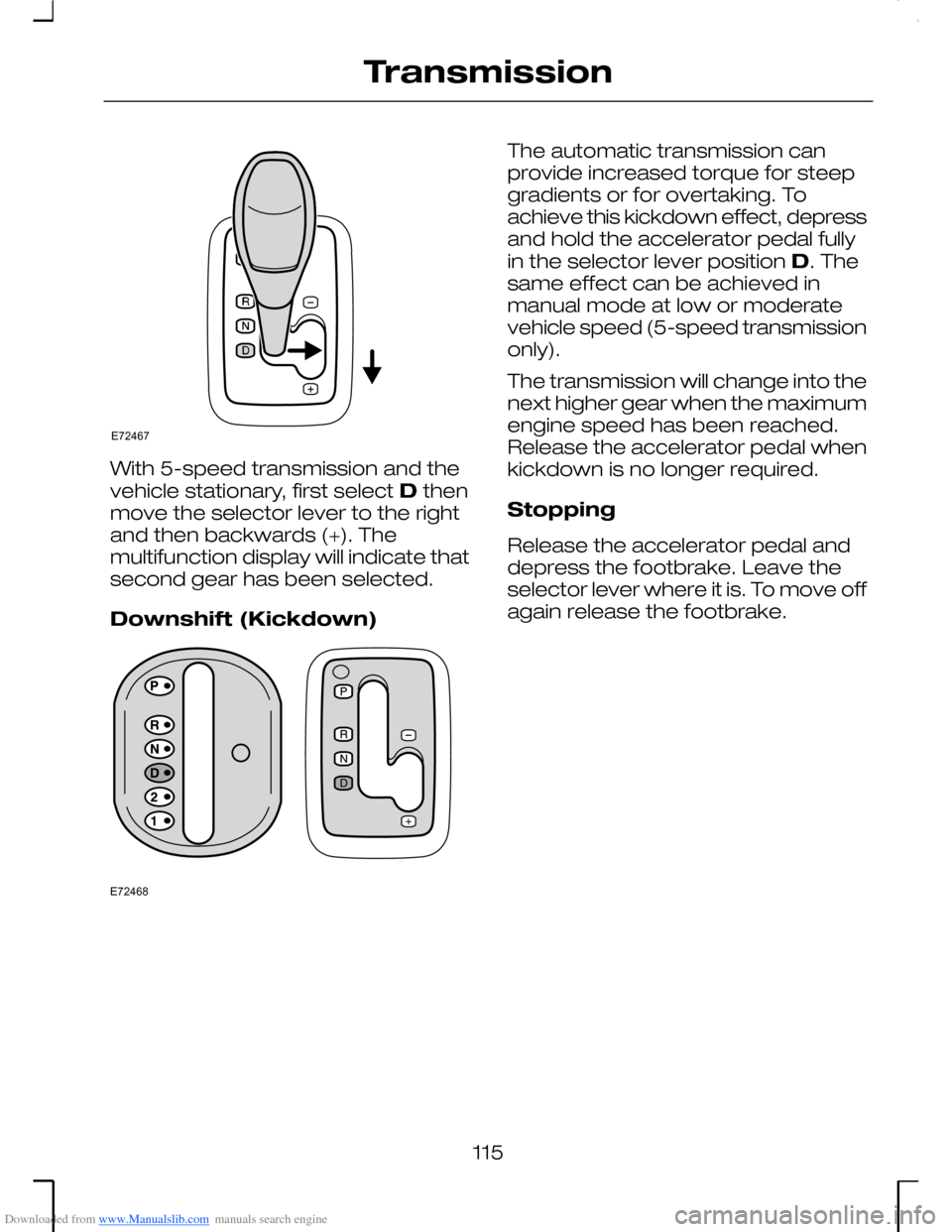
Downloaded from www.Manualslib.com manuals search engine With 5-speed transmission and thevehicle stationary, first select D thenmove the selector lever to the rightand then backwards (+). Themultifunction display will indicate thatsecond gear has been selected.
Downshift (Kickdown)
The automatic transmission canprovide increased torque for steepgradients or for overtaking. Toachieve this kickdown effect, depressand hold the accelerator pedal fullyin the selector lever position D. Thesame effect can be achieved inmanual mode at low or moderatevehicle speed (5-speed transmissiononly).
The transmission will change into thenext higher gear when the maximumengine speed has been reached.Release the accelerator pedal whenkickdown is no longer required.
Stopping
Release the accelerator pedal anddepress the footbrake. Leave theselector lever where it is. To move offagain release the footbrake.
115
TransmissionE72467 E72468
Page 119 of 198
Downloaded from www.Manualslib.com manuals search engine Downhill mode
The transmission recognizes downhilldriving conditions and supports yourbraking manoeuvre by downshiftingto increase engine braking.
Uphill mode
The transmission recognizes uphilldriving or trailer towing conditionsand will select a lower gear to providemore engine power.
Fast off mode
If you release the accelerator pedalquickly, e.g. when driving through acurve, the transmission stays in theselected gear to avoid a sequenceof upshifts and downshifts.
Auto sport mode
If you press down the acceleratorpedal quickly, for example, if youprefer sporty driving, the transmissionsupports your driving style byimmediately shifting down or byshifting up later, i.e at high enginespeeds.
Stop-and-go mode (2.5 lDuratec-VE)
The transmission recognizesstop-and-go traffic conditions andinhibits first gear for smoothacceleration and to avoid a sequenceof upshifts and downshifts.
Neutral idle control (2.0 lDuratorq-TDCi)
To increase your comfort, enginenoise and vibration characteristics willbe optimised if the vehicle stands stillwith the engine sunning, the selectorlever in D and the footbrake isapplied.
117
Transmission
Page 120 of 198
Downloaded from www.Manualslib.com manuals search engine PRINCIPLE OF
OPERATION
Dual circuit braking system
WARNING
If a brake circuit fails, you will atfirst experience a softer feel tothe brake pedal. You will then needto exert a greater force on the brakepedal, and make allowance forincreased stopping distances. Havethe braking system checked by anexpert before continuing yourjourney.
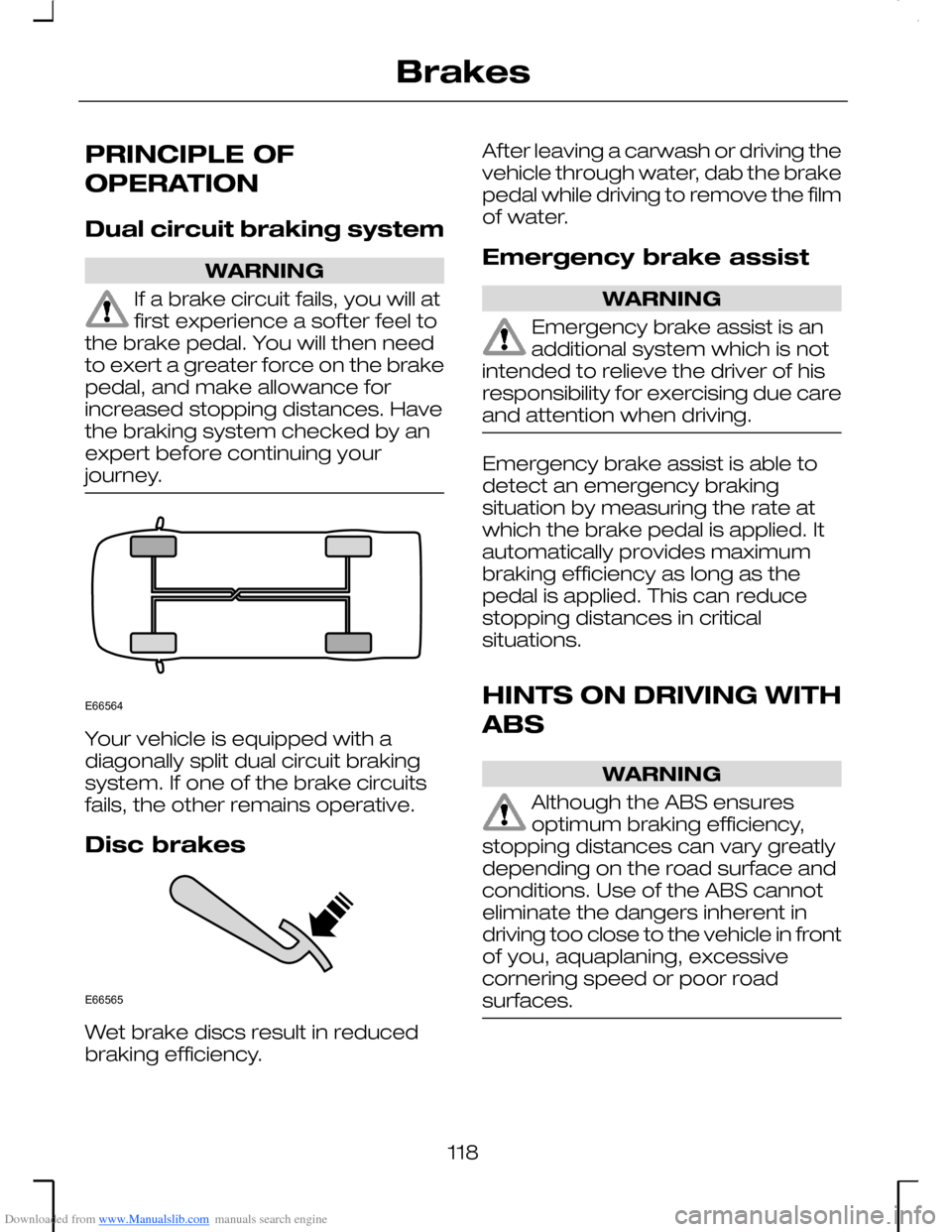
Your vehicle is equipped with adiagonally split dual circuit brakingsystem. If one of the brake circuitsfails, the other remains operative.
Disc brakes
Wet brake discs result in reducedbraking efficiency.
After leaving a carwash or driving thevehicle through water, dab the brakepedal while driving to remove the filmof water.
Emergency brake assist
WARNING
Emergency brake assist is anadditional system which is notintended to relieve the driver of hisresponsibility for exercising due careand attention when driving.
Emergency brake assist is able todetect an emergency brakingsituation by measuring the rate atwhich the brake pedal is applied. Itautomatically provides maximumbraking efficiency as long as thepedal is applied. This can reducestopping distances in criticalsituations.
HINTS ON DRIVING WITH
ABS
WARNING
Although the ABS ensuresoptimum braking efficiency,stopping distances can vary greatlydepending on the road surface andconditions. Use of the ABS cannoteliminate the dangers inherent indriving too close to the vehicle in frontof you, aquaplaning, excessivecornering speed or poor roadsurfaces.
118
BrakesE66564 E66565
Page 121 of 198
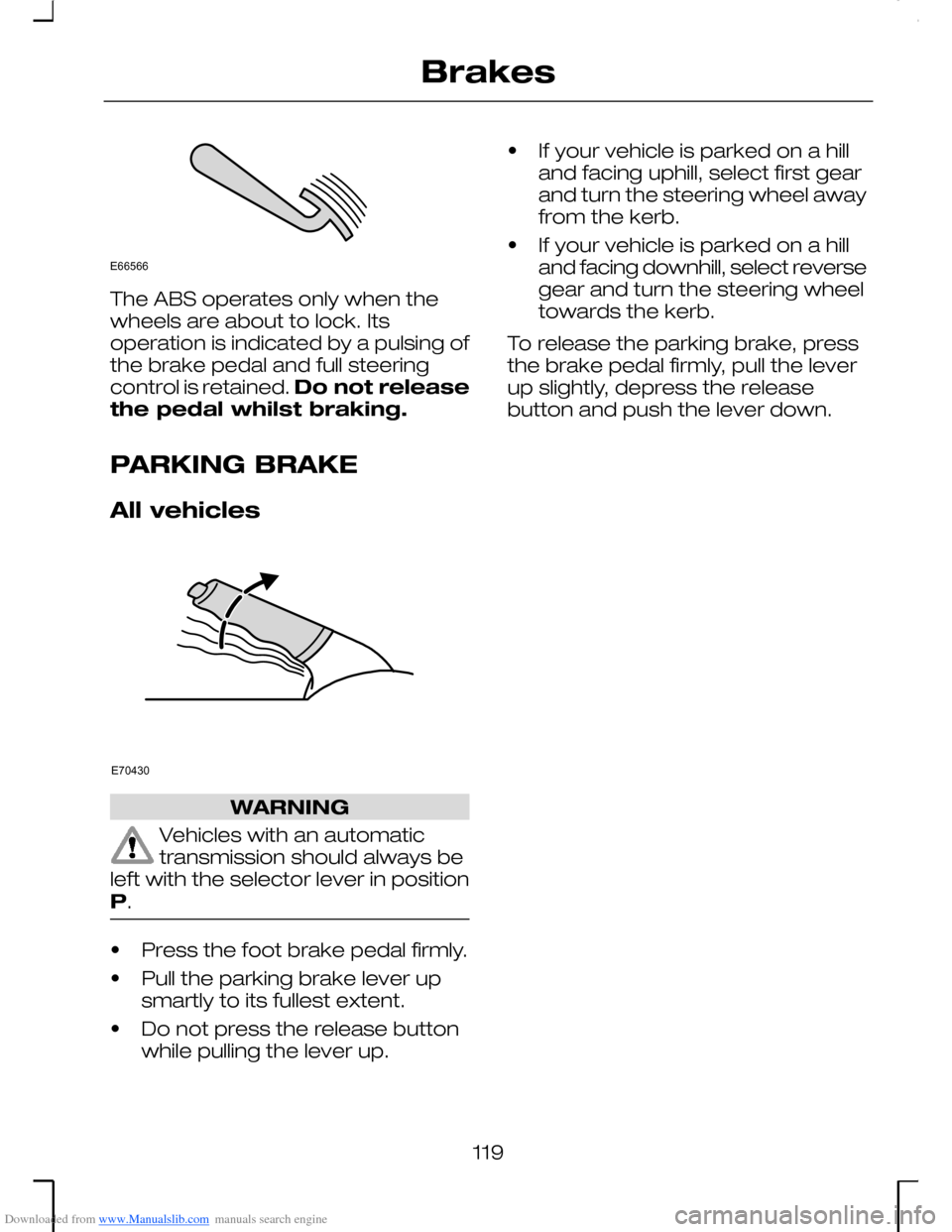
Downloaded from www.Manualslib.com manuals search engine The ABS operates only when thewheels are about to lock. Itsoperation is indicated by a pulsing ofthe brake pedal and full steeringcontrol is retained. Do not releasethe pedal whilst braking.
PARKING BRAKE
All vehicles
WARNING
Vehicles with an automatictransmission should always beleft with the selector lever in positionP.
•Press the foot brake pedal firmly.
•Pull the parking brake lever upsmartly to its fullest extent.
•Do not press the release buttonwhile pulling the lever up.
•If your vehicle is parked on a hilland facing uphill, select first gearand turn the steering wheel awayfrom the kerb.
•If your vehicle is parked on a hilland facing downhill, select reversegear and turn the steering wheeltowards the kerb.
To release the parking brake, pressthe brake pedal firmly, pull the leverup slightly, depress the releasebutton and push the lever down.
119
BrakesE66566 E70430
Page 126 of 198
Downloaded from www.Manualslib.com manuals search engine PRINCIPLE OF
OPERATION
WARNING
Don not use cruise control inheavy traffic, on twisty roads orwhen the road surface is slippery.
The cruise control systemautomatically adjusts the poweroutput of the engine to maintain thestored speed. When travellingdownhill, vehicle speed may increaseabove the stored speed as thesystem does not apply the brakes.In this case, changing down a gearand then pressing the RES buttonmay assist the system in returningthe vehicle to the stored speed.
The system will not function until thevehicle speed is above 40 km/h (25mph). On vehicles with a dieselengine, the system will not functionin first or second gear.
USING CRUISE CONTROL
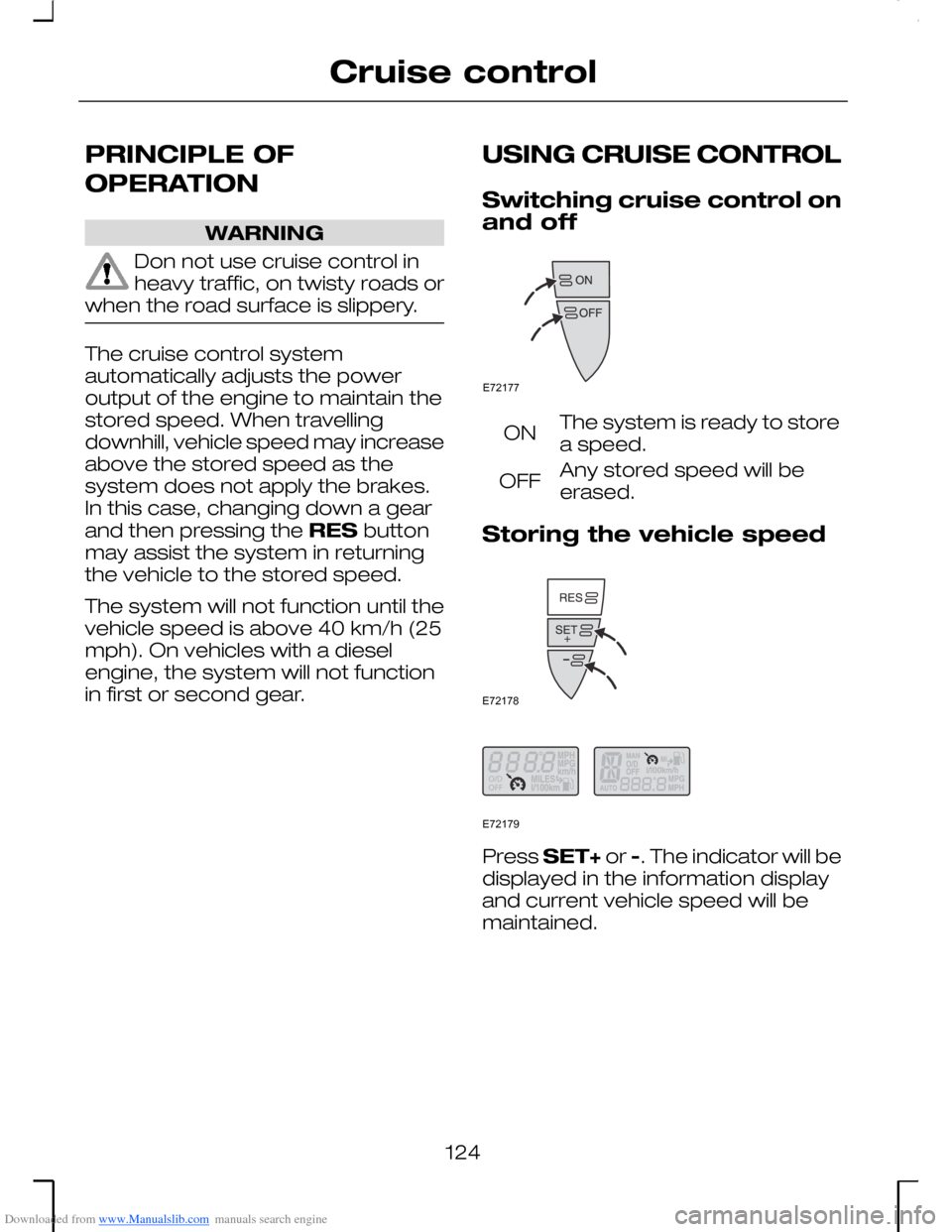
Switching cruise control onand off
The system is ready to storea speed.ON
Any stored speed will beerased.OFF
Storing the vehicle speed
Press SET+ or -. The indicator will bedisplayed in the information displayand current vehicle speed will bemaintained.
124
Cruise controlE72177 E72178 E72179
Page 127 of 198
Downloaded from www.Manualslib.com manuals search engine Changing the storedvehicle speed
Press SET+ to accelerate. Press the- to decelerate. Vehicle speed willchange without the need to depressthe accelerator pedal.
The speed at which the switch isreleased becomes the new storedspeed.
Press SET+ or - momentarily toincrease or decrease vehicle speedin small steps.
Depressing the accelerator willaccelerate the vehicle, withoutchanging the stored speed.
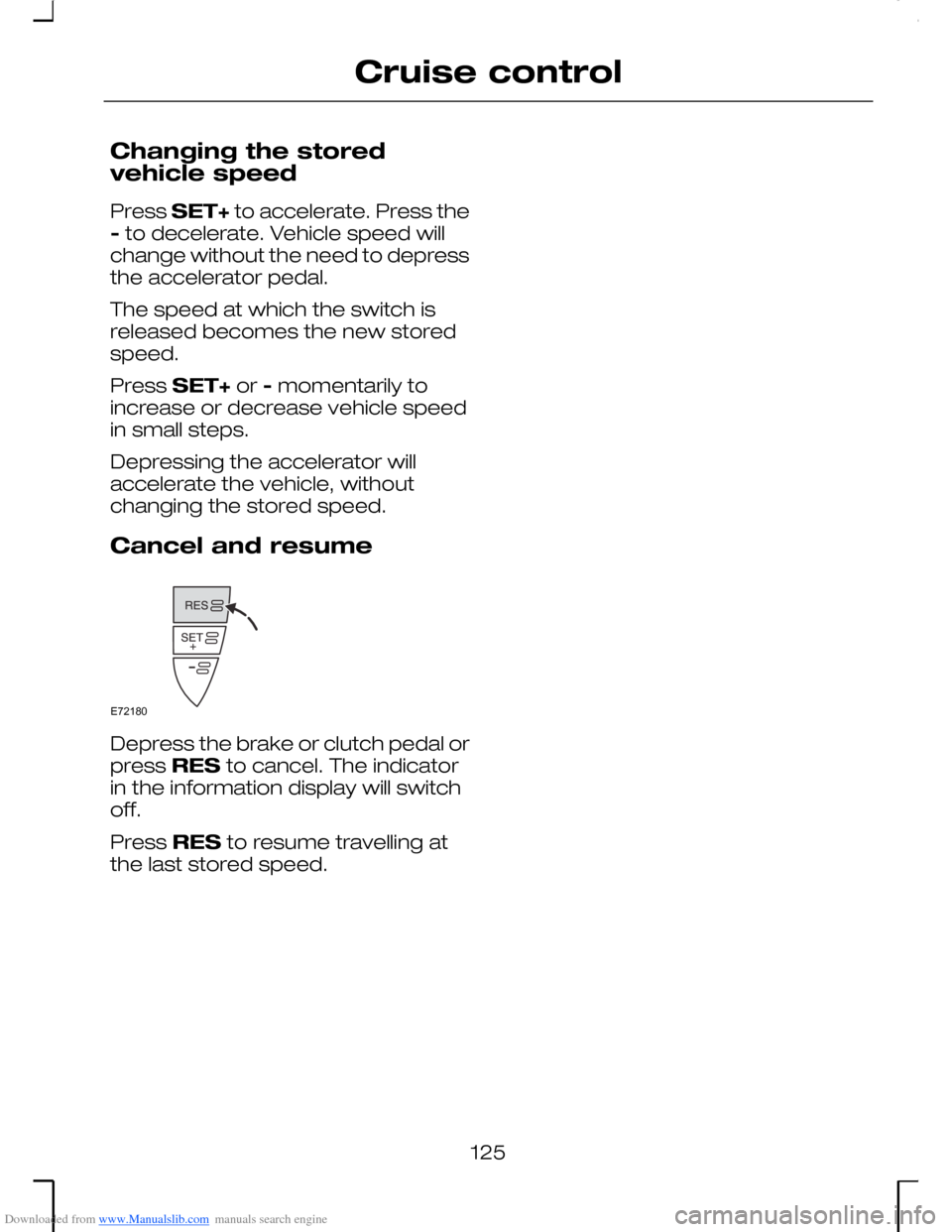
Cancel and resume
Depress the brake or clutch pedal orpress RES to cancel. The indicatorin the information display will switchoff.
Press RES to resume travelling atthe last stored speed.
125
Cruise controlE72180
Page 131 of 198
Downloaded from www.Manualslib.com manuals search engine TOWING A TRAILER
Note: Mondeo ST vehicles are notapproved for trailer towing.
The maximum vehicle and trailerpayloads represent technicallybinding values for gradients up to 12% and at an altitude of 1 000 metresabove sea level. In high altituderegions, thinner atmosphere canreduce engine performance so thefollowing restrictions will apply:
Above 1 000 metres, the stipulatedmaximum permitted gross trainweight must be reduced by 10 % forevery 1 000 metres in altitude.
Steep gradients
WARNING
The overrun brake on a trailer isnot controlled by the anti-lockbraking system.
Change down in plenty of timebefore downhill gradients.
For vehicles with an automatictransmission, if downhill modeprovides insufficient braking thenselect manual mode and second orfirst gear as necessary.
ESSENTIAL TOWING
CHECKS
WARNING
If any of the following conditionscannot be met, do not use thetow bar and have it inspected by anexpert.
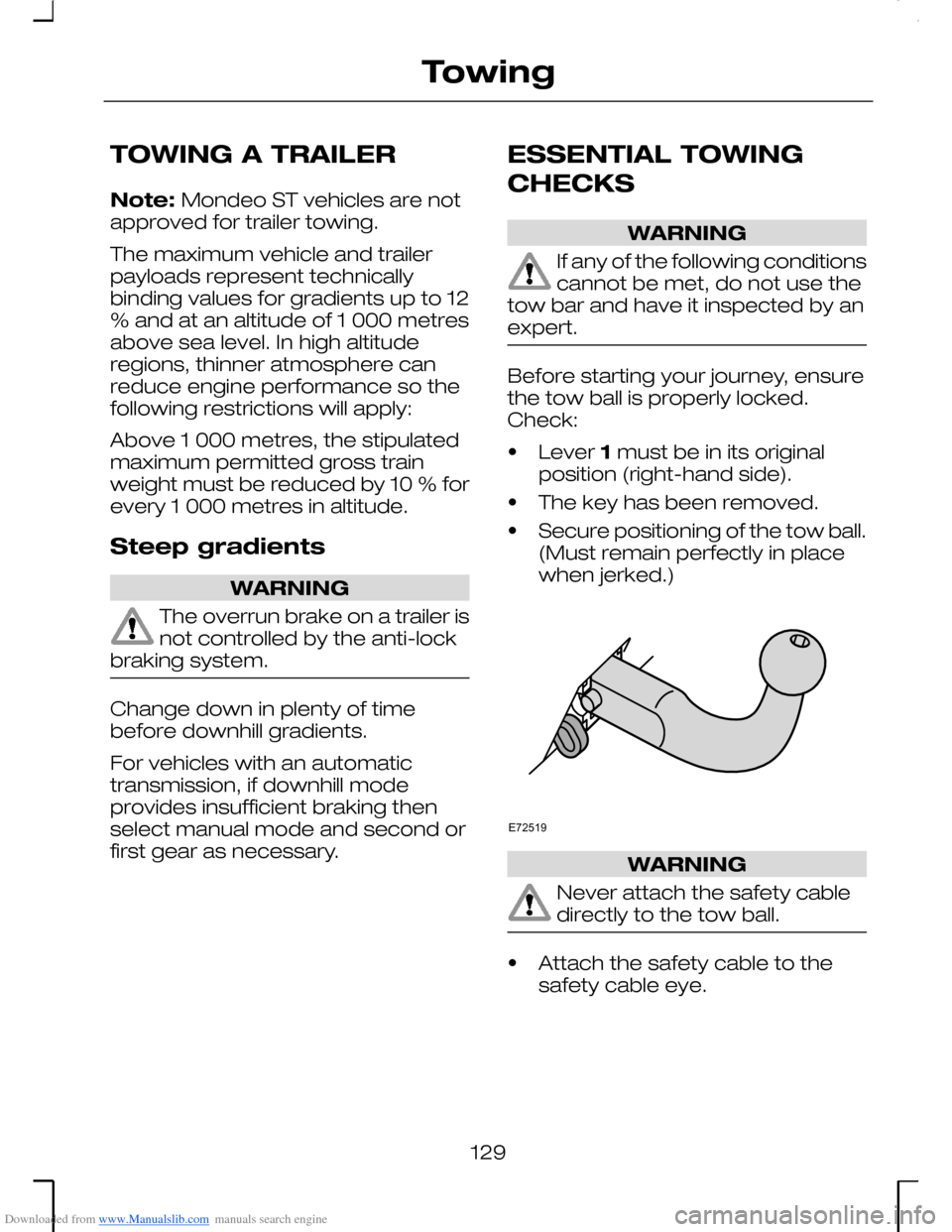
Before starting your journey, ensurethe tow ball is properly locked.Check:
•Lever 1 must be in its originalposition (right-hand side).
•The key has been removed.
•Secure positioning of the tow ball.(Must remain perfectly in placewhen jerked.)
WARNING
Never attach the safety cabledirectly to the tow ball.
•Attach the safety cable to thesafety cable eye.
129
TowingE72519
Page 135 of 198
Downloaded from www.Manualslib.com manuals search engine RUNNING-IN
Avoid driving too briskly during thefirst 1 500 km (1 000 miles). Vary thespeed frequently and change up agear early. Avoid labouring theengine.
New tyres require a running-indistance of approximately 500 km(300 miles). During this period, thecar may exhibit different drivingcharacteristics. Therefore, avoiddriving too briskly during the first 500km (300 miles).
If possible, you should avoid heavyuse of the brake for the first 150 km(100 miles) in town and for the first 1500 km (1 000 miles) on motorways.
From 1 500 km (1 000 miles) onwardsyou can gradually increase theperformance of your vehicle up tothe permitted maximum speeds.
We wish you safe and pleasurabledriving with your Ford vehicle.
133
Driving hints
Page 140 of 198
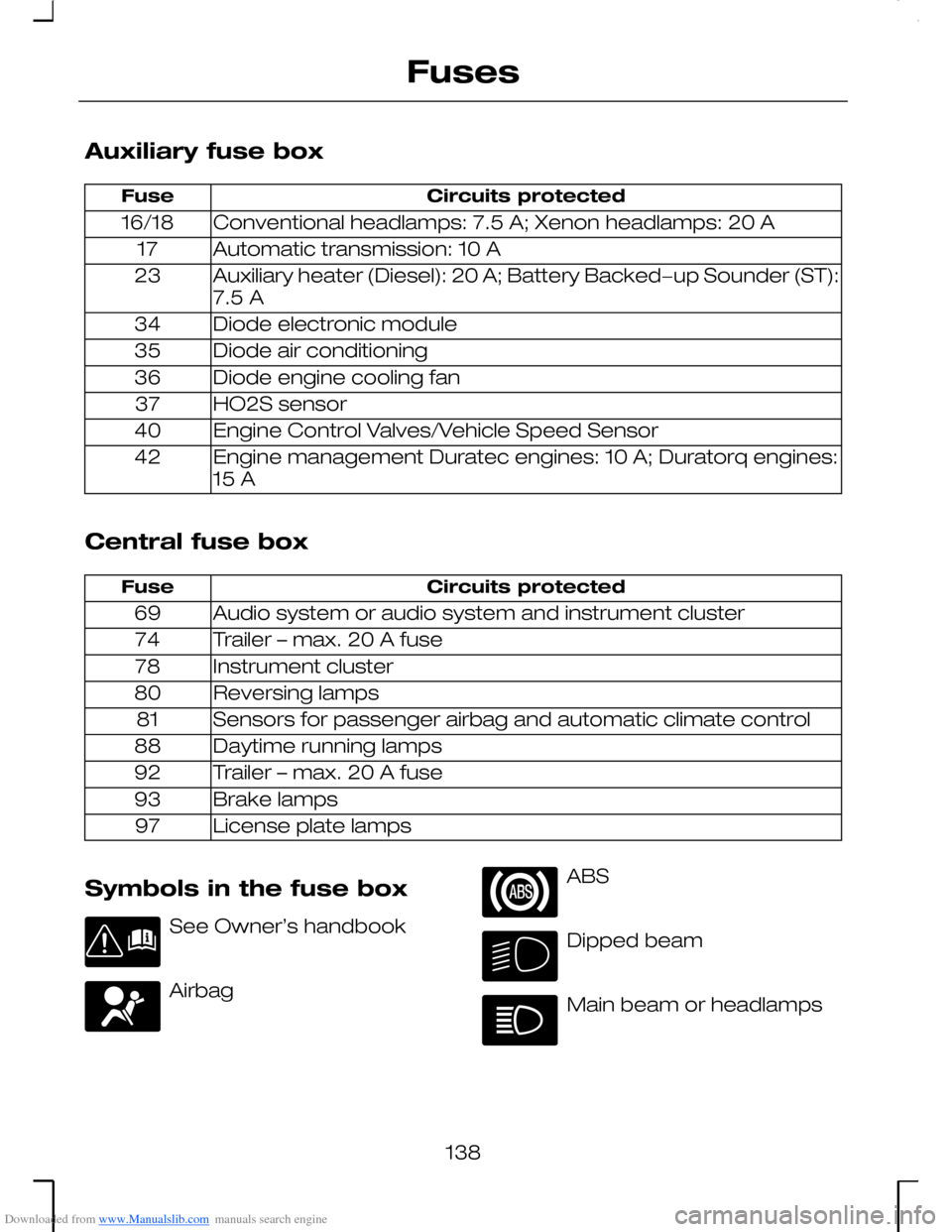
Downloaded from www.Manualslib.com manuals search engine Auxiliary fuse box
Circuits protectedFuse
Conventional headlamps: 7.5 A; Xenon headlamps: 20 A16/18
Automatic transmission: 10 A17
Auxiliary heater (Diesel): 20 A; Battery Backed−up Sounder (ST):7.5 A23
Diode electronic module34
Diode air conditioning35
Diode engine cooling fan36
HO2S sensor37
Engine Control Valves/Vehicle Speed Sensor40
Engine management Duratec engines: 10 A; Duratorq engines:15 A42
Central fuse box
Circuits protectedFuse
Audio system or audio system and instrument cluster69
Trailer – max. 20 A fuse74
Instrument cluster78
Reversing lamps80
Sensors for passenger airbag and automatic climate control81
Daytime running lamps88
Trailer – max. 20 A fuse92
Brake lamps93
License plate lamps97
Symbols in the fuse box
See Owner’s handbook
Airbag
ABS
Dipped beam
Main beam or headlamps
138
Fuses
Page 145 of 198
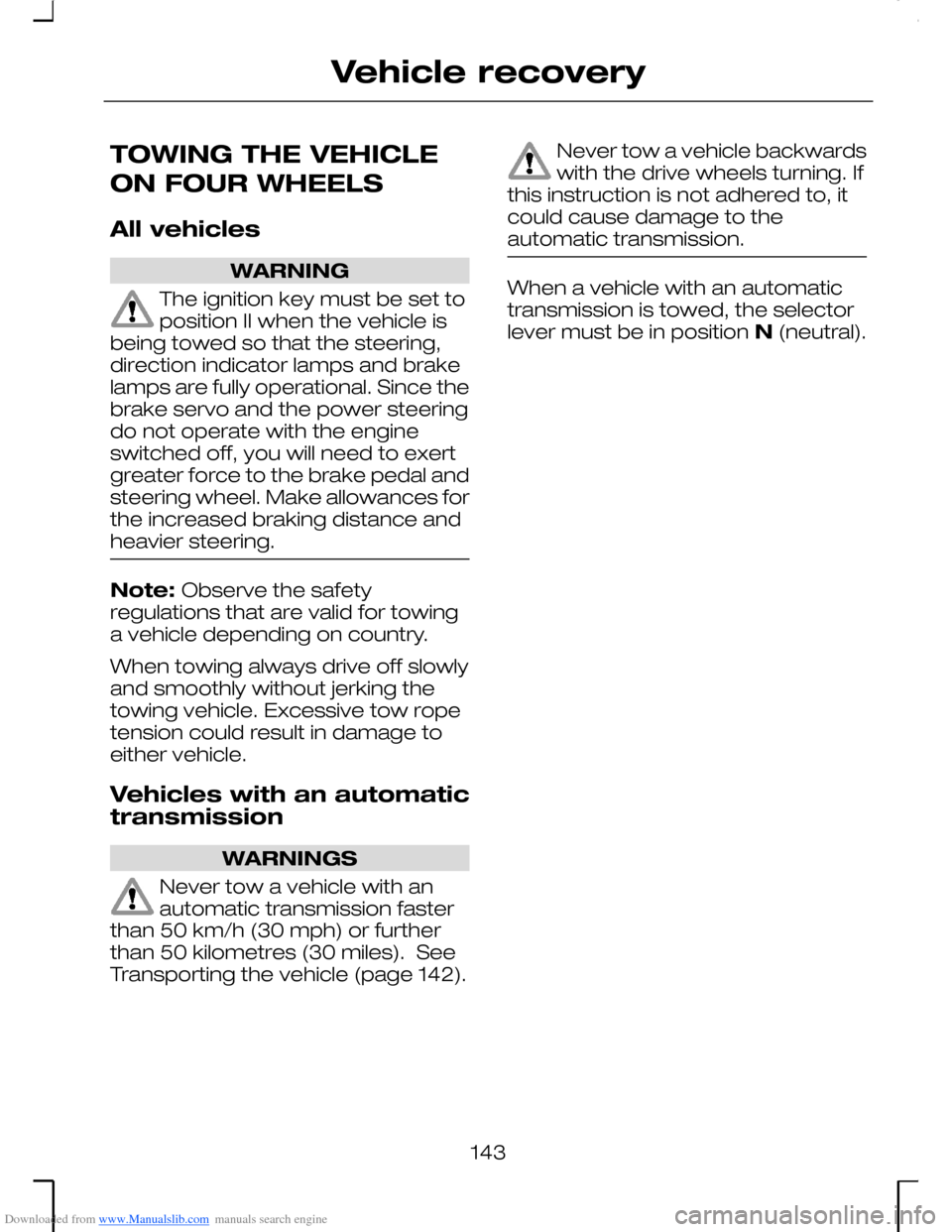
Downloaded from www.Manualslib.com manuals search engine TOWING THE VEHICLE
ON FOUR WHEELS
All vehicles
WARNING
The ignition key must be set toposition II when the vehicle isbeing towed so that the steering,direction indicator lamps and brakelamps are fully operational. Since thebrake servo and the power steeringdo not operate with the engineswitched off, you will need to exertgreater force to the brake pedal andsteering wheel. Make allowances forthe increased braking distance andheavier steering.
Note: Observe the safetyregulations that are valid for towinga vehicle depending on country.
When towing always drive off slowlyand smoothly without jerking thetowing vehicle. Excessive tow ropetension could result in damage toeither vehicle.
Vehicles with an automatictransmission
WARNINGS
Never tow a vehicle with anautomatic transmission fasterthan 50 km/h (30 mph) or furtherthan 50 kilometres (30 miles). SeeTransporting the vehicle (page 142).
Never tow a vehicle backwardswith the drive wheels turning. Ifthis instruction is not adhered to, itcould cause damage to theautomatic transmission.
When a vehicle with an automatictransmission is towed, the selectorlever must be in position N (neutral).
143
Vehicle recovery