wheel FORD MONDEO 2006 2.G Owner's Manual
[x] Cancel search | Manufacturer: FORD, Model Year: 2006, Model line: MONDEO, Model: FORD MONDEO 2006 2.GPages: 198, PDF Size: 4.69 MB
Page 121 of 198
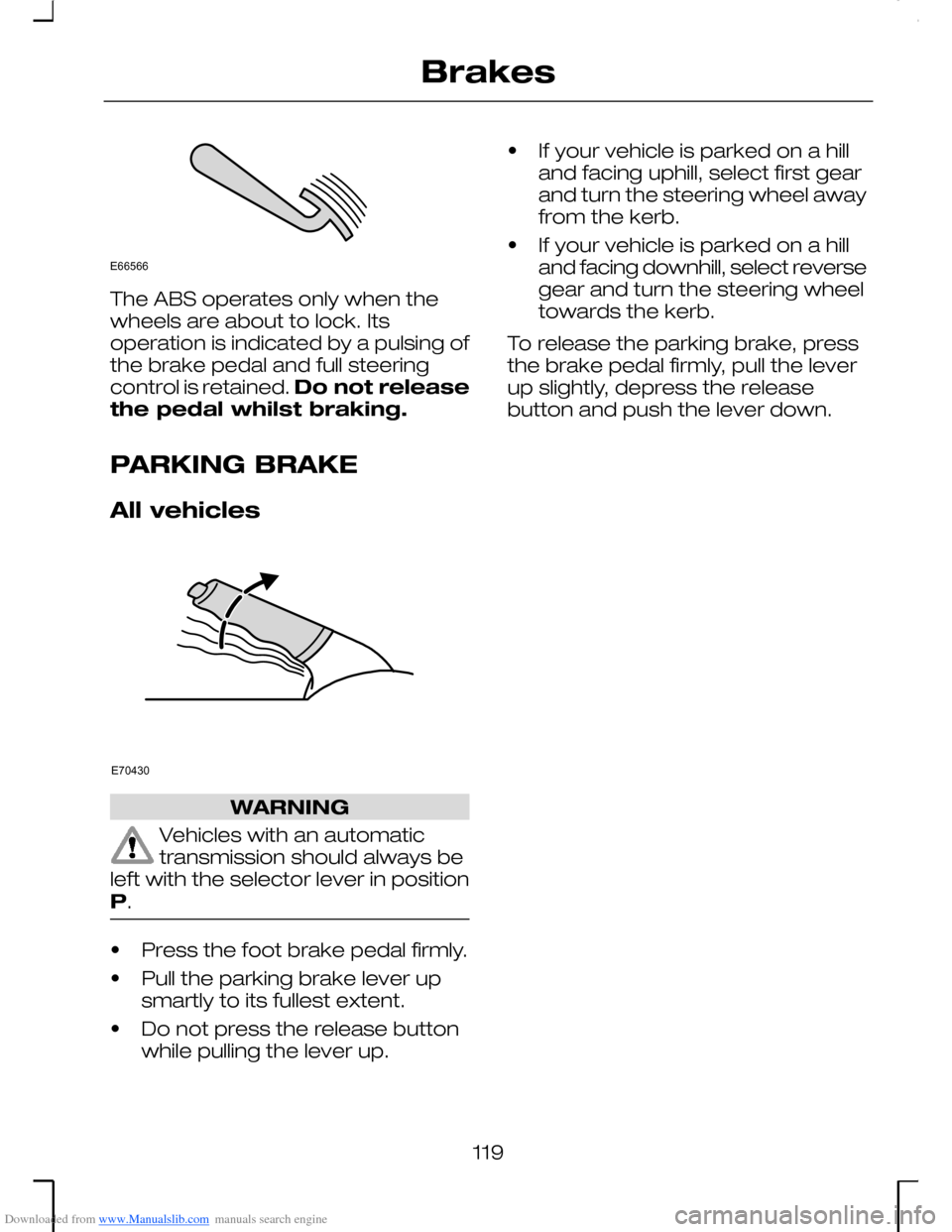
Downloaded from www.Manualslib.com manuals search engine The ABS operates only when thewheels are about to lock. Itsoperation is indicated by a pulsing ofthe brake pedal and full steeringcontrol is retained. Do not releasethe pedal whilst braking.
PARKING BRAKE
All vehicles
WARNING
Vehicles with an automatictransmission should always beleft with the selector lever in positionP.
•Press the foot brake pedal firmly.
•Pull the parking brake lever upsmartly to its fullest extent.
•Do not press the release buttonwhile pulling the lever up.
•If your vehicle is parked on a hilland facing uphill, select first gearand turn the steering wheel awayfrom the kerb.
•If your vehicle is parked on a hilland facing downhill, select reversegear and turn the steering wheeltowards the kerb.
To release the parking brake, pressthe brake pedal firmly, pull the leverup slightly, depress the releasebutton and push the lever down.
119
BrakesE66566 E70430
Page 122 of 198
Downloaded from www.Manualslib.com manuals search engine PRINCIPLE OF
OPERATION
Electronic stability program(ESP)
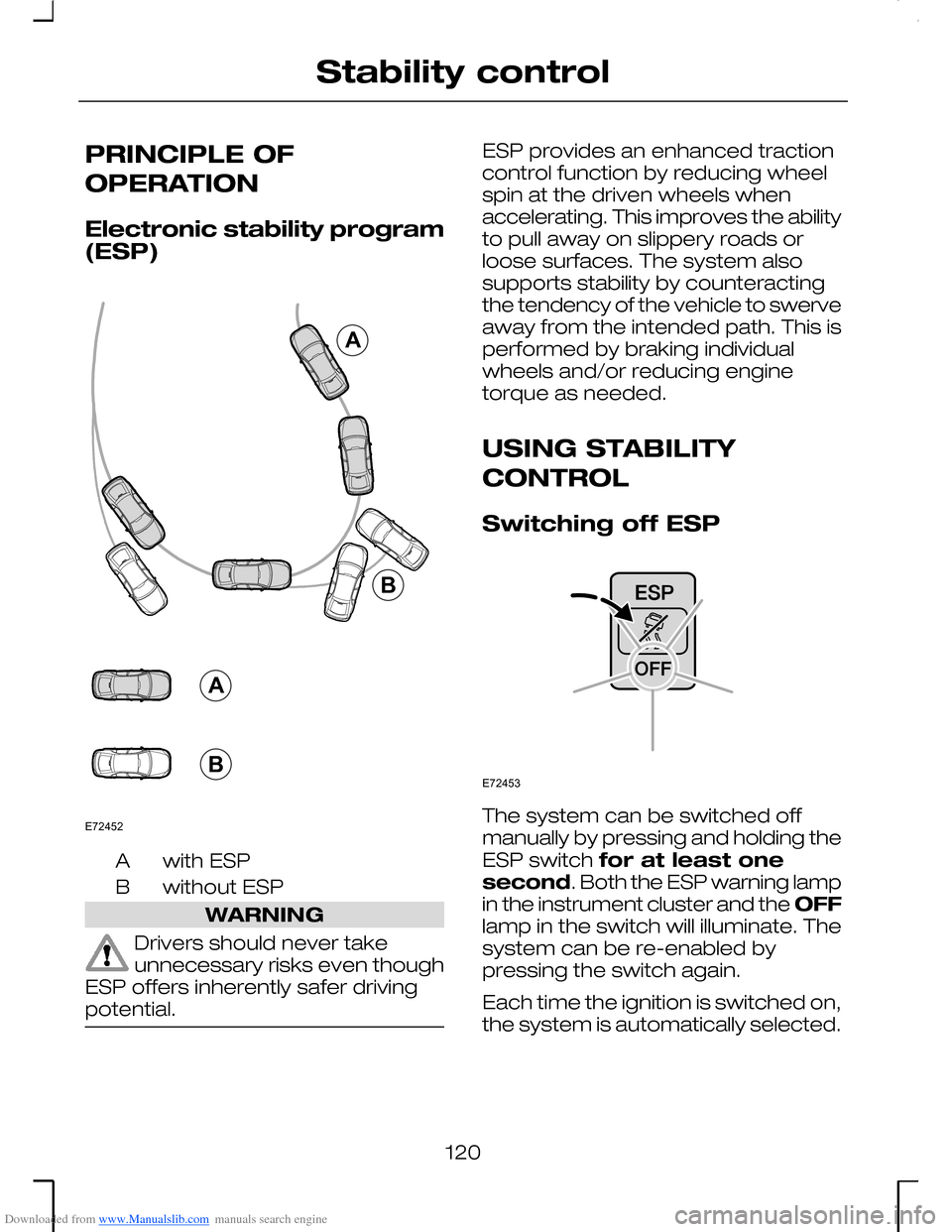
with ESPA
without ESPB
WARNING
Drivers should never takeunnecessary risks even thoughESP offers inherently safer drivingpotential.
ESP provides an enhanced tractioncontrol function by reducing wheelspin at the driven wheels whenaccelerating. This improves the abilityto pull away on slippery roads orloose surfaces. The system alsosupports stability by counteractingthe tendency of the vehicle to swerveaway from the intended path. This isperformed by braking individualwheels and/or reducing enginetorque as needed.
USING STABILITY
CONTROL
Switching off ESP
The system can be switched offmanually by pressing and holding theESP switch for at least onesecond. Both the ESP warning lampin the instrument cluster and the OFFlamp in the switch will illuminate. Thesystem can be re-enabled bypressing the switch again.
Each time the ignition is switched on,the system is automatically selected.
120
Stability controlAABBE72452 E72453
Page 123 of 198
Downloaded from www.Manualslib.com manuals search engine PRINCIPLE OF
OPERATION
WARNING
Drivers should never takeunnecessary risks even thoughthe system offers inherently saferdriving potential.
The system reduces wheel spin atthe driven wheels at speeds up to 40km/h (25 mph).
The system may become activewhen accelerating on a slippery roador loose surface, or when pullingaway on a hill.
USING TRACTION
CONTROL
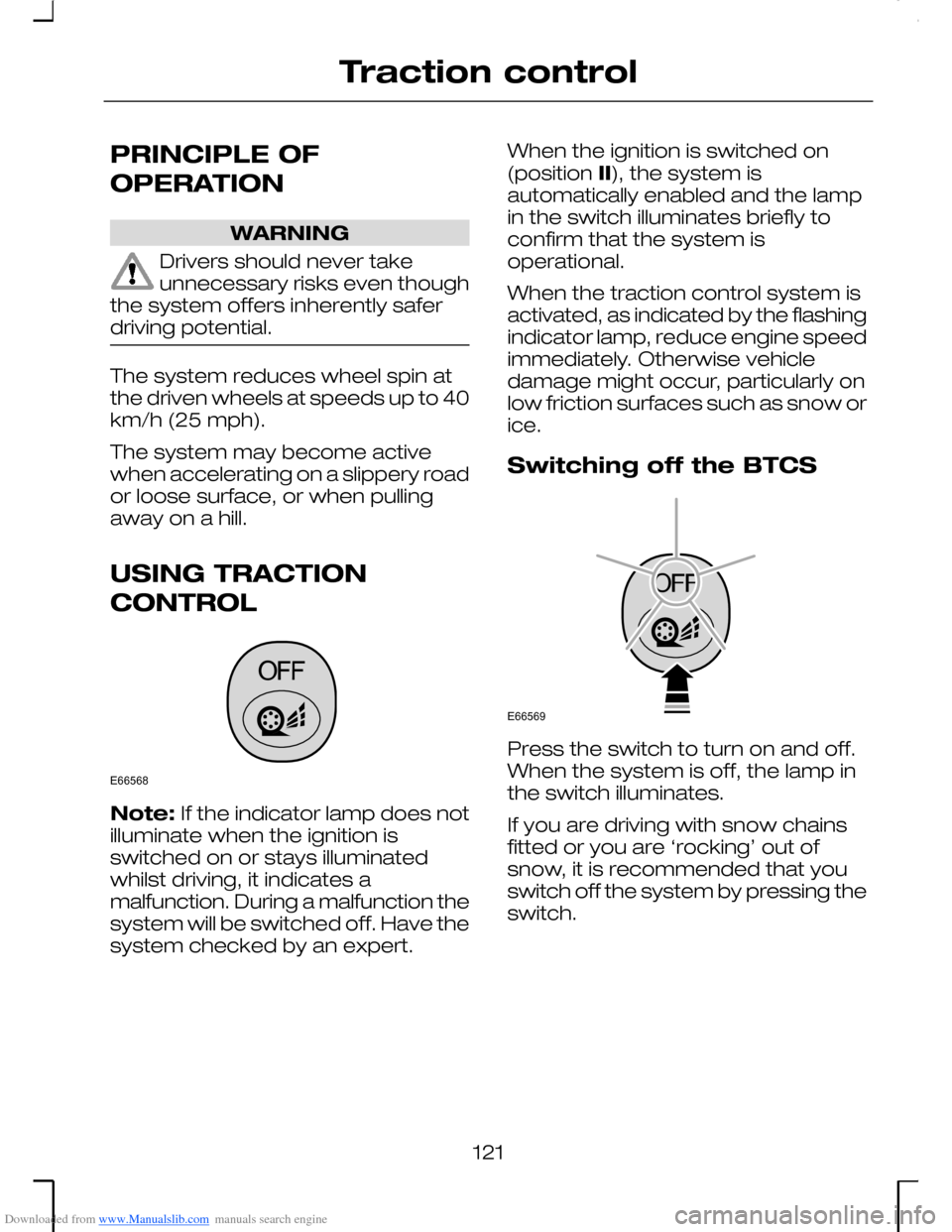
Note: If the indicator lamp does notilluminate when the ignition isswitched on or stays illuminatedwhilst driving, it indicates amalfunction. During a malfunction thesystem will be switched off. Have thesystem checked by an expert.
When the ignition is switched on(position II), the system isautomatically enabled and the lampin the switch illuminates briefly toconfirm that the system isoperational.
When the traction control system isactivated, as indicated by the flashingindicator lamp, reduce engine speedimmediately. Otherwise vehicledamage might occur, particularly onlow friction surfaces such as snow orice.
Switching off the BTCS
Press the switch to turn on and off.When the system is off, the lamp inthe switch illuminates.
If you are driving with snow chainsfitted or you are ‘rocking’ out ofsnow, it is recommended that youswitch off the system by pressing theswitch.
121
Traction controlE66568 E66569
Page 136 of 198
Downloaded from www.Manualslib.com manuals search engine FIRST AID KIT
4-door and 5-door
Vehicles with a temporaryspare wheel
Storage for a first aid kit is located oneither side of the luggagecompartment.
Vehicles with a full-size sparewheel
A fastening tape to secure a first aidkit is provided on the left side of theluggage compartment.
Estate
Storage for a first aid kit is located onthe left-hand side of the luggagecompartment.
WARNING TRIANGLE
4-door and 5-door
Vehicles with a temporaryspare wheel
Storage for a warning triangle islocated on either side of the luggagecompartment.
Vehicles with a full-size sparewheel
Storage for a warning triangle islocated on the right side of theluggage compartment in a foam trayunder the carpet.
Estate
Storage for a warning triangle islocated on the left-hand side of theluggage compartment.
134
Emergency equipment
Page 144 of 198
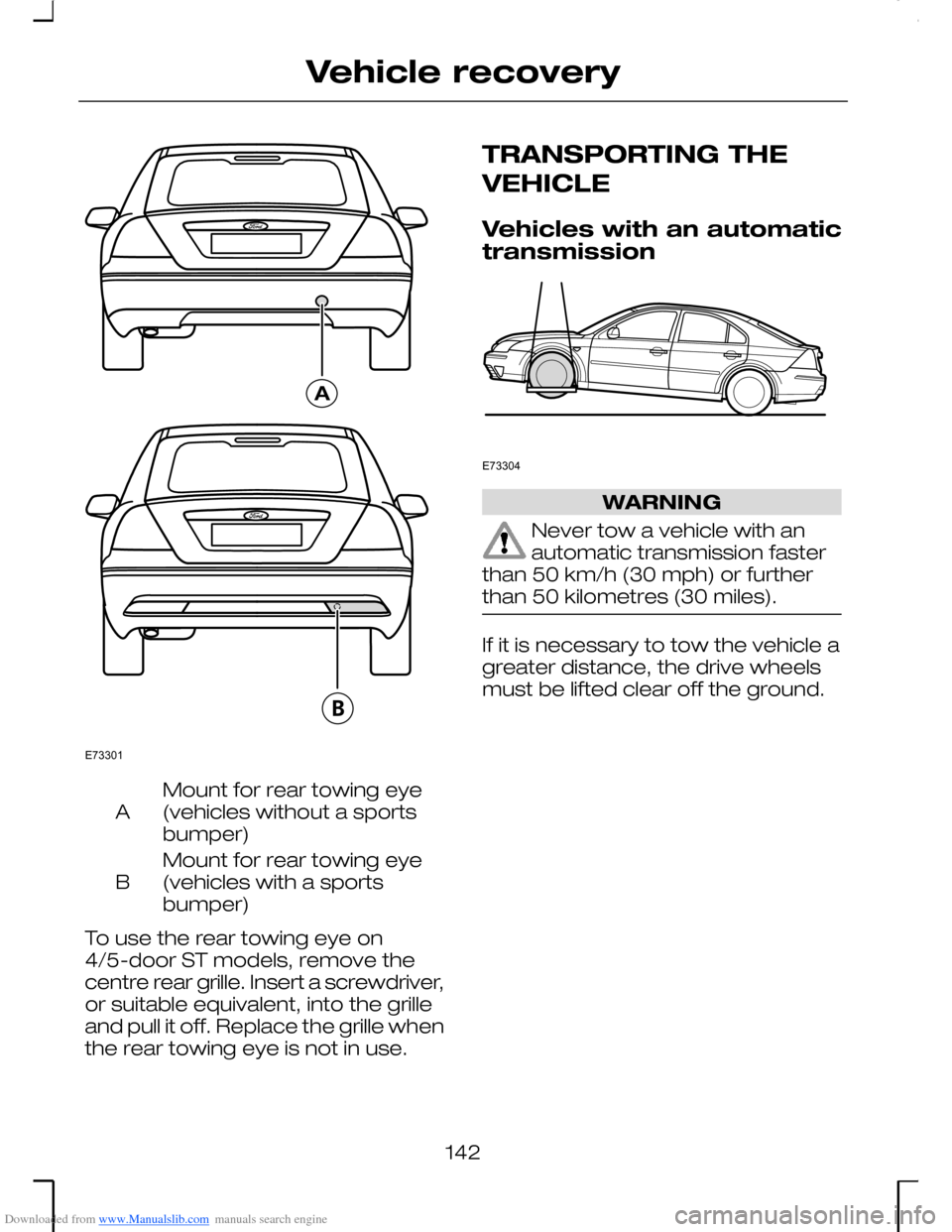
Downloaded from www.Manualslib.com manuals search engine Mount for rear towing eye(vehicles without a sportsbumper)A
Mount for rear towing eye(vehicles with a sportsbumper)B
To use the rear towing eye on4/5-door ST models, remove thecentre rear grille. Insert a screwdriver,or suitable equivalent, into the grilleand pull it off. Replace the grille whenthe rear towing eye is not in use.
TRANSPORTING THE
VEHICLE
Vehicles with an automatictransmission
WARNING
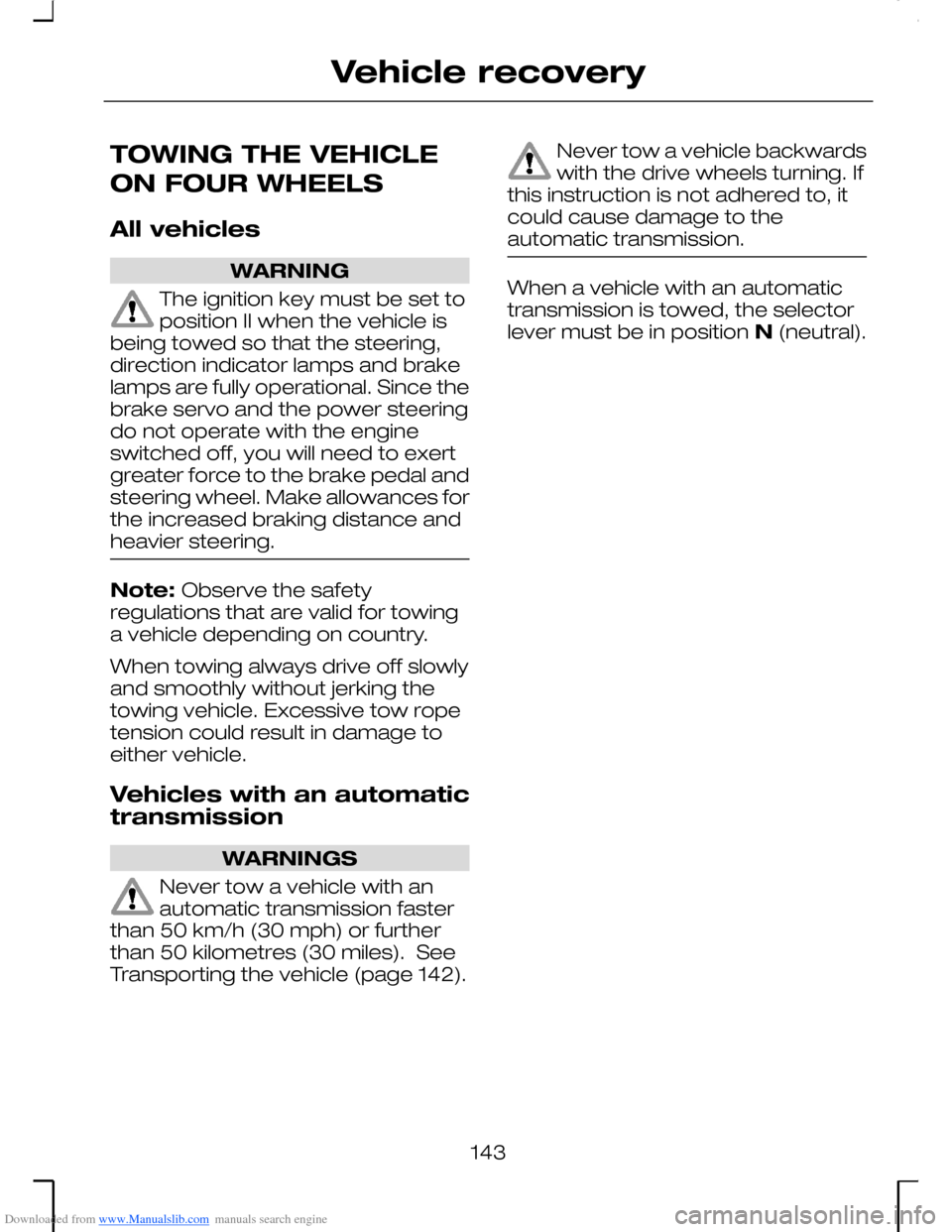
Never tow a vehicle with anautomatic transmission fasterthan 50 km/h (30 mph) or furtherthan 50 kilometres (30 miles).
If it is necessary to tow the vehicle agreater distance, the drive wheelsmust be lifted clear off the ground.
142
Vehicle recoveryE73301 E73304
Page 145 of 198
Downloaded from www.Manualslib.com manuals search engine TOWING THE VEHICLE
ON FOUR WHEELS
All vehicles
WARNING
The ignition key must be set toposition II when the vehicle isbeing towed so that the steering,direction indicator lamps and brakelamps are fully operational. Since thebrake servo and the power steeringdo not operate with the engineswitched off, you will need to exertgreater force to the brake pedal andsteering wheel. Make allowances forthe increased braking distance andheavier steering.
Note: Observe the safetyregulations that are valid for towinga vehicle depending on country.
When towing always drive off slowlyand smoothly without jerking thetowing vehicle. Excessive tow ropetension could result in damage toeither vehicle.
Vehicles with an automatictransmission
WARNINGS
Never tow a vehicle with anautomatic transmission fasterthan 50 km/h (30 mph) or furtherthan 50 kilometres (30 miles). SeeTransporting the vehicle (page 142).
Never tow a vehicle backwardswith the drive wheels turning. Ifthis instruction is not adhered to, itcould cause damage to theautomatic transmission.
When a vehicle with an automatictransmission is towed, the selectorlever must be in position N (neutral).
143
Vehicle recovery
Page 162 of 198
Downloaded from www.Manualslib.com manuals search engine CHANGING A ROAD
WHEEL
Spare wheel
All vehicles
WARNING
Use only approved wheel andtyre sizes. Using other sizescould damage the vehicle and willmake the National Type Approvalinvalid.
Vehicles with a temporaryspare wheel
WARNINGS
If the spare wheel differs fromthe other fitted wheels, theserules must be followed:
Do not exceed 80 km/h (50mph).
Drive the shortest possibledistances.
Do not fit more than one sparewheel on your vehicle at anyone time.
Do not use snow chains on thistype of wheel.
Do not drive through anautomatic car wash.
Vehicles with stability assist
Vehicles with ESP may exhibit someunusual driving characteristics. Switchthe ESP off. See Using stabilitycontrol (page 120).
4-door and 5-door
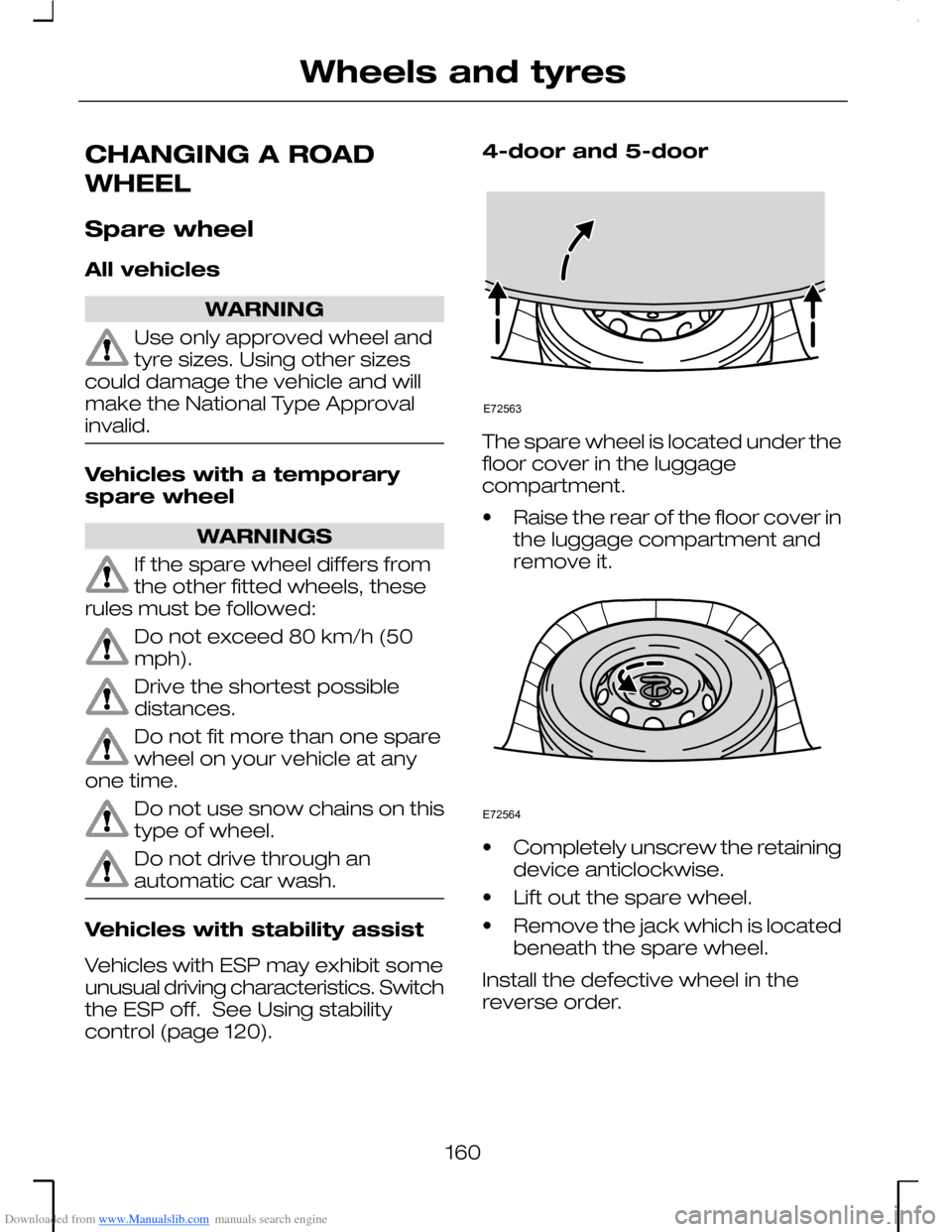
The spare wheel is located under thefloor cover in the luggagecompartment.
•Raise the rear of the floor cover inthe luggage compartment andremove it.
•Completely unscrew the retainingdevice anticlockwise.
•Lift out the spare wheel.
•Remove the jack which is locatedbeneath the spare wheel.
Install the defective wheel in thereverse order.
160
Wheels and tyresE72563 E72564
Page 163 of 198
Downloaded from www.Manualslib.com manuals search engine Estate
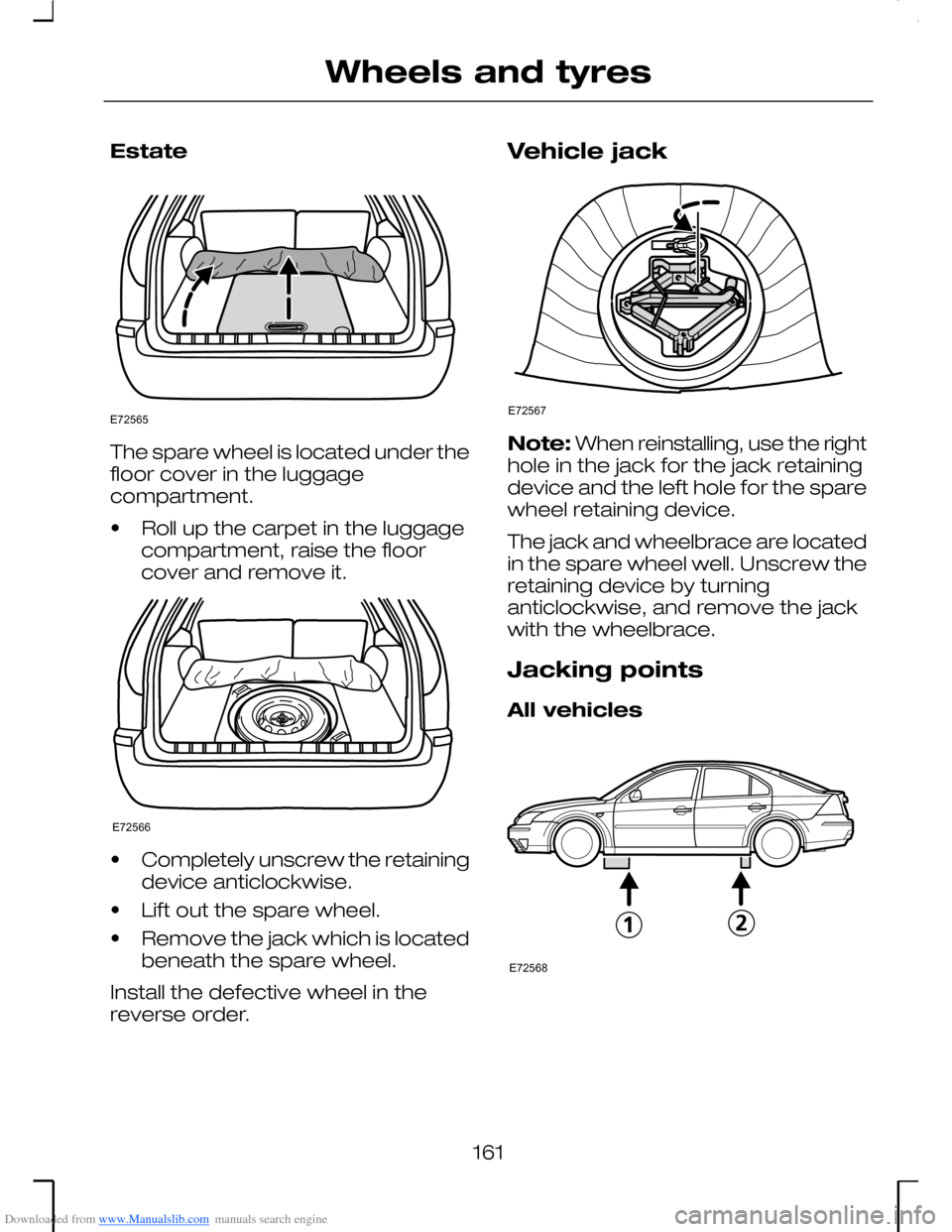
The spare wheel is located under thefloor cover in the luggagecompartment.
•Roll up the carpet in the luggagecompartment, raise the floorcover and remove it.
•Completely unscrew the retainingdevice anticlockwise.
•Lift out the spare wheel.
•Remove the jack which is locatedbeneath the spare wheel.
Install the defective wheel in thereverse order.
Vehicle jack
Note: When reinstalling, use the righthole in the jack for the jack retainingdevice and the left hole for the sparewheel retaining device.
The jack and wheelbrace are locatedin the spare wheel well. Unscrew theretaining device by turninganticlockwise, and remove the jackwith the wheelbrace.
Jacking points
All vehicles
161
Wheels and tyresE72565 E72566 E72567 E72568
Page 164 of 198
Downloaded from www.Manualslib.com manuals search engine WARNING
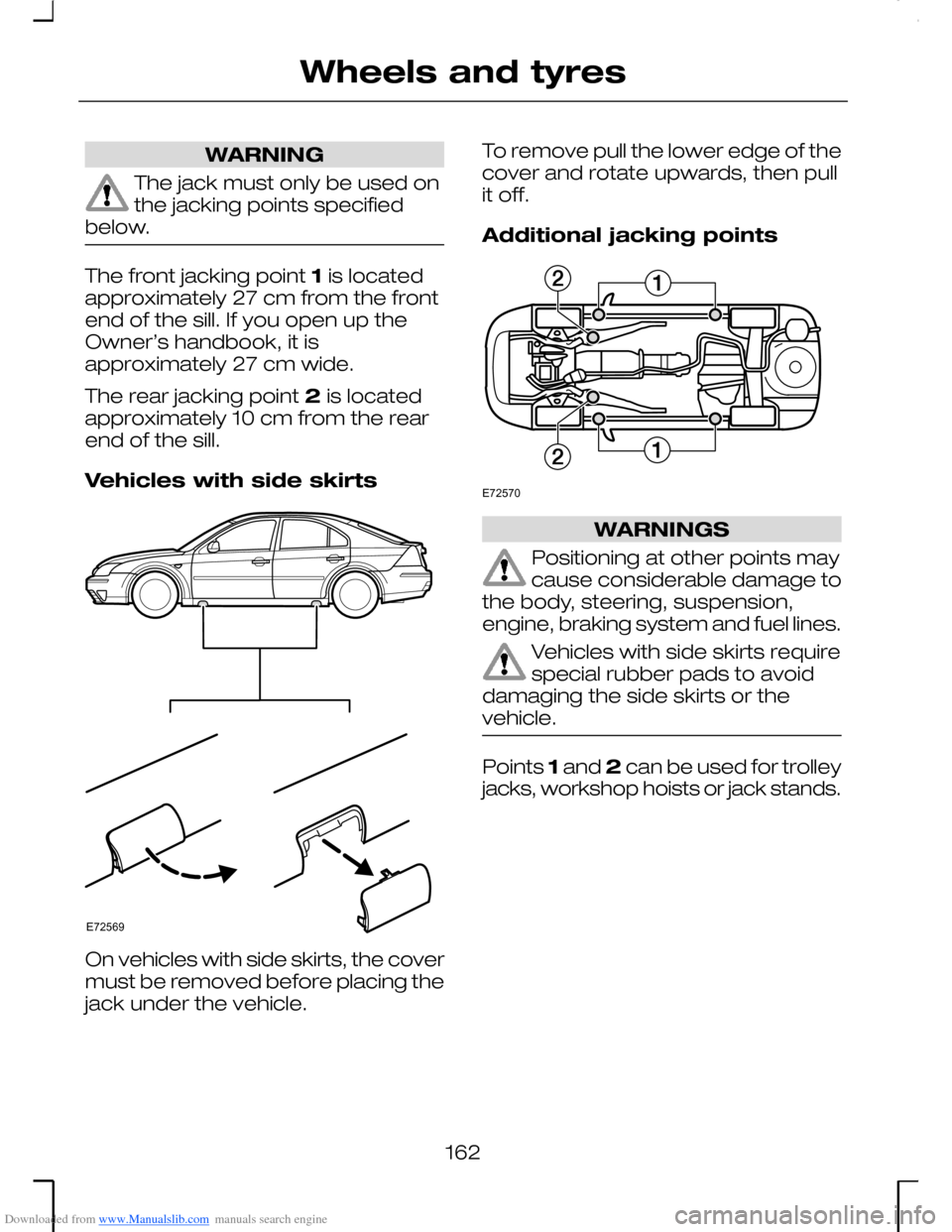
The jack must only be used onthe jacking points specifiedbelow.
The front jacking point 1 is locatedapproximately 27 cm from the frontend of the sill. If you open up theOwner’s handbook, it isapproximately 27 cm wide.
The rear jacking point 2 is locatedapproximately 10 cm from the rearend of the sill.
Vehicles with side skirts
On vehicles with side skirts, the covermust be removed before placing thejack under the vehicle.
To remove pull the lower edge of thecover and rotate upwards, then pullit off.
Additional jacking points
WARNINGS
Positioning at other points maycause considerable damage tothe body, steering, suspension,engine, braking system and fuel lines.
Vehicles with side skirts requirespecial rubber pads to avoiddamaging the side skirts or thevehicle.
Points 1 and 2 can be used for trolleyjacks, workshop hoists or jack stands.
162
Wheels and tyresE72569 E72570
Page 165 of 198
Downloaded from www.Manualslib.com manuals search engine Removing a wheel
All vehicles
WARNINGS
Park your vehicle in such aposition that neither the trafficnor you are hindered or endangeredwhen changing a wheel.
Set up a warning triangle.
Ensure that the vehicle is onfirm, level ground.
If necessary, secure the vehiclewith suitable chocks.
Point the front wheels straightahead.
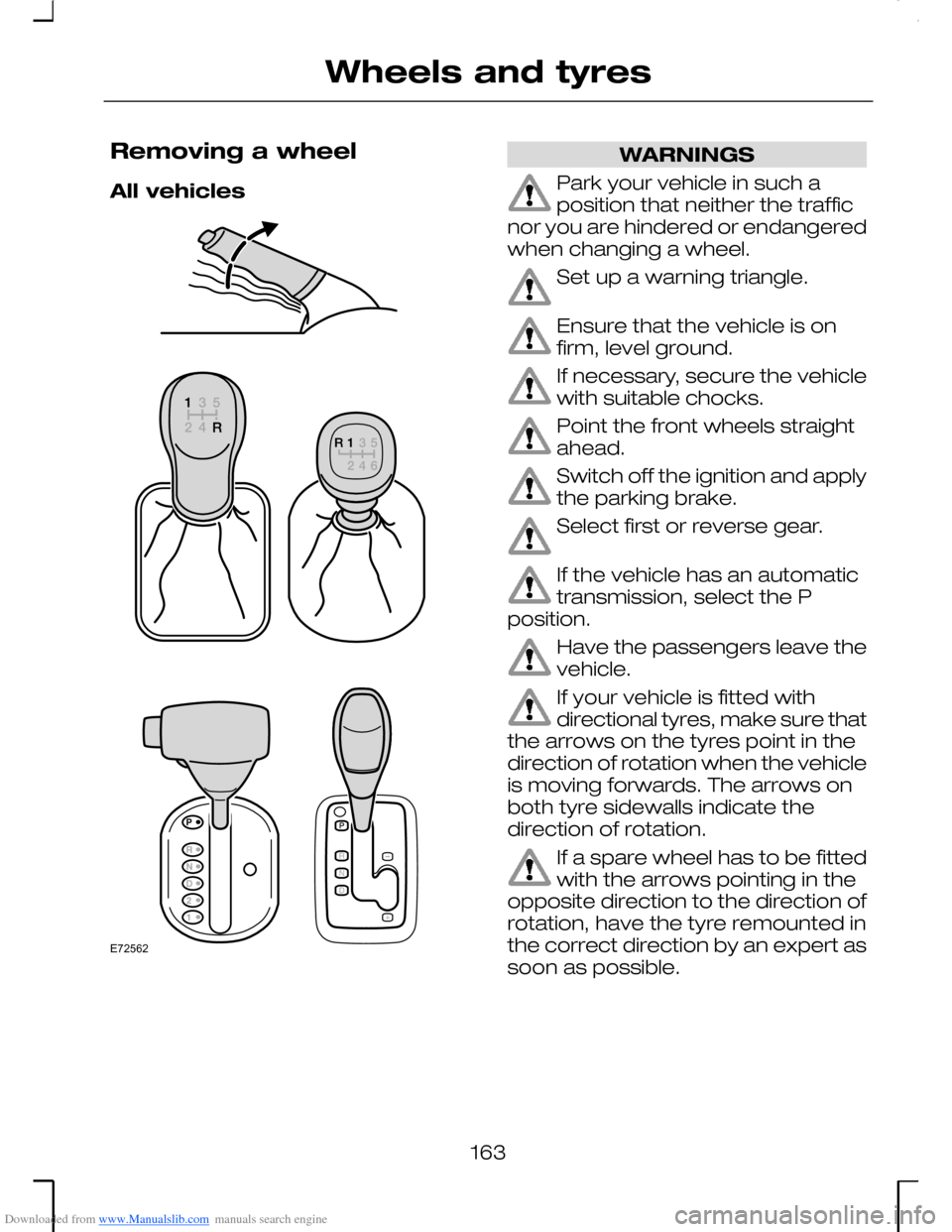
Switch off the ignition and applythe parking brake.
Select first or reverse gear.
If the vehicle has an automatictransmission, select the Pposition.
Have the passengers leave thevehicle.
If your vehicle is fitted withdirectional tyres, make sure thatthe arrows on the tyres point in thedirection of rotation when the vehicleis moving forwards. The arrows onboth tyre sidewalls indicate thedirection of rotation.
If a spare wheel has to be fittedwith the arrows pointing in theopposite direction to the direction ofrotation, have the tyre remounted inthe correct direction by an expert assoon as possible.
163
Wheels and tyresE72562