height FORD POLICE INTERCEPTOR 2018 Warranty Guide
[x] Cancel search | Manufacturer: FORD, Model Year: 2018, Model line: POLICE INTERCEPTOR, Model: FORD POLICE INTERCEPTOR 2018Pages: 364, PDF Size: 8.07 MB
Page 195 of 364
CHANGING THE WIPER
BLADES
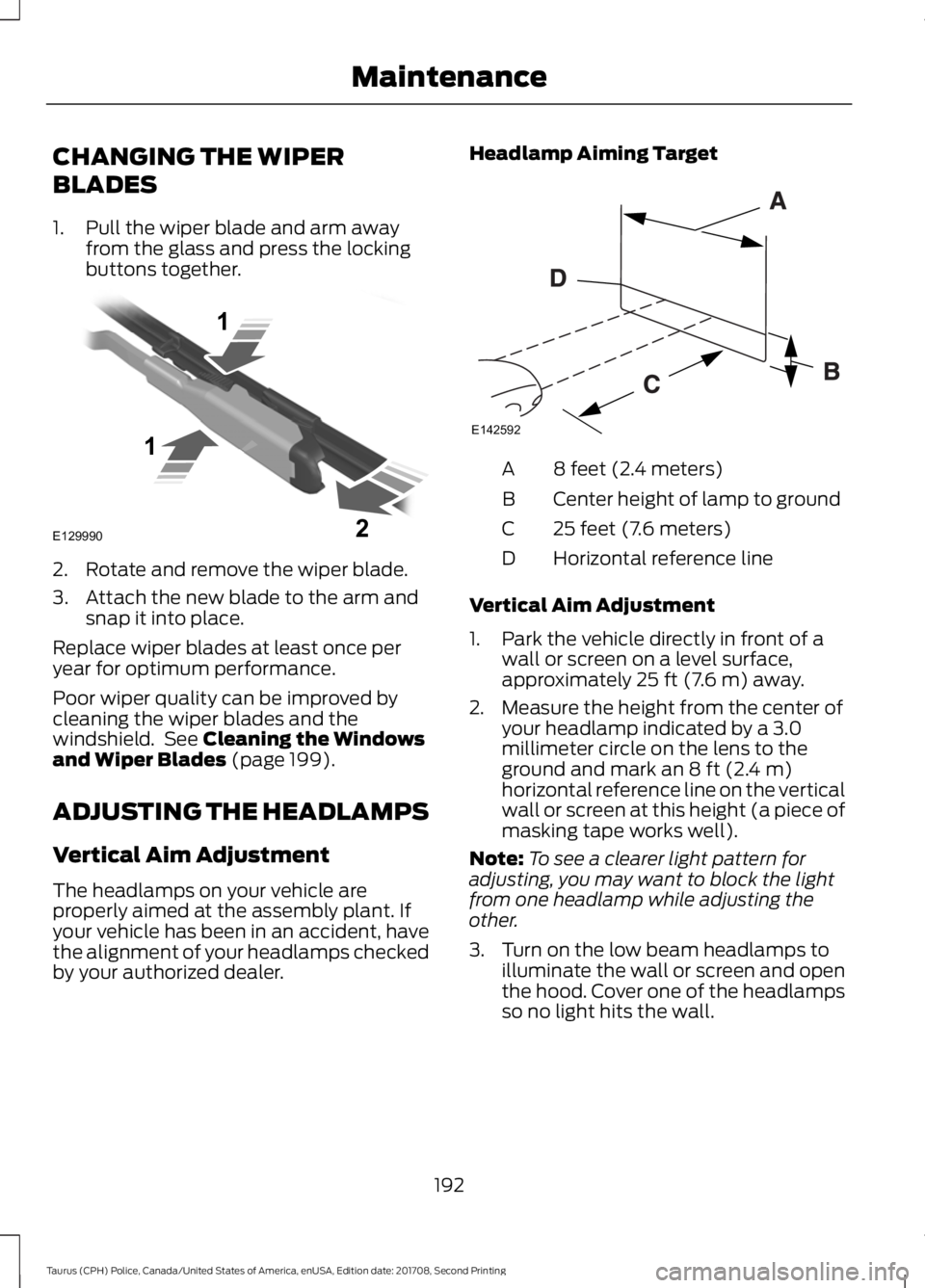
1. Pull the wiper blade and arm away
from the glass and press the locking
buttons together. 2. Rotate and remove the wiper blade.
3. Attach the new blade to the arm and
snap it into place.
Replace wiper blades at least once per
year for optimum performance.
Poor wiper quality can be improved by
cleaning the wiper blades and the
windshield. See Cleaning the Windows
and Wiper Blades (page 199).
ADJUSTING THE HEADLAMPS
Vertical Aim Adjustment
The headlamps on your vehicle are
properly aimed at the assembly plant. If
your vehicle has been in an accident, have
the alignment of your headlamps checked
by your authorized dealer. Headlamp Aiming Target
8 feet (2.4 meters)
A
Center height of lamp to ground
B
25 feet (7.6 meters)
C
Horizontal reference line
D
Vertical Aim Adjustment
1. Park the vehicle directly in front of a wall or screen on a level surface,
approximately
25 ft (7.6 m) away.
2. Measure the height from the center of your headlamp indicated by a 3.0
millimeter circle on the lens to the
ground and mark an
8 ft (2.4 m)
horizontal reference line on the vertical
wall or screen at this height (a piece of
masking tape works well).
Note: To see a clearer light pattern for
adjusting, you may want to block the light
from one headlamp while adjusting the
other.
3. Turn on the low beam headlamps to illuminate the wall or screen and open
the hood. Cover one of the headlamps
so no light hits the wall.
192
Taurus (CPH) Police, Canada/United States of America, enUSA, Edition date: 201708, Second Printing MaintenanceE129990
1
1 2 E142592
Page 211 of 364
describes the fundamental
characteristics of the tire and also
provides a U.S. DOT Tire
Identification Number for safety
standard certification and in case
of a recall.
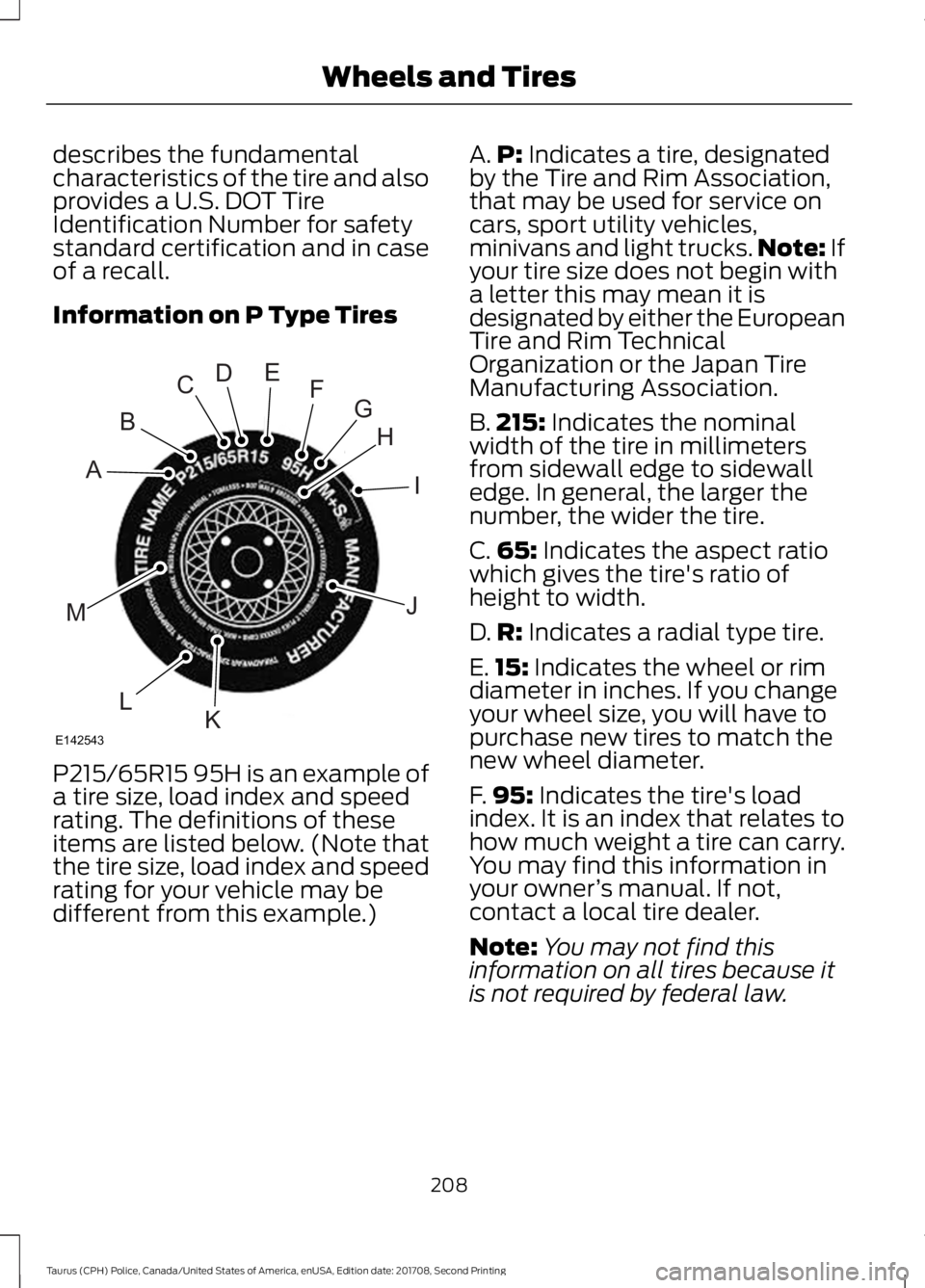
Information on P Type Tires
P215/65R15 95H is an example of
a tire size, load index and speed
rating. The definitions of these
items are listed below. (Note that
the tire size, load index and speed
rating for your vehicle may be
different from this example.) A.
P: Indicates a tire, designated
by the Tire and Rim Association,
that may be used for service on
cars, sport utility vehicles,
minivans and light trucks. Note:
If
your tire size does not begin with
a letter this may mean it is
designated by either the European
Tire and Rim Technical
Organization or the Japan Tire
Manufacturing Association.
B. 215:
Indicates the nominal
width of the tire in millimeters
from sidewall edge to sidewall
edge. In general, the larger the
number, the wider the tire.
C. 65:
Indicates the aspect ratio
which gives the tire's ratio of
height to width.
D. R:
Indicates a radial type tire.
E. 15:
Indicates the wheel or rim
diameter in inches. If you change
your wheel size, you will have to
purchase new tires to match the
new wheel diameter.
F. 95:
Indicates the tire's load
index. It is an index that relates to
how much weight a tire can carry.
You may find this information in
your owner ’s manual. If not,
contact a local tire dealer.
Note: You may not find this
information on all tires because it
is not required by federal law.
208
Taurus (CPH) Police, Canada/United States of America, enUSA, Edition date: 201708, Second Printing Wheels and TiresH
I
J
KL
M
A
B
CDEFG
E142543
Page 215 of 364
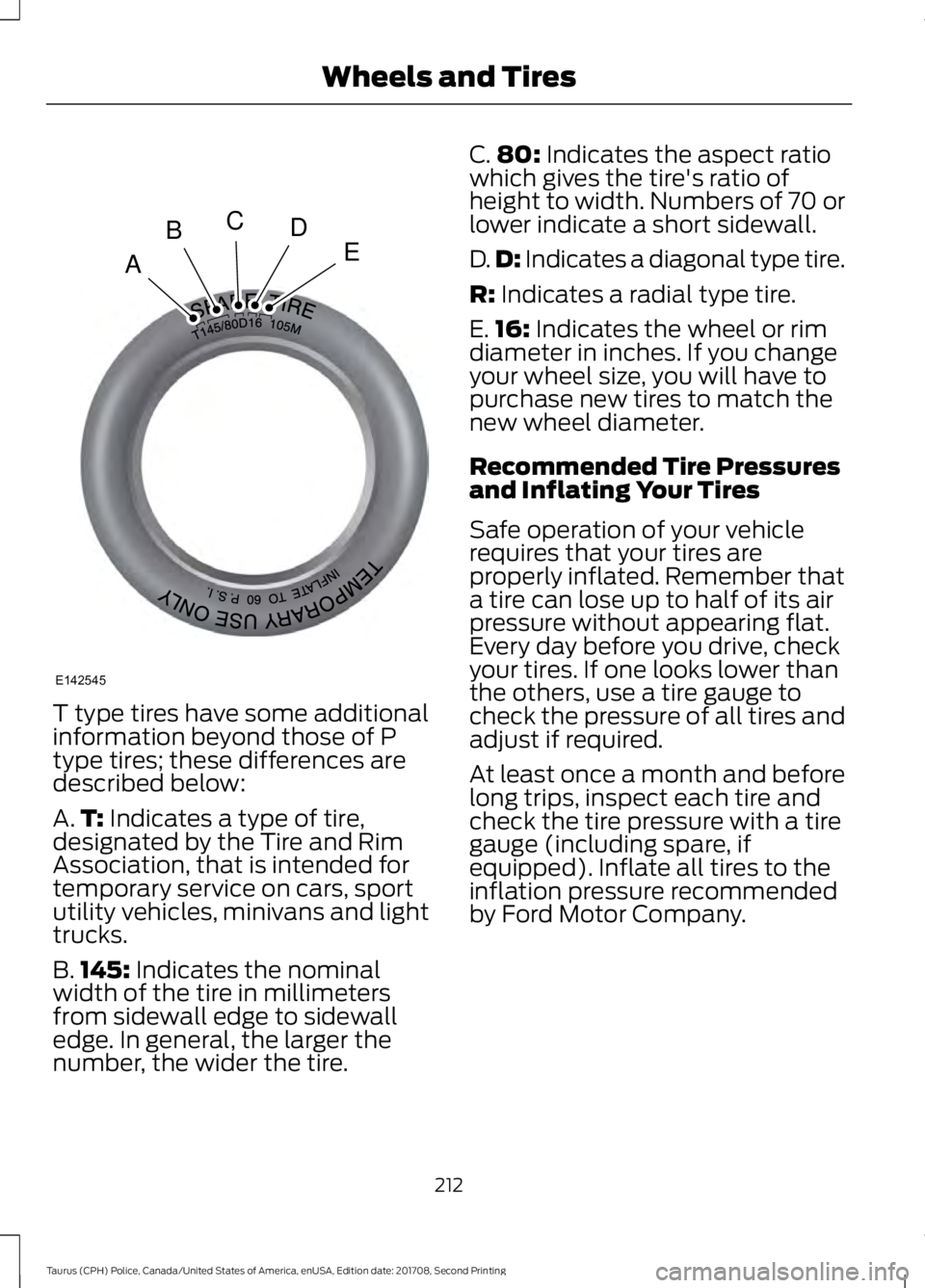
T type tires have some additional
information beyond those of P
type tires; these differences are
described below:
A.
T: Indicates a type of tire,
designated by the Tire and Rim
Association, that is intended for
temporary service on cars, sport
utility vehicles, minivans and light
trucks.
B. 145:
Indicates the nominal
width of the tire in millimeters
from sidewall edge to sidewall
edge. In general, the larger the
number, the wider the tire. C.
80:
Indicates the aspect ratio
which gives the tire's ratio of
height to width. Numbers of 70 or
lower indicate a short sidewall.
D. D:
Indicates a diagonal type tire.
R:
Indicates a radial type tire.
E. 16:
Indicates the wheel or rim
diameter in inches. If you change
your wheel size, you will have to
purchase new tires to match the
new wheel diameter.
Recommended Tire Pressures
and Inflating Your Tires
Safe operation of your vehicle
requires that your tires are
properly inflated. Remember that
a tire can lose up to half of its air
pressure without appearing flat.
Every day before you drive, check
your tires. If one looks lower than
the others, use a tire gauge to
check the pressure of all tires and
adjust if required.
At least once a month and before
long trips, inspect each tire and
check the tire pressure with a tire
gauge (including spare, if
equipped). Inflate all tires to the
inflation pressure recommended
by Ford Motor Company.
212
Taurus (CPH) Police, Canada/United States of America, enUSA, Edition date: 201708, Second Printing Wheels and TiresA
BCDE
E142545
Page 217 of 364
is suspected, have the tire
demounted and inspected in case
it needs to be repaired or replaced.
For your safety, tires that are
damaged or show signs of
excessive wear should not be used
because they are more likely to
blow out or fail.
Improper or inadequate vehicle
maintenance can cause tires to
wear abnormally. Inspect all your
tires, including the spare,
frequently, and replace them if
one or more of the following
conditions exist:
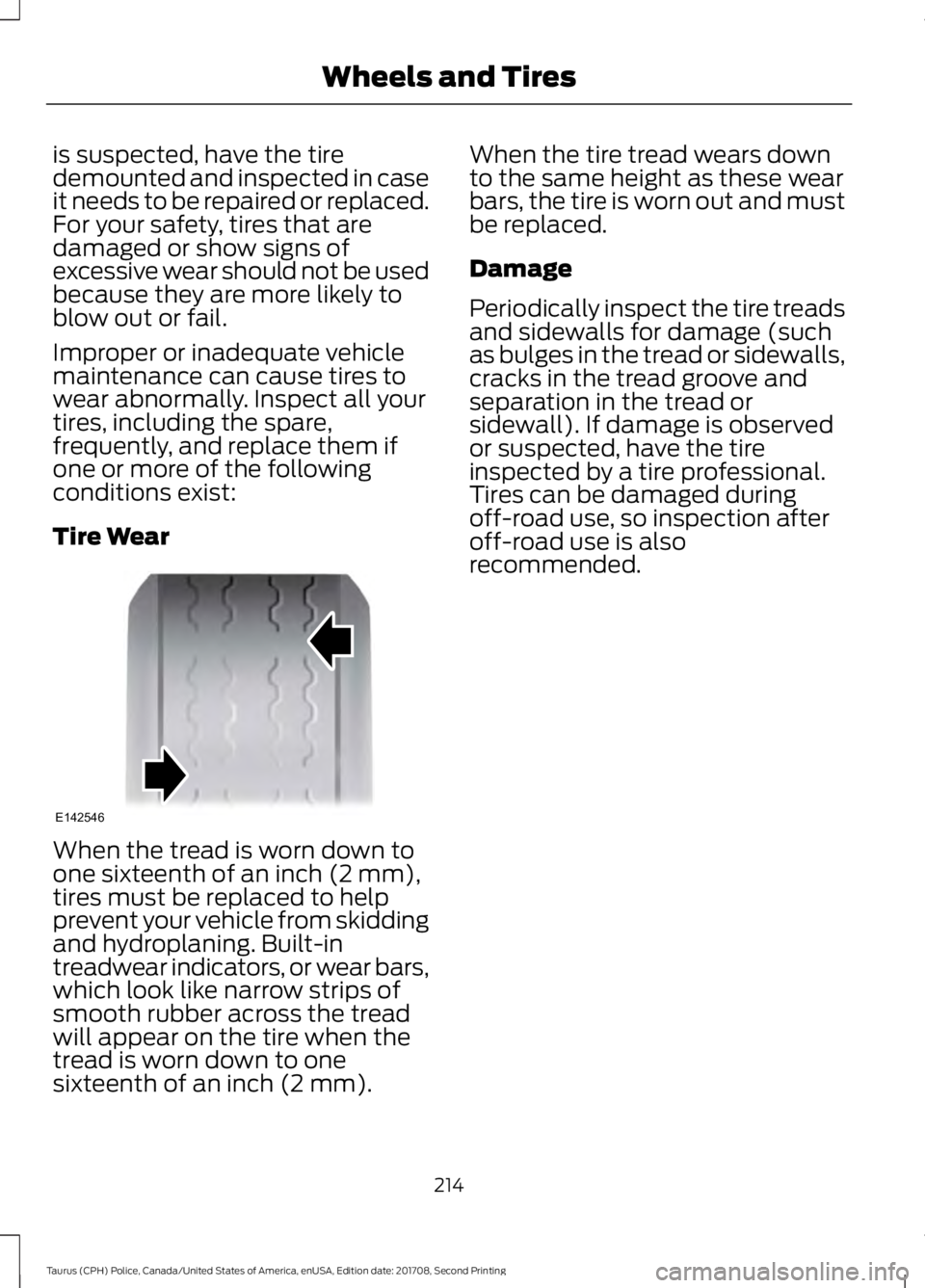
Tire Wear
When the tread is worn down to
one sixteenth of an inch (2 mm),
tires must be replaced to help
prevent your vehicle from skidding
and hydroplaning. Built-in
treadwear indicators, or wear bars,
which look like narrow strips of
smooth rubber across the tread
will appear on the tire when the
tread is worn down to one
sixteenth of an inch (2 mm). When the tire tread wears down
to the same height as these wear
bars, the tire is worn out and must
be replaced.
Damage
Periodically inspect the tire treads
and sidewalls for damage (such
as bulges in the tread or sidewalls,
cracks in the tread groove and
separation in the tread or
sidewall). If damage is observed
or suspected, have the tire
inspected by a tire professional.
Tires can be damaged during
off-road use, so inspection after
off-road use is also
recommended.
214
Taurus (CPH) Police, Canada/United States of America, enUSA, Edition date: 201708, Second Printing Wheels and TiresE142546
Page 362 of 364
Filling a Portable Fuel Container..................
100
S
Safety Canopy ™............................................43
Safety Precautions........................................97
Scheduled Maintenance Record............314
Scheduled Maintenance..........................306
Seatbelt Extension
........................................35
Seatbelt Height Adjustment......................32
Seatbelt Reminder
.........................................33
Belt-Minder™........................................................ 33
Seatbelts...........................................................29 Principle of Operation........................................ 29
Seatbelt Warning Lamp and Indicator Chime...............................................................32
Conditions of operation..................................... 32
Seats...................................................................86
Security..............................................................55
Side Airbags.....................................................42
Sitting in the Correct Position...................86
Snow Chains See: Using Snow Chains.................................. 219
Spare Wheel See: Changing a Road Wheel........................ 223
Special Notices................................................12 My Fleet Management........................................ 13
New Vehicle Limited Warranty......................... 12
On-board Diagnostics (OBD-II)....................... 13
Special Instructions.............................................. 12
Special Operating Conditions Scheduled Maintenance................................................312
Engine Idle Hour Meter..................................... 313
Exceptions............................................................. 314
Speed Control See: Cruise Control............................................ 129
Stability Control
............................................123
Principle of Operation....................................... 123
Starter Switch See: Ignition Switch............................................. 92
Starting a Gasoline Engine.........................92 Cold Weather Starting - Flex Fuel
Vehicles............................................................... 93
Failure to Start....................................................... 93
Guarding Against Exhaust Fumes.................94
Important Ventilating Information................94
Stopping the Engine When Your Vehicle is Moving................................................................. 94Stopping the Engine When Your Vehicle is
Stationary.......................................................... 94
Starting and Stopping the Engine...........92 General Information............................................ 92
Steering............................................................135 Electric Power Steering.................................... 135
Steering Wheel
...............................................56
Storage Compartments...............................91
Sun Visors.........................................................68 Slide-on-rod.......................................................... 68
Supplementary Restraints System..........37 Principle of Operation......................................... 37
Symbols Glossary
.............................................7
SYNC™ Applications and Services........................................................282
911 Assist............................................................... 282
SYNC™ AppLink ™
.....................................284
SYNC Mobile Apps............................................ 284
SYNC™...........................................................264 General Information......................................... 264
SYNC™ Troubleshooting.........................295
T
Technical Specifications See: Capacities and Specifications............229
The Better Business Bureau (BBB) Auto Line Program (U.S. Only).......................158
Tire Care..........................................................205 Glossary of Tire Terminology........................ 206
Information About Uniform Tire Quality Grading............................................................. 205
Information Contained on the Tire Sidewall............................................................ 207
Police Wheels and Tires................................... 218
Temperature A B C............................................ 206
Traction AA A B C.............................................. 206
Treadwear............................................................ 205
Tire Pressure Monitoring System...........220 Changing Tires With a Tire Pressure
Monitoring System........................................ 221
Understanding Your Tire Pressure Monitoring System ....................................... 221
Tires See: Wheels and Tires..................................... 205
Towing a Trailer
.............................................142
Load Placement.................................................. 142
359
Taurus (CPH) Police, Canada/United States of America, enUSA, Edition date: 201708, Second Printing Index