cooling FORD POLICE INTERCEPTOR 2019 User Guide
[x] Cancel search | Manufacturer: FORD, Model Year: 2019, Model line: POLICE INTERCEPTOR, Model: FORD POLICE INTERCEPTOR 2019Pages: 370, PDF Size: 4.5 MB
Page 187 of 370
When Fail-Safe Mode Is Activated
WARNING: Fail-safe mode is for
use during emergencies only. Operate
your vehicle in fail-safe mode only as
long as necessary to bring your vehicle
to rest in a safe location and seek
immediate repairs. When in fail-safe
mode, your vehicle will have limited
power, will not be able to maintain
high-speed operation, and may
completely shut down without warning,
potentially losing engine power, power
steering assist, and power brake assist,
which may increase the possibility of a
crash resulting in serious injury. WARNING:
Do not remove the
coolant reservoir cap when the engine is
on or the cooling system is hot. Wait 10
minutes for the cooling system to cool
down. Cover the coolant reservoir cap
with a thick cloth to prevent the
possibility of scalding and slowly remove
the cap. Failure to follow this instruction
could result in personal injury.
Your vehicle has limited engine power
when in the fail-safe mode, drive your
vehicle with caution. Your vehicle does not
maintain high-speed operation and the
engine may operate poorly.
Remember that the engine is capable of
automatically shutting down to prevent
engine damage. In this situation:
1. Pull off the road as soon as safely possible and switch the engine off.
2. If you are a member of a roadside assistance program, we recommend
that you contact your roadside
assistance service provider.
3. If this is not possible, wait for a short period of time for the engine to cool. 4. Check the coolant level. If the coolant
level is at or below the minimum mark,
add prediluted coolant immediately.
5. When the engine temperature cools, you can re-start the engine. Have your
vehicle checked as soon as possible to
minimize engine damage.
Note: Driving your vehicle without repair
increases the chance of engine damage.
Engine Coolant Temperature
Management
(If Equipped) WARNING:
To reduce the risk of
crash and injury, be prepared that the
vehicle speed may reduce and the
vehicle may not be able to accelerate
with full power until the coolant
temperature reduces.
If you tow a trailer with your vehicle, the
engine may temporarily reach a higher
temperature during severe operating
conditions, for example ascending a long
or steep grade in high ambient
temperatures.
At this time, you may notice the coolant
temperature gauge moves toward the red
zone and a message may appear in the
information display.
You may notice a reduction in vehicle
speed caused by reduced engine power in
order to manage the engine coolant
temperature. Your vehicle may enter this
mode if certain high-temperature and
high-load conditions take place. The
amount of speed reduction depends on
vehicle loading, grade and ambient
temperature. If this occurs, there is no
need to stop your vehicle. You can
continue to drive.
184
Police Interceptor (CPH) Police, Canada/United States of America, enUSA, Edition date: 201806, First-Printing Maintenance
Page 188 of 370
The air conditioning may automatically
turn on and off during severe operating
conditions to protect the engine from
overheating. When the coolant
temperature decreases to the normal
operating temperature, the air conditioning
turns on.
If the coolant temperature gauge moves
fully into the red zone, or if the coolant
temperature warning or service engine
soon messages appear in your information
display, do the following:
1. Stop your vehicle as soon as it is safe
to do so. Fully apply the parking brake,
shift into park (P) or neutral (N).
2. Leave the engine running until the coolant temperature gauge needle
returns to the normal position. If the
temperature does not drop after
several minutes, follow the remaining
steps.
3. Switch the engine off and wait for it to
cool. Check the coolant level.
4. If the coolant level is at or below the minimum mark, add prediluted coolant
immediately.
5. If the coolant level is normal, restart the engine and continue.
AUTOMATIC TRANSMISSION
FLUID CHECK - 3.5L DURATEC/
3.5L ECOBOOST™/3.7L
6F50/6F55 Transmission (If Equipped) WARNING: The dipstick and
surrounding components are hot. Use
gloves when moving components and
checking the transmission fluid level.
Failure to follow this warning could result
in serious personal injury. Note:
Automatic transmission fluid
expands when warmed. To obtain an
accurate fluid check, drive your vehicle until
you warm it up, approximately
20 mi
(30 km). If you operate your vehicle for an
extended period at high speeds, in city traffic
during hot weather or pulling a trailer, switch
your vehicle off until it reaches normal
operating temperatures to allow the fluid
to cool before checking. Depending on
vehicle use, cooling times could take up to
30 minutes or longer.
Refer to your scheduled maintenance
information for scheduled intervals for fluid
checks and changes. Your transmission
does not consume fluid. However, you
should check the fluid level if the
transmission is not working properly. For
example, if the transmission slips or shifts
slowly or if you notice some sign of a fluid
leak.
1. Drive your vehicle
20 mi (30 km) or
until it reaches normal operating
temperature.
2. Park your vehicle on a level surface and
engage the parking brake.
3. With the parking brake engaged and your foot on the brake pedal, start the
engine and move the gearshift lever
through all of the gear ranges. Allow a
minimum of 10 seconds for each gear
to engage.
4. Put the gearshift lever in park (P) and leave the engine running.
Note: For vehicles with the EcoBoost
engine, move the air filter assembly aside
to access the transmission dipstick. See
Moving the Air Filter Assembly for more
information.
5. Remove the dipstick and wipe it clean with a dry, lint free clean rag. If
necessary, refer to the Under hood
overview in this chapter for the location
of the dipstick.
185
Police Interceptor (CPH) Police, Canada/United States of America, enUSA, Edition date: 201806, First-Printing Maintenance
Page 190 of 370
7. Pull the air filter assembly up to
disconnect it from the seated
grommets located under the air filter
assembly.
8. Rotate the air filter assembly 90 degrees counterclockwise. Make sure
the rubber hose is still connected to the
air filter assembly.
9. Tighten the clamp.
You can now access the transmission fluid
level indicator.
Checking the fluid level
Check the transmission fluid at the normal
operating temperatures between
88°C+5°C (190°F+10°F) on a level
surface. Drive your vehicle until you warm
it up to the normal operating temperature
after approximately 20 mi (30 km).
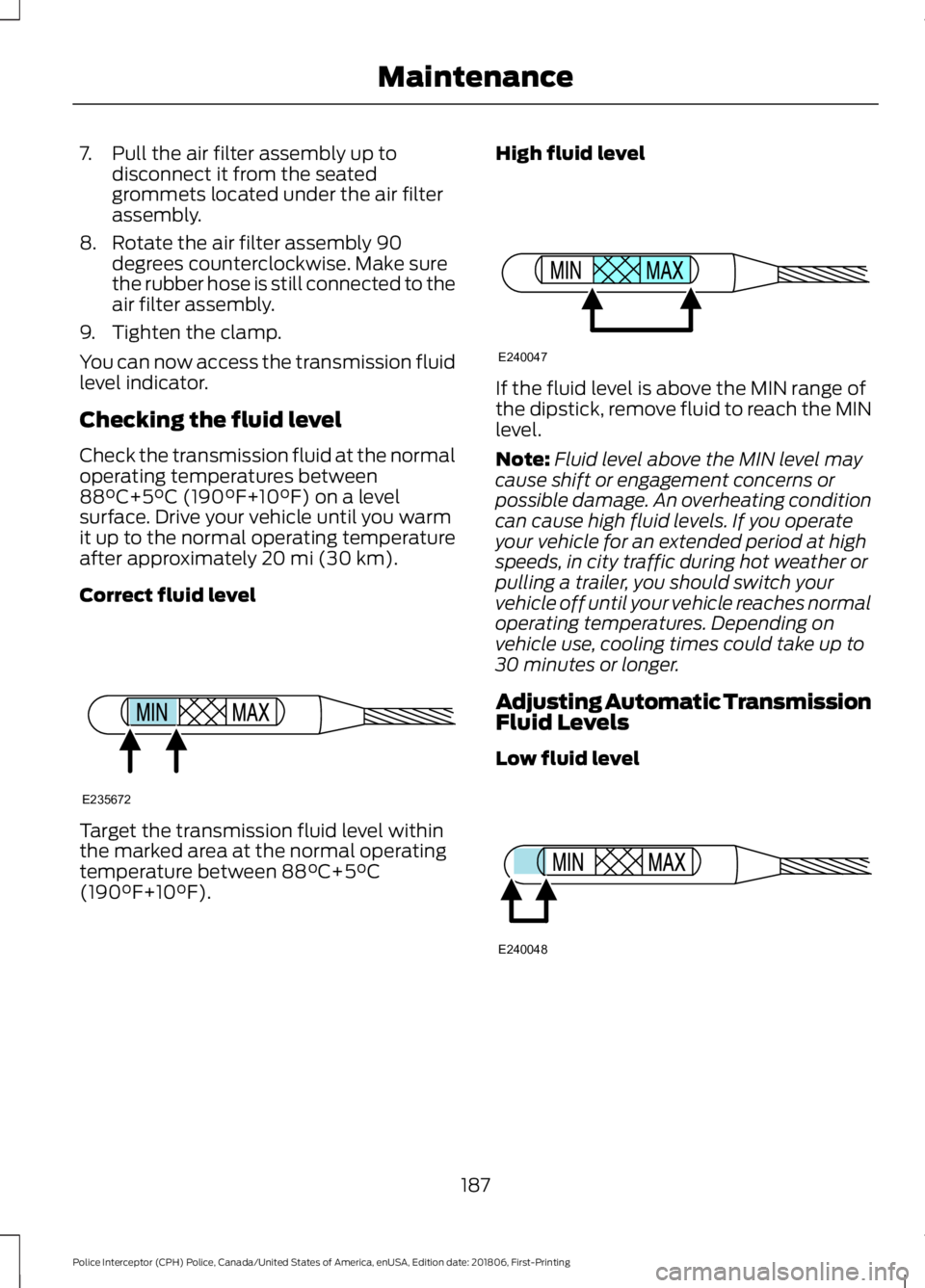
Correct fluid level Target the transmission fluid level within
the marked area at the normal operating
temperature between 88°C+5°C
(190°F+10°F). High fluid level If the fluid level is above the MIN range of
the dipstick, remove fluid to reach the MIN
level.
Note:
Fluid level above the MIN level may
cause shift or engagement concerns or
possible damage. An overheating condition
can cause high fluid levels. If you operate
your vehicle for an extended period at high
speeds, in city traffic during hot weather or
pulling a trailer, you should switch your
vehicle off until your vehicle reaches normal
operating temperatures. Depending on
vehicle use, cooling times could take up to
30 minutes or longer.
Adjusting Automatic Transmission
Fluid Levels
Low fluid level 187
Police Interceptor (CPH) Police, Canada/United States of America, enUSA, Edition date: 201806, First-Printing MaintenanceE235672 E240047 E240048
Page 205 of 370
•
Cover interior trim to prevent fading.
• Keep all rubber parts free from oil and
solvents.
Engine
• Change the engine oil and filter prior to
storage because used engine oil
contains contaminates which may
cause engine damage.
• Start the engine every 15 days for a
minimum of 15 minutes. Run at fast idle
with the climate controls set to defrost
until the engine reaches normal
operating temperature.
• With your foot on the brake, shift
through all the gears while the engine
is running.
• We recommend that you change the
engine oil before you use your vehicle
again.
Fuel system
• Fill the fuel tank with high-quality fuel
until the first automatic shutoff of the
fuel pump nozzle.
Cooling system
• Protect against freezing temperatures.
• When removing your vehicle from
storage, check coolant fluid level.
Confirm that there are no cooling
system leaks and that fluid is at the
recommended level.
Battery
• Check and recharge as necessary. Keep
connections clean.
• If storing your vehicle for more than 30
days without recharging the battery,
we recommend that you disconnect
the battery cables to maintain battery
charge for quick starting. Note:
It is necessary to reset memory
features if battery cables are disconnected.
Brakes
• Make sure the brakes and parking brake
release fully.
Tires
• Maintain recommended air pressure.
Miscellaneous
• Make sure all linkages, cables, levers
and pins under your vehicle are covered
with grease to prevent rust.
• Move vehicles at least 25 ft (7.5 m)
every 15 days to lubricate working parts
and prevent corrosion.
Removing Vehicle From Storage
When your vehicle is ready to come out of
storage, do the following:
• Wash your vehicle to remove any dirt
or grease film build-up on window
surfaces.
• Check windshield wipers for any
deterioration.
• Check under the hood for any foreign
material that may have collected
during storage such as mice or squirrel
nests.
• Check the exhaust for any foreign
material that may have collected
during storage.
• Check tire pressures and set tire
inflation per the Tire Label.
• Check brake pedal operation. Drive
your vehicle
15 ft (4.5 m) back and
forth to remove rust build-up.
202
Police Interceptor (CPH) Police, Canada/United States of America, enUSA, Edition date: 201806, First-Printing Vehicle Care
Page 304 of 370
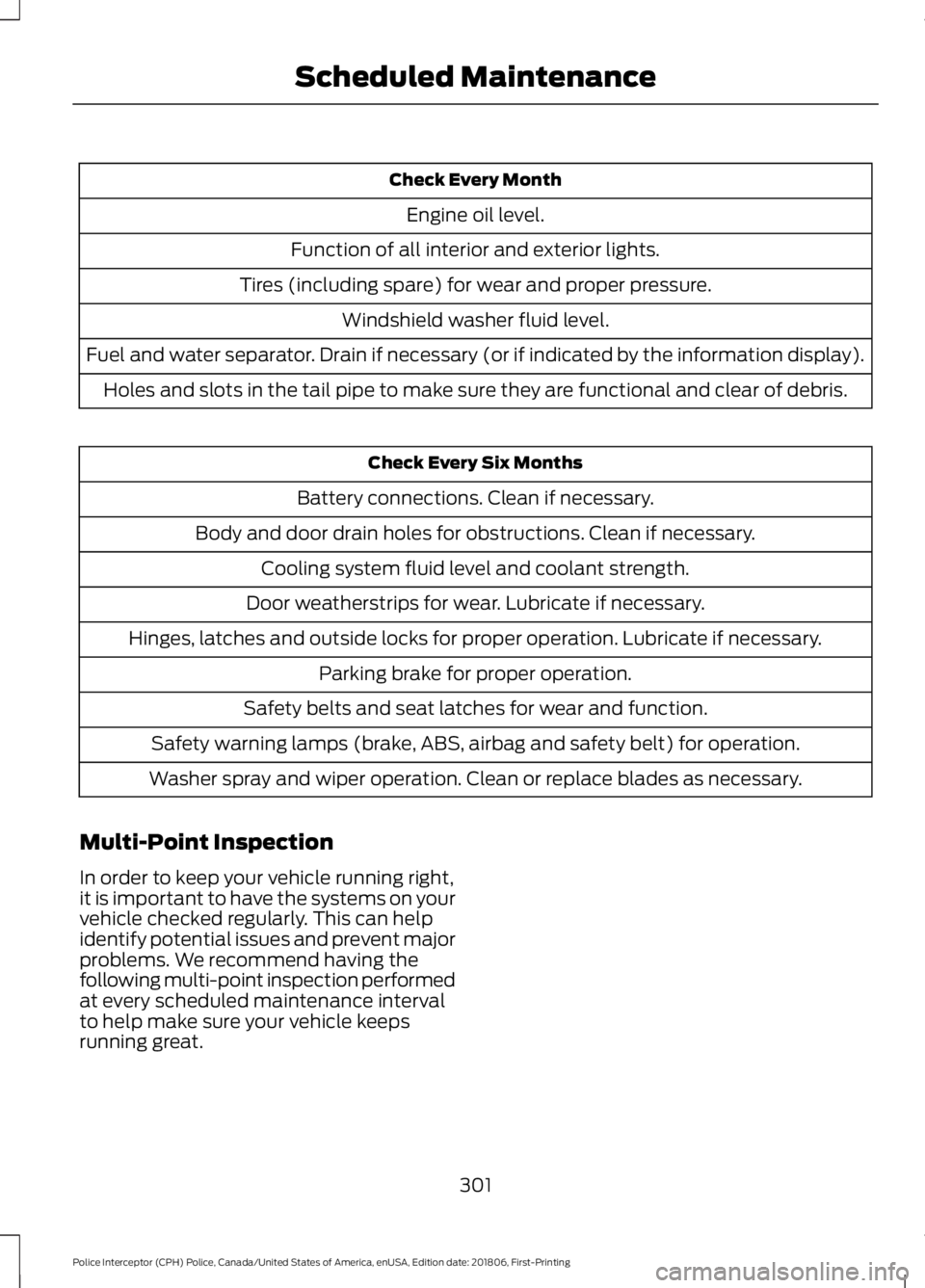
Check Every Month
Engine oil level.
Function of all interior and exterior lights.
Tires (including spare) for wear and proper pressure. Windshield washer fluid level.
Fuel and water separator. Drain if necessary (or if indicated by the information display). Holes and slots in the tail pipe to make sure they are functional and clear of debris. Check Every Six Months
Battery connections. Clean if necessary.
Body and door drain holes for obstructions. Clean if necessary. Cooling system fluid level and coolant strength.
Door weatherstrips for wear. Lubricate if necessary.
Hinges, latches and outside locks for proper operation. Lubricate if necessary. Parking brake for proper operation.
Safety belts and seat latches for wear and function.
Safety warning lamps (brake, ABS, airbag and safety belt) for operation.
Washer spray and wiper operation. Clean or replace blades as necessary.
Multi-Point Inspection
In order to keep your vehicle running right,
it is important to have the systems on your
vehicle checked regularly. This can help
identify potential issues and prevent major
problems. We recommend having the
following multi-point inspection performed
at every scheduled maintenance interval
to help make sure your vehicle keeps
running great.
301
Police Interceptor (CPH) Police, Canada/United States of America, enUSA, Edition date: 201806, First-Printing Scheduled Maintenance
Page 306 of 370
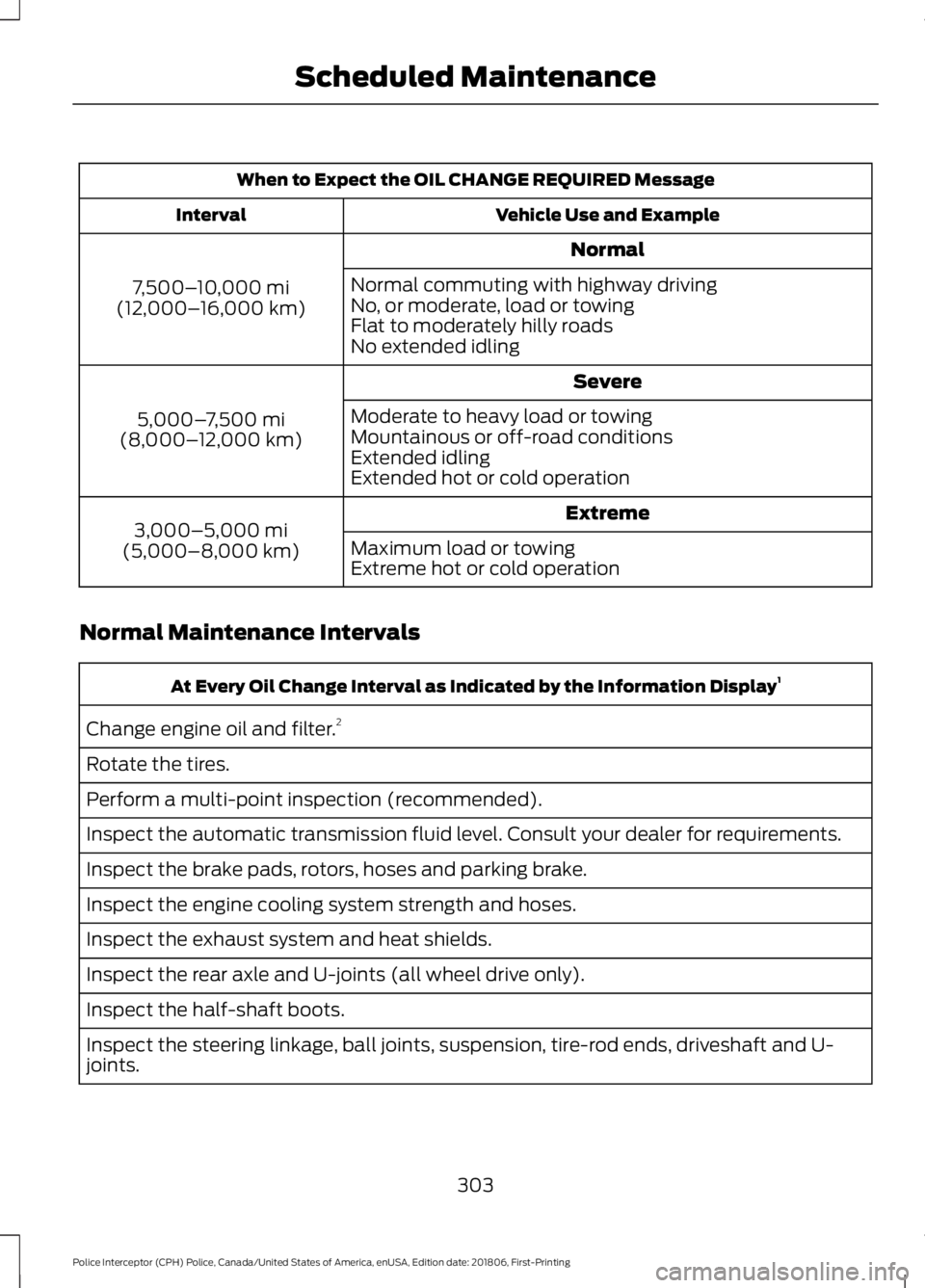
When to Expect the OIL CHANGE REQUIRED Message
Vehicle Use and Example
Interval
Normal
7,500– 10,000 mi
(12,000– 16,000 km) Normal commuting with highway driving
No, or moderate, load or towing
Flat to moderately hilly roads
No extended idling
Severe
5,000– 7,500 mi
(8,000– 12,000 km) Moderate to heavy load or towing
Mountainous or off-road conditions
Extended idling
Extended hot or cold operation
Extreme
3,000–5,000 mi
(5,000–8,000 km) Maximum load or towing
Extreme hot or cold operation
Normal Maintenance Intervals At Every Oil Change Interval as Indicated by the Information Display
1
Change engine oil and filter. 2
Rotate the tires.
Perform a multi-point inspection (recommended).
Inspect the automatic transmission fluid level. Consult your dealer for requirements.
Inspect the brake pads, rotors, hoses and parking brake.
Inspect the engine cooling system strength and hoses.
Inspect the exhaust system and heat shields.
Inspect the rear axle and U-joints (all wheel drive only).
Inspect the half-shaft boots.
Inspect the steering linkage, ball joints, suspension, tire-rod ends, driveshaft and U-
joints.
303
Police Interceptor (CPH) Police, Canada/United States of America, enUSA, Edition date: 201806, First-Printing Scheduled Maintenance
Page 364 of 370
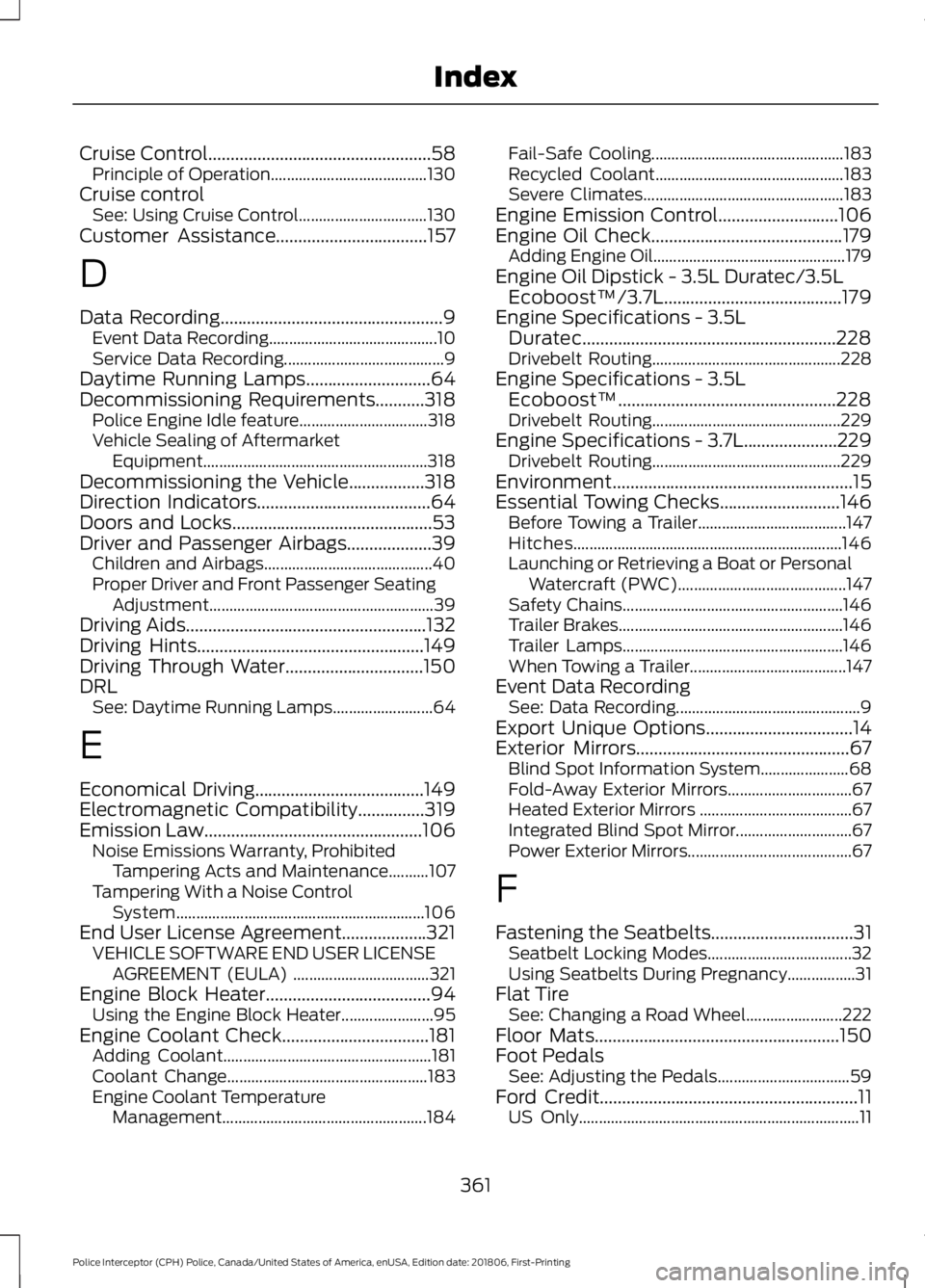
Cruise Control..................................................58
Principle of Operation....................................... 130
Cruise control See: Using Cruise Control................................ 130
Customer Assistance..................................157
D
Data Recording
..................................................9
Event Data Recording.......................................... 10
Service Data Recording........................................ 9
Daytime Running Lamps
............................64
Decommissioning Requirements...........318
Police Engine Idle feature................................ 318
Vehicle Sealing of Aftermarket Equipment........................................................ 318
Decommissioning the Vehicle
.................318
Direction Indicators.......................................64
Doors and Locks.............................................53
Driver and Passenger Airbags...................39 Children and Airbags.......................................... 40
Proper Driver and Front Passenger Seating Adjustment........................................................ 39
Driving Aids......................................................132
Driving Hints
...................................................149
Driving Through Water...............................150
DRL See: Daytime Running Lamps......................... 64
E
Economical Driving
......................................149
Electromagnetic Compatibility...............319
Emission Law.................................................106 Noise Emissions Warranty, Prohibited
Tampering Acts and Maintenance..........107
Tampering With a Noise Control System.............................................................. 106
End User License Agreement...................321 VEHICLE SOFTWARE END USER LICENSE
AGREEMENT (EULA) .................................. 321
Engine Block Heater
.....................................94
Using the Engine Block Heater....................... 95
Engine Coolant Check.................................181 Adding Coolant.................................................... 181
Coolant Change.................................................. 183
Engine Coolant Temperature Management................................................... 184Fail-Safe Cooling................................................
183
Recycled Coolant............................................... 183
Severe Climates.................................................. 183
Engine Emission Control
...........................106
Engine Oil Check...........................................179
Adding Engine Oil................................................ 179
Engine Oil Dipstick - 3.5L Duratec/3.5L Ecoboost™/3.7L........................................179
Engine Specifications - 3.5L Duratec.........................................................228
Drivebelt Routing............................................... 228
Engine Specifications - 3.5L Ecoboost™.................................................228
Drivebelt Routing............................................... 229
Engine Specifications - 3.7L.....................229 Drivebelt Routing............................................... 229
Environment
......................................................15
Essential Towing Checks...........................146 Before Towing a Trailer..................................... 147
Hitches................................................................... 146
Launching or Retrieving a Boat or Personal Watercraft (PWC).......................................... 147
Safety Chains....................................................... 146
Trailer Brakes........................................................ 146
Trailer Lamps....................................................... 146
When Towing a Trailer....................................... 147
Event Data Recording See: Data Recording.............................................. 9
Export Unique Options.................................14
Exterior Mirrors................................................67 Blind Spot Information System...................... 68
Fold-Away Exterior Mirrors............................... 67
Heated Exterior Mirrors ...................................... 67
Integrated Blind Spot Mirror............................. 67
Power Exterior Mirrors......................................... 67
F
Fastening the Seatbelts
................................31
Seatbelt Locking Modes.................................... 32
Using Seatbelts During Pregnancy.................31
Flat Tire See: Changing a Road Wheel........................ 222
Floor Mats
.......................................................150
Foot Pedals See: Adjusting the Pedals................................. 59
Ford Credit
..........................................................11
US Only...................................................................... 11
361
Police Interceptor (CPH) Police, Canada/United States of America, enUSA, Edition date: 201806, First-Printing Index
Page 365 of 370
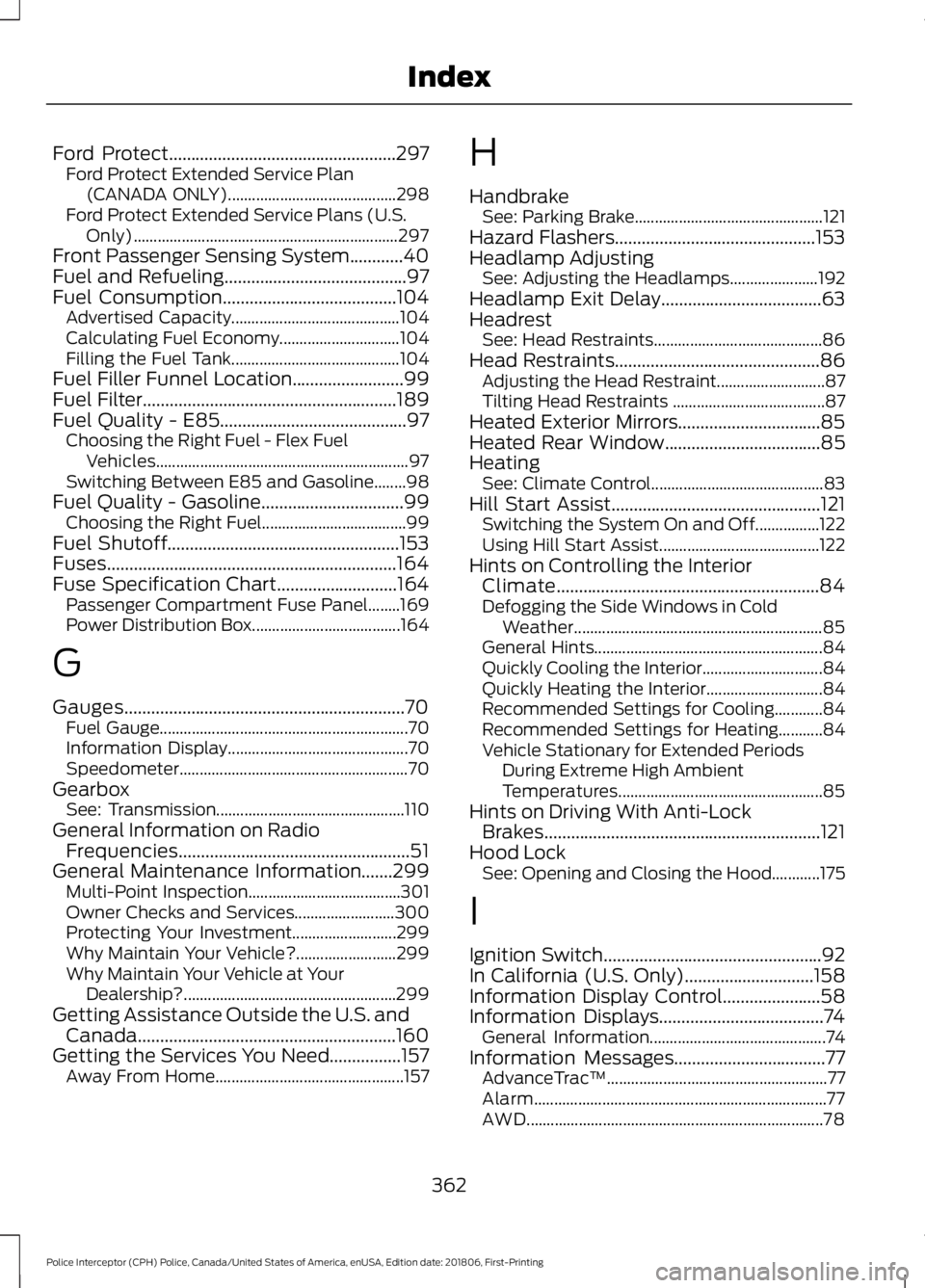
Ford Protect...................................................297
Ford Protect Extended Service Plan
(CANADA ONLY).......................................... 298
Ford Protect Extended Service Plans (U.S. Only).................................................................. 297
Front Passenger Sensing System............40
Fuel and Refueling.........................................97
Fuel Consumption
.......................................104
Advertised Capacity.......................................... 104
Calculating Fuel Economy.............................. 104
Filling the Fuel Tank.......................................... 104
Fuel Filler Funnel Location.........................99
Fuel Filter
.........................................................189
Fuel Quality - E85..........................................97 Choosing the Right Fuel - Flex Fuel
Vehicles............................................................... 97
Switching Between E85 and Gasoline........98
Fuel Quality - Gasoline................................99 Choosing the Right Fuel.................................... 99
Fuel Shutoff
....................................................153
Fuses.................................................................164
Fuse Specification Chart
...........................164
Passenger Compartment Fuse Panel........169
Power Distribution Box..................................... 164
G
Gauges...............................................................70 Fuel Gauge.............................................................. 70
Information Display............................................. 70
Speedometer......................................................... 70
Gearbox See: Transmission............................................... 110
General Information on Radio Frequencies....................................................51
General Maintenance Information.......299 Multi-Point Inspection...................................... 301
Owner Checks and Services......................... 300
Protecting Your Investment.......................... 299
Why Maintain Your Vehicle?......................... 299
Why Maintain Your Vehicle at Your Dealership?..................................................... 299
Getting Assistance Outside the U.S. and Canada..........................................................160
Getting the Services You Need................157 Away From Home............................................... 157H
Handbrake
See: Parking Brake............................................... 121
Hazard Flashers.............................................153
Headlamp Adjusting See: Adjusting the Headlamps...................... 192
Headlamp Exit Delay....................................63
Headrest See: Head Restraints.......................................... 86
Head Restraints
..............................................86
Adjusting the Head Restraint........................... 87
Tilting Head Restraints ...................................... 87
Heated Exterior Mirrors................................85
Heated Rear Window...................................85
Heating See: Climate Control........................................... 83
Hill Start Assist...............................................121 Switching the System On and Off................122
Using Hill Start Assist........................................ 122
Hints on Controlling the Interior Climate...........................................................84
Defogging the Side Windows in Cold Weather.............................................................. 85
General Hints......................................................... 84
Quickly Cooling the Interior.............................. 84
Quickly Heating the Interior............................. 84
Recommended Settings for Cooling............84
Recommended Settings for Heating...........84
Vehicle Stationary for Extended Periods During Extreme High Ambient
Temperatures................................................... 85
Hints on Driving With Anti-Lock Brakes..............................................................121
Hood Lock See: Opening and Closing the Hood............175
I
Ignition Switch.................................................92
In California (U.S. Only).............................158
Information Display Control......................58
Information Displays.....................................74 General Information............................................ 74
Information Messages
..................................77
AdvanceTrac ™....................................................... 77
Alarm........................................................................\
. 77
AWD........................................................................\
.. 78
362
Police Interceptor (CPH) Police, Canada/United States of America, enUSA, Edition date: 201806, First-Printing Index
Page 370 of 370
System Indicator Lights and
Messages.......................................................... 123
Using a Switch..................................................... 123
Using the Information Display Controls............................................................. 123
Using Voice Recognition...........................259
Initiating a Voice Session................................ 259
System Interaction and Feedback..............260
Utilizing the Mediation/Arbitration Program (Canada Only).........................160
V
Vehicle Care...................................................196 General Information.......................................... 196
Vehicle Certification Label.......................234
Vehicle Identification Number
................233
Vehicle Storage.............................................201
Battery................................................................... 202
Body........................................................................\
. 201
Brakes.................................................................... 202
Cooling system................................................... 202
Engine.................................................................... 202
Fuel system.......................................................... 202
General................................................................... 201
Miscellaneous..................................................... 202
Removing Vehicle From Storage.................202
Tires........................................................................\
202
Ventilation See: Climate Control........................................... 83
VIN See: Vehicle Identification Number............233
Voice Control....................................................57
W
Warning Lamps and Indicators..................71 Airbag readiness.................................................... 71
Anti-Lock Braking System.................................. 71
Brake System.......................................................... 71
Charging System.................................................... 71
Cruise Control......................................................... 71
Direction Indicator................................................ 72
Door Ajar.................................................................. 72
Engine Coolant Temperature........................... 72
Engine Oil................................................................. 72
Fasten Seatbelt..................................................... 72
High Beam............................................................... 72Low Fuel Level.......................................................
72
Low Tire Pressure Warning................................ 72
Low Washer Fluid................................................. 72
Parking Lamps....................................................... 72
Police Engine Idle feature.................................. 72
Powertrain Fault.................................................... 73
Service Engine Soon............................................ 73
Stability Control.................................................... 73
Stability Control Off............................................. 73
Washer Fluid Check.....................................189
Washers See: Cleaning the Exterior............................... 196
Waxing..............................................................198
Wheel Nuts See: Changing a Road Wheel........................ 222
Wheels and Tires
.........................................204
General Information......................................... 204
Technical Specifications................................. 226
Windows and Mirrors
...................................66
Windshield Washers.....................................60
Windshield Wipers........................................60
Speed Dependent Wipers................................ 60
Wiper Blades See: Checking the Wiper Blades.................... 191
Wipers and Washers....................................60
367
Police Interceptor (CPH) Police, Canada/United States of America, enUSA, Edition date: 201806, First-Printing Index