traction control FORD POLICE INTERCEPTOR 2019 User Guide
[x] Cancel search | Manufacturer: FORD, Model Year: 2019, Model line: POLICE INTERCEPTOR, Model: FORD POLICE INTERCEPTOR 2019Pages: 370, PDF Size: 4.5 MB
Page 207 of 370
GENERAL INFORMATION
The recommended tire inflation pressures
are on the tire information label on the
driver side B-pillar.
Check and set the tire pressure at the
ambient temperature in which you are
intending to drive your vehicle and when
the tires are cold. See Technical
Specifications (page 226).
Note: Check your tire pressures regularly to
optimize fuel economy.
Only use approved wheel and tire sizes.
Using other sizes could damage your
vehicle and could make the National Type
Approval invalid.
Installation of any tires that are not the
original equipment tire size can cause the
speedometer to display incorrect vehicle
speed.
TIRE CARE
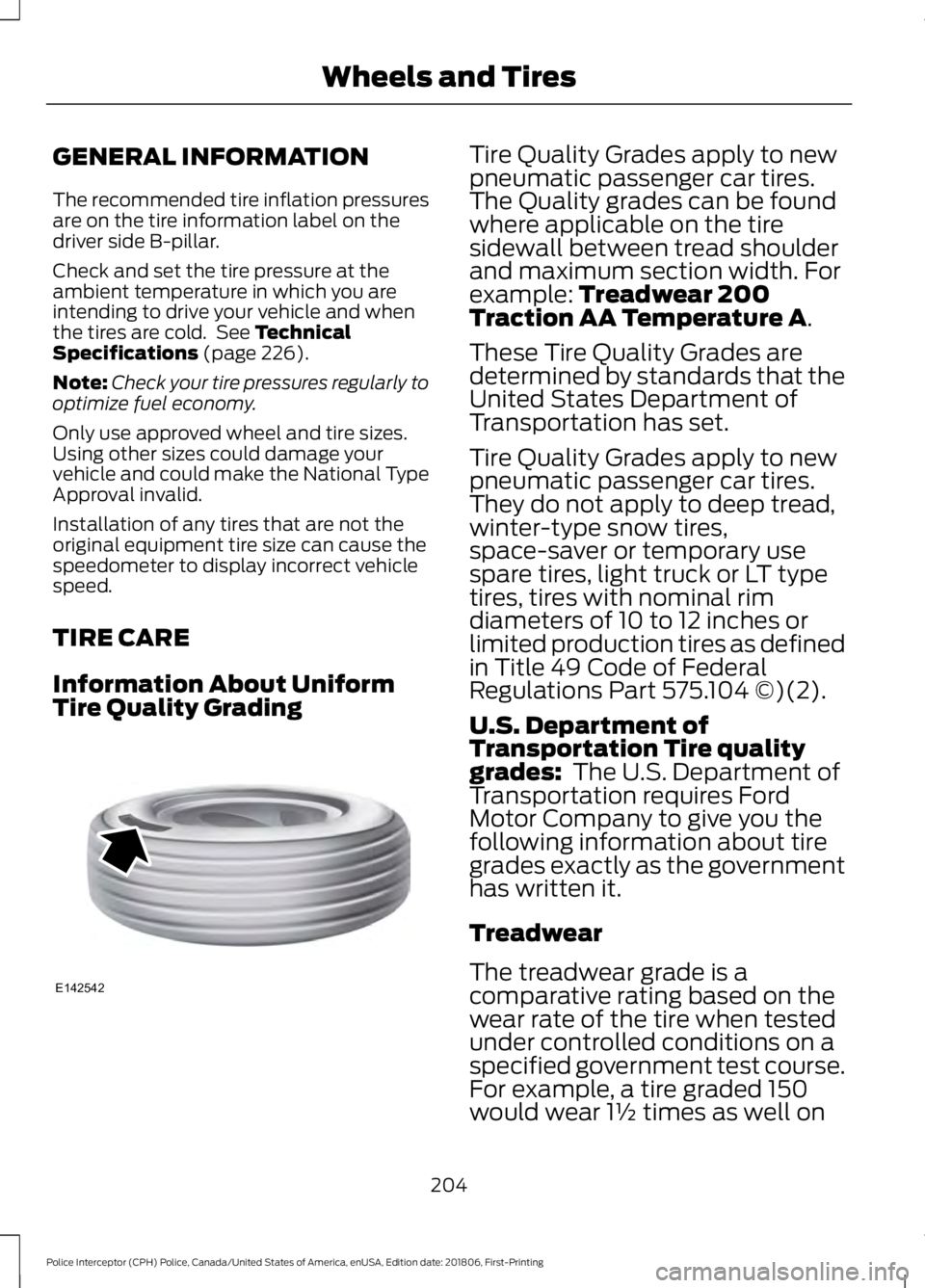
Information About Uniform
Tire Quality Grading Tire Quality Grades apply to new
pneumatic passenger car tires.
The Quality grades can be found
where applicable on the tire
sidewall between tread shoulder
and maximum section width. For
example:
Treadwear 200
Traction AA Temperature A.
These Tire Quality Grades are
determined by standards that the
United States Department of
Transportation has set.
Tire Quality Grades apply to new
pneumatic passenger car tires.
They do not apply to deep tread,
winter-type snow tires,
space-saver or temporary use
spare tires, light truck or LT type
tires, tires with nominal rim
diameters of 10 to 12 inches or
limited production tires as defined
in Title 49 Code of Federal
Regulations Part 575.104 ©)(2).
U.S. Department of
Transportation Tire quality
grades:
The U.S. Department of
Transportation requires Ford
Motor Company to give you the
following information about tire
grades exactly as the government
has written it.
Treadwear
The treadwear grade is a
comparative rating based on the
wear rate of the tire when tested
under controlled conditions on a
specified government test course.
For example, a tire graded 150
would wear 1½ times as well on
204
Police Interceptor (CPH) Police, Canada/United States of America, enUSA, Edition date: 201806, First-Printing Wheels and TiresE142542
Page 208 of 370
the government course as a tire
graded 100. The relative
performance of tires depends
upon the actual conditions of their
use, however, and may depart
significantly from the norm due to
variations in driving habits, service
practices, and differences in road
characteristics and climate.
Traction AA A B C
WARNING: The traction
grade assigned to this tire is
based on straight-ahead braking
traction tests, and does not
include acceleration, cornering,
hydroplaning or peak traction
characteristics.
The traction grades, from highest
to lowest are AA, A, B, and C. The
grades represent the tire ’s ability
to stop on wet pavement as
measured under controlled
conditions on specified
government test surfaces of
asphalt and concrete. A tire
marked C may have poor traction
performance. Temperature A B C WARNING:
The
temperature grade for this tire is
established for a tire that is
properly inflated and not
overloaded. Excessive speed,
underinflation, or excessive
loading, either separately or in
combination, can cause heat
buildup and possible tire failure.
The temperature grades are A
(the highest), B and C,
representing the tire ’s resistance
to the generation of heat and its
ability to dissipate heat when
tested under controlled conditions
on a specified indoor laboratory
test wheel. Sustained high
temperature can cause the
material of the tire to degenerate
and reduce tire life, and excessive
temperature can lead to sudden
tire failure. The grade C
corresponds to a level of
performance which all passenger
car tires must meet under the
Federal Motor Vehicle Safety
Standard No. 139. Grades B and A
represent higher levels of
performance on the laboratory
test wheel than the minimum
required by law.
Glossary of Tire Terminology
*
Tire label: A label showing the
original equipment tire sizes,
recommended inflation pressure
and the maximum weight the
vehicle can carry.
205
Police Interceptor (CPH) Police, Canada/United States of America, enUSA, Edition date: 201806, First-Printing Wheels and Tires
Page 212 of 370
J.
Tire Ply Composition and
Material Used: Indicates the
number of plies or the number of
layers of rubber-coated fabric in
the tire tread and sidewall. Tire
manufacturers also must indicate
the ply materials in the tire and the
sidewall, which include steel,
nylon, polyester, and others.
K. Maximum Load: Indicates the
maximum load in kilograms and
pounds that can be carried by the
tire. See the Safety Compliance
Certification Label, affixed to
either the door hinge pillar,
door-latch post, or the door edge
that meets the door-latch post,
next to the driver seating position,
for the correct tire pressure for
your vehicle.
L. Treadwear, Traction and
Temperature Grades:
*Treadwear The treadwear grade
is a comparative rating based on
the wear rate of the tire when
tested under controlled conditions
on a specified government test
course. For example, a tire graded
150 would wear one and one-half
times as well on the government
course as a tire graded 100. *Traction: The traction grades,
from highest to lowest are AA, A,
B, and C. The grades represent the
tire's ability to stop on wet
pavement as measured under
controlled conditions on specified
government test surfaces of
asphalt and concrete. A tire
marked C may have poor traction
performance.
*
Temperature: The temperature
grades are A, the highest, B and C,
representing the tire's resistance
to the generation of heat and its
ability to dissipate heat when
tested under controlled conditions
on a specified indoor laboratory
test wheel.
M. Maximum Inflation
Pressure:
Indicates the tire
manufacturers' maximum
permissible pressure or the
pressure at which the maximum
load can be carried by the tire. This
pressure is normally higher than
the vehicle manufacturer's
recommended cold inflation
pressure found on the Safety
Compliance Certification Label,
affixed to either the door hinge
pillar, door-latch post, or the door
edge that meets the door-latch
post, next to the driver seating
position, or Tire Label which is
located on the B-Pillar or the edge
of the driver door. The cold
inflation pressure should never be
set lower than the recommended
pressure on the vehicle label.
209
Police Interceptor (CPH) Police, Canada/United States of America, enUSA, Edition date: 201806, First-Printing Wheels and Tires
Page 221 of 370
In regions with snow and ice
during the winter months,
installation of snow tires may be
desirable. Snow tires can usually
exhibit a drop in dry pavement
handling, but may show an
increase in snow and ice traction.
When snow tires are used, they
should be installed on all four
wheels, never on the drive wheels
only.
Tire storage
Most high performance tires are
made with a nylon overlay. As
such, the following steps should
be taken to avoid flatspotting
when the vehicles are not used for
a period of time.
•
Fleets should store the vehicles
with 44 psi (303 kPa) in the
tires.
• If the vehicle is stored for
periods longer than 30 days,
you should move it several feet
at least once during each
30-day period, so that a
different portion of the tread
contacts the ground.
• Tire pressure should be
reduced to the recommended
pressure shown on the vehicle
certification label before the
vehicle is placed back into
service. USING SNOW CHAINS WARNING: If you choose to install
snow tires on your vehicle, they must be
the same size, construction, and load
range as the original tires listed on the
tire placard, and they must be installed
on all four wheels. Mixing tires of
different size or construction on your
vehicle can adversely affect your
vehicle's handling and braking, and may
lead to loss of vehicle control. WARNING:
Do not use snow
chains or cables on this vehicle as they
may cause damage to your vehicle which
may lead to loss of vehicle control.
Snow chains have not been approved for
use on your vehicle.
The original equipment tires on your vehicle
may have an all-weather tread design to
provide traction, handling, and braking
performance in year-round driving. You
may install snow tires for improved traction
when driving in areas with sustained
periods of snow or icy driving conditions.
TIRE PRESSURE MONITORING
SYSTEM WARNING:
The tire pressure
monitoring system is not a substitute for
manually checking tire pressures. You
should periodically check tire pressures
using a pressure gauge. Failure to
correctly maintain tire pressures could
increase the risk of tire failure, loss of
control, vehicle rollover and personal
injury.
218
Police Interceptor (CPH) Police, Canada/United States of America, enUSA, Edition date: 201806, First-Printing Wheels and Tires
Page 328 of 370
SYNC® Automotive Important Safety
Information Read and follow
instructions:
•
Before using your SYNC® system, read
and follow all instructions and safety
information provided in this end user
manual ("Owner Guide".) Not
following precautions found in the
Owner Guide can lead to an accident
or other serious injuries.
General Operation
• Voice Command Control: Certain
functions within the SYNC® system
may be accomplished using voice
commands. Using voice commands
while driving helps you to operate the
system without removing your hands
from the wheel or eyes from the road.
• Prolonged Views of Screen:
Do not
access any function requiring a
prolonged view of the screen while you
are driving. Pull over in a safe and legal
manner before attempting to access a
function of the system requiring
prolonged attention.
• Volume Setting:
Do not raise the
volume excessively. Keep the volume
at a level where you can still hear
outside traffic and emergency signals
while driving. Driving while unable to
hear these sounds could cause an
accident.
• Navigation Features:
Any navigation
features included in the system are
intended to provide turn by turn
instructions to get you to a desired
destination. Please make certain all
persons using this system carefully
read and follow instructions and safety
information fully. •
Distraction Hazard:
Any navigation
features may require manual
(non-verbal) setup. Attempting to
perform such set-up or insert data
while driving can distract your attention
and could cause an accident or other
serious injury. Stop the vehicle in a safe
and legal manner before attempting
these operations.
• Let Your Judgment Prevail:
Any
navigation features are provided only
as an aid. Make your driving decisions
based on your observations of local
conditions and existing traffic
regulations. Any such feature is not a
substitute for your personal judgment.
Any route suggestions made by this
system should never replace any local
traffic regulations or your personal
judgment or knowledge of safe driving
practices.
• Route Safety: Do not follow the route
suggestions if doing so would result in
an unsafe or illegal maneuver, if you
would be placed in an unsafe situation,
or if you would be directed into an area
that you consider unsafe. The driver is
ultimately responsible for the safe
operation of the vehicle and therefore,
must evaluate whether it is safe to
follow the suggested directions.
• Potential Map Inaccuracy:
Maps
used by this system may be inaccurate
because of changes in roads, traffic
controls or driving conditions. Always
use good judgment and common sense
when following the suggested routes.
• Emergency Services:
Do not rely on
any navigation features included in the
system to route you to emergency
services. Ask local authorities or an
emergency services operator for these
locations. Not all emergency services
such as police, fire stations, hospitals
and clinics are likely to be contained in
the map database for such navigation
features.
325
Police Interceptor (CPH) Police, Canada/United States of America, enUSA, Edition date: 201806, First-Printing Appendices
Page 366 of 370
Battery and Charging System..........................
78
Blind Spot Information and Cross Traffic Alert System...................................................... 79
Brake System......................................................... 79
Doors and Locks................................................... 79
Fuel........................................................................\
... 80
Maintenance..........................................................80
Park Aid................................................................... 80
Police Engine Idle feature.................................. 81
Power Steering....................................................... 81
Reminder Messages............................................. 81
Seats........................................................................\
. 82
Tire Pressure Monitoring System................... 82
Traction Control.................................................... 82
Installing Child Restraints............................19 Child Seats............................................................... 19
Using Lap and Shoulder Belts......................... 20
Using Lower Anchors and Tethers for CHildren (LATCH)............................................ 22
Using Tether Straps............................................. 24
Instrument Cluster.........................................70
Instrument Lighting Dimmer.....................63
Instrument Panel Overview........................16
Interior Lamps.................................................64
Dome Task Lamp................................................. 65
Front Map Lamps................................................ 64
Interior Luggage Compartment Release............................................................55
Interior Mirror
...................................................68
Automatic Dimming Mirror.............................. 68
Manual Dimming Mirror..................................... 68
Introduction.........................................................7
J
Jump Starting the Vehicle.........................154 Connecting the Jumper Cables..................... 154
Jump Starting....................................................... 155
Preparing Your Vehicle..................................... 154
Removing the Jumper Cables........................ 155
K
Keys and Remote Controls..........................51 L
Lighting Control...............................................61
Headlamp Flasher............................................... 62
High Beams............................................................. 61
Spot Lamp Control.............................................. 62
Lighting...............................................................61 General Information............................................. 61
Load Carrying
.................................................138
Load Limit.......................................................138
Special Loading Instructions for Owners of
Pick-up Trucks and Utility-type
Vehicles............................................................. 143
Vehicle Loading - with and without a Trailer .................................................................. 138
Locking and Unlocking
.................................53
Battery Saver......................................................... 54
Hidden Rear Door Locks.................................... 53
Illuminated Entry.................................................. 54
Illuminated Exit..................................................... 54
Locking and Unlocking the Doors with the Key Blade............................................................ 54
Opening a Rear Door From the Inside..........54
Opening the Luggage Compartment...........54
Power Door Locks................................................ 53
Remote Control..................................................... 53
Lug Nuts See: Changing a Road Wheel........................ 222
M
Maintenance...................................................175 General Information........................................... 175
Manual Climate Control
..............................83
Directing the Air.................................................... 83
Setting the Blower Motor Speed.................... 83
Setting the Temperature................................... 83
Switching Defrost On and Off......................... 83
Switching Maximum Air Conditioning On and Off................................................................ 84
Switching Recirculated Air On and Off........................................................................\
. 84
Switching the Air Conditioning On and Off........................................................................\
. 83
Switching the Climate Control On and Off........................................................................\
. 83
Manual Seats..................................................88 Lumbar Adjustment........................................... 89
363
Police Interceptor (CPH) Police, Canada/United States of America, enUSA, Edition date: 201806, First-Printing Index
Page 369 of 370
Temperature A B C............................................
205
Traction AA A B C.............................................. 205
Treadwear............................................................ 204
Tire Pressure Monitoring System............218 Changing Tires With a Tire Pressure
Monitoring System....................................... 220
Understanding Your Tire Pressure Monitoring System ...................................... 220
Tires See: Wheels and Tires..................................... 204
Towing a Trailer.............................................144
Load Placement................................................. 144
Towing the Vehicle on Four Wheels..........................................................148
Emergency Towing............................................ 148
Recreational Towing......................................... 148
Towing..............................................................144
Traction Control
.............................................123
Principle of Operation....................................... 123
Transmission Code Designation............234
Transmission
...................................................110
Transporting the Vehicle............................156
Type Approvals.............................................347 Radio Frequency Certification for Keys and
Remote Controls........................................... 357
Radio Frequency Certifications for Blind Spot Information System.......................... 355
Radio Frequency Certifications for Body Control Module.............................................. 357
Radio Frequency Certifications for Cruise Control Module.............................................. 357
Radio Frequency Certifications for Mid Range Radar................................................... 349
Radio Frequency Certifications for Passive Anti-Theft System....................................... 350
Radio Frequency Certifications for Radio Transceiver Module...................................... 353
Radio Frequency Certifications for SYNC 3........................................................................\
.. 356
Radio Frequency Certifications for Tire Pressure Monitoring Sensor(s)................347
Radio Frequency Certifications for Wireless Charging........................................................... 356
Radio Frequency Statement for Audio Unit..................................................................... 357U
Under Hood Overview - 3.5L Duratec/
3.7L..................................................................176
Engine Shield........................................................ 177
Under Hood Overview - 3.5L Ecoboost™..................................................178
USB Port
.........................................................255
Using All-Wheel Drive..................................113 Driving In Special Conditions With
All-Wheel Drive (AWD)................................ 115
Operating AWD Vehicles With Mismatched Tires..................................................................... 114
Operating AWD Vehicles With Spare Tires..................................................................... 114
Using Cruise Control...................................130 Canceling the Set Speed................................. 130
Changing the Set Speed.................................. 130
Resuming the Set Speed.................................. 131
Setting the Cruise Speed................................. 130
Switching Cruise Control Off........................... 131
Switching Cruise Control On.......................... 130
Using Snow Chains
......................................218
Using Stability Control................................125
Using SYNC™ With Your Media Player
.............................................................278
Accessing Your Play Menu............................. 283
Connecting Your Digital Media Player to the USB Port........................................................... 278
Media Menu Features....................................... 281
Media Voice Commands................................ 280
System Settings................................................. 285
What's Playing?................................................ 280
Using SYNC™ With Your Phone............262 Accessing Features Through the Phone
Menu................................................................. 266
Accessing Your Phone Settings..................... 271
Making a Call....................................................... 265
Pairing Subsequent Cell Phones.................263
Pairing Your Cell Phone for the First Time ........................................................................\
..... 262
Phone Options during an Active Call.........265
Phone Voice Commands................................ 263
Receiving Calls.................................................... 265
System Settings.................................................. 272
Text Messaging................................................... 269
Using Traction Control................................123 Switching the System Off................................ 123
366
Police Interceptor (CPH) Police, Canada/United States of America, enUSA, Edition date: 201806, First-Printing Index