trailer FORD POLICE INTERCEPTOR 2019 Owner's Manual
[x] Cancel search | Manufacturer: FORD, Model Year: 2019, Model line: POLICE INTERCEPTOR, Model: FORD POLICE INTERCEPTOR 2019Pages: 370, PDF Size: 4.5 MB
Page 187 of 370
When Fail-Safe Mode Is Activated
WARNING: Fail-safe mode is for
use during emergencies only. Operate
your vehicle in fail-safe mode only as
long as necessary to bring your vehicle
to rest in a safe location and seek
immediate repairs. When in fail-safe
mode, your vehicle will have limited
power, will not be able to maintain
high-speed operation, and may
completely shut down without warning,
potentially losing engine power, power
steering assist, and power brake assist,
which may increase the possibility of a
crash resulting in serious injury. WARNING:
Do not remove the
coolant reservoir cap when the engine is
on or the cooling system is hot. Wait 10
minutes for the cooling system to cool
down. Cover the coolant reservoir cap
with a thick cloth to prevent the
possibility of scalding and slowly remove
the cap. Failure to follow this instruction
could result in personal injury.
Your vehicle has limited engine power
when in the fail-safe mode, drive your
vehicle with caution. Your vehicle does not
maintain high-speed operation and the
engine may operate poorly.
Remember that the engine is capable of
automatically shutting down to prevent
engine damage. In this situation:
1. Pull off the road as soon as safely possible and switch the engine off.
2. If you are a member of a roadside assistance program, we recommend
that you contact your roadside
assistance service provider.
3. If this is not possible, wait for a short period of time for the engine to cool. 4. Check the coolant level. If the coolant
level is at or below the minimum mark,
add prediluted coolant immediately.
5. When the engine temperature cools, you can re-start the engine. Have your
vehicle checked as soon as possible to
minimize engine damage.
Note: Driving your vehicle without repair
increases the chance of engine damage.
Engine Coolant Temperature
Management
(If Equipped) WARNING:
To reduce the risk of
crash and injury, be prepared that the
vehicle speed may reduce and the
vehicle may not be able to accelerate
with full power until the coolant
temperature reduces.
If you tow a trailer with your vehicle, the
engine may temporarily reach a higher
temperature during severe operating
conditions, for example ascending a long
or steep grade in high ambient
temperatures.
At this time, you may notice the coolant
temperature gauge moves toward the red
zone and a message may appear in the
information display.
You may notice a reduction in vehicle
speed caused by reduced engine power in
order to manage the engine coolant
temperature. Your vehicle may enter this
mode if certain high-temperature and
high-load conditions take place. The
amount of speed reduction depends on
vehicle loading, grade and ambient
temperature. If this occurs, there is no
need to stop your vehicle. You can
continue to drive.
184
Police Interceptor (CPH) Police, Canada/United States of America, enUSA, Edition date: 201806, First-Printing Maintenance
Page 188 of 370
The air conditioning may automatically
turn on and off during severe operating
conditions to protect the engine from
overheating. When the coolant
temperature decreases to the normal
operating temperature, the air conditioning
turns on.
If the coolant temperature gauge moves
fully into the red zone, or if the coolant
temperature warning or service engine
soon messages appear in your information
display, do the following:
1. Stop your vehicle as soon as it is safe
to do so. Fully apply the parking brake,
shift into park (P) or neutral (N).
2. Leave the engine running until the coolant temperature gauge needle
returns to the normal position. If the
temperature does not drop after
several minutes, follow the remaining
steps.
3. Switch the engine off and wait for it to
cool. Check the coolant level.
4. If the coolant level is at or below the minimum mark, add prediluted coolant
immediately.
5. If the coolant level is normal, restart the engine and continue.
AUTOMATIC TRANSMISSION
FLUID CHECK - 3.5L DURATEC/
3.5L ECOBOOST™/3.7L
6F50/6F55 Transmission (If Equipped) WARNING: The dipstick and
surrounding components are hot. Use
gloves when moving components and
checking the transmission fluid level.
Failure to follow this warning could result
in serious personal injury. Note:
Automatic transmission fluid
expands when warmed. To obtain an
accurate fluid check, drive your vehicle until
you warm it up, approximately
20 mi
(30 km). If you operate your vehicle for an
extended period at high speeds, in city traffic
during hot weather or pulling a trailer, switch
your vehicle off until it reaches normal
operating temperatures to allow the fluid
to cool before checking. Depending on
vehicle use, cooling times could take up to
30 minutes or longer.
Refer to your scheduled maintenance
information for scheduled intervals for fluid
checks and changes. Your transmission
does not consume fluid. However, you
should check the fluid level if the
transmission is not working properly. For
example, if the transmission slips or shifts
slowly or if you notice some sign of a fluid
leak.
1. Drive your vehicle
20 mi (30 km) or
until it reaches normal operating
temperature.
2. Park your vehicle on a level surface and
engage the parking brake.
3. With the parking brake engaged and your foot on the brake pedal, start the
engine and move the gearshift lever
through all of the gear ranges. Allow a
minimum of 10 seconds for each gear
to engage.
4. Put the gearshift lever in park (P) and leave the engine running.
Note: For vehicles with the EcoBoost
engine, move the air filter assembly aside
to access the transmission dipstick. See
Moving the Air Filter Assembly for more
information.
5. Remove the dipstick and wipe it clean with a dry, lint free clean rag. If
necessary, refer to the Under hood
overview in this chapter for the location
of the dipstick.
185
Police Interceptor (CPH) Police, Canada/United States of America, enUSA, Edition date: 201806, First-Printing Maintenance
Page 190 of 370
7. Pull the air filter assembly up to
disconnect it from the seated
grommets located under the air filter
assembly.
8. Rotate the air filter assembly 90 degrees counterclockwise. Make sure
the rubber hose is still connected to the
air filter assembly.
9. Tighten the clamp.
You can now access the transmission fluid
level indicator.
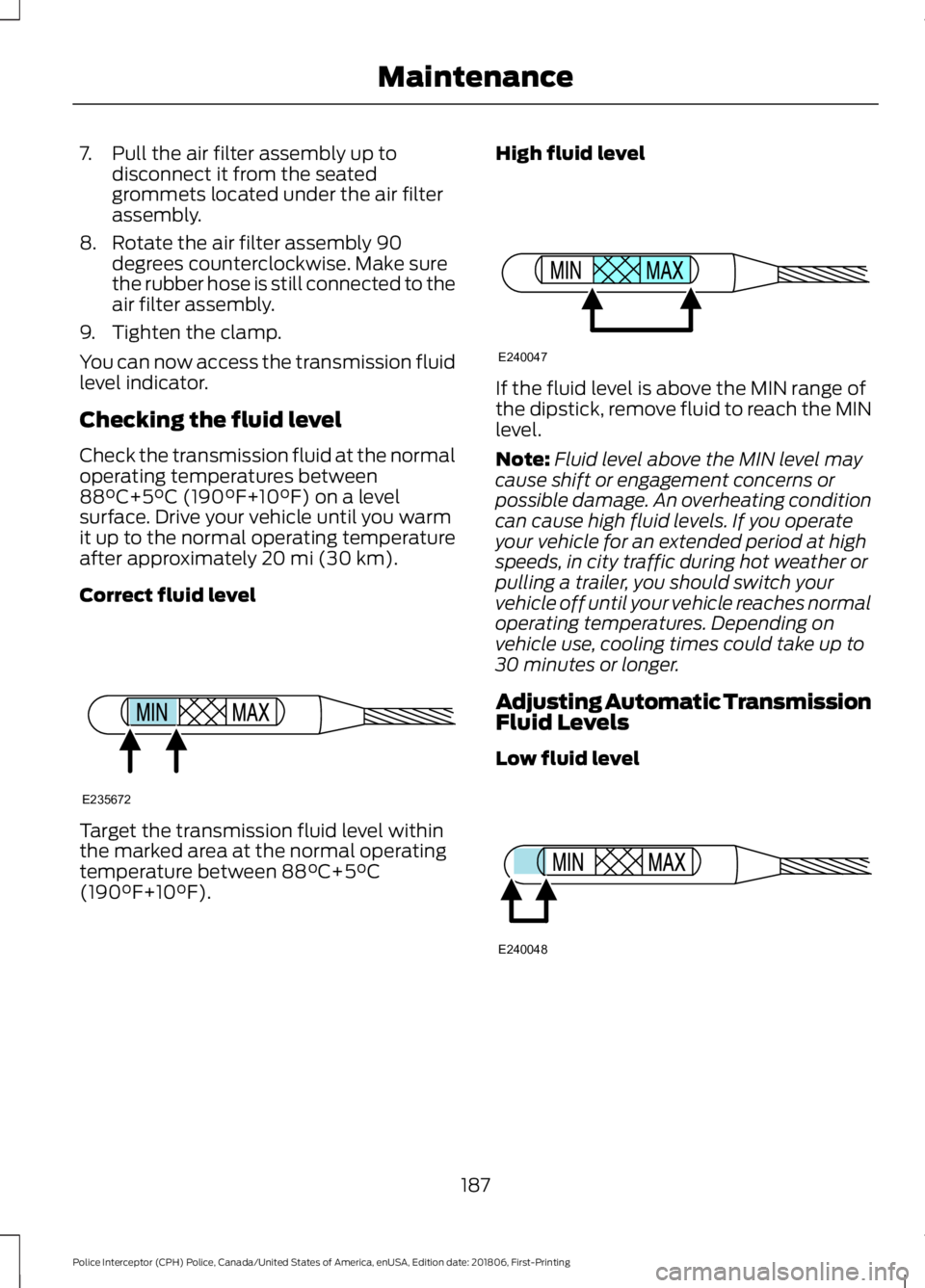
Checking the fluid level
Check the transmission fluid at the normal
operating temperatures between
88°C+5°C (190°F+10°F) on a level
surface. Drive your vehicle until you warm
it up to the normal operating temperature
after approximately 20 mi (30 km).
Correct fluid level Target the transmission fluid level within
the marked area at the normal operating
temperature between 88°C+5°C
(190°F+10°F). High fluid level If the fluid level is above the MIN range of
the dipstick, remove fluid to reach the MIN
level.
Note:
Fluid level above the MIN level may
cause shift or engagement concerns or
possible damage. An overheating condition
can cause high fluid levels. If you operate
your vehicle for an extended period at high
speeds, in city traffic during hot weather or
pulling a trailer, you should switch your
vehicle off until your vehicle reaches normal
operating temperatures. Depending on
vehicle use, cooling times could take up to
30 minutes or longer.
Adjusting Automatic Transmission
Fluid Levels
Low fluid level 187
Police Interceptor (CPH) Police, Canada/United States of America, enUSA, Edition date: 201806, First-Printing MaintenanceE235672 E240047 E240048
Page 226 of 370
2.
Full-size dissimilar spare with label
on wheel: This spare tire has a label on
the wheel that states: THIS WHEEL AND
TIRE ASSEMBLY FOR TEMPORARY USE
ONLY.
When driving with one of the dissimilar
spare tires listed above, do not:
• Exceed
50 mph (80 km/h).
• Load the vehicle beyond maximum
vehicle load rating listed on the Safety
Compliance Label.
• Tow a trailer.
• Use snow chains on the end of the
vehicle with the dissimilar spare tire.
• Use more than one dissimilar spare tire
at a time.
• Use commercial car washing
equipment.
• Try to repair the dissimilar spare tire.
Use of one of the dissimilar spare tires
listed above at any one wheel location can
lead to impairment of the following:
• Handling, stability and braking
performance.
• Comfort and noise.
• Ground clearance and parking at curbs.
• Winter weather driving capability.
• Wet weather driving capability.
• All-wheel driving capability.
3. Full-size dissimilar spare without
label on wheel
When driving with the full-size dissimilar
spare wheel and tire assembly, do not:
• Exceed
70 mph (113 km/h).
• Use more than one dissimilar spare
wheel and tire assembly at a time.
• Use commercial car washing
equipment.
• Use snow chains on the end of the
vehicle with the dissimilar spare wheel
and tire assembly. The usage of a full-size dissimilar spare
wheel and tire assembly can lead to
impairment of the following:
•
Handling, stability and braking
performance.
• Comfort and noise.
• Ground clearance and parking at curbs.
• Winter weather driving capability.
• Wet weather driving capability.
• All-wheel driving capability.
When driving with the full-size dissimilar
spare wheel and tire assembly additional
caution should be given to:
• Towing a trailer.
• Driving vehicles equipped with a
camper body.
• Driving vehicles with a load on the
cargo rack.
Drive cautiously when using a full-size
dissimilar spare wheel and tire assembly
and seek service as soon as possible.
Tire Change Procedure WARNING:
When one of the front
wheels is off the ground, the
transmission alone will not prevent the
vehicle from moving or slipping off the
jack, even if the transmission is in park
(P). WARNING:
To help prevent your
vehicle from moving when changing a
wheel, shift the transmission into park
(P), set the parking brake and use an
appropriate block or wheel chock to
secure the wheel diagonally opposite to
the wheel being changed. For example,
when changing the front left wheel,
place an appropriate block or wheel
chock on the right rear wheel.
223
Police Interceptor (CPH) Police, Canada/United States of America, enUSA, Edition date: 201806, First-Printing Wheels and Tires
Page 308 of 370
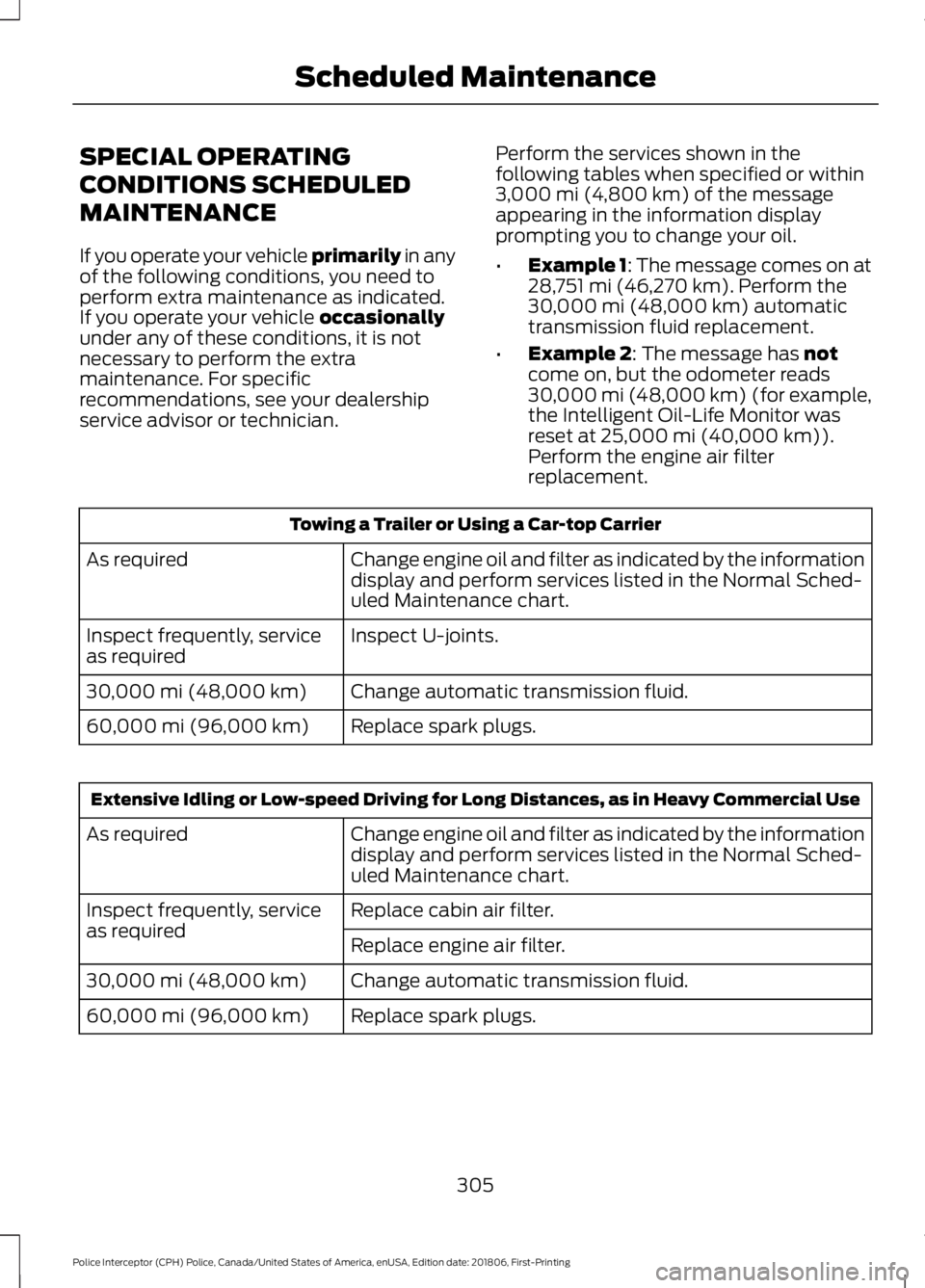
SPECIAL OPERATING
CONDITIONS SCHEDULED
MAINTENANCE
If you operate your vehicle primarily in any
of the following conditions, you need to
perform extra maintenance as indicated.
If you operate your vehicle
occasionally
under any of these conditions, it is not
necessary to perform the extra
maintenance. For specific
recommendations, see your dealership
service advisor or technician. Perform the services shown in the
following tables when specified or within
3,000 mi (4,800 km)
of the message
appearing in the information display
prompting you to change your oil.
• Example 1: The message comes on at
28,751 mi (46,270 km)
. Perform the
30,000 mi (48,000 km) automatic
transmission fluid replacement.
• Example 2
: The message has not
come on, but the odometer reads
30,000 mi (48,000 km) (for example,
the Intelligent Oil-Life Monitor was
reset at
25,000 mi (40,000 km)).
Perform the engine air filter
replacement. Towing a Trailer or Using a Car-top Carrier
Change engine oil and filter as indicated by the information
display and perform services listed in the Normal Sched-
uled Maintenance chart.
As required
Inspect U-joints.
Inspect frequently, service
as required
Change automatic transmission fluid.
30,000 mi (48,000 km)
Replace spark plugs.
60,000 mi (96,000 km) Extensive Idling or Low-speed Driving for Long Distances, as in Heavy Commercial Use
Change engine oil and filter as indicated by the information
display and perform services listed in the Normal Sched-
uled Maintenance chart.
As required
Replace cabin air filter.
Inspect frequently, service
as required
Replace engine air filter.
Change automatic transmission fluid.
30,000 mi (48,000 km)
Replace spark plugs.
60,000 mi (96,000 km)
305
Police Interceptor (CPH) Police, Canada/United States of America, enUSA, Edition date: 201806, First-Printing Scheduled Maintenance
Page 364 of 370
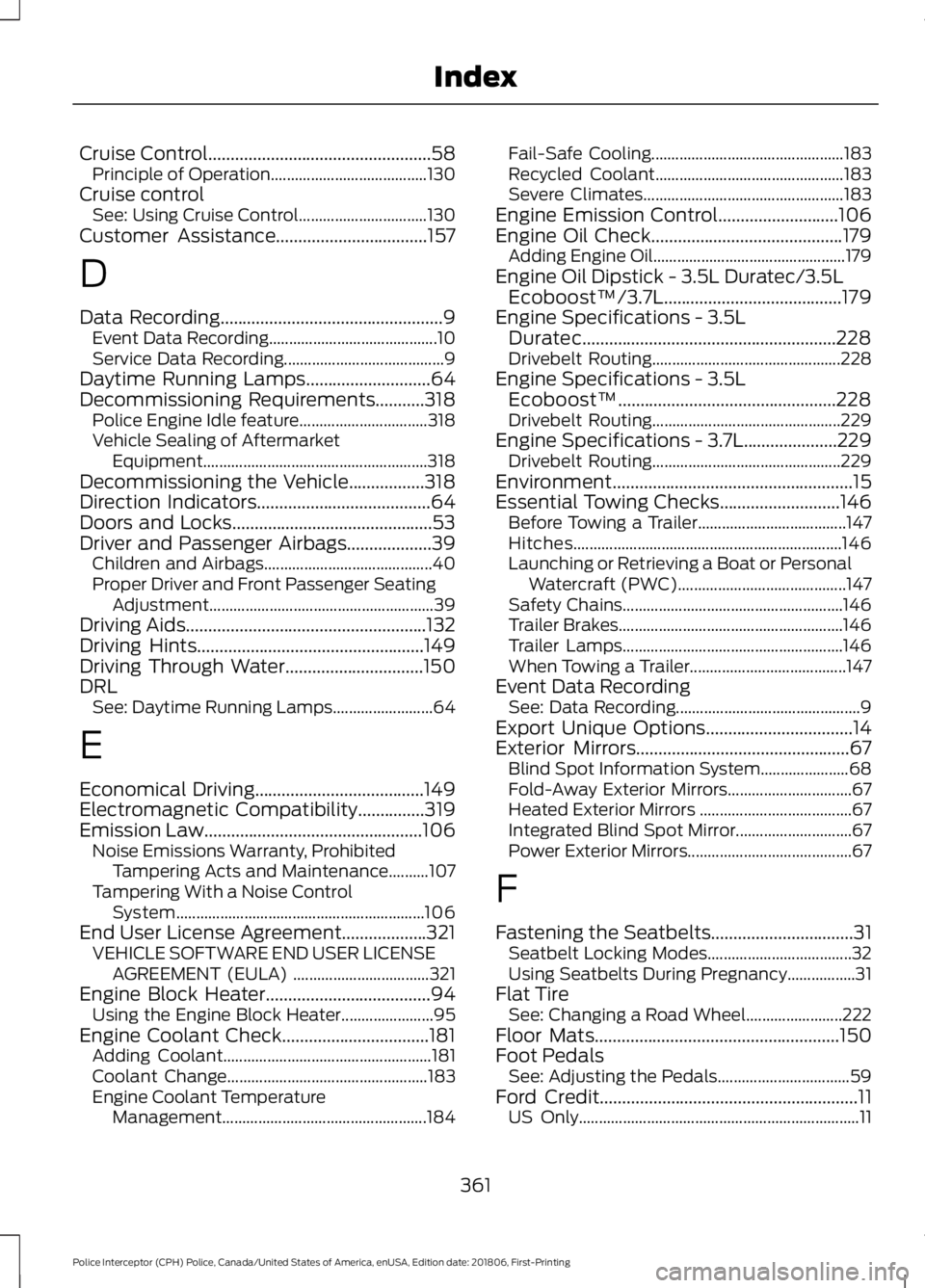
Cruise Control..................................................58
Principle of Operation....................................... 130
Cruise control See: Using Cruise Control................................ 130
Customer Assistance..................................157
D
Data Recording
..................................................9
Event Data Recording.......................................... 10
Service Data Recording........................................ 9
Daytime Running Lamps
............................64
Decommissioning Requirements...........318
Police Engine Idle feature................................ 318
Vehicle Sealing of Aftermarket Equipment........................................................ 318
Decommissioning the Vehicle
.................318
Direction Indicators.......................................64
Doors and Locks.............................................53
Driver and Passenger Airbags...................39 Children and Airbags.......................................... 40
Proper Driver and Front Passenger Seating Adjustment........................................................ 39
Driving Aids......................................................132
Driving Hints
...................................................149
Driving Through Water...............................150
DRL See: Daytime Running Lamps......................... 64
E
Economical Driving
......................................149
Electromagnetic Compatibility...............319
Emission Law.................................................106 Noise Emissions Warranty, Prohibited
Tampering Acts and Maintenance..........107
Tampering With a Noise Control System.............................................................. 106
End User License Agreement...................321 VEHICLE SOFTWARE END USER LICENSE
AGREEMENT (EULA) .................................. 321
Engine Block Heater
.....................................94
Using the Engine Block Heater....................... 95
Engine Coolant Check.................................181 Adding Coolant.................................................... 181
Coolant Change.................................................. 183
Engine Coolant Temperature Management................................................... 184Fail-Safe Cooling................................................
183
Recycled Coolant............................................... 183
Severe Climates.................................................. 183
Engine Emission Control
...........................106
Engine Oil Check...........................................179
Adding Engine Oil................................................ 179
Engine Oil Dipstick - 3.5L Duratec/3.5L Ecoboost™/3.7L........................................179
Engine Specifications - 3.5L Duratec.........................................................228
Drivebelt Routing............................................... 228
Engine Specifications - 3.5L Ecoboost™.................................................228
Drivebelt Routing............................................... 229
Engine Specifications - 3.7L.....................229 Drivebelt Routing............................................... 229
Environment
......................................................15
Essential Towing Checks...........................146 Before Towing a Trailer..................................... 147
Hitches................................................................... 146
Launching or Retrieving a Boat or Personal Watercraft (PWC).......................................... 147
Safety Chains....................................................... 146
Trailer Brakes........................................................ 146
Trailer Lamps....................................................... 146
When Towing a Trailer....................................... 147
Event Data Recording See: Data Recording.............................................. 9
Export Unique Options.................................14
Exterior Mirrors................................................67 Blind Spot Information System...................... 68
Fold-Away Exterior Mirrors............................... 67
Heated Exterior Mirrors ...................................... 67
Integrated Blind Spot Mirror............................. 67
Power Exterior Mirrors......................................... 67
F
Fastening the Seatbelts
................................31
Seatbelt Locking Modes.................................... 32
Using Seatbelts During Pregnancy.................31
Flat Tire See: Changing a Road Wheel........................ 222
Floor Mats
.......................................................150
Foot Pedals See: Adjusting the Pedals................................. 59
Ford Credit
..........................................................11
US Only...................................................................... 11
361
Police Interceptor (CPH) Police, Canada/United States of America, enUSA, Edition date: 201806, First-Printing Index
Page 366 of 370
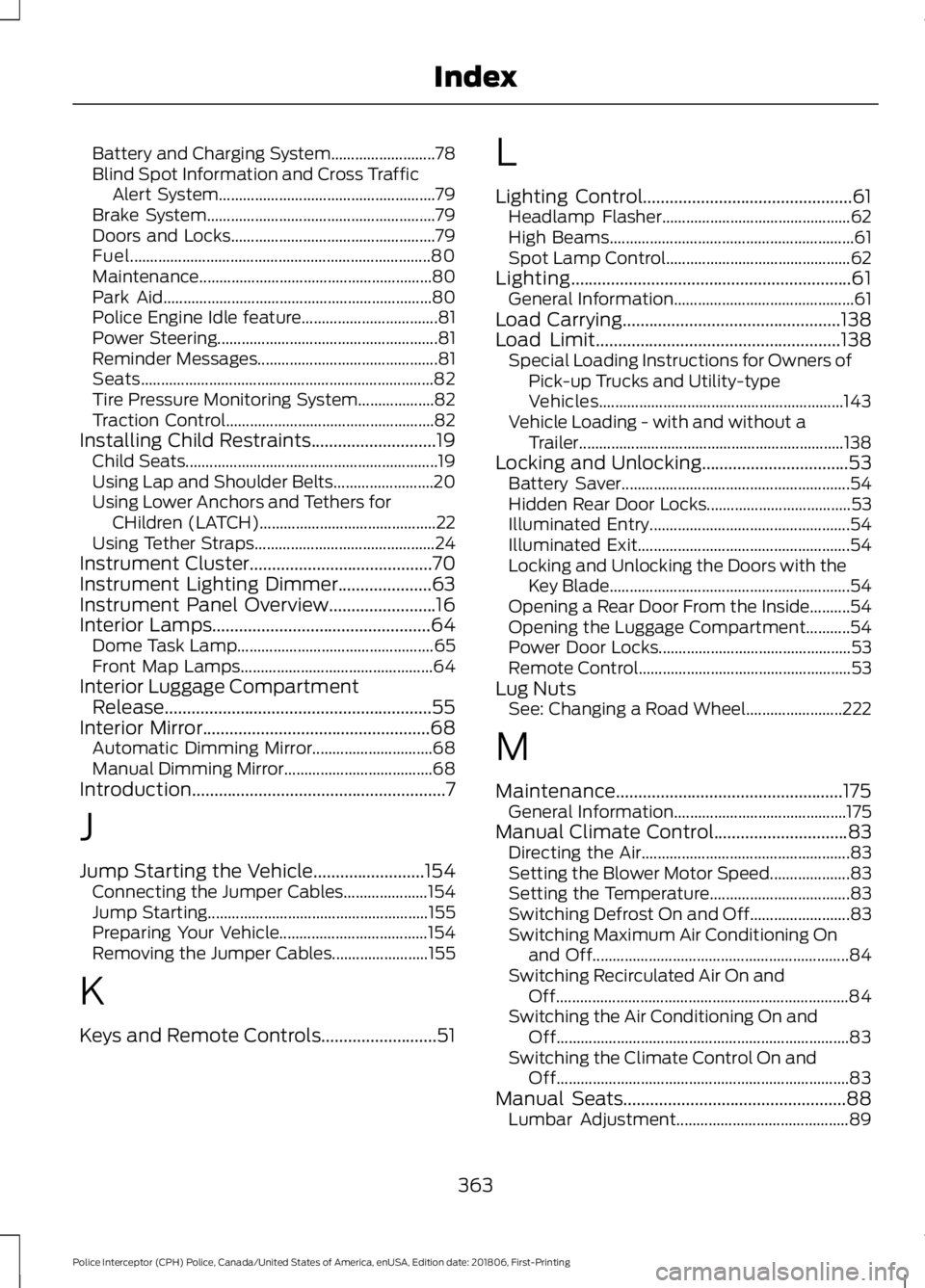
Battery and Charging System..........................
78
Blind Spot Information and Cross Traffic Alert System...................................................... 79
Brake System......................................................... 79
Doors and Locks................................................... 79
Fuel........................................................................\
... 80
Maintenance..........................................................80
Park Aid................................................................... 80
Police Engine Idle feature.................................. 81
Power Steering....................................................... 81
Reminder Messages............................................. 81
Seats........................................................................\
. 82
Tire Pressure Monitoring System................... 82
Traction Control.................................................... 82
Installing Child Restraints............................19 Child Seats............................................................... 19
Using Lap and Shoulder Belts......................... 20
Using Lower Anchors and Tethers for CHildren (LATCH)............................................ 22
Using Tether Straps............................................. 24
Instrument Cluster.........................................70
Instrument Lighting Dimmer.....................63
Instrument Panel Overview........................16
Interior Lamps.................................................64
Dome Task Lamp................................................. 65
Front Map Lamps................................................ 64
Interior Luggage Compartment Release............................................................55
Interior Mirror
...................................................68
Automatic Dimming Mirror.............................. 68
Manual Dimming Mirror..................................... 68
Introduction.........................................................7
J
Jump Starting the Vehicle.........................154 Connecting the Jumper Cables..................... 154
Jump Starting....................................................... 155
Preparing Your Vehicle..................................... 154
Removing the Jumper Cables........................ 155
K
Keys and Remote Controls..........................51 L
Lighting Control...............................................61
Headlamp Flasher............................................... 62
High Beams............................................................. 61
Spot Lamp Control.............................................. 62
Lighting...............................................................61 General Information............................................. 61
Load Carrying
.................................................138
Load Limit.......................................................138
Special Loading Instructions for Owners of
Pick-up Trucks and Utility-type
Vehicles............................................................. 143
Vehicle Loading - with and without a Trailer .................................................................. 138
Locking and Unlocking
.................................53
Battery Saver......................................................... 54
Hidden Rear Door Locks.................................... 53
Illuminated Entry.................................................. 54
Illuminated Exit..................................................... 54
Locking and Unlocking the Doors with the Key Blade............................................................ 54
Opening a Rear Door From the Inside..........54
Opening the Luggage Compartment...........54
Power Door Locks................................................ 53
Remote Control..................................................... 53
Lug Nuts See: Changing a Road Wheel........................ 222
M
Maintenance...................................................175 General Information........................................... 175
Manual Climate Control
..............................83
Directing the Air.................................................... 83
Setting the Blower Motor Speed.................... 83
Setting the Temperature................................... 83
Switching Defrost On and Off......................... 83
Switching Maximum Air Conditioning On and Off................................................................ 84
Switching Recirculated Air On and Off........................................................................\
. 84
Switching the Air Conditioning On and Off........................................................................\
. 83
Switching the Climate Control On and Off........................................................................\
. 83
Manual Seats..................................................88 Lumbar Adjustment........................................... 89
363
Police Interceptor (CPH) Police, Canada/United States of America, enUSA, Edition date: 201806, First-Printing Index
Page 369 of 370
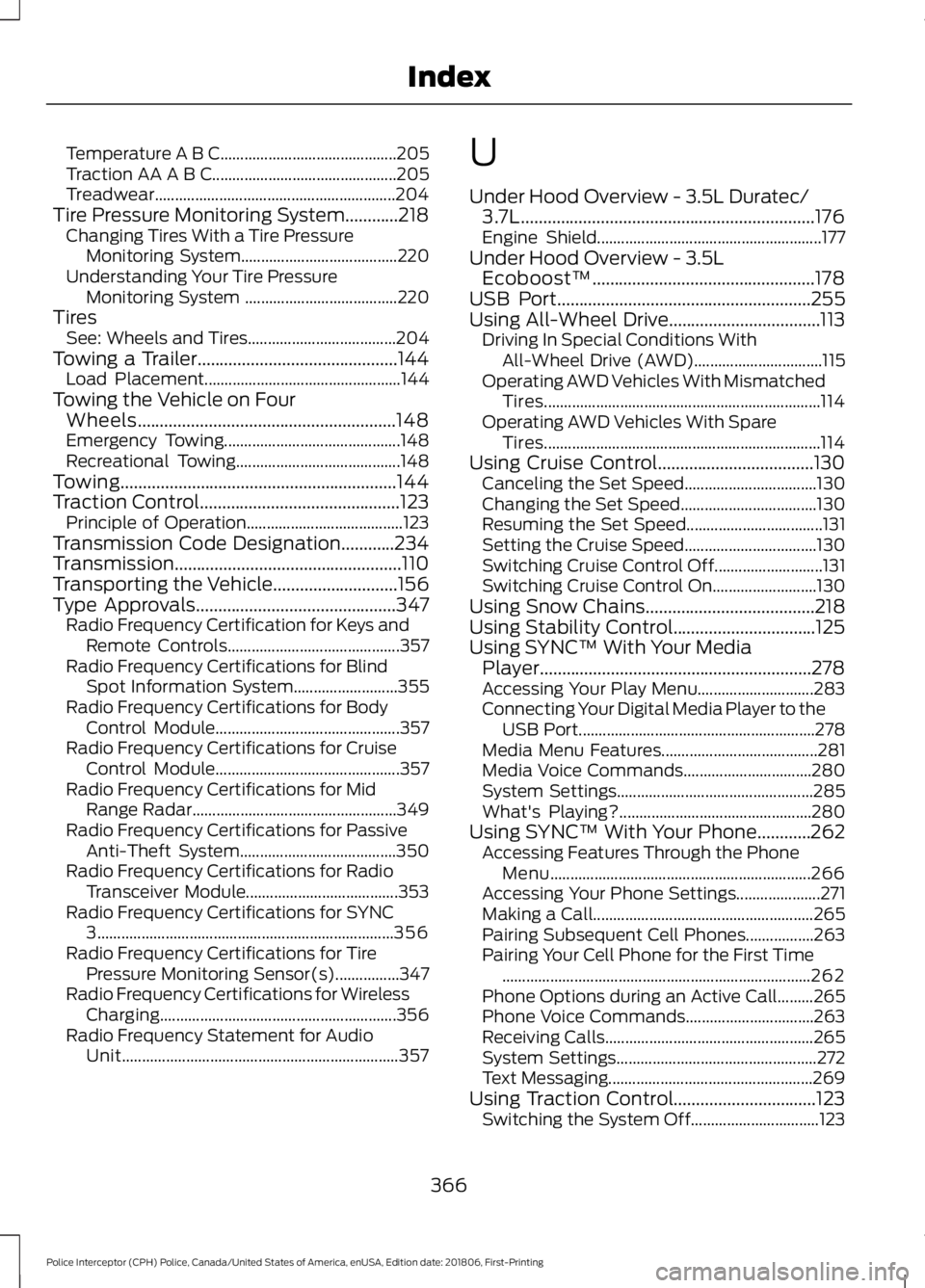
Temperature A B C............................................
205
Traction AA A B C.............................................. 205
Treadwear............................................................ 204
Tire Pressure Monitoring System............218 Changing Tires With a Tire Pressure
Monitoring System....................................... 220
Understanding Your Tire Pressure Monitoring System ...................................... 220
Tires See: Wheels and Tires..................................... 204
Towing a Trailer.............................................144
Load Placement................................................. 144
Towing the Vehicle on Four Wheels..........................................................148
Emergency Towing............................................ 148
Recreational Towing......................................... 148
Towing..............................................................144
Traction Control
.............................................123
Principle of Operation....................................... 123
Transmission Code Designation............234
Transmission
...................................................110
Transporting the Vehicle............................156
Type Approvals.............................................347 Radio Frequency Certification for Keys and
Remote Controls........................................... 357
Radio Frequency Certifications for Blind Spot Information System.......................... 355
Radio Frequency Certifications for Body Control Module.............................................. 357
Radio Frequency Certifications for Cruise Control Module.............................................. 357
Radio Frequency Certifications for Mid Range Radar................................................... 349
Radio Frequency Certifications for Passive Anti-Theft System....................................... 350
Radio Frequency Certifications for Radio Transceiver Module...................................... 353
Radio Frequency Certifications for SYNC 3........................................................................\
.. 356
Radio Frequency Certifications for Tire Pressure Monitoring Sensor(s)................347
Radio Frequency Certifications for Wireless Charging........................................................... 356
Radio Frequency Statement for Audio Unit..................................................................... 357U
Under Hood Overview - 3.5L Duratec/
3.7L..................................................................176
Engine Shield........................................................ 177
Under Hood Overview - 3.5L Ecoboost™..................................................178
USB Port
.........................................................255
Using All-Wheel Drive..................................113 Driving In Special Conditions With
All-Wheel Drive (AWD)................................ 115
Operating AWD Vehicles With Mismatched Tires..................................................................... 114
Operating AWD Vehicles With Spare Tires..................................................................... 114
Using Cruise Control...................................130 Canceling the Set Speed................................. 130
Changing the Set Speed.................................. 130
Resuming the Set Speed.................................. 131
Setting the Cruise Speed................................. 130
Switching Cruise Control Off........................... 131
Switching Cruise Control On.......................... 130
Using Snow Chains
......................................218
Using Stability Control................................125
Using SYNC™ With Your Media Player
.............................................................278
Accessing Your Play Menu............................. 283
Connecting Your Digital Media Player to the USB Port........................................................... 278
Media Menu Features....................................... 281
Media Voice Commands................................ 280
System Settings................................................. 285
What's Playing?................................................ 280
Using SYNC™ With Your Phone............262 Accessing Features Through the Phone
Menu................................................................. 266
Accessing Your Phone Settings..................... 271
Making a Call....................................................... 265
Pairing Subsequent Cell Phones.................263
Pairing Your Cell Phone for the First Time ........................................................................\
..... 262
Phone Options during an Active Call.........265
Phone Voice Commands................................ 263
Receiving Calls.................................................... 265
System Settings.................................................. 272
Text Messaging................................................... 269
Using Traction Control................................123 Switching the System Off................................ 123
366
Police Interceptor (CPH) Police, Canada/United States of America, enUSA, Edition date: 201806, First-Printing Index