sensor FORD POLICE INTERCEPTOR SEDAN 2017 1.G Owner's Manual
[x] Cancel search | Manufacturer: FORD, Model Year: 2017, Model line: POLICE INTERCEPTOR SEDAN, Model: FORD POLICE INTERCEPTOR SEDAN 2017 1.GPages: 358, PDF Size: 3.74 MB
Page 164 of 358
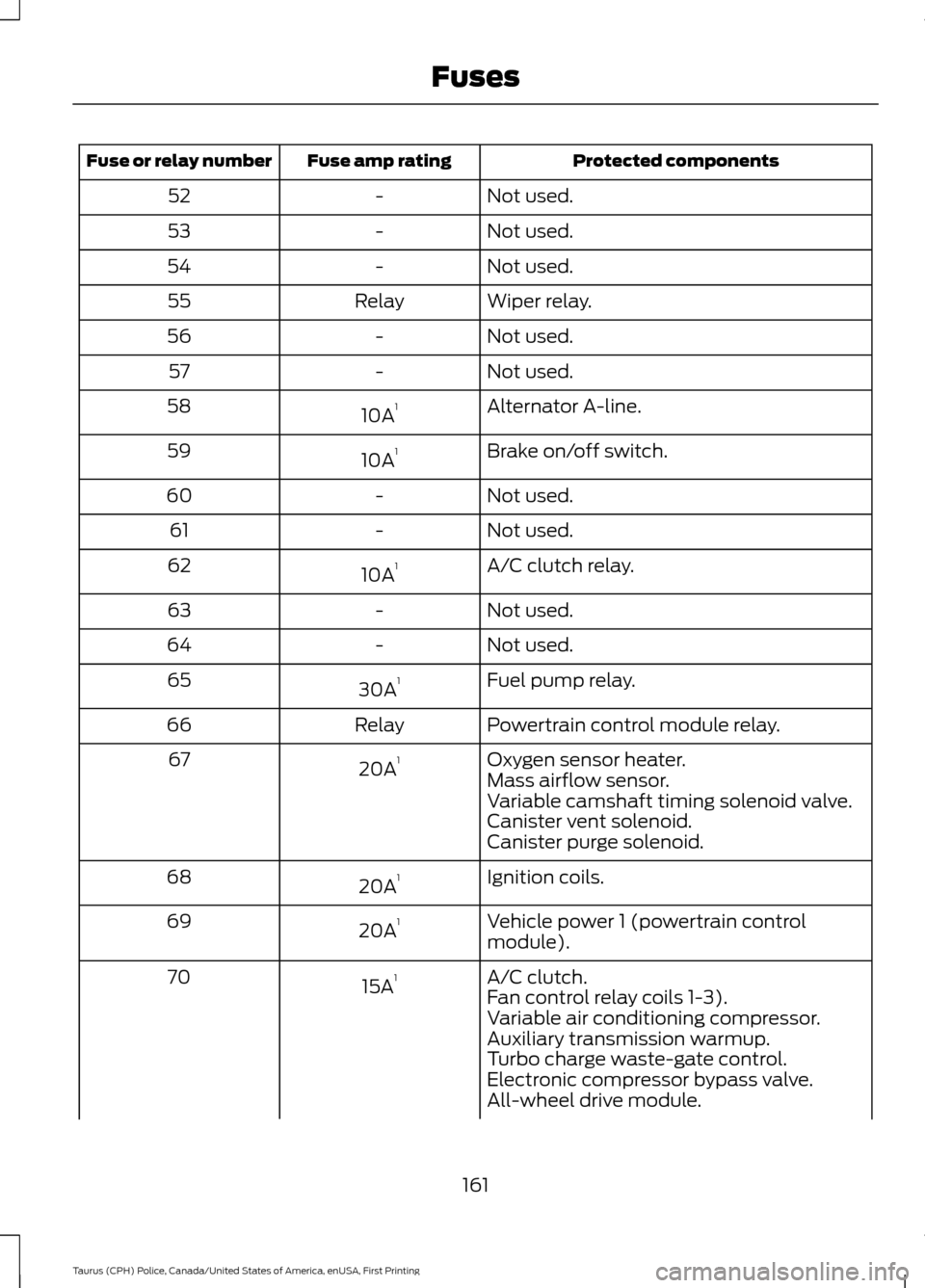
Protected components
Fuse amp rating
Fuse or relay number
Not used.
-
52
Not used.
-
53
Not used.
-
54
Wiper relay.
Relay
55
Not used.
-
56
Not used.
-
57
Alternator A-line.
10A 1
58
Brake on/off switch.
10A 1
59
Not used.
-
60
Not used.
-
61
A/C clutch relay.
10A 1
62
Not used.
-
63
Not used.
-
64
Fuel pump relay.
30A 1
65
Powertrain control module relay.
Relay
66
Oxygen sensor heater.
20A 1
67
Mass airflow sensor.
Variable camshaft timing solenoid valve.
Canister vent solenoid.
Canister purge solenoid.
Ignition coils.
20A 1
68
Vehicle power 1 (powertrain control
module).
20A 1
69
A/C clutch.
15A 1
70
Fan control relay coils 1-3).
Variable air conditioning compressor.
Auxiliary transmission warmup.
Turbo charge waste-gate control.
Electronic compressor bypass valve.
All-wheel drive module.
161
Taurus (CPH) Police, Canada/United States of America, enUSA, First Printing Fuses
Page 169 of 358
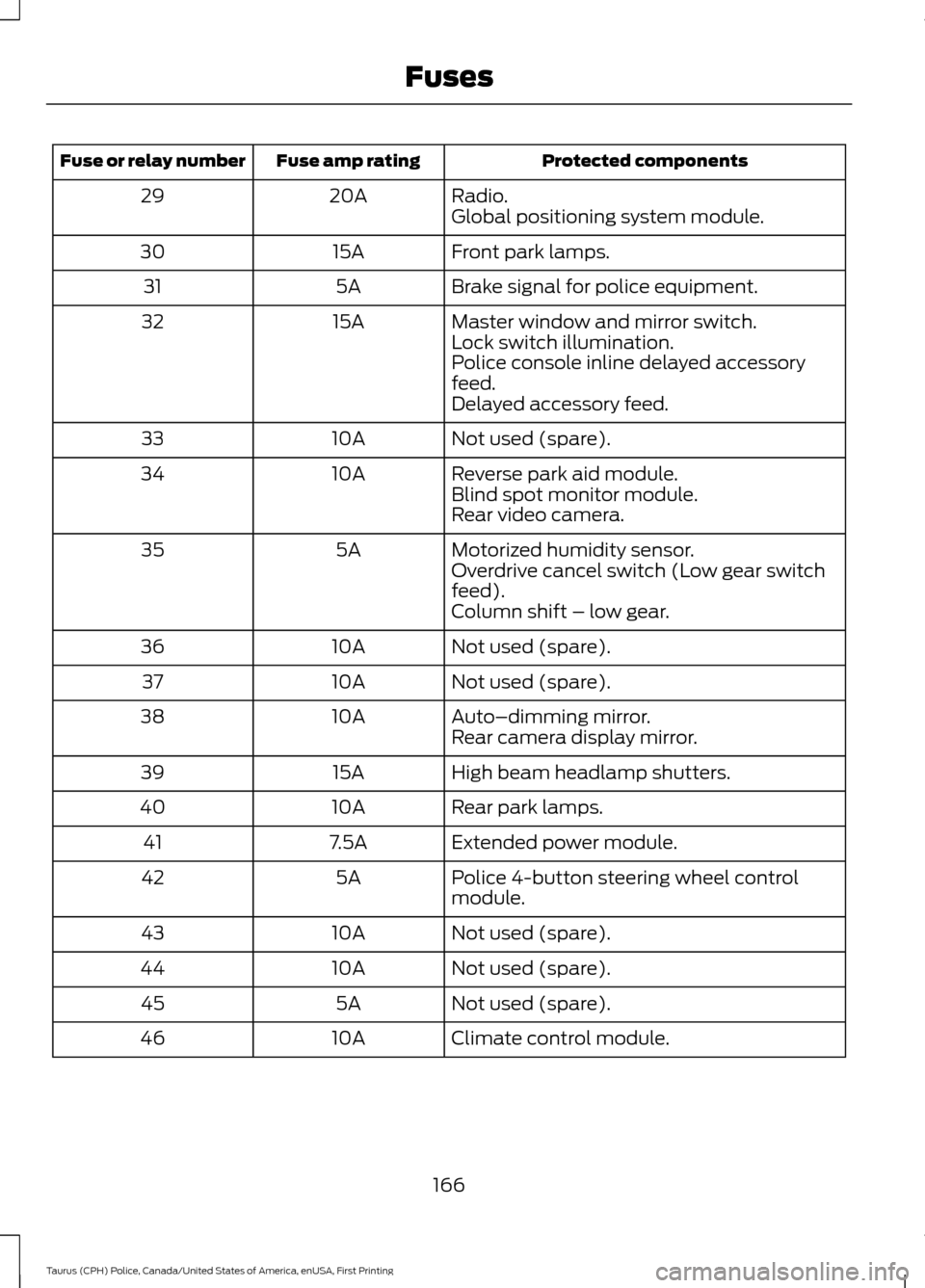
Protected components
Fuse amp rating
Fuse or relay number
Radio.
20A
29
Global positioning system module.
Front park lamps.
15A
30
Brake signal for police equipment.
5A
31
Master window and mirror switch.
15A
32
Lock switch illumination.
Police console inline delayed accessory
feed.
Delayed accessory feed.
Not used (spare).
10A
33
Reverse park aid module.
10A
34
Blind spot monitor module.
Rear video camera.
Motorized humidity sensor.
5A
35
Overdrive cancel switch (Low gear switch
feed).
Column shift – low gear.
Not used (spare).
10A
36
Not used (spare).
10A
37
Auto–dimming mirror.
10A
38
Rear camera display mirror.
High beam headlamp shutters.
15A
39
Rear park lamps.
10A
40
Extended power module.
7.5A
41
Police 4-button steering wheel control
module.
5A
42
Not used (spare).
10A
43
Not used (spare).
10A
44
Not used (spare).
5A
45
Climate control module.
10A
46
166
Taurus (CPH) Police, Canada/United States of America, enUSA, First Printing Fuses
Page 185 of 358
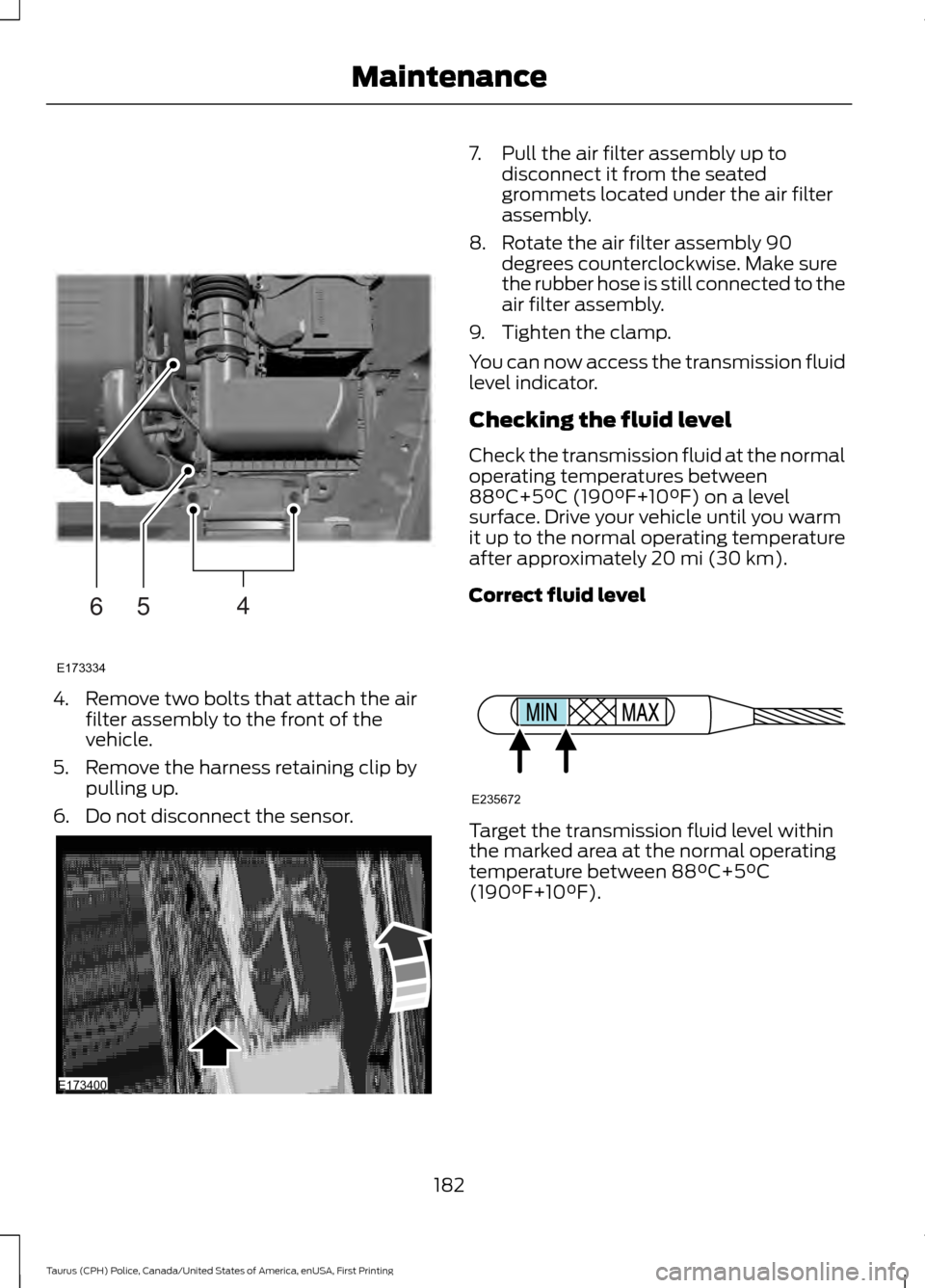
4. Remove two bolts that attach the air
filter assembly to the front of the
vehicle.
5. Remove the harness retaining clip by pulling up.
6. Do not disconnect the sensor. 7. Pull the air filter assembly up to
disconnect it from the seated
grommets located under the air filter
assembly.
8. Rotate the air filter assembly 90 degrees counterclockwise. Make sure
the rubber hose is still connected to the
air filter assembly.
9. Tighten the clamp.
You can now access the transmission fluid
level indicator.
Checking the fluid level
Check the transmission fluid at the normal
operating temperatures between
88°C+5°C (190°F+10°F) on a level
surface. Drive your vehicle until you warm
it up to the normal operating temperature
after approximately 20 mi (30 km).
Correct fluid level Target the transmission fluid level within
the marked area at the normal operating
temperature between 88°C+5°C
(190°F+10°F).
182
Taurus (CPH) Police, Canada/United States of America, enUSA, First Printing MaintenanceE173334
654 E173400 E235672
Page 214 of 358
WARNINGS
is located on the B-Pillar or edge
of the driver's door. If this
information is not found on these
labels, then you should contact
your authorized dealer as soon as
possible. Use of any tire or wheel
not recommended by Ford can
affect the safety and performance
of your vehicle, which could result
in an increased risk of loss of
vehicle control, vehicle rollover,
personal injury and death. To reduce the risk of serious
injury, when mounting
replacement tires and wheels, you
should not exceed the maximum
pressure indicated on the sidewall
of the tire to set the beads without
additional precautions listed
below. If the beads do not seat at
the maximum pressure indicated,
re-lubricate and try again.
When inflating the tire for
mounting pressures up to 20 psi
(1.38 bar) greater than the
maximum pressure on the tire
sidewall, the following
precautions must be taken to
protect the person mounting the
tire:
1. Make sure that you have the
correct tire and wheel size.
2. Lubricate the tire bead and
wheel bead seat area again. WARNINGS
3. Stand at a minimum of
12 ft
(3.66 m) away from the wheel
and tire assembly.
4. Use both eye and ear
protection.
For a mounting pressure more
than 20 psi (1.38 bar) greater than
the maximum pressure, a Ford
dealer or other tire service
professional should do the
mounting.
Always inflate steel carcass tires
with a remote air fill with the
person inflating standing at a
minimum of
12 ft (3.66 m) away
from the wheel and tire assembly. Important: Remember to replace
the wheel valve stems when the
road tires are replaced on your
vehicle.
It is recommended that the two
front tires or two rear tires
generally be replaced as a pair.
The tire pressure sensors mounted
in the wheels (originally installed
on your vehicle) are not designed
to be used in aftermarket wheels.
The use of wheels or tires not
recommended by Ford Motor
Company may affect the
operation of your tire pressure
monitoring system.
211
Taurus (CPH) Police, Canada/United States of America, enUSA, First Printing Wheels and Tires
Page 219 of 358
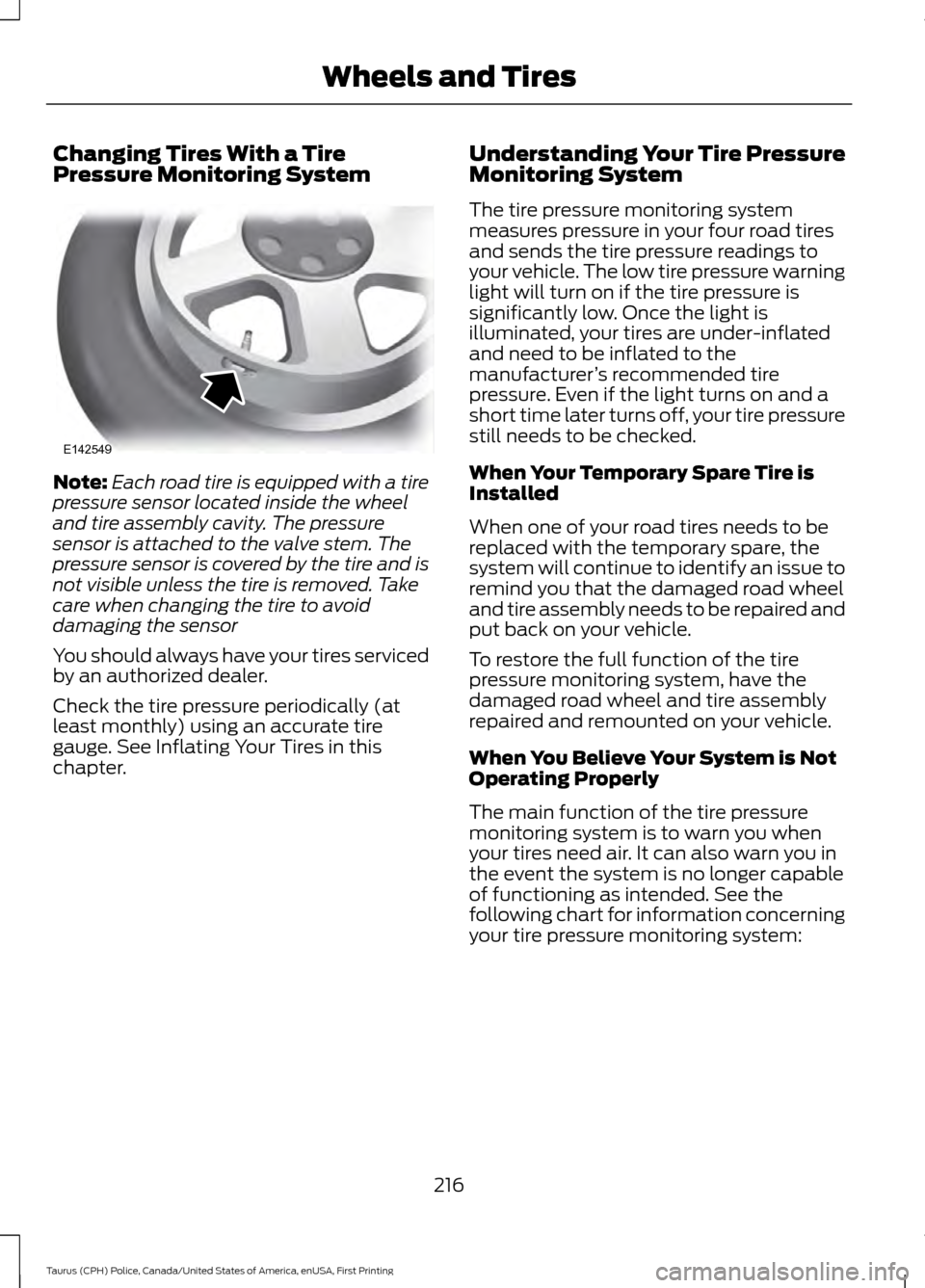
Changing Tires With a Tire
Pressure Monitoring System
Note:
Each road tire is equipped with a tire
pressure sensor located inside the wheel
and tire assembly cavity. The pressure
sensor is attached to the valve stem. The
pressure sensor is covered by the tire and is
not visible unless the tire is removed. Take
care when changing the tire to avoid
damaging the sensor
You should always have your tires serviced
by an authorized dealer.
Check the tire pressure periodically (at
least monthly) using an accurate tire
gauge. See Inflating Your Tires in this
chapter. Understanding Your Tire Pressure
Monitoring System
The tire pressure monitoring system
measures pressure in your four road tires
and sends the tire pressure readings to
your vehicle. The low tire pressure warning
light will turn on if the tire pressure is
significantly low. Once the light is
illuminated, your tires are under-inflated
and need to be inflated to the
manufacturer
’s recommended tire
pressure. Even if the light turns on and a
short time later turns off, your tire pressure
still needs to be checked.
When Your Temporary Spare Tire is
Installed
When one of your road tires needs to be
replaced with the temporary spare, the
system will continue to identify an issue to
remind you that the damaged road wheel
and tire assembly needs to be repaired and
put back on your vehicle.
To restore the full function of the tire
pressure monitoring system, have the
damaged road wheel and tire assembly
repaired and remounted on your vehicle.
When You Believe Your System is Not
Operating Properly
The main function of the tire pressure
monitoring system is to warn you when
your tires need air. It can also warn you in
the event the system is no longer capable
of functioning as intended. See the
following chart for information concerning
your tire pressure monitoring system:
216
Taurus (CPH) Police, Canada/United States of America, enUSA, First Printing Wheels and TiresE142549
Page 221 of 358
How Temperature Affects Your Tire
Pressure
The tire pressure monitoring system
monitors tire pressure in each pneumatic
tire. While driving in a normal manner, a
typical passenger tire inflation pressure
may increase about 2
–4 psi (14– 28 kPa)
from a cold start situation. If the vehicle is
stationary overnight with the outside
temperature significantly lower than the
daytime temperature, the tire pressure may
decrease about 3 psi (21 kPa) for a drop of
30°F (17°C) in ambient temperature. This
lower pressure value may be detected by
the tire pressure monitoring system as
being significantly lower than the
recommended inflation pressure and
activate the system warning light for low
tire pressure. If the low tire pressure
warning light is on, visually check each tire
to verify that no tire is flat. If one or more
tires are flat, repair as necessary. Check
the air pressure in the road tires. If any tire
is under-inflated, carefully drive the vehicle
to the nearest location where air can be
added to the tires. Inflate all the tires to
the recommended inflation pressure.
CHANGING A ROAD WHEEL WARNINGS
Do not use tire sealants as they may
damage the tire pressure monitoring
system.
If the tire pressure monitor sensor
becomes damaged it may not
function.
Note:
The tire pressure monitoring system
indicator light will illuminate when the spare
tire is in use. To restore the full function of
the monitoring system, all road wheels
equipped with tire pressure monitoring
sensors must be mounted on the vehicle. If you get a flat tire while driving, do not
apply the brake heavily. Instead, gradually
decrease your speed. Hold the steering
wheel firmly and slowly move to a safe
place on the side of the road.
Have a flat serviced by an authorized
dealer in order to prevent damage to the
tire pressure monitoring system sensors.
See
Tire Pressure Monitoring System
(page 215). Replace the spare tire with a
road tire as soon as possible. During
repairing or replacing of the flat tire, have
the authorized dealer inspect the tire
pressure monitoring system sensor for
damage.
Dissimilar Spare Wheel and Tire
Assembly Information WARNING
Failure to follow these guidelines
could result in an increased risk of
loss of vehicle control, injury or death.
If you have a dissimilar spare wheel and
tire, then it is intended for temporary use
only. This means that if you need to use it,
you should replace it as soon as possible
with a road wheel and tire assembly that
is the same size and type as the road tires
and wheels that were originally provided
by Ford. If the dissimilar spare tire or wheel
is damaged, it should be replaced rather
than repaired.
A dissimilar spare wheel and tire assembly
is defined as a spare wheel and tire
assembly that is different in brand, size or
appearance from the road tires and wheels
and can be one of three types:
1.
T-type mini-spare:
This spare tire
begins with the letter T for tire size and
may have Temporary Use Only molded in
the sidewall.
218
Taurus (CPH) Police, Canada/United States of America, enUSA, First Printing Wheels and Tires
Page 351 of 358
Capacities and Specifications - 2.0L
EcoBoost™.................................................233
Alternative Engine Oil for Extremely Cold Climates........................................................... 236
Specifications...................................................... 233
Capacities and Specifications - 3.5L Duratec..........................................................237
Alternative Engine Oil for Extremely Cold Climates........................................................... 240
Specifications..................................................... 238
Capacities and Specifications - 3.5L Ecoboost™..................................................241
Alternative Engine Oil for Extreme Cold Climates........................................................... 245
Specifications...................................................... 242
Capacities and Specifications - 3.7L.................................................................246
Alternative Engine Oil for Extremely Cold Climates........................................................... 249
Specifications..................................................... 246
Capacities and Specifications................224
Car Wash See: Cleaning the Exterior............................... 193
Center Console
...............................................89
Console Mounting Plates.................................. 89
Universal Top Tray............................................... 89
Changing a Bulb...........................................189 Front Fog Lamp.................................................. 189
High-Intensity Discharge Headlamps........189
LED Lamps........................................................... 189
License Plate Lamp........................................... 189
Changing a Fuse............................................167 Fuses........................................................................\
167
Changing a Road Wheel............................218 Dissimilar Spare Wheel and Tire Assembly
Information...................................................... 218
Tire Change Procedure..................................... 219
Changing the 12V Battery..........................185 Battery Management System....................... 186
Changing the Engine Air Filter.................192
Changing the Wiper Blades......................187
Checking the Wiper Blades.......................187
Child Restraint and Seatbelt Maintenance.................................................34
Child Restraint Positioning
..........................27
Child Safety.......................................................18
General Information............................................. 18
Cleaning Leather Seats
..............................197 Cleaning Products
........................................193
Materials................................................................ 193
Cleaning the Engine.....................................195
Cleaning the Exterior...................................193 Exterior Chrome Parts...................................... 194
Exterior Plastic Parts......................................... 194
Stripes or Graphics............................................ 194
Underbody............................................................ 194
Under Hood.......................................................... 194
Cleaning the Instrument Panel and Instrument Cluster Lens.........................196
Cleaning the Interior....................................196
Cleaning the Wheels
...................................197
Cleaning the Windows and Wiper Blades............................................................195
Climate Control
..............................................80
Coolant Check See: Engine Coolant Check............................. 176
Crash Sensors and Airbag Indicator........43 Airbags and Police Equipment....................... 44
Cross Traffic Alert.........................................128 False Alerts........................................................... 130
Switching the System Off and On...............130
System Errors....................................................... 130
System Lights, Messages and Audible Alerts.................................................................. 129
System Limitations............................................ 130
Using the System................................................ 128
Cruise Control
..................................................55
Principle of Operation....................................... 124
Cruise control See: Using Cruise Control................................ 124
Customer Assistance
...................................151
D
Data Recording
..................................................9
Event Data Recording.......................................... 10
Service Data Recording........................................ 9
Daytime Running Lamps
.............................59
Decommissioning Requirements..........320 Police Engine Idle feature............................... 320
Decommissioning the Vehicle................320
Direction Indicators
.......................................60
Doors and Locks.............................................50
Driver and Passenger Airbags....................37 Children and Airbags........................................... 37
348
Taurus (CPH) Police, Canada/United States of America, enUSA, First Printing Index