four wheel drive FORD POLICE INTERCEPTOR SEDAN 2017 1.G Owners Manual
[x] Cancel search | Manufacturer: FORD, Model Year: 2017, Model line: POLICE INTERCEPTOR SEDAN, Model: FORD POLICE INTERCEPTOR SEDAN 2017 1.GPages: 358, PDF Size: 3.74 MB
Page 111 of 358
USING ALL-WHEEL DRIVE (If
Equipped)
All-wheel drive uses all four wheels to
power the vehicle. This increases traction,
enabling you to drive over terrain and road
conditions that a conventional two-wheel
drive vehicle cannot. The AWD system is
active all the time and requires no input
from the operator.
Note: Your AWD vehicle is not intended for
off-road use. The AWD feature gives your
vehicle some limited off-road capabilities
in which driving surfaces are relatively level,
obstruction-free and otherwise similar to
normal on-road driving conditions.
Operating your vehicle under other than
those conditions could subject the vehicle
to excessive stress which might result in
damage which is not covered under your
warranty.
Note: The Power Transfer Unit (PTU) does
not require any normal scheduled
maintenance. The system is electronically
monitored and notifies the driver of required
service by displaying the message
Change
AWD Power Transfer Unit Lube in the
information display. The PTU lubricant will
be more likely to require a fluid change if the
vehicle has experienced extended periods
of extreme or severe duty cycle driving. Do
not check or change the PTU lubricant
unless the unit shows signs of leakage or a
message indicating required service is
displayed. Contact an authorized dealer for
service if the PTU was submerged in water
and to reset the PTU lube life monitor. Note:
When an AWD system fault is
present, the warning Check AWD displays
in the information display. The AWD system
is not functioning correctly and defaulted
to front-wheel drive. When this warning
displays, have your vehicle serviced at an
authorized dealer.
Note: The
AWD OFF message may also
appear in the information display if the AWD
system overheats and defaults to
front-wheel drive. This may occur if the
vehicle is operated in extreme conditions
with excessive wheel slip, such as deep
sand. To resume normal AWD function as
soon as possible, stop the vehicle in a safe
location and stop the engine for at least 10
minutes. After the engine has been
restarted and the AWD system has
adequately cooled, the AWD OFF message
will turn off and normal AWD function
returns. If the engine is not stopped, the
AWD OFF
message turns off when the
system cools and normal AWD function
returns.
108
Taurus (CPH) Police, Canada/United States of America, enUSA, First Printing All-Wheel Drive
(If Equipped)
Page 115 of 358
Sand
Most of the time traction control improves
tire traction by managing wheel slip
through Brake, Engine, and AWD
calibrations. However, during low speed
driving, disabling traction control in deep
sand can help keep the wheels moving to
maintain vehicle momentum.
When driving over sand, try to keep all four
wheels on the most solid area of the trail.
Avoid reducing the tire pressures but shift
to a lower gear and drive steadily through
the terrain. Apply the accelerator slowly
and avoid spinning the wheels.
Do not drive your vehicle in deep sand for
an extended period of time. This could
cause the AWD system to overheat and
default to front-wheel drive. If this occurs,
an AWD OFF message displays in the
information display. To resume normal
AWD function as soon as possible, stop
the vehicle in a safe location and stop the
engine for at least 10 minutes. After the
engine has been restarted and the AWD
system has adequately cooled, the
AWD
OFF message turns off and normal AWD
function returns. In the event the engine is
not stopped, the AWD OFF message turns
off when the system cools and normal
AWD function returns.
When driving at slow speeds in deep sand
under high outside temperatures, use L
(Low) gear when possible. L (Low) gear
operation will maximize the engine and
transmission cooling capability.
Under severe operating conditions, the A/C
may cycle on and off to protect
overheating of the engine.
Avoid excessive speed because vehicle
momentum can work against you and
cause the vehicle to become stuck to the
point that assistance may be required from
another vehicle. Remember, you may be
able to back out the way you came if you
proceed with caution. Mud and Water
If you must drive through high water, drive
slowly. Traction or brake capability may
be limited.
When driving through water, determine the
depth; avoid water higher than the bottom
of the wheel rims (for cars) or the bottom
of the hubs (for trucks) (if possible) and
proceed slowly. If the ignition system gets
wet, the vehicle may stall.
Once through water, always try the brakes.
Wet brakes do not stop the vehicle as
effectively as dry brakes. Drying can be
improved by moving your vehicle slowly
while applying light pressure on the brake
pedal.
Be cautious of sudden changes in vehicle
speed or direction when you are driving in
mud. Even AWD vehicles can lose traction
in slick mud. As when you are driving over
sand, apply the accelerator slowly and
avoid spinning your wheels. If the vehicle
does slide, steer in the direction of the slide
until you regain control of the vehicle.
After driving through mud, clean off residue
stuck to rotating driveshafts and tires.
Excess mud stuck on tires and rotating
driveshafts causes an imbalance that
could damage drive components.
Note:
Driving through deep water may
damage the transmission.
If the front or rear axle is submerged in
water, have the power transfer unit (PTU)
or rear axle serviced by an authorized
dealer. 112
Taurus (CPH) Police, Canada/United States of America, enUSA, First Printing All-Wheel Drive
(If Equipped)E143950
Page 117 of 358
Should you start to slide while driving on
snowy or icy roads, turn the steering wheel
in the direction of the slide until you regain
control.
Avoid sudden applications of power and
quick changes of direction on snow and
ice. Apply the accelerator slowly and
steadily when starting from a full stop.
Avoid sudden braking as well. Although an
AWD vehicle may accelerate better than
a two-wheel drive vehicle in snow and ice,
it won
’t stop any faster, because as in other
vehicles, braking occurs at all four wheels.
Do not become overconfident as to road
conditions.
Make sure you allow sufficient distance
between you and other vehicles for
stopping. Drive slower than usual and
consider using one of the lower gears. In
emergency stopping situations, apply the
brake steadily. Since your vehicle is
equipped with a four wheel (ABS), do not
“pump ” the brakes. See Hints on Driving
With Anti-Lock Brakes (page 115).
Maintenance and Modifications
The suspension and steering systems on
your vehicle have been designed and
tested to provide predictable performance
whether loaded or empty and durable load
carrying capability. For this reason, Ford
Motor Company strongly recommends that
you do not make modifications such as
adding or removing parts (such as lowering
kits or stabilizer bars) or by using
replacement parts not equivalent to the
original factory equipment.
Any modifications to a vehicle that raise
the center of gravity can make it more likely
the vehicle will rollover as a result of a loss
of control. Ford Motor Company
recommends that caution be used with
any vehicle equipped with a high load or
device (such as ladder or luggage racks). Failure to maintain your vehicle properly
may void the warranty, increase your repair
cost, reduce vehicle performance and
operational capabilities and adversely
affect driver and passenger safety.
Frequent inspection of vehicle chassis
components is recommended if the vehicle
is subjected to off-highway usage.
114
Taurus (CPH) Police, Canada/United States of America, enUSA, First Printing All-Wheel Drive
(If Equipped)
Page 145 of 358
TOWING THE VEHICLE ON
FOUR WHEELS
Emergency Towing
You can flat-tow (all wheels on the
ground, regardless of the
powertrain/transmission configuration)
your disabled vehicle (without access to
wheel dollies, car-hauling trailer, or flatbed
transport vehicle) under the following
conditions:
•
Your vehicle is facing forward so you
tow it in a forward direction.
• You place the transmission in neutral
(N). If you cannot place the
transmission in neutral (N), you may
need to override it. See Transmission
(page 105).
• Maximum speed is 35 mph (56 km/h).
• Maximum distance is
50 mi (80 km).
Recreational Towing
Note: Put your climate control system in
recirculated air mode to prevent exhaust
fumes from entering your vehicle. See
Climate Control
(page 80).
Vehicles Equipped with a 2.0L Engine
Follow these guidelines if you have a need
for recreational towing, such as towing
your vehicle behind a motorhome. We
designed these guidelines to prevent
damage to your transmission.
Front-wheel drive vehicles
CANNOT be
flat-towed (all wheels on the ground) as
vehicle or transmission damage may occur.
You must place the front wheels on a
two-wheel tow dolly. If you are using a tow
dolly, follow the instructions specified by
the equipment provider. Vehicles Equipped with a 3.5L Engine
Follow these guidelines if you have a need
for recreational towing, such as towing
your vehicle behind a motorhome or truck.
We designed these guidelines to prevent
damage to your vehicle after it is
hooked-up to the recreational vehicle or
tow dolly.
You can tow your front-wheel drive vehicle
with all four wheels on the ground or with
the front wheels off the ground by using a
tow dolly. If you are using a tow dolly,
follow the instructions specified by the
equipment provider. If you are towing with
all four wheels on the ground, see the
following instructions.
You can tow your all-wheel drive vehicle
with all four wheels on the ground or with
all four wheels off the ground using a
vehicle transport trailer. Do not tow your
all-wheel drive vehicle with the front
wheels off the ground (by using a tow
dolly) and the rear wheels on the ground.
This causes damage to your all-wheel drive
system. If you are using a vehicle transport
trailer, follow the instructions specified by
the equipment provider. If you are towing
with all four wheels on the ground, see the
following instructions.
If you tow your vehicle with all four wheels
on the ground:
•
Tow only in the forward direction.
• Release the parking brake.
• Shift into neutral (N).
• Do not exceed 65 mph (105 km/h).
• Start the engine and allow it to run for
five minutes at the beginning of each
day and every six hours thereafter. With
the engine running and your foot on the
brake, shift into drive (D) and then into
reverse (R) before shifting back into
neutral (N).
142
Taurus (CPH) Police, Canada/United States of America, enUSA, First Printing Towing
Page 147 of 358
•
Transmissions give their best fuel
economy when operated in the top
cruise gear and with steady pressure
on the gas pedal.
• Four-wheel-drive operation (if
equipped) is less fuel efficient than
two-wheel-drive operation.
• Close the windows for high-speed
driving.
DRIVING THROUGH WATER WARNING
Do not drive through flowing or deep
water as you may lose control of your
vehicle.
Note:
Driving through standing water can
cause vehicle damage.
Note: Engine damage can occur if water
enters the air filter.
Before driving through standing water,
check the depth. Never drive through water
that is higher than the bottom of the front
rocker area of your vehicle. When driving through standing water, drive
very slowly and do not stop your vehicle.
Your brake performance and traction may
be limited. After driving through water and
as soon as it is safe to do so: •
Lightly press the brake pedal to dry the
brakes and to check that they work.
• Check that the horn works.
• Check that the exterior lights work.
• Turn the steering wheel to check that
the steering power assist works.
FLOOR MATS WARNINGS
Always use floor mats that are
designed to fit the foot well of your
vehicle. Only use floor mats that
leave the pedal area unobstructed. Only
use floor mats that are firmly secured to
retention posts so that they cannot slip out
of position and interfere with the pedals
or impair safe operation of your vehicle in
other ways. Pedals that cannot move freely can
cause loss of vehicle control and
increase the risk of serious personal
injury. Always make sure that the floor
mats are properly attached to the
retention posts in the carpet that are
supplied with your vehicle. Floor mats must
be properly secured to both retention posts
to make sure mats do not shift out of
position. Never place floor mats or any other
covering in the vehicle foot well that
cannot be properly secured to
prevent them from moving and interfering
with the pedals or the ability to control the
vehicle. Never place floor mats or any other
covering on top of already installed
floor mats. Floor mats should always
rest on top of vehicle carpeting surface and
not another floor mat or other covering.
Additional floor mats or any other covering
will reduce the pedal clearance and
potentially interfere with pedal operation.
144
Taurus (CPH) Police, Canada/United States of America, enUSA, First Printing Driving HintsE176360
Page 207 of 358
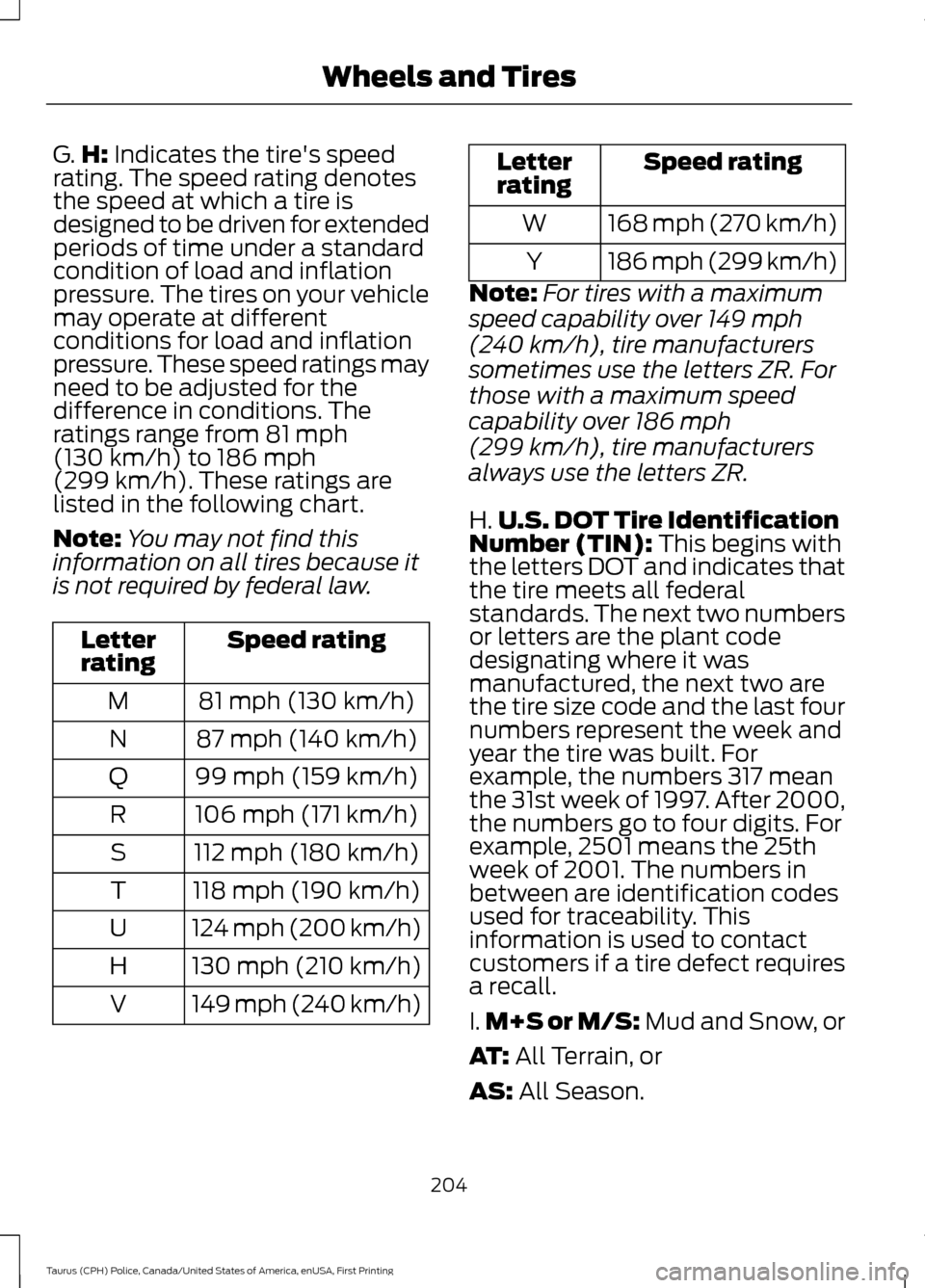
G.
H: Indicates the tire's speed
rating. The speed rating denotes
the speed at which a tire is
designed to be driven for extended
periods of time under a standard
condition of load and inflation
pressure. The tires on your vehicle
may operate at different
conditions for load and inflation
pressure. These speed ratings may
need to be adjusted for the
difference in conditions. The
ratings range from
81 mph
(130 km/h) to 186 mph
(299 km/h). These ratings are
listed in the following chart.
Note: You may not find this
information on all tires because it
is not required by federal law. Speed rating
Letter
rating
81 mph (130 km/h)
M
87 mph (140 km/h)
N
99 mph (159 km/h)
Q
106 mph (171 km/h)
R
112 mph (180 km/h)
S
118 mph (190 km/h)
T
124 mph (200 km/h)
U
130 mph (210 km/h)
H
149 mph (240 km/h)
V Speed rating
Letter
rating
168 mph (270 km/h)
W
186 mph (299 km/h)
Y
Note: For tires with a maximum
speed capability over 149 mph
(240 km/h), tire manufacturers
sometimes use the letters ZR. For
those with a maximum speed
capability over
186 mph
(299 km/h)
, tire manufacturers
always use the letters ZR.
H. U.S. DOT Tire Identification
Number (TIN):
This begins with
the letters DOT and indicates that
the tire meets all federal
standards. The next two numbers
or letters are the plant code
designating where it was
manufactured, the next two are
the tire size code and the last four
numbers represent the week and
year the tire was built. For
example, the numbers 317 mean
the 31st week of 1997. After 2000,
the numbers go to four digits. For
example, 2501 means the 25th
week of 2001. The numbers in
between are identification codes
used for traceability. This
information is used to contact
customers if a tire defect requires
a recall.
I. M+S or M/S:
Mud and Snow, or
AT:
All Terrain, or
AS:
All Season.
204
Taurus (CPH) Police, Canada/United States of America, enUSA, First Printing Wheels and Tires
Page 213 of 358
Age
WARNING
Tires degrade over time
depending on many factors
such as weather, storage
conditions, and conditions of use
(load, speed, inflation pressure)
the tires experience throughout
their lives.
In general, tires should be
replaced after six years regardless
of tread wear. However, heat
caused by hot climates or
frequent high loading conditions
can accelerate the aging process
and may require tires to be
replaced more frequently.
You should replace your spare tire
when you replace the road tires or
after six years due to aging even if
it has not been used. U.S. DOT Tire Identification
Number
Both United States and Canada
Federal regulations require tire
manufacturers to place
standardized information on the
sidewall of all tires. This
information identifies and
describes the fundamental
characteristics of the tire and also
provides a U.S. DOT Tire
Identification Number for safety
standard certification and in case
of a recall. This begins with the letters DOT
and indicates that the tire meets
all federal standards. The next
two numbers or letters are the
plant code designating where it
was manufactured, the next two
are the tire size code and the last
four numbers represent the week
and year the tire was built. For
example, the numbers 317 mean
the 31st week of 1997. After 2000,
the numbers go to four digits. For
example, 2501 means the 25th
week of 2001. The numbers in
between are identification codes
used for traceability. This
information is used to contact
customers if a tire defect requires
a recall.
Tire Replacement
Requirements
Your vehicle is equipped with tires
designed to provide a safe ride
and handling capability.
WARNINGS
Only use replacement tires
and wheels that are the same
size, load index, speed rating and
type (such as P-metric versus
LT-metric or all-season versus
all-terrain) as those originally
provided by Ford. The
recommended tire and wheel size
may be found on either the Safety
Compliance Certification Label
(affixed to either the door hinge
pillar, door-latch post, or the door
edge that meets the door-latch
post, next to the driver's seating
position), or the Tire Label which
210
Taurus (CPH) Police, Canada/United States of America, enUSA, First Printing Wheels and Tires
Page 216 of 358
Wheel misalignment in the front
or the rear can cause uneven and
rapid treadwear of your tires and
should be corrected by an
authorized dealer. Front-wheel
drive vehicles and those with an
independent rear suspension (if
equipped) may require alignment
of all four wheels.
The tires should also be balanced
periodically. An unbalanced tire
and wheel assembly may result in
irregular tire wear.
Tire Rotation
Note:
If your tires show uneven
wear, ask an authorized dealer to
check for and correct any wheel
misalignment, tire imbalance or
mechanical problem involved
before tire rotation.
Note: Your vehicle may be
equipped with a dissimilar spare
wheel and tire assembly. A
dissimilar spare wheel and tire
assembly is defined as a spare
wheel and tire assembly that is
different in brand, size or
appearance from the road tires and
wheels. If you have a dissimilar
spare wheel and tire assembly, it is
intended for temporary use only
and should not be used in a tire
rotation.
Note: After having your tires
rotated, inflation pressure must be
checked and adjusted to the
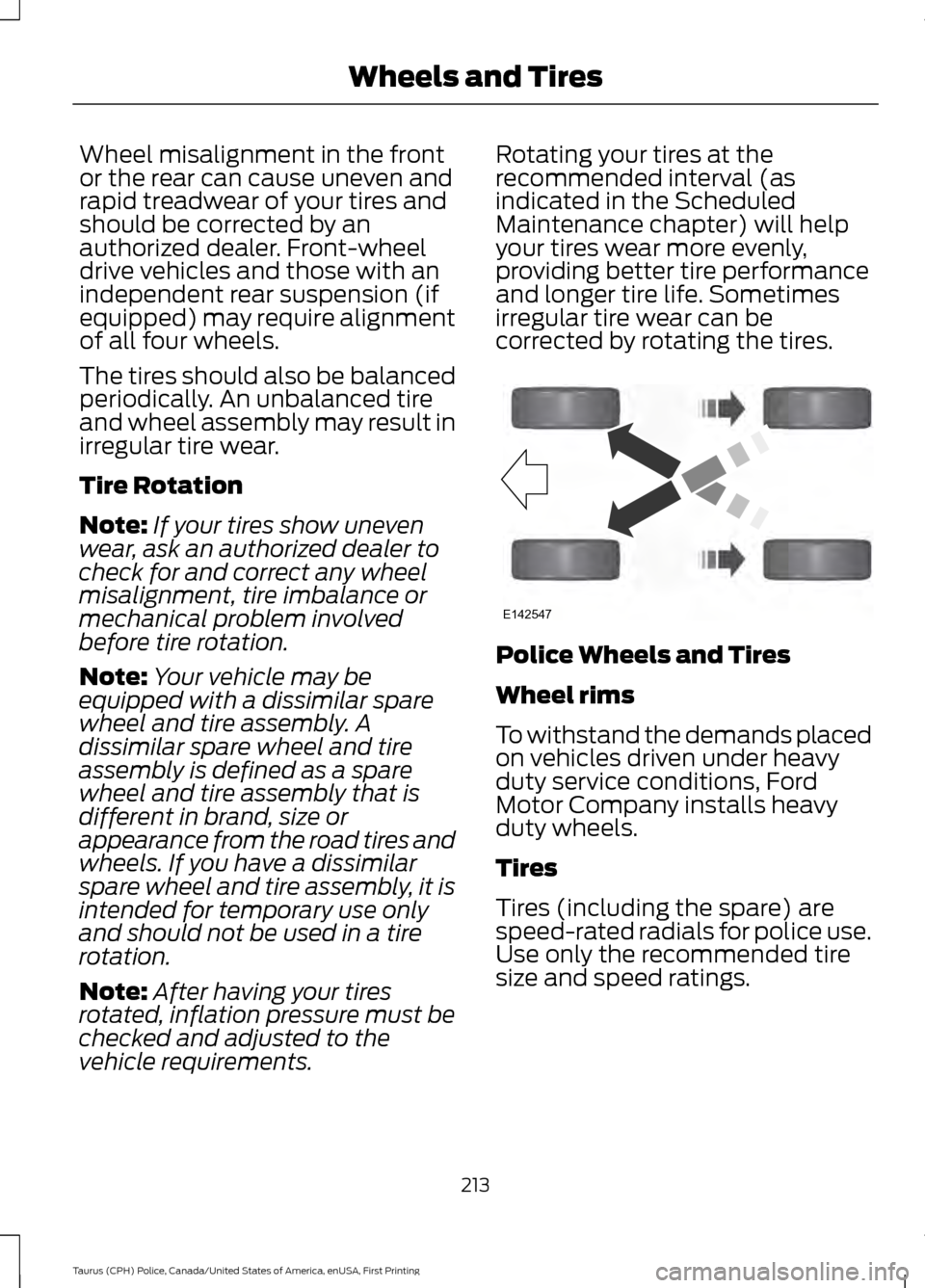
vehicle requirements. Rotating your tires at the
recommended interval (as
indicated in the Scheduled
Maintenance chapter) will help
your tires wear more evenly,
providing better tire performance
and longer tire life. Sometimes
irregular tire wear can be
corrected by rotating the tires.
Police Wheels and Tires
Wheel rims
To withstand the demands placed
on vehicles driven under heavy
duty service conditions, Ford
Motor Company installs heavy
duty wheels.
Tires
Tires (including the spare) are
speed-rated radials for police use.
Use only the recommended tire
size and speed ratings.
213
Taurus (CPH) Police, Canada/United States of America, enUSA, First Printing Wheels and TiresE142547
Page 217 of 358
2.0L GTDI Police sedans equipped
with the P235/55R18 99H tire can
switch to the Police Interceptor
sedan 245/55R18 103V tire if
desired. All of the tires (including
the spare) need to be replaced if
the change is being made. The
original equipment tire size is
located on the Safety Compliance
Certification Label (affixed to
either the door hinge pillar,
door-latch post, or the door edge
that meets the door-latch on the
B-pillar, or on the edge of the
driver
’s door. The 245/55R18 tire
will use the same Ford
recommended tire inflation
pressure as the P235/55R18 tire,
found on the Safety Compliance
Certification Label.
In regions with snow and ice
during the winter months,
installation of snow tires may be
desirable. Snow tires will usually
exhibit a drop in dry pavement
handling, but may show an
increase in snow and ice traction.
When snow tires are used, they
should be installed on all four
wheels, never on the drive wheels
only.
Tire storage
Most high performance tires are
made with a nylon overlay. As
such, the following steps should
be taken to avoid flatspotting
when the vehicles are not used for
a period of time. •
Fleets should store the vehicles
with 44 psi (303 kPa) in the
tires.
• If the vehicle is stored for
periods longer than 30 days,
you should move it several feet
at least once during each
30-day period, so that a
different portion of the tread
contacts the ground.
• Tire pressure should be
reduced to the recommended
pressure shown on the vehicle
certification label before the
vehicle is placed back into
service.
USING SNOW CHAINS WARNINGS
If you choose to install snow tires on
your vehicle, they must be the same
size, construction, and load range as
the original tires listed on the tire placard,
and they must be installed on all four
wheels. Mixing tires of different size or
construction on your vehicle can adversely
affect your vehicle's handling and braking,
and may lead to loss of vehicle control. Do not use snow chains or cables on
this vehicle as they may cause
damage to your vehicle which may
lead to loss of vehicle control. Snow chains have not been approved for
use on your vehicle.
The original equipment tires on your vehicle
may have an all-weather tread design to
provide traction, handling, and braking
performance in year-round driving. You
may install snow tires for improved traction
when driving in areas with sustained
periods of snow or icy driving conditions.
214
Taurus (CPH) Police, Canada/United States of America, enUSA, First Printing Wheels and Tires
Page 356 of 358
On-board Diagnostics (OBD-II).......................
13
Special Instructions.............................................. 12
Special Operating Conditions Scheduled Maintenance...............................................307
Engine Idle Hour Meter.................................... 308
Exceptions........................................................... 309
Speed Control See: Cruise Control............................................. 124
Stability Control.............................................118
Principle of Operation........................................ 118
Starter Switch See: Ignition Switch............................................ 90
Starting a Gasoline Engine........................90 Cold Weather Starting - Flex Fuel
Vehicles................................................................ 91
Failure to Start........................................................ 91
Guarding Against Exhaust Fumes.................92
Important Ventilating Information................92
Stopping the Engine When Your Vehicle is Moving................................................................. 92
Stopping the Engine When Your Vehicle is Stationary........................................................... 92
Starting and Stopping the Engine...........90 General Information........................................... 90
Steering.............................................................131 Electric Power Steering..................................... 131
Steering Wheel
...............................................54
Storage Compartments..............................89
Sun Visors
.........................................................65
Slide-on-rod.......................................................... 65
Supplementary Restraints System.........36 Principle of Operation........................................ 36
Symbols Glossary
.............................................7
SYNC™ Applications and Services.......276 911 Assist............................................................... 276
SYNC™ AppLink ™
......................................278
SYNC Mobile Apps............................................ 278
SYNC™...........................................................258 General Information......................................... 258
SYNC™ Troubleshooting
.........................290
T
Technical Specifications See: Capacities and Specifications............224
The Better Business Bureau (BBB) Auto Line Program (U.S. Only)
........................153 Tire Care.........................................................200
Glossary of Tire Terminology......................... 201
Information About Uniform Tire Quality Grading............................................................. 200
Information Contained on the Tire Sidewall........................................................... 202
Police Wheels and Tires................................... 213
Temperature A B C............................................. 201
Traction AA A B C............................................... 201
Treadwear............................................................ 200
Tire Pressure Monitoring System............215 Changing Tires With a Tire Pressure
Monitoring System........................................ 216
Understanding Your Tire Pressure Monitoring System ....................................... 216
Tires See: Wheels and Tires..................................... 200
Towing a Trailer.............................................138 Load Placement.................................................. 138
Towing the Vehicle on Four Wheels...........................................................142
Emergency Towing............................................. 142
Recreational Towing.......................................... 142
Towing..............................................................138
Traction Control
..............................................117
Principle of Operation........................................ 117
Transmission Code Designation............232
Transmission
..................................................105
Transmission See: Transmission.............................................. 105
U
Under Hood Overview - 2.0L EcoBoost™....................................................171
Under Hood Overview - 3.5L Duratec/ 3.7L
...................................................................172
Engine Shield........................................................ 173
Under Hood Overview - 3.5L Ecoboost™...................................................173
USB Port..........................................................257
Using All-Wheel Drive
................................108
Driving In Special Conditions With
All-Wheel Drive (AWD)................................ 110
Operating AWD Vehicles With Mismatched Tires..................................................................... 110
Operating AWD Vehicles With Spare Tires.................................................................... 109
353
Taurus (CPH) Police, Canada/United States of America, enUSA, First Printing Index