warning FORD POLICE INTERCEPTOR UTILITY 2013 1.G Repair Manual
[x] Cancel search | Manufacturer: FORD, Model Year: 2013, Model line: POLICE INTERCEPTOR UTILITY, Model: FORD POLICE INTERCEPTOR UTILITY 2013 1.GPages: 375, PDF Size: 5.47 MB
Page 114 of 375
USB PORT (IF EQUIPPED)
WARNING:Driving while distracted can result in loss of vehicle
control, accident and injury. Ford strongly recommends that you
use extreme caution when using any device or feature that may take
your focus off the road. Your primary responsibility is the safe operation
of the vehicle. We recommend against the use of any handheld device
while driving, encourage the use of voice-operated systems when
possible and that you become aware of applicable state and local laws
that may affect use of electronic devices while driving.
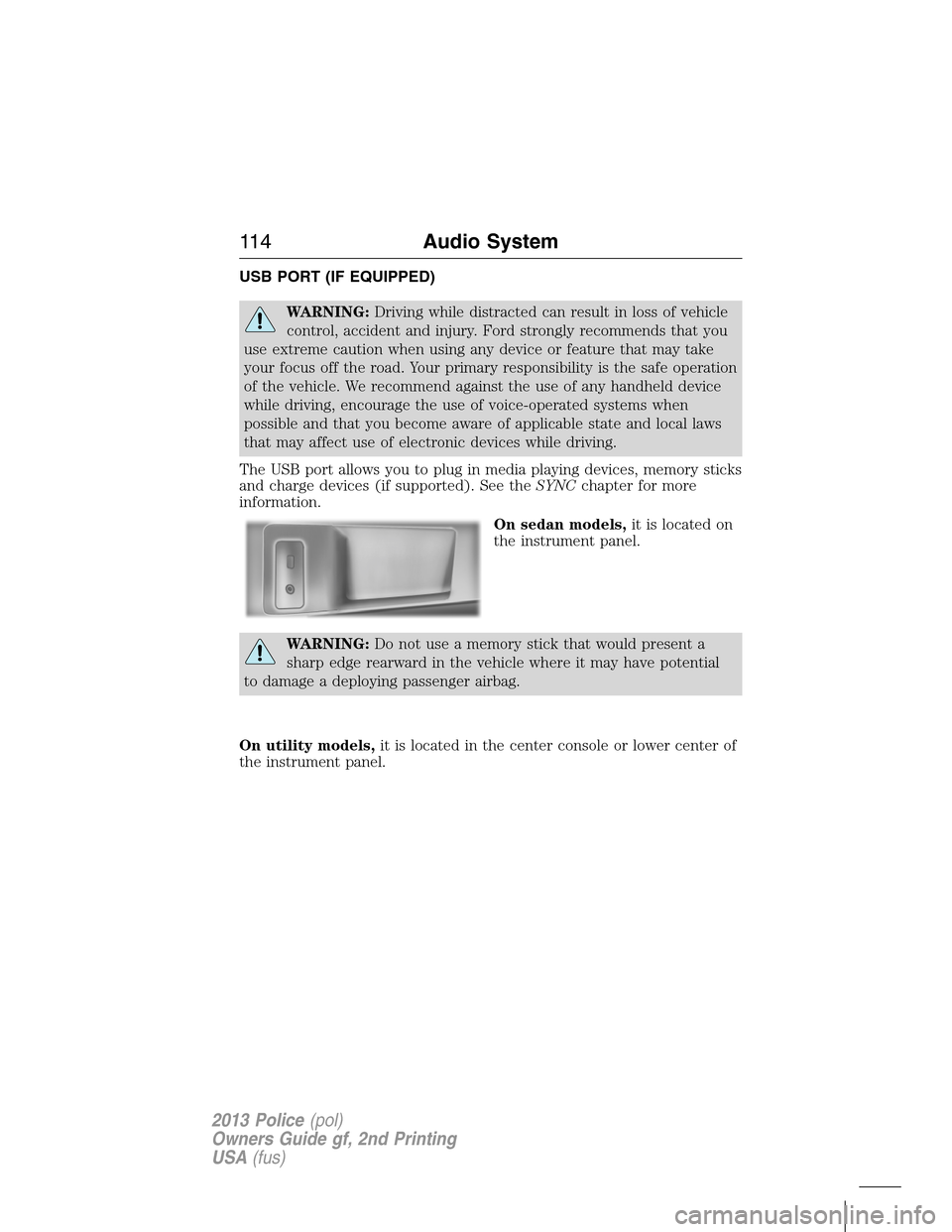
The USB port allows you to plug in media playing devices, memory sticks
and charge devices (if supported). See theSYNCchapter for more
information.
On sedan models,it is located on
the instrument panel.
WARNING:Do not use a memory stick that would present a
sharp edge rearward in the vehicle where it may have potential
to damage a deploying passenger airbag.
On utility models,it is located in the center console or lower center of
the instrument panel.
11 4Audio System
2013 Police(pol)
Owners Guide gf, 2nd Printing
USA(fus)
Page 118 of 375
SITTING IN THE CORRECT POSITION
WARNING:Sitting improperly out of position or with the seat
back reclined too far can take off weight from the seat cushion
and affect the decision of the passenger sensing system, resulting in
serious injury or death in a crash. Always sit upright against your seat
back, with your feet on the floor.
WARNING:Do not recline the seat back as this can cause the
occupant to slide under the seat’s safety belt, resulting in severe
personal injury in the event of a collision.
WARNING:Do not place objects higher than the seat backs to
reduce the risk of injury in a collision or during heavy braking or
when stopping suddenly.
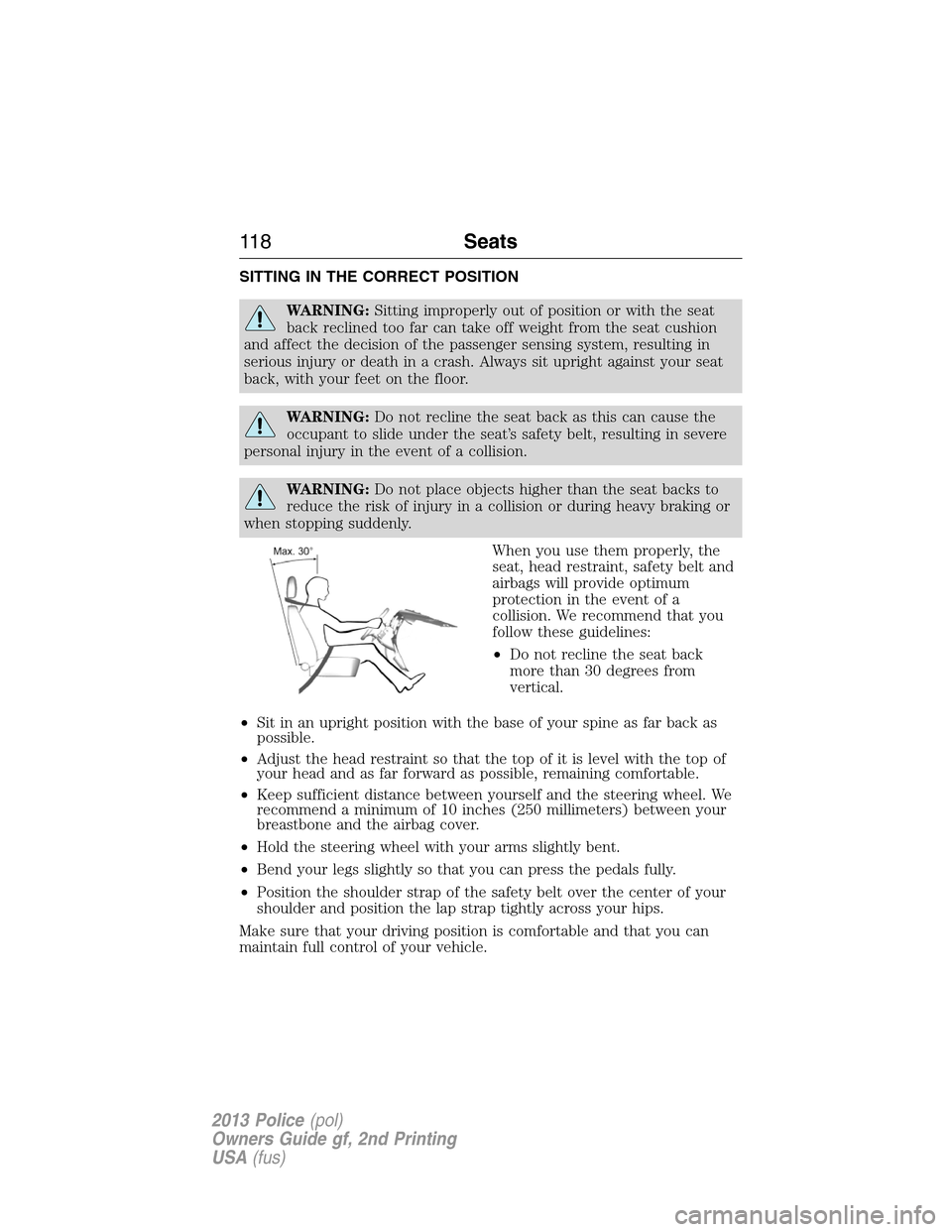
When you use them properly, the
seat, head restraint, safety belt and
airbags will provide optimum
protection in the event of a
collision. We recommend that you
follow these guidelines:
•Do not recline the seat back
more than 30 degrees from
vertical.
•Sit in an upright position with the base of your spine as far back as
possible.
•Adjust the head restraint so that the top of it is level with the top of
your head and as far forward as possible, remaining comfortable.
•Keep sufficient distance between yourself and the steering wheel. We
recommend a minimum of 10 inches (250 millimeters) between your
breastbone and the airbag cover.
•Hold the steering wheel with your arms slightly bent.
•Bend your legs slightly so that you can press the pedals fully.
•Position the shoulder strap of the safety belt over the center of your
shoulder and position the lap strap tightly across your hips.
Make sure that your driving position is comfortable and that you can
maintain full control of your vehicle.
11 8Seats
2013 Police(pol)
Owners Guide gf, 2nd Printing
USA(fus)
Page 119 of 375
HEAD RESTRAINTS
WARNING:To minimize the risk of neck injury in the event of a
crash, the driver and passenger occupants should not sit in
and/or operate the vehicle, until the head restraint is placed in its
proper position. The driver should never adjust the head restraint while
the vehicle is in motion.
WARNING:The adjustable head restraint is a safety device.
Whenever possible it should be installed and properly adjusted
when the seat is occupied.
WARNING:Install the head restraint properly to minimize the
risk of neck injury in the event of a crash.
Note:Before adjusting any head restraint, adjust the seatback to an
upright driving/riding position. Properly adjust the head restraint so that
the top of the head restraint is even with the top of your head and
positioned as close as possible to the back of your head. For occupants
of extremely tall stature, adjust the head restraint to its full up position.
To adjust the head restraint, do the following:
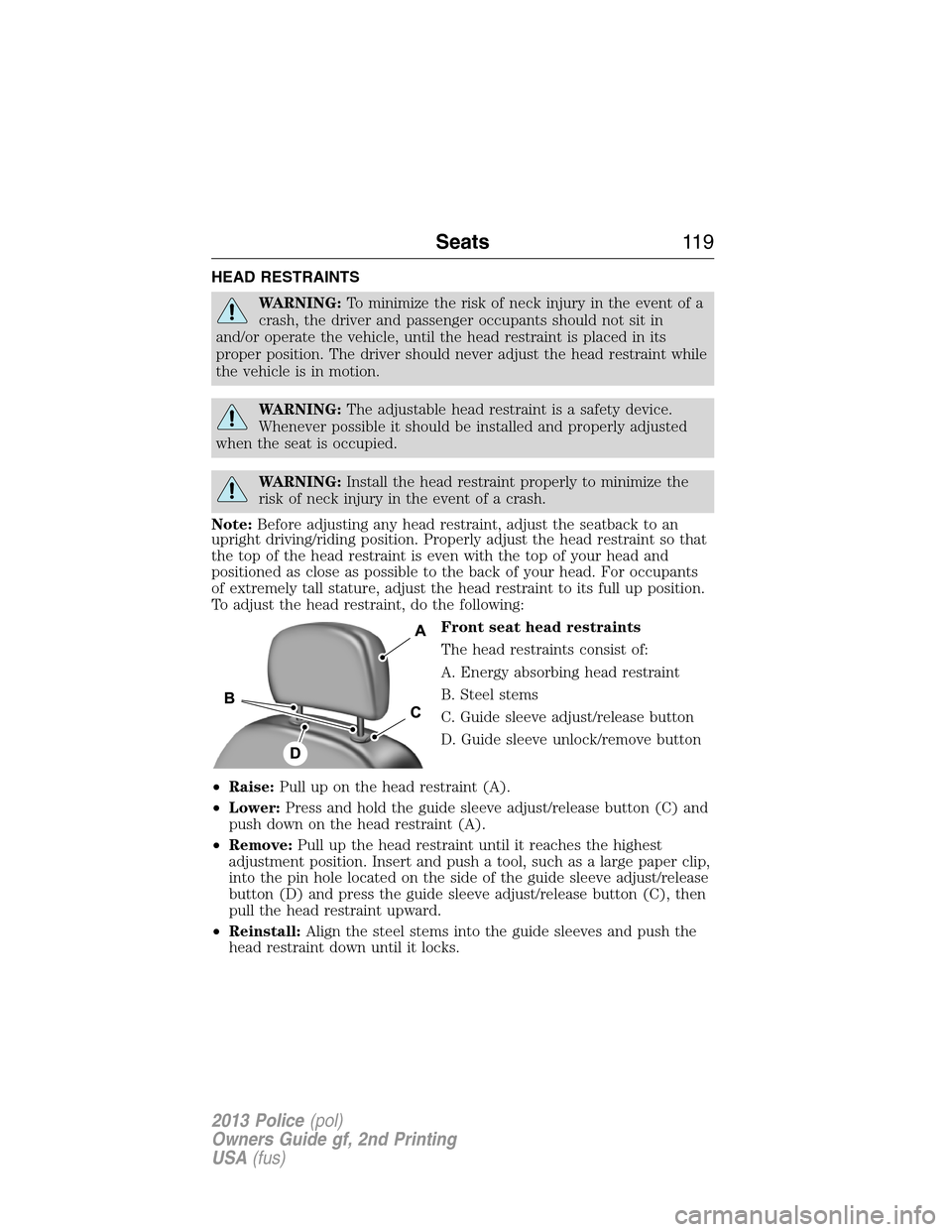
Front seat head restraints
The head restraints consist of:
A. Energy absorbing head restraint
B. Steel stems
C. Guide sleeve adjust/release button
D. Guide sleeve unlock/remove button
•Raise:Pull up on the head restraint (A).
•Lower:Press and hold the guide sleeve adjust/release button (C) and
push down on the head restraint (A).
•Remove:Pull up the head restraint until it reaches the highest
adjustment position. Insert and push a tool, such as a large paper clip,
into the pin hole located on the side of the guide sleeve adjust/release
button (D) and press the guide sleeve adjust/release button (C), then
pull the head restraint upward.
•Reinstall:Align the steel stems into the guide sleeves and push the
head restraint down until it locks.
Seats11 9
2013 Police(pol)
Owners Guide gf, 2nd Printing
USA(fus)
Page 120 of 375
Tilting Head Restraints (If Equipped)
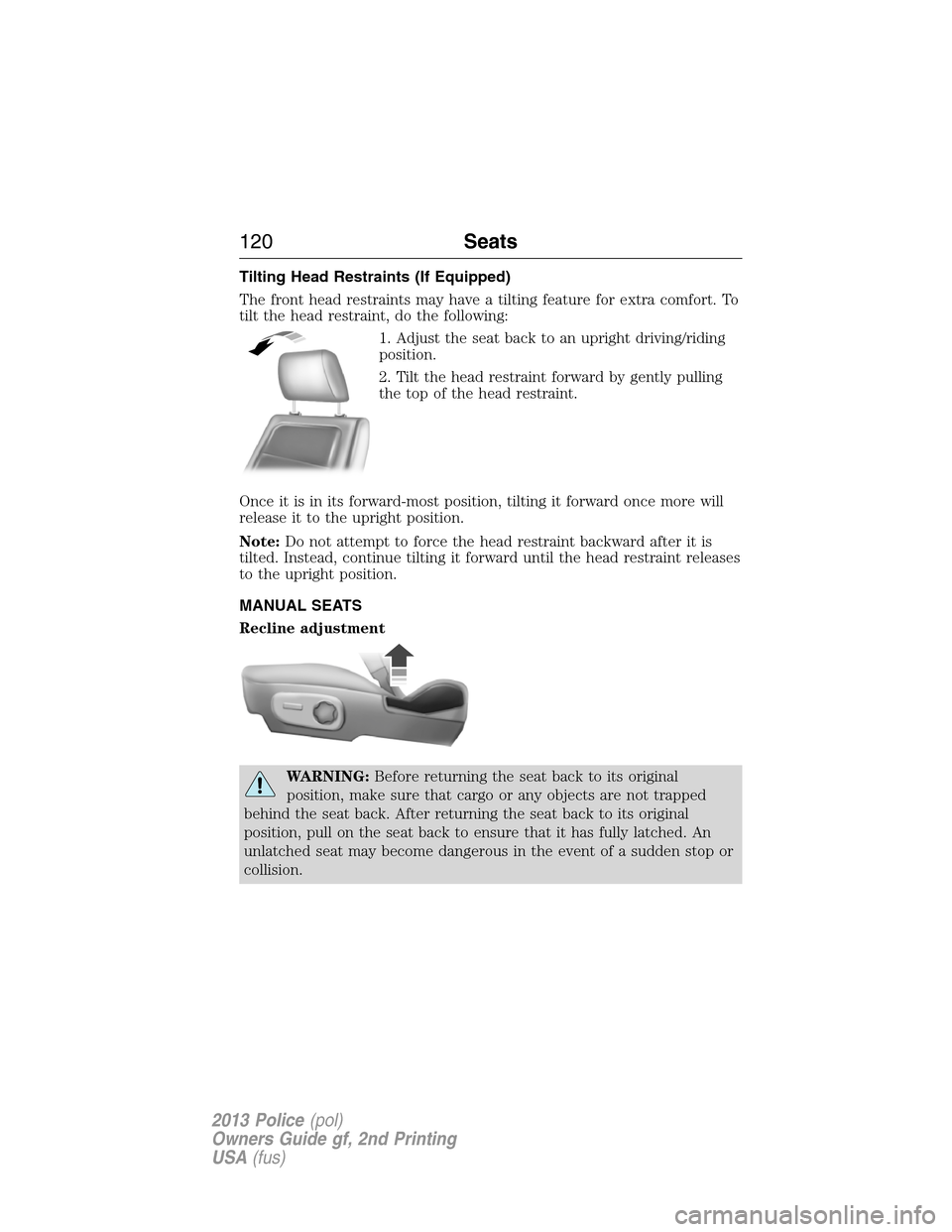
The front head restraints may have a tilting feature for extra comfort. To
tilt the head restraint, do the following:
1. Adjust the seat back to an upright driving/riding
position.
2. Tilt the head restraint forward by gently pulling
the top of the head restraint.
Once it is in its forward-most position, tilting it forward once more will
release it to the upright position.
Note:Do not attempt to force the head restraint backward after it is
tilted. Instead, continue tilting it forward until the head restraint releases
to the upright position.
MANUAL SEATS
Recline adjustment
WARNING:Before returning the seat back to its original
position, make sure that cargo or any objects are not trapped
behind the seat back. After returning the seat back to its original
position, pull on the seat back to ensure that it has fully latched. An
unlatched seat may become dangerous in the event of a sudden stop or
collision.
120Seats
2013 Police(pol)
Owners Guide gf, 2nd Printing
USA(fus)
Page 121 of 375
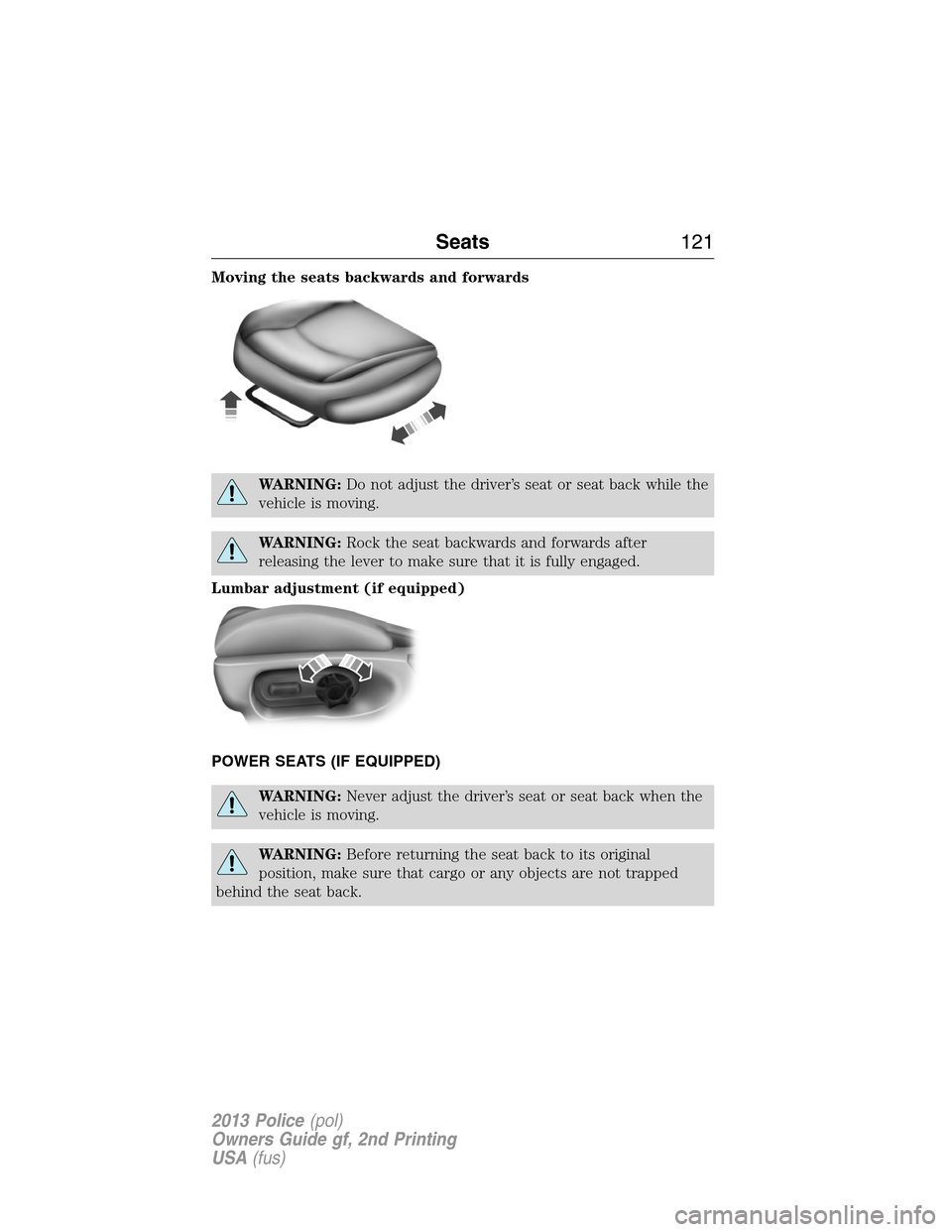
Moving the seats backwards and forwards
WARNING:Do not adjust the driver’s seat or seat back while the
vehicle is moving.
WARNING:Rock the seat backwards and forwards after
releasing the lever to make sure that it is fully engaged.
Lumbar adjustment (if equipped)
POWER SEATS (IF EQUIPPED)
WARNING:Never adjust the driver’s seat or seat back when the
vehicle is moving.
WARNING:Before returning the seat back to its original
position, make sure that cargo or any objects are not trapped
behind the seat back.
Seats121
2013 Police(pol)
Owners Guide gf, 2nd Printing
USA(fus)
Page 122 of 375
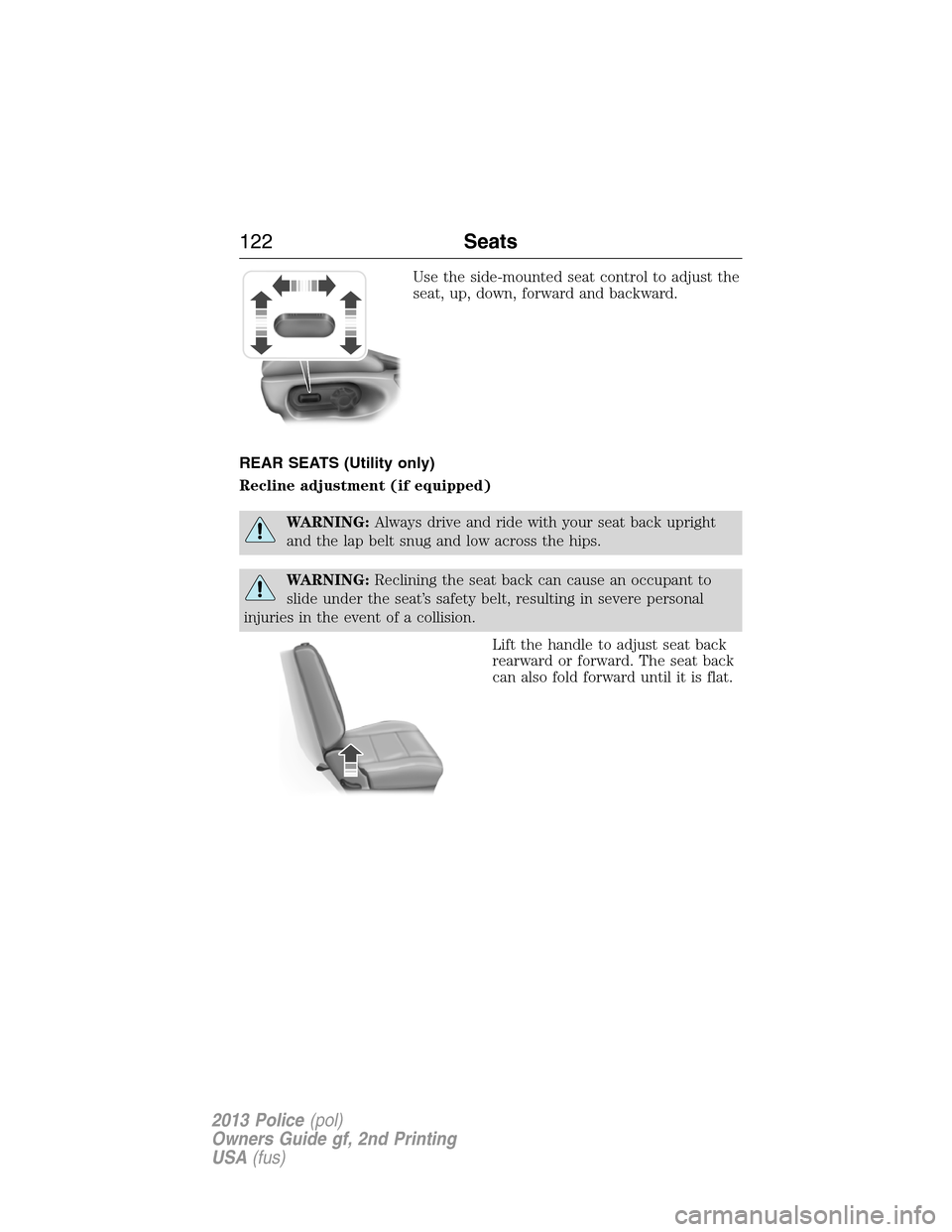
Use the side-mounted seat control to adjust the
seat, up, down, forward and backward.
REAR SEATS (Utility only)
Recline adjustment (if equipped)
WARNING:Always drive and ride with your seat back upright
and the lap belt snug and low across the hips.
WARNING:Reclining the seat back can cause an occupant to
slide under the seat’s safety belt, resulting in severe personal
injuries in the event of a collision.
Lift the handle to adjust seat back
rearward or forward. The seat back
can also fold forward until it is flat.
122Seats
2013 Police(pol)
Owners Guide gf, 2nd Printing
USA(fus)
Page 123 of 375
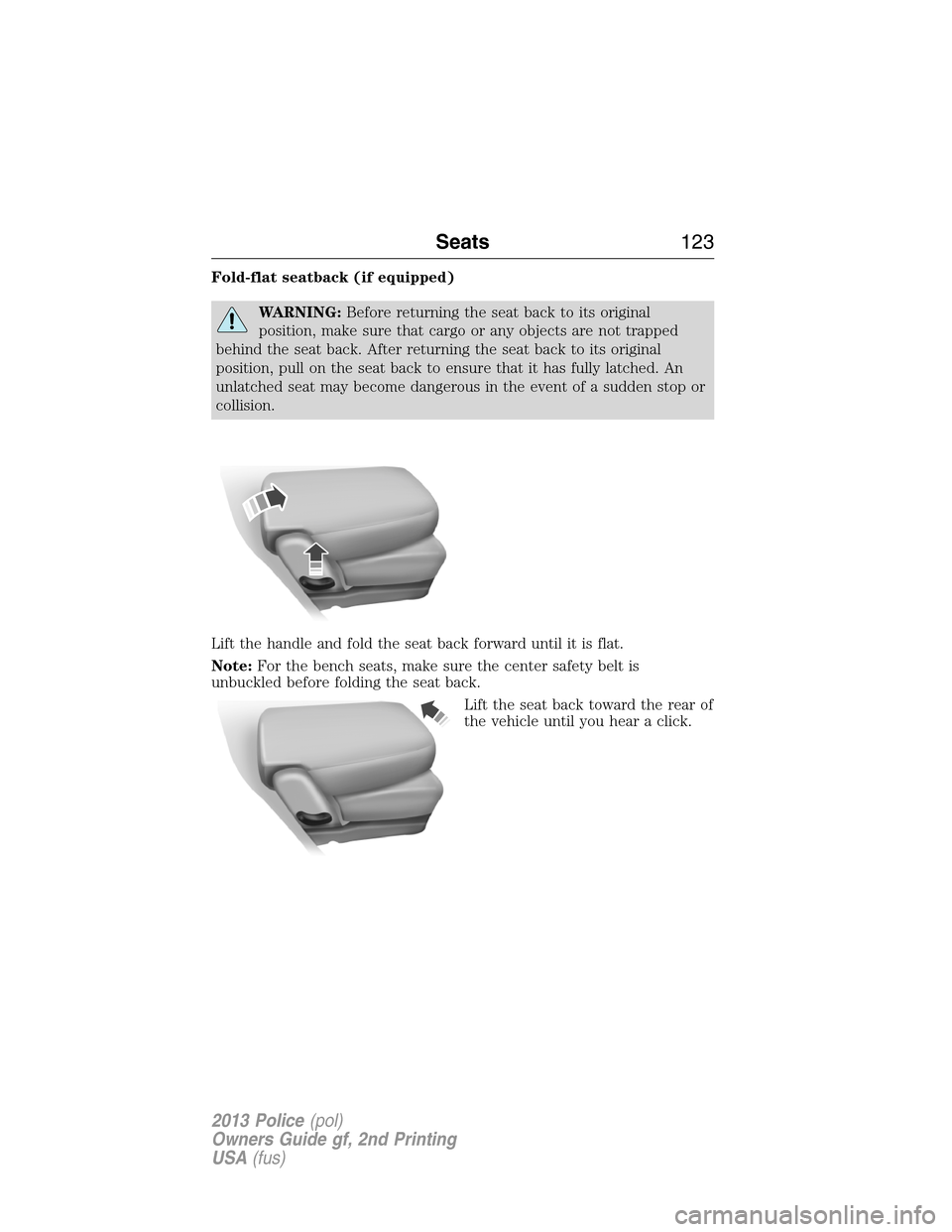
Fold-flat seatback (if equipped)
WARNING:Before returning the seat back to its original
position, make sure that cargo or any objects are not trapped
behind the seat back. After returning the seat back to its original
position, pull on the seat back to ensure that it has fully latched. An
unlatched seat may become dangerous in the event of a sudden stop or
collision.
Lift the handle and fold the seat back forward until it is flat.
Note:For the bench seats, make sure the center safety belt is
unbuckled before folding the seat back.
Lift the seat back toward the rear of
the vehicle until you hear a click.
Seats123
2013 Police(pol)
Owners Guide gf, 2nd Printing
USA(fus)
Page 124 of 375
AUXILIARY POWER POINTS
WARNING:Do not plug optional electrical accessories into the
cigarette lighter socket (if equipped). Improper use of the lighter
can cause damage not covered by your warranty, and can result in fire
or serious injury.
Note:If used when the engine is not running, the battery will discharge.
There may be insufficient power to restart your engine.
Note:Do not insert objects other than an accessory plug into the power
point. This will damage the outlet and blow the fuse.
Note:Do not hang any type of accessory or accessory bracket from the
plug.
Note:Do not use the power point over the vehicle capacity of 12 volts
DC 180 watts or a fuse may blow.
Note:Do not use the power point for operating a cigarette lighter
element.
Note:Improper use of the power outlet can cause damage not covered
by your warranty.
Note:Always keep the power point caps closed when not being used.
Run the engine for full capacity use of the power point. To prevent the
battery from being discharged:
•Do not use the power point longer than necessary when the engine is
not running.
•Do not leave devices plugged in overnight or when the vehicle is
parked for extended periods.
Locations
Power points may be found:
•on the instrument panel
•inside the center console storage compartment
•on the rear of the center console (utility only).
124Auxiliary Power Points
2013 Police(pol)
Owners Guide gf, 2nd Printing
USA(fus)
Page 125 of 375
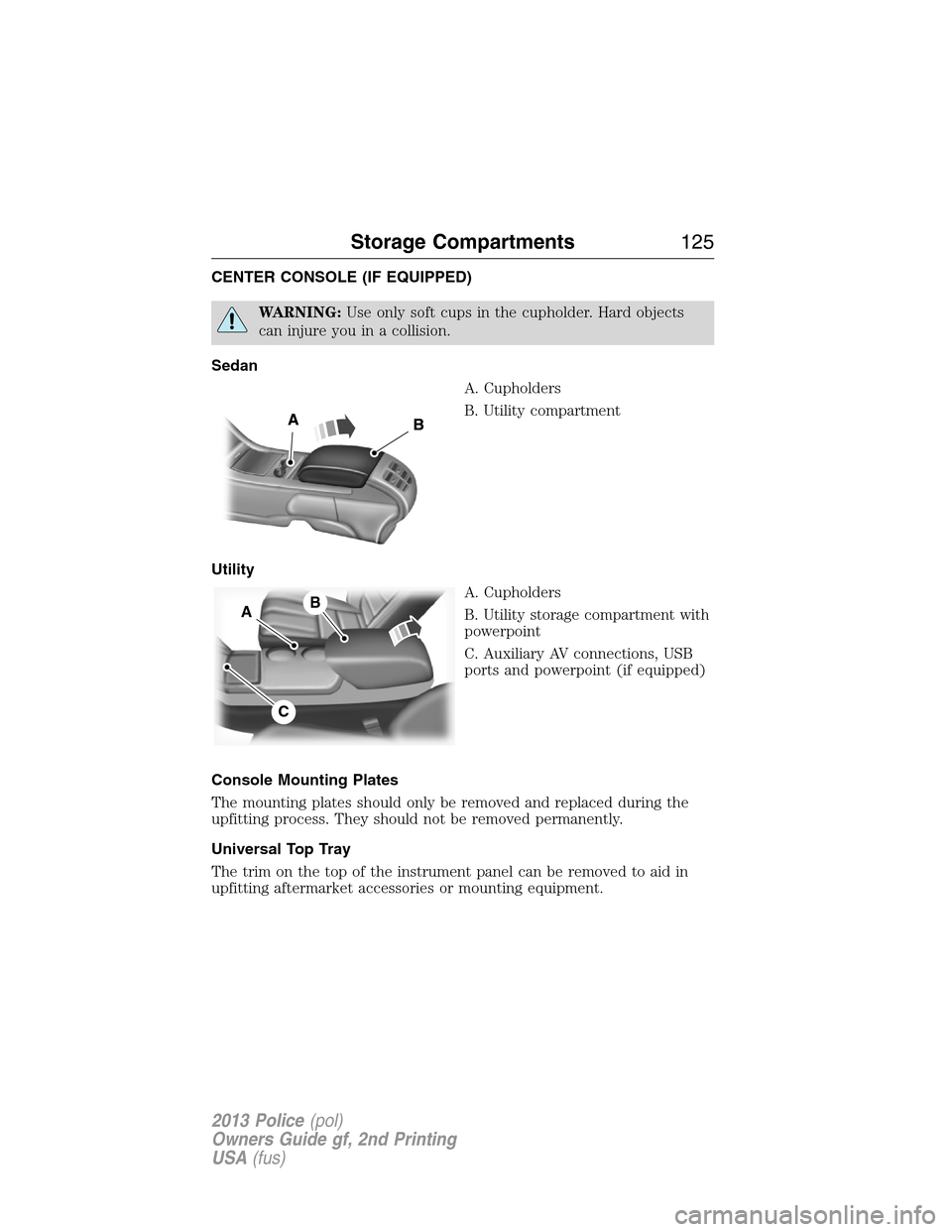
CENTER CONSOLE (IF EQUIPPED)
WARNING:Use only soft cups in the cupholder. Hard objects
can injure you in a collision.
Sedan
A. Cupholders
B. Utility compartment
Utility
A. Cupholders
B. Utility storage compartment with
powerpoint
C. Auxiliary AV connections, USB
ports and powerpoint (if equipped)
Console Mounting Plates
The mounting plates should only be removed and replaced during the
upfitting process. They should not be removed permanently.
Universal Top Tray
The trim on the top of the instrument panel can be removed to aid in
upfitting aftermarket accessories or mounting equipment.
B
C
A
Storage Compartments125
2013 Police(pol)
Owners Guide gf, 2nd Printing
USA(fus)
Page 127 of 375
GENERAL INFORMATION
WARNING:Extended idling at high engine speeds can produce
very high temperatures in the engine and exhaust system,
creating the risk of fire or other damage.
WARNING:Do not park, idle, or drive your vehicle on dry grass
or other dry ground cover. The emission system heats up the
engine compartment and exhaust system, which can start a fire.
WARNING:Do not start your vehicle in a closed garage or in
other enclosed areas. Exhaust fumes can be toxic. Always open
the garage door before you start the engine.
WARNING:If you smell exhaust fumes inside your vehicle, have
your vehicle checked by an authorized dealer immediately. Do
not drive if you smell exhaust fumes.
If you disconnect the battery, your vehicle may exhibit some unusual
driving characteristics for approximately 5 miles (8 kilometers) after you
connect it. This is because the engine management system must realign
itself with the engine. You may disregard any unusual driving
characteristics during this period.
The powertrain control system meets all Canadian interference-causing
equipment standard requirements regulating the impulse electrical field
strength of radio noise.
When starting your vehicle, avoid pressing the accelerator pedal before
and during operation. Only use the accelerator pedal when you have
difficulty starting the engine.
Starting and Stopping the Engine127
2013 Police(pol)
Owners Guide gf, 2nd Printing
USA(fus)