lock FORD POLICE INTERCEPTOR UTILITY 2014 1.G User Guide
[x] Cancel search | Manufacturer: FORD, Model Year: 2014, Model line: POLICE INTERCEPTOR UTILITY, Model: FORD POLICE INTERCEPTOR UTILITY 2014 1.GPages: 406, PDF Size: 6.86 MB
Page 37 of 406
WARNING:When possible, all children 12 years old and under
should be properly restrained in a rear seating position. Failure
to follow this could seriously increase the risk of injury or death.
WARNING:Safety belts and seats can become hot in a vehicle
that has been closed up in sunny weather; they could burn a
small child. Check seat covers and buckles before you place a child
anywhere near them.
WARNING:Front and rear seat occupants, including pregnant
women, should wear safety belts for optimum protection in an
accident.
All seating positions in your vehicle have lap and shoulder safety belts.
All occupants of the vehicle should always properly wear their safety
belts, even when an airbag supplemental restraint system is provided.
The safety belt system consists of:
•Lap and shoulder safety belts.
•Shoulder safety belt with automatic locking mode (except driver
safety belt).
•Height adjuster at the front outboard seating positions.
•Safety belt pretensioner at the front outboard seating positions.
•Belt tension sensor at the front outboard passenger seating position.
•Safety belt warning light and chime. SeeSafety belt warning
light and indicator chimelater in this chapter.
•Crash sensors and monitoring system with readiness
indicator. SeeCrash sensors and airbag indicatorin the
Supplemental Restraint Systemchapter.
The safety belt pretensioners are designed to activate in frontal,
near-frontal and side crashes, and in rollovers. The safety belt
pretensioners at the front seating positions are designed to tighten the
safety belts firmly against the occupant’s body when activated. This helps
increase the effectiveness of the safety belts. In frontal crashes, the
safety belt pretensioners can be activated alone or, if the crash is of
sufficient severity, together with the front airbags.
36Safety Belts
2014 Police(pol)
Owners Guide gf, 3rd Printing, September 2013
USA(fus)
Page 39 of 406
Pregnant women should always
wear their safety belts. The lap belt
portion of a combination lap and
shoulder belt should be positioned
low across the hips below the belly
and worn as tight as comfort will
allow. The shoulder belt should be
positioned to cross the middle of
the shoulder and the center of the
chest.
Safety Belt Locking Modes
WARNING:After any vehicle crash, the safety belt system at all
passenger seating positions must be checked by an authorized
dealer to verify that the automatic locking retractor feature for child
seats is still functioning properly. In addition, all safety belts should be
checked for proper function.
WARNING:The belt and retractor assembly must be replaced if
the safety belt assembly automatic locking retractor feature or
any other safety belt function is not operating properly when checked
by an authorized dealer. Failure to replace the belt and retractor
assembly could increase the risk of injury in crashes.
All safety restraints in the vehicle are combination lap and shoulder
belts. The driver safety belt has the first type of locking mode. The front
outboard passenger and rear seat safety belts have both types of locking
modes described as follows:
Vehicle Sensitive Mode
This is the normal retractor mode, which allows free shoulder belt length
adjustment to your movements and locking in response to vehicle
movement. For example, if the driver brakes suddenly or turns a corner
sharply, or the vehicle receives an impact of about 5 mph (8 km/h) or
more, the combination safety belts will lock to help reduce forward
movement of the driver and passengers.
In addition, the retractor is designed to lock if the webbing is pulled out
too quickly. If this occurs, let the belt retract slightly and pull webbing
out again in a slow and controlled manner.
38Safety Belts
2014 Police(pol)
Owners Guide gf, 3rd Printing, September 2013
USA(fus)
Page 40 of 406
Automatic Locking Mode
In this mode, the shoulder belt is automatically pre-locked. The belt will
still retract to remove any slack in the shoulder belt. The automatic
locking mode is not available on the driver safety belt.
When to Use the Automatic Locking Mode
This mode should be used any time a child safety seat, except a booster,
is installed in passenger front or rear seating positions. Children 12 years
old and under should be properly restrained in a rear seating position
whenever possible. See theChild Safetychapter.
How to Use the Automatic Locking Mode
1. Buckle the combination lap and shoulder
belt.
2. Grasp the shoulder portion and pull
downward until the entire belt is pulled out.
3. Allow the belt to retract. As the belt
retracts, you will hear a clicking sound.
This indicates the safety belt is now in the
automatic locking mode.
How to Disengage the Automatic Locking Mode
Unbuckle the combination lap and shoulder belt and allow it to retract
completely to disengage the automatic locking mode and activate the
vehicle sensitive (emergency) locking mode.
Safety Belt Extension Assembly
WARNING:Do not use extensions to change the fit of the
shoulder belt across the torso.
If the safety belt is too short when fully extended, you can obtain a
safety belt extension assembly from an authorized dealer.
Use only extensions manufactured by the same supplier as the safety
belt. Manufacturer identification is located at the end of the webbing on
the label or on the retractor behind the trim. Also, use the safety belt
extension only if the safety belt is too short for you when fully extended.
Safety Belts39
2014 Police(pol)
Owners Guide gf, 3rd Printing, September 2013
USA(fus)
Page 59 of 406
Airbags and Police Equipment
WARNING:Do not place objects or mount equipment in front of
the airbag module cover or in front of the seat areas that may
come in contact with a deploying airbag. Failure to follow this
instruction could result in personal injury.
WARNING:Dash, tunnel or console-mounted equipment should
not be placed outside of the specified zone. Failure to follow this
instruction could result in personal injury.
WARNING:Do not mount equipment between the side of front
seat to the door trim to block deployment of the side airbag.
Failure to follow this instruction could result in personal injury.
Dual driver and passenger airbags, side airbags and knee airbags affect
the way police equipment can be mounted in police vehicles.
Any surfaces that could come into contact with an airbag, once it has
deployed, must not damage the airbag or alter its deployment path.
Once the airbag has fully deployed, any peripheral equipment surfaces
that could come into contact with the airbag (such as when the airbag
deflates with the loading of an occupant) must not damage the airbag or
alter its deployment path. Sharp edges, corners or protrusions could
damage the nylon airbag material and reduce the effectiveness of the
airbag.
Some approximate dimensions for airbags, at full inflation, are provided
in Figures 1 through 5. These dimensions are somewhat flexible and
represent free form deployments without the loading of occupants.
The shaded areas in Figures 6 through 8 represent available police
equipment mounting zones. These zones are shown for police vehicles
equipped with standard bucket seats. The zone dimensions provided in
Figures 6 through 8 are approximate and will vary with the loading of
occupants in the seats.
All airbag and equipment mounting zone dimensions are approximate
due to different airbag deployment characteristics.
58Supplementary Restraints System
2014 Police(pol)
Owners Guide gf, 3rd Printing, September 2013
USA(fus)
Page 60 of 406
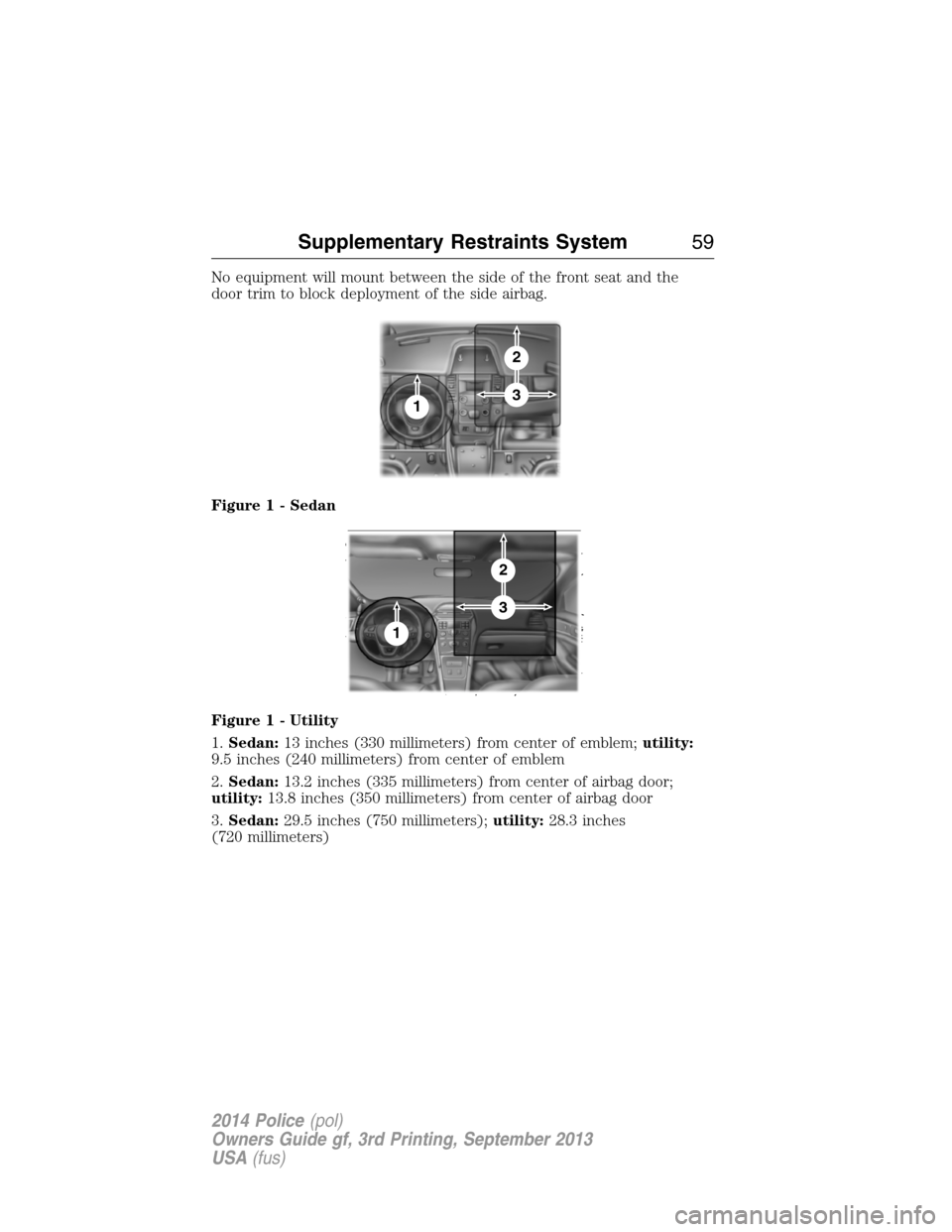
No equipment will mount between the side of the front seat and the
door trim to block deployment of the side airbag.
Figure 1 - Sedan
Figure 1 - Utility
1.Sedan:13 inches (330 millimeters) from center of emblem;utility:
9.5 inches (240 millimeters) from center of emblem
2.Sedan:13.2 inches (335 millimeters) from center of airbag door;
utility:13.8 inches (350 millimeters) from center of airbag door
3.Sedan:29.5 inches (750 millimeters);utility:28.3 inches
(720 millimeters)
2
13
2
1
3
Supplementary Restraints System59
2014 Police(pol)
Owners Guide gf, 3rd Printing, September 2013
USA(fus)
Page 66 of 406
GENERAL INFORMATION ON RADIO FREQUENCIES
This device complies with part 15 of the FCC Rules and with Industry
Canada license-exempt RSS standard(s). Operation is subject to the
following two conditions: (1) This device may not cause harmful
interference, and (2) This device must accept any interference received,
including interference that may cause undesired operation.
Note:Changes or modifications not expressly approved by the party
responsible for compliance could void the user’s authority to operate the
equipment. The termICbefore the radio certification number only
signifies that Industry Canada technical specifications were met.
The typical operating range for your transmitter is approximately 33 feet
(10 meters). Vehicles with the remote start feature will have a greater
range. A decrease in operating range could be caused by:
•weather conditions
•nearby radio towers
•structures around your vehicle
•other vehicles parked next to your vehicle.
The radio frequency used by your remote control can also be used by
other short-distance radio transmissions, for example amateur radios,
medical equipment, wireless headphones, remote controls and alarm
systems. If the frequencies are jammed, you will not be able to use your
remote control. You can lock and unlock the doors with the key.
Note:Make sure your vehicle is locked before leaving it unattended.
Note:If you are in range, the remote control will operate if you press
any button unintentionally.
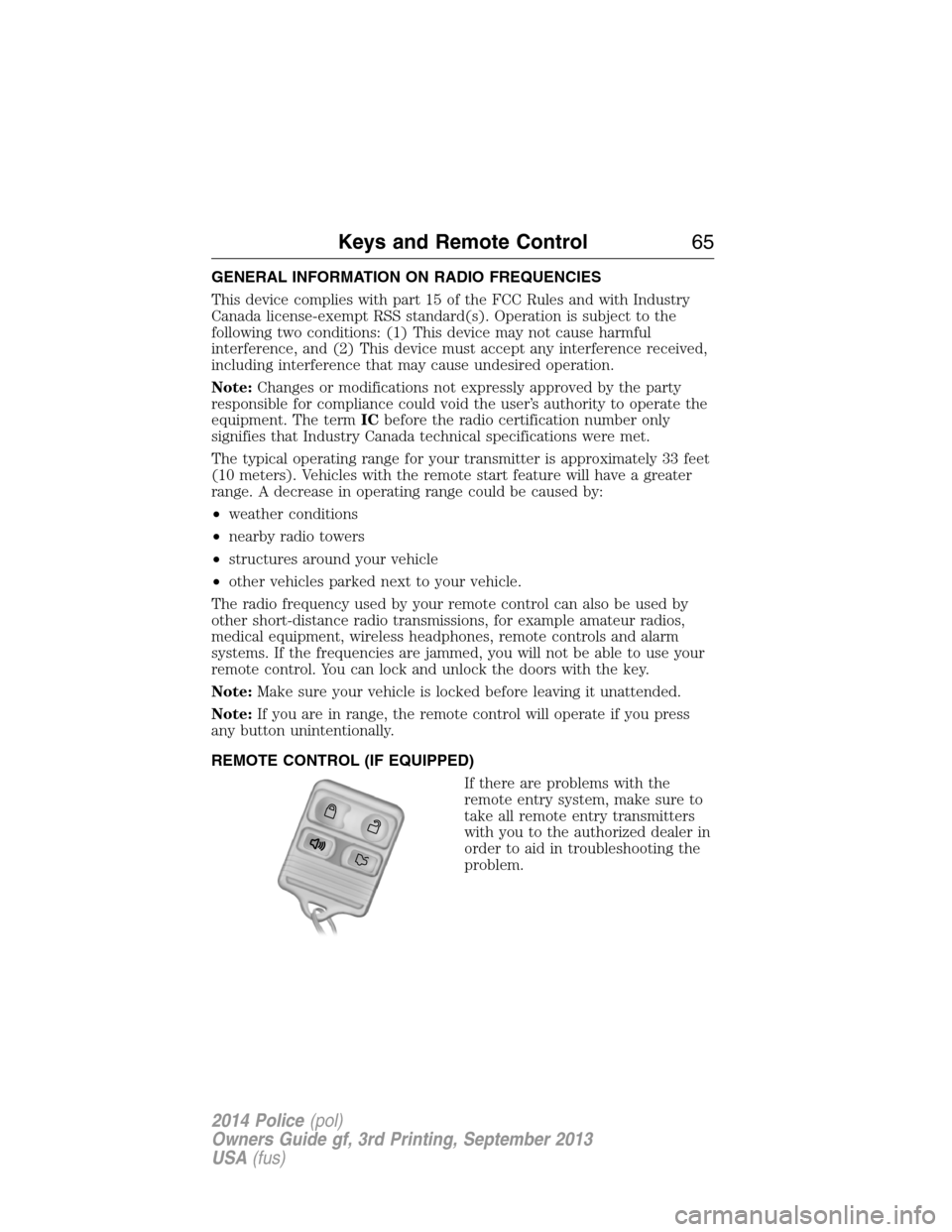
REMOTE CONTROL (IF EQUIPPED)
If there are problems with the
remote entry system, make sure to
take all remote entry transmitters
with you to the authorized dealer in
order to aid in troubleshooting the
problem.
Keys and Remote Control65
2014 Police(pol)
Owners Guide gf, 3rd Printing, September 2013
USA(fus)
Page 68 of 406
Replacing Lost Remote Entry Transmitters
If you would like to have your remote entry transmitter reprogrammed
because you lost one, or would like to buy additional remote entry
transmitters, you can either reprogram them yourself, or take all remote
entry transmitters to your authorized dealer for reprogramming.
How to Reprogram Your Remote Entry Transmitters
You must have all remote entry transmitters (maximum of four) available
before beginning this procedure.Note:Do not press the brake pedal at
any time during this procedure. If the brake pedal is pressed at any time
during this procedure, programming mode will be exited and the entire
procedure must be repeated.
Note:Ensure the brake pedal is not pressed during this sequence.
To reprogram the remote entry transmitters:
1. Make sure your vehicle is electronically unlocked.
2. Put the key in the ignition.
3. Cycle eight times rapidly (within 10 seconds) between the off and on
positions.Note:The eighth turn must end in the on position.
4. The doors will lock, then unlock, to confirm that the programming
mode has been activated.
5. Within 20 seconds press any button on the remote entry transmitter.
Note:If more than 20 seconds have passed you will need to start the
procedure over again.
6. The doors will lock, then unlock, to confirm that this remote entry
transmitter has been programmed.
7. Repeat Step 5 to program each additional remote entry transmitter.
8. Turn the ignition to the off position after you have finished
programming all of the remote entry transmitters.Note:After
20 seconds, you will automatically exit the programming mode.
9. The doors will lock, then unlock, to confirm that the programming
mode has been exited.
Keys and Remote Control67
2014 Police(pol)
Owners Guide gf, 3rd Printing, September 2013
USA(fus)
Page 70 of 406
LOCKING AND UNLOCKING
You can use the power door lock control or the remote control to lock
and unlock your vehicle.
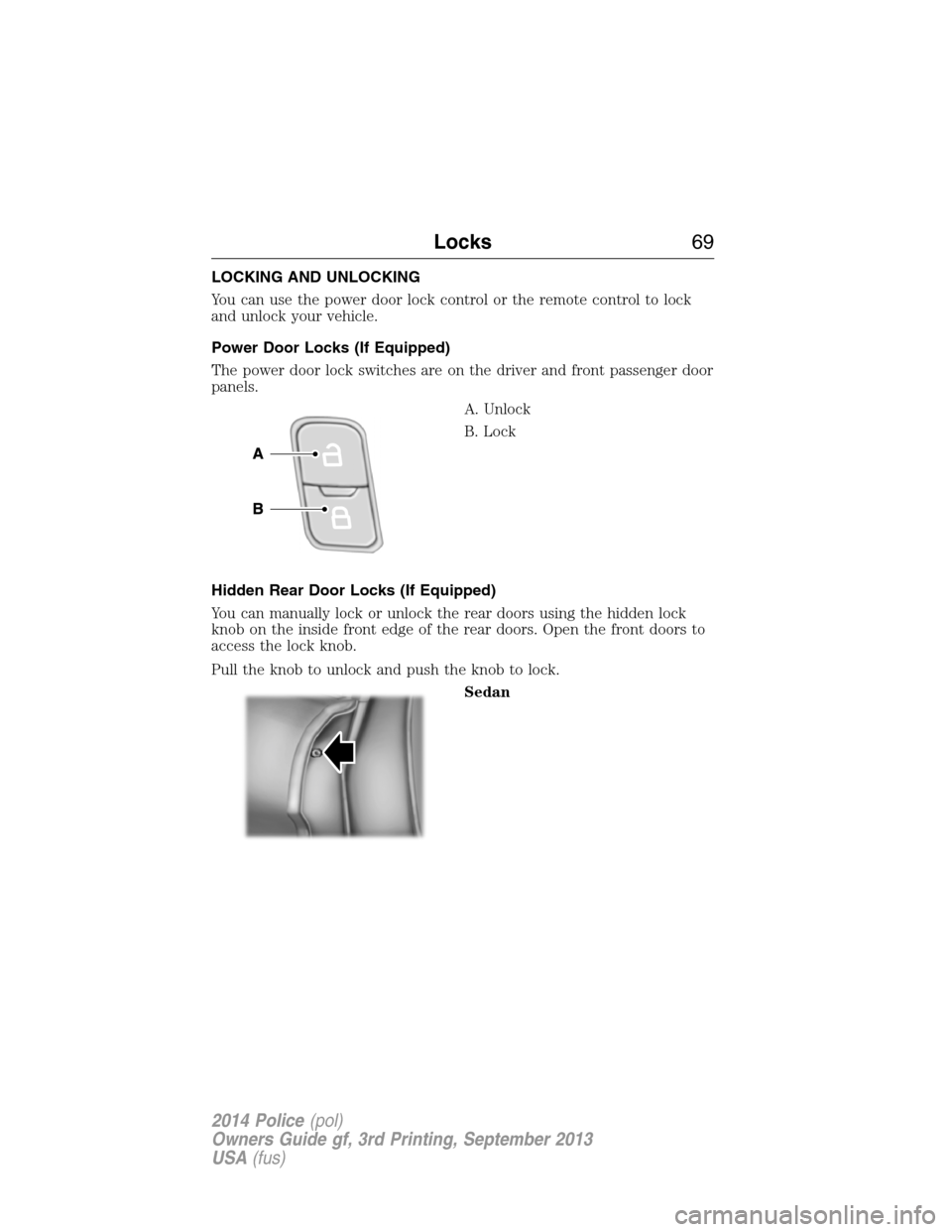
Power Door Locks (If Equipped)
The power door lock switches are on the driver and front passenger door
panels.
A. Unlock
B. Lock
Hidden Rear Door Locks (If Equipped)
You can manually lock or unlock the rear doors using the hidden lock
knob on the inside front edge of the rear doors. Open the front doors to
access the lock knob.
Pull the knob to unlock and push the knob to lock.
Sedan
Locks69
2014 Police(pol)
Owners Guide gf, 3rd Printing, September 2013
USA(fus)
Page 71 of 406
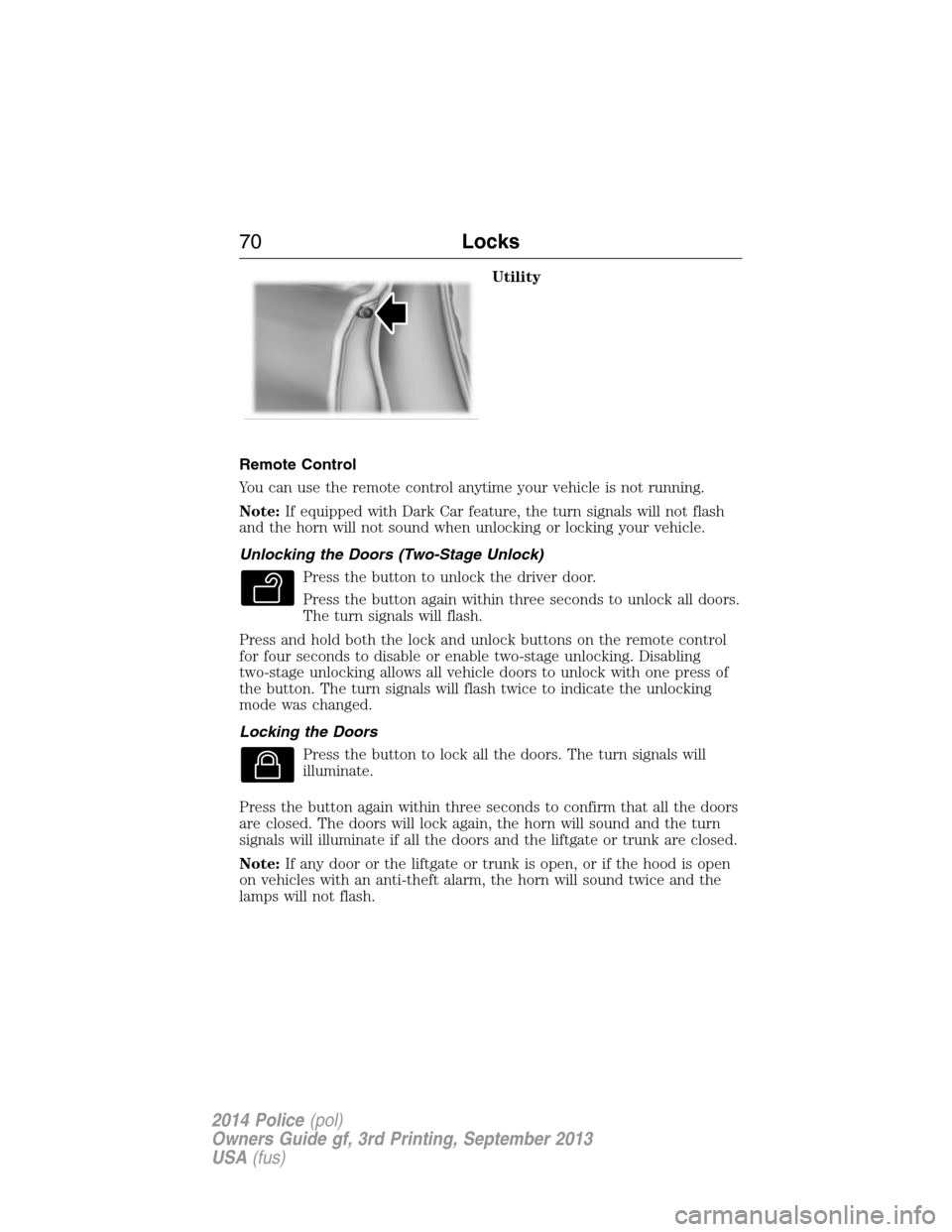
Utility
Remote Control
You can use the remote control anytime your vehicle is not running.
Note:If equipped with Dark Car feature, the turn signals will not flash
and the horn will not sound when unlocking or locking your vehicle.
Unlocking the Doors (Two-Stage Unlock)
Press the button to unlock the driver door.
Press the button again within three seconds to unlock all doors.
The turn signals will flash.
Press and hold both the lock and unlock buttons on the remote control
for four seconds to disable or enable two-stage unlocking. Disabling
two-stage unlocking allows all vehicle doors to unlock with one press of
the button. The turn signals will flash twice to indicate the unlocking
mode was changed.
Locking the Doors
Press the button to lock all the doors. The turn signals will
illuminate.
Press the button again within three seconds to confirm that all the doors
are closed. The doors will lock again, the horn will sound and the turn
signals will illuminate if all the doors and the liftgate or trunk are closed.
Note:If any door or the liftgate or trunk is open, or if the hood is open
on vehicles with an anti-theft alarm, the horn will sound twice and the
lamps will not flash.
70Locks
2014 Police(pol)
Owners Guide gf, 3rd Printing, September 2013
USA(fus)
Page 72 of 406
Opening the Trunk (Sedan Only)
Press the button twice within three seconds to open the trunk.
Make sure the trunk is closed and latched before driving your vehicle.
An unlatched trunk may cause objects to fall out or block the driver’s
rear view.
Smart Locks (If Equipped)
This feature helps to prevent you from locking yourself out of your
vehicle if your key is still in the ignition.
When you open one of the front doors and lock your vehicle with the
power door lock control (on the driver or passenger door trim panel), all
the doors will lock, then all doors will automatically unlock reminding
you that your key is still in the ignition.
Your vehicle can still be locked, with the key in the ignition, by locking
the driver door with a key or using the lock control on the remote
control.
If both front doors and the liftgate are closed, your vehicle can be locked
from any method, regardless of whether the key is in the ignition or not.
Illuminated Entry (If Equipped)
The interior lamps and parking lamps will illuminate when you use the
remote control to unlock the doors or when you open any door.
The illuminated entry system will turn off the lights:
•if you switch the ignition on,
•if you press the remote control lock button,
•after 25 seconds of illumination.
The interior lights will not turn off if:
•you turn them on with the dimmer control, or
•any door is open.
Locks71
2014 Police(pol)
Owners Guide gf, 3rd Printing, September 2013
USA(fus)