heating FORD POLICE INTERCEPTOR UTILITY 2016 1.G User Guide
[x] Cancel search | Manufacturer: FORD, Model Year: 2016, Model line: POLICE INTERCEPTOR UTILITY, Model: FORD POLICE INTERCEPTOR UTILITY 2016 1.GPages: 350, PDF Size: 3.58 MB
Page 189 of 350
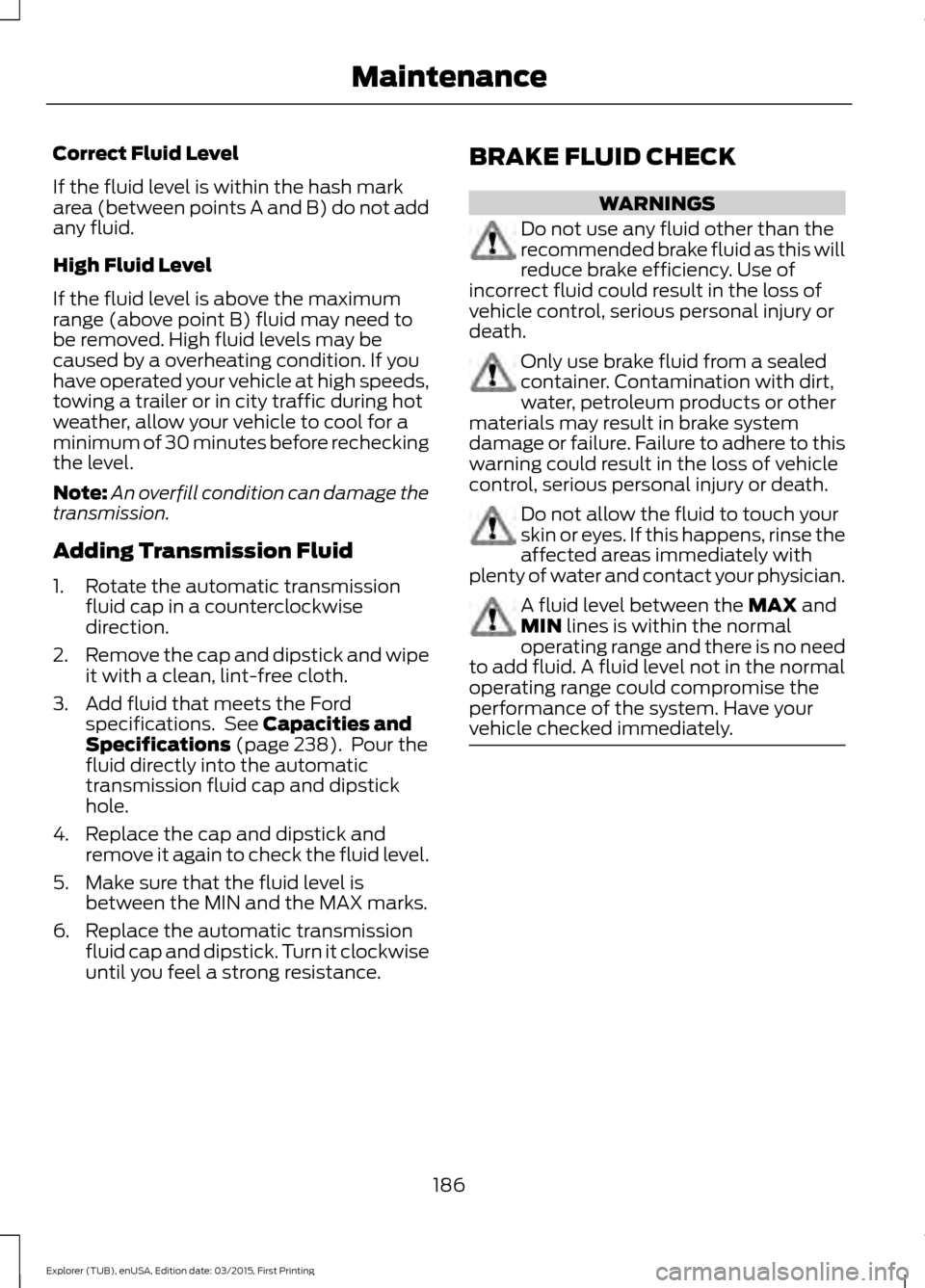
Correct Fluid Level
If the fluid level is within the hash mark
area (between points A and B) do not add
any fluid.
High Fluid Level
If the fluid level is above the maximum
range (above point B) fluid may need to
be removed. High fluid levels may be
caused by a overheating condition. If you
have operated your vehicle at high speeds,
towing a trailer or in city traffic during hot
weather, allow your vehicle to cool for a
minimum of 30 minutes before rechecking
the level.
Note:
An overfill condition can damage the
transmission.
Adding Transmission Fluid
1. Rotate the automatic transmission fluid cap in a counterclockwise
direction.
2. Remove the cap and dipstick and wipe
it with a clean, lint-free cloth.
3. Add fluid that meets the Ford specifications. See Capacities and
Specifications (page 238). Pour the
fluid directly into the automatic
transmission fluid cap and dipstick
hole.
4. Replace the cap and dipstick and remove it again to check the fluid level.
5. Make sure that the fluid level is between the MIN and the MAX marks.
6. Replace the automatic transmission fluid cap and dipstick. Turn it clockwise
until you feel a strong resistance. BRAKE FLUID CHECK WARNINGS
Do not use any fluid other than the
recommended brake fluid as this will
reduce brake efficiency. Use of
incorrect fluid could result in the loss of
vehicle control, serious personal injury or
death. Only use brake fluid from a sealed
container. Contamination with dirt,
water, petroleum products or other
materials may result in brake system
damage or failure. Failure to adhere to this
warning could result in the loss of vehicle
control, serious personal injury or death. Do not allow the fluid to touch your
skin or eyes. If this happens, rinse the
affected areas immediately with
plenty of water and contact your physician. A fluid level between the
MAX and
MIN lines is within the normal
operating range and there is no need
to add fluid. A fluid level not in the normal
operating range could compromise the
performance of the system. Have your
vehicle checked immediately. 186
Explorer (TUB), enUSA, Edition date: 03/2015, First Printing Maintenance
Page 225 of 350
and ice conditions. Like any tire, summer
tire performance is affected by tire wear
and environmental conditions. If you must
drive in those conditions, we recommend
using Mud and Snow (M+S, M/S),
All-season or Snow tires.
Always store your summer tires indoors at
temperatures above 20ºF (-7ºC). The
rubber compounds used in these tires lose
flexibility and may develop surface cracks
in the tread area at temperatures below
20ºF (-7ºC). If the tires have been
subjected to 20ºF (-7ºC) or less, warm
them in a heated space to at least 40ºF
(5ºC) for at least 24 hours before installing
them on a vehicle, or moving the vehicle
with the tires installed, or checking tire
inflation. Do not place tires near heaters
or heating devices used to warm the room
where the tires are stored. Do not apply
heat or blow heated air directly on the tires.
Always inspect the tires after storage
periods and before use.
USING SNOW CHAINS WARNING
Snow tires must be the same size,
load index, and speed rating as those
originally provided by Ford. Use of
any tire or wheel not recommended by
Ford can affect the safety and
performance of your vehicle, which could
result in an increased risk of loss of vehicle
control, vehicle rollover, personal injury,
and death. Additionally, the use of
non-recommended tires and wheels could
cause steering, suspension, axle, transfer
case, or power transfer unit failure. It is also
strongly advised to follow the Ford
recommended tire inflation pressure found
on the Safety Compliance Certification
Label (affixed to either the door hinge
pillar, door-latch post, or the door edge
that meets the door-latch post, next to the
driver ’s seating position), or Tire Label
which is located on the B-Pillar or the edge
of the driver door. Failure to follow the tire
pressure recommendations can cause
uneven treadwear patterns and adversely
affect the way your vehicle handles. The tires on your vehicle (excluding the
265/45ZR20 Sport Tire) may have
all-weather treads to provide traction in
rain and snow. However, in some climates
you may need to use snow chains.
Your vehicle may not be compatible with
snow chain or cable usage with the
factory-fitted wheels and tires. Only
certain chains or snow cables have been
approved by Ford as safe for use on your
vehicle with the following wheel and tire
combination(s): 18”
x8”x44mm Wheel and
P245/60 R18 Tire. You should only install
chains or cables that have been rated as
10 mm or less in dimension as measured
on the sidewall of your tire. Not all S-class
snow chains meet these restrictions.
Chains of this size restriction will include a
222
Explorer (TUB), enUSA, Edition date: 03/2015, First Printing Wheels and Tires
Page 300 of 350
When the oil change message appears in
the information display, it is time for an oil
change. Make sure you perform the oil
change within two weeks or 500 miles
(800 kilometers) of the message
appearing. Make sure you reset the
Intelligent Oil-Life Monitor after each oil
change. See Oil Change Indicator Reset
(page 180).
If your information display resets
prematurely or becomes inoperative, you
should perform the oil change interval at
six months or 5000 miles (8000
kilometers) from your last oil change.
Never exceed one year or 10000 miles
(16000 kilometers) between oil change
intervals.
Your vehicle is very sophisticated and built
with multiple, complex, performance
systems. Every manufacturer develops
these systems using different
specifications and performance features.
That is why it is important to rely upon your
dealership to properly diagnose and repair
your vehicle.
Ford Motor Company has recommended
maintenance intervals for various parts
and component systems based upon
engineering testing. Ford Motor Company
relies upon this testing to determine the
most appropriate mileage for replacement
of oils and fluids to protect your vehicle at
the lowest overall cost to you and
recommends against maintenance
schedules that deviate from the scheduled
maintenance information.
We strongly recommend the use of only
genuine Ford, Motorcraft or
Ford-authorized re-manufactured
replacement parts engineered for your
vehicle. Additives and Chemicals
This owner's manual and the Ford
Workshop Manual list the recommended
additives and chemicals for your vehicle.
We do not recommend using chemicals or
additives not approved by us as part of
your vehicle
’s normal maintenance. Please
consult your warranty information.
Oils, Fluids and Flushing
In many cases, fluid discoloration is a
normal operating characteristic and, by
itself, does not necessarily indicate a
concern or that the fluid needs to be
changed. However, a qualified expert, such
as the factory-trained technicians at your
dealership, should inspect discolored fluids
that also show signs of overheating or
foreign material contamination
immediately.
Make sure to change your vehicle ’s oils and
fluids at the specified intervals or in
conjunction with a repair. Flushing is a
viable way to change fluid for many vehicle
sub-systems during scheduled
maintenance. It is critical that systems are
flushed only with new fluid that is the same
as that required to fill and operate the
system or using a Ford-approved flushing
chemical.
Owner Checks and Services
Make sure you perform the following basic
maintenance checks and inspections every
month or at six-month intervals.
297
Explorer (TUB), enUSA, Edition date: 03/2015, First Printing Scheduled Maintenance
Page 345 of 350
Head Restraints..............................................90
Adjusting the Head Restraint........................... 91
Tilting Head Restraints ...................................... 91
Heated Windows and Mirrors...................88 Heated Exterior Mirror........................................ 88
Heated Rear Window......................................... 88
Heating See: Climate Control.......................................... 86
Hints on Controlling the Interior Climate
............................................................87
Cooling the Interior Quickly.............................. 87
General Hints......................................................... 87
Heating the Interior Quickly.............................. 87
Maximum Cooling Performance in Instrument Panel or Instrument Panel
and Footwell Positions................................. 88
Recommended Settings for Cooling ...........88
Recommended Settings for Heating............87
Side Window Defogging in Cold Weather.............................................................. 88
Vehicle Stationary for Extended Periods During Extreme High Ambient
Temperatures................................................... 88
Hints on Driving With Anti-Lock Brakes.............................................................119
Hood Lock See: Opening and Closing the Hood............177
I
Ignition Switch
.................................................97
In California (U.S. Only).............................162
Information Display Control.......................54 Information Display Control Features..........54
Information Displays.....................................73 General Information............................................ 73Information Messages..................................76
AdvanceTrac ™....................................................... 77
Alarm........................................................................\
. 77
AWD........................................................................\
... 77
Battery and Charging System.......................... 78
Blind Spot Information and Cross Traffic Alert System...................................................... 78
Brake System......................................................... 79
Doors and Locks................................................... 79
Electronic Stability Control............................... 79
Engine...................................................................... 80
Fuel........................................................................\
... 80
Keys and Intelligent Access............................. 80
Lane Keeping System.......................................... 81
Maintenance........................................................... 81
Park Aid.................................................................... 82
Park Brake............................................................... 82
Power Steering...................................................... 83
Seats........................................................................\
. 83
Starting System.................................................... 83
Tire Pressure Monitoring System................... 84
Traction Control.................................................... 84
Transmission......................................................... 84
Installing Child Seats.....................................14 Child Seats............................................................... 14
Using Lap and Shoulder Belts.......................... 15
Using Lower Anchors and Tethers for CHildren (LATCH)............................................. 17
Using Tether Straps.............................................. 19
Instrument Cluster.........................................67
Instrument Lighting Dimmer.....................60
Interior Lamps..................................................61 Dome Lamp............................................................ 61
Dome Task Lamp.................................................. 61
Front Map Lamps.................................................. 61
Rear Interior Lamp............................................... 62
Interior Mirror
...................................................65
Auto-Dimming Mirror......................................... 65
Introduction........................................................5
J
Jump Starting the Vehicle
.........................158
Connecting the Jumper Cables..................... 158
Jump Starting....................................................... 159
Preparing Your Vehicle..................................... 158
Removing the Jumper Cables........................ 159
342
Explorer (TUB), enUSA, Edition date: 03/2015, First Printing Index