check engine FORD POSTAL EXPLORER 2000 2.G User Guide
[x] Cancel search | Manufacturer: FORD, Model Year: 2000, Model line: POSTAL EXPLORER, Model: FORD POSTAL EXPLORER 2000 2.GPages: 80, PDF Size: 0.77 MB
Page 51 of 80
WINDSHIELD WASHER FLUID
Checking and adding washer fluid
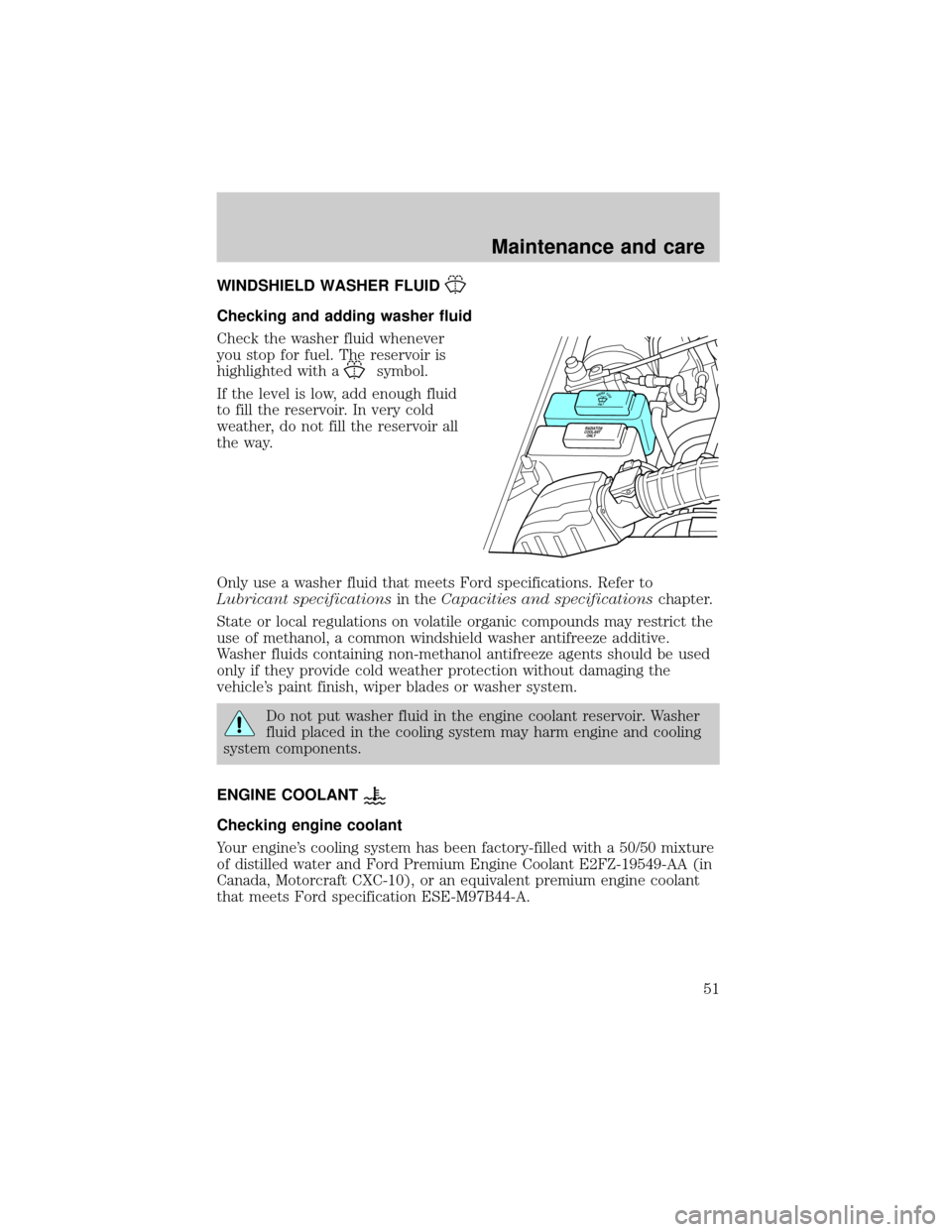
Check the washer fluid whenever
you stop for fuel. The reservoir is
highlighted with a
symbol.
If the level is low, add enough fluid
to fill the reservoir. In very cold
weather, do not fill the reservoir all
the way.
Only use a washer fluid that meets Ford specifications. Refer to
Lubricant specificationsin theCapacities and specificationschapter.
State or local regulations on volatile organic compounds may restrict the
use of methanol, a common windshield washer antifreeze additive.
Washer fluids containing non-methanol antifreeze agents should be used
only if they provide cold weather protection without damaging the
vehicle's paint finish, wiper blades or washer system.
Do not put washer fluid in the engine coolant reservoir. Washer
fluid placed in the cooling system may harm engine and cooling
system components.
ENGINE COOLANT
Checking engine coolant
Your engine's cooling system has been factory-filled with a 50/50 mixture
of distilled water and Ford Premium Engine Coolant E2FZ-19549-AA (in
Canada, Motorcraft CXC-10), or an equivalent premium engine coolant
that meets Ford specification ESE-M97B44-A.
RADIATOR
COOLANT
ONLY
WASHERFLUIDONLY
Maintenance and care
51
Page 52 of 80
A50/50 mixtureof distilled water and Ford Premium Engine Coolant
provides:
²maximum cooling system efficiency.
²freeze protection down to -36É C (-34É F).
²boiling protection up to 129É C (265É F).
²protection against rust and other forms of corrosion.
²an accurate temperature readout from the engine coolant
gauge.
The engine coolant must be maintained at the correct fluid level
and concentration to work properly. If the engine coolant fluid
level and concentration is not maintained correctly, damage to
the engine and cooling system may result.
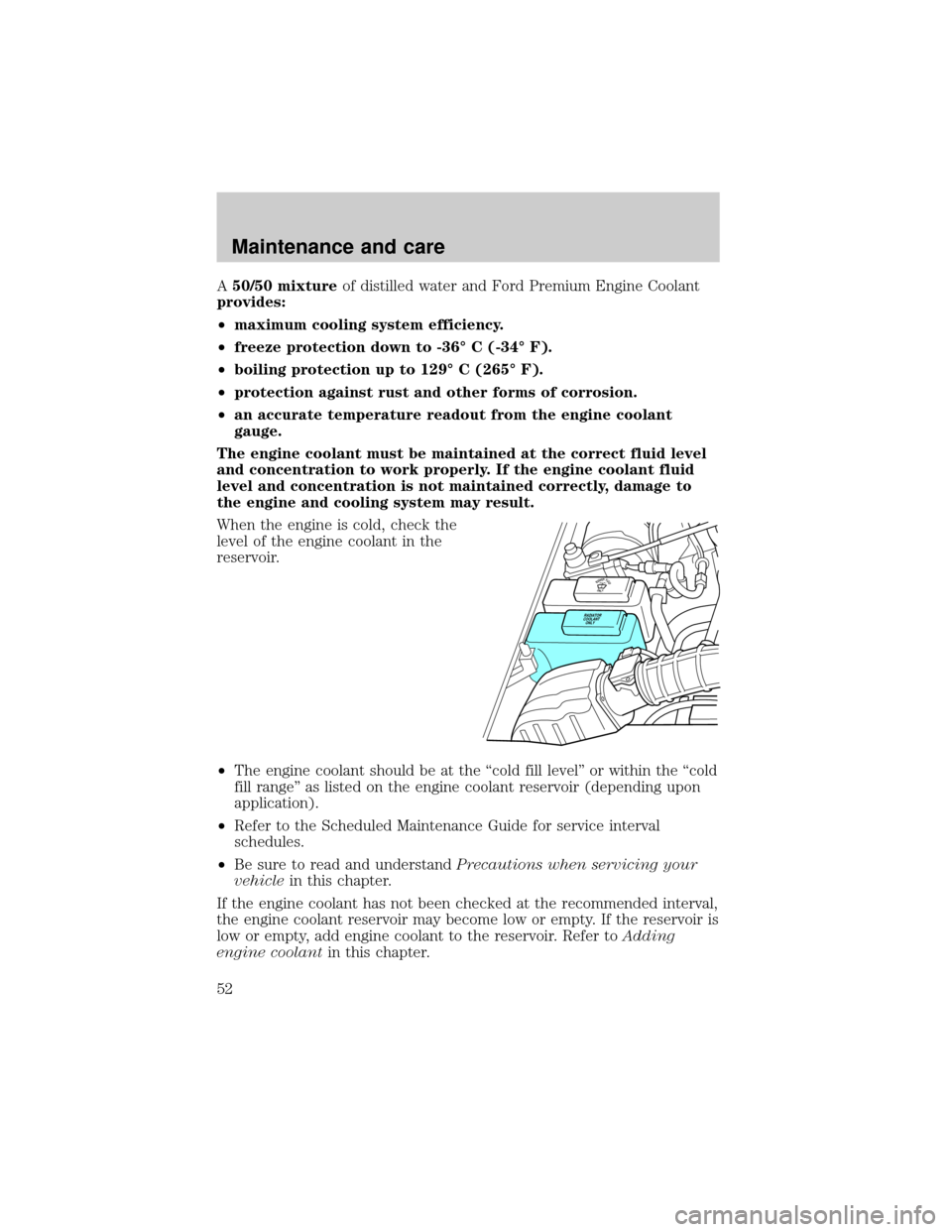
When the engine is cold, check the
level of the engine coolant in the
reservoir.
²The engine coolant should be at the ªcold fill levelº or within the ªcold
fill rangeº as listed on the engine coolant reservoir (depending upon
application).
²Refer to the Scheduled Maintenance Guide for service interval
schedules.
²Be sure to read and understandPrecautions when servicing your
vehiclein this chapter.
If the engine coolant has not been checked at the recommended interval,
the engine coolant reservoir may become low or empty. If the reservoir is
low or empty, add engine coolant to the reservoir. Refer toAdding
engine coolantin this chapter.
RADIATOR
COOLANT
ONLY
WASHERFLUIDONLY
Maintenance and care
52
Page 54 of 80
²Engine coolant concentrations above 60% or below 40% will
decrease the freeze protection characteristics of the engine
coolant and may cause engine damage.
Plain water may be added in an emergency, but youmustreplace it with
a 50/50 mixture of engine coolant and distilled water as soon as possible.
Check the coolant level in the reservoir before you drive your vehicle the
next few times (with the engine cool). If necessary, add a50/50
mixtureof engine coolant and distilled water to the engine coolant
reservoir until the coolant level is at the ªcold fill levelº or within the
ªcold fill rangeº as listed on the reservoir (depending upon application).
Have your dealer check the engine cooling system for leaks if you have
to add more than 1.0 liter (1.0 quart) of engine coolant per month.
To avoid scalding hot steam or coolant from being released from
the engine cooling system, never remove the reservoir cap while
the engine is running or hot. Failure to follow this warning may result
in damage to the engine's cooling system and possible severe personal
injury.
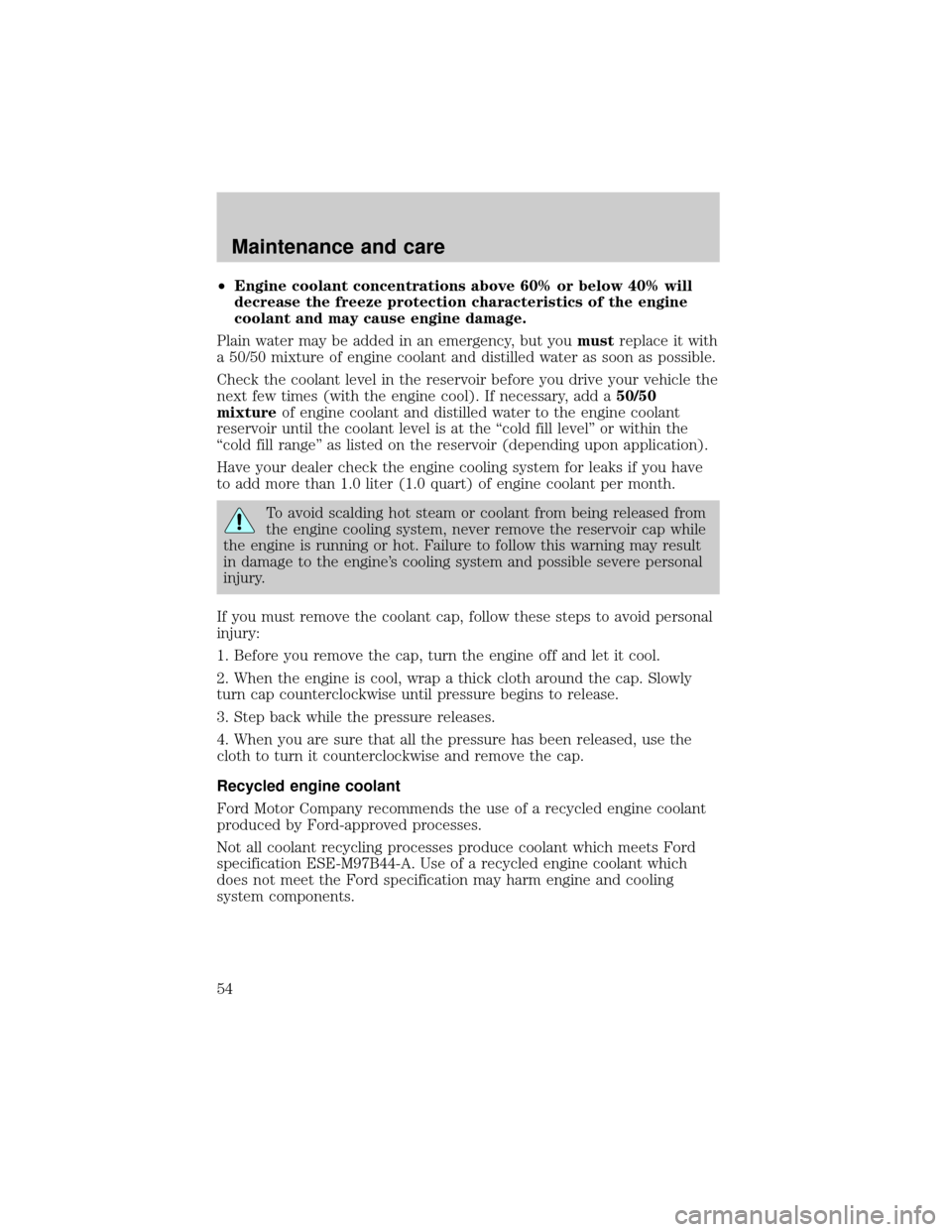
If you must remove the coolant cap, follow these steps to avoid personal
injury:
1. Before you remove the cap, turn the engine off and let it cool.
2. When the engine is cool, wrap a thick cloth around the cap. Slowly
turn cap counterclockwise until pressure begins to release.
3. Step back while the pressure releases.
4. When you are sure that all the pressure has been released, use the
cloth to turn it counterclockwise and remove the cap.
Recycled engine coolant
Ford Motor Company recommends the use of a recycled engine coolant
produced by Ford-approved processes.
Not all coolant recycling processes produce coolant which meets Ford
specification ESE-M97B44-A. Use of a recycled engine coolant which
does not meet the Ford specification may harm engine and cooling
system components.
Maintenance and care
54
Page 56 of 80
Vehicles driven year-round in non-extreme climates should use a 50/50
mixture of engine coolant and distilled water for optimum cooling system
and engine protection.
CHECKING AND ADDING POWER STEERING FLUID
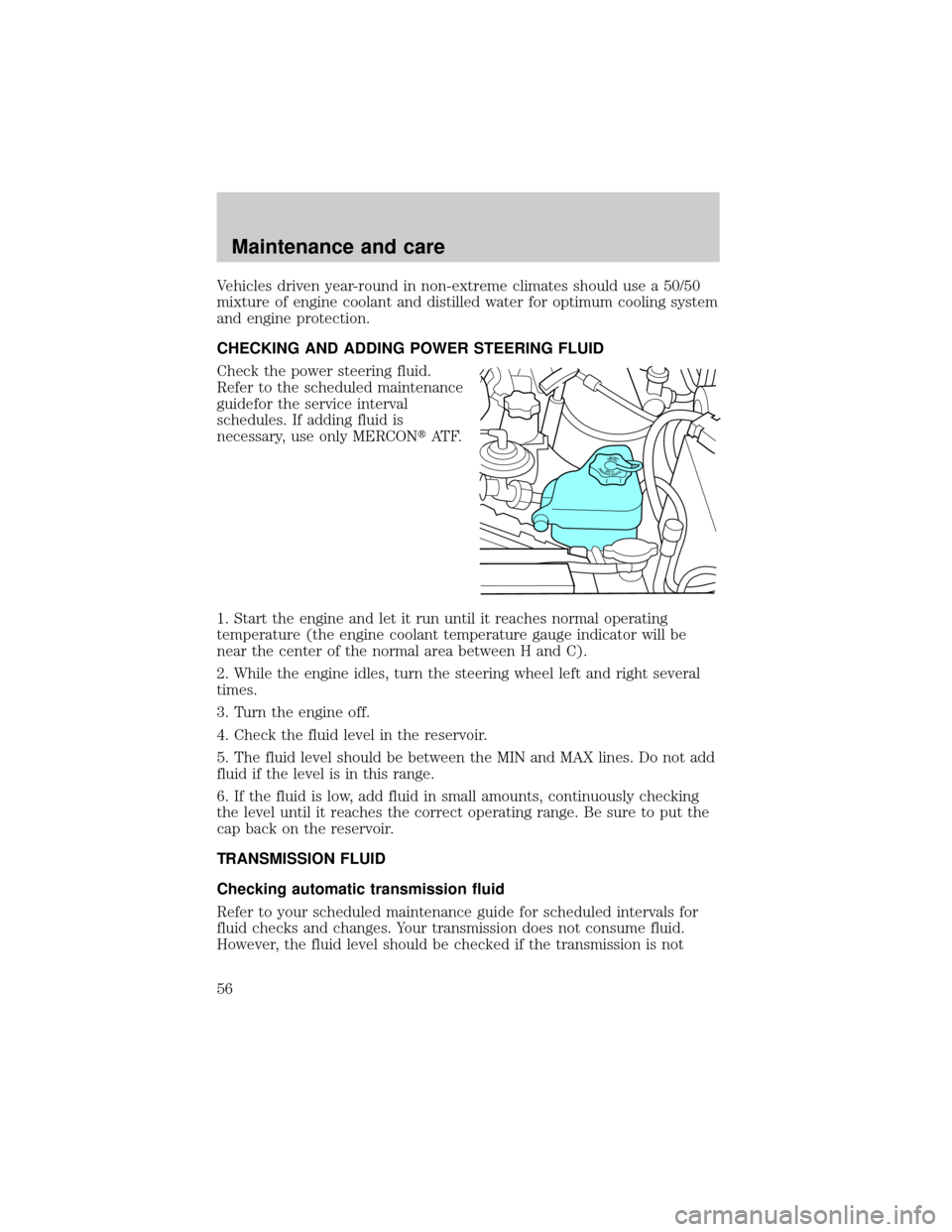
Check the power steering fluid.
Refer to the scheduled maintenance
guidefor the service interval
schedules. If adding fluid is
necessary, use only MERCONtAT F.
1. Start the engine and let it run until it reaches normal operating
temperature (the engine coolant temperature gauge indicator will be
near the center of the normal area between H and C).
2. While the engine idles, turn the steering wheel left and right several
times.
3. Turn the engine off.
4. Check the fluid level in the reservoir.
5. The fluid level should be between the MIN and MAX lines. Do not add
fluid if the level is in this range.
6. If the fluid is low, add fluid in small amounts, continuously checking
the level until it reaches the correct operating range. Be sure to put the
cap back on the reservoir.
TRANSMISSION FLUID
Checking automatic transmission fluid
Refer to your scheduled maintenance guide for scheduled intervals for
fluid checks and changes. Your transmission does not consume fluid.
However, the fluid level should be checked if the transmission is not
DONOTOVERFILLPOWERSTEERINGFLUID
Maintenance and care
56
Page 57 of 80
working properly, i.e., if the transmission slips or shifts slowly or if you
notice some sign of fluid leakage.
Automatic transmission fluid expands when warmed. To obtain an
accurate fluid check, drive the vehicle until it is at normal operating
temperature (approximately 30 km [20 miles]). If your vehicle has been
operated for an extended period at high speeds, in city traffic during hot
weather or pulling a trailer, the vehicle should be turned off for about 30
minutes to allow fluid to cool before checking.
1. Drive the vehicle 30 km (20 miles) or until it reaches normal operating
temperature.
2. Park the vehicle on a level surface and engage the parking brake.
3. With the parking brake engaged and your foot on the brake pedal,
start the engine and move the gearshift lever through all of the gear
ranges. Allow sufficient time for each gear to engage.
4. Latch the gearshift lever in P (Park) and leave the engine running.
5. Remove the dipstick, wiping it clean with a clean, dry lint free rag. If
necessary, refer toIdentifying components in the engine compartment
in this chapter for the location of the dipstick.
6. Install the dipstick making sure it is fully seated in the filler tube.
7. Remove the dipstick and inspect the fluid level. The fluid should be in
the designated area for normal operating temperature or ambient
temperature.
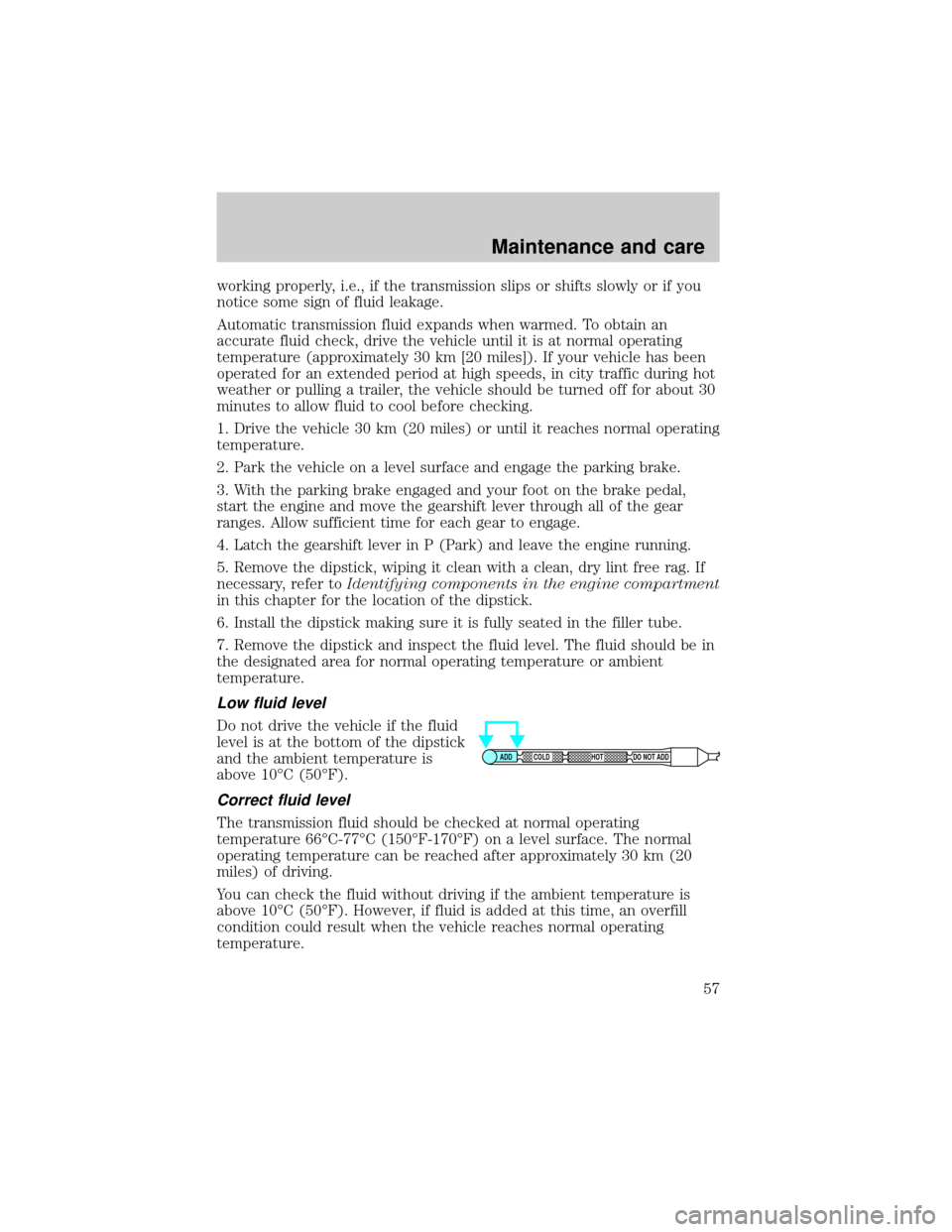
Low fluid level
Do not drive the vehicle if the fluid
level is at the bottom of the dipstick
and the ambient temperature is
above 10ÉC (50ÉF).
Correct fluid level
The transmission fluid should be checked at normal operating
temperature 66ÉC-77ÉC (150ÉF-170ÉF) on a level surface. The normal
operating temperature can be reached after approximately 30 km (20
miles) of driving.
You can check the fluid without driving if the ambient temperature is
above 10ÉC (50ÉF). However, if fluid is added at this time, an overfill
condition could result when the vehicle reaches normal operating
temperature.
ADD COLD HOT DO NOT ADD
Maintenance and care
57
Page 69 of 80
Running out of fuel
Avoid running out of fuel because this situation may have an adverse
affect on powertrain components.
If you have run out of fuel:
²You may need to cycle the ignition from OFF to ON several times after
refueling, to allow the fuel system to pump the fuel from the tank to
the engine.
²Your ªCheck Engineº indicator may come on. For more information on
the ªCheck Engineº indicator, refer to theInstrumentationchapter.
Fuel Filler Cap
Your fuel tank filler cap has an indexed design with a 1/8 turn on/off
feature.
When fueling your vehicle:
1. Turn the engine off.
2. Carefully turn the filler cap counterclockwise 1/8 of a turn until it
stops.
3. Pull to remove the cap from the fuel filler pipe.
4. To install the cap, align the tabs on the cap with the notches on the
filler pipe.
5. Turn the filler cap clockwise 1/8 of a turn until it stops.
If the ªService Engine Soon/Check Engineº indicator comes on and stays
on after you start the engine, the fuel filler cap may not be properly
installed. Turn off the engine, remove the fuel filler cap, align the cap
properly and reinstall it.
If you must replace the fuel filler cap, replace it with a fuel filler
cap that is designed for your vehicle. The customer warranty may
be void for any damage to the fuel tank or fuel system if the
correct genuine Ford or Motorcraft fuel filler cap is not used.
The fuel system may be under pressure. If the fuel filler cap is
venting vapor or if you hear a hissing sound, wait until it stops
before completely removing the fuel filler cap. Otherwise, fuel may
spray out and injure you or others.
Maintenance and care
69
Page 71 of 80
Illumination of the ªCheck Engineº light, charging system warning light
or the temperature warning light, fluid leaks, strange odors, smoke or
loss of engine power, could indicate that the emission control system is
not working properly.
Exhaust leaks may result in entry of harmful and potentially
lethal fumes into the passenger compartment.
Do not make any unauthorized changes to your vehicle or engine. By
law, vehicle owners and anyone who manufactures, repairs, services,
sells, leases, trades vehicles, or supervises a fleet of vehicles are not
permitted to intentionally remove an emission control device or prevent
it from working. Information about your vehicle's emission system is on
the Vehicle Emission Control Information Decal located on or near the
engine. This decal identifies engine displacement and gives some tune up
specifications.
Please consult your ªWarranty Guideº for complete emission warranty
information.
Readiness for Inspection/Maintenance (I/M) testing
In some localities, it may be a legal requirement to pass an I/M test of
the on-board diagnostics system. If your ªCheck Engine/Service Engine
Soonº light is on, refer to the description in theWarning Lights and
Chimessection of theInstrumentationchapter. Your vehicle may not
pass the I/M test with the ªCheck Engine/Service Engine Soonº light on.
If the vehicle's powertrain system or its battery has just been serviced,
the on-board diagnostics system is reset to a ªnot ready for I/M testº
condition. To ready the on-board diagnostics system for I/M testing, a
minimum of 30 minutes of city and highway driving is necessary as
described below:
²First, at least 10 minutes of driving on an expressway or highway.
²Next, at least 20 minutes driving in stop-and-go, city-type traffic with
at least four idle periods.
Allow the vehicle to sit for at least eight hours without starting the
engine. Then, start the engine and complete the above driving cycle. The
engine must warm up to its normal operating temperature. Once started,
do not turn off the engine until the above driving cycle is complete.
Maintenance and care
71
Page 76 of 80

Air cleaner filter .........................72
Antifreeze
(see Engine coolant) ..................51
Anti-lock brake system
(see Brakes) ...........................22,23
Automatic transmission
driving an automatic
overdrive ...................................26
fluid, adding ..............................56
fluid, checking ..........................56
fluid, refill capacities ................72
fluid, specification ....................74
Axle
lubricant specifications .......73,74
refill capacities ..........................72
Battery .........................................59
acid, treating emergencies .......59
charging system warning light ..9
jumping a disabled battery ......37
maintenance-free ......................59
replacement, specifications .....72
servicing ....................................59
voltage gauge ............................11
Brakes ..........................................22
anti-lock ................................22,23
anti-lock brake system
(ABS) warning light ..............8,23
brake warning light ....................7
fluid, checking and adding ......50
fluid, refill capacities ................72
fluid, specifications ..............73,74
lubricant specifications .......73,74
shift interlock ............................25
Break-in period .............................3
Capacities for refilling fluids ......72
Coolant
checking and adding ................51
refill capacities .....................55,72
specifications .......................73,74
Dipstick
automatic transmission fluid ...56
engine oil ...................................48Doors
lubricant specifications ............73
Driveline universal
joint and slip yoke ......................58
Emergencies, roadside
jump-starting ............................37
Emission control system ............70
Engine ..........................................74
check engine/service engine
soon light ....................................6
coolant .......................................51
idle speed control .....................59
lubrication specifications ....73,74
refill capacities ..........................72
service points ............................47
starting after a collision ...........29
Engine oil ....................................48
checking and adding ................48
dipstick ......................................48
filter, specifications .............49,72
recommendations .....................49
refill capacities ..........................72
specifications .......................73,74
Exhaust fumes ............................20
Fluid capacities ...........................72
Fuel ..............................................65
cap .............................................69
capacity .....................................72
choosing the right fuel .............67
detergent in fuel .......................68
filling your
vehicle with fuel ..................65,69
filter, specifications .............70,72
fuel pump shut-off switch .......29
gauge .........................................12
octane rating ........................68,74
quality ........................................68
running out of fuel ...................69
safety information relating
to automotive fuels ..................65
Fuses .......................................29,30
Gas cap (see Fuel cap) ..............69
Index
76
Page 77 of 80

Gauges ...........................................9
battery voltage gauge ...............11
engine coolant
temperature gauge ...................10
engine oil pressure gauge ........11
fuel gauge ..................................12
odometer ...................................10
speedometer ...............................9
trip odometer ............................11
Headlamps ...................................13
flash to pass ..............................14
high beam ..............................8,13
turning on and off ....................13
Ignition ....................................14,74
Inspection/maintenance (I/M)
testing ..........................................71
Instrument panel
cluster ..........................................6
lighting up
panel and interior .....................13
Jump-starting your vehicle ........37
Keys
positions of the ignition ...........14
Lamps
cargo lamps ...............................13
headlamps .................................13
headlamps, flash to pass ..........14
instrument panel, dimming .....13
Lane change indicator
(see Turn signal) ........................16
Lights, warning and indicator ......6
anti-lock brakes (ABS) .........8,23
brake ............................................7
charging system ..........................9
high beam ...................................8
overdrive off ................................8
safety belt ...................................7
service engine soon ....................6
turn signal indicator ...................8
Lubricant specifications ........73,74
Manual transmission
fluid capacities ..........................72lubricant specifications ............74
Motorcraft parts .....................70,72
Octane rating ..............................68
Odometer .....................................10
Oil (see Engine oil) ....................48
Overdrive .....................................16
Parking brake ..............................23
Parts (see Motorcraft parts) ......72
Power distribution box
(see Fuses) .................................32
Power steering ............................24
fluid, checking and adding ......56
fluid, refill capacity ..................72
fluid, specifications ..............73,74
Relays .....................................29,34
Safety defects, reporting ............75
Safety restraints
warning light and chime .........7,9
Servicing your vehicle ................46
Spark plugs, specifications ....72,74
Special notice ................................3
utility-type vehicles ....................3
Specification chart,
lubricants ................................73,74
Speedometer .................................9
Starting your vehicle .............17,19
jump starting ............................37
Steering wheel
tilting .........................................15
Tires ..............................35,61,62,63
changing ....................................35
checking the pressure ..............63
replacing ....................................64
rotating ......................................63
snow tires and chains ..............64
tire grades .................................62
treadwear ..................................62
Towing .........................................63
wrecker ......................................43
Transmission ...............................25
fluid, checking and adding
(automatic) ...............................56
Index
77