ABS FORD RANGER 1998 2.G User Guide
[x] Cancel search | Manufacturer: FORD, Model Year: 1998, Model line: RANGER, Model: FORD RANGER 1998 2.GPages: 160, PDF Size: 1.38 MB
Page 66 of 160
ABS warning lamp
The
ABSwarning lamp in the instrument cluster illuminates for about
five seconds when starting the vehicle. If an ABS fault is detected, the
light will remain on and your vehicle should be serviced as soon as
possible.
Normal braking is still effective
unless the BRAKE warning lamp is
also illuminated.
Using ABS
²In an emergency or when maximum efficiency from the ABS is
required, apply continuous full force on the brake. The ABS will be
activated immediately, thus allowing you to retain full steering control
of your vehicle and, providing there is sufficient space, will enable you
to avoid obstacles and bring the vehicle to a controlled stop.
²We recommend that you familiarize yourself with this braking
technique. However, avoid taking any unnecessary risks.
Parking brake
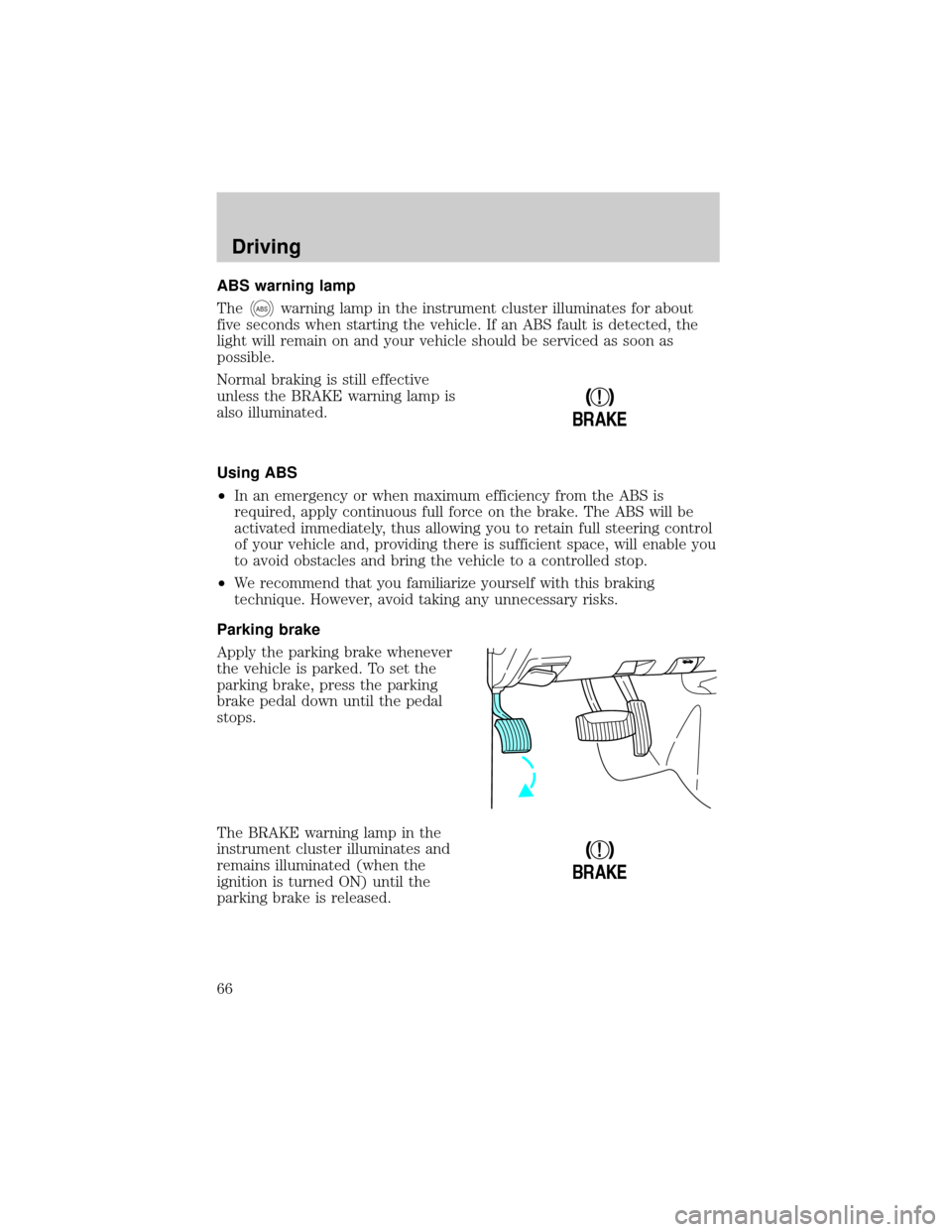
Apply the parking brake whenever
the vehicle is parked. To set the
parking brake, press the parking
brake pedal down until the pedal
stops.
The BRAKE warning lamp in the
instrument cluster illuminates and
remains illuminated (when the
ignition is turned ON) until the
parking brake is released.
!
BRAKE
!
BRAKE
Driving
66
Page 79 of 160
If speed control cancels after climbing the hill, reset speed by pressing
and holding the SET ACCEL button to resume speeds over 50 km/h
(30 mph).
Automatic transmissions may shift frequently while driving up steep
grades. Eliminate frequent shifting by shifting out of
(Overdrive) into
D (Drive).
Driving on snow and ice
A 4WD vehicle has advantages over 2WD vehicles in snow and ice but
can skid like any other vehicle.
Avoid sudden applications of power and quick changes of direction on
snow and ice. Apply the accelerator slowly and steadily when starting
from a full stop.
When braking, apply the brakes as you normally would. In order to allow
the anti-lock brake system (ABS) to operate properly, keep steady
pressure on the brake pedal.
Allow more stopping distance and drive slower than usual. Consider
using one of the lower gears.
TRACTION-LOK AXLE (IF EQUIPPED)
This axle provides added traction on slippery surfaces, particularly when
one wheel is on a poor traction surface. Under normal conditions, the
Traction-Lok axle functions like a standard rear axle.
Extended use of other than the manufacturer's specified size tires on a
Traction-Lok rear axle could result in a permanent reduction in
effectiveness. This loss of effectiveness does not affect normal driving
and should not be noticeable to the driver.
To avoid injury, never run the engine with one wheel off the
ground, such as when changing a tire.
VEHICLE LOADING
Before loading a vehicle, familiarize yourself with the following terms:
²Base Curb Weight: Weight of the vehicle including any standard
equipment, fluids, lubricants, etc. It does not include passengers or
aftermarket equipment.
Driving
79
Page 97 of 160

Fuse/
Relay
LocationFuse
Amp
RatingDescription
11 7.5A Instrument Cluster, Daytime Running Lights
(DRL), RABS Resistor
12 - NOT USED
13 20A Brake Pedal Position Switch
14 20A or
10A20A: If equipped with Rear Anti-Lock Brake
System (RABS) Module. 10A: If equipped with
4 Wheel Anti-Lock Brake System (4WABS)
Module, 4WABS Main Relay
15 7.5A Instrument Cluster
16 30A Windshield Wiper Motor, Wiper Hi-Lo Relay,
Wiper Run/Park Relay
17 25A Cigar Lighter
18 15A Driver's Unlock Relay, All-Unlock Relay, All-Lock
Relay
19 25A PCM Power Diode
20 7.5A RAP Module, Generic Electronic Module (GEM),
Radio
21 15A Flasher (Hazard)
22 20A Auxiliary Power Socket
23 Ð Not Used
24 7.5A Clutch Pedal Position (CPP) switch, Starter
Interrupt Relay, Anti-Theft
25 7.5A Generic Electronic Module (GEM), Instrument
Cluster
26 10A Battery Saver Relay, Electronic Shift Relay,
Interior Lamp Relay, Power Window Relay,
Electronic Shift Control Module, Dome/Map
Lamp, GEM
27 15A Electric Shift, Backup Lamps, Daytime Running
Lamps (DRL), Transmission Control Switch
28 7.5A Generic Electronic Module (GEM), Radio
Roadside emergencies
97
Page 98 of 160
Fuse/
Relay
LocationFuse
Amp
RatingDescription
29 15A Radio
30 15A Park Lamp/Trailer Tow Relay
31 Ð Not Used
32 Ð Not Used
33 15A Headlamps, Daytime Running Lamps (DRL)
Module, Instrument Cluster
34 Ð Not Used
35 10A RABS Test Connector
36 Ð Not Used
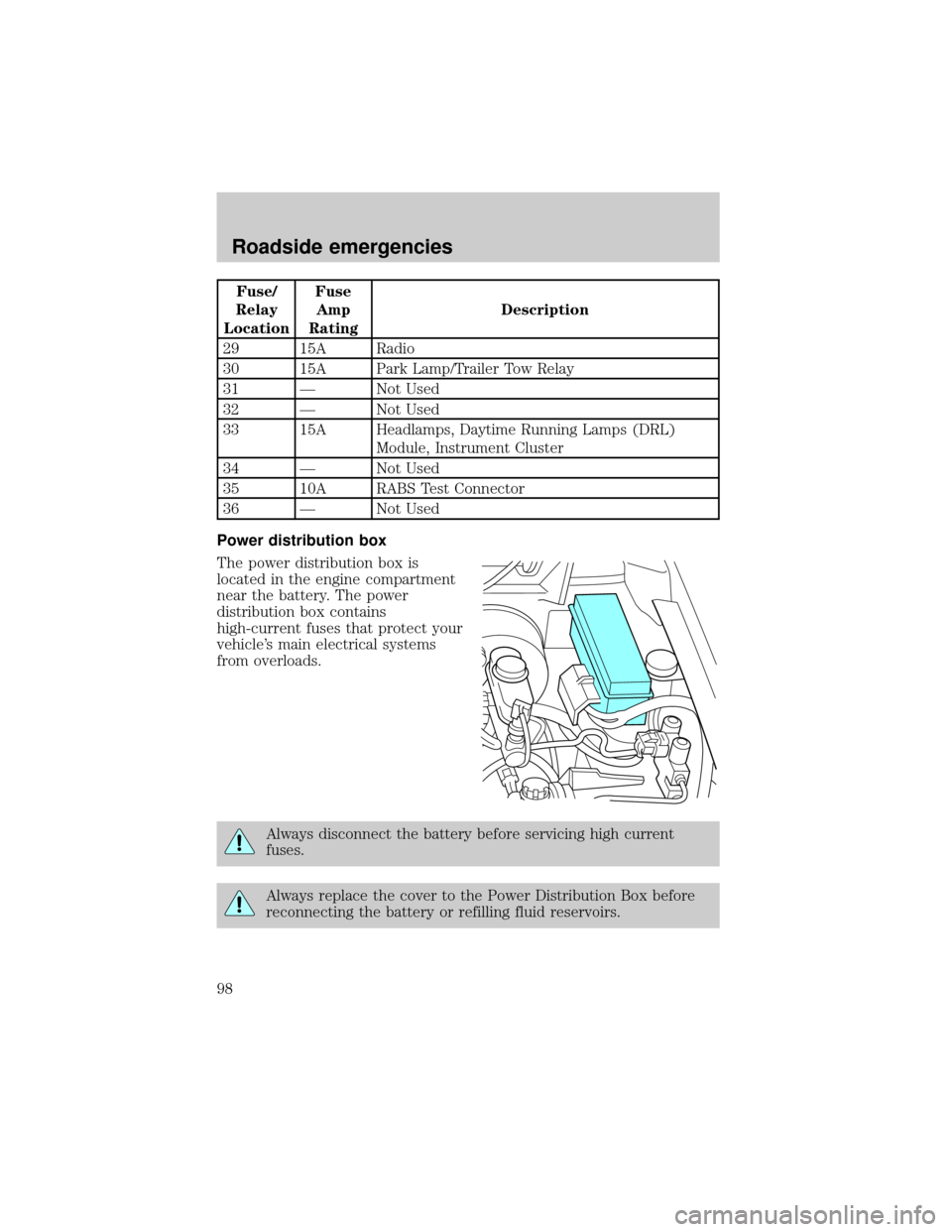
Power distribution box
The power distribution box is
located in the engine compartment
near the battery. The power
distribution box contains
high-current fuses that protect your
vehicle's main electrical systems
from overloads.
Always disconnect the battery before servicing high current
fuses.
Always replace the cover to the Power Distribution Box before
reconnecting the battery or refilling fluid reservoirs.
Roadside emergencies
98
Page 99 of 160
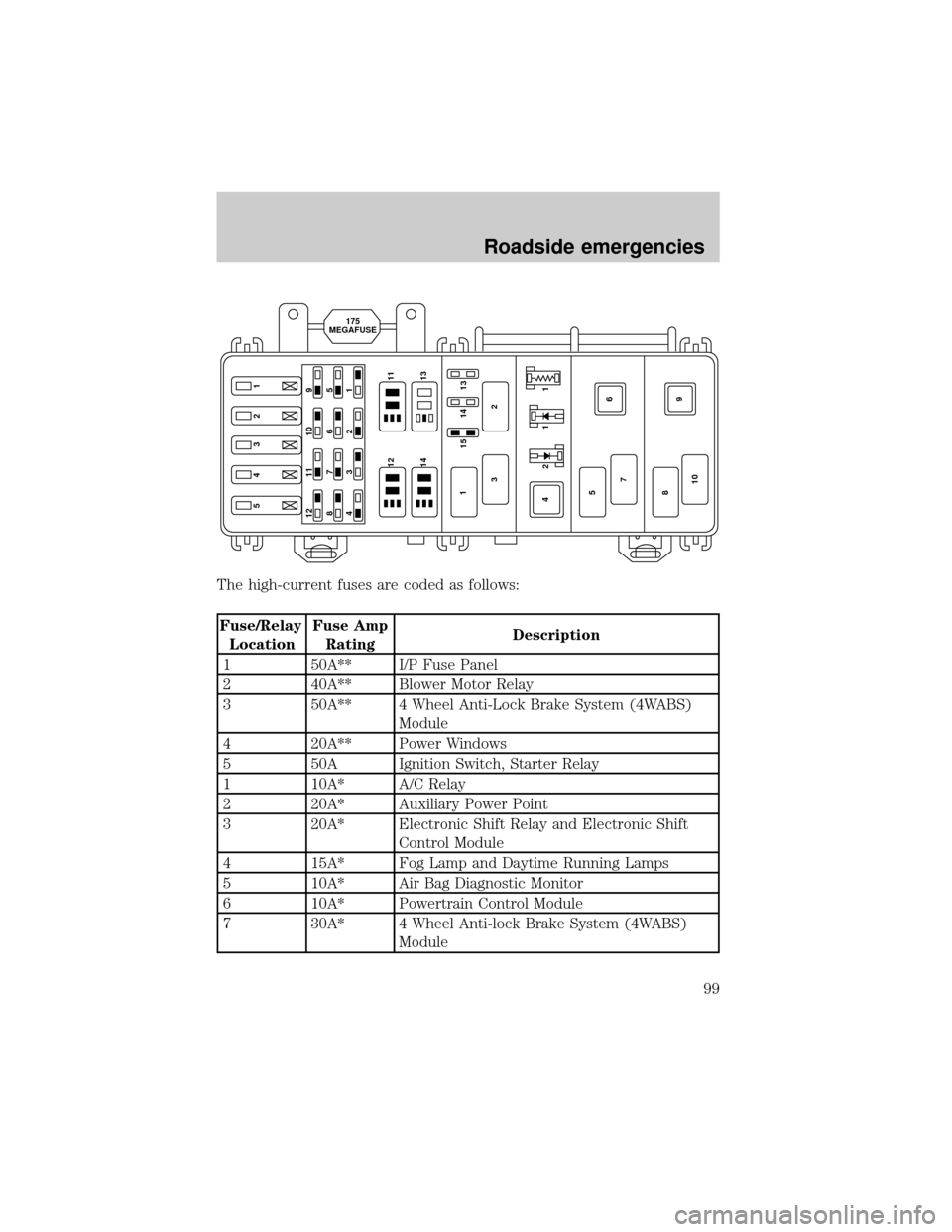
The high-current fuses are coded as follows:
Fuse/Relay
LocationFuse Amp
RatingDescription
1 50A** I/P Fuse Panel
2 40A** Blower Motor Relay
3 50A** 4 Wheel Anti-Lock Brake System (4WABS)
Module
4 20A** Power Windows
5 50A Ignition Switch, Starter Relay
1 10A* A/C Relay
2 20A* Auxiliary Power Point
3 20A* Electronic Shift Relay and Electronic Shift
Control Module
4 15A* Fog Lamp and Daytime Running Lamps
5 10A* Air Bag Diagnostic Monitor
6 10A* Powertrain Control Module
7 30A* 4 Wheel Anti-lock Brake System (4WABS)
Module
5432112 11 10 9
876 5
432 1
14 15 13
9 6
10 87 5 41
2 3
211
175
MEGAFUSE
11
13 12
14
Roadside emergencies
99
Page 100 of 160

Fuse/Relay
LocationFuse Amp
RatingDescription
8 30A* PCM Relay
9 20A* Fuel Pump Relay and RAP Module
10 15A* Horn Relay
11 15A* Parklamps Relay and Main Light Switch
12 30A* Main Light Switch and Multifunction Switch
13 15A* Heated Oxygen Sensor, EGR Vacuum
Regulator, EVR Solenoid, Camshaft Position
Sensor (CMP), Canister Vent Solenoid
14 30A* Generator Voltage Regulator
15 - NOT USED
1 - Wiper Park Relay
2 - A/C Relay
3 - Wiper Hi/Lo Relay
4 - PCM Power Relay
5 - Fuel Pump Relay
6 - Starter Relay
7 - Horn Relay
8 - Washer Pump Relay
9 - Blower Motor Relay
10 - Foglamp Relay
11 - Not Used
12 - Not Used
13 - Park Lamp/Trailer Tow Relay
14 - Not Used
1 - RABS Resistor
1 - RABS Diode
2 - Electronic Engine Controls Diode
* Mini Fuses ** Maxi Fuses
Roadside emergencies
100
Page 135 of 160
WHAT YOU SHOULD KNOW ABOUT AUTOMOTIVE FUELS
Important safety precautions
Do not overfill the fuel tank. The pressure in an overfilled tank
may cause leakage and lead to fuel spray and fire.
If you do not use the proper fuel cap, the pressure in the fuel
tank can damage the fuel system or cause it to work improperly
in a collision.
The fuel system may be under pressure. If the fuel cap is venting
vapor or if you hear a hissing sound, wait until it stops before
completely removing the cap.
Automotive fuels can cause serious injury or death if misused or
mishandled.
Observe the following guidelines when handling automotive fuel:
²Extinguish all smoking materials
and any open flames before
fueling your vehicle.
²Always turn off the vehicle before
fueling.
²Automotive fuels can be harmful
or fatal if swallowed. If fuel is
swallowed, call a physician
immediately, even if no symptoms
are immediately apparent. The
toxic effects of fuel may not be visible for hours.
²Fuels can also be harmful if absorbed through the skin. If fuel is
splashed on the skin, promptly remove contaminated clothing and
wash skin thoroughly with soap and water.
²If fuel is splashed in the eyes, remove contact lenses (if worn), flush
with water for 15 minutes and seek medical attention.
Maintenance and care
135
Page 141 of 160
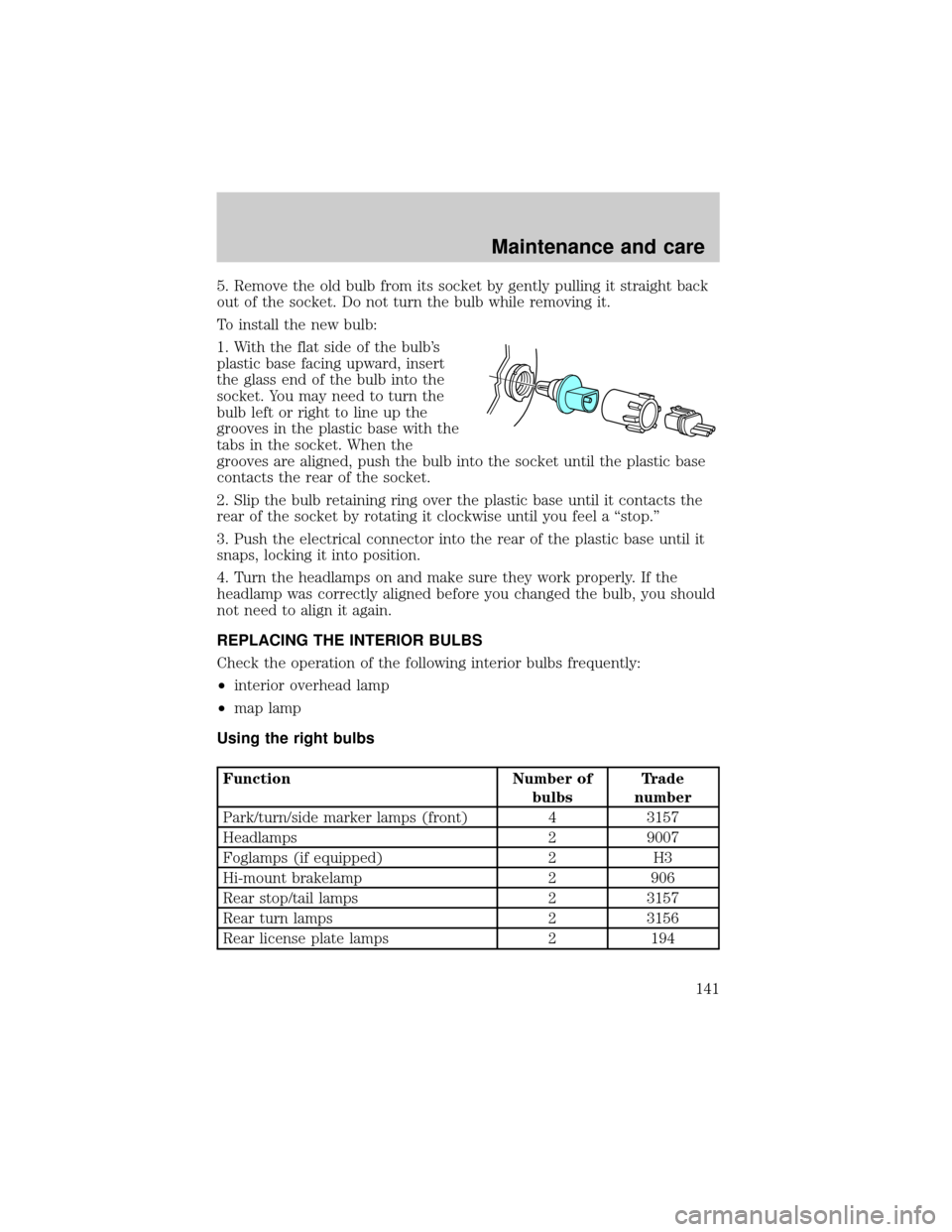
5. Remove the old bulb from its socket by gently pulling it straight back
out of the socket. Do not turn the bulb while removing it.
To install the new bulb:
1. With the flat side of the bulb's
plastic base facing upward, insert
the glass end of the bulb into the
socket. You may need to turn the
bulb left or right to line up the
grooves in the plastic base with the
tabs in the socket. When the
grooves are aligned, push the bulb into the socket until the plastic base
contacts the rear of the socket.
2. Slip the bulb retaining ring over the plastic base until it contacts the
rear of the socket by rotating it clockwise until you feel a ªstop.º
3. Push the electrical connector into the rear of the plastic base until it
snaps, locking it into position.
4. Turn the headlamps on and make sure they work properly. If the
headlamp was correctly aligned before you changed the bulb, you should
not need to align it again.
REPLACING THE INTERIOR BULBS
Check the operation of the following interior bulbs frequently:
²interior overhead lamp
²map lamp
Using the right bulbs
Function Number of
bulbsTrade
number
Park/turn/side marker lamps (front) 4 3157
Headlamps 2 9007
Foglamps (if equipped) 2 H3
Hi-mount brakelamp 2 906
Rear stop/tail lamps 2 3157
Rear turn lamps 2 3156
Rear license plate lamps 2 194
Maintenance and care
141
Page 156 of 160

Aiming headlamps ....................142
Air bag supplemental restraint
system ..........................................47
and child safety seats ..............48
description ................................47
disposal ......................................50
indicator light ...........................50
passenger air bag ...........48,51,52
Air conditioning
manual heating and air
conditioning system .......19,20,21
Ambulance packages ....................3
Anti-lock brake system (ABS)
description ................................66
Anti-theft system ........................35
Battery .......................................128
voltage gauge ............................15
Brake fluid
checking and adding ..............118
Brakes ..........................................64
anti-lock ................................64,65
anti-lock brake system (ABS)
warning light .............................66
fluid, checking and adding ....118
Brake-shift interlock ...................67
Break-in period .............................2
Bulbs, replacing ........................139
headlamps ...............................140
specifications ..........................141
Changing a tire .........................101
Child safety seats ........................54
Chime
headlamps on ............................11
Cleaning your vehicle ...............142
engine compartment ..............143
fabric ........................................146
instrument panel ....................146
plastic parts ............................145
safety belts ..............................146
tail lamps .................................145
washing ....................................142
waxing .....................................143wheels ......................................143
windows ..................................146
Clutch
fluid ..........................................119
Controls ..................................23,31
Driving under special
conditions ....................................77
high water .................................78
slippery roads ......................78,79
Emission control system ..........138
Engine ........................................151
service points ............112,113,114
Engine block heater ...................62
Engine coolant
checking and adding ..............121
disposal ....................................122
refill capacities ........................123
Engine oil ...........................115,117
changing oil and oil filter .......118
checking and adding .......115,117
Exhaust fumes ............................63
Foglamps .....................................16
Four-Wheel Drive vehicles .........74
control trac ..........................22,75
indicator light ...........................75
Fuel
calculating fuel economy .......137
improving fuel economy ..........92
octane rating ...........................136
quality ......................................136
running out of fuel .................137
safety information relating
to automotive fuels ................135
Fuel gauge ...................................12
Fuel pump shut-off switch .........93
Fuse panels
instrument panel ......................95
power distribution box .............98
Fuses .......................................94,95
Gauges, Mechanical
engine coolant temperature
gauge .........................................13
Index
156
Page 157 of 160

Hazard flashers ...........................93
Headlamps ...................................16
daytime running lights .............16
flashing ......................................17
high beam .................................16
Heating ........................................17
High beams
indicator light .............................9
Hood ..........................................111
Instrument panel
lighting up panel and interior .17
Jump-starting your vehicle .....106,
107
attaching cables ......................107
disconnecting cables ..............108
Keys
key in ignition chime ...............11
Lamps
interior lamps .........................141
Lights, warning and indicator
air bag ..........................................8
anti-lock brakes (ABS) ..............8
anti-theft .....................................9
brake ............................................8
charging system ..........................9
check engine ............................6,7
cruise indicator .........................10
door ajar ....................................10
fuel reset .....................................8
overdrive off ................................9
safety belt ...................................8
turn signal indicator ...................9
Load limits
trailer towing ............................81
Lubricant specifications ...........150
Manual transmission
driving .............................72,73,74
Mirrors
cleaning ...................................146
side view mirrors (power) .......31
Motorcraft parts ........................147
Odometer .....................................14Off road driving, 4-wheel drive .77
Overdrive .....................................28
Panic alarm feature, remote
entry system ................................33
Parking brake ..............................66
Power door locks ........................31
Power steering
fluid, checking and adding ....123
Radio ............................................24
Recreational towing, all wheels
on the ground .............................89
Refill capacities for fluids ........148
Relays ..........................................94
Remote entry system .................32
illuminated entry ......................34
locking/unlocking doors ...........32
replacement/additional
transmitters ...............................34
replacing the batteries .............33
Reporting safety defects ..........155
Safety restraints
extension assembly ..................45
lap and shoulder belts ...40,41,42
maintenance ..............................46
proper use .................................39
warning light and chime .........11,
45,46
Safety seats for children
attaching with tether straps ....57
tether anchorage hardware .....58
Seats ............................................37
adjusting the seat, manual .......37
jump seats ............................38,39
lumbar support .........................38
rear seat access ........................38
Servicing your vehicle ..............110
precautions when servicing ...110
Snowplowing .................................2
Special notice
diesel-powered vehicles .............3
utility-type vehicles ....................2
Speed control ..............................24
Index
157