instrument panel FORD RANGER 1999 2.G User Guide
[x] Cancel search | Manufacturer: FORD, Model Year: 1999, Model line: RANGER, Model: FORD RANGER 1999 2.GPages: 216, PDF Size: 1.47 MB
Page 153 of 216
²Manual transmission:
1. Set the parking brake.
2. Depress the clutch and place the gearshift in 1 (First).
3. Turn off the engine and remove the key.
4. Block the wheels to prevent the vehicle from moving unexpectedly.
Working with the engine on
²Automatic transmission:
1. Set the parking brake and ensure the gearshift is securely latched in P
(Park).
2. Block the wheels to prevent the vehicle from moving unexpectedly.
Do not start your engine with the air cleaner removed and do
not remove it while the engine is running.
²Manual transmission:
1. Set the parking brake, depress the clutch and place the gearshift in N
(Neutral).
2. Block the wheels to prevent the vehicle from moving unexpectedly.
Do not start your engine with the air cleaner removed and do
not remove it while the engine is running.
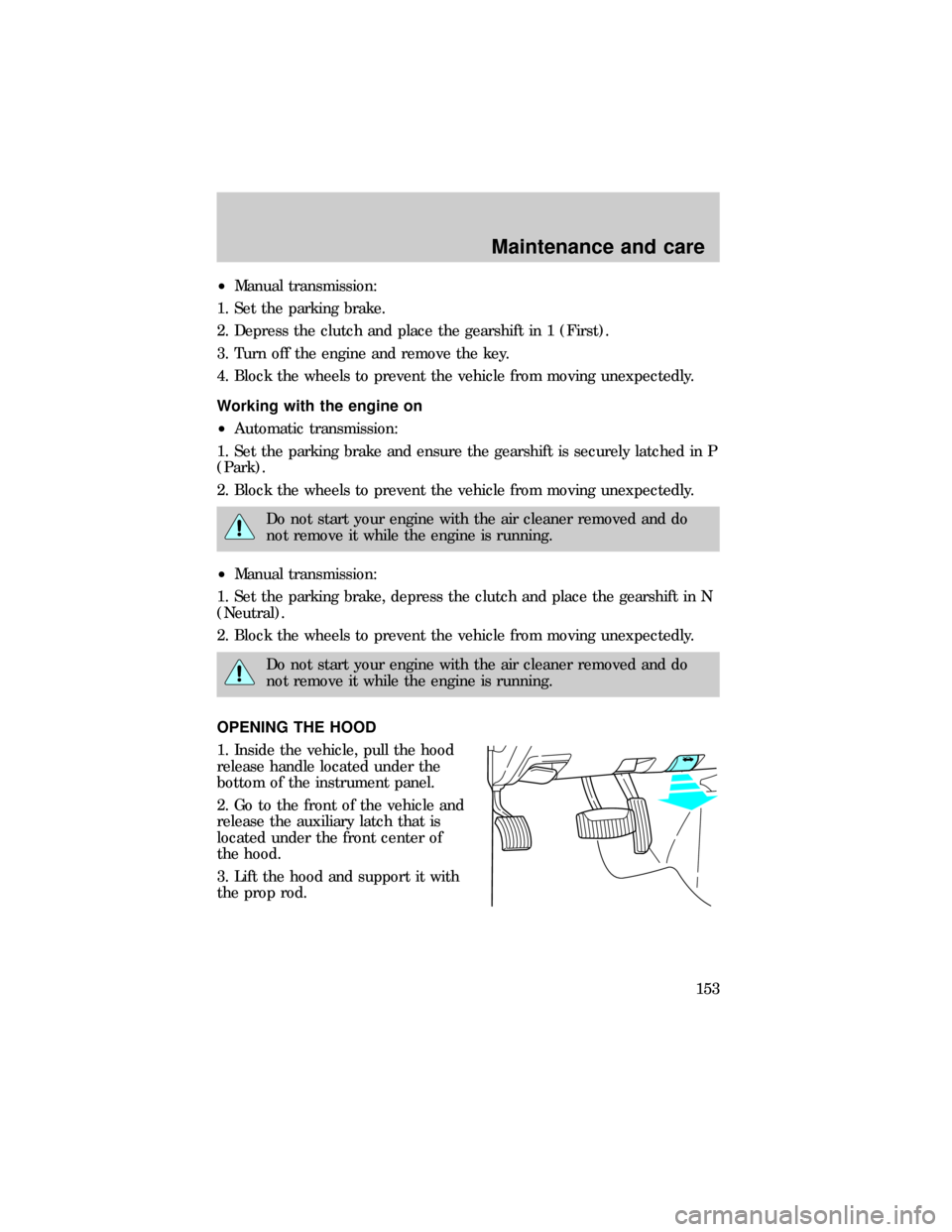
OPENING THE HOOD
1. Inside the vehicle, pull the hood
release handle located under the
bottom of the instrument panel.
2. Go to the front of the vehicle and
release the auxiliary latch that is
located under the front center of
the hood.
3. Lift the hood and support it with
the prop rod.
Maintenance and care
153
Page 194 of 216
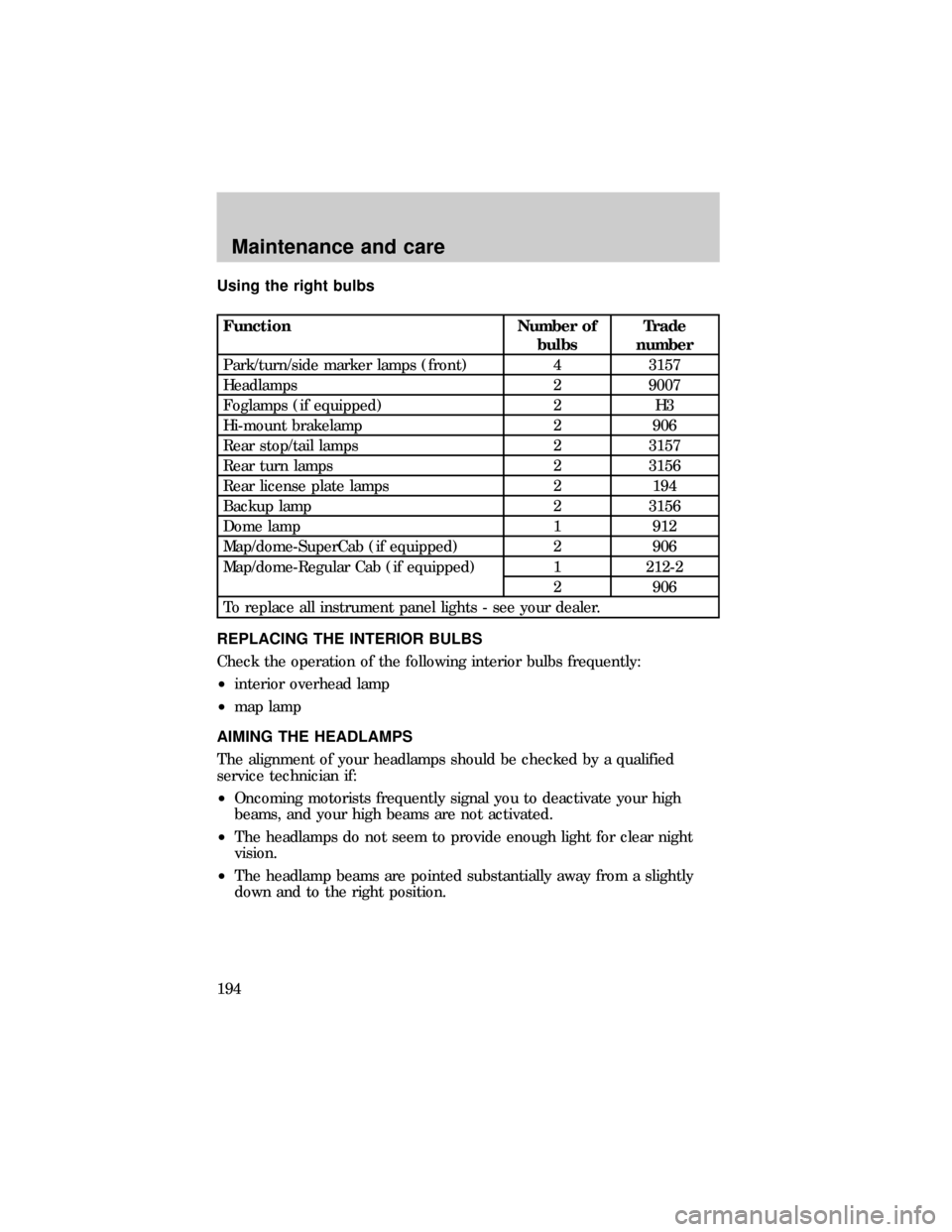
Using the right bulbs
Function Number of
bulbsTrade
number
Park/turn/side marker lamps (front) 4 3157
Headlamps 2 9007
Foglamps (if equipped) 2 H3
Hi-mount brakelamp 2 906
Rear stop/tail lamps 2 3157
Rear turn lamps 2 3156
Rear license plate lamps 2 194
Backup lamp 2 3156
Dome lamp 1 912
Map/dome-SuperCab (if equipped) 2 906
Map/dome-Regular Cab (if equipped) 1 212-2
2 906
To replace all instrument panel lights - see your dealer.
REPLACING THE INTERIOR BULBS
Check the operation of the following interior bulbs frequently:
²interior overhead lamp
²map lamp
AIMING THE HEADLAMPS
The alignment of your headlamps should be checked by a qualified
service technician if:
²Oncoming motorists frequently signal you to deactivate your high
beams, and your high beams are not activated.
²The headlamps do not seem to provide enough light for clear night
vision.
²The headlamp beams are pointed substantially away from a slightly
down and to the right position.
Maintenance and care
194
Page 198 of 216

Cleaning plastic exterior parts
Use vinyl cleaner for routine cleaning. Clean with a tar remover if
necessary. Do not clean plastic parts with thinners, solvents or
petroleum-based cleaners.
Cleaning the exterior lamps
Wash with the same detergent as the exterior of your vehicle. Use glass
cleaner or tar remover if necessary.
To avoid scratching the lamps, do not use a dry paper towel, chemical
solvents or abrasive cleaners.
Cleaning the wiper blades and windshield
If the wiper blades do not wipe properly, clean the wiper blade rubber
element with undiluted windshield washer solution or a mild detergent.
To avoid damaging the blades, do not use fuel, kerosene, paint thinner or
other solvents.
If the wiper still does not wipe properly, this could be caused by
substances on the windshield such as tree sap and some hot wax
treatments used by commercial car washes. Clean the outside of the
windshield with a non-abrasive cleanser such as the non-abrasive
Bon-Amitpowder. Rinse thoroughly with clean water.Do notuse
abrasive cleansers on glass as they may cause scratches. The windshield
is clean if beads do not form when you rinse it with water. The
windshield and wiper blades should be cleaned on a regular basis, and
blades or rubber elements replaced when worn.
Cleaning the instrument panel
Clean with a damp cloth, then dry with a dry cloth.
Avoid cleaner or polish that increases the gloss of the upper portion of
the instrument panel. The dull finish in this area helps protect the driver
from undesirable windshield reflection.
Maintenance and care
198
Page 208 of 216
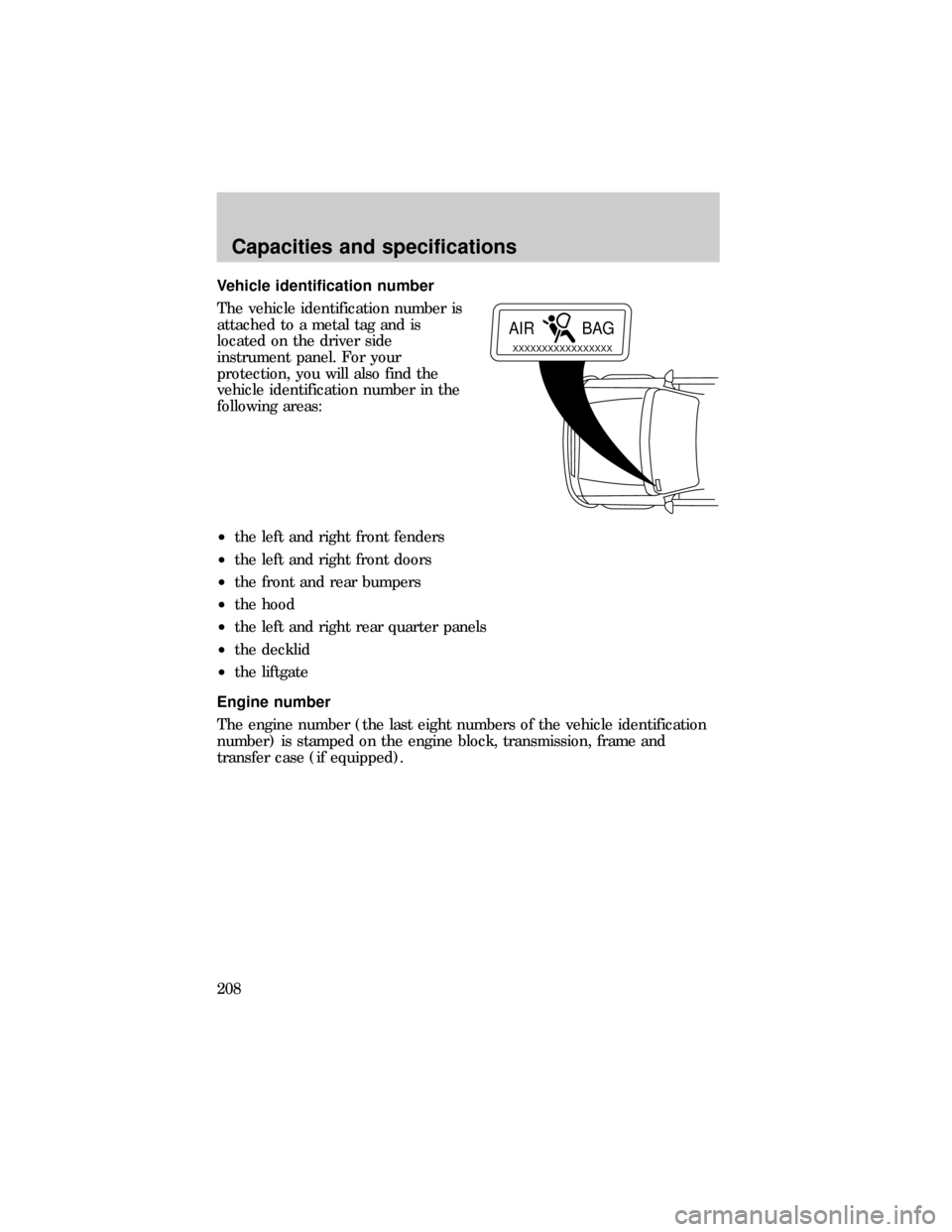
Vehicle identification number
The vehicle identification number is
attached to a metal tag and is
located on the driver side
instrument panel. For your
protection, you will also find the
vehicle identification number in the
following areas:
²the left and right front fenders
²the left and right front doors
²the front and rear bumpers
²the hood
²the left and right rear quarter panels
²the decklid
²the liftgate
Engine number
The engine number (the last eight numbers of the vehicle identification
number) is stamped on the engine block, transmission, frame and
transfer case (if equipped).
XXXXXXXXXXXXXXXXX
AIR BAG
Capacities and specifications
208
Page 211 of 216

filling your vehicle
with fuel ...........................178,180
gauge .........................................12
quality ......................................182
running out of fuel .................183
safety information relating to
automotive fuels .....................178
Fuses ...................................134,135
Gas mileage (see Fuel
economy) ..............183,184,185,186
Gauges ....................................11,12
engine coolant temperature
gauge .........................................13
engine oil pressure gauge ........15
GVWR
(Gross Vehicle Weight Rating)
calculating ..........123,128,129,130
Hazard flashers .........................133
Headlamps
aiming ......................................194
bulb specifications ..................194
high beam ..............................9,16
warning chime ..........................11
Heating ........................................17
heater only system ..............17,18
Hood ..........................................153
Ignition .......................................204
Inspection/maintenance
(I/M) testing ..............................188
Instrument panel ..........................6
cleaning ...................................198
Keys
key in ignition chime ...............11
positions of the ignition ...........55
Lamps
daytime running light ...............16
fog lamps ...................................16
headlamps .................................16
headlamps, flash to pass ..........17
instrument panel, dimming .....17
interior lamps .........................194replacing
bulbs .....188,189,190,191,192,193
Lane change indicator (see
Turn signal) .................................55
Lights, warning and indicator
air bag ..........................................8
anti-lock brakes (ABS) ..............9
anti-theft .....................................9
brake ............................................8
charging system ..........................9
check coolant ............................10
cruise indicator .........................11
door ajar ....................................10
fuel reset .....................................8
overdrive off ..............................10
safety belt ...................................8
speed control ............................60
turn signal indicator ...................9
Lumbar support, seats ..........72,73
Manual transmission
reverse .....................................114
Mirrors
cleaning ...................................199
side view mirrors (power) .......63
Motorcraft parts ........................183
Octane rating ............................181
Odometer .....................................14
Overdrive .....................................60
Panic alarm feature, remote
entry system ................................65
Parking brake ............................105
Power distribution box
(see Fuses) ...............................138
Power door locks ........................63
Power steering ..........................106
fluid, checking and adding ....165
Radio ...24,25,26,27,28,29,30,31,32,
33,34,35,36,37,38,39,41,
42,43,44,45,46,47,48,49,51
Relays ........................................134
Remote entry system ..64,68,69,70
illuminated entry ......................67
Index
211
Page 215 of 216
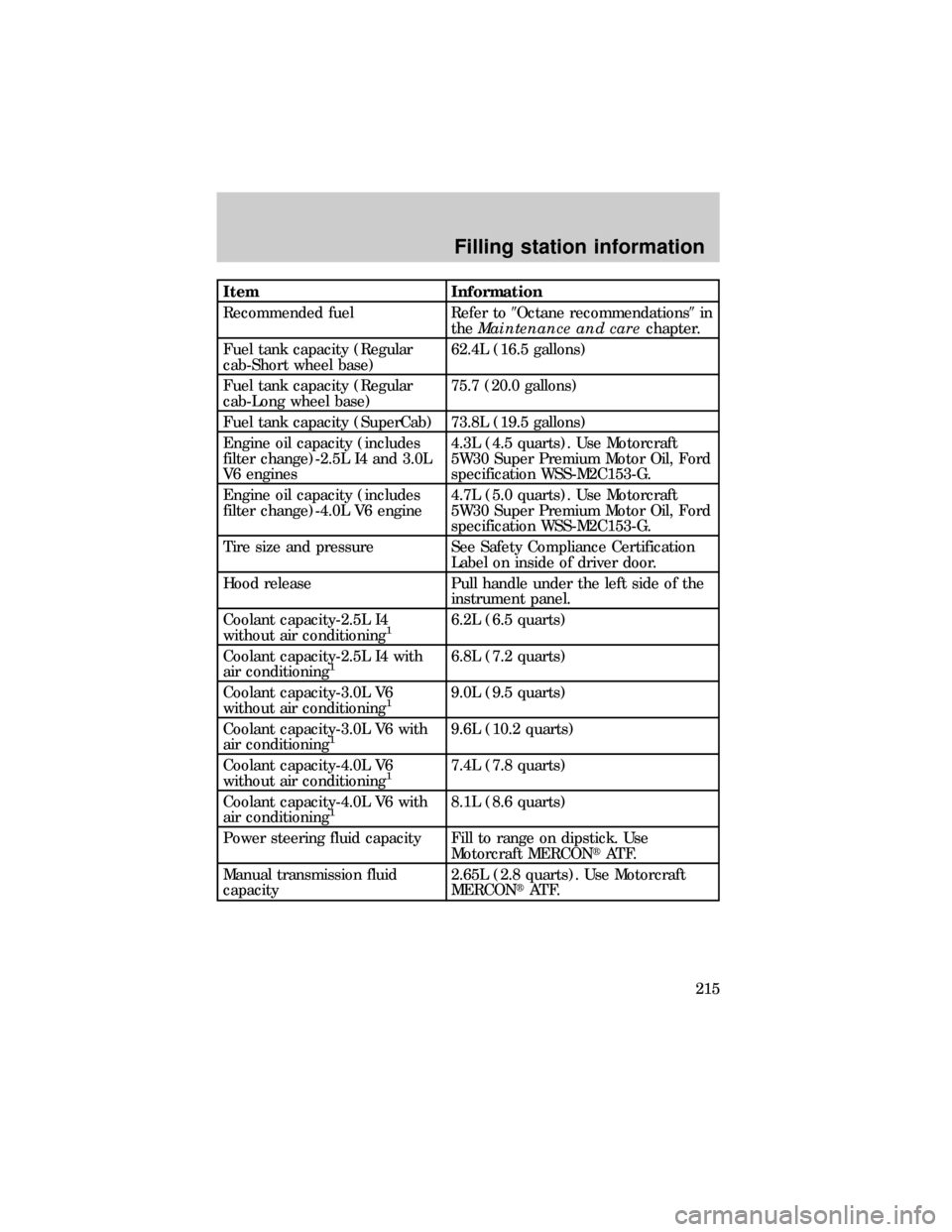
Item Information
Recommended fuel Refer to9Octane recommendations9in
theMaintenance and carechapter.
Fuel tank capacity (Regular
cab-Short wheel base)62.4L (16.5 gallons)
Fuel tank capacity (Regular
cab-Long wheel base)75.7 (20.0 gallons)
Fuel tank capacity (SuperCab) 73.8L (19.5 gallons)
Engine oil capacity (includes
filter change)-2.5L I4 and 3.0L
V6 engines4.3L (4.5 quarts). Use Motorcraft
5W30 Super Premium Motor Oil, Ford
specification WSS-M2C153-G.
Engine oil capacity (includes
filter change)-4.0L V6 engine4.7L (5.0 quarts). Use Motorcraft
5W30 Super Premium Motor Oil, Ford
specification WSS-M2C153-G.
Tire size and pressure See Safety Compliance Certification
Label on inside of driver door.
Hood release Pull handle under the left side of the
instrument panel.
Coolant capacity-2.5L I4
without air conditioning
16.2L (6.5 quarts)
Coolant capacity-2.5L I4 with
air conditioning
16.8L (7.2 quarts)
Coolant capacity-3.0L V6
without air conditioning
19.0L (9.5 quarts)
Coolant capacity-3.0L V6 with
air conditioning
19.6L (10.2 quarts)
Coolant capacity-4.0L V6
without air conditioning
17.4L (7.8 quarts)
Coolant capacity-4.0L V6 with
air conditioning
18.1L (8.6 quarts)
Power steering fluid capacity Fill to range on dipstick. Use
Motorcraft MERCONtAT F.
Manual transmission fluid
capacity2.65L (2.8 quarts). Use Motorcraft
MERCONtAT F.
Filling station information
215