ignition FORD RANGER 1999 2.G Owner's Guide
[x] Cancel search | Manufacturer: FORD, Model Year: 1999, Model line: RANGER, Model: FORD RANGER 1999 2.GPages: 216, PDF Size: 1.47 MB
Page 119 of 216

Sand
When driving over sand, try to keep all four wheels on the most solid
area of the trail. Do not reduce the tire pressures but shift to a lower
gear and drive steadily through the terrain. Apply the accelerator slowly
and avoid spinning the wheels.
Mud and water
If you must drive through high water, drive slowly. Traction or brake
capability may be limited.
When driving through water, determine the depth; avoid water higher
than the bottom of the hubs (if possible) and proceed slowly. If the
ignition system gets wet, the vehicle may stall.
Once through water, always try the brakes. Wet brakes do not stop the
vehicle as effectively as dry brakes. Drying can be improved by moving
your vehicle slowly while applying light pressure on the brake pedal.
After driving through mud, clean off residue stuck to rotating driveshafts,
halfshafts and tires. Excess mud stuck on tires and rotating driveshafts
causes an imbalance that could damage drive components.
If the transmission, transfer case or front axle are submerged in water,
their fluids should be checked and changed, if necessary.
Water intrusion into the transmission may damage the
transmission.
Replace rear axle lubricant any time the axle has been submerged in
water. The rear axle does not normally require a lubricant change for the
life of the vehicle. Rear axle lubricant quantities are not to be checked or
changed unless a leak is suspected or repair is required.
Driving on hilly or sloping terrain
When driving on a hill, avoid driving crosswise or turning on steep
slopes. You could lose traction and slip sideways. Drive straight up,
straight down or avoid the hill completely. Know the conditions on the
other side of a hill before driving over the crest.
When climbing a steep hill, start in a lower gear rather than downshifting
to a lower gear from a higher gear once the ascent has started. This
reduces strain on the engine and the possibility of stalling.
When descending a steep hill, avoid sudden braking. Shift to a lower gear
when added engine braking is desired.
Driving
119
Page 121 of 216

DRIVING THROUGH WATER
Do not drive quickly through standing water, especially if the depth is
unknown. Traction or brake capability may be limited and if the ignition
system gets wet, your engine may stall. Water may also enter your
engine's air intake and severely damage your engine.
If driving through deep or standing water is unavoidable, proceed very
slowly. Never drive through water that is higher than the bottom of the
hubs.
Once through the water, always try the brakes. Wet brakes do not stop
the vehicle as effectively as dry brakes. Drying can be improved by
moving your vehicle slowly while applying light pressure on the brake
pedal.
Driving through deep water where the transmission is submerged
may allow water into the transmission and cause internal
transmission damage.
VEHICLE LOADING
Before loading a vehicle, familiarize yourself with the following terms:
²Base Curb Weight: Weight of the vehicle including any standard
equipment, fluids, lubricants, etc. It does not include passengers or
aftermarket equipment.
²Payload: Combined maximum allowable weight of cargo, passengers
and optional equipment. The payload equals the gross vehicle weight
rating minus base curb weight.
²GVW (Gross Vehicle Weight): Base curb weight plus payload
weight. The GVW is not a limit or a specification.
²GVWR (Gross Vehicle Weight Rating): Maximum total weight of
the base vehicle, passengers, optional equipment and cargo. The
GVWR is specific to each vehicle and is listed on the Safety
Compliance Label on the driver's door pillar.
²GAWR (Gross Axle Weight Rating): Carrying capacity for each
axle system. The GAWR is specific to each vehicle and is listed on the
Safety Compliance Label on the driver's door pillar.
Driving
121
Page 133 of 216
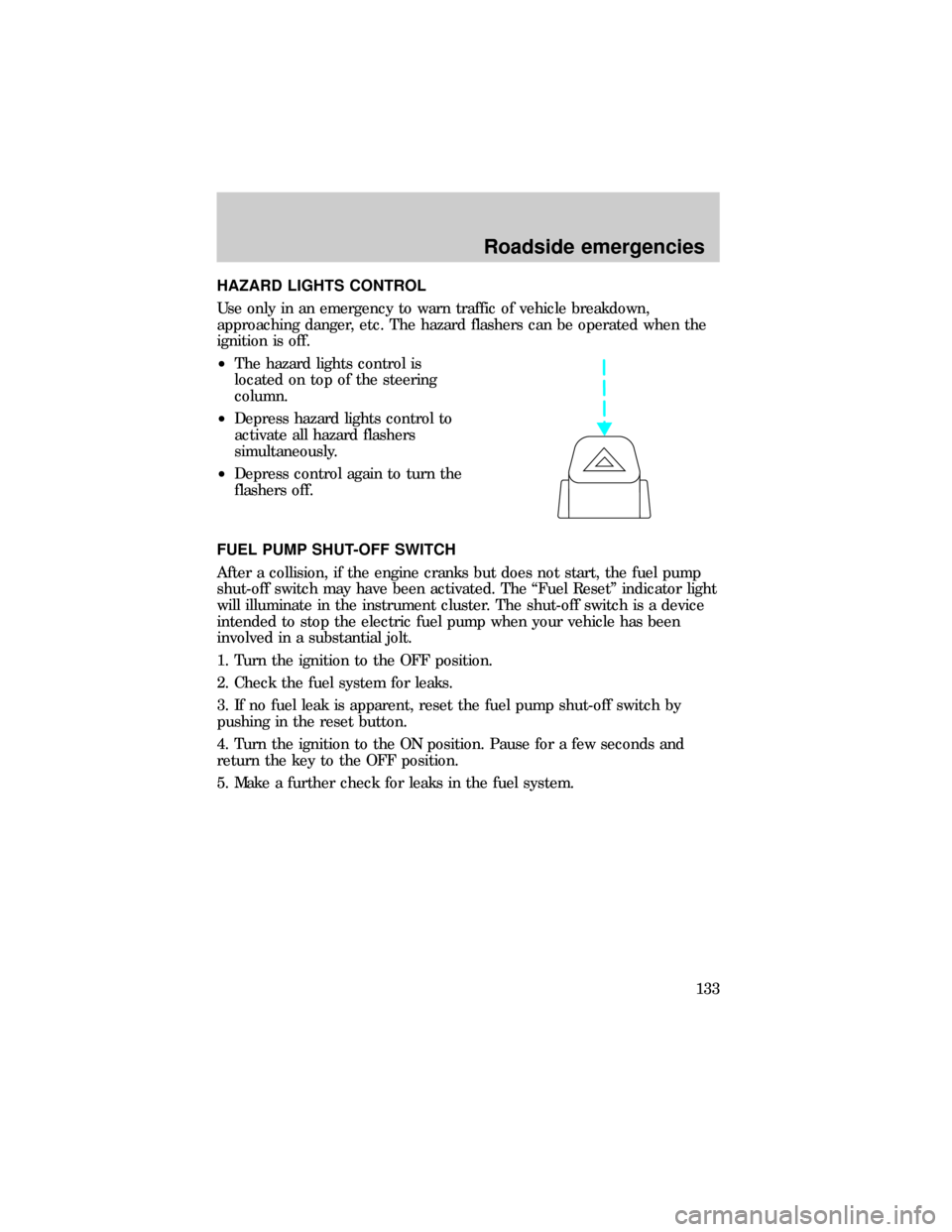
HAZARD LIGHTS CONTROL
Use only in an emergency to warn traffic of vehicle breakdown,
approaching danger, etc. The hazard flashers can be operated when the
ignition is off.
²The hazard lights control is
located on top of the steering
column.
²Depress hazard lights control to
activate all hazard flashers
simultaneously.
²Depress control again to turn the
flashers off.
FUEL PUMP SHUT-OFF SWITCH
After a collision, if the engine cranks but does not start, the fuel pump
shut-off switch may have been activated. The ªFuel Resetº indicator light
will illuminate in the instrument cluster. The shut-off switch is a device
intended to stop the electric fuel pump when your vehicle has been
involved in a substantial jolt.
1. Turn the ignition to the OFF position.
2. Check the fuel system for leaks.
3. If no fuel leak is apparent, reset the fuel pump shut-off switch by
pushing in the reset button.
4. Turn the ignition to the ON position. Pause for a few seconds and
return the key to the OFF position.
5. Make a further check for leaks in the fuel system.
Roadside emergencies
133
Page 139 of 216
Always replace the cover to the Power Distribution Box before
reconnecting the battery or refilling fluid reservoirs.
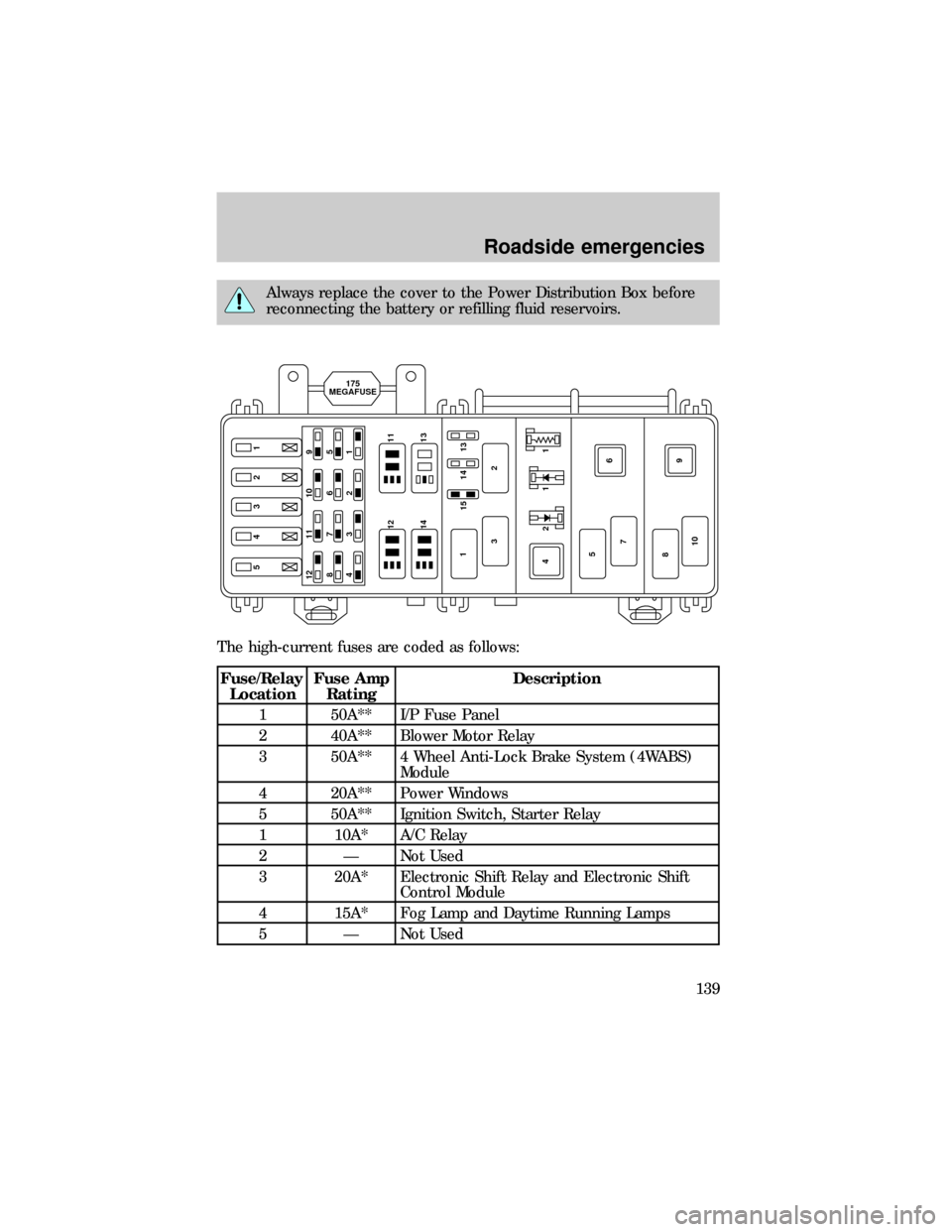
The high-current fuses are coded as follows:
Fuse/Relay
LocationFuse Amp
RatingDescription
1 50A** I/P Fuse Panel
2 40A** Blower Motor Relay
3 50A** 4 Wheel Anti-Lock Brake System (4WABS)
Module
4 20A** Power Windows
5 50A** Ignition Switch, Starter Relay
1 10A* A/C Relay
2 Ð Not Used
3 20A* Electronic Shift Relay and Electronic Shift
Control Module
4 15A* Fog Lamp and Daytime Running Lamps
5 Ð Not Used
5432112 11 10 9
876 5
432 1
14 15 13
9 6
10 87 5 41
2 3
211
175
MEGAFUSE
11
13 12
14
Roadside emergencies
139
Page 187 of 216
²Do not turn off the ignition while your vehicle is moving, especially at
high speeds.
²Have the items listed in your maintenance guide and or service guide
performed according to the specified schedule.
The scheduled maintenance items listed in the maintenance guide and or
service guide are essential to the life and performance of your vehicle
and to its emissions system.
If other than Ford, Motorcraft or Ford-authorized parts are used for
maintenance replacements or for service of components affecting
emission control, such non-Ford parts should be equivalent to genuine
Ford Motor Company parts in performance and durability.
Do not park, idle, or drive your vehicle in dry grass or other dry
ground cover. The emission system heats up the engine
compartment and exhaust system, which can start a fire.
Illumination of the charging system warning light, ªCheck Engineº light
or the temperature warning light, fluid leaks, strange odors, smoke or
loss of oil pressure, could indicate that the emission control system is
not working properly.
Exhaust leaks may result in entry of harmful and potentially
lethal fumes into the passenger compartment.
Do not make any unauthorized changes to your vehicle or engine. By
law, vehicle owners and anyone who manufactures, repairs, items, sells,
leases, trades vehicles, or supervises a fleet of vehicles are not permitted
to intentionally remove an emission control device or prevent it from
working. Information about your vehicle's emission system is on the
Vehicle Emission Control Information Decal located on or near the
engine. This decal identifies engine displacement and gives some tune up
specifications.
Please consult your ªWarranty Guideº for complete emission warranty
information.
Maintenance and care
187
Page 205 of 216
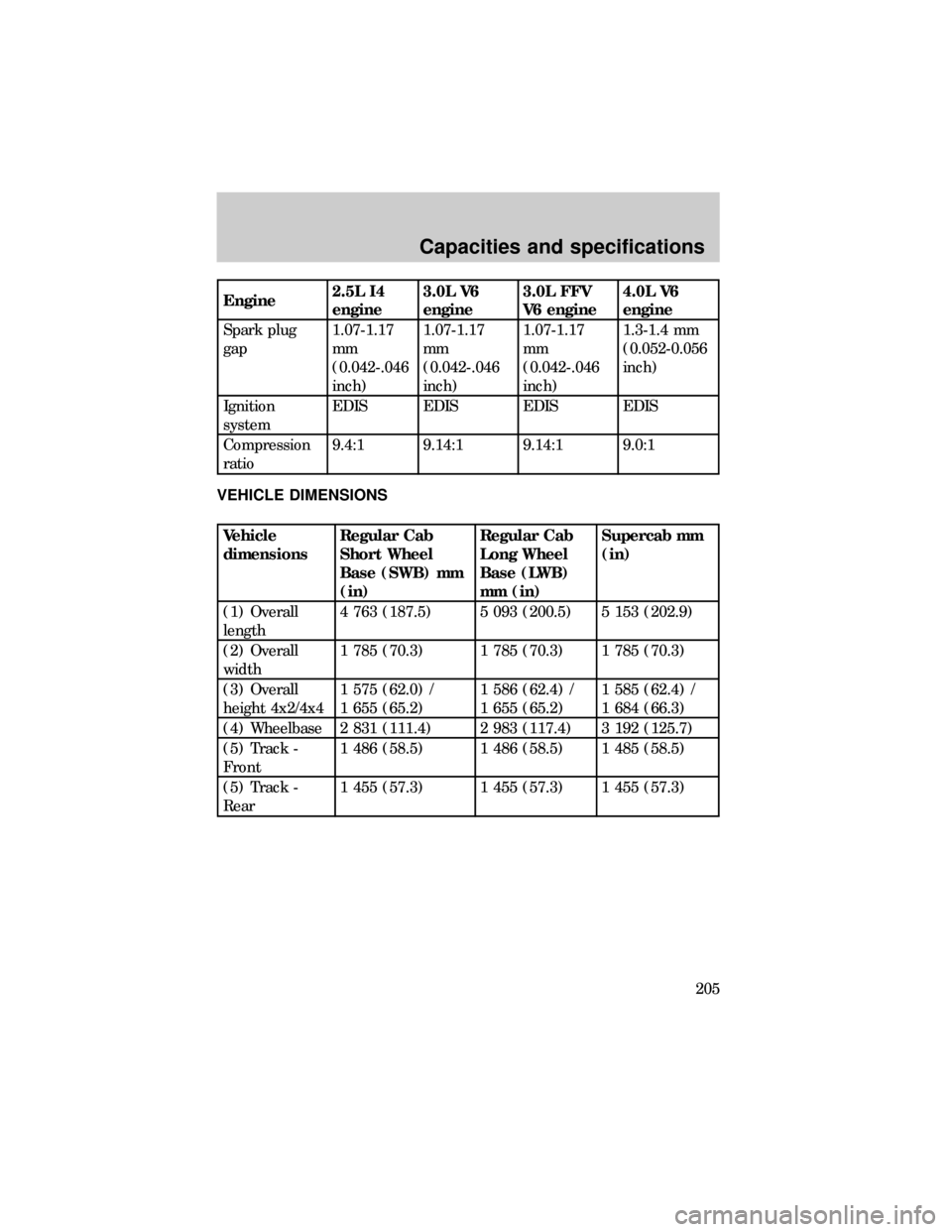
Engine2.5L I4
engine3.0L V6
engine3.0L FFV
V6 engine4.0L V6
engine
Spark plug
gap1.07-1.17
mm
(0.042-.046
inch)1.07-1.17
mm
(0.042-.046
inch)1.07-1.17
mm
(0.042-.046
inch)1.3-1.4 mm
(0.052-0.056
inch)
Ignition
systemEDIS EDIS EDIS EDIS
Compression
ratio9.4:1 9.14:1 9.14:1 9.0:1
VEHICLE DIMENSIONS
Vehicle
dimensionsRegular Cab
Short Wheel
Base (SWB) mm
(in)Regular Cab
Long Wheel
Base (LWB)
mm (in)Supercab mm
(in)
(1) Overall
length4 763 (187.5) 5 093 (200.5) 5 153 (202.9)
(2) Overall
width1 785 (70.3) 1 785 (70.3) 1 785 (70.3)
(3) Overall
height 4x2/4x41 575 (62.0) /
1 655 (65.2)1 586 (62.4) /
1 655 (65.2)1 585 (62.4) /
1 684 (66.3)
(4) Wheelbase 2 831 (111.4) 2 983 (117.4) 3 192 (125.7)
(5) Track -
Front1 486 (58.5) 1 486 (58.5) 1 485 (58.5)
(5) Track -
Rear1 455 (57.3) 1 455 (57.3) 1 455 (57.3)
Capacities and specifications
205
Page 211 of 216

filling your vehicle
with fuel ...........................178,180
gauge .........................................12
quality ......................................182
running out of fuel .................183
safety information relating to
automotive fuels .....................178
Fuses ...................................134,135
Gas mileage (see Fuel
economy) ..............183,184,185,186
Gauges ....................................11,12
engine coolant temperature
gauge .........................................13
engine oil pressure gauge ........15
GVWR
(Gross Vehicle Weight Rating)
calculating ..........123,128,129,130
Hazard flashers .........................133
Headlamps
aiming ......................................194
bulb specifications ..................194
high beam ..............................9,16
warning chime ..........................11
Heating ........................................17
heater only system ..............17,18
Hood ..........................................153
Ignition .......................................204
Inspection/maintenance
(I/M) testing ..............................188
Instrument panel ..........................6
cleaning ...................................198
Keys
key in ignition chime ...............11
positions of the ignition ...........55
Lamps
daytime running light ...............16
fog lamps ...................................16
headlamps .................................16
headlamps, flash to pass ..........17
instrument panel, dimming .....17
interior lamps .........................194replacing
bulbs .....188,189,190,191,192,193
Lane change indicator (see
Turn signal) .................................55
Lights, warning and indicator
air bag ..........................................8
anti-lock brakes (ABS) ..............9
anti-theft .....................................9
brake ............................................8
charging system ..........................9
check coolant ............................10
cruise indicator .........................11
door ajar ....................................10
fuel reset .....................................8
overdrive off ..............................10
safety belt ...................................8
speed control ............................60
turn signal indicator ...................9
Lumbar support, seats ..........72,73
Manual transmission
reverse .....................................114
Mirrors
cleaning ...................................199
side view mirrors (power) .......63
Motorcraft parts ........................183
Octane rating ............................181
Odometer .....................................14
Overdrive .....................................60
Panic alarm feature, remote
entry system ................................65
Parking brake ............................105
Power distribution box
(see Fuses) ...............................138
Power door locks ........................63
Power steering ..........................106
fluid, checking and adding ....165
Radio ...24,25,26,27,28,29,30,31,32,
33,34,35,36,37,38,39,41,
42,43,44,45,46,47,48,49,51
Relays ........................................134
Remote entry system ..64,68,69,70
illuminated entry ......................67
Index
211