radio FORD RANGER 2000 2.G Owner's Manual
[x] Cancel search | Manufacturer: FORD, Model Year: 2000, Model line: RANGER, Model: FORD RANGER 2000 2.GPages: 240, PDF Size: 2.07 MB
Page 65 of 240
Changes or modifications not expressly approved by the party
responsible for compliance could void the user's authority to
operate the equipment.
Replacing the battery
The transmitter is powered by one coin type three-volt lithium battery
CR2032 or equivalent. Typical operating range will allow you to be up to
10 meters (33 feet) away from your vehicle. A decrease in operating
range can be caused by:
²weather conditions
²nearby radio towers
²structures around the vehicle
²other vehicles parked next to the vehicle
To replace the battery:
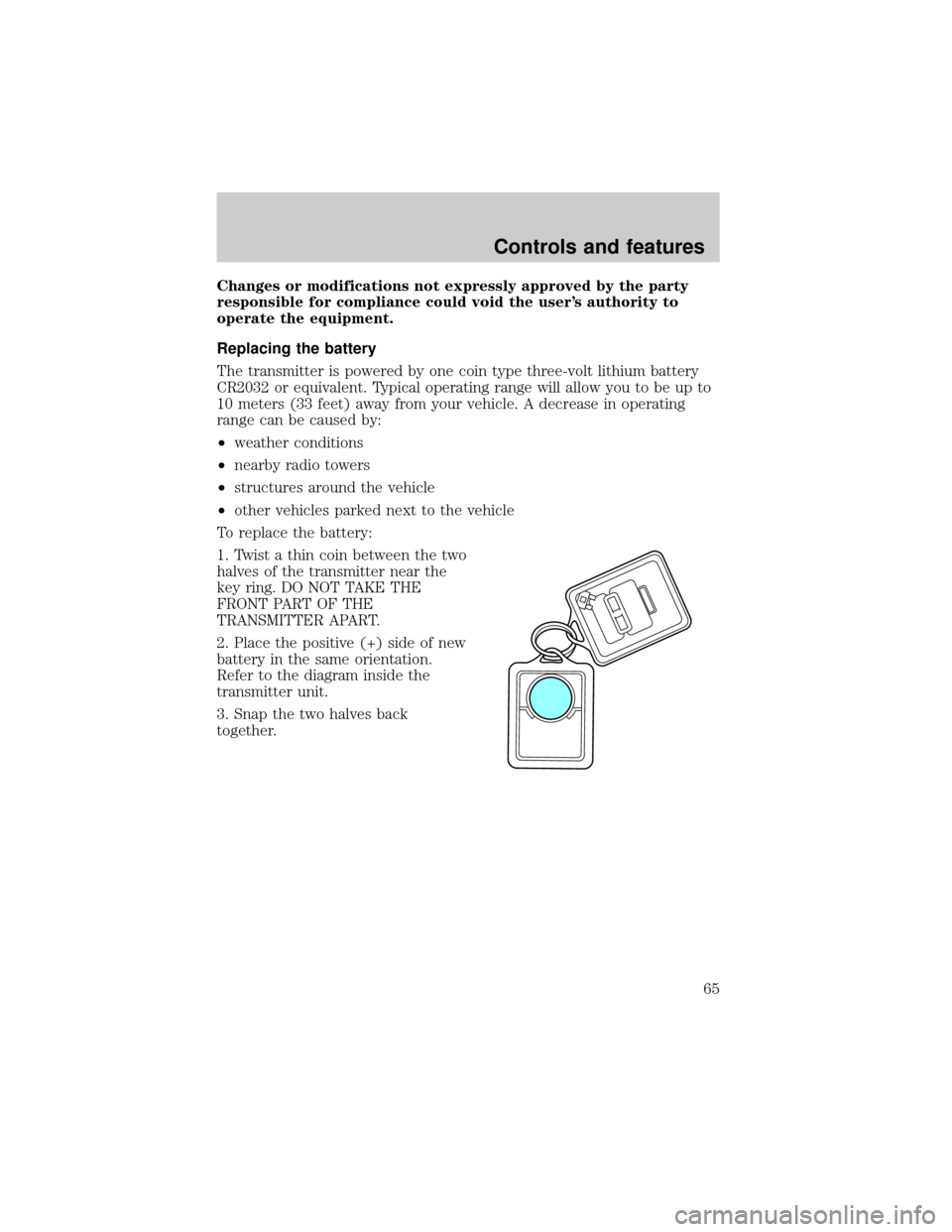
1. Twist a thin coin between the two
halves of the transmitter near the
key ring. DO NOT TAKE THE
FRONT PART OF THE
TRANSMITTER APART.
2. Place the positive (+) side of new
battery in the same orientation.
Refer to the diagram inside the
transmitter unit.
3. Snap the two halves back
together.
Controls and features
65
Page 100 of 240
PREPARING TO START YOUR VEHICLE
Engine starting is controlled by the powertrain control system. This
system meets all Canadian Interference-Causing Equipment standard
requirements regulating the impulse electrical field strength of radio
noise.
When starting a fuel-injected engine, avoid pressing the accelerator
before or during starting. Only use the accelerator when you have
difficulty starting the engine. For more information on starting the
vehicle, refer toStarting the enginein this chapter.
Extended idling at high engine speeds can produce very high
temperatures in the engine and exhaust system, creating the risk
of fire or other damage.
Do not park, idle, or drive your vehicle in dry grass or other dry
ground cover. The emission system heats up the engine
compartment and exhaust system, which can start a fire.
Do not start your vehicle in a closed garage or in other enclosed
areas. Exhaust fumes can be toxic. Always open the garage door
before you start the engine. SeeGuarding against exhaust fumesin
this chapter for more instructions.
If you smell exhaust fumes inside your vehicle, have your dealer
inspect your vehicle immediately. Do not drive if you smell
exhaust fumes.
Important safety precautions
A computer system controls the engine's idle revolutions per minute
(RPM). When the engine starts, the idle RPM runs faster to warm the
engine. If the engine idle speed does not slow down automatically, have
the vehicle checked. Do not allow the vehicle to idle for more than 10
minutes at high engine RPM.
Before starting the vehicle:
1. Make sure all vehicle occupants have buckled their safety belts. For
more information on safety belts and their proper usage, refer to the
Seating and safety restraintschapter.
Starting
100
Page 142 of 240
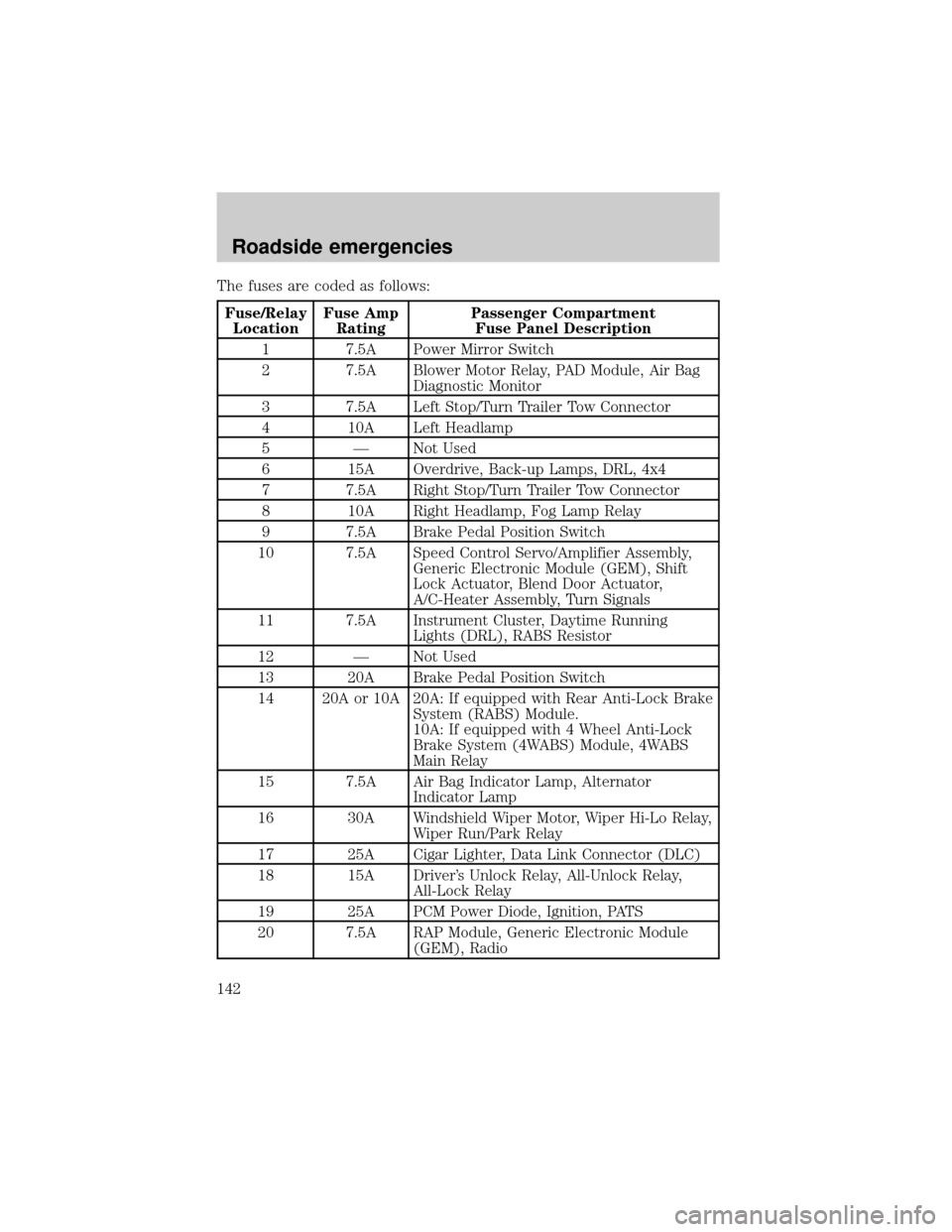
The fuses are coded as follows:
Fuse/Relay
LocationFuse Amp
RatingPassenger Compartment
Fuse Panel Description
1 7.5A Power Mirror Switch
2 7.5A Blower Motor Relay, PAD Module, Air Bag
Diagnostic Monitor
3 7.5A Left Stop/Turn Trailer Tow Connector
4 10A Left Headlamp
5 Ð Not Used
6 15A Overdrive, Back-up Lamps, DRL, 4x4
7 7.5A Right Stop/Turn Trailer Tow Connector
8 10A Right Headlamp, Fog Lamp Relay
9 7.5A Brake Pedal Position Switch
10 7.5A Speed Control Servo/Amplifier Assembly,
Generic Electronic Module (GEM), Shift
Lock Actuator, Blend Door Actuator,
A/C-Heater Assembly, Turn Signals
11 7.5A Instrument Cluster, Daytime Running
Lights (DRL), RABS Resistor
12 Ð Not Used
13 20A Brake Pedal Position Switch
14 20A or 10A 20A: If equipped with Rear Anti-Lock Brake
System (RABS) Module.
10A: If equipped with 4 Wheel Anti-Lock
Brake System (4WABS) Module, 4WABS
Main Relay
15 7.5A Air Bag Indicator Lamp, Alternator
Indicator Lamp
16 30A Windshield Wiper Motor, Wiper Hi-Lo Relay,
Wiper Run/Park Relay
17 25A Cigar Lighter, Data Link Connector (DLC)
18 15A Driver's Unlock Relay, All-Unlock Relay,
All-Lock Relay
19 25A PCM Power Diode, Ignition, PATS
20 7.5A RAP Module, Generic Electronic Module
(GEM), Radio
Roadside emergencies
142
Page 143 of 240
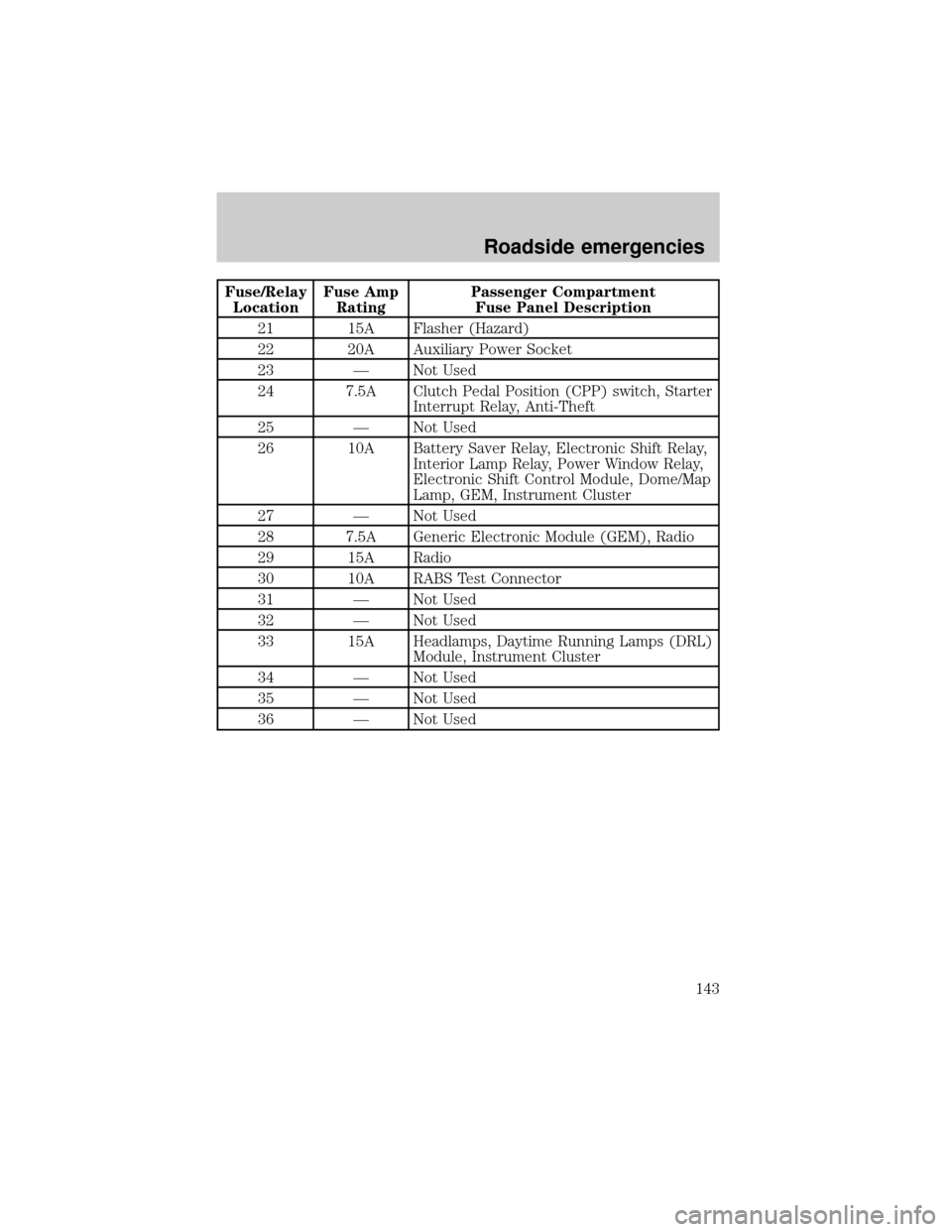
Fuse/Relay
LocationFuse Amp
RatingPassenger Compartment
Fuse Panel Description
21 15A Flasher (Hazard)
22 20A Auxiliary Power Socket
23 Ð Not Used
24 7.5A Clutch Pedal Position (CPP) switch, Starter
Interrupt Relay, Anti-Theft
25 Ð Not Used
26 10A Battery Saver Relay, Electronic Shift Relay,
Interior Lamp Relay, Power Window Relay,
Electronic Shift Control Module, Dome/Map
Lamp, GEM, Instrument Cluster
27 Ð Not Used
28 7.5A Generic Electronic Module (GEM), Radio
29 15A Radio
30 10A RABS Test Connector
31 Ð Not Used
32 Ð Not Used
33 15A Headlamps, Daytime Running Lamps (DRL)
Module, Instrument Cluster
34 Ð Not Used
35 Ð Not Used
36 Ð Not Used
Roadside emergencies
143
Page 180 of 240

²If you do not allow the engine to relearn its idle trim, the idle
quality of your vehicle may be adversely affected until the idle
trim is eventually relearned.
If the battery has been disconnected or a new battery has been installed,
the clock and the preset radio stations must be reset once the battery is
reconnected.
²Always dispose of automotive
batteries in a responsible manner.
Follow your local authorized
standards for disposal. Call your
local authorized recycling center
to find out more about recycling
automotive batteries.
WINDSHIELD WIPER BLADES
Check the wiper blades at least twice a year or when they seem less
effective. Substances such as tree sap and some hot wax treatments used
by commercial car washes reduce the effectiveness of wiper blades.
Checking the wiper blades
If the wiper blades do not wipe properly, clean both the windshield and
wiper blades using undiluted windshield wiper solution or a mild
detergent. Rinse thoroughly with clean water. To avoid damaging the
blades, do not use fuel, kerosene, paint thinner or other solvents.
LEAD
RETURN
RECYCLE
Maintenance and care
180
Page 228 of 240

Hood deflectors
Locking gas cap
Lubricants and oils
Molded vinyl floor mats
Side window air deflectors
Spare tire lock
Step bumpers
Step/sill plates
Tailgate protector
Tonneau covers
Touch-up paint
Universal floor mats
For maximum vehicle performance, keep the following information in
mind when adding accessories or equipment to your vehicle:
²When adding accessories, equipment, passengers and luggage to your
vehicle, do not exceed the total weight capacity of the vehicle or of
the front or rear axle (GVWR or GAWR as indicated on the Safety
compliance certification label). Consult your dealer for specific weight
information.
²The Federal Communications Commission (FCC) and Canadian Radio
Telecommunications Commission (CRTC) regulate the use of mobile
communications systems - such as two-way radios, telephones and
theft alarms - that are equipped with radio transmitters. Any such
equipment installed in your vehicle should comply with FCC or CRTC
regulations and should be installed only by a qualified service
technician.
²Mobile communications systems may harm the operation of your
vehicle, particularly if they are not properly designed for automotive
use or are not properly installed. When operated, such systems may
cause the engine to stumble or stall. In addition, such systems may be
damaged or their performance may be affected by operating your
vehicle. (Citizens band [CB] transceivers, garage door openers and
other transmitters with outputs of five watts or less will not ordinarily
affect your vehicle's operation.)
²Ford cannot assume responsibility for any adverse effects or damage
that may result from the use of such equipment.
Customer assistance
228
Page 231 of 240

Air bag supplemental
restraint system ..........................84
and child safety seats ..............85
description ................................84
disposal ......................................88
driver air bag ............................86
indicator light ......................10,87
operation ...................................86
passenger air bag .....................86
passenger
deactivation switch ..............25,88
Air cleaner filter .......................209
Air conditioning ..........................19
manual heating and air
conditioning system .................21
Ambulance packages ....................3
Antifreeze
(see Engine coolant) ................168
Anti-lock brake system
(see Brakes) .......................107,108
Anti-theft system
warning light .............................11
Audio system (see Radio) .........26
Automatic transmission ............111
driving an automatic
overdrive ..........................112,114
fluid, adding ............................173
fluid, checking ........................173
fluid, refill capacities ..............209
fluid, specification ..................214
Auxiliary power point .................25
Axle
lubricant specifications ...212,214
refill capacities ........................209
traction lok ..............................124
Battery .......................................178
acid, treating emergencies .....178
charging system
warning light .............................11
jumping a disabled battery ....152
maintenance-free ....................178
replacement, specifications ...209servicing ..................................178
voltage gauge ............................17
Belt minder .................................80
Brakes ........................................106
anti-lock .....................106,107,108
anti-lock brake system (ABS)
warning light ......................10,108
brake warning light ..................10
fluid, checking and adding ....166
fluid, refill capacities ..............209
fluid, specifications ..........212,214
lubricant specifications ...212,214
parking ....................................108
shift interlock ..........................111
Break-in period .............................2
Capacities for refilling fluids ....209
Cargo area shade ........................63
Cargo net .....................................63
Certification Label ....................217
Child safety restraints ................93
child safety belts ......................93
Child safety seats ........................94
attaching with tether straps ....99
in front seat ..............................96
in rear seat ................................96
tether anchorage hardware .....99
Cleaning your vehicle ...............203
engine compartment ..............204
exterior .............................204,207
exterior lamps .........................206
instrument panel ....................207
instrument panel lens ............207
interior .....................................207
mirrors .....................................208
plastic parts ............................206
safety belts ..............................207
washing ....................................203
waxing .....................................203
wheels ......................................204
windows ..................................208
wiper blades ............................206
Index
231
Page 234 of 240

air bag ........................................10
anti-lock brakes (ABS) .....10,108
anti-theft ...................................11
brake ..........................................10
charging system ........................11
check coolant ............................12
check engine ...............................8
cruise indicator .........................12
door ajar ....................................12
fuel reset ...................................10
high beam .................................11
overdrive off ..............................11
safety belt .................................10
speed control ............................59
turn signal indicator .................11
Load limits .................................125
GAWR ......................................125
GVWR ......................................125
trailer towing ..........................125
Loading instructions .................126
Lubricant specifications ....212,214
Lumbar support, seats ...............71
Manual transmission .................116
fluid capacities ........................209
lubricant specifications ..........214
reverse .....................................118
Mirrors
cleaning ...................................208
side view mirrors (power) .......62
Motorcraft parts .................192,209
Octane rating ............................190
Odometer .....................................16
Oil (see Engine oil) ..................163
Overdrive .....................................59
Panic alarm feature, remote
entry system ................................64
Parking brake ............................108
Parts (see Motorcraft parts) ....209
Power distribution box
(see Fuses) ...............................144
Power door locks ........................62
Power steering ..........................109fluid, checking and adding ....173
fluid, refill capacity ................209
fluid, specifications ..........212,214
Preparing to
drive your vehicle .....................110
Radio ............................................26
Relays ........................................140
Remote entry system ............63,64
illuminated entry ......................67
locking/unlocking doors ...........64
panic alarm ...............................64
replacement/additional
transmitters ...............................66
replacing the batteries .............65
Safety belts (see Safety
restraints) ...........13,72,73,74,75,76
Safety defects, reporting ..........230
Safety restraints ......72,73,74,75,76
belt minder ...............................80
cleaning the safety belts ...83,207
extension assembly ..................79
for adults ....................73,74,75,76
for children ...............................93
lap belt ......................................78
warning light
and chime ........................10,13,79
Safety seats for children ............94
Seat belts
(see Safety restraints) ...............72
Seats ............................................70
child safety seats ......................94
SecuriLock passive
anti-theft system ...............67,68,69
Servicing your vehicle ..............158
Snowplowing .................................3
Spark plugs,
specifications ...............209,214,215
Special notice ................................3
ambulance conversions ..............3
utility-type vehicles ....................3
Specification chart,
lubricants ............................212,214
Index
234