wheel FORD RANGER 2000 2.G Owner's Guide
[x] Cancel search | Manufacturer: FORD, Model Year: 2000, Model line: RANGER, Model: FORD RANGER 2000 2.GPages: 240, PDF Size: 2.07 MB
Page 183 of 240
SERVICING YOUR TIRES
Checking the tire pressure
²Use an accurate tire pressure gauge.
²Check the tire pressure when tires are cold, after the vehicle has been
parked for at least one hour or has been driven less than 5 km (3
miles).
²Adjust tire pressure to recommended specifications found on the
Certification Label.
Improperly inflated tires can affect vehicle handling and can fail
suddenly, possibly resulting in loss of vehicle control.
Tire rotation
Because your vehicle's tires perform different jobs, they often wear
differently. To make sure your tires wear evenly and last longer, rotate
them as indicated in the Scheduled Maintenance Guide. If you notice
that the tires wear unevenly, have them checked.
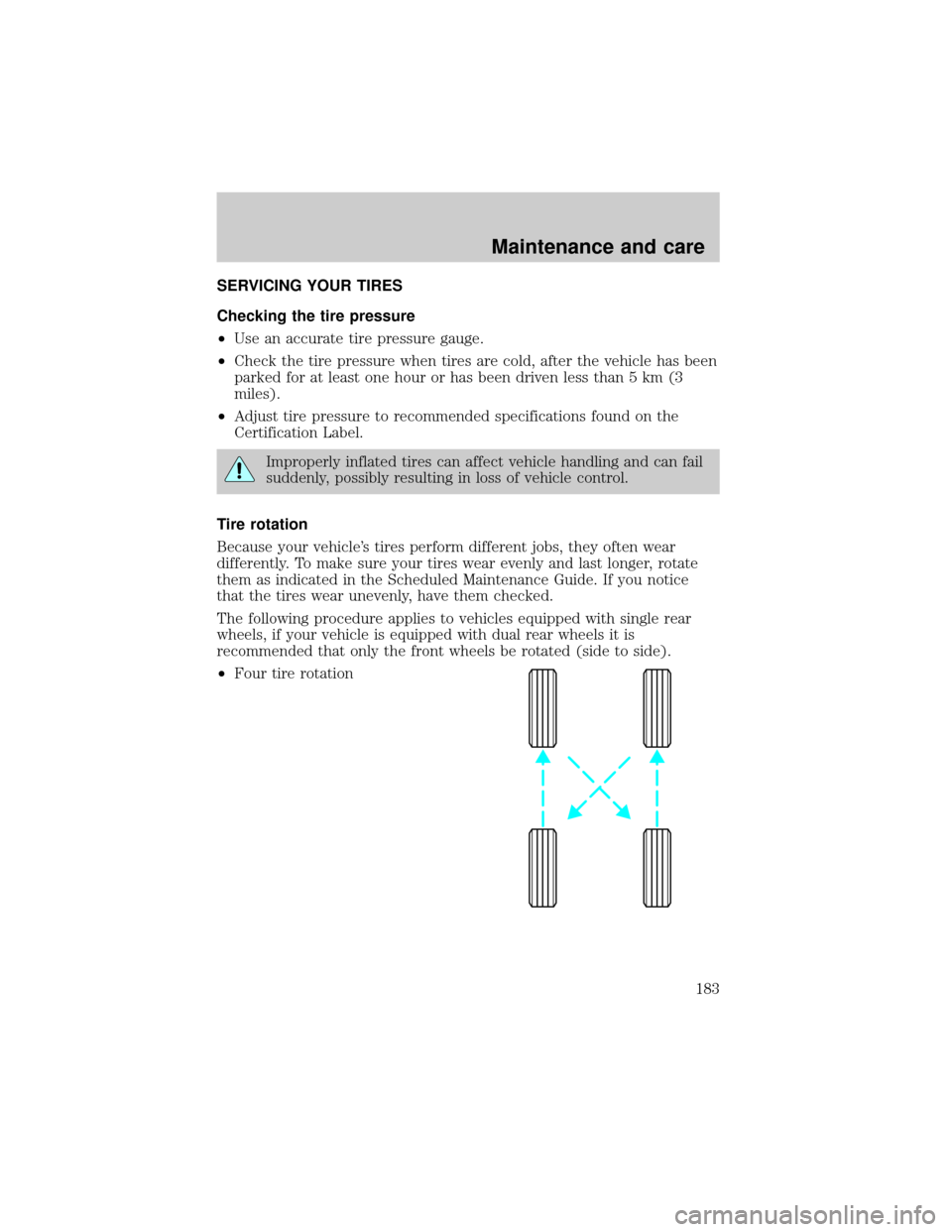
The following procedure applies to vehicles equipped with single rear
wheels, if your vehicle is equipped with dual rear wheels it is
recommended that only the front wheels be rotated (side to side).
²Four tire rotation
Maintenance and care
183
Page 185 of 240
Do not replace your tires with ªhigh performanceº tires or larger
size tires.
Failure to follow these precautions may adversely affect the
handling of the vehicle and make it easier for the driver to lose
control and roll over.
Tires that are larger or smaller than your vehicle's original tires may also
affect the accuracy of your speedometer.
SNOW TIRES AND CHAINS
Driving too fast for conditions creates the possibility of loss of
vehicle control. Driving at very high speeds for extended periods
of time may result in damage to vehicle components.
Snow tires must be the same size and grade as the tires you
currently have on your vehicle.
The tires on your vehicle have all weather treads to provide traction in
rain and snow. However, in some climates, you may need to use snow
tires and chains. If you need to use snow tires and chains,it is
recommended that steel wheels are used of the same size and
specifications as those originally installed.
Follow these guidelines when using snow tires and chains:
²Do not use tire chains on aluminum wheels. Chains may chip the
wheels.
²Use only SAE Class S chains.
²Install chains securely, verifying that the chains do not touch any
wiring, brake lines or fuel lines.
²Drive cautiously. If you hear the chains rub or bang against your
vehicle, stop and re-tighten the chains. If this does not work, remove
the chains to prevent damage to your vehicle.
²If possible, avoid fully loading your vehicle.
²Remove the tire chains when they are no longer needed. Do not use
tire chains on dry roads.
Maintenance and care
185
Page 194 of 240

²Idling for long periods of time (greater than one minute) may waste
fuel.
²Anticipate stopping; slowing down may eliminate the need to stop.
²Sudden or hard accelerations may reduce fuel economy.
²Slow down gradually.
²Driving at reasonable speeds (traveling at 88 km/h [55 mph] uses 15%
less fuel than traveling at 105 km/h [65 mph]).
²Revving the engine before turning it off may reduce fuel economy.
²Using the air conditioner or defroster may reduce fuel economy.
²You may want to turn off the speed control in hilly terrain if
unnecessary shifting between third and fourth gear occurs.
Unnecessary shifting of this type could result in reduced fuel
economy.
²Warming up a vehicle on cold mornings is not required and may
reduce fuel economy.
²Resting your foot on the brake pedal while driving may reduce fuel
economy.
²Combine errands and minimize stop-and-go driving.
Maintenance
²Keep tires properly inflated and use only recommended size.
²Operating a vehicle with the wheels out of alignment will reduce fuel
economy.
²Use recommended engine oil. Refer toLubricant Specifications.
²Perform all regularly scheduled maintenance items. Follow the
recommended maintenance schedule and owner maintenance checks
found in your vehicle Scheduled Maintenance Guide.
Conditions
²Heavily loading a vehicle or towing a trailer may reduce fuel economy
at any speed.
²Carrying unnecessary weight may reduce fuel economy (approximately
0.4 km/L [1 mpg] is lost for every 180 kg [400 lb] of weight carried).
²Adding certain accessories to your vehicle (for example bug
deflectors, rollbars/light bars, running boards, ski/luggage racks) may
reduce fuel economy.
Maintenance and care
194
Page 195 of 240
²Using fuel blended with alcohol may lower fuel economy.
²Fuel economy may decrease with lower temperatures during the first
12±16 km (8±10 miles) of driving.
²Driving on flat terrain offers improved fuel economy as compared to
driving on hilly terrain.
²Transmissions give their best fuel economy when operated in the top
cruise gear and with steady pressure on the gas pedal.
²Four-wheel-drive operation (if equipped) is less fuel efficient than
two-wheel-drive operation.
²Close windows for high speed driving.
EPA window sticker
Every new vehicle should have the EPA window sticker. Contact your
dealer if the window sticker is not supplied with your vehicle. The EPA
window sticker should be your guide for the fuel economy comparisons
with other vehicles.
It is important to note the box in the lower left corner of the window
sticker. These numbers represent the Range of L/100 km (MPG)
expected on the vehicle under optimum conditions. Your fuel economy
may vary depending upon the method of operation and conditions.
EMISSION CONTROL SYSTEM
Your vehicle is equipped with various emission control components and a
catalytic converter which will enable your vehicle to comply with
applicable exhaust emission standards. To make sure that the catalytic
converter and other emission control components continue to work
properly:
²Use only unleaded fuel (or E85, if equipped with the 3.0L FFV V6
engine).
²Avoid running out of fuel.
²Do not turn off the ignition while your vehicle is moving, especially at
high speeds.
²Have the items listed in your Scheduled Maintenance Guide performed
according to the specified schedule.
The scheduled maintenance items listed in the Scheduled Maintenance
Guide are essential to the life and performance of your vehicle and to its
emissions system.
Maintenance and care
195
Page 204 of 240

recommended that you clean the wiper blades and windshield as
described inCleaning the wiper blades and windshield.
Repairing paint chips
Minor scratches or paint damage from road debris may be repaired with
the Ultra Touch Prep and Finishing Kit (#F7AZ-19K507±BA), Lacquer
Touch-up Paint (#ALBZ-19500±XXXXA), or Exterior Acrylic Spray
Lacquer (#ALAZ-19500±XXXXA) from the Ford Car Care Chemicals line.
Please note that the part numbers (shown as XXXX above) will vary with
your vehicle's specific coloring. Observe the application instructions on
the products.
Remove particles such as bird droppings, tree sap, insect remains, tar
spots, road salt and industrial fallout immediately.
Cleaning the wheels
Wash with the same detergent as the body of your vehicle. Do not use
acid-based or alcohol-based wheel cleaners, steel wool, fuel or strong
detergents. Never use abrasives that will damage the finish of special
wheel surfaces. Use a tar remover to remove grease and tar.
The brushes used in some automatic car washes may damage the finish
on your wheels. Before going to a car wash, find out if the brushes are
abrasive.
Cleaning the engine
Engines are more efficient when they are clean because grease and dirt
buildup keep the engine warmer than normal. When washing:
²Take care when using a power washer to clean the engine. The high
pressure fluid could penetrate the sealed parts and cause damage.
²Do not spray with cold water to avoid cracking the engine block or
other engine components.
²Cover the highlighted areas to prevent water damage when cleaning
the engine.
Maintenance and care
204
Page 207 of 240
Ultra-Clear Spray Glass Cleaner, (E4AZ-19C507±AA), available from your
Ford Dealer.Do notuse abrasive cleansers on glass as they may cause
scratches. The windshield or rear window is clean if beads do not form
when you rinse it with water. The windshield, rear window and wiper
blades should be cleaned on a regular basis, and blades or rubber
elements replaced when worn.
Cleaning the instrument panel
Clean with a damp cloth, then dry with a dry cloth.
Avoid cleaner or polish that increases the gloss of the upper portion of
the instrument panel. The dull finish in this area helps protect the driver
from undesirable windshield reflection.
Do not use chemical solvents or strong detergents when cleaning
the steering wheel or instrument panel to avoid contamination of
the air bag system.
Cleaning the instrument cluster lens
Clean with a damp cloth, then dry with a dry cloth.
Do not use household or glass cleaners as these may damage the lens.
Cleaning the interior fabric
Remove dust and loose dirt with a whisk broom or a vacuum cleaner.
Remove fresh spots immediately. Do not use household or glass cleaners.
These agents can stain and discolor the fabric. Use a mild soap and
water solution if necessary.
Cleaning and maintaining the safety belts
Clean the safety belts with a mild soap solution recommended for
cleaning upholstery or carpets. Do not bleach or dye the belts, because
these actions may weaken the belt webbing.
Check the safety belt system periodically to make sure there are no
nicks, wear or cuts. If your vehicle has been involved in an accident,
refer to theSafety belt maintenancesection in theSeating and safety
restraintschapter.
Underbody
Flush the complete underside of vehicle frequently. Keep body drain
holes unplugged. Inspect for road damage.
Maintenance and care
207
Page 210 of 240
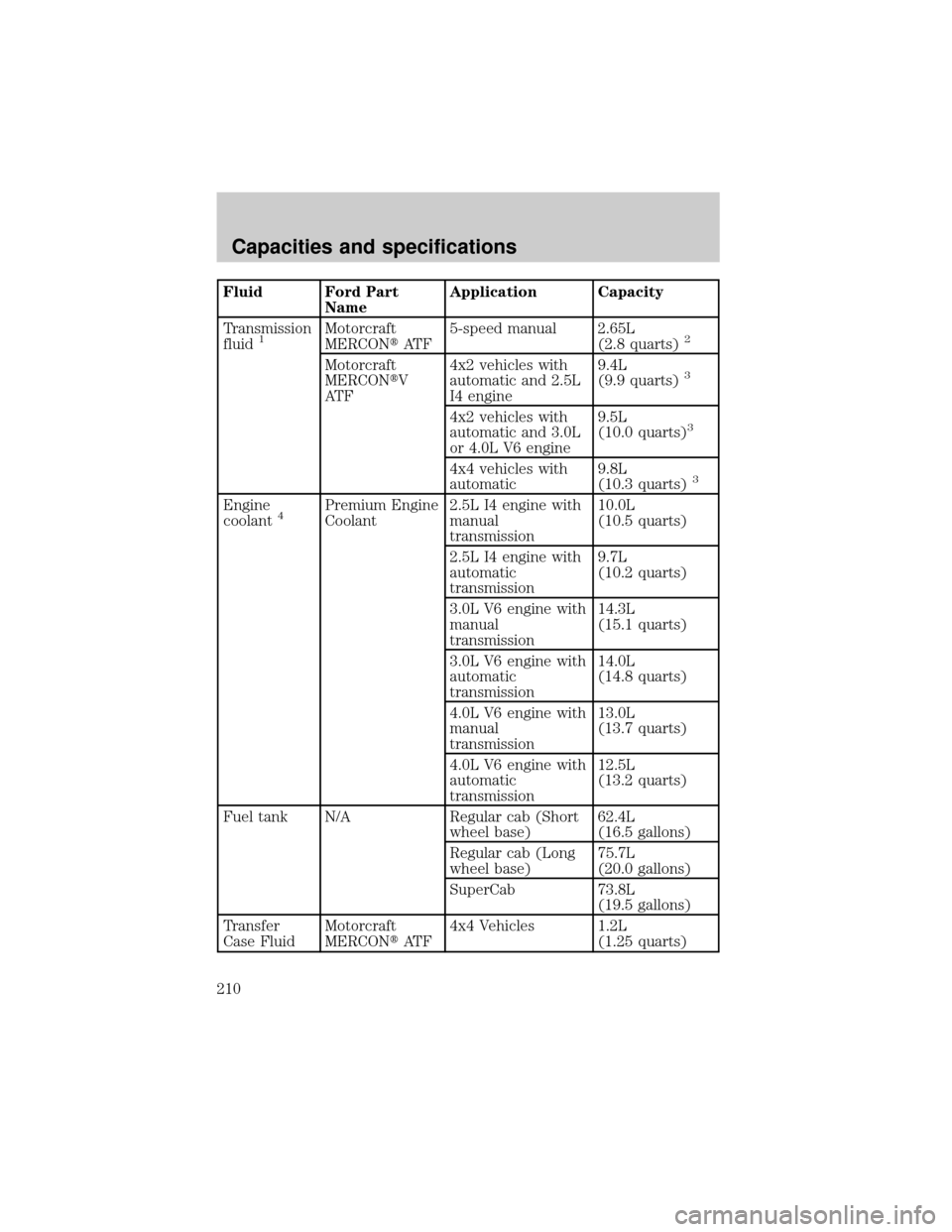
Fluid Ford Part
NameApplication Capacity
Transmission
fluid
1Motorcraft
MERCONtAT F5-speed manual 2.65L
(2.8 quarts)2
Motorcraft
MERCONtV
AT F4x2 vehicles with
automatic and 2.5L
I4 engine9.4L
(9.9 quarts)3
4x2 vehicles with
automatic and 3.0L
or 4.0L V6 engine9.5L
(10.0 quarts)3
4x4 vehicles with
automatic9.8L
(10.3 quarts)3
Engine
coolant4Premium Engine
Coolant2.5L I4 engine with
manual
transmission10.0L
(10.5 quarts)
2.5L I4 engine with
automatic
transmission9.7L
(10.2 quarts)
3.0L V6 engine with
manual
transmission14.3L
(15.1 quarts)
3.0L V6 engine with
automatic
transmission14.0L
(14.8 quarts)
4.0L V6 engine with
manual
transmission13.0L
(13.7 quarts)
4.0L V6 engine with
automatic
transmission12.5L
(13.2 quarts)
Fuel tank N/A Regular cab (Short
wheel base)62.4L
(16.5 gallons)
Regular cab (Long
wheel base)75.7L
(20.0 gallons)
SuperCab 73.8L
(19.5 gallons)
Transfer
Case FluidMotorcraft
MERCONtAT F4x4 Vehicles 1.2L
(1.25 quarts)
Capacities and specifications
210
Page 215 of 240
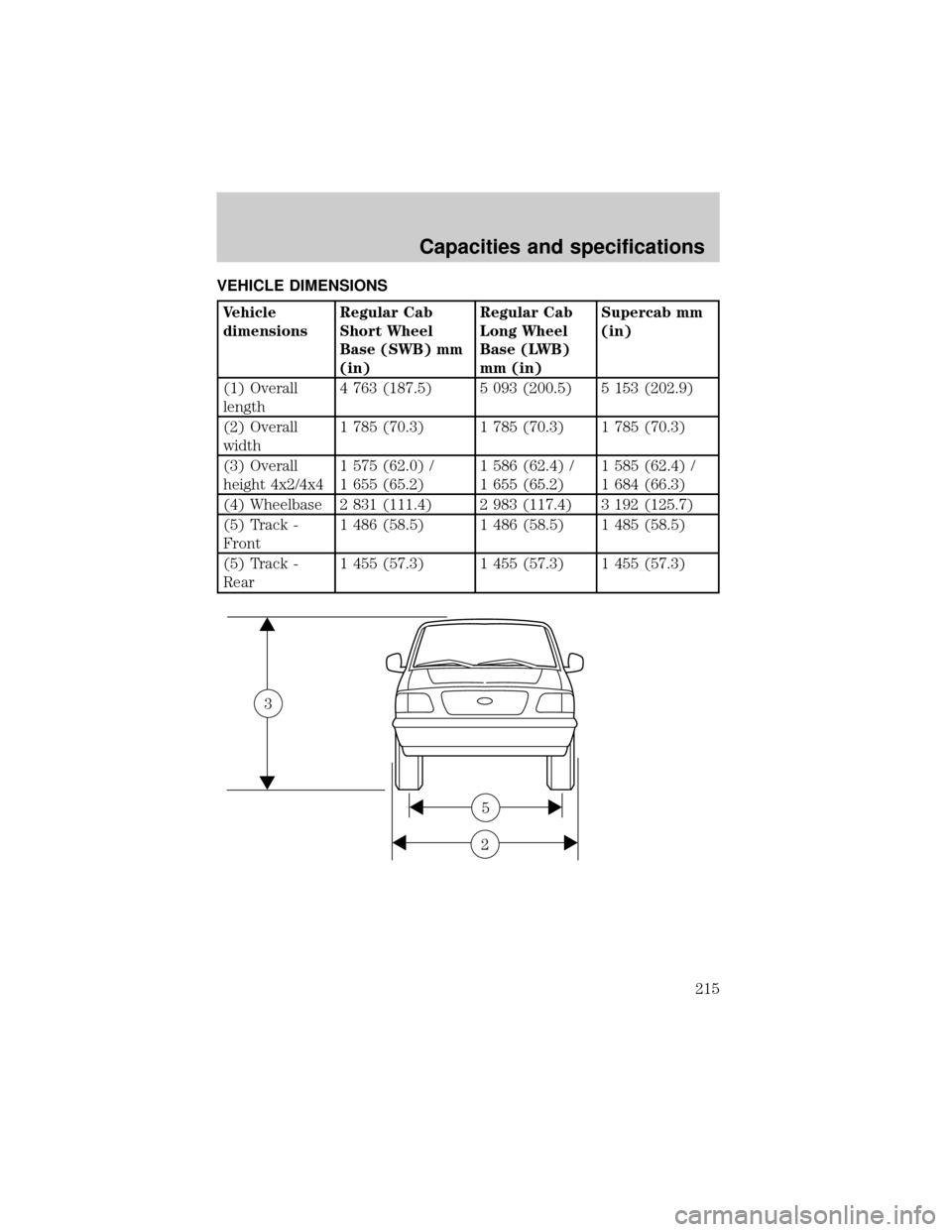
VEHICLE DIMENSIONS
Vehicle
dimensionsRegular Cab
Short Wheel
Base (SWB) mm
(in)Regular Cab
Long Wheel
Base (LWB)
mm (in)Supercab mm
(in)
(1) Overall
length4 763 (187.5) 5 093 (200.5) 5 153 (202.9)
(2) Overall
width1 785 (70.3) 1 785 (70.3) 1 785 (70.3)
(3) Overall
height 4x2/4x41 575 (62.0) /
1 655 (65.2)1 586 (62.4) /
1 655 (65.2)1 585 (62.4) /
1 684 (66.3)
(4) Wheelbase 2 831 (111.4) 2 983 (117.4) 3 192 (125.7)
(5) Track -
Front1 486 (58.5) 1 486 (58.5) 1 485 (58.5)
(5) Track -
Rear1 455 (57.3) 1 455 (57.3) 1 455 (57.3)
2
5
3
Capacities and specifications
215
Page 227 of 240

Vehicle Security
Styled wheel protector locks
Vehicle security systems
Comfort and convenience
Cargo nets
Cargo organizers
Cargo shades (Super Cab only)
Engine block heaters
Manual sliding rear window
Tire step
Travel equipment
Daytime running lights
Fog lights
Heavy-duty battery
Pickup box rails
Removable luggage rack
Running boards
Speed control
Trailer hitch
Trailer hitch bars and balls
Trailer hitch wiring adaptor
Protection and appearance equipment
Air bag anti-theft locks
Bed mat/bedliner tailgate covers
Bed mats
Bedliners
Carpet floor mats
Cleaners, waxes and polishes
Front end covers (full and sport)
Customer assistance
227
Page 231 of 240

Air bag supplemental
restraint system ..........................84
and child safety seats ..............85
description ................................84
disposal ......................................88
driver air bag ............................86
indicator light ......................10,87
operation ...................................86
passenger air bag .....................86
passenger
deactivation switch ..............25,88
Air cleaner filter .......................209
Air conditioning ..........................19
manual heating and air
conditioning system .................21
Ambulance packages ....................3
Antifreeze
(see Engine coolant) ................168
Anti-lock brake system
(see Brakes) .......................107,108
Anti-theft system
warning light .............................11
Audio system (see Radio) .........26
Automatic transmission ............111
driving an automatic
overdrive ..........................112,114
fluid, adding ............................173
fluid, checking ........................173
fluid, refill capacities ..............209
fluid, specification ..................214
Auxiliary power point .................25
Axle
lubricant specifications ...212,214
refill capacities ........................209
traction lok ..............................124
Battery .......................................178
acid, treating emergencies .....178
charging system
warning light .............................11
jumping a disabled battery ....152
maintenance-free ....................178
replacement, specifications ...209servicing ..................................178
voltage gauge ............................17
Belt minder .................................80
Brakes ........................................106
anti-lock .....................106,107,108
anti-lock brake system (ABS)
warning light ......................10,108
brake warning light ..................10
fluid, checking and adding ....166
fluid, refill capacities ..............209
fluid, specifications ..........212,214
lubricant specifications ...212,214
parking ....................................108
shift interlock ..........................111
Break-in period .............................2
Capacities for refilling fluids ....209
Cargo area shade ........................63
Cargo net .....................................63
Certification Label ....................217
Child safety restraints ................93
child safety belts ......................93
Child safety seats ........................94
attaching with tether straps ....99
in front seat ..............................96
in rear seat ................................96
tether anchorage hardware .....99
Cleaning your vehicle ...............203
engine compartment ..............204
exterior .............................204,207
exterior lamps .........................206
instrument panel ....................207
instrument panel lens ............207
interior .....................................207
mirrors .....................................208
plastic parts ............................206
safety belts ..............................207
washing ....................................203
waxing .....................................203
wheels ......................................204
windows ..................................208
wiper blades ............................206
Index
231