climate control FORD RANGER 2000 2.G Owners Manual
[x] Cancel search | Manufacturer: FORD, Model Year: 2000, Model line: RANGER, Model: FORD RANGER 2000 2.GPages: 240, PDF Size: 2.07 MB
Page 7 of 240
4X4
HIGH
2WD4X4
LOW
OFF
ON
OFF
OFF
PASSENGER AIRBAG
1234AM/FM
SEEKTONE
CLKTUNETONE VOL
12 FMSTDXVOL
PUSH
ON
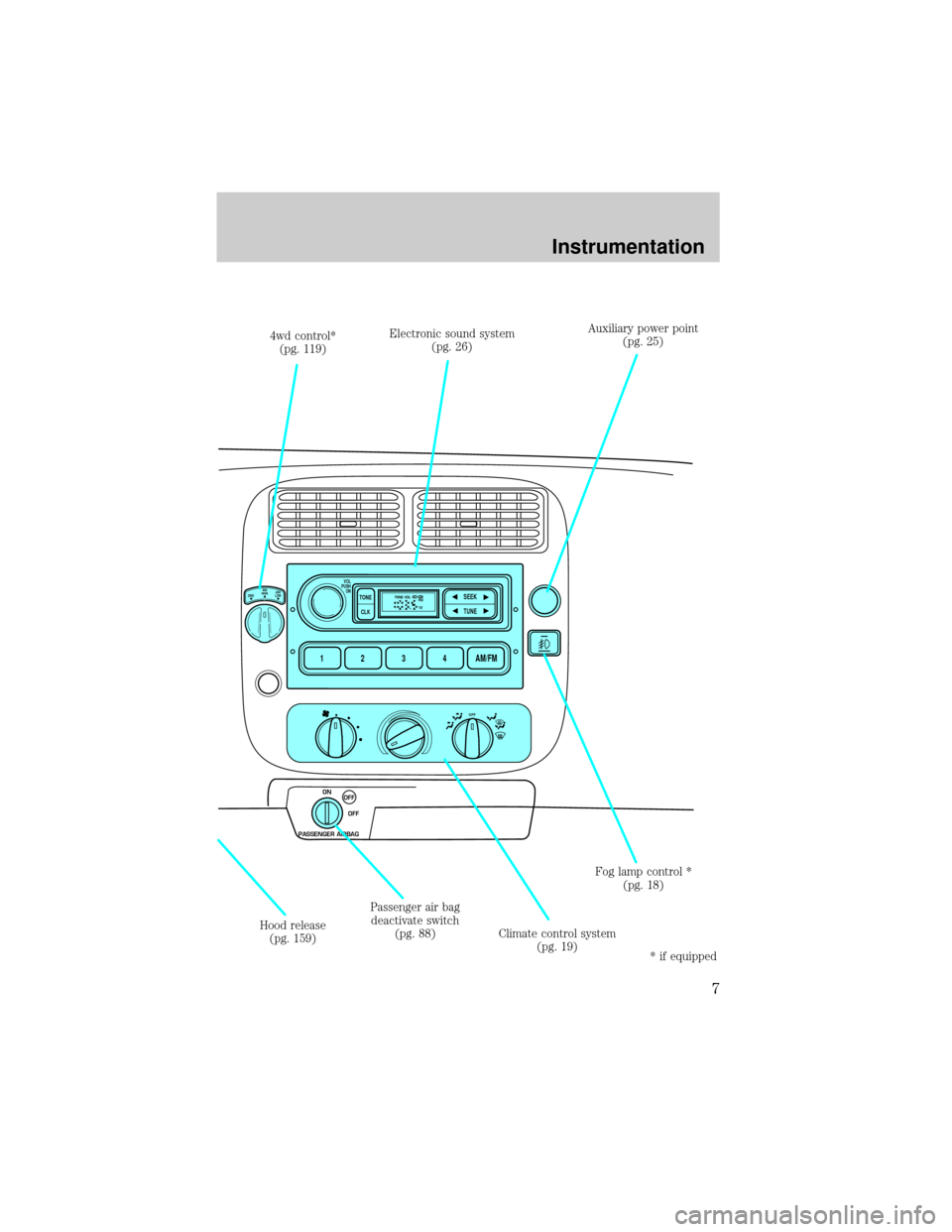
Climate control system
(pg. 19)Auxiliary power point
(pg. 25) Electronic sound system
(pg. 26)
Passenger air bag
deactivate switch
(pg. 88)Fog lamp control *
(pg. 18)
Hood release
(pg. 159)4wd control*
(pg. 119)
* if equipped
Instrumentation
7
Page 19 of 240
Flash to pass
Pull toward you to activate and
release to deactivate.
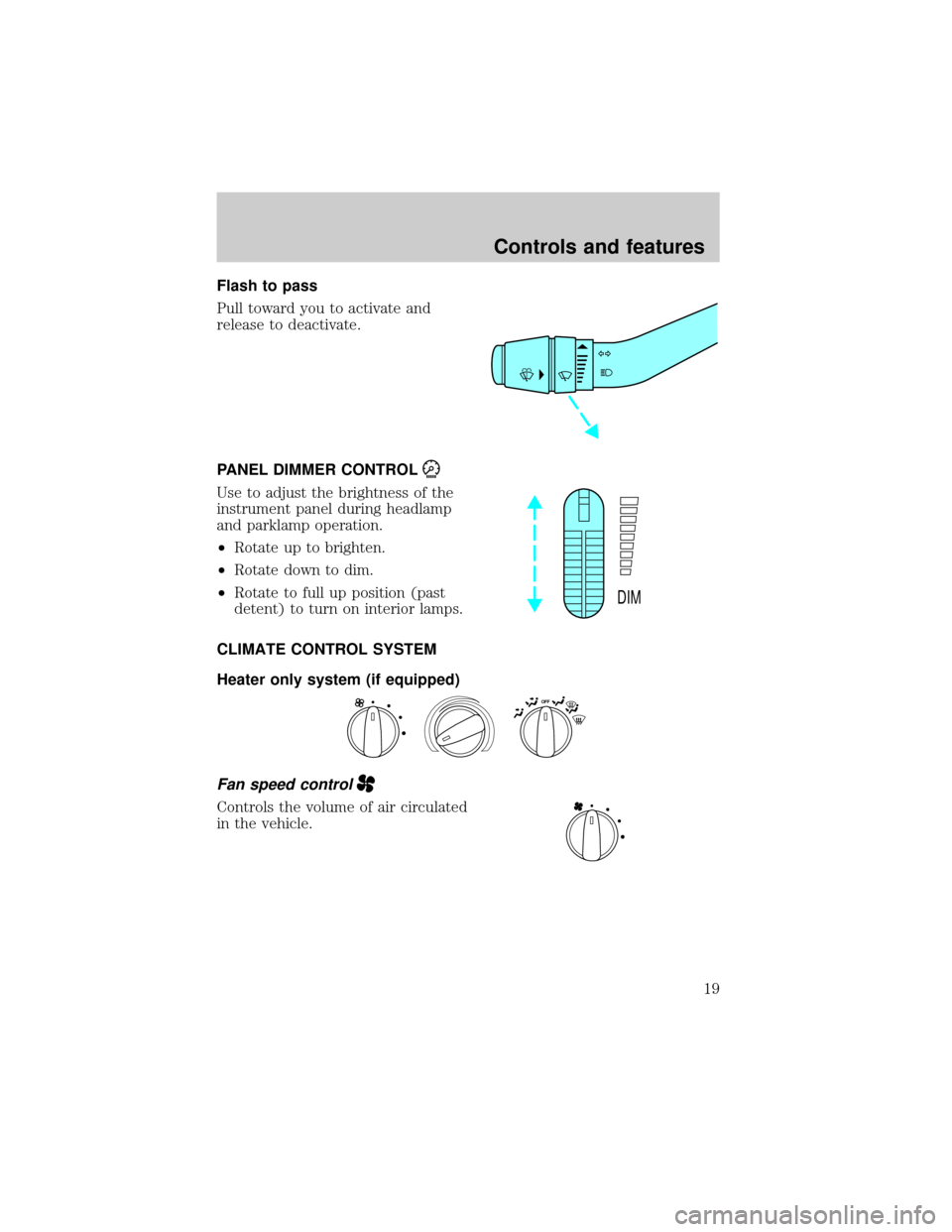
PANEL DIMMER CONTROL
Use to adjust the brightness of the
instrument panel during headlamp
and parklamp operation.
²Rotate up to brighten.
²Rotate down to dim.
²Rotate to full up position (past
detent) to turn on interior lamps.
CLIMATE CONTROL SYSTEM
Heater only system (if equipped)
Fan speed control
Controls the volume of air circulated
in the vehicle.
DIM
OFF
Controls and features
19
Page 20 of 240
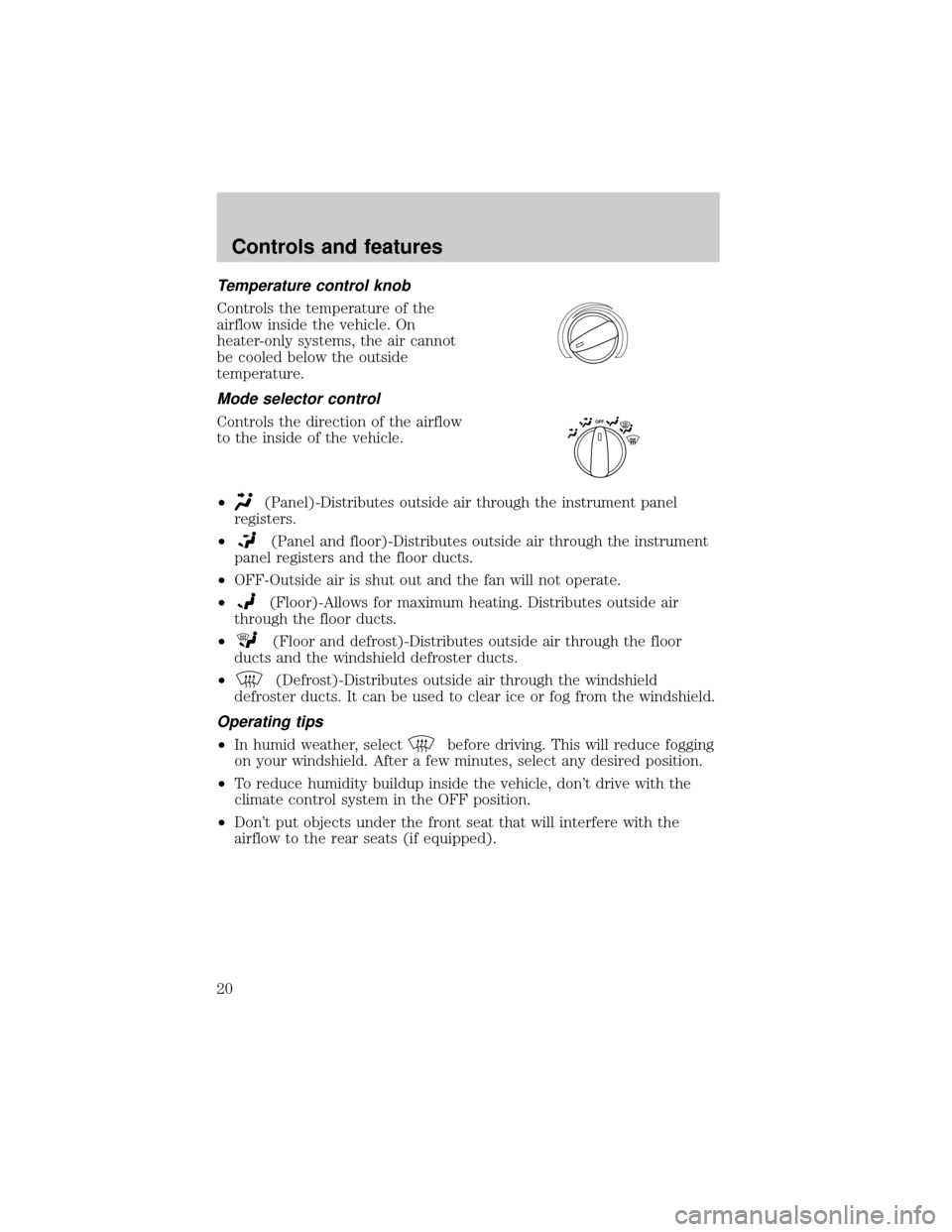
Temperature control knob
Controls the temperature of the
airflow inside the vehicle. On
heater-only systems, the air cannot
be cooled below the outside
temperature.
Mode selector control
Controls the direction of the airflow
to the inside of the vehicle.
²
(Panel)-Distributes outside air through the instrument panel
registers.
²
(Panel and floor)-Distributes outside air through the instrument
panel registers and the floor ducts.
²OFF-Outside air is shut out and the fan will not operate.
²
(Floor)-Allows for maximum heating. Distributes outside air
through the floor ducts.
²
(Floor and defrost)-Distributes outside air through the floor
ducts and the windshield defroster ducts.
²
(Defrost)-Distributes outside air through the windshield
defroster ducts. It can be used to clear ice or fog from the windshield.
Operating tips
²In humid weather, selectbefore driving. This will reduce fogging
on your windshield. After a few minutes, select any desired position.
²To reduce humidity buildup inside the vehicle, don't drive with the
climate control system in the OFF position.
²Don't put objects under the front seat that will interfere with the
airflow to the rear seats (if equipped).
OFF
Controls and features
20
Page 21 of 240
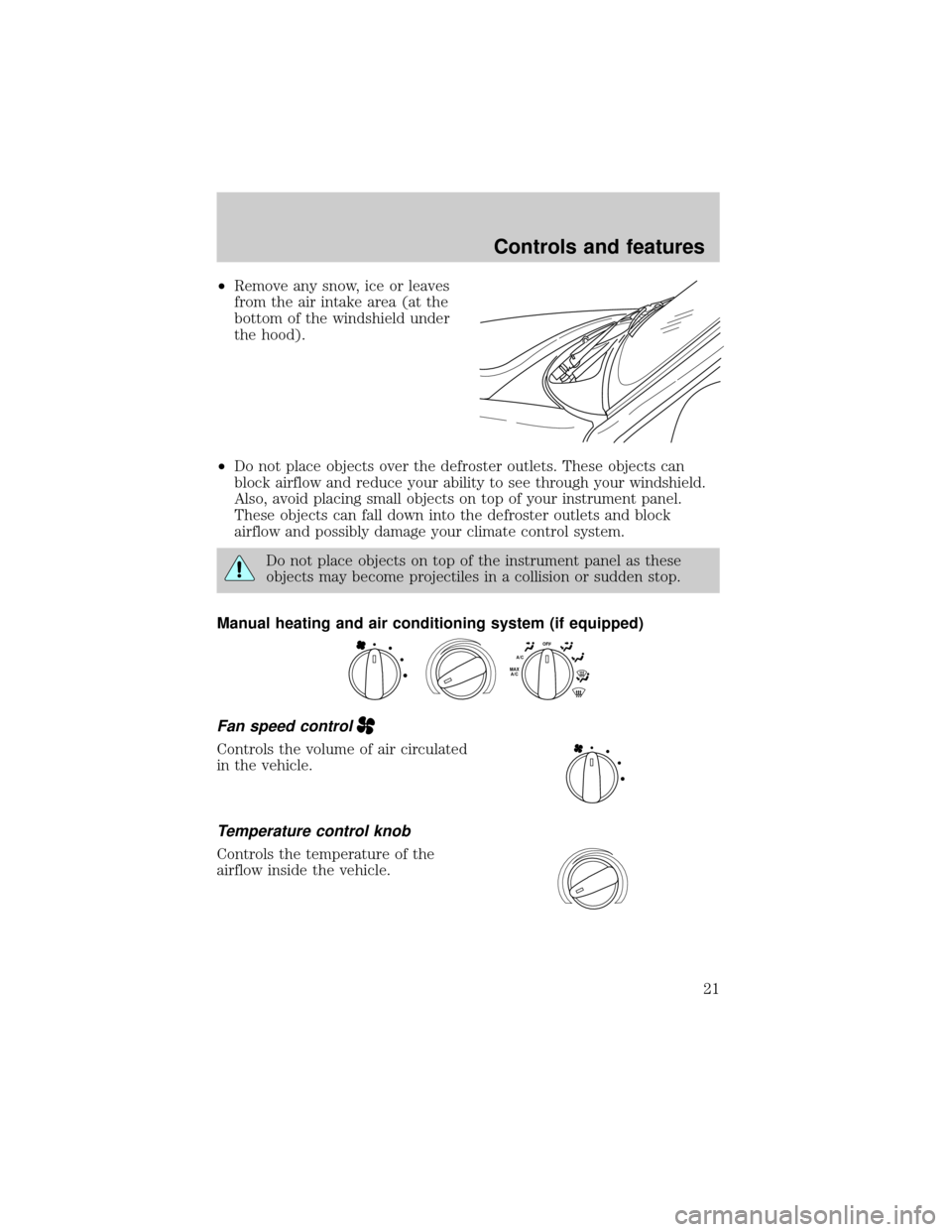
²Remove any snow, ice or leaves
from the air intake area (at the
bottom of the windshield under
the hood).
²Do not place objects over the defroster outlets. These objects can
block airflow and reduce your ability to see through your windshield.
Also, avoid placing small objects on top of your instrument panel.
These objects can fall down into the defroster outlets and block
airflow and possibly damage your climate control system.
Do not place objects on top of the instrument panel as these
objects may become projectiles in a collision or sudden stop.
Manual heating and air conditioning system (if equipped)
Fan speed control
Controls the volume of air circulated
in the vehicle.
Temperature control knob
Controls the temperature of the
airflow inside the vehicle.
OFFA/CMAX
A/C
Controls and features
21
Page 22 of 240

Mode selector control
Controls the direction of the airflow
to the inside of the vehicle.
The air conditioning compressor will operate in all modes except
and. However, the air conditioning will only function if the outside
temperature is about 10ÉC (50ÉF) or higher.
Since the air conditioner removes considerable moisture from the air
during operation, it is normal if clear water drips on the ground under
the air conditioner drain while the system is working and even after you
have stopped the vehicle.
Under normal conditions, your vehicle's climate control system should be
left in any position other than MAX A/C or OFF when the vehicle is
parked. This allows the vehicle to ªbreatheº through the outside air inlet
duct. In snowy or dirty conditions, leave the mode selector in the OFF
position.
²MAX A/C-Uses recirculated air to cool the vehicle. MAX A/C is noisier
than A/C but more economical and will cool the inside of the vehicle
faster. Airflow will be from the instrument panel registers. This mode
can also be used to prevent undesirable odors from entering the
vehicle.
²A/C-Uses outside air to cool the vehicle. It is quieter than MAX A/C
but not as economical. Airflow will be from the instrument panel
registers.
²
(Panel)-Distributes outside air through the instrument panel
registers. However, the air will not be cooled below the outside
temperature because the air conditioning does not operate in this
mode.
²OFF-Outside air is shut out and the fan will not operate. For short
periods of time only, use this mode to prevent undesirable odors from
entering the vehicle.
²
(Panel and floor)-Distributes outside air through the instrument
panel registers and the floor ducts. Heating and air conditioning
capabilities are provided in this mode. For added customer comfort,
when the temperature control knob is anywhere in between the full hot
and full cold positions, the air distributed through the floor ducts will be
slightly warmer than the air sent to the instrument panel registers.
OFFA/CMAX
A/C
Controls and features
22
Page 23 of 240
²(Floor)-Allows for maximum heating by distributing outside air
through the floor ducts. However, the air will not be cooled below the
outside temperature because the air conditioning does not operate in
this mode.
²
(Floor and defrost)-Distributes outside air through the windshield
defroster ducts and the floor ducts. Heating and air conditioning
capabilities are provided in this mode. For added customer comfort,
when the temperature control knob is anywhere in between the full hot
and full cold positions, the air distributed through the floor ducts will be
slightly warmer than the air sent to the windshield defrost ducts. If the
temperature is about 10ÉC (50ÉF) or higher, the air conditioner will
automatically dehumidify the air to reduce fogging.
²(Defrost)-Distributes outside air through the windshield
defroster ducts. It can be used to clear ice or fog from the windshield.
If the temperature is about 10ÉC (50ÉF) or higher, the air conditioner
will automatically dehumidify the air to reduce fogging.
Operating tips
²In humid weather, selectbefore driving. This will reduce fogging
on your windshield. After a few minutes, select any desired position.
²To prevent humidity buildup inside the vehicle, do not drive with the
climate control system in the OFF or MAX A/C position.
²Do not put objects under the front seat that will interfere with the
airflow to the rear seats (if equipped).
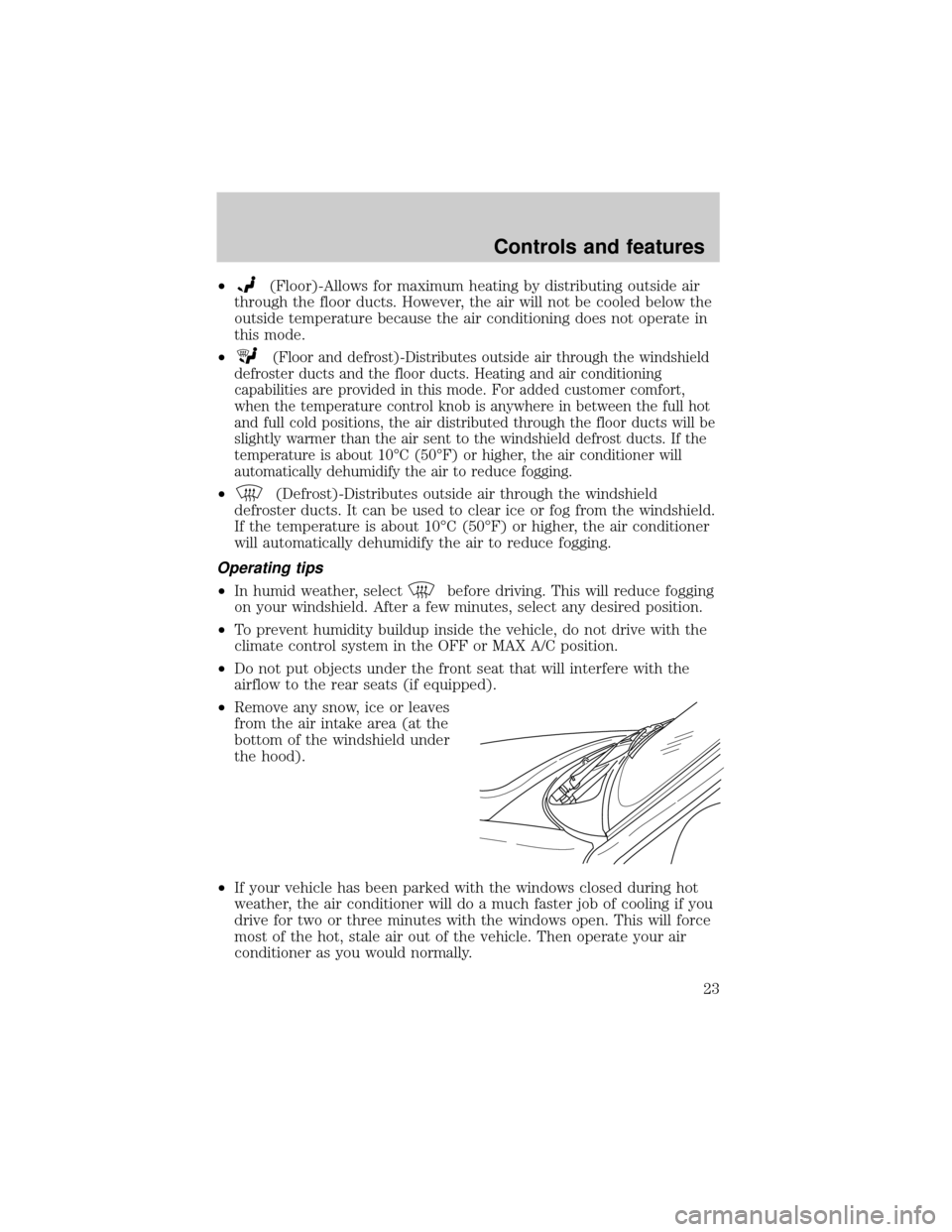
²Remove any snow, ice or leaves
from the air intake area (at the
bottom of the windshield under
the hood).
²If your vehicle has been parked with the windows closed during hot
weather, the air conditioner will do a much faster job of cooling if you
drive for two or three minutes with the windows open. This will force
most of the hot, stale air out of the vehicle. Then operate your air
conditioner as you would normally.
Controls and features
23
Page 24 of 240
²Do not place objects over the defroster outlets. These objects can
block airflow and reduce your ability to see through your windshield.
Also, avoid placing small objects on top of your instrument panel.
These objects can fall down into the defroster outlets and block
airflow and possibly damage your climate control system.
Do not place objects on top of the instrument panel, as these
objects may become projectiles in a collision or sudden stop.
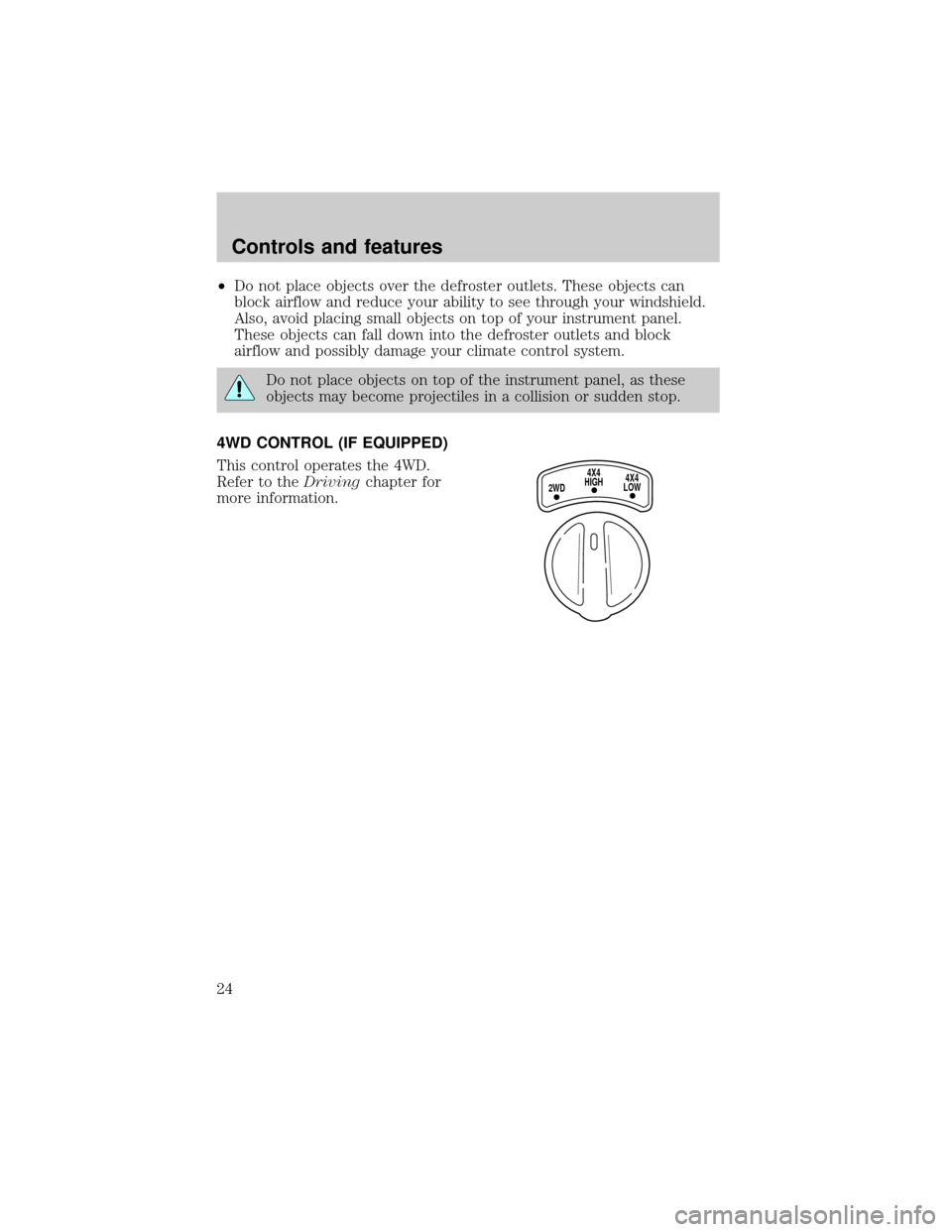
4WD CONTROL (IF EQUIPPED)
This control operates the 4WD.
Refer to theDrivingchapter for
more information.
4X4
HIGH
2WD4X4
LOW
Controls and features
24
Page 182 of 240
Treadwear
The treadwear grade is a comparative rating based on the wear rate of
the tire when tested under controlled conditions on a specified
government test course. For example, a tire graded 150 would wear one
and one-half (1 1/2) times as well on the government course as a tire
graded 100. The relative performance of tires depends upon the actual
conditions of their use, however, and may depart significantly from the
norm due to variations in driving habits, service practices, and
differences in road characteristics and climate.
Traction AA A B C
The traction grades, from highest to lowest are AA, A, B, and C. Those
grades represent the tire's ability to stop on wet pavement as measured
under controlled conditions on specified government test surfaces of
asphalt and concrete. A tire marked C may have poor traction
performance.
The traction grade assigned to this tire is based on
straight-ahead braking traction tests, and does not include
acceleration, cornering, hydroplaning or peak traction characteristics.
Temperature A B C
The temperature grades are A (the highest), B, and C, representing the
tire's resistance to the generation of heat and its ability to dissipate heat
when tested under controlled conditions on a specified indoor laboratory
test wheel. Sustained high temperature can cause the material of the tire
to degenerate and reduce tire life, and excessive temperature can lead to
sudden tire failure. The grade C corresponds to a level of performance
which all passenger car tires must meet under the Federal Motor Vehicle
Safety Standard No. 109. Grades B and A represent higher levels of
performance on the laboratory test wheel than the minimum required by
law.
The temperature grade for this tire is established for a tire that
is properly inflated and not overloaded. Excessive speed,
underinflation, or excessive loading, either separately or in
combination, can cause heat buildup and possible tire failure.
Maintenance and care
182
Page 185 of 240
Do not replace your tires with ªhigh performanceº tires or larger
size tires.
Failure to follow these precautions may adversely affect the
handling of the vehicle and make it easier for the driver to lose
control and roll over.
Tires that are larger or smaller than your vehicle's original tires may also
affect the accuracy of your speedometer.
SNOW TIRES AND CHAINS
Driving too fast for conditions creates the possibility of loss of
vehicle control. Driving at very high speeds for extended periods
of time may result in damage to vehicle components.
Snow tires must be the same size and grade as the tires you
currently have on your vehicle.
The tires on your vehicle have all weather treads to provide traction in
rain and snow. However, in some climates, you may need to use snow
tires and chains. If you need to use snow tires and chains,it is
recommended that steel wheels are used of the same size and
specifications as those originally installed.
Follow these guidelines when using snow tires and chains:
²Do not use tire chains on aluminum wheels. Chains may chip the
wheels.
²Use only SAE Class S chains.
²Install chains securely, verifying that the chains do not touch any
wiring, brake lines or fuel lines.
²Drive cautiously. If you hear the chains rub or bang against your
vehicle, stop and re-tighten the chains. If this does not work, remove
the chains to prevent damage to your vehicle.
²If possible, avoid fully loading your vehicle.
²Remove the tire chains when they are no longer needed. Do not use
tire chains on dry roads.
Maintenance and care
185
Page 232 of 240

Climate control (see Air
conditioning or Heating) ............19
Clock .............................29,36,42,51
Clutch
fluid ..........................................167
operation while driving ..........116
recommended shift speeds ....118
Console ........................................63
Coolant
checking and adding ..............168
refill capacities .................172,209
specifications ...................212,214
Cruise control
(see Speed control) ....................55
Customer Assistance ................137
Ford accessories
for your vehicle ......................225
Ford Extended
Service Plan ............................218
Getting assistance outside the
U.S. and Canada .....................224
Getting roadside assistance ...137
Getting the
service you need ....................218
Ordering additional
owner's literature ...................229
The Dispute
Settlement Board ...................221
Utilizing the Mediation/
Arbitration Program ...............224
Daytime running lamps
(see Lamps) ................................18
Dipstick
automatic
transmission fluid ...................173
engine oil .................................163
Doors
door ajar warning .....................12
lubricant specifications ..........212
Driveline universal
joint and slip yoke ....................177Driving under
special conditions ..............122,123
mud ..........................................122
sand .........................................122
snow and ice ...........................123
through water ..................122,124
Emergencies, roadside
jump-starting ..........................152
Emission control system ..........195
Engine .................................214,215
check engine/
service engine soon light ...........8
cleaning ...................................204
coolant .....................................168
idle speed control ...................178
lubrication
specifications ...................212,214
refill capacities ........................209
service points ............160,161,162
starting after a collision .........138
Engine block heater .................104
Engine oil ..................................163
checking and adding ..............163
dipstick ....................................163
filter, specifications .........165,209
recommendations ...................165
refill capacities ........................209
specifications ...................212,214
Exhaust fumes ..........................105
Fluid capacities .........................209
Foglamps .....................................18
Four-Wheel Drive vehicles ..12,119
control trac ...............................24
description ..............................119
driving off road .......................121
electronic shift ...................24,119
indicator light .........................119
preparing to drive your
vehicle .....................................110
Fuel ............................................186
calculating fuel economy .......192
cap ...........................................188
Index
232