instrument panel FORD RANGER 2000 2.G Owners Manual
[x] Cancel search | Manufacturer: FORD, Model Year: 2000, Model line: RANGER, Model: FORD RANGER 2000 2.GPages: 240, PDF Size: 2.07 MB
Page 6 of 240
DIM
OFF
SET
ACC
COAST OFF ON
ABS
CHECK
ENGINEFH
H
H
ELSPEED
CONTO/D
OFFPRND21LL
10MPH 205060
70
304080
90
km/h
0 0 0
10 100
1
20
10 0 0 0 0 0406080100
120
140
160
180
20DOOR
AJAR
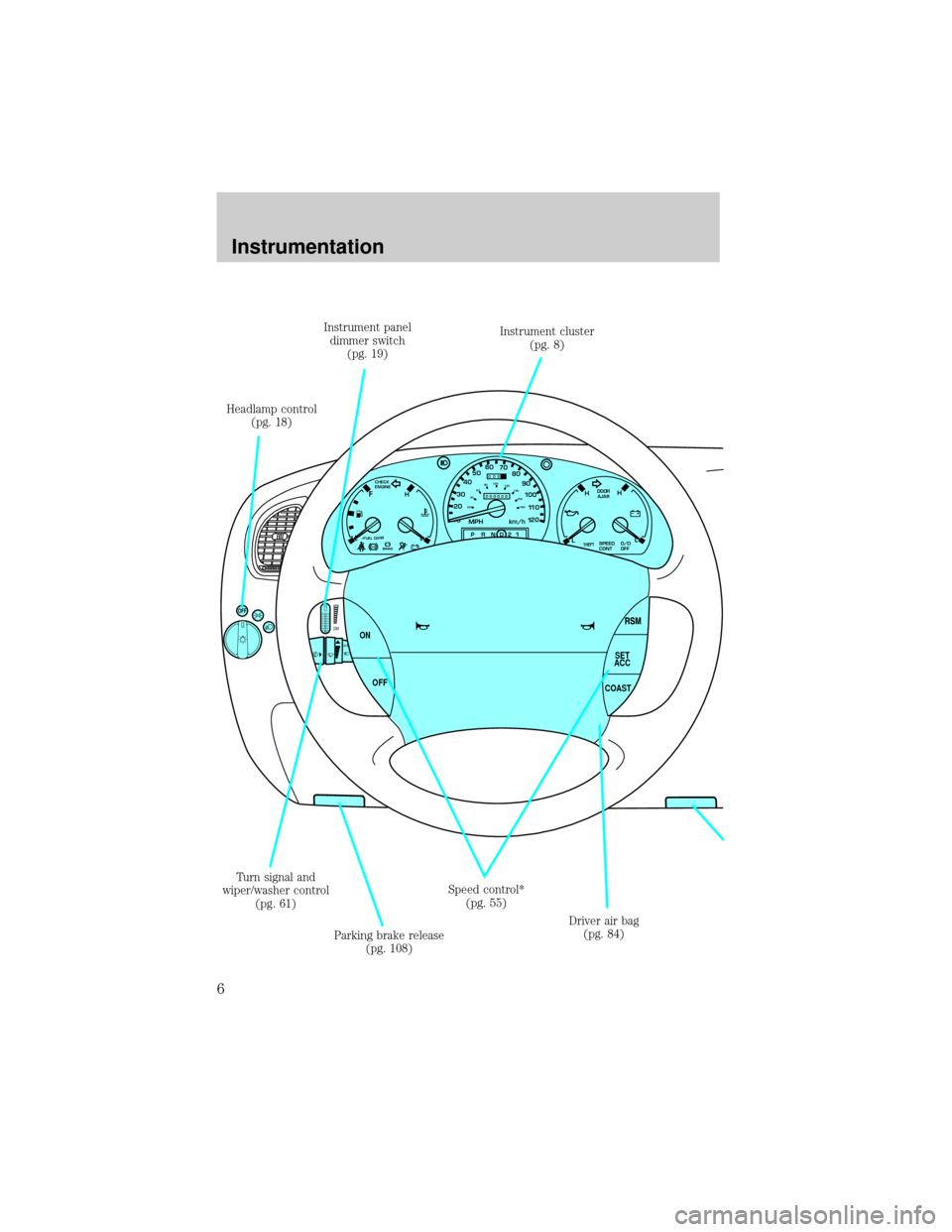
Headlamp control
(pg. 18)Instrument cluster
(pg. 8) Instrument panel
dimmer switch
(pg. 19)
Speed control*
(pg. 55)
Driver air bag
(pg. 84) Turn signal and
wiper/washer control
(pg. 61)
Parking brake release
(pg. 108)
Instrumentation
6
Page 19 of 240
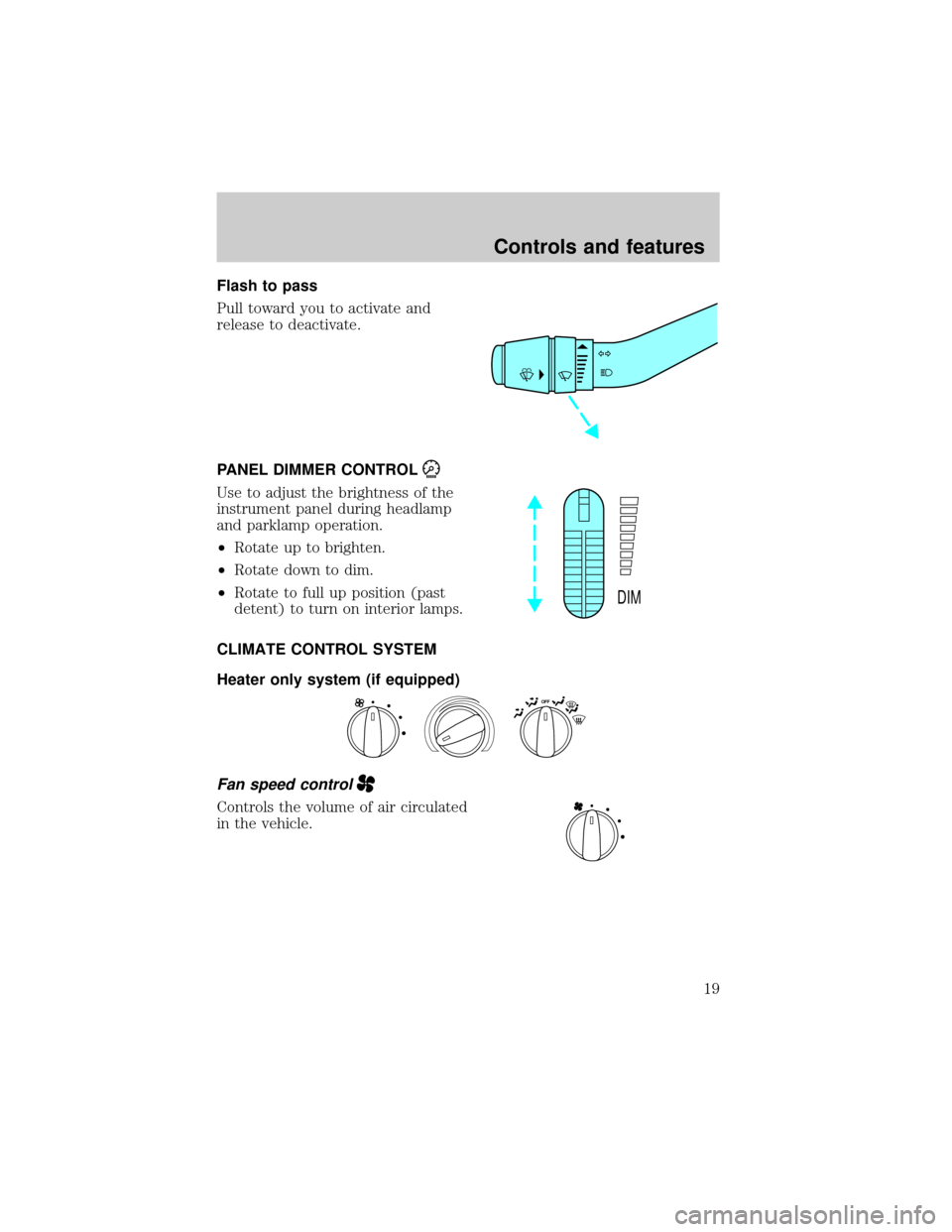
Flash to pass
Pull toward you to activate and
release to deactivate.
PANEL DIMMER CONTROL
Use to adjust the brightness of the
instrument panel during headlamp
and parklamp operation.
²Rotate up to brighten.
²Rotate down to dim.
²Rotate to full up position (past
detent) to turn on interior lamps.
CLIMATE CONTROL SYSTEM
Heater only system (if equipped)
Fan speed control
Controls the volume of air circulated
in the vehicle.
DIM
OFF
Controls and features
19
Page 20 of 240
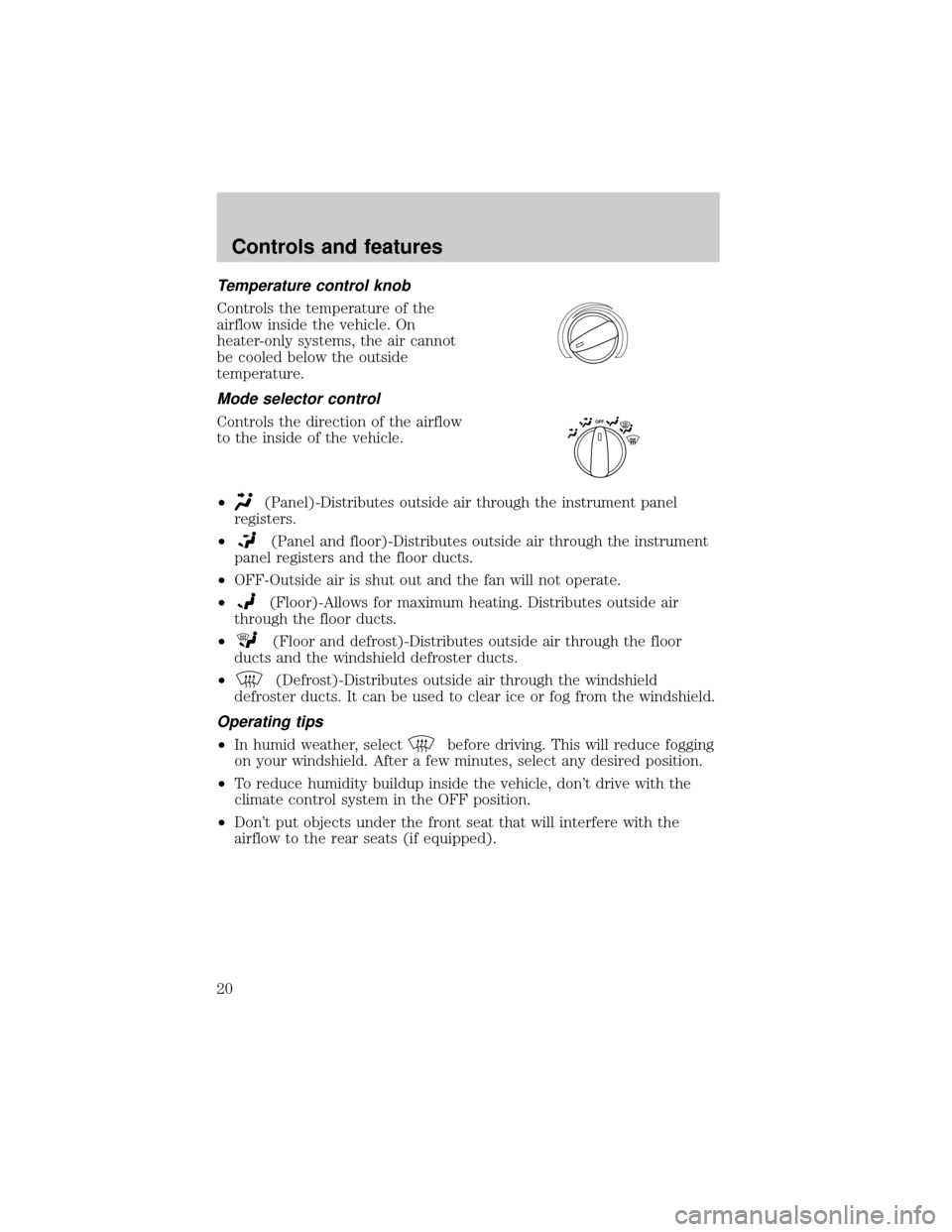
Temperature control knob
Controls the temperature of the
airflow inside the vehicle. On
heater-only systems, the air cannot
be cooled below the outside
temperature.
Mode selector control
Controls the direction of the airflow
to the inside of the vehicle.
²
(Panel)-Distributes outside air through the instrument panel
registers.
²
(Panel and floor)-Distributes outside air through the instrument
panel registers and the floor ducts.
²OFF-Outside air is shut out and the fan will not operate.
²
(Floor)-Allows for maximum heating. Distributes outside air
through the floor ducts.
²
(Floor and defrost)-Distributes outside air through the floor
ducts and the windshield defroster ducts.
²
(Defrost)-Distributes outside air through the windshield
defroster ducts. It can be used to clear ice or fog from the windshield.
Operating tips
²In humid weather, selectbefore driving. This will reduce fogging
on your windshield. After a few minutes, select any desired position.
²To reduce humidity buildup inside the vehicle, don't drive with the
climate control system in the OFF position.
²Don't put objects under the front seat that will interfere with the
airflow to the rear seats (if equipped).
OFF
Controls and features
20
Page 21 of 240
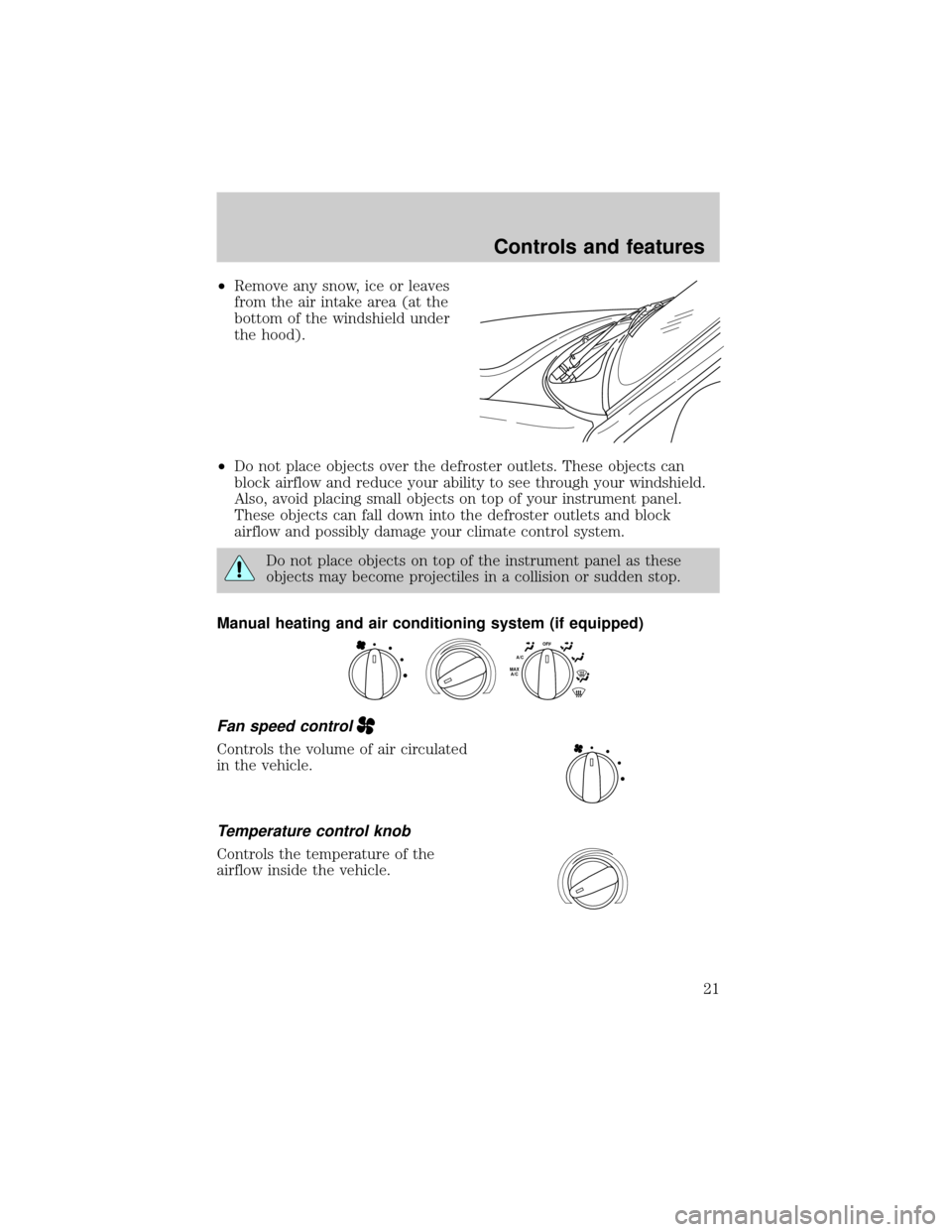
²Remove any snow, ice or leaves
from the air intake area (at the
bottom of the windshield under
the hood).
²Do not place objects over the defroster outlets. These objects can
block airflow and reduce your ability to see through your windshield.
Also, avoid placing small objects on top of your instrument panel.
These objects can fall down into the defroster outlets and block
airflow and possibly damage your climate control system.
Do not place objects on top of the instrument panel as these
objects may become projectiles in a collision or sudden stop.
Manual heating and air conditioning system (if equipped)
Fan speed control
Controls the volume of air circulated
in the vehicle.
Temperature control knob
Controls the temperature of the
airflow inside the vehicle.
OFFA/CMAX
A/C
Controls and features
21
Page 22 of 240
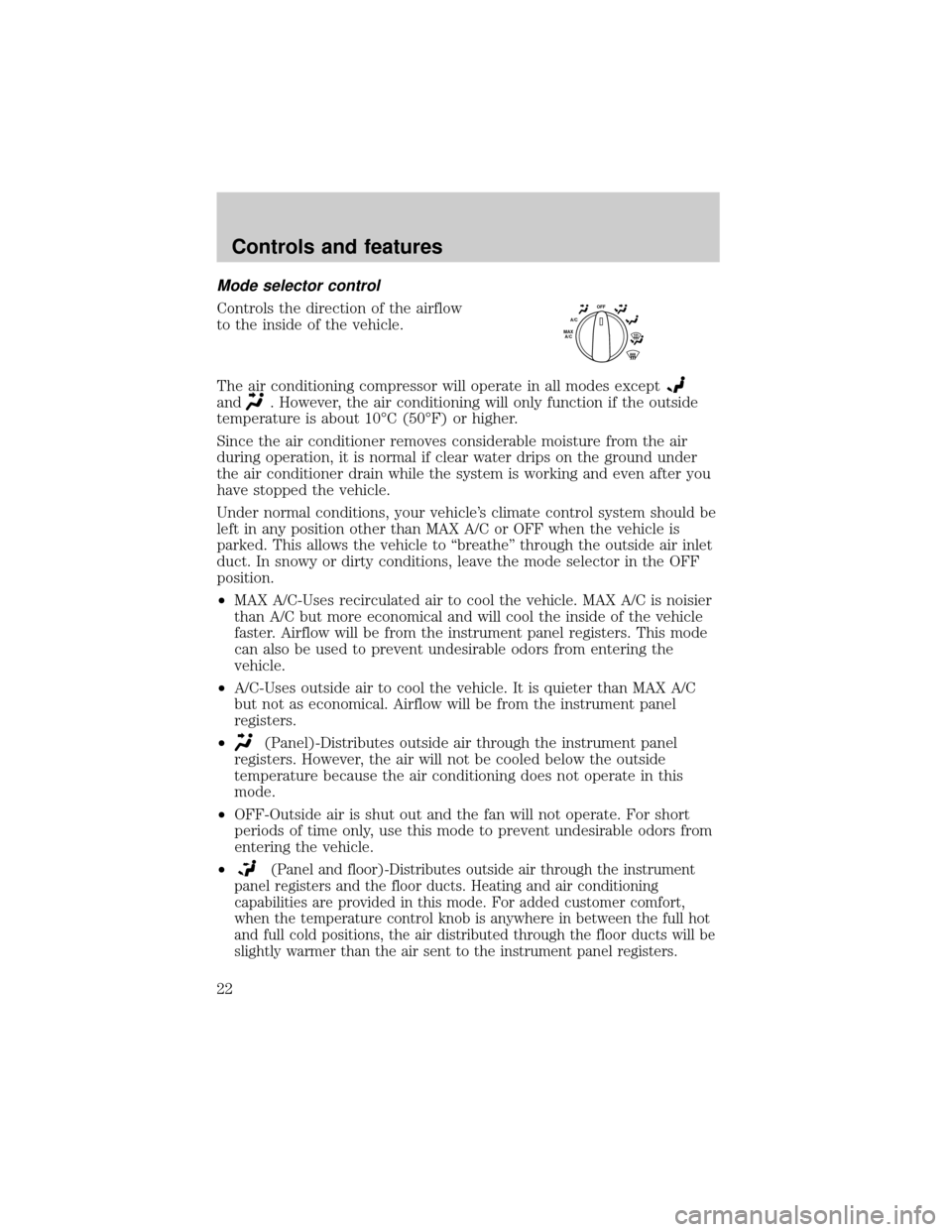
Mode selector control
Controls the direction of the airflow
to the inside of the vehicle.
The air conditioning compressor will operate in all modes except
and. However, the air conditioning will only function if the outside
temperature is about 10ÉC (50ÉF) or higher.
Since the air conditioner removes considerable moisture from the air
during operation, it is normal if clear water drips on the ground under
the air conditioner drain while the system is working and even after you
have stopped the vehicle.
Under normal conditions, your vehicle's climate control system should be
left in any position other than MAX A/C or OFF when the vehicle is
parked. This allows the vehicle to ªbreatheº through the outside air inlet
duct. In snowy or dirty conditions, leave the mode selector in the OFF
position.
²MAX A/C-Uses recirculated air to cool the vehicle. MAX A/C is noisier
than A/C but more economical and will cool the inside of the vehicle
faster. Airflow will be from the instrument panel registers. This mode
can also be used to prevent undesirable odors from entering the
vehicle.
²A/C-Uses outside air to cool the vehicle. It is quieter than MAX A/C
but not as economical. Airflow will be from the instrument panel
registers.
²
(Panel)-Distributes outside air through the instrument panel
registers. However, the air will not be cooled below the outside
temperature because the air conditioning does not operate in this
mode.
²OFF-Outside air is shut out and the fan will not operate. For short
periods of time only, use this mode to prevent undesirable odors from
entering the vehicle.
²
(Panel and floor)-Distributes outside air through the instrument
panel registers and the floor ducts. Heating and air conditioning
capabilities are provided in this mode. For added customer comfort,
when the temperature control knob is anywhere in between the full hot
and full cold positions, the air distributed through the floor ducts will be
slightly warmer than the air sent to the instrument panel registers.
OFFA/CMAX
A/C
Controls and features
22
Page 24 of 240
²Do not place objects over the defroster outlets. These objects can
block airflow and reduce your ability to see through your windshield.
Also, avoid placing small objects on top of your instrument panel.
These objects can fall down into the defroster outlets and block
airflow and possibly damage your climate control system.
Do not place objects on top of the instrument panel, as these
objects may become projectiles in a collision or sudden stop.
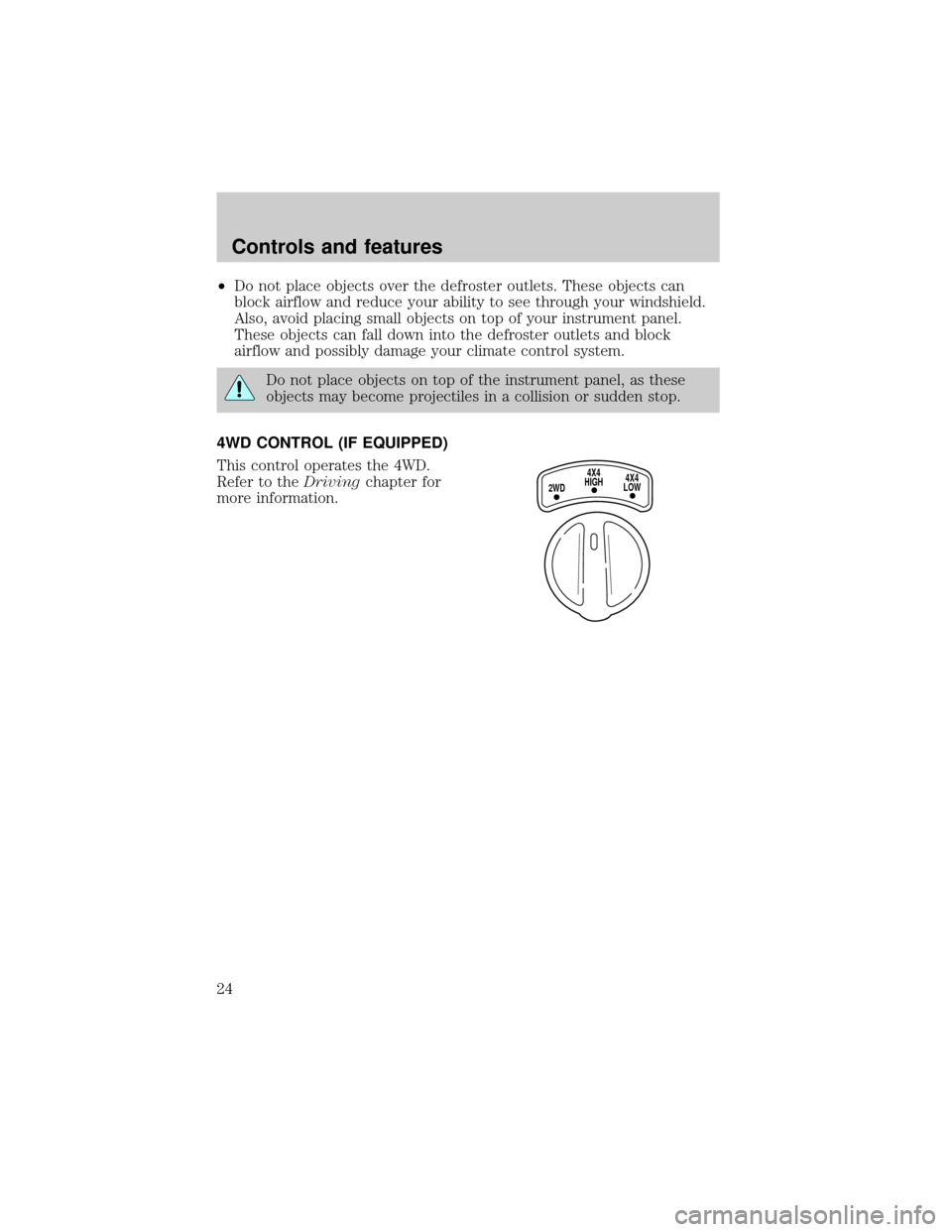
4WD CONTROL (IF EQUIPPED)
This control operates the 4WD.
Refer to theDrivingchapter for
more information.
4X4
HIGH
2WD4X4
LOW
Controls and features
24
Page 25 of 240
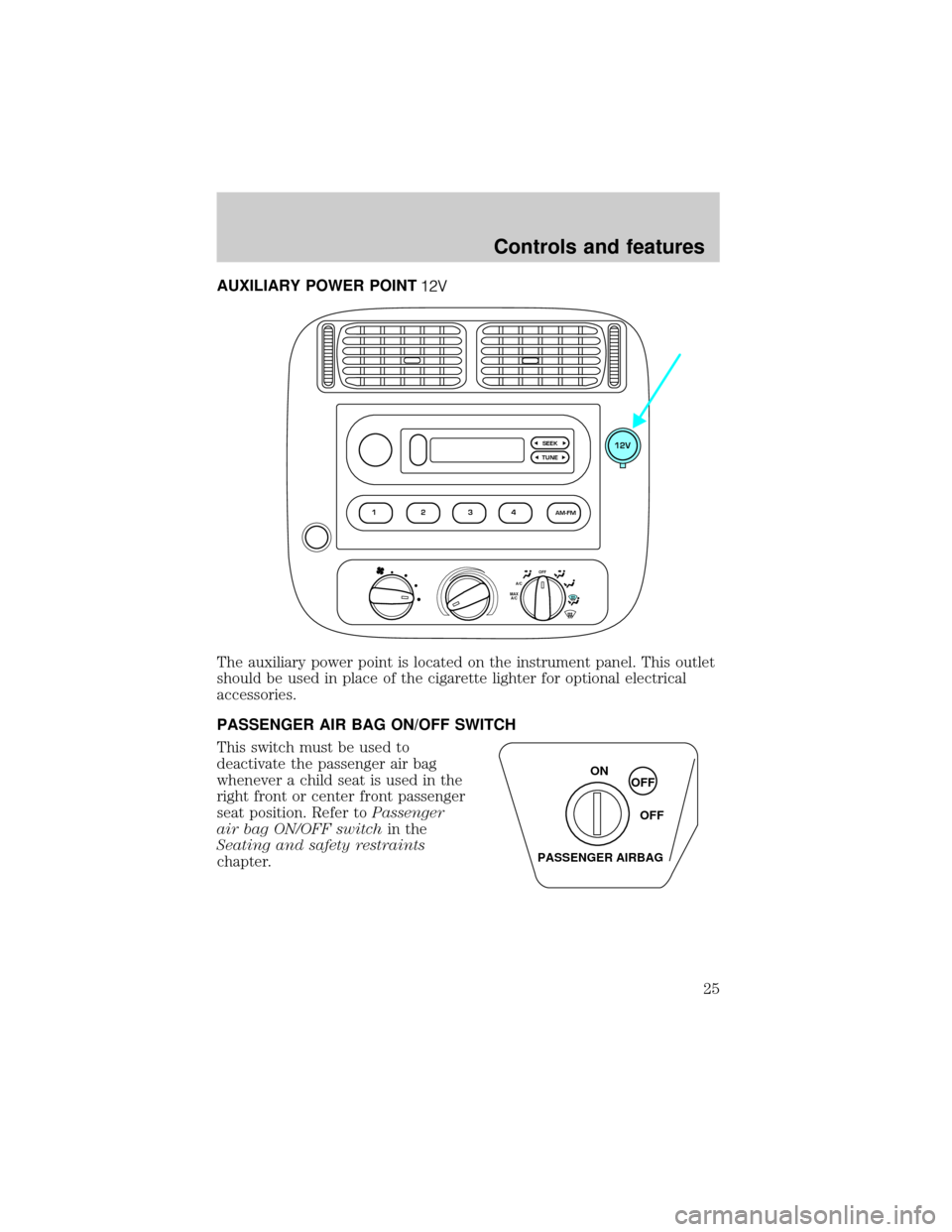
AUXILIARY POWER POINT
The auxiliary power point is located on the instrument panel. This outlet
should be used in place of the cigarette lighter for optional electrical
accessories.
PASSENGER AIR BAG ON/OFF SWITCH
This switch must be used to
deactivate the passenger air bag
whenever a child seat is used in the
right front or center front passenger
seat position. Refer toPassenger
air bag ON/OFF switchin the
Seating and safety restraints
chapter.
OFFA/CMAX
A/C
TUNESEEK12V
12
34AM-FM
ON
OFF
OFF
PASSENGER AIRBAG
Controls and features
25
Page 119 of 240
FOUR-WHEEL DRIVE (4WD) OPERATION (IF EQUIPPED)
For important information regarding safe operation of this type
of vehicle, seePreparing to drive your vehiclein this chapter.
When Four±wheel drive (4WD) is engaged, power is supplied to all four
wheels through a transfer case. 4WD power can be selected when
additional driving power is desired.
If equipped with the Electronic Shift 4WD System, and the
instrument panel control is moved to 4WD Low while the vehicle
is moving, the system will not engage and no damage will occur to
the 4WD system. Before 4WD Low can be engaged, the vehicle
must be brought to a complete stop with the brake pedal
depressed and the transmission placed in neutral (or the clutch
pedal depressed on manual transmissions).
4WD operation is not recommended on dry pavement. Doing so could
result in difficult disengagement of the transfer case, increased tire wear
and decreased fuel economy.
4WD system indicator lights
The 4WD system indicator lights illuminate only under the following
conditions. If these lights illuminate when driving in 2WD, contact your
Ford dealer as soon as possible.
²4WD HIGH-momentarily
illuminates when the vehicle is
started. Illuminates when 4H
(4WD High) is engaged.
²4WD LOW±momentarily
illuminates when the vehicle is
started. Illuminates when 4L
(4WD Low) is engaged.
Using the electronic shift 4WD system (if equipped)
Positions of the electronic shift system
2WD (2WD High)± Power to rear axle only.
4X4 HIGH (4WD High)± Power delivered to front and rear axles for
increased traction.
4X4 LOW (4WD Low)± Power to front and rear axles at low speeds.
4WD
HIGH
4WD
LOW
Driving
119
Page 141 of 240
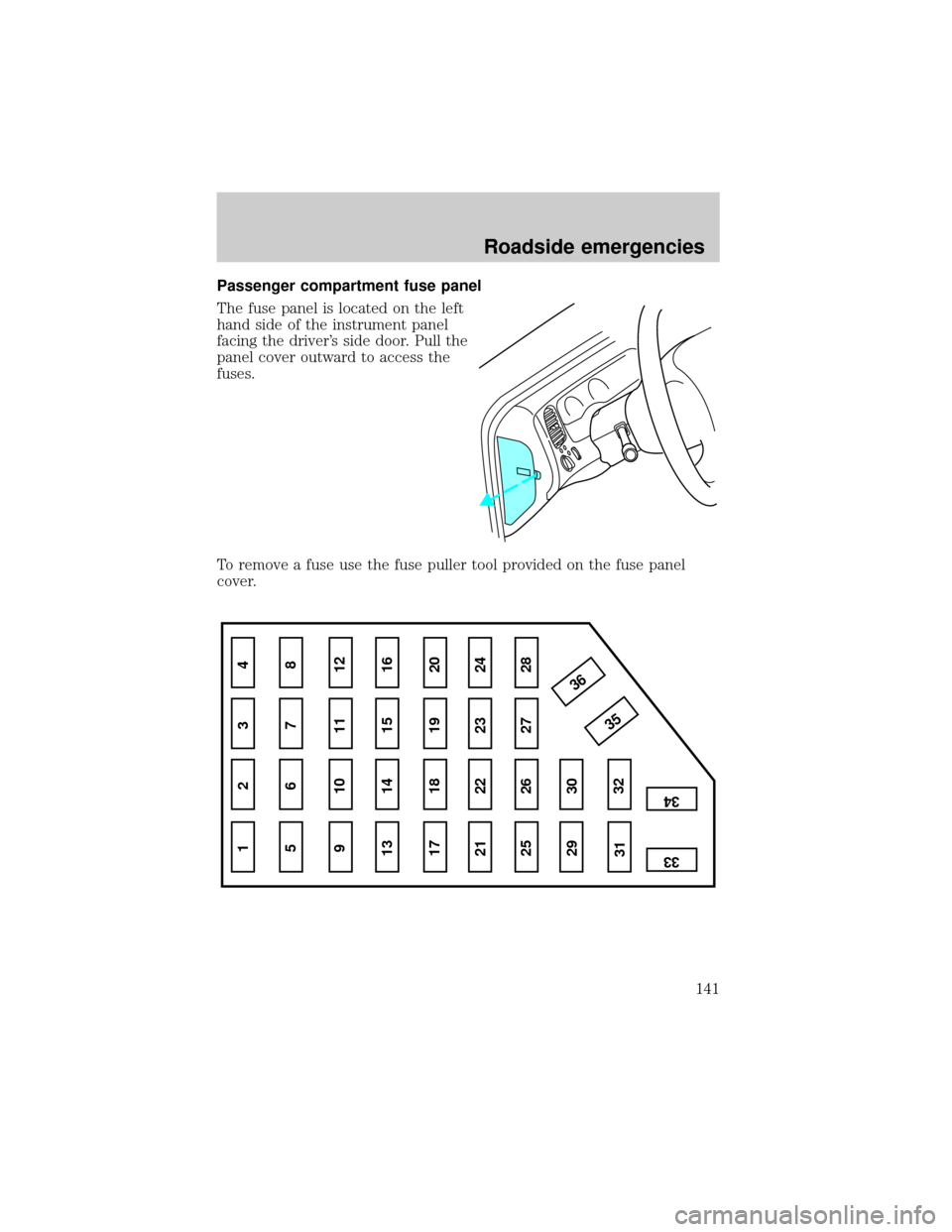
Passenger compartment fuse panel
The fuse panel is located on the left
hand side of the instrument panel
facing the driver's side door. Pull the
panel cover outward to access the
fuses.
To remove a fuse use the fuse puller tool provided on the fuse panel
cover.
1 234
5 678
9 101112
13 14 15 16
17 18 19 20
21 22 23 24
25 26
29 30
35 36
313233
34
27 28
Roadside emergencies
141
Page 142 of 240
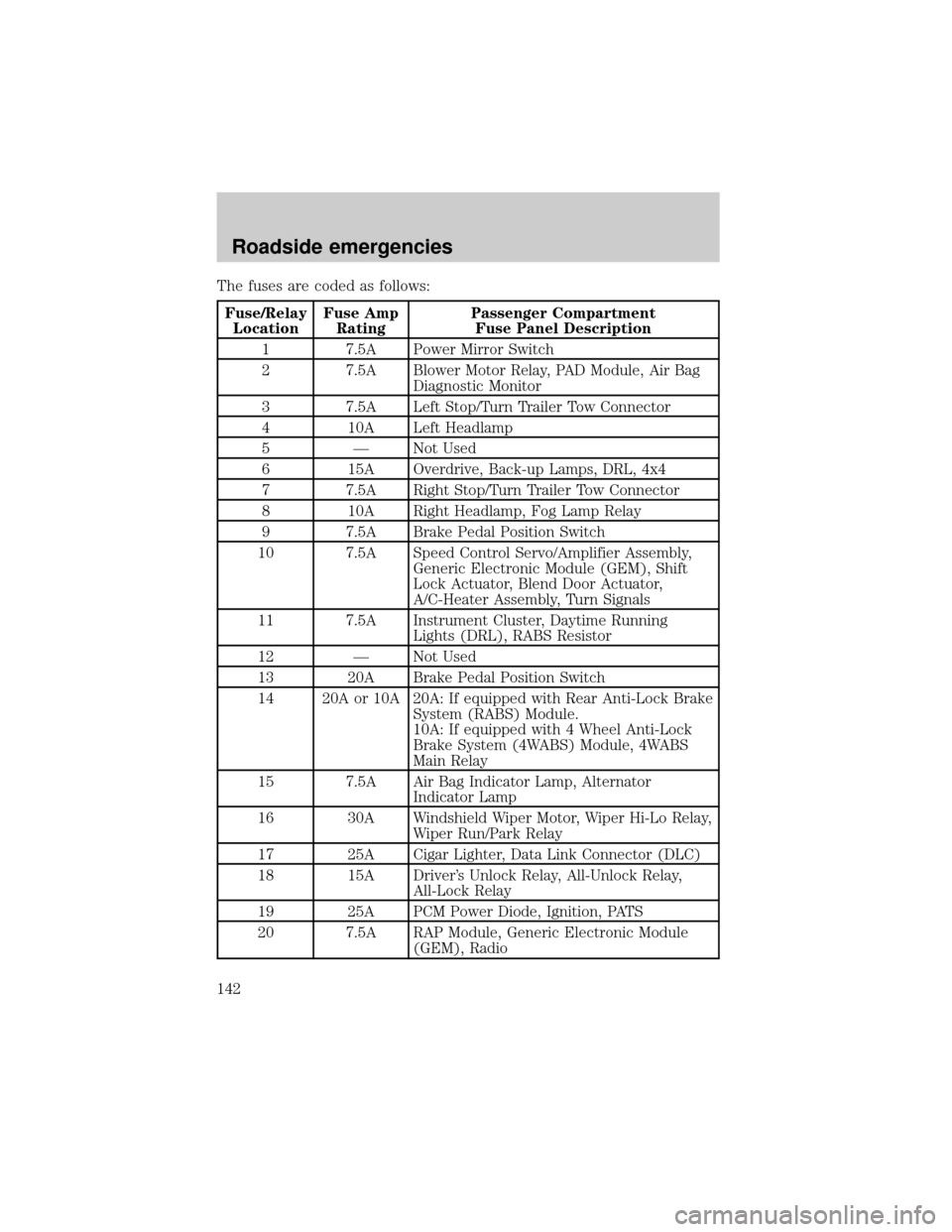
The fuses are coded as follows:
Fuse/Relay
LocationFuse Amp
RatingPassenger Compartment
Fuse Panel Description
1 7.5A Power Mirror Switch
2 7.5A Blower Motor Relay, PAD Module, Air Bag
Diagnostic Monitor
3 7.5A Left Stop/Turn Trailer Tow Connector
4 10A Left Headlamp
5 Ð Not Used
6 15A Overdrive, Back-up Lamps, DRL, 4x4
7 7.5A Right Stop/Turn Trailer Tow Connector
8 10A Right Headlamp, Fog Lamp Relay
9 7.5A Brake Pedal Position Switch
10 7.5A Speed Control Servo/Amplifier Assembly,
Generic Electronic Module (GEM), Shift
Lock Actuator, Blend Door Actuator,
A/C-Heater Assembly, Turn Signals
11 7.5A Instrument Cluster, Daytime Running
Lights (DRL), RABS Resistor
12 Ð Not Used
13 20A Brake Pedal Position Switch
14 20A or 10A 20A: If equipped with Rear Anti-Lock Brake
System (RABS) Module.
10A: If equipped with 4 Wheel Anti-Lock
Brake System (4WABS) Module, 4WABS
Main Relay
15 7.5A Air Bag Indicator Lamp, Alternator
Indicator Lamp
16 30A Windshield Wiper Motor, Wiper Hi-Lo Relay,
Wiper Run/Park Relay
17 25A Cigar Lighter, Data Link Connector (DLC)
18 15A Driver's Unlock Relay, All-Unlock Relay,
All-Lock Relay
19 25A PCM Power Diode, Ignition, PATS
20 7.5A RAP Module, Generic Electronic Module
(GEM), Radio
Roadside emergencies
142