steering FORD RANGER 2001 2.G User Guide
[x] Cancel search | Manufacturer: FORD, Model Year: 2001, Model line: RANGER, Model: FORD RANGER 2001 2.GPages: 272, PDF Size: 1.98 MB
Page 171 of 272
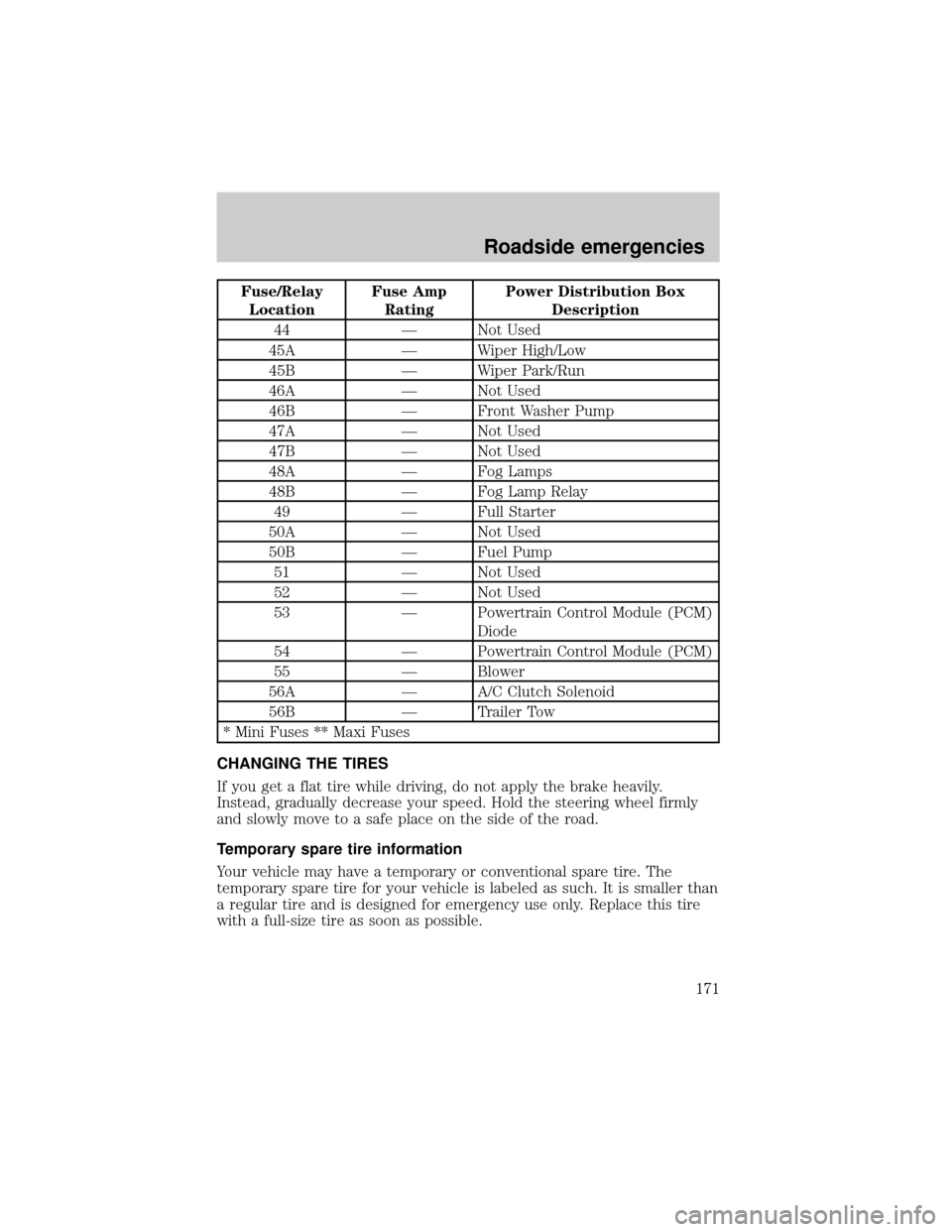
Fuse/Relay
LocationFuse Amp
RatingPower Distribution Box
Description
44 Ð Not Used
45A Ð Wiper High/Low
45B Ð Wiper Park/Run
46A Ð Not Used
46B Ð Front Washer Pump
47A Ð Not Used
47B Ð Not Used
48A Ð Fog Lamps
48B Ð Fog Lamp Relay
49 Ð Full Starter
50A Ð Not Used
50B Ð Fuel Pump
51 Ð Not Used
52 Ð Not Used
53 Ð Powertrain Control Module (PCM)
Diode
54 Ð Powertrain Control Module (PCM)
55 Ð Blower
56A Ð A/C Clutch Solenoid
56B Ð Trailer Tow
* Mini Fuses ** Maxi Fuses
CHANGING THE TIRES
If you get a flat tire while driving, do not apply the brake heavily.
Instead, gradually decrease your speed. Hold the steering wheel firmly
and slowly move to a safe place on the side of the road.
Temporary spare tire information
Your vehicle may have a temporary or conventional spare tire. The
temporary spare tire for your vehicle is labeled as such. It is smaller than
a regular tire and is designed for emergency use only. Replace this tire
with a full-size tire as soon as possible.
Roadside emergencies
171
Page 185 of 272
3. Turn off the engine and remove the key.
4. Block the wheels to prevent the vehicle from moving unexpectedly.
Working with the engine on
²Automatic transmission:
1. Set the parking brake and ensure the gearshift is securely latched in P
(Park).
2. Block the wheels to prevent the vehicle from moving unexpectedly.
Note:Do not start your engine with the air cleaner removed and do not
remove it while the engine is running.
²Manual transmission:
1. Set the parking brake, depress the clutch and place the gearshift in
neutral.
2. Block the wheels to prevent the vehicle from moving unexpectedly.
Note:Do not start your engine with the air cleaner removed and do not
remove it while the engine is running.
The cooling fan is automatic and may come on at any time.
Always disconnect the negative terminal of the battery before
working near the fan.
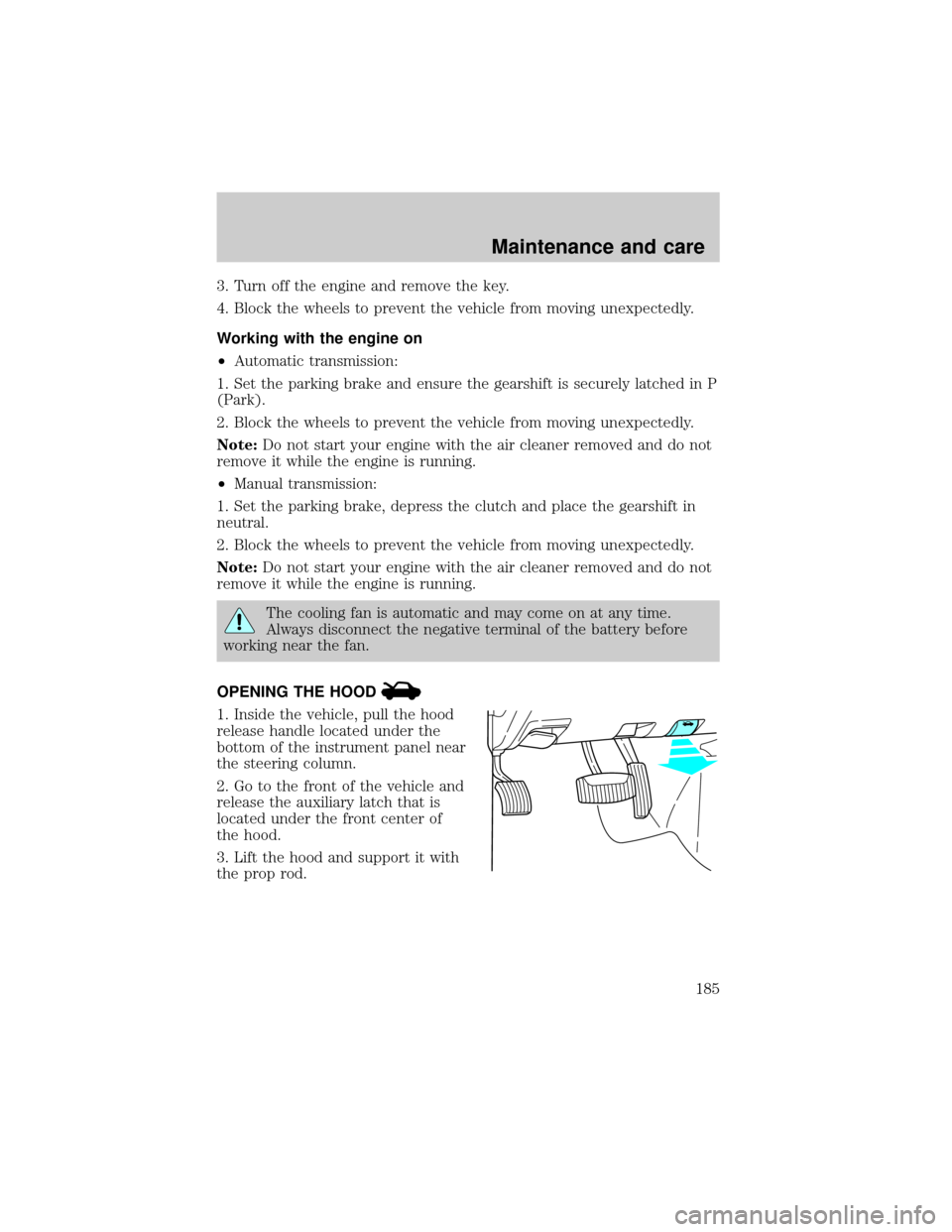
OPENING THE HOOD
1. Inside the vehicle, pull the hood
release handle located under the
bottom of the instrument panel near
the steering column.
2. Go to the front of the vehicle and
release the auxiliary latch that is
located under the front center of
the hood.
3. Lift the hood and support it with
the prop rod.
Maintenance and care
185
Page 186 of 272
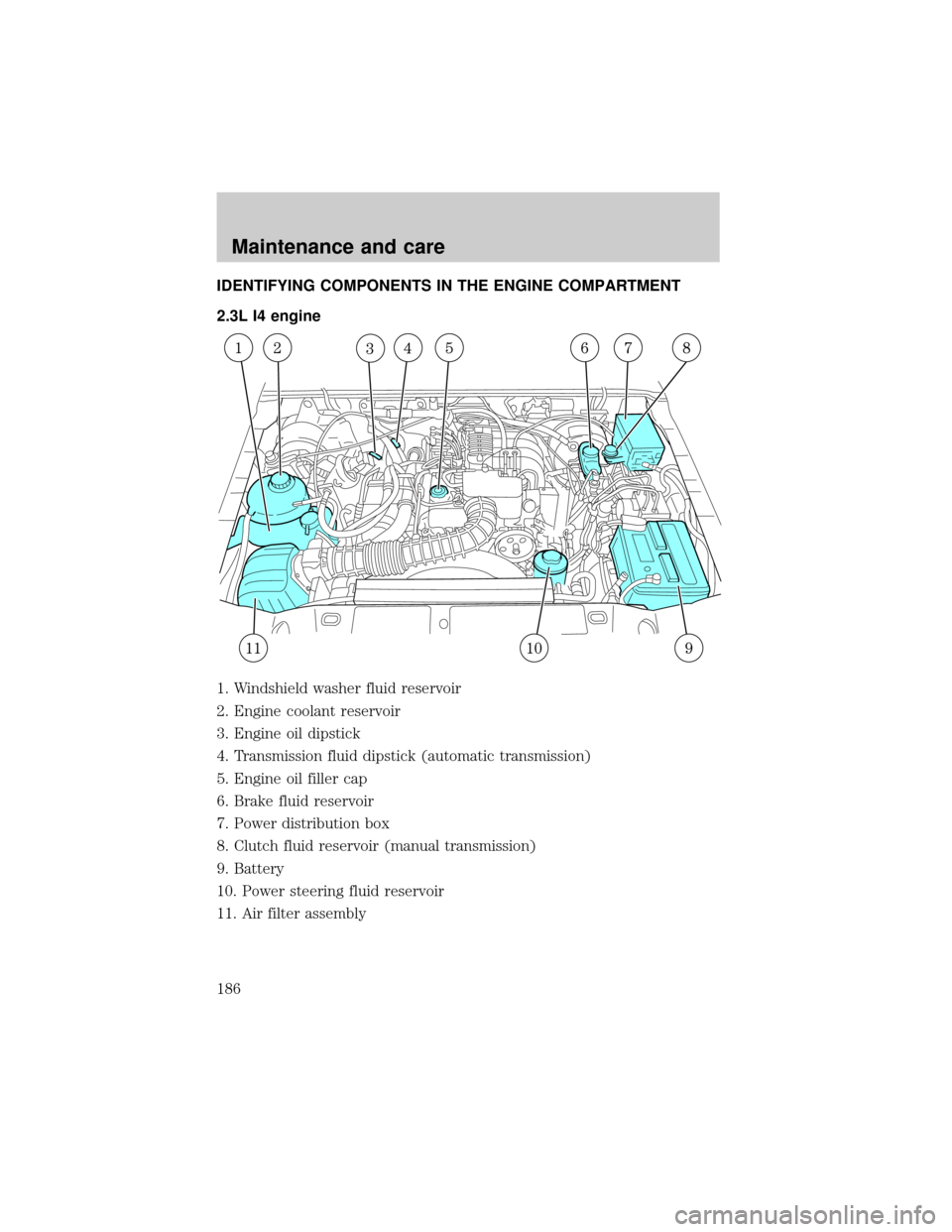
IDENTIFYING COMPONENTS IN THE ENGINE COMPARTMENT
2.3L I4 engine
1. Windshield washer fluid reservoir
2. Engine coolant reservoir
3. Engine oil dipstick
4. Transmission fluid dipstick (automatic transmission)
5. Engine oil filler cap
6. Brake fluid reservoir
7. Power distribution box
8. Clutch fluid reservoir (manual transmission)
9. Battery
10. Power steering fluid reservoir
11. Air filter assembly
Maintenance and care
186
Page 187 of 272
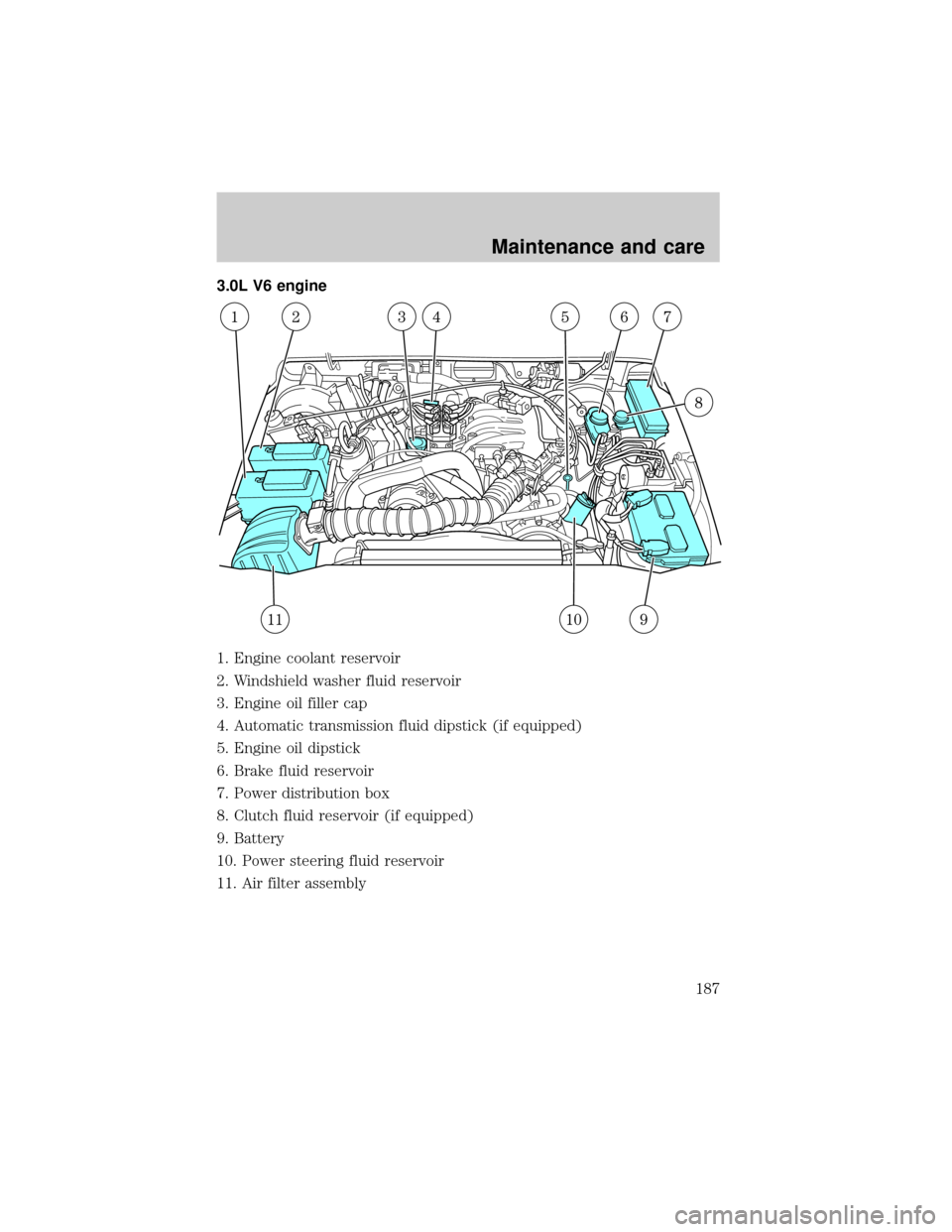
3.0L V6 engine
1. Engine coolant reservoir
2. Windshield washer fluid reservoir
3. Engine oil filler cap
4. Automatic transmission fluid dipstick (if equipped)
5. Engine oil dipstick
6. Brake fluid reservoir
7. Power distribution box
8. Clutch fluid reservoir (if equipped)
9. Battery
10. Power steering fluid reservoir
11. Air filter assembly
Maintenance and care
187
Page 188 of 272
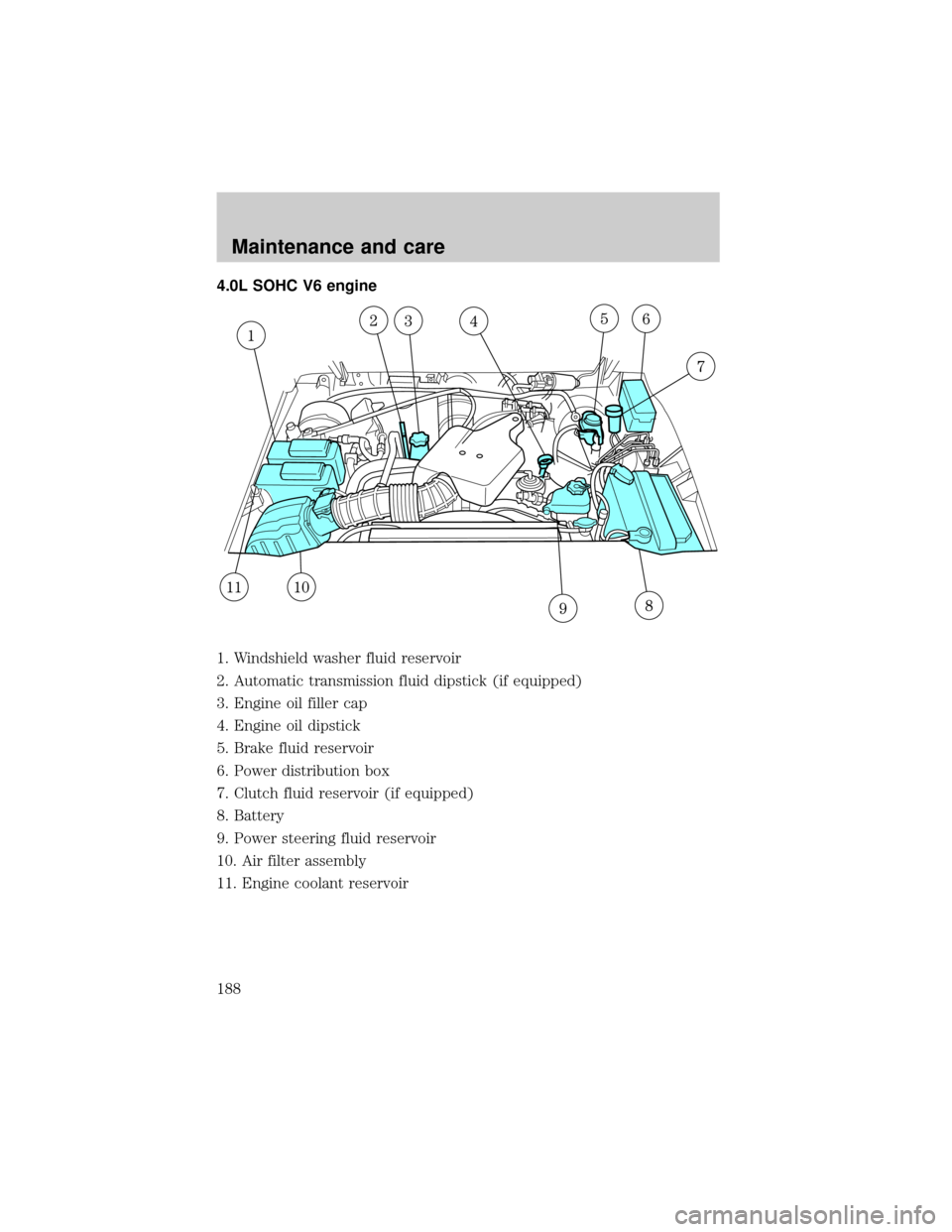
4.0L SOHC V6 engine
1. Windshield washer fluid reservoir
2. Automatic transmission fluid dipstick (if equipped)
3. Engine oil filler cap
4. Engine oil dipstick
5. Brake fluid reservoir
6. Power distribution box
7. Clutch fluid reservoir (if equipped)
8. Battery
9. Power steering fluid reservoir
10. Air filter assembly
11. Engine coolant reservoir
Maintenance and care
188
Page 202 of 272
If you drive in extremely hot climates:
²It is still necessary to maintain the coolant concentration
above 40%.
²NEVER decrease the coolant concentration below 40%.
²Decreased engine coolant concentrations below 40% will
decrease the corrosion protection characteristics of the engine
coolant and may cause engine damage.
²Decreased engine coolant concentrations below 40% will
decrease the freeze protection characteristics of the engine
coolant and may cause engine damage.
²Refer to the chart on the coolant container to ensure the
coolant concentration in your vehicle will provide adequate
protection at the temperatures in which you drive.
Vehicles driven year-round in non-extreme climates should use a 50/50
mixture of engine coolant and distilled water for optimum cooling system
and engine protection.
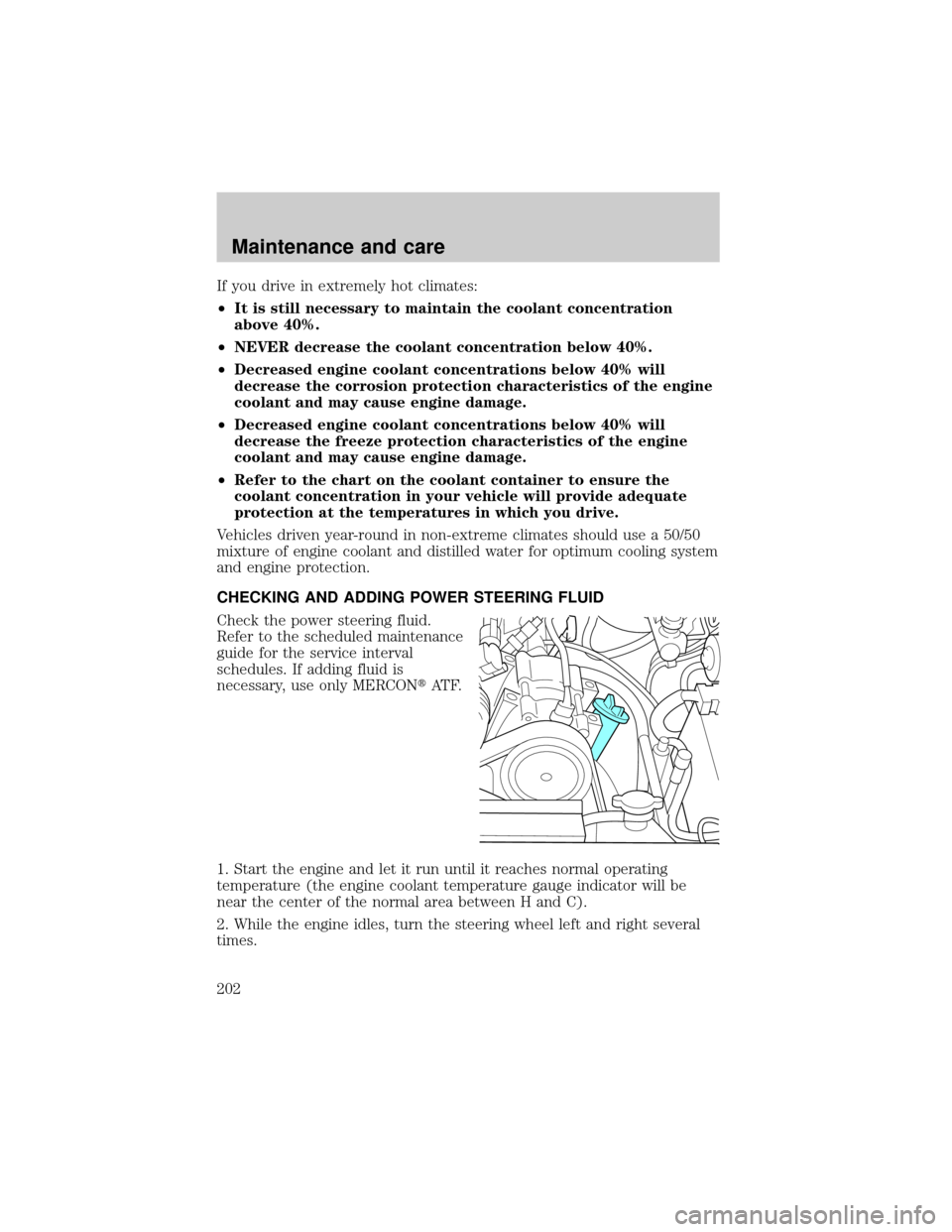
CHECKING AND ADDING POWER STEERING FLUID
Check the power steering fluid.
Refer to the scheduled maintenance
guide for the service interval
schedules. If adding fluid is
necessary, use only MERCONtAT F.
1. Start the engine and let it run until it reaches normal operating
temperature (the engine coolant temperature gauge indicator will be
near the center of the normal area between H and C).
2. While the engine idles, turn the steering wheel left and right several
times.
Maintenance and care
202
Page 238 of 272
Cleaning the exterior lamps
Wash with the same detergent as the exterior of your vehicle. If
necessary, use a tar remover such as Ford Extra Strength Tar and Road
Oil Remover (B7A-19520±AA).
To avoid scratching the lamps, do not use a dry paper towel, chemical
solvents or abrasive cleaners.
Cleaning the windshield, wiper blades and rear window
If the wiper blades do not wipe properly, clean the wiper blade rubber
element with undiluted windshield washer solution or a mild detergent.
To avoid damaging the blades, do not use fuel, kerosene, paint thinner or
other solvents.
If the wiper still does not wipe properly, this could be caused by
substances on the windshield or rear window such as tree sap and some
hot wax treatments used by commercial car washes. Clean the outside of
the windshield or rear window with a non-abrasive cleaner such as Ford
Ultra-Clear Spray Glass Cleaner, (E4AZ-19C507±AA), available from your
Ford Dealer.Do notuse abrasive cleansers on glass as they may cause
scratches. The windshield or rear window is clean if beads do not form
when you rinse it with water. The windshield, rear window and wiper
blades should be cleaned on a regular basis, and blades or rubber
elements replaced when worn.
Cleaning the instrument panel
Clean with a damp cloth, then dry with a dry cloth.
Avoid cleaner or polish that increases the gloss of the upper portion of
the instrument panel. The dull finish in this area helps protect the driver
from undesirable windshield reflection.
Do not use chemical solvents or strong detergents when cleaning
the steering wheel or instrument panel to avoid contamination of
the air bag system.
Cleaning the instrument cluster lens
Clean with a damp cloth, then dry with a dry cloth.
Do not use household or glass cleaners as these may damage the lens.
Maintenance and care
238
Page 241 of 272
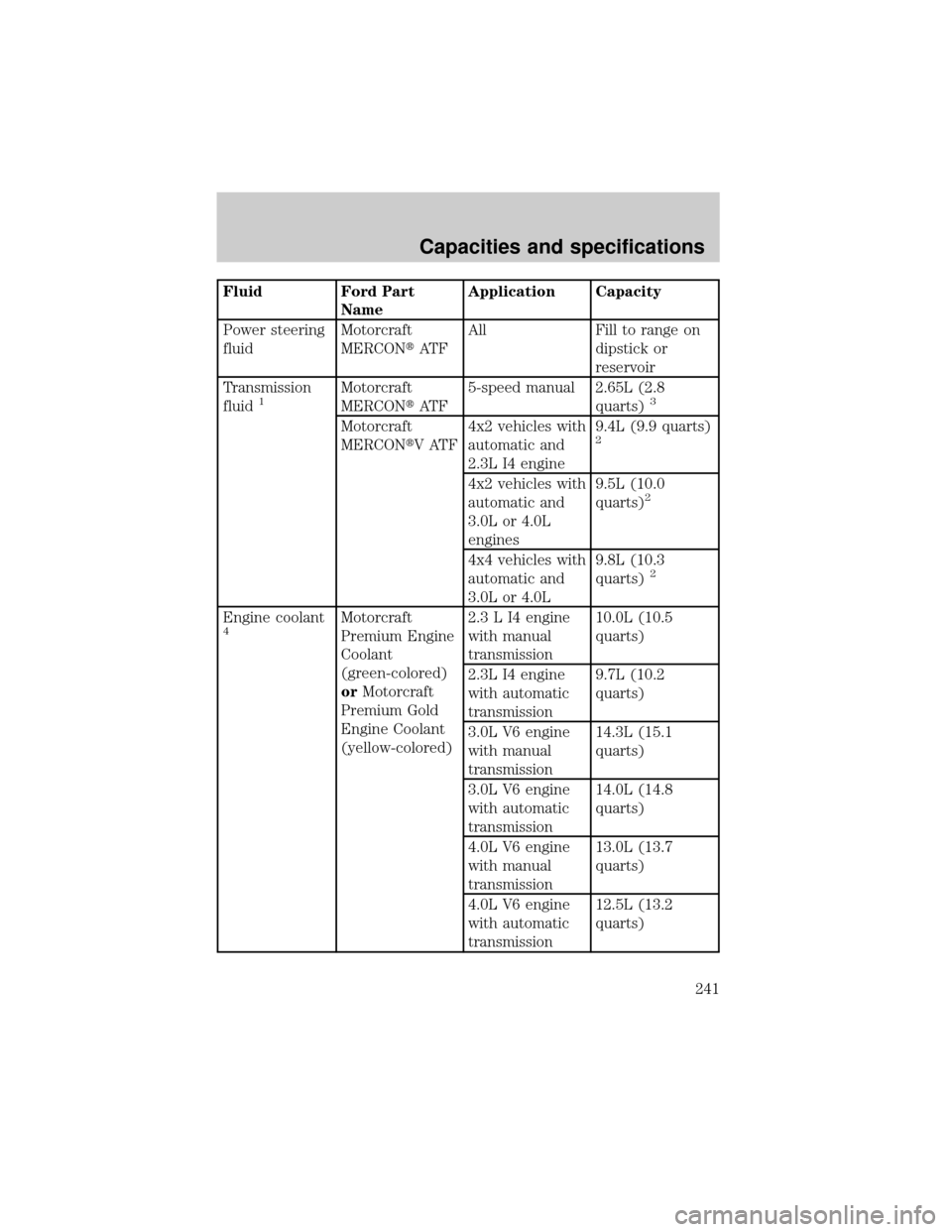
Fluid Ford Part
NameApplication Capacity
Power steering
fluidMotorcraft
MERCONtAT FAll Fill to range on
dipstick or
reservoir
Transmission
fluid
1Motorcraft
MERCONtAT F5-speed manual 2.65L (2.8
quarts)3
Motorcraft
MERCONtVATF4x2 vehicles with
automatic and
2.3L I4 engine9.4L (9.9 quarts)2
4x2 vehicles with
automatic and
3.0L or 4.0L
engines9.5L (10.0
quarts)2
4x4 vehicles with
automatic and
3.0L or 4.0L9.8L (10.3
quarts)2
Engine coolant4Motorcraft
Premium Engine
Coolant
(green-colored)
orMotorcraft
Premium Gold
Engine Coolant
(yellow-colored)2.3 L I4 engine
with manual
transmission10.0L (10.5
quarts)
2.3L I4 engine
with automatic
transmission9.7L (10.2
quarts)
3.0L V6 engine
with manual
transmission14.3L (15.1
quarts)
3.0L V6 engine
with automatic
transmission14.0L (14.8
quarts)
4.0L V6 engine
with manual
transmission13.0L (13.7
quarts)
4.0L V6 engine
with automatic
transmission12.5L (13.2
quarts)
Capacities and specifications
241
Page 244 of 272
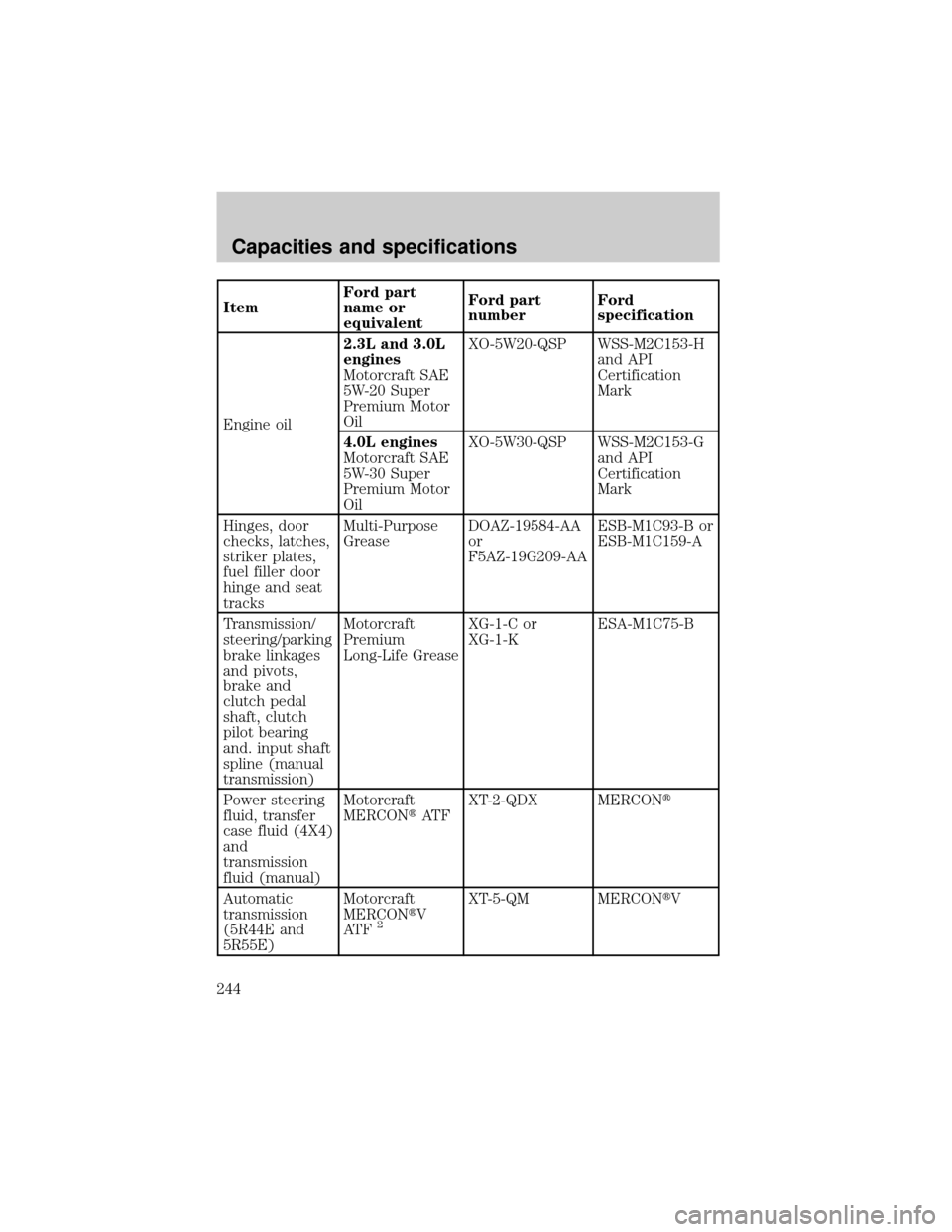
ItemFord part
name or
equivalentFord part
numberFord
specification
Engine oil2.3L and 3.0L
engines
Motorcraft SAE
5W-20 Super
Premium Motor
OilXO-5W20-QSP WSS-M2C153-H
and API
Certification
Mark
4.0L engines
Motorcraft SAE
5W-30 Super
Premium Motor
OilXO-5W30-QSP WSS-M2C153-G
and API
Certification
Mark
Hinges, door
checks, latches,
striker plates,
fuel filler door
hinge and seat
tracksMulti-Purpose
GreaseDOAZ-19584-AA
or
F5AZ-19G209-AAESB-M1C93-B or
ESB-M1C159-A
Transmission/
steering/parking
brake linkages
and pivots,
brake and
clutch pedal
shaft, clutch
pilot bearing
and. input shaft
spline (manual
transmission)Motorcraft
Premium
Long-Life GreaseXG-1-C or
XG-1-KESA-M1C75-B
Power steering
fluid, transfer
case fluid (4X4)
and
transmission
fluid (manual)Motorcraft
MERCONtAT FXT-2-QDX MERCONt
Automatic
transmission
(5R44E and
5R55E)Motorcraft
MERCONtV
AT F
2
XT-5-QM MERCONtV
Capacities and specifications
244
Page 267 of 272

trailer towing ..........................144
Loading instructions .................146
Lubricant specifications ...243, 245
Lumbar support, seats ...............90
M
Manual transmission .................136
fluid capacities ........................240
lubricant specifications ..........245
reverse .....................................138
Mirrors
cleaning ...................................239
side view mirrors (power) .......73
Moon roof ....................................64
Motorcraft parts ................221, 240
O
Octane rating ............................219
Odometer .....................................18
Oil (see Engine oil) ..................189
Overdrive .....................................69
P
Panic alarm feature, remote
entry system ................................83
Parking brake ............................129
Parts (see Motorcraft parts) ....240
Power distribution box (see
Fuses) ........................................165
Power door locks ........................73
Power steering ..........................130
fluid, checking and adding ....202
fluid, refill capacity ................240fluid, specifications .........243, 245
Preparing to drive your
vehicle ........................................131
R
Radio ............................................29
Relays ........................................161
Remote entry system ...........81, 83
illuminated entry ......................85
locking/unlocking doors ...........82
panic alarm ...............................83
replacement/additional
transmitters ...............................84
replacing the batteries .............83
S
Safety belts (see Safety
restraints) ........................15, 91±96
Safety defects, reporting ..........262
Safety restraints ....................91±96
belt minder ...............................99
cleaning the safety
belts .................................102, 239
extension assembly ..................98
for adults .............................92±95
for children .....................112±113
lap belt ......................................97
warning light and
chime .............................12, 15, 98
Safety seats for children ..........114
Seat belts (see Safety
restraints) ....................................91
Seats ............................................89
child safety seats ....................114
SecuriLock passive anti-theft
system ....................................85±87
Index
267