fuel FORD RANGER 2002 2.G Service Manual
[x] Cancel search | Manufacturer: FORD, Model Year: 2002, Model line: RANGER, Model: FORD RANGER 2002 2.GPages: 288, PDF Size: 3.03 MB
Page 255 of 288
Calculating fuel economy
1. Fill the fuel tank completely and record the initial odometer reading
(in kilometers or miles).
2. Each time you fill the tank, record the amount of fuel added (in liters
or gallons).
3. After at least three to five tank fill-ups, fill the fuel tank and record
the current odometer reading.
4. Subtract your initial odometer reading from the current odometer
reading.
5. Follow one of the simple calculations in order to determine fuel
economy:
Multiply liters used by 100, then divide by total kilometers
traveled.
Divide total miles traveled by total gallons used.
Keep a record for at least one month and record the type of driving (city
or highway). This will provide an accurate estimate of the vehicle's fuel
economy under current driving conditions. Additionally, keeping records
during summer and winter will show how temperature impacts fuel
economy. In general, lower temperatures give lower fuel economy.
Driving style Ð good driving and fuel economy habits
Give consideration to the lists that follow and you may be able to change
a number of variables and improve your fuel economy.
Habits
²Smooth, moderate operation can yield up to 10% savings in fuel.
²Steady speeds without stopping will usually give the best fuel
economy.
²Idling for long periods of time (greater than one minute) may waste
fuel.
²Anticipate stopping; slowing down may eliminate the need to stop.
²Sudden or hard accelerations may reduce fuel economy.
²Slow down gradually.
²Driving at reasonable speeds (traveling at 88 km/h [55 mph] uses 15%
less fuel than traveling at 105 km/h [65 mph]).
²Revving the engine before turning it off may reduce fuel economy.
Maintenance and Specifications
255
Page 256 of 288

²Using the air conditioner or defroster may reduce fuel economy.
²You may want to turn off the speed control in hilly terrain if
unnecessary shifting between third and fourth gear occurs.
Unnecessary shifting of this type could result in reduced fuel
economy.
²Warming up a vehicle on cold mornings is not required and may
reduce fuel economy.
²Resting your foot on the brake pedal while driving may reduce fuel
economy.
²Combine errands and minimize stop-and-go driving.
Maintenance
²Keep tires properly inflated and use only recommended size.
²Operating a vehicle with the wheels out of alignment will reduce fuel
economy.
²Use recommended engine oil. Refer toLubricant specificationsin
this chapter.
²Perform all regularly scheduled maintenance items. Follow the
recommended maintenance schedule and owner maintenance checks
found in your vehicle scheduled maintenance guide.
Conditions
²Heavily loading a vehicle or towing a trailer may reduce fuel economy
at any speed.
²Carrying unnecessary weight may reduce fuel economy (approximately
0.4 km/L [1 mpg] is lost for every 180 kg [400 lb] of weight carried).
²Adding certain accessories to your vehicle (for example bug
deflectors, rollbars/light bars, running boards, ski/luggage racks) may
reduce fuel economy.
²Using fuel blended with alcohol may lower fuel economy.
²Fuel economy may decrease with lower temperatures during the first
12±16 km (8±10 miles) of driving.
²Driving on flat terrain offers improved fuel economy as compared to
driving on hilly terrain.
²Transmissions give their best fuel economy when operated in the top
cruise gear and with steady pressure on the gas pedal.
Maintenance and Specifications
256
Page 257 of 288
²Four-wheel-drive operation (if equipped) is less fuel efficient than
two-wheel-drive operation.
²Close windows for high speed driving.
EPA window sticker
Every new vehicle should have the EPA window sticker. Contact your
dealer if the window sticker is not supplied with your vehicle. The EPA
window sticker should be your guide for the fuel economy comparisons
with other vehicles.
It is important to note the box in the lower left corner of the window
sticker. These numbers represent the Range of L/100 km (MPG)
expected on the vehicle under optimum conditions. Your fuel economy
may vary depending upon the method of operation and conditions.
EMISSION CONTROL SYSTEM
Your vehicle is equipped with various emission control components and a
catalytic converter which will enable your vehicle to comply with
applicable exhaust emission standards. To make sure that the catalytic
converter and other emission control components continue to work
properly:
²Use only the specified fuel listed.
²Avoid running out of fuel.
²Do not turn off the ignition while your vehicle is moving, especially at
high speeds.
²Have the items listed in your scheduled maintenance guide performed
according to the specified schedule.
The scheduled maintenance items listed in the scheduled maintenance
guide are essential to the life and performance of your vehicle and to its
emissions system.
If other than Ford, Motorcraft or Ford-authorized parts are used for
maintenance replacements or for service of components affecting
emission control, such non-Ford parts should be equivalent to genuine
Ford Motor Company parts in performance and durability.
Do not park, idle, or drive your vehicle in dry grass or other dry
ground cover. The emission system heats up the engine
compartment and exhaust system, which can start a fire.
Maintenance and Specifications
257
Page 267 of 288
The traction grade assigned to this tire is based on
straight-ahead braking traction tests, and does not include
acceleration, cornering, hydroplaning or peak traction characteristics.
Temperature A B C
The temperature grades are A (the highest), B, and C, representing the
tire's resistance to the generation of heat and its ability to dissipate heat
when tested under controlled conditions on a specified indoor laboratory
test wheel. Sustained high temperature can cause the material of the tire
to degenerate and reduce tire life, and excessive temperature can lead to
sudden tire failure. The grade C corresponds to a level of performance
which all passenger car tires must meet under the Federal Motor Vehicle
Safety Standard No. 109. Grades B and A represent higher levels of
performance on the laboratory test wheel than the minimum required by
law.
The temperature grade for this tire is established for a tire that
is properly inflated and not overloaded. Excessive speed,
underinflation, or excessive loading, either separately or in
combination, can cause heat buildup and possible tire failure.
SERVICING YOUR TIRES
Checking the tire pressure
²Use an accurate tire pressure gauge.
²Check the tire pressure when tires are cold, after the vehicle has been
parked for at least one hour or has been driven less than 5 km (3
miles).
²Adjust tire pressure to recommended specifications found on the
Certification Label. Tire pressure information can also be found on the
Tire Information label located on the inside of the fuel filler door.
Improperly inflated tires can affect vehicle handling and can fail
suddenly, possibly resulting in loss of vehicle control.
Maintenance and Specifications
267
Page 270 of 288
Snow tires must be the same size and grade as the tires you
currently have on your vehicle.
The tires on your vehicle have all weather treads to provide traction in
rain and snow. However, in some climates, you may need to use snow
tires and chains. If you need to use snow tires and chains, it is
recommended that steel wheels are used of the same size and
specifications as those originally installed.
Follow these guidelines when using snow tires and chains:
²Do not use tire chains on aluminum wheels. Chains may chip the
wheels.
²Use only SAE Class S chains.
²Install chains securely, verifying that the chains do not touch any
wiring, brake lines or fuel lines.
²Drive cautiously. If you hear the chains rub or bang against your
vehicle, stop and re-tighten the chains. If this does not work, remove
the chains to prevent damage to your vehicle.
²If possible, avoid fully loading your vehicle.
²Remove the tire chains when they are no longer needed. Do not use
tire chains on dry roads.
²The suspension insulation and bumpers will help prevent vehicle
damage. Do not remove these components from your vehicle when
using snow tires and chains.
MOTORCRAFT PART NUMBERS
Component 2.3L I4
engine3.0L V6 engine 4.0L V6 engine
Air filter
elementFA-1658 FA-1658 FA-1658
FA1665
(FX4 only)
Fuel filter FG±1002 FG±1002 FG±1002
Battery BXT-59 BXT-59 BXT-59
Oil filter FL-400S FL-400S FL-820S
PCV valve EV-227 EV-130 EV-225
Spark plugs*
AWSF-32FEM**AWSF-32PP*** AGSF-34FP
Maintenance and Specifications
270
Page 273 of 288
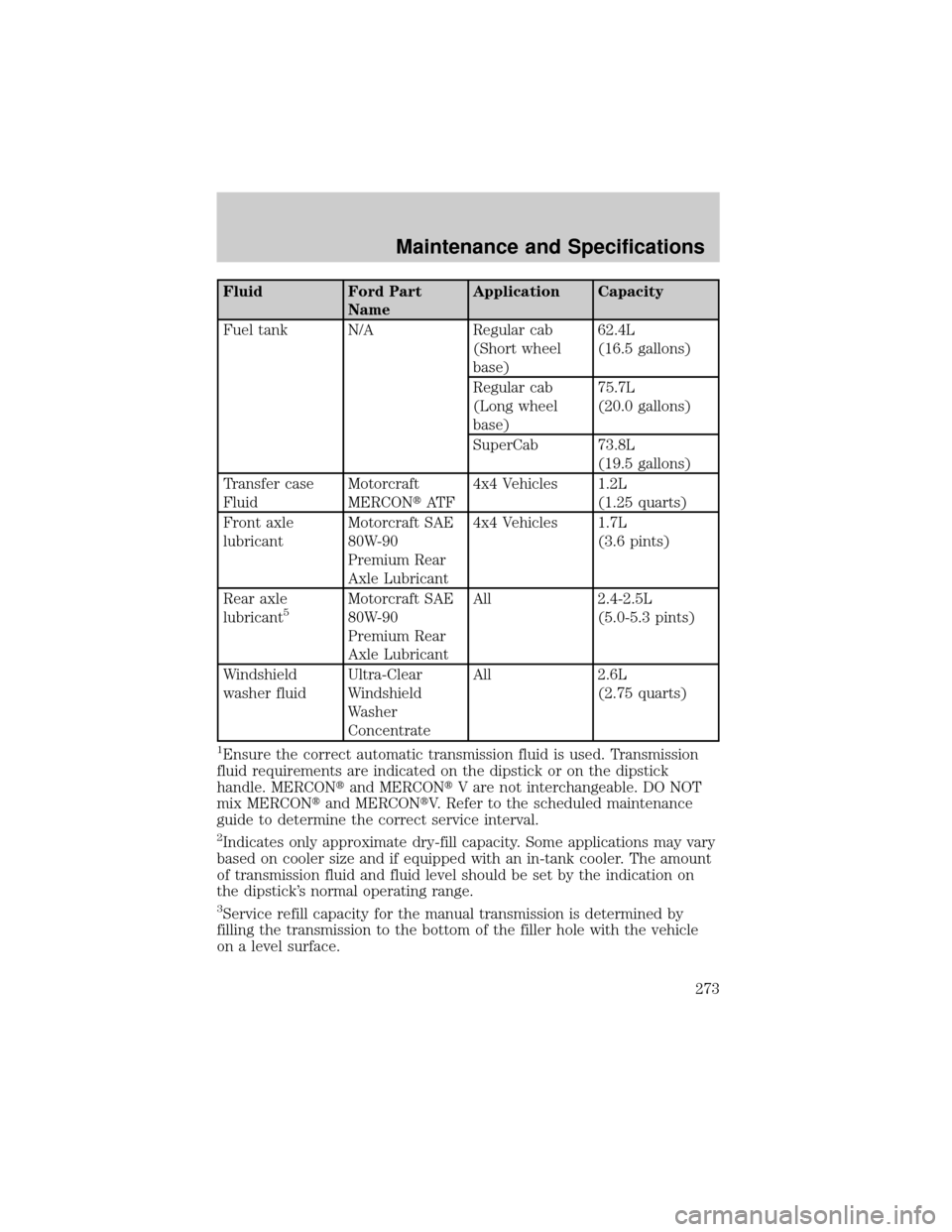
Fluid Ford Part
NameApplication Capacity
Fuel tank N/A Regular cab
(Short wheel
base)62.4L
(16.5 gallons)
Regular cab
(Long wheel
base)75.7L
(20.0 gallons)
SuperCab 73.8L
(19.5 gallons)
Transfer case
FluidMotorcraft
MERCONtAT F4x4 Vehicles 1.2L
(1.25 quarts)
Front axle
lubricantMotorcraft SAE
80W-90
Premium Rear
Axle Lubricant4x4 Vehicles 1.7L
(3.6 pints)
Rear axle
lubricant
5Motorcraft SAE
80W-90
Premium Rear
Axle LubricantAll 2.4-2.5L
(5.0-5.3 pints)
Windshield
washer fluidUltra-Clear
Windshield
Washer
ConcentrateAll 2.6L
(2.75 quarts)
1Ensure the correct automatic transmission fluid is used. Transmission
fluid requirements are indicated on the dipstick or on the dipstick
handle. MERCONtand MERCONtV are not interchangeable. DO NOT
mix MERCONtand MERCONtV. Refer to the scheduled maintenance
guide to determine the correct service interval.
2Indicates only approximate dry-fill capacity. Some applications may vary
based on cooler size and if equipped with an in-tank cooler. The amount
of transmission fluid and fluid level should be set by the indication on
the dipstick's normal operating range.
3Service refill capacity for the manual transmission is determined by
filling the transmission to the bottom of the filler hole with the vehicle
on a level surface.
Maintenance and Specifications
273
Page 275 of 288
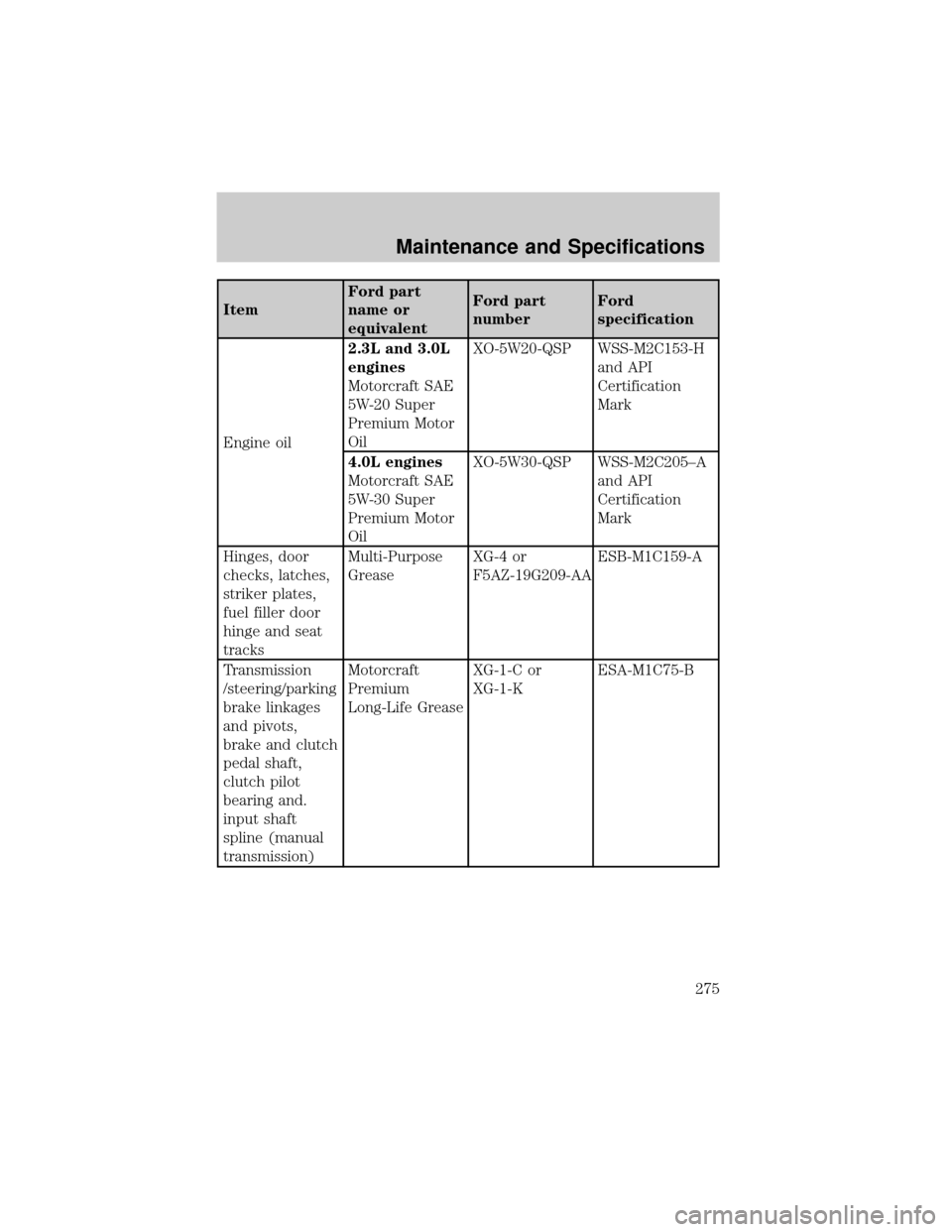
ItemFord part
name or
equivalentFord part
numberFord
specification
Engine oil2.3L and 3.0L
engines
Motorcraft SAE
5W-20 Super
Premium Motor
OilXO-5W20-QSP WSS-M2C153-H
and API
Certification
Mark
4.0L engines
Motorcraft SAE
5W-30 Super
Premium Motor
OilXO-5W30-QSP WSS-M2C205±A
and API
Certification
Mark
Hinges, door
checks, latches,
striker plates,
fuel filler door
hinge and seat
tracksMulti-Purpose
GreaseXG-4 or
F5AZ-19G209-AAESB-M1C159-A
Transmission
/steering/parking
brake linkages
and pivots,
brake and clutch
pedal shaft,
clutch pilot
bearing and.
input shaft
spline (manual
transmission)Motorcraft
Premium
Long-Life GreaseXG-1-C or
XG-1-KESA-M1C75-B
Maintenance and Specifications
275
Page 276 of 288
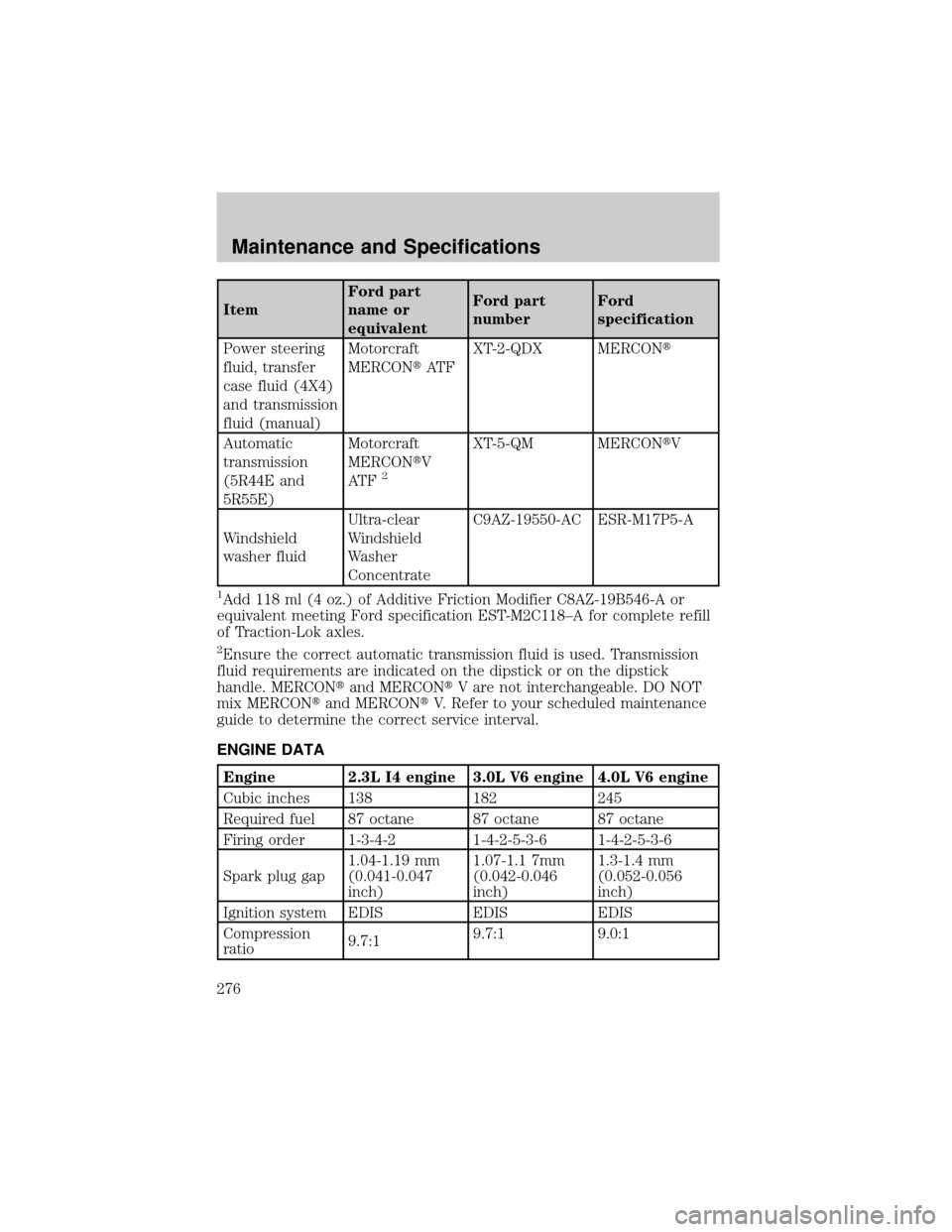
ItemFord part
name or
equivalentFord part
numberFord
specification
Power steering
fluid, transfer
case fluid (4X4)
and transmission
fluid (manual)Motorcraft
MERCONtAT FXT-2-QDX MERCONt
Automatic
transmission
(5R44E and
5R55E)Motorcraft
MERCONtV
AT F
2
XT-5-QM MERCONtV
Windshield
washer fluidUltra-clear
Windshield
Washer
ConcentrateC9AZ-19550-AC ESR-M17P5-A
1Add 118 ml (4 oz.) of Additive Friction Modifier C8AZ-19B546-A or
equivalent meeting Ford specification EST-M2C118±A for complete refill
of Traction-Lok axles.
2Ensure the correct automatic transmission fluid is used. Transmission
fluid requirements are indicated on the dipstick or on the dipstick
handle. MERCONtand MERCONtV are not interchangeable. DO NOT
mix MERCONtand MERCONtV. Refer to your scheduled maintenance
guide to determine the correct service interval.
ENGINE DATA
Engine 2.3L I4 engine 3.0L V6 engine 4.0L V6 engine
Cubic inches 138 182 245
Required fuel 87 octane 87 octane 87 octane
Firing order 1-3-4-2 1-4-2-5-3-6 1-4-2-5-3-6
Spark plug gap1.04-1.19 mm
(0.041-0.047
inch)1.07-1.1 7mm
(0.042-0.046
inch)1.3-1.4 mm
(0.052-0.056
inch)
Ignition system EDIS EDIS EDIS
Compression
ratio9.7:19.7:1 9.0:1
Maintenance and Specifications
276
Page 285 of 288

Engine block heater .................147
Engine oil ..................................236
checking and adding ..............236
dipstick ....................................236
filter, specifications ........240, 270
recommendations ...................240
refill capacities ........................271
specifications ..................274, 276
Exhaust fumes ..........................148
F
Fluid capacities .........................271
Foglamps .....................................73
Four-Wheel Drive
vehicles ................................14, 162
description ..............................162
driving off road .......................164
electronic shift ........................162
indicator light .........................162
lever operated shift ................160
preparing to drive your
vehicle .....................................152
Fuel ............................................249
calculating fuel economy .......254
cap .....................................12, 251
capacity ...................................271
choosing the right fuel ...........252
comparisons with EPA fuel
economy estimates .................257
detergent in fuel .....................253
filling your vehicle with
fuel ...........................249, 251, 254
filter, specifications ........253, 270
fuel pump shut-off switch .....188
gauge .........................................16
improving fuel economy ........254
octane rating ...........252, 276±277
quality ......................................252
running out of fuel .................253safety information relating to
automotive fuels .....................249
Fuses ..................................190±191
G
Gas cap (see Fuel cap) ......12, 251
Gas mileage
(see Fuel economy) .................254
Gauges .........................................15
battery voltage gauge ...............16
engine coolant temperature
gauge .........................................15
engine oil pressure gauge ........16
fuel gauge ..................................16
odometer ...................................17
speedometer .............................17
tachometer ................................17
trip odometer ............................17
GAWR (Gross Axle Weight
Rating) .......................................173
calculating ...............................175
definition .................................173
driving with a heavy load ......173
location ....................................173
GVWR (Gross Vehicle Weight
Rating) .......................................173
calculating .......................173, 175
definition .................................173
driving with a heavy load ......173
location ....................................173
H
Hazard flashers .........................188
Headlamps ...................................73
aiming ........................................74
bulb specifications ....................76
daytime running lights .............73
Index
285
Page 286 of 288

flash to pass ..............................74
high beam ...........................13, 74
replacing bulbs .........................77
turning on and off ....................73
warning chime ..........................14
Heating
heater only system ...................68
heating and air conditioning
system .......................................70
Hood ..........................................231
I
Ignition .......................144, 276±277
Infant seats
(see Safety seats) .....................134
Inspection/maintenance (I/M)
testing ........................................258
Instrument panel
cleaning ...................................227
cluster ................................10, 227
lighting up panel and
interior .......................................74
J
Jack ............................................200
positioning .......................200, 204
storage .............................200±203
Jump-starting your vehicle ......206
K
Keys ...................................106, 108
key in ignition chime ...............14
positions of the ignition .........144L
Lamps
bulb replacement
specifications chart ..................76
cargo lamps ...............................74
daytime running light ...............73
fog lamps ...................................73
headlamps .................................73
headlamps, flash to pass ..........74
instrument panel, dimming .....74
interior lamps .....................75, 77
replacing bulbs .......75, 77, 79±82
Lane change indicator
(see Turn signal) ........................75
Lights, warning and indicator ....10
air bag ........................................12
anti-lock brakes (ABS) ....12, 150
anti-theft ...................................14
brake ..........................................11
charging system ........................12
check coolant ............................11
check engine .............................10
cruise indicator .........................13
door ajar ....................................13
fuel cap light .............................12
high beam .................................13
overdrive off ..............................13
safety belt .................................12
speed control ............................91
turn signal indicator .................13
Load limits .................................173
GAWR ......................................173
GVWR ......................................173
trailer towing ..........................173
Loading instructions .................175
Lubricant specifications ...274, 276
Lumbar support, seats .............110
Index
286