warning light FORD RANGER 2005 2.G Owner's Manual
[x] Cancel search | Manufacturer: FORD, Model Year: 2005, Model line: RANGER, Model: FORD RANGER 2005 2.GPages: 256, PDF Size: 2.41 MB
Page 146 of 256
The BRAKE warning lamp will
illuminate and will remain
illuminated until the parking brake
is released.
To release, pull the lever (2).
Always set the parking brake fully and make sure that the
gearshift is securely latched in P (Park) (automatic
transmission) or in 1 (First) (manual transmission).
STEERING
To prevent damage to the power steering system:
•Never hold the steering wheel at its furthest turning points (until it
stops) for more than a few seconds when the engine is running.
•Do not operate the vehicle with a low power steering pump fluid level
(below the MIN mark on the reservoir).
If the power steering system breaks down (or if the engine is turned
off), you can steer the vehicle manually, but it takes more effort.
If the steering wanders or pulls, check for:
•an improperly inflated tire
•uneven tire wear
•loose or worn suspension components
•loose or worn steering components
•improper steering alignment
A high crown in the road or high crosswinds may also make the steering
seem to wander/pull.
TRACTION-LOK AXLE (IF EQUIPPED)
This axle provides added traction on slippery surfaces, particularly when
one wheel is on a poor traction surface. Under normal conditions, the
Traction-Lok axle functions like a standard rear axle. The axle may
exhibit a slight noise or vibration in tight turns with low vehicle speed.
This is normal behavior and indicates the axle is working.
P!
BRAKE
REVIEW COPY
2005 Ranger(ran), Owners Guide (post-2002-fmt)(own2002),
Market:USA_English(fus)
Driving
146
Page 148 of 256
When the key is in the ignition and in the OFF position, the
automatic transmission shift lever can be moved from the P
(Park) position without the brake pedal depressed. To avoid unwanted
vehicle movement, always set the parking brake.
3. Start the vehicle.
If it is necessary to use the above procedure to move the gearshift lever,
it is possible that a fuse has blown or the vehicle’s brakelamps are not
operating properly. Refer toFuses and relaysin theRoadside
Emergencieschapter.
Do not drive your vehicle until you verify that the brakelamps
are working.
Always set the parking brake fully and make sure the gearshift is
latched in P (Park). Turn the ignition to the LOCK position and
remove the key whenever you leave your vehicle.
If the parking brake is fully released, but the brake warning lamp
remains illuminated, the brakes may not be working properly.
See your dealer or a qualified service technician.
Driving with a 5–speed automatic transmission (if equipped)
This vehicle is equipped with an adaptive Transmission Shift Strategy.
Adaptive Shift Strategy offers the optimal transmission operation and
shift quality. When the vehicle’s battery has been disconnected for any
type of service or repair, the transmission will need to relearn the normal
shift strategy parameters, much like having to reset your radio stations
when your vehicle battery has been disconnected. The Adaptive
Transmission Strategy allows the transmission to relearn these operating
parameters. This learning process could take several transmission
upshifts and downshifts; during this learning process, slightly firmer
shifts may occur. After this learning process, normal shift feel and shift
scheduling will resume.
REVIEW COPY
2005 Ranger(ran), Owners Guide (post-2002-fmt)(own2002),
Market:USA_English(fus)
Driving
148
Page 224 of 256
•Use only the specified fuel listed.
•Avoid running out of fuel.
•Do not turn off the ignition while your vehicle is moving, especially at
high speeds.
•Have the items listed in yourScheduled Maintenance Guide
performed according to the specified schedule.
The scheduled maintenance items listed in theScheduled Maintenance
Guideare essential to the life and performance of your vehicle and to its
emissions system.
If other than Ford, Motorcraft or Ford-authorized parts are used for
maintenance replacements or for service of components affecting
emission control, such non-Ford parts should be equivalent to genuine
Ford Motor Company parts in performance and durability.
Do not park, idle, or drive your vehicle in dry grass or other dry
ground cover. The emission system heats up the engine
compartment and exhaust system, which can start a fire.
Illumination of the“Check Engine”light, charging system warning light
or the temperature warning light, fluid leaks, strange odors, smoke or
loss of engine power, could indicate that the emission control system is
not working properly.
Exhaust leaks may result in entry of harmful and potentially
lethal fumes into the passenger compartment.
Do not make any unauthorized changes to your vehicle or engine. By
law, vehicle owners and anyone who manufactures, repairs, services,
sells, leases, trades vehicles, or supervises a fleet of vehicles are not
permitted to intentionally remove an emission control device or prevent
it from working. Information about your vehicle’s emission system is on
the Vehicle Emission Control Information Decal located on or near the
engine. This decal identifies engine displacement and gives some tune up
specifications.
Please consult yourWarranty Guidefor complete emission warranty
information.
On board diagnostics (OBD-II)
Your vehicle is equipped with a computer that monitors the engine’s
emission control system. This system is commonly known as the On
REVIEW COPY
2005 Ranger(ran), Owners Guide (post-2002-fmt)(own2002),
Market:USA_English(fus)
Maintenance and Specifications
224
Page 225 of 256
Board Diagnostics System (OBD-II). This OBD-II system protects the
environment by ensuring that your vehicle continues to meet
government emission standards. The OBD-II system also assists the
service technician in properly servicing your vehicle. When theCheck
enginelight illuminates, the OBD-II system has detected a malfunction.
Temporary malfunctions may cause yourCheck enginelight to
illuminate. Examples are:
1. The vehicle has run out of fuel. (The engine may misfire or run
poorly.)
2. Poor fuel quality or water in the fuel.
3. The fuel cap may not have been securely tightened. In which case, the
fuel filler cap light will also be illuminated.
These temporary malfunctions can be corrected by filling the fuel tank
with good quality fuel and/or properly tightening the fuel cap. After three
driving cycles without these or any other temporary malfunctions
present, theCheck enginelight should turn off. (A driving cycle consists
of a cold engine startup followed by mixed city/highway driving.) No
additional vehicle service is required.
If theCheck enginelight remains on, have your vehicle serviced at the
first available opportunity.
Readiness for Inspection/Maintenance (I/M) testing
In some localities, it may be a legal requirement to pass an I/M test of
the on-board diagnostics system. If yourCheck engine/Service engine
soonlight is on, refer to the description in theWarning lights and
chimessection of theInstrument Clusterchapter. Your vehicle may not
pass the I/M test with theCheck engine/Service engine soonlight on.
If the vehicle’s powertrain system or its battery has just been serviced,
the on-board diagnostics system is reset to a“not ready for I/M test”
condition. To ready the on-board diagnostics system for I/M testing, a
minimum of 30 minutes of city and highway driving is necessary as
described below:
•First, at least 10 minutes of driving on an expressway or highway.
•Next, at least 20 minutes driving in stop-and-go, city-type traffic with
at least four idle periods.
Allow the vehicle to sit for at least eight hours without starting the
engine. Then, start the engine and complete the above driving cycle. The
engine must warm up to its normal operating temperature. Once started,
do not turn off the engine until the above driving cycle is complete.
REVIEW COPY
2005 Ranger(ran), Owners Guide (post-2002-fmt)(own2002),
Market:USA_English(fus)
Maintenance and Specifications
225
Page 247 of 256
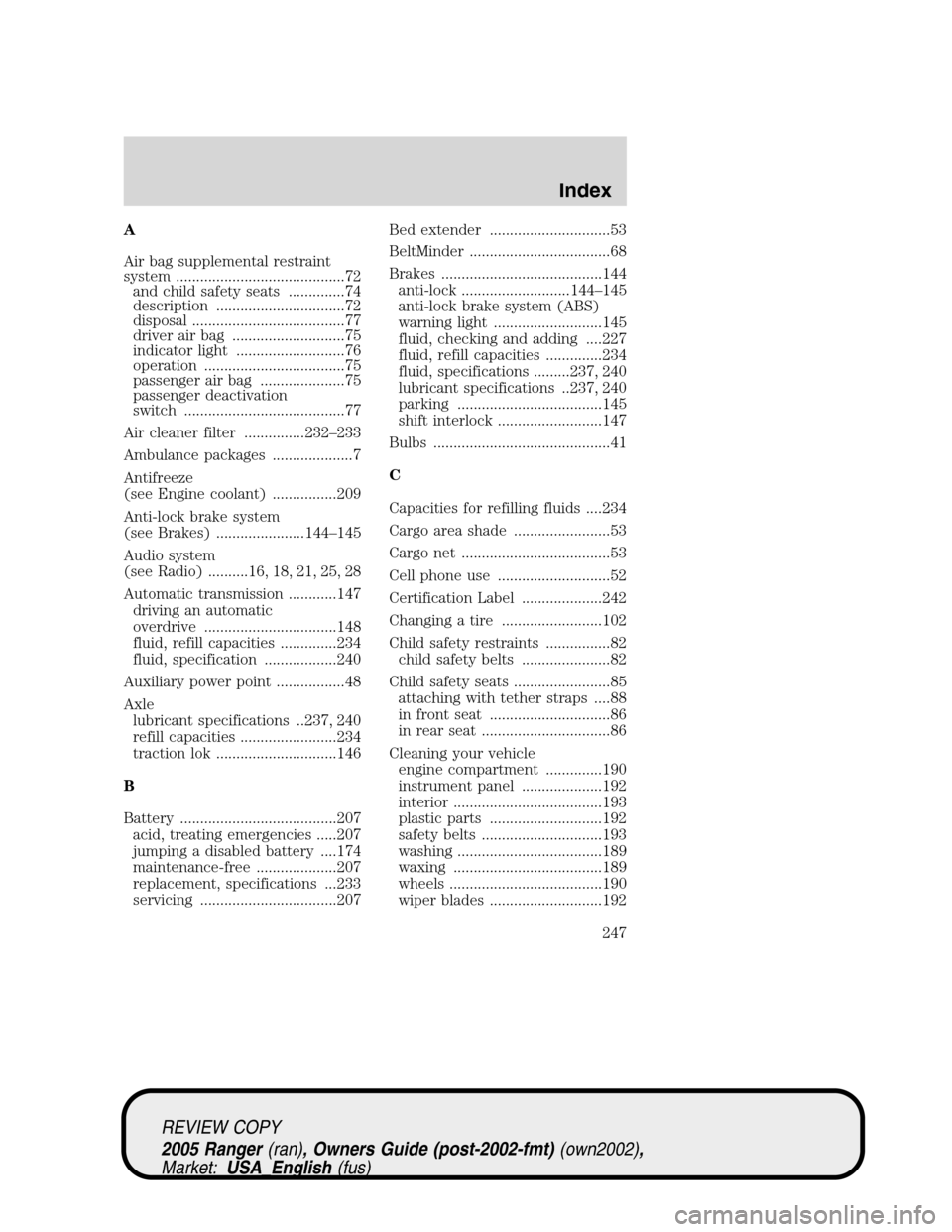
A
Air bag supplemental restraint
system ..........................................72
and child safety seats ..............74
description ................................72
disposal ......................................77
driver air bag ............................75
indicator light ...........................76
operation ...................................75
passenger air bag .....................75
passenger deactivation
switch ........................................77
Air cleaner filter ...............232–233
Ambulance packages ....................7
Antifreeze
(see Engine coolant) ................209
Anti-lock brake system
(see Brakes) ......................144–145
Audio system
(see Radio) ..........16, 18, 21, 25, 28
Automatic transmission ............147
driving an automatic
overdrive .................................148
fluid, refill capacities ..............234
fluid, specification ..................240
Auxiliary power point .................48
Axle
lubricant specifications ..237, 240
refill capacities ........................234
traction lok ..............................146
B
Battery .......................................207
acid, treating emergencies .....207
jumping a disabled battery ....174
maintenance-free ....................207
replacement, specifications ...233
servicing ..................................207Bed extender ..............................53
BeltMinder ...................................68
Brakes ........................................144
anti-lock ...........................144–145
anti-lock brake system (ABS)
warning light ...........................145
fluid, checking and adding ....227
fluid, refill capacities ..............234
fluid, specifications .........237, 240
lubricant specifications ..237, 240
parking ....................................145
shift interlock ..........................147
Bulbs ............................................41
C
Capacities for refilling fluids ....234
Cargo area shade ........................53
Cargo net .....................................53
Cell phone use ............................52
Certification Label ....................242
Changing a tire .........................102
Child safety restraints ................82
child safety belts ......................82
Child safety seats ........................85
attaching with tether straps ....88
in front seat ..............................86
in rear seat ................................86
Cleaning your vehicle
engine compartment ..............190
instrument panel ....................192
interior .....................................193
plastic parts ............................192
safety belts ..............................193
washing ....................................189
waxing .....................................189
wheels ......................................190
wiper blades ............................192
REVIEW COPY
2005 Ranger(ran), Owners Guide (post-2002-fmt)(own2002),
Market:USA_English(fus)
Index
Index
247
Page 250 of 256
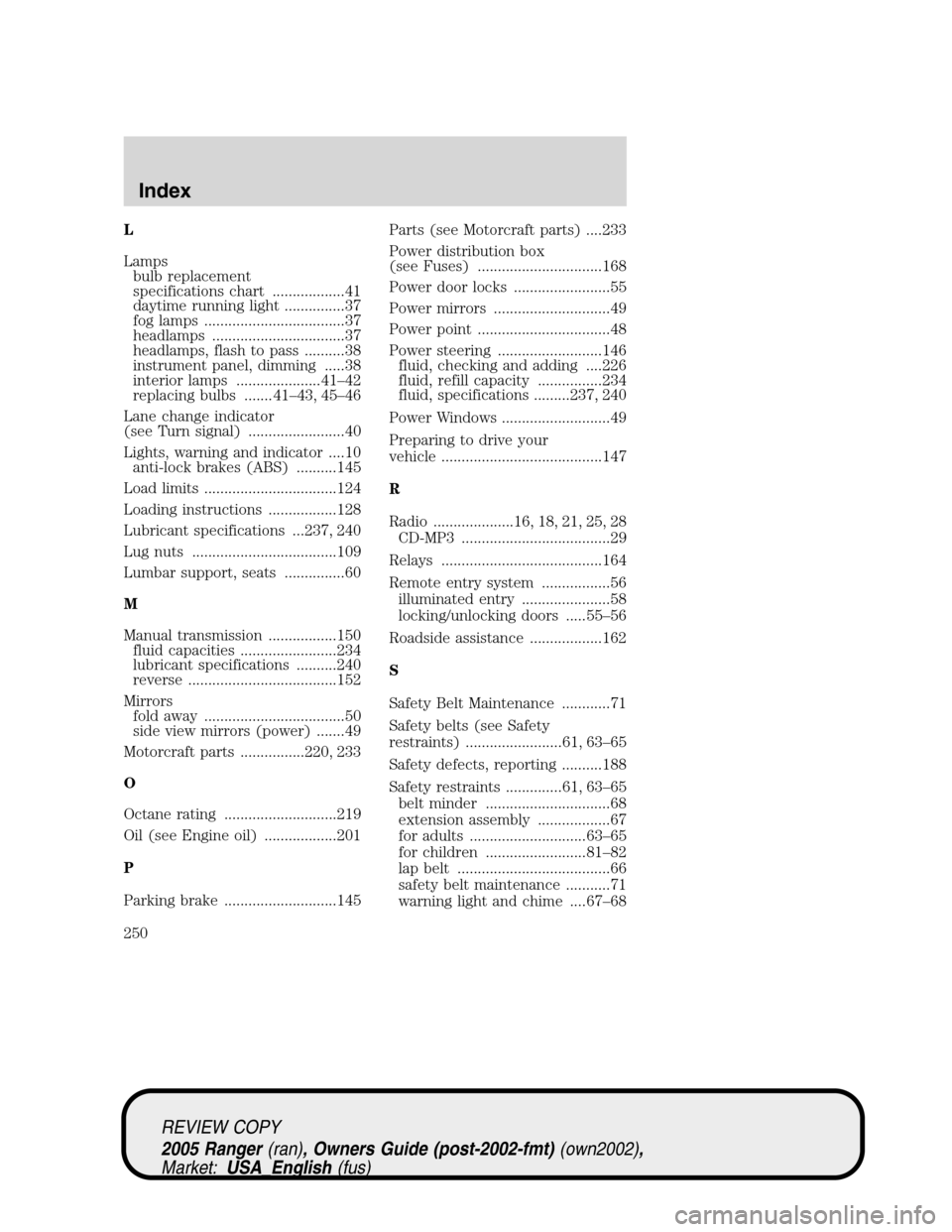
L
Lamps
bulb replacement
specifications chart ..................41
daytime running light ...............37
fog lamps ...................................37
headlamps .................................37
headlamps, flash to pass ..........38
instrument panel, dimming .....38
interior lamps .....................41–42
replacing bulbs ....... 41–43, 45–46
Lane change indicator
(see Turn signal) ........................40
Lights, warning and indicator ....10
anti-lock brakes (ABS) ..........145
Load limits .................................124
Loading instructions .................128
Lubricant specifications ...237, 240
Lug nuts ....................................109
Lumbar support, seats ...............60
M
Manual transmission .................150
fluid capacities ........................234
lubricant specifications ..........240
reverse .....................................152
Mirrors
fold away ...................................50
side view mirrors (power) .......49
Motorcraft parts ................220, 233
O
Octane rating ............................219
Oil (see Engine oil) ..................201
P
Parking brake ............................145Parts (see Motorcraft parts) ....233
Power distribution box
(see Fuses) ...............................168
Power door locks ........................55
Power mirrors .............................49
Power point .................................48
Power steering ..........................146
fluid, checking and adding ....226
fluid, refill capacity ................234
fluid, specifications .........237, 240
Power Windows ...........................49
Preparing to drive your
vehicle ........................................147
R
Radio ....................16, 18, 21, 25, 28
CD-MP3 .....................................29
Relays ........................................164
Remote entry system .................56
illuminated entry ......................58
locking/unlocking doors .....55–56
Roadside assistance ..................162
S
Safety Belt Maintenance ............71
Safety belts (see Safety
restraints) ........................61, 63–65
Safety defects, reporting ..........188
Safety restraints ..............61, 63–65
belt minder ...............................68
extension assembly ..................67
for adults .............................63–65
for children .........................81–82
lap belt ......................................66
safety belt maintenance ...........71
warning light and chime ....67–68
REVIEW COPY
2005 Ranger(ran), Owners Guide (post-2002-fmt)(own2002),
Market:USA_English(fus)
Index
250
Page 252 of 256
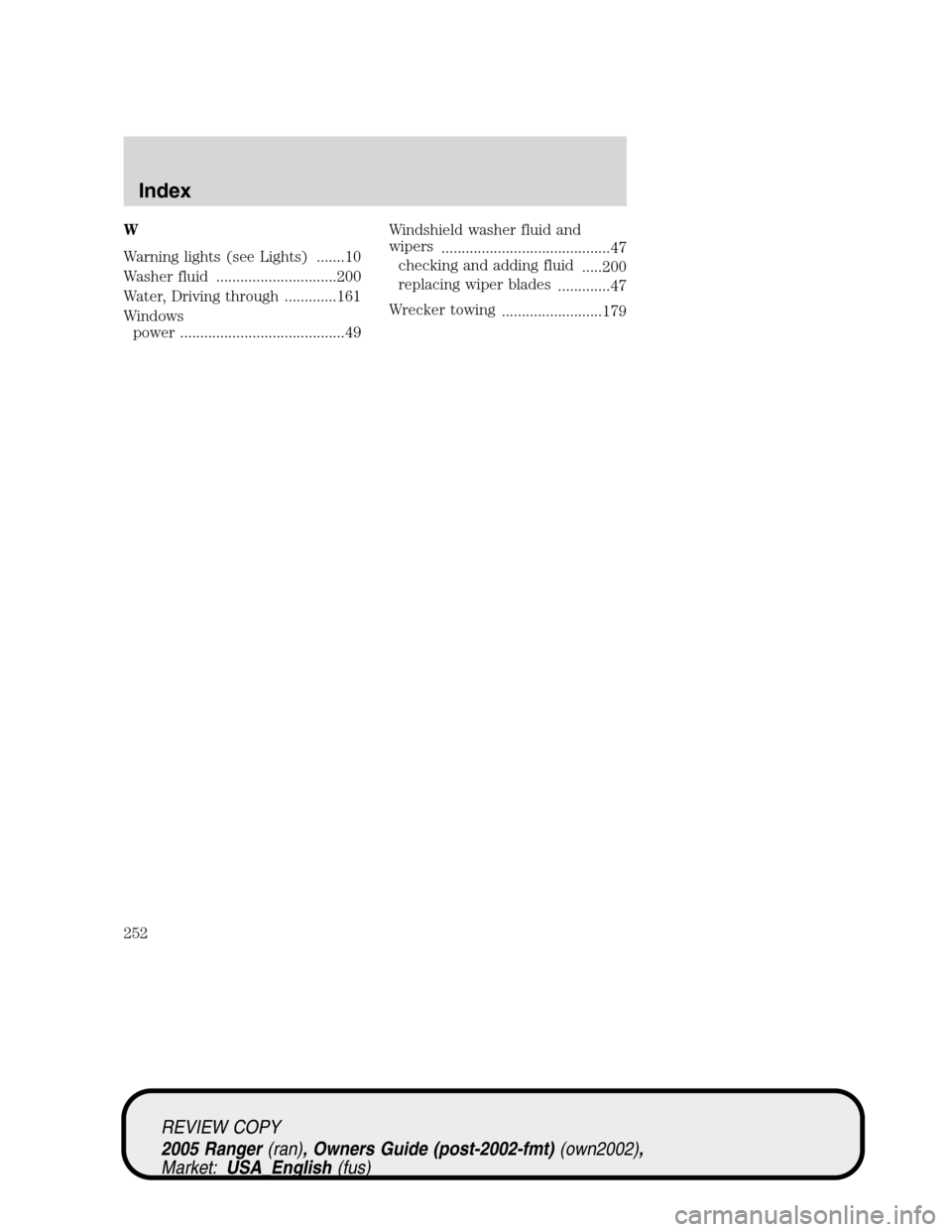
W
Warning lights (see Lights) .......10
Washer fluid ..............................200
Water, Driving through .............161
Windows
power .........................................49Windshield washer fluid and
wipers
..........................................47
checking and adding fluid
.....200
replacing wiper blades
.............47
Wrecker towing
.........................179
REVIEW COPY
2005 Ranger(ran), Owners Guide (post-2002-fmt)(own2002),
Market:USA_English(fus)
Index
252