brake FORD RANGER 2006 2.G User Guide
[x] Cancel search | Manufacturer: FORD, Model Year: 2006, Model line: RANGER, Model: FORD RANGER 2006 2.GPages: 256, PDF Size: 2.64 MB
Page 117 of 256
SNOW TIRES AND CHAINS
Driving too fast for conditions creates the possibility of loss of
vehicle control. Driving at very high speeds for extended periods
of time may result in damage to vehicle components.
Snow tires must be the same size and grade as the tires you
currently have on your vehicle.
The tires on your vehicle have all weather treads to provide traction in
rain and snow. However, in some climates, you may need to use snow
tires and chains. If you need to use snow tires and chains, it is
recommended that steel wheels are used of the same size and
specifications as those originally installed.
Follow these guidelines when using snow tires and chains:
•Do not use tire chains on aluminum wheels. Chains may chip the
wheels.
•Use only SAE Class S chains.
•Install chains securely, verifying that the chains do not touch any
wiring, brake lines or fuel lines.
•Drive cautiously. If you hear the chains rub or bang against your
vehicle, stop and re-tighten the chains. If this does not work, remove
the chains to prevent damage to your vehicle.
•If possible, avoid fully loading your vehicle.
•Remove the tire chains when they are no longer needed. Do not use
tire chains on dry roads.
•The suspension insulation and bumpers will help prevent vehicle
damage. Do not remove these components from your vehicle when
using snow tires and chains.
VEHICLE LOADING – WITH AND WITHOUT A TRAILER
This section will guide you in the proper loading of your vehicle and/or
trailer, to keep your loaded vehicle weight within its design rating
capability, with or without a trailer. Properly loading your vehicle will
provide maximum return of vehicle design performance. Before loading
your vehicle, familiarize yourself with the following terms for determining
your vehicle’s weight ratings, with or without a trailer, from the vehicle’s
Safety Compliance Certification Label:
2006 Ranger(ran)
Owners Guide (post-2002-fmt)
USA(fus)
Tires, Wheels and Loading
117
Page 121 of 256
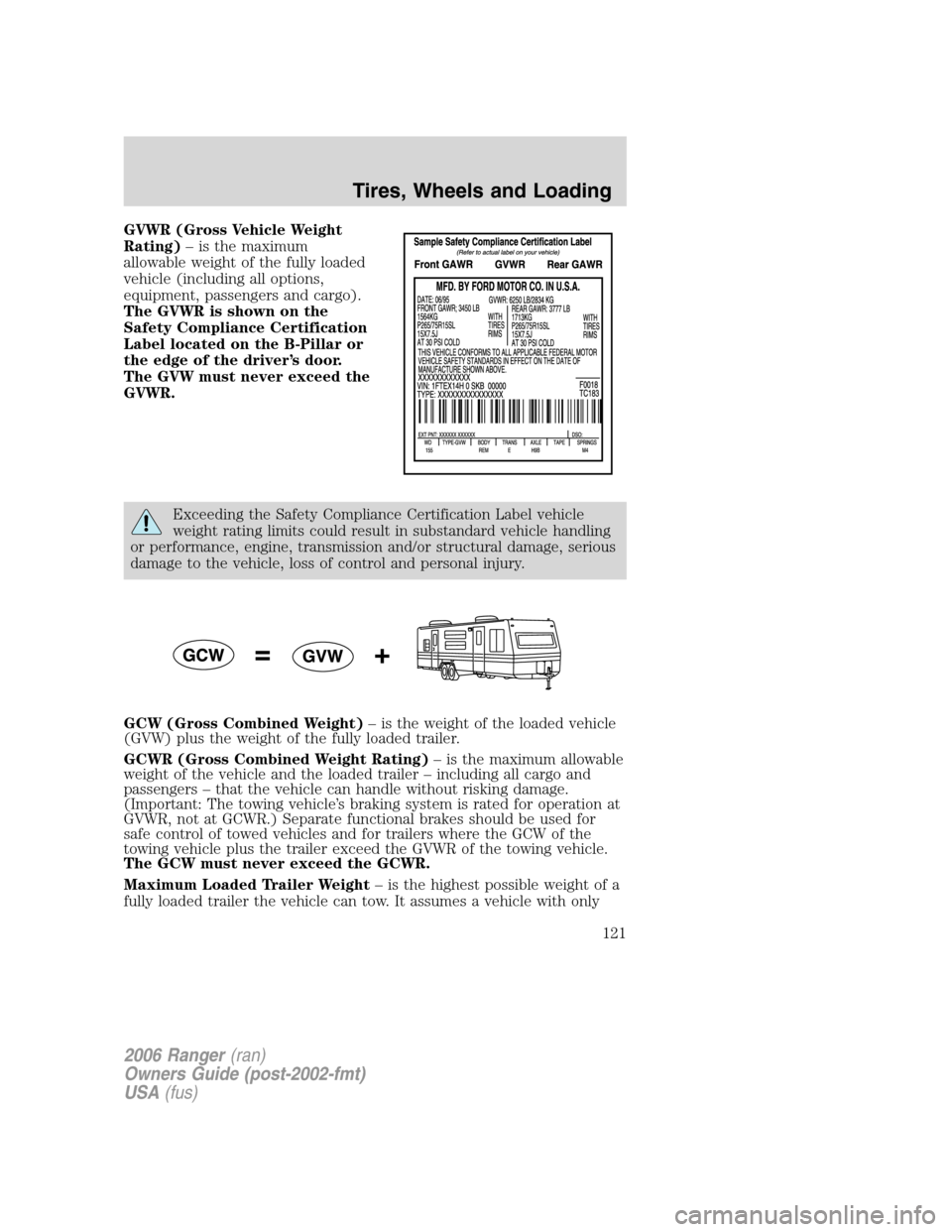
GVWR (Gross Vehicle Weight
Rating)– is the maximum
allowable weight of the fully loaded
vehicle (including all options,
equipment, passengers and cargo).
The GVWR is shown on the
Safety Compliance Certification
Label located on the B-Pillar or
the edge of the driver’s door.
The GVW must never exceed the
GVWR.
Exceeding the Safety Compliance Certification Label vehicle
weight rating limits could result in substandard vehicle handling
or performance, engine, transmission and/or structural damage, serious
damage to the vehicle, loss of control and personal injury.
GCW (Gross Combined Weight)– is the weight of the loaded vehicle
(GVW) plus the weight of the fully loaded trailer.
GCWR (Gross Combined Weight Rating)– is the maximum allowable
weight of the vehicle and the loaded trailer – including all cargo and
passengers – that the vehicle can handle without risking damage.
(Important: The towing vehicle’s braking system is rated for operation at
GVWR, not at GCWR.) Separate functional brakes should be used for
safe control of towed vehicles and for trailers where the GCW of the
towing vehicle plus the trailer exceed the GVWR of the towing vehicle.
The GCW must never exceed the GCWR.
Maximum Loaded Trailer Weight– is the highest possible weight of a
fully loaded trailer the vehicle can tow. It assumes a vehicle with only
2006 Ranger(ran)
Owners Guide (post-2002-fmt)
USA(fus)
Tires, Wheels and Loading
121
Page 124 of 256
Special loading instructions for owners of pickup trucks and
utility-type vehicles
For important information regarding safe operation of this type
of vehicle, see thePreparing to drive your vehiclesection in
theDrivingchapter of thisOwner’s Guide.
Loaded vehicles may handle differently than unloaded vehicles.
Extra precautions, such as slower speeds and increased stopping
distance, should be taken when driving a heavily loaded vehicle.
Your vehicle can haul more cargo and people than most passenger cars.
Depending upon the type and placement of the load, hauling cargo and
people may raise the center of gravity of the vehicle.
TRAILER TOWING
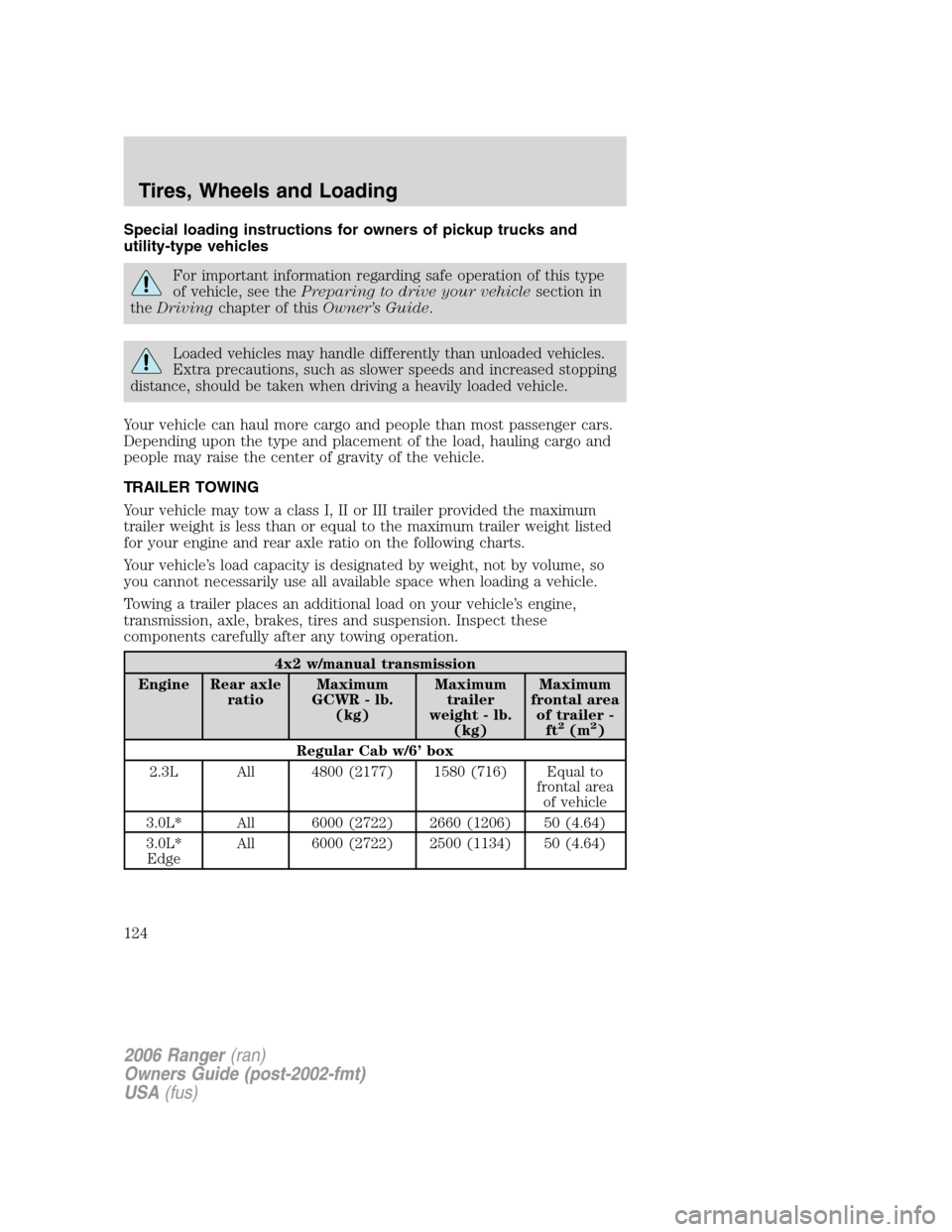
Your vehicle may tow a class I, II or III trailer provided the maximum
trailer weight is less than or equal to the maximum trailer weight listed
for your engine and rear axle ratio on the following charts.
Your vehicle’s load capacity is designated by weight, not by volume, so
you cannot necessarily use all available space when loading a vehicle.
Towing a trailer places an additional load on your vehicle’s engine,
transmission, axle, brakes, tires and suspension. Inspect these
components carefully after any towing operation.
4x2 w/manual transmission
Engine Rear axle
ratioMaximum
GCWR - lb.
(kg)Maximum
trailer
weight - lb.
(kg)Maximum
frontal area
of trailer -
ft
2(m2)
Regular Cab w/6’ box
2.3L All 4800 (2177) 1580 (716) Equal to
frontal area
of vehicle
3.0L* All 6000 (2722) 2660 (1206) 50 (4.64)
3.0L*
EdgeAll 6000 (2722) 2500 (1134) 50 (4.64)
2006 Ranger(ran)
Owners Guide (post-2002-fmt)
USA(fus)
Tires, Wheels and Loading
124
Page 125 of 256
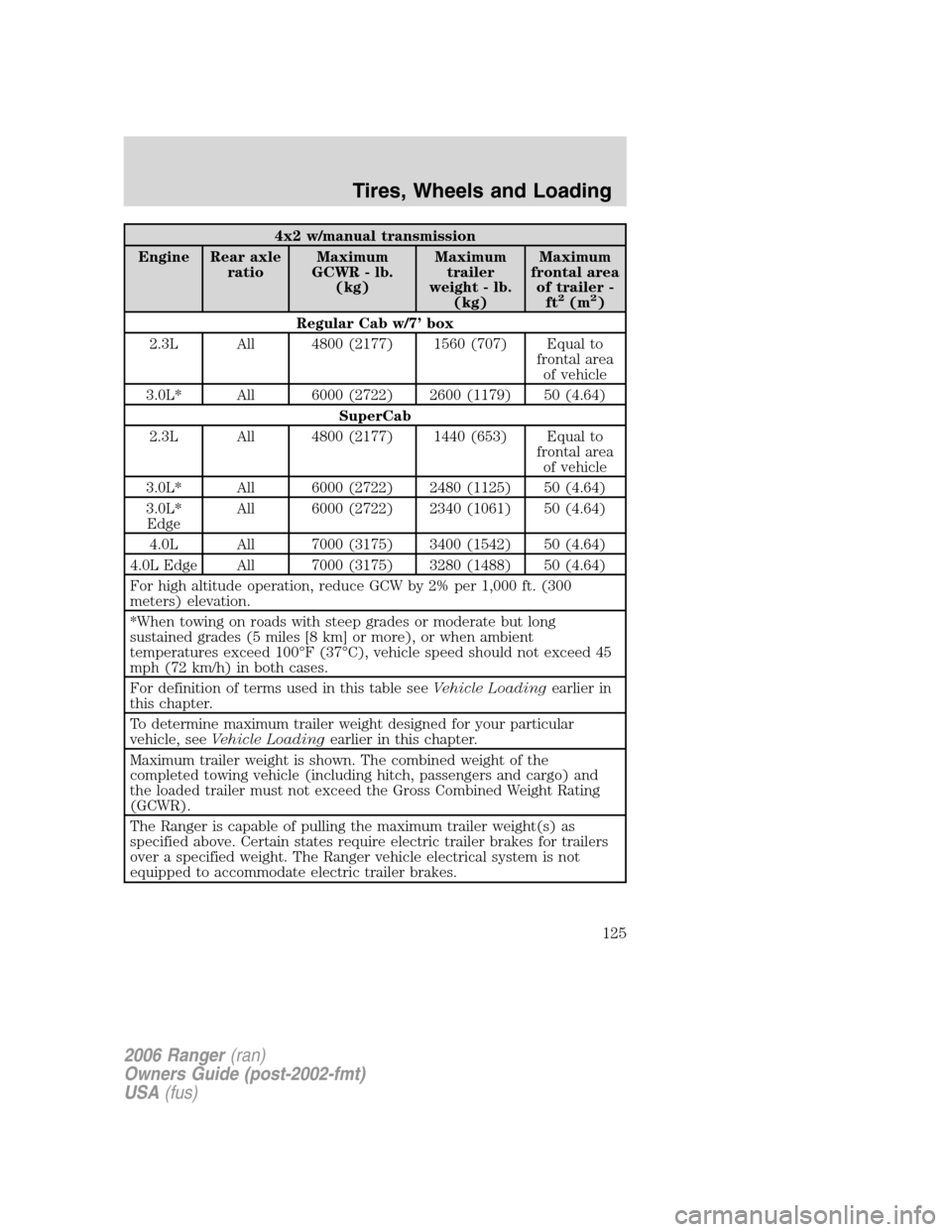
4x2 w/manual transmission
Engine Rear axle
ratioMaximum
GCWR - lb.
(kg)Maximum
trailer
weight - lb.
(kg)Maximum
frontal area
of trailer -
ft
2(m2)
Regular Cab w/7’ box
2.3L All 4800 (2177) 1560 (707) Equal to
frontal area
of vehicle
3.0L* All 6000 (2722) 2600 (1179) 50 (4.64)
SuperCab
2.3L All 4800 (2177) 1440 (653) Equal to
frontal area
of vehicle
3.0L* All 6000 (2722) 2480 (1125) 50 (4.64)
3.0L*
EdgeAll 6000 (2722) 2340 (1061) 50 (4.64)
4.0L All 7000 (3175) 3400 (1542) 50 (4.64)
4.0L Edge All 7000 (3175) 3280 (1488) 50 (4.64)
For high altitude operation, reduce GCW by 2% per 1,000 ft. (300
meters) elevation.
*When towing on roads with steep grades or moderate but long
sustained grades (5 miles [8 km] or more), or when ambient
temperatures exceed 100°F (37°C), vehicle speed should not exceed 45
mph (72 km/h) in both cases.
For definition of terms used in this table seeVehicle Loadingearlier in
this chapter.
To determine maximum trailer weight designed for your particular
vehicle, seeVehicle Loadingearlier in this chapter.
Maximum trailer weight is shown. The combined weight of the
completed towing vehicle (including hitch, passengers and cargo) and
the loaded trailer must not exceed the Gross Combined Weight Rating
(GCWR).
The Ranger is capable of pulling the maximum trailer weight(s) as
specified above. Certain states require electric trailer brakes for trailers
over a specified weight. The Ranger vehicle electrical system is not
equipped to accommodate electric trailer brakes.
2006 Ranger(ran)
Owners Guide (post-2002-fmt)
USA(fus)
Tires, Wheels and Loading
125
Page 126 of 256
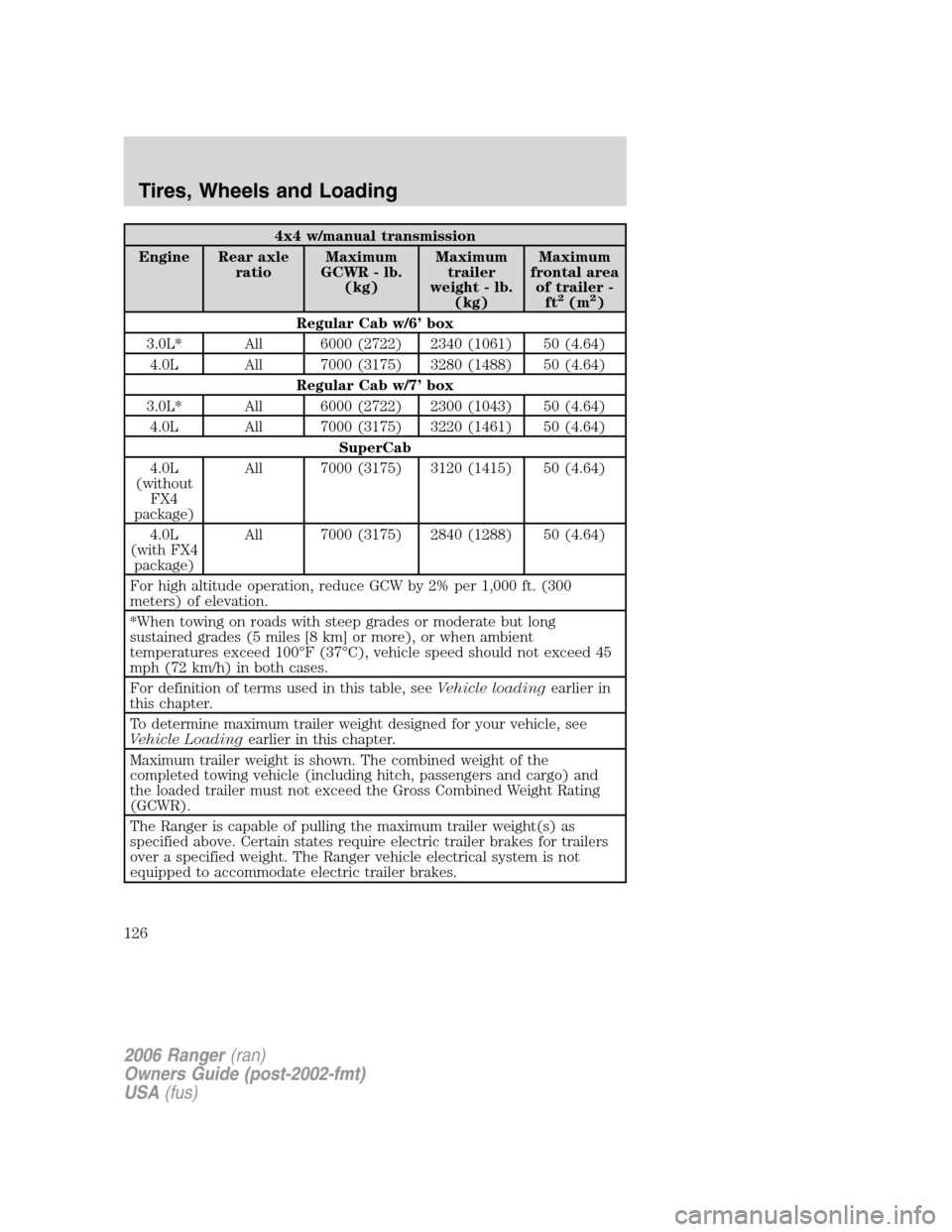
4x4 w/manual transmission
Engine Rear axle
ratioMaximum
GCWR - lb.
(kg)Maximum
trailer
weight - lb.
(kg)Maximum
frontal area
of trailer -
ft
2(m2)
Regular Cab w/6’ box
3.0L* All 6000 (2722) 2340 (1061) 50 (4.64)
4.0L All 7000 (3175) 3280 (1488) 50 (4.64)
Regular Cab w/7’ box
3.0L* All 6000 (2722) 2300 (1043) 50 (4.64)
4.0L All 7000 (3175) 3220 (1461) 50 (4.64)
SuperCab
4.0L
(without
FX4
package)All 7000 (3175) 3120 (1415) 50 (4.64)
4.0L
(with FX4
package)All 7000 (3175) 2840 (1288) 50 (4.64)
For high altitude operation, reduce GCW by 2% per 1,000 ft. (300
meters) of elevation.
*When towing on roads with steep grades or moderate but long
sustained grades (5 miles [8 km] or more), or when ambient
temperatures exceed 100°F (37°C), vehicle speed should not exceed 45
mph (72 km/h) in both cases.
For definition of terms used in this table, seeVehicle loadingearlier in
this chapter.
To determine maximum trailer weight designed for your vehicle, see
Vehicle Loadingearlier in this chapter.
Maximum trailer weight is shown. The combined weight of the
completed towing vehicle (including hitch, passengers and cargo) and
the loaded trailer must not exceed the Gross Combined Weight Rating
(GCWR).
The Ranger is capable of pulling the maximum trailer weight(s) as
specified above. Certain states require electric trailer brakes for trailers
over a specified weight. The Ranger vehicle electrical system is not
equipped to accommodate electric trailer brakes.
2006 Ranger(ran)
Owners Guide (post-2002-fmt)
USA(fus)
Tires, Wheels and Loading
126
Page 127 of 256
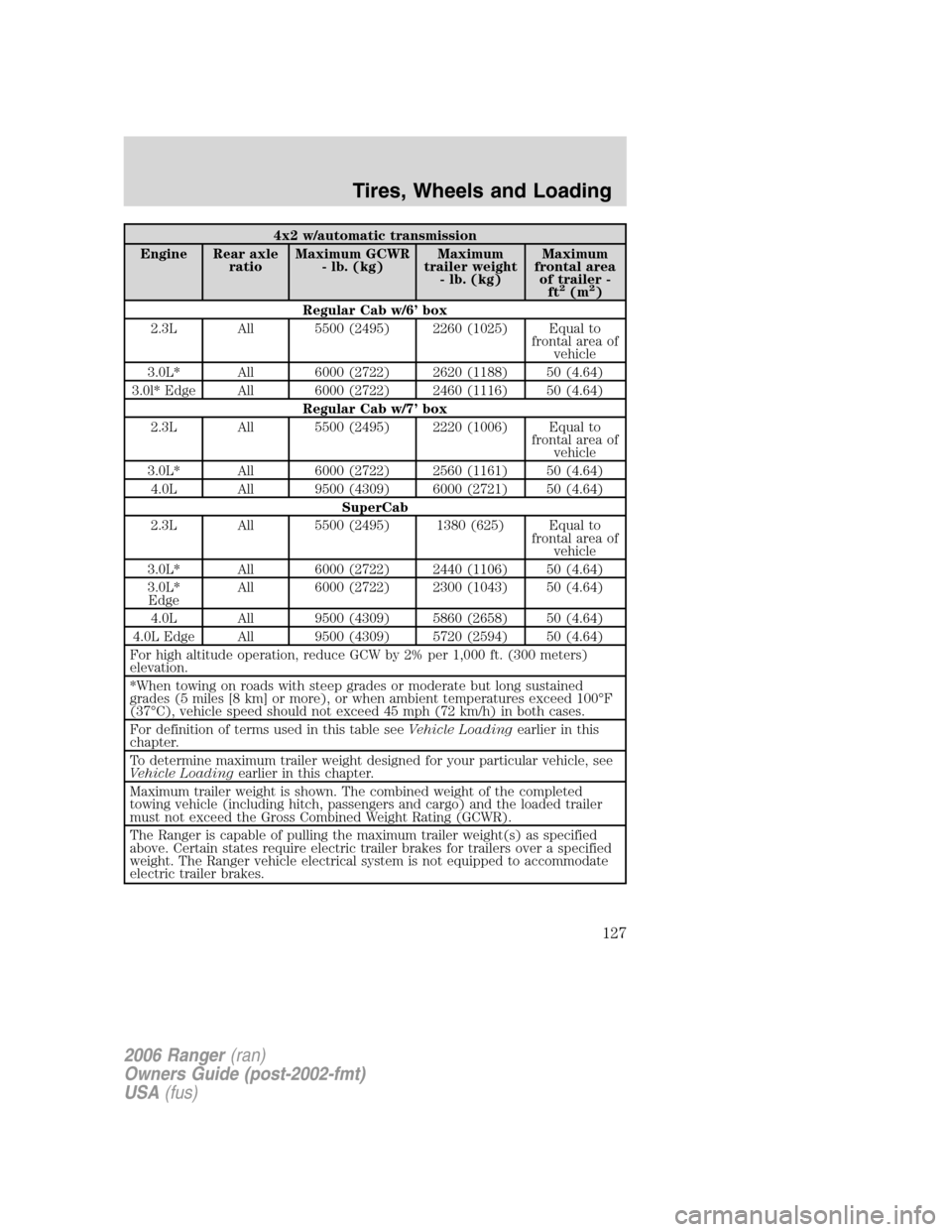
4x2 w/automatic transmission
Engine Rear axle
ratioMaximum GCWR
- lb. (kg)Maximum
trailer weight
- lb. (kg)Maximum
frontal area
of trailer -
ft
2(m2)
Regular Cab w/6’ box
2.3L All 5500 (2495) 2260 (1025) Equal to
frontal area of
vehicle
3.0L* All 6000 (2722) 2620 (1188) 50 (4.64)
3.0l* Edge All 6000 (2722) 2460 (1116) 50 (4.64)
Regular Cab w/7’ box
2.3L All 5500 (2495) 2220 (1006) Equal to
frontal area of
vehicle
3.0L* All 6000 (2722) 2560 (1161) 50 (4.64)
4.0L All 9500 (4309) 6000 (2721) 50 (4.64)
SuperCab
2.3L All 5500 (2495) 1380 (625) Equal to
frontal area of
vehicle
3.0L* All 6000 (2722) 2440 (1106) 50 (4.64)
3.0L*
EdgeAll 6000 (2722) 2300 (1043) 50 (4.64)
4.0L All 9500 (4309) 5860 (2658) 50 (4.64)
4.0L Edge All 9500 (4309) 5720 (2594) 50 (4.64)
For high altitude operation, reduce GCW by 2% per 1,000 ft. (300 meters)
elevation.
*When towing on roads with steep grades or moderate but long sustained
grades (5 miles [8 km] or more), or when ambient temperatures exceed 100°F
(37°C), vehicle speed should not exceed 45 mph (72 km/h) in both cases.
For definition of terms used in this table seeVehicle Loadingearlier in this
chapter.
To determine maximum trailer weight designed for your particular vehicle, see
Vehicle Loadingearlier in this chapter.
Maximum trailer weight is shown. The combined weight of the completed
towing vehicle (including hitch, passengers and cargo) and the loaded trailer
must not exceed the Gross Combined Weight Rating (GCWR).
The Ranger is capable of pulling the maximum trailer weight(s) as specified
above. Certain states require electric trailer brakes for trailers over a specified
weight. The Ranger vehicle electrical system is not equipped to accommodate
electric trailer brakes.
2006 Ranger(ran)
Owners Guide (post-2002-fmt)
USA(fus)
Tires, Wheels and Loading
127
Page 128 of 256
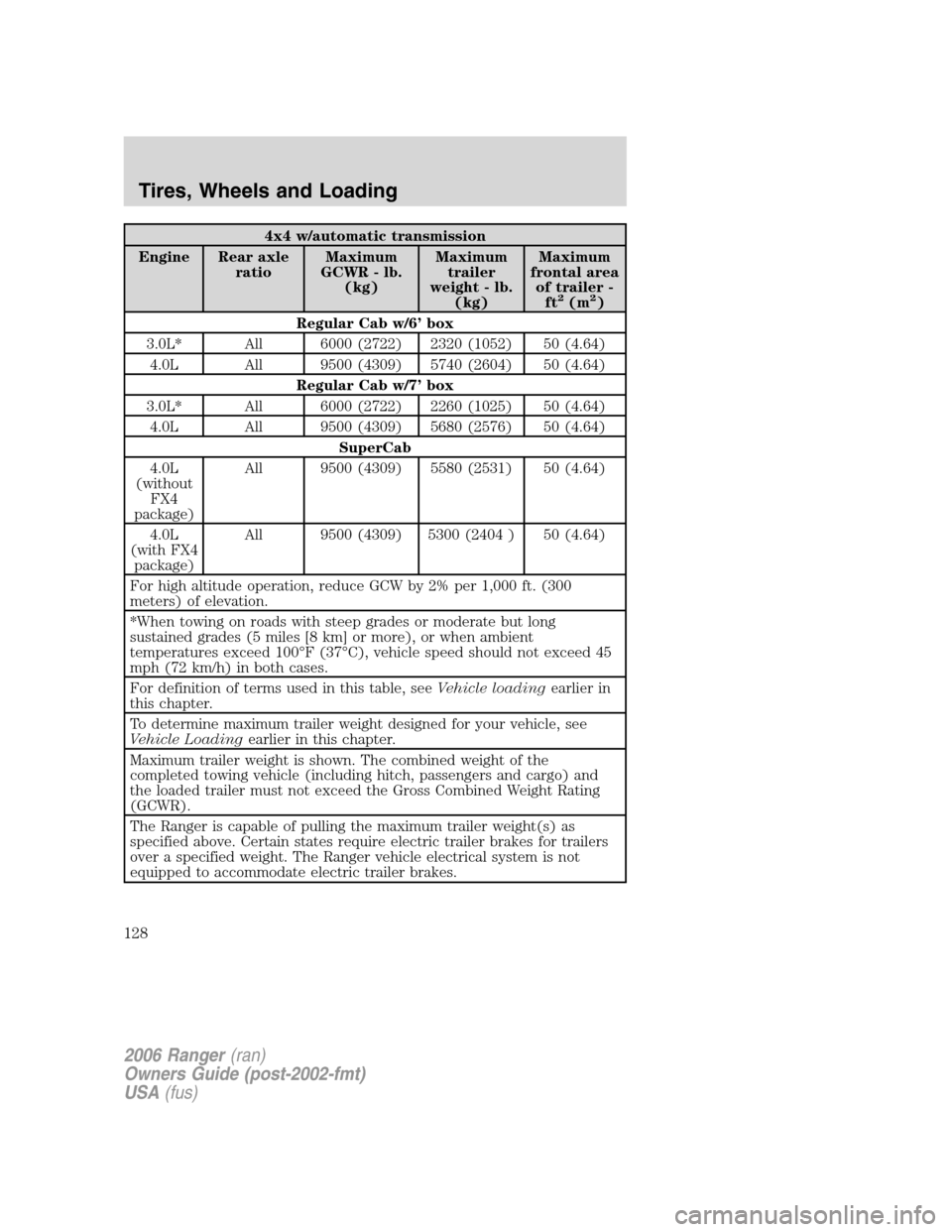
4x4 w/automatic transmission
Engine Rear axle
ratioMaximum
GCWR - lb.
(kg)Maximum
trailer
weight - lb.
(kg)Maximum
frontal area
of trailer -
ft
2(m2)
Regular Cab w/6’ box
3.0L* All 6000 (2722) 2320 (1052) 50 (4.64)
4.0L All 9500 (4309) 5740 (2604) 50 (4.64)
Regular Cab w/7’ box
3.0L* All 6000 (2722) 2260 (1025) 50 (4.64)
4.0L All 9500 (4309) 5680 (2576) 50 (4.64)
SuperCab
4.0L
(without
FX4
package)All 9500 (4309) 5580 (2531) 50 (4.64)
4.0L
(with FX4
package)All 9500 (4309) 5300 (2404 ) 50 (4.64)
For high altitude operation, reduce GCW by 2% per 1,000 ft. (300
meters) of elevation.
*When towing on roads with steep grades or moderate but long
sustained grades (5 miles [8 km] or more), or when ambient
temperatures exceed 100°F (37°C), vehicle speed should not exceed 45
mph (72 km/h) in both cases.
For definition of terms used in this table, seeVehicle loadingearlier in
this chapter.
To determine maximum trailer weight designed for your vehicle, see
Vehicle Loadingearlier in this chapter.
Maximum trailer weight is shown. The combined weight of the
completed towing vehicle (including hitch, passengers and cargo) and
the loaded trailer must not exceed the Gross Combined Weight Rating
(GCWR).
The Ranger is capable of pulling the maximum trailer weight(s) as
specified above. Certain states require electric trailer brakes for trailers
over a specified weight. The Ranger vehicle electrical system is not
equipped to accommodate electric trailer brakes.
2006 Ranger(ran)
Owners Guide (post-2002-fmt)
USA(fus)
Tires, Wheels and Loading
128
Page 129 of 256
Do not exceed the GVWR or the GAWR specified on the
certification label.
Towing trailers beyond the maximum recommended gross trailer
weight exceeds the limit of the vehicle and could result in
engine damage, transmission damage, structural damage, loss of vehicle
control, vehicle rollover and personal injury.
Preparing to tow
Use the proper equipment for towing a trailer and make sure it is
properly attached to your vehicle. See your authorized dealer or a
reliable trailer dealer if you require assistance.
Hitches
For towing trailers up to 2,000 lb. (907 kg), use a weight carrying hitch
and ball which uniformly distributes the trailer tongue loads through the
underbody structure. Use a frame-mounted weight distributing hitch for
trailers over 2,000 lb. (907 kg).
Do not install a single or multi-clamp type bumper hitch, or a hitch
which attaches to the axle. Underbody mounted hitches are acceptable if
they are installed properly. Follow the towing instructions of a reputable
rental agency.
Whenever a trailer hitch and hardware are removed, make sure all
mounting holes in the underbody are properly sealed to prevent noxious
gases or water from entering.
Safety chains
Always connect the trailer’s safety chains to the frame or hook retainers
of the vehicle hitch. To connect the trailer’s safety chains, cross the
chains under the trailer tongue and allow slack for turning corners.
If you use a rental trailer, follow the instructions that the rental agency
gives to you.
Do not attach safety chains to the bumper.
Trailer brakes
Electric brakes and manual, automatic or surge-type trailer brakes are
safe if installed properly and adjusted to the manufacturer’s
specifications. The trailer brakes must meet local and Federal
regulations.
2006 Ranger(ran)
Owners Guide (post-2002-fmt)
USA(fus)
Tires, Wheels and Loading
129
Page 130 of 256
Do not connect a trailer’s hydraulic brake system directly to your
vehicle’s brake system. Your vehicle may not have enough
braking power and your chances of having a collision greatly increase.
The braking system of the tow vehicle is rated for operation at the
GVWR not GCWR.
Trailer lamps
Trailer lamps are required on most towed vehicles. Make sure all running
lights, brake lights, turn signals and hazard lights are working. See your
authorized dealer or trailer rental agency for proper instructions and
equipment for hooking up trailer lamps.
Using a step bumper (if equipped)
The optional step bumper is equipped with an integral hitch and requires
only a ball with a 3/4 inch (19 mm) shank diameter. The bumper has a
2,000 lb. (907 kg) trailer weight and 200 lb. (91 kg) tongue weight
capability.
The rated capacities (as shown in this guide) for trailer towing with the
factory bumper are only valid when the trailer hitch ball is installed
directly into the ball hole in the bumper. Addition of bracketry to either
lower the ball hitch position or extend the ball hitch rearward will
significantly increase the loads on the bumper and its attachments. This
can result in the failure of the bumper or the bumper attachments. Use
of any type of hitch extensions should be considered abuse.
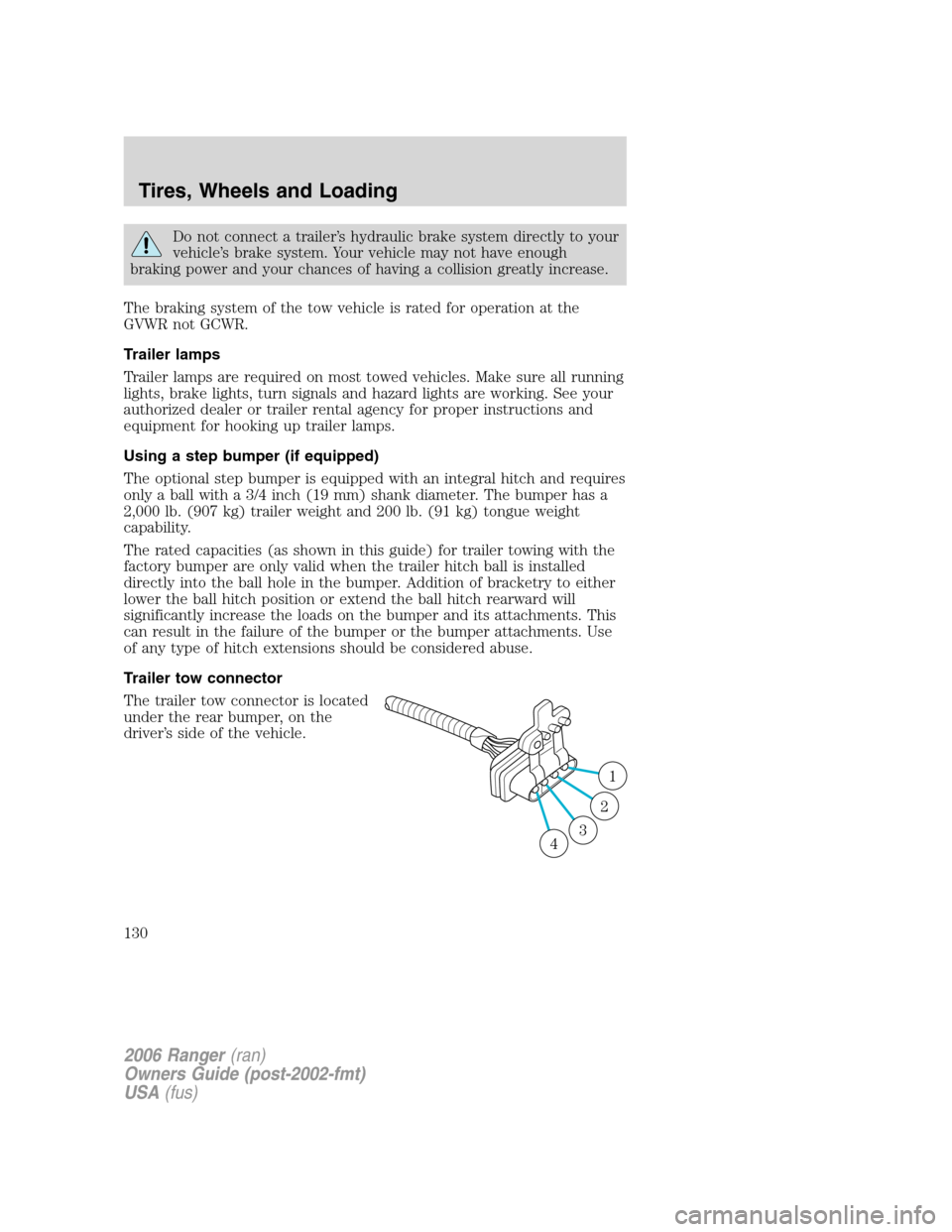
Trailer tow connector
The trailer tow connector is located
under the rear bumper, on the
driver’s side of the vehicle.
1
2
34
2006 Ranger(ran)
Owners Guide (post-2002-fmt)
USA(fus)
Tires, Wheels and Loading
130
Page 131 of 256
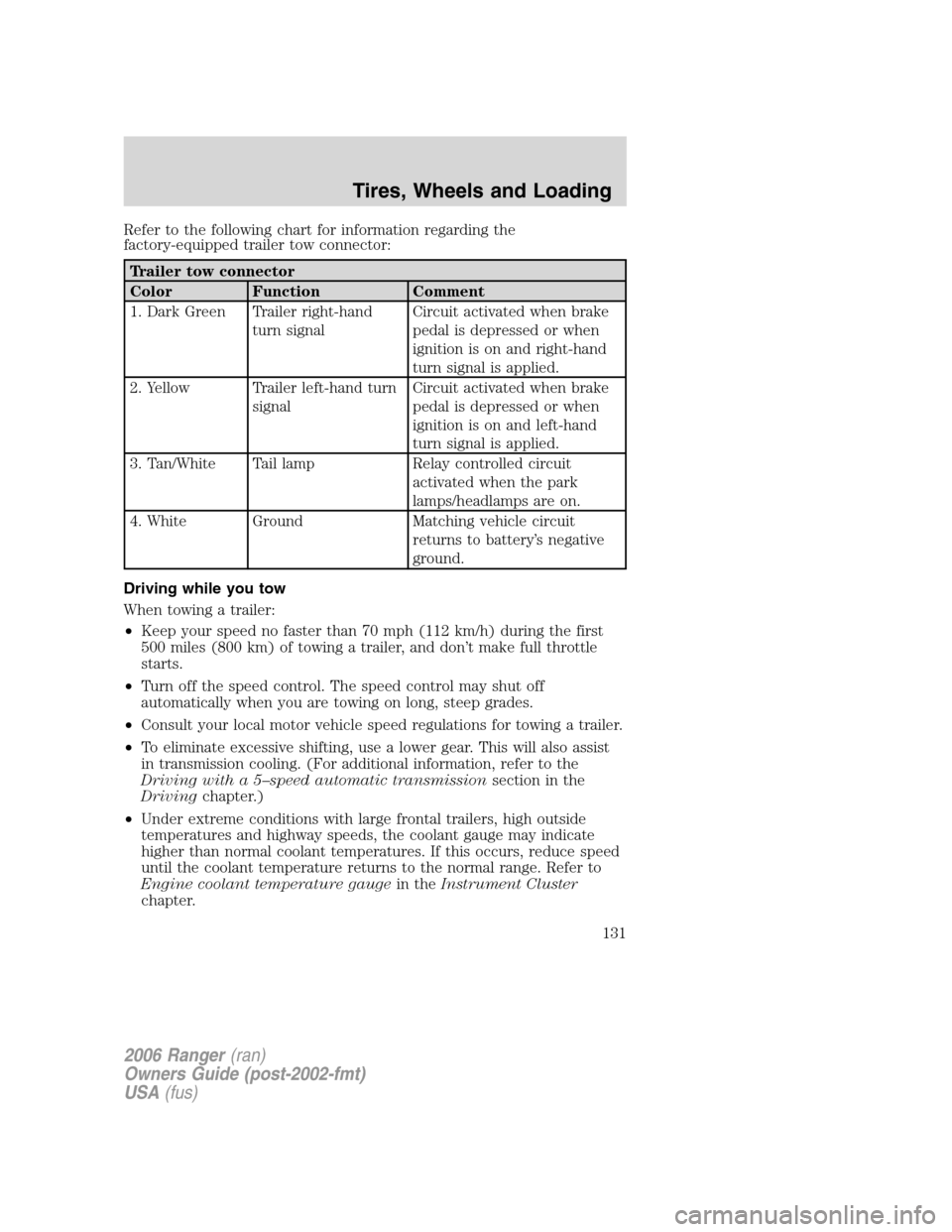
Refer to the following chart for information regarding the
factory-equipped trailer tow connector:
Trailer tow connector
Color Function Comment
1. Dark Green Trailer right-hand
turn signalCircuit activated when brake
pedal is depressed or when
ignition is on and right-hand
turn signal is applied.
2. Yellow Trailer left-hand turn
signalCircuit activated when brake
pedal is depressed or when
ignition is on and left-hand
turn signal is applied.
3. Tan/White Tail lamp Relay controlled circuit
activated when the park
lamps/headlamps are on.
4. White Ground Matching vehicle circuit
returns to battery’s negative
ground.
Driving while you tow
When towing a trailer:
•Keep your speed no faster than 70 mph (112 km/h) during the first
500 miles (800 km) of towing a trailer, and don’t make full throttle
starts.
•Turn off the speed control. The speed control may shut off
automatically when you are towing on long, steep grades.
•Consult your local motor vehicle speed regulations for towing a trailer.
•To eliminate excessive shifting, use a lower gear. This will also assist
in transmission cooling. (For additional information, refer to the
Driving with a 5–speed automatic transmissionsection in the
Drivingchapter.)
•Under extreme conditions with large frontal trailers, high outside
temperatures and highway speeds, the coolant gauge may indicate
higher than normal coolant temperatures. If this occurs, reduce speed
until the coolant temperature returns to the normal range. Refer to
Engine coolant temperature gaugein theInstrument Cluster
chapter.
2006 Ranger(ran)
Owners Guide (post-2002-fmt)
USA(fus)
Tires, Wheels and Loading
131