ignition FORD RANGER 2006 2.G Service Manual
[x] Cancel search | Manufacturer: FORD, Model Year: 2006, Model line: RANGER, Model: FORD RANGER 2006 2.GPages: 256, PDF Size: 2.64 MB
Page 223 of 256
Octane recommendations
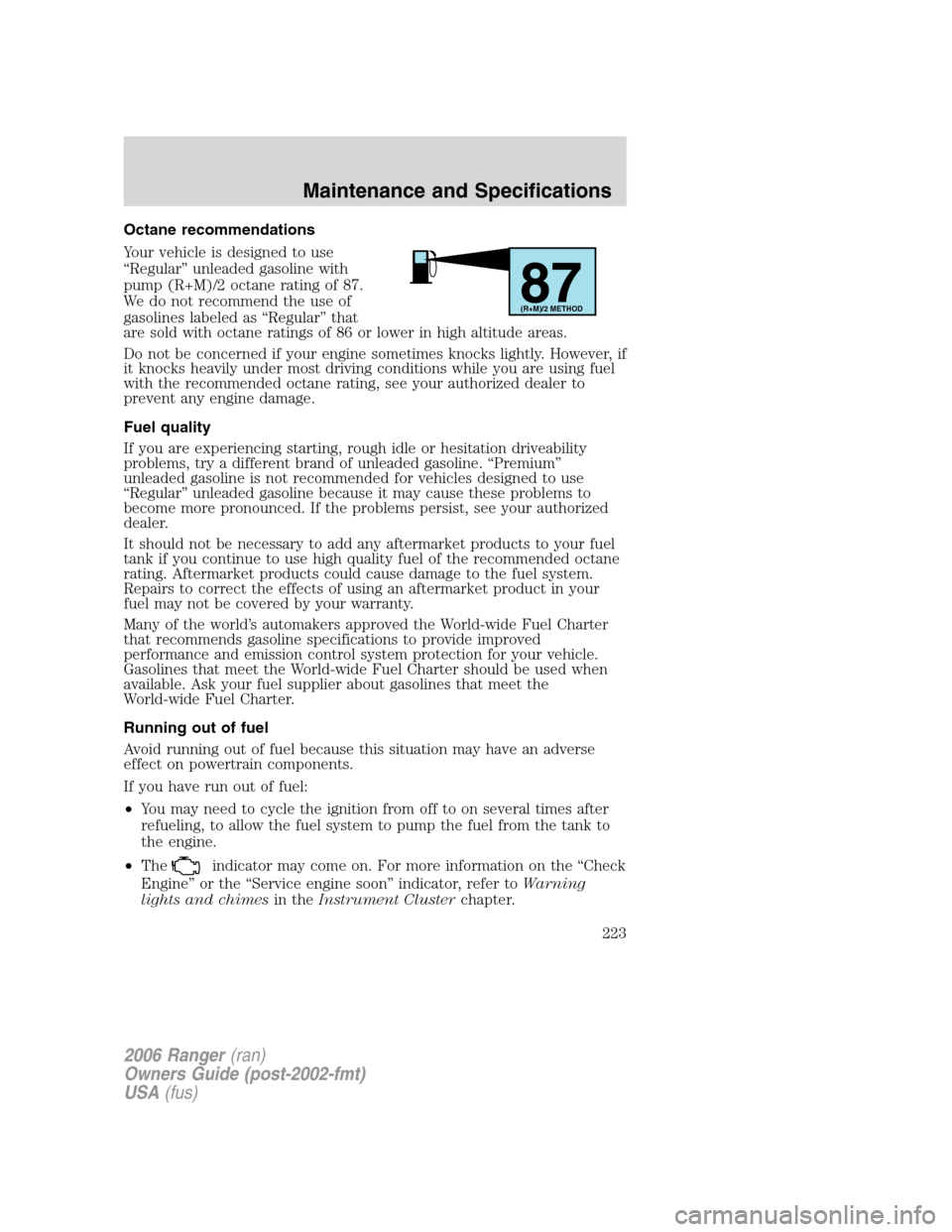
Your vehicle is designed to use
“Regular” unleaded gasoline with
pump (R+M)/2 octane rating of 87.
We do not recommend the use of
gasolines labeled as “Regular” that
are sold with octane ratings of 86 or lower in high altitude areas.
Do not be concerned if your engine sometimes knocks lightly. However, if
it knocks heavily under most driving conditions while you are using fuel
with the recommended octane rating, see your authorized dealer to
prevent any engine damage.
Fuel quality
If you are experiencing starting, rough idle or hesitation driveability
problems, try a different brand of unleaded gasoline. “Premium”
unleaded gasoline is not recommended for vehicles designed to use
“Regular” unleaded gasoline because it may cause these problems to
become more pronounced. If the problems persist, see your authorized
dealer.
It should not be necessary to add any aftermarket products to your fuel
tank if you continue to use high quality fuel of the recommended octane
rating. Aftermarket products could cause damage to the fuel system.
Repairs to correct the effects of using an aftermarket product in your
fuel may not be covered by your warranty.
Many of the world’s automakers approved the World-wide Fuel Charter
that recommends gasoline specifications to provide improved
performance and emission control system protection for your vehicle.
Gasolines that meet the World-wide Fuel Charter should be used when
available. Ask your fuel supplier about gasolines that meet the
World-wide Fuel Charter.
Running out of fuel
Avoid running out of fuel because this situation may have an adverse
effect on powertrain components.
If you have run out of fuel:
•You may need to cycle the ignition from off to on several times after
refueling, to allow the fuel system to pump the fuel from the tank to
the engine.
•The
indicator may come on. For more information on the “Check
Engine” or the “Service engine soon” indicator, refer toWarning
lights and chimesin theInstrument Clusterchapter.
87(R+M)/2 METHOD
2006 Ranger(ran)
Owners Guide (post-2002-fmt)
USA(fus)
Maintenance and Specifications
223
Page 224 of 256
ESSENTIALS OF GOOD FUEL ECONOMY
Measuring techniques
Your best source of information about actual fuel economy is you, the
driver. You must gather information as accurately and consistently as
possible. Fuel expense, frequency of fill-ups or fuel gauge readings are
NOT accurate as a measure of fuel economy. We do not recommend
taking fuel economy measurements during the first 1,000 miles (1,600
km) of driving (engine break-in period). You will get a more accurate
measurement after 2,000 miles-3,000 miles (3,000 km–5,000 km).
Filling the tank
The advertised fuel capacity of the fuel tank on your vehicle is equal to
the rated refill capacity of the fuel tank as listed in theRefill capacities
section of this chapter.
The advertised capacity is the amount of the indicated capacity and the
empty reserve combined. Indicated capacity is the difference in the
amount of fuel in a full tank and a tank when the fuel gauge indicates
empty. Empty reserve is the small amount of fuel remaining in the fuel
tank after the fuel gauge indicates empty.
The amount of usable fuel in the empty reserve varies and should
not be relied upon to increase driving range. When refueling your
vehicle after the fuel gauge indicates empty, you might not be
able to refuel the full amount of the advertised capacity of the
fuel tank due to the empty reserve still present in the tank.
For consistent results when filling the fuel tank:
•Turn the engine/ignition switch to the off position prior to refueling,
an error in the reading will result if the engine is left running.
•Use the same filling rate setting (low — medium — high) each time
the tank is filled.
•Allow no more than two automatic click-offs when filling.
•Always use fuel with the recommended octane rating.
•Use a known quality gasoline, preferably a national brand.
•Use the same side of the same pump and have the vehicle facing the
same direction each time you fill up.
•Have the vehicle loading and distribution the same every time.
Your results will be most accurate if your filling method is consistent.
Calculating fuel economy
1. Fill the fuel tank completely and record the initial odometer reading
(in miles or kilometers).
2006 Ranger(ran)
Owners Guide (post-2002-fmt)
USA(fus)
Maintenance and Specifications
224
Page 227 of 256
The EPA window sticker should be your guide for the fuel economy
comparisons with other vehicles.
It is important to note the box in the lower left corner of the window
sticker. These numbers represent the Range of MPG (L/100 km)
expected on the vehicle under optimum conditions. Your fuel economy
may vary depending upon the method of operation and conditions.
EMISSION CONTROL SYSTEM
Your vehicle is equipped with various emission control components and a
catalytic converter which will enable your vehicle to comply with
applicable exhaust emission standards. To make sure that the catalytic
converter and other emission control components continue to work
properly:
•Use only the specified fuel listed.
•Avoid running out of fuel.
•Do not turn off the ignition while your vehicle is moving, especially at
high speeds.
•Have the items listed inscheduled maintenance information
performed according to the specified schedule.
The scheduled maintenance items listed inscheduled maintenance
informationare essential to the life and performance of your vehicle
and to its emissions system.
If other than Ford, Motorcraft or Ford-authorized parts are used for
maintenance replacements or for service of components affecting
emission control, such non-Ford parts should be equivalent to genuine
Ford Motor Company parts in performance and durability.
Do not park, idle, or drive your vehicle in dry grass or other dry
ground cover. The emission system heats up the engine
compartment and exhaust system, which can start a fire.
Illumination of the
indicator, charging system warning light or the
temperature warning light, fluid leaks, strange odors, smoke or loss of
engine power could indicate that the emission control system is not
working properly.
Exhaust leaks may result in entry of harmful and potentially
lethal fumes into the passenger compartment.
2006 Ranger(ran)
Owners Guide (post-2002-fmt)
USA(fus)
Maintenance and Specifications
227
Page 243 of 256
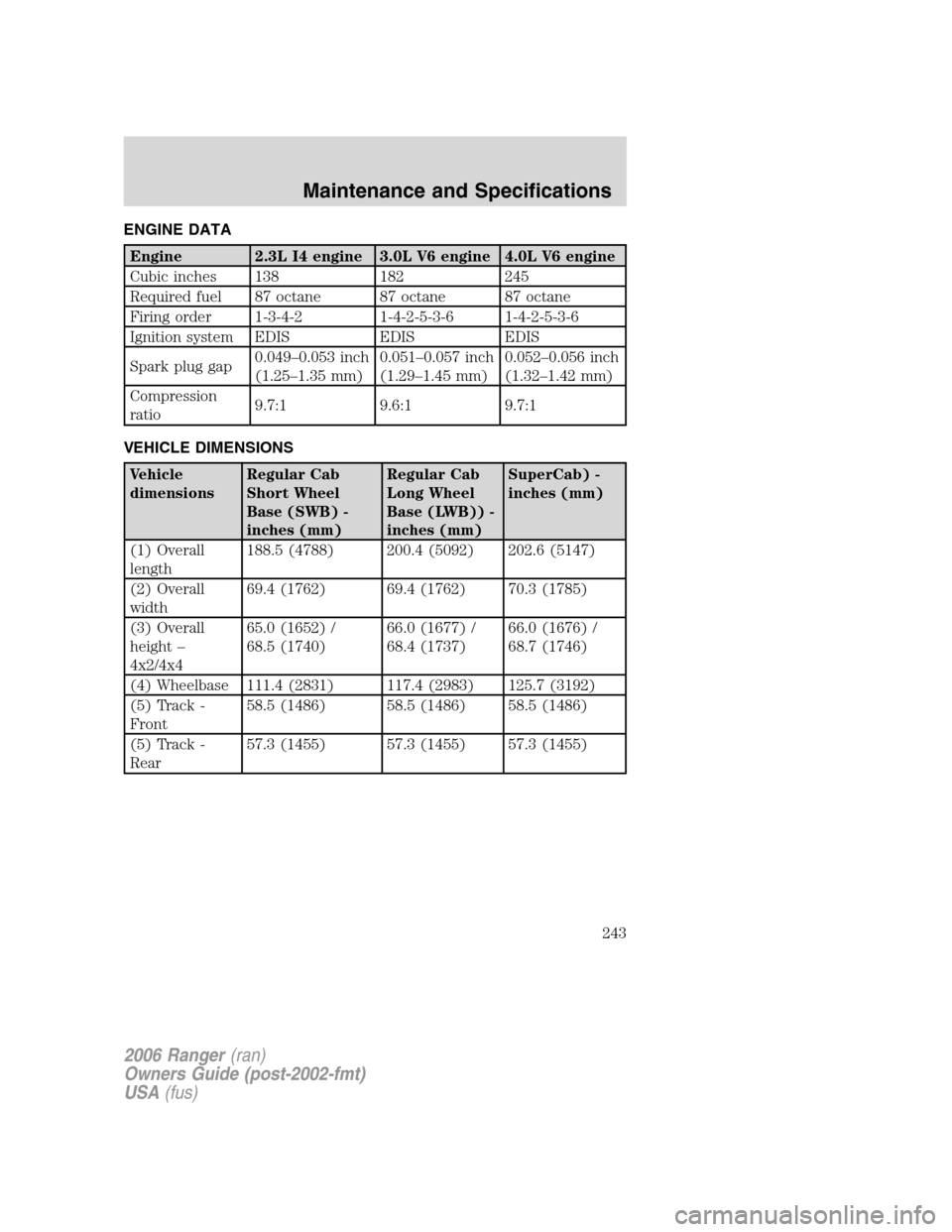
ENGINE DATA
Engine 2.3L I4 engine 3.0L V6 engine 4.0L V6 engine
Cubic inches 138 182 245
Required fuel 87 octane 87 octane 87 octane
Firing order 1-3-4-2 1-4-2-5-3-6 1-4-2-5-3-6
Ignition system EDIS EDIS EDIS
Spark plug gap0.049–0.053 inch
(1.25–1.35 mm)0.051–0.057 inch
(1.29–1.45 mm)0.052–0.056 inch
(1.32–1.42 mm)
Compression
ratio9.7:1 9.6:1 9.7:1
VEHICLE DIMENSIONS
Vehicle
dimensionsRegular Cab
Short Wheel
Base (SWB) -
inches (mm)Regular Cab
Long Wheel
Base (LWB)) -
inches (mm)SuperCab) -
inches (mm)
(1) Overall
length188.5 (4788) 200.4 (5092) 202.6 (5147)
(2) Overall
width69.4 (1762) 69.4 (1762) 70.3 (1785)
(3) Overall
height –
4x2/4x465.0 (1652) /
68.5 (1740)66.0 (1677) /
68.4 (1737)66.0 (1676) /
68.7 (1746)
(4) Wheelbase 111.4 (2831) 117.4 (2983) 125.7 (3192)
(5) Track -
Front58.5 (1486) 58.5 (1486) 58.5 (1486)
(5) Track -
Rear57.3 (1455) 57.3 (1455) 57.3 (1455)
2006 Ranger(ran)
Owners Guide (post-2002-fmt)
USA(fus)
Maintenance and Specifications
243
Page 253 of 256
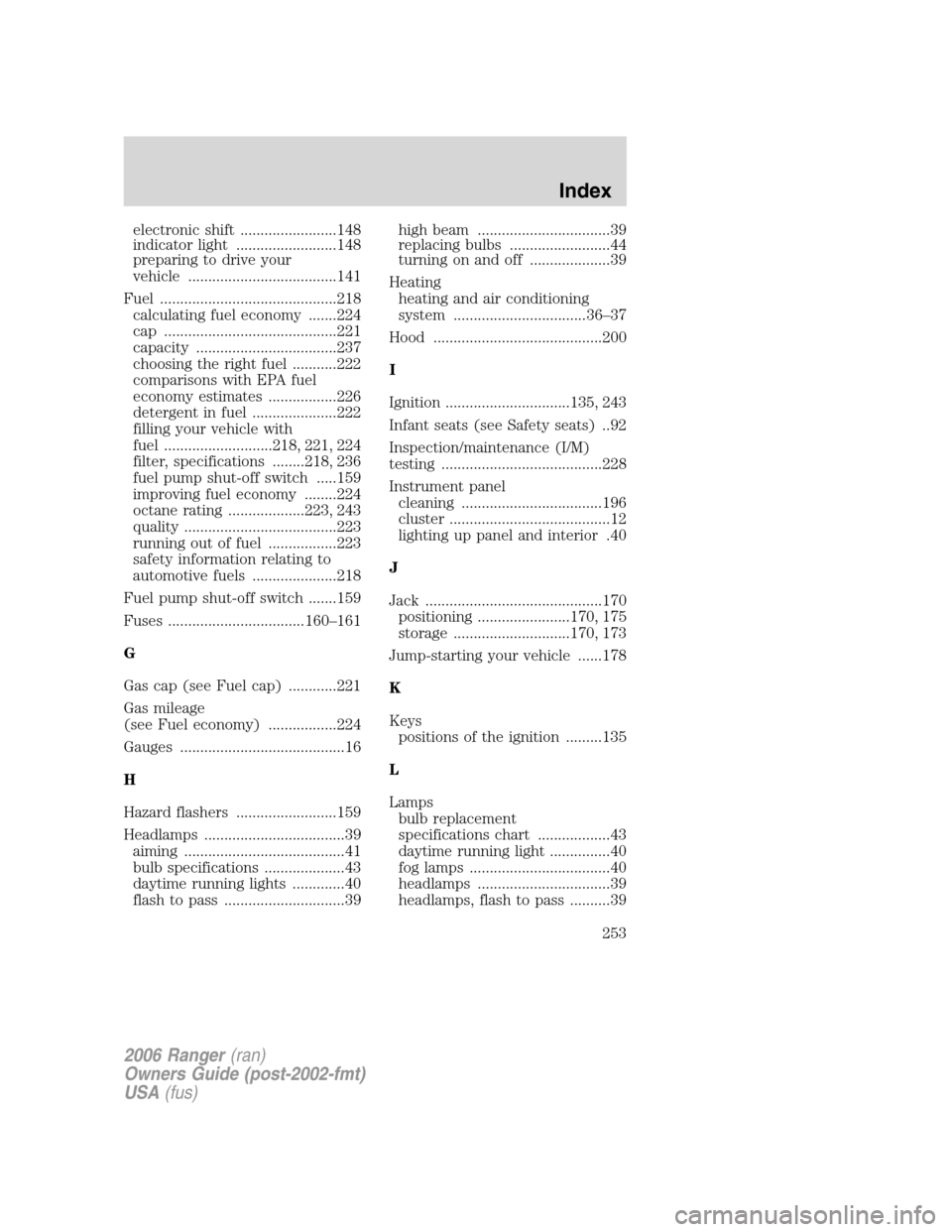
electronic shift ........................148
indicator light .........................148
preparing to drive your
vehicle .....................................141
Fuel ............................................218
calculating fuel economy .......224
cap ...........................................221
capacity ...................................237
choosing the right fuel ...........222
comparisons with EPA fuel
economy estimates .................226
detergent in fuel .....................222
filling your vehicle with
fuel ...........................218, 221, 224
filter, specifications ........218, 236
fuel pump shut-off switch .....159
improving fuel economy ........224
octane rating ...................223, 243
quality ......................................223
running out of fuel .................223
safety information relating to
automotive fuels .....................218
Fuel pump shut-off switch .......159
Fuses ..................................160–161
G
Gas cap (see Fuel cap) ............221
Gas mileage
(see Fuel economy) .................224
Gauges .........................................16
H
Hazard flashers .........................159
Headlamps ...................................39
aiming ........................................41
bulb specifications ....................43
daytime running lights .............40
flash to pass ..............................39high beam .................................39
replacing bulbs .........................44
turning on and off ....................39
Heating
heating and air conditioning
system .................................36–37
Hood ..........................................200
I
Ignition ...............................135, 243
Infant seats (see Safety seats) ..92
Inspection/maintenance (I/M)
testing ........................................228
Instrument panel
cleaning ...................................196
cluster ........................................12
lighting up panel and interior .40
J
Jack ............................................170
positioning .......................170, 175
storage .............................170, 173
Jump-starting your vehicle ......178
K
Keys
positions of the ignition .........135
L
Lamps
bulb replacement
specifications chart ..................43
daytime running light ...............40
fog lamps ...................................40
headlamps .................................39
headlamps, flash to pass ..........39
2006 Ranger(ran)
Owners Guide (post-2002-fmt)
USA(fus)
Index
253