tire pressure FORD RANGER 2007 2.G Owner's Manual
[x] Cancel search | Manufacturer: FORD, Model Year: 2007, Model line: RANGER, Model: FORD RANGER 2007 2.GPages: 280, PDF Size: 2.9 MB
Page 191 of 280
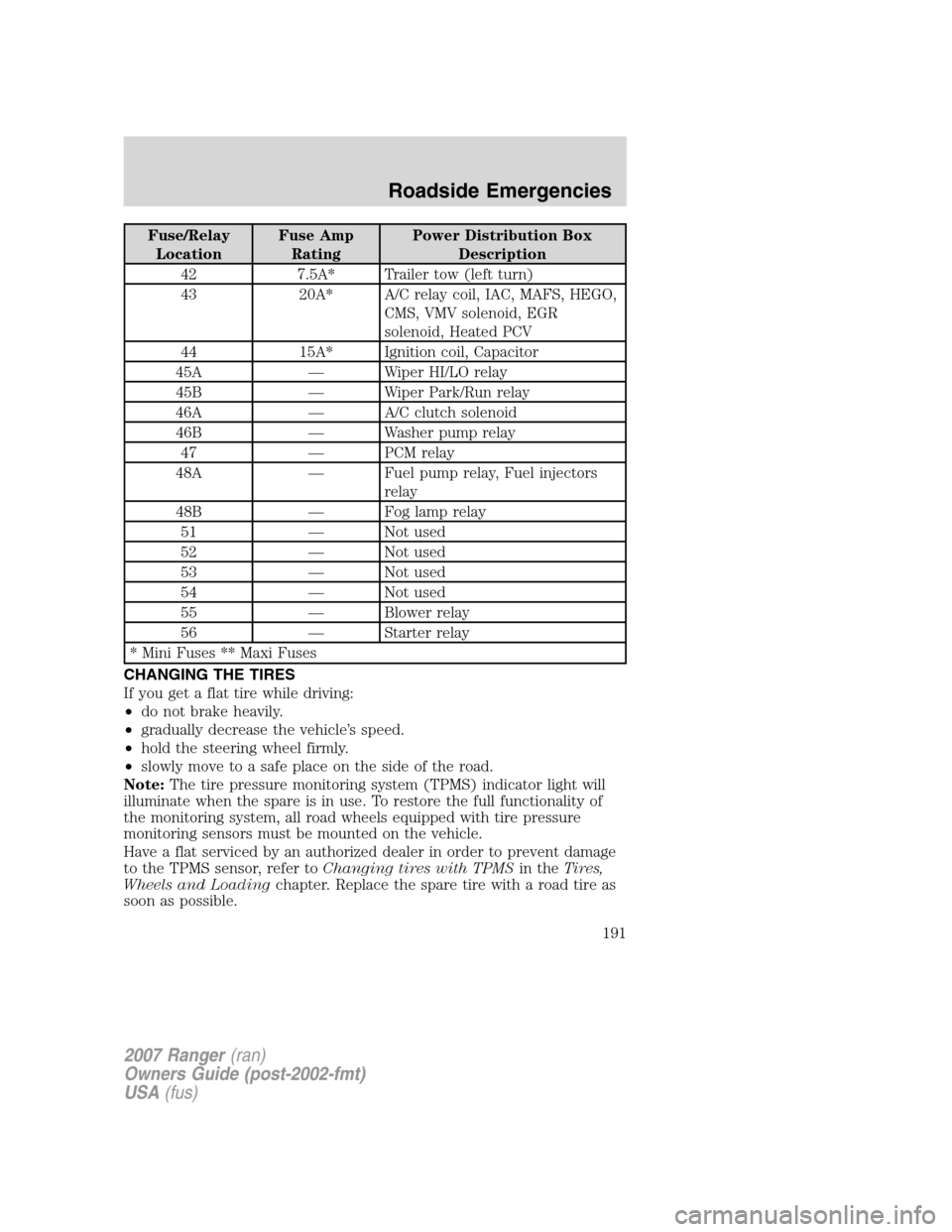
Fuse/Relay
LocationFuse Amp
RatingPower Distribution Box
Description
42 7.5A* Trailer tow (left turn)
43 20A* A/C relay coil, IAC, MAFS, HEGO,
CMS, VMV solenoid, EGR
solenoid, Heated PCV
44 15A* Ignition coil, Capacitor
45A — Wiper HI/LO relay
45B — Wiper Park/Run relay
46A — A/C clutch solenoid
46B — Washer pump relay
47 — PCM relay
48A — Fuel pump relay, Fuel injectors
relay
48B — Fog lamp relay
51 — Not used
52 — Not used
53 — Not used
54 — Not used
55 — Blower relay
56 — Starter relay
* Mini Fuses ** Maxi Fuses
CHANGING THE TIRES
If you get a flat tire while driving:
•do not brake heavily.
•gradually decrease the vehicle’s speed.
•hold the steering wheel firmly.
•slowly move to a safe place on the side of the road.
Note:The tire pressure monitoring system (TPMS) indicator light will
illuminate when the spare is in use. To restore the full functionality of
the monitoring system, all road wheels equipped with tire pressure
monitoring sensors must be mounted on the vehicle.
Have a flat serviced by an authorized dealer in order to prevent damage
to the TPMS sensor, refer toChanging tires with TPMSin theTires,
Wheels and Loadingchapter. Replace the spare tire with a road tire as
soon as possible.
2007 Ranger(ran)
Owners Guide (post-2002-fmt)
USA(fus)
Roadside Emergencies
191
Page 192 of 280
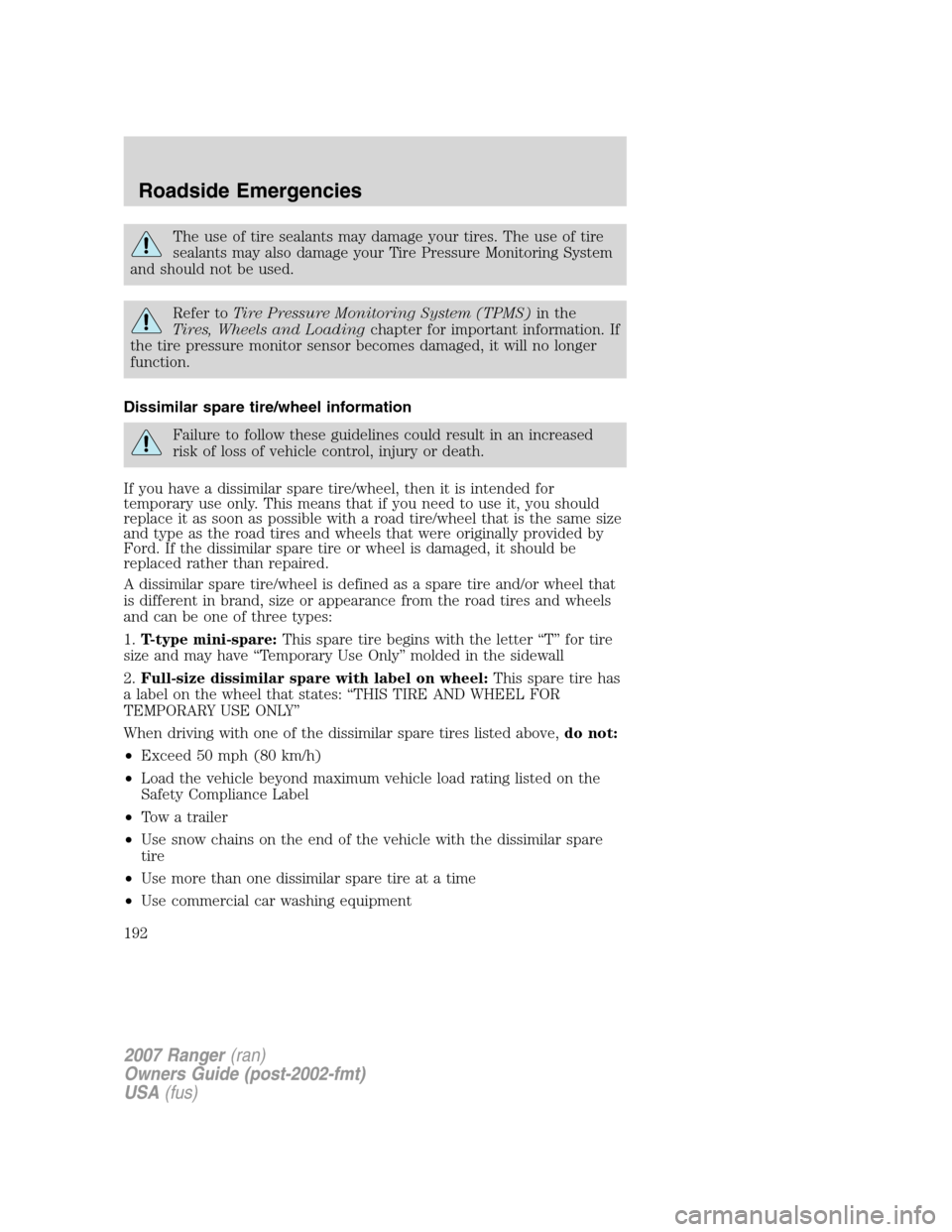
The use of tire sealants may damage your tires. The use of tire
sealants may also damage your Tire Pressure Monitoring System
and should not be used.
Refer toTire Pressure Monitoring System (TPMS)in the
Tires, Wheels and Loadingchapter for important information. If
the tire pressure monitor sensor becomes damaged, it will no longer
function.
Dissimilar spare tire/wheel information
Failure to follow these guidelines could result in an increased
risk of loss of vehicle control, injury or death.
If you have a dissimilar spare tire/wheel, then it is intended for
temporary use only. This means that if you need to use it, you should
replace it as soon as possible with a road tire/wheel that is the same size
and type as the road tires and wheels that were originally provided by
Ford. If the dissimilar spare tire or wheel is damaged, it should be
replaced rather than repaired.
A dissimilar spare tire/wheel is defined as a spare tire and/or wheel that
is different in brand, size or appearance from the road tires and wheels
and can be one of three types:
1.T-type mini-spare:This spare tire begins with the letter “T” for tire
size and may have “Temporary Use Only” molded in the sidewall
2.Full-size dissimilar spare with label on wheel:This spare tire has
a label on the wheel that states: “THIS TIRE AND WHEEL FOR
TEMPORARY USE ONLY”
When driving with one of the dissimilar spare tires listed above,do not:
•Exceed 50 mph (80 km/h)
•Load the vehicle beyond maximum vehicle load rating listed on the
Safety Compliance Label
•Tow a trailer
•Use snow chains on the end of the vehicle with the dissimilar spare
tire
•Use more than one dissimilar spare tire at a time
•Use commercial car washing equipment
2007 Ranger(ran)
Owners Guide (post-2002-fmt)
USA(fus)
Roadside Emergencies
192
Page 194 of 280
Drive cautiously when using a full-size dissimilar spare tire/wheel and
seek service as soon as possible.
Full-size Matching Spare Tire/Wheel Information
This spare tire/wheel will match the road tire/wheel. When driving with
the full size matching spare tire/wheel, do not exceed 70 mph (113 km/h).
It is intended for temporary use only. This means if you need to use it,
you should replace it as soon as possible.
Location of the spare tire and tools
Note:The tire pressure monitoring system (TPMS) indicator light will
illuminate when the spare is in use. To restore the full functionality of
the TPMS system, all road wheels equipped with the tire pressure
monitoring sensors must be mounted on the vehicle.
Have a flat tire serviced by an authorized dealer in order to prevent
damage to the TPMS sensor, refer toTire Pressure Monitoring System
(TPMS)in theTires, Wheels and Loadingchapter. Replace the spare
tire with a road tire as soon as possible.
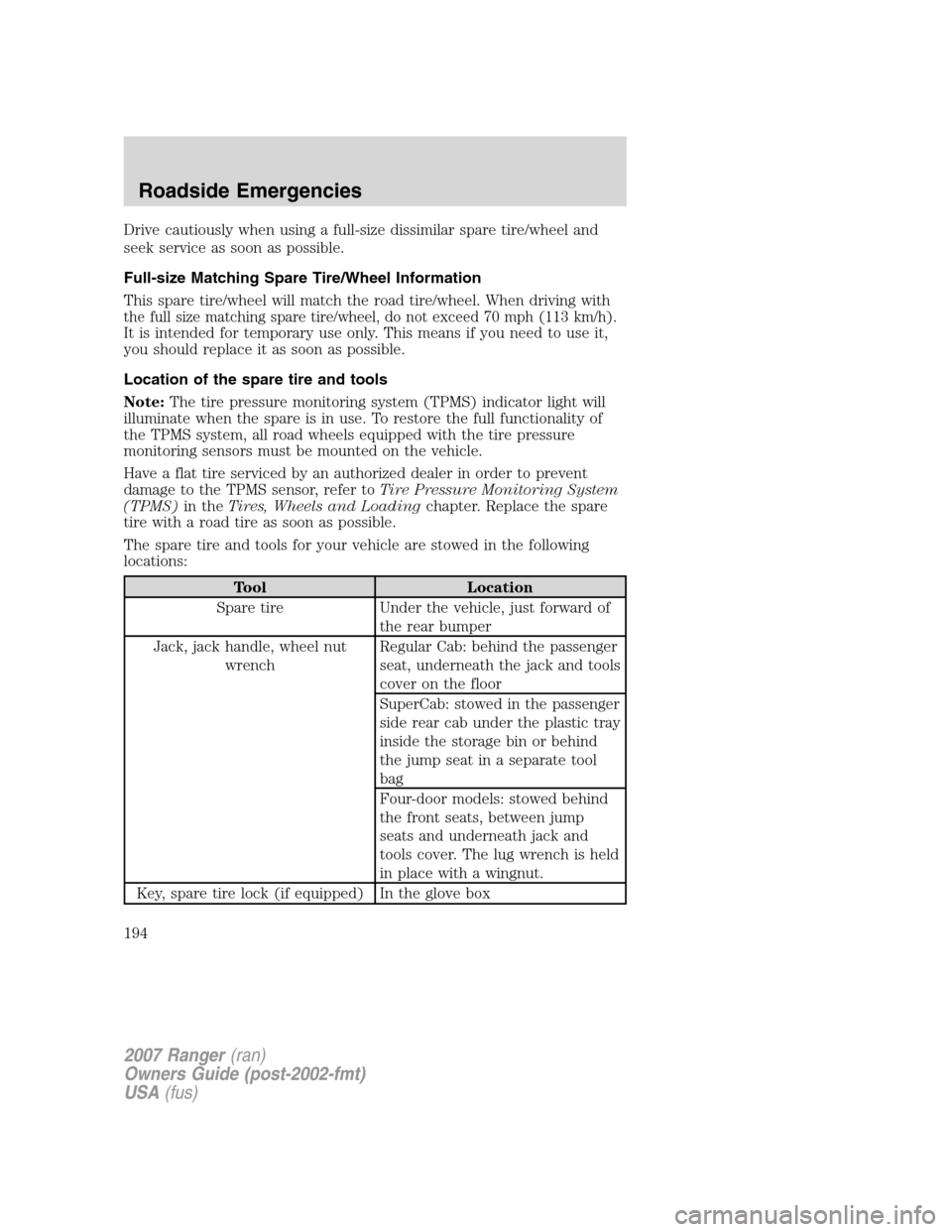
The spare tire and tools for your vehicle are stowed in the following
locations:
Tool Location
Spare tire Under the vehicle, just forward of
the rear bumper
Jack, jack handle, wheel nut
wrenchRegular Cab: behind the passenger
seat, underneath the jack and tools
cover on the floor
SuperCab: stowed in the passenger
side rear cab under the plastic tray
inside the storage bin or behind
the jump seat in a separate tool
bag
Four-door models: stowed behind
the front seats, between jump
seats and underneath jack and
tools cover. The lug wrench is held
in place with a wingnut.
Key, spare tire lock (if equipped) In the glove box
2007 Ranger(ran)
Owners Guide (post-2002-fmt)
USA(fus)
Roadside Emergencies
194
Page 199 of 280
Stowing the flat/spare tire
Note:Failure to follow spare tire stowage instructions may result in
failure of cable or loss of spare tire.
1. Lay the tire on the ground with the valve stem facing up.
2. Slide the wheel partially under the vehicle and install the wire and
retainer through the center of the wheel.
3. Turn the jack handle clockwise until the tire is raised to its original
position underneath the vehicle. The effort to turn the jack handle
increases significantly as the tire contacts the frame. The spare tire
carrier will ratchet when the tire is in the fully stowed position. The
spare tire carrier has a built-in ratchet feature that will not allow you to
overtighten. If the spare tire carrier ratchets with very little effort, take
the vehicle to your authorized dealer for assistance at your earliest
convenience.
4. Check that the tire lies flat against the frame assembly. Push against
the tire to make sure it is tightly seated under the vehicle. Loosen and
retighten, if necessary. Failure to properly stow the spare tire may result
in failure of the winch cable and loss of the spare tire.
5. Repeat this tightness check procedure when servicing the spare tire
pressure (every six months, perScheduled Maintenance Guide),or at
any time that the spare tire is disturbed through service of other
components.
6. Install the spare tire lock (if equipped) into the access hole above the
rear bumper with the spare tire lock key (if equipped) and jack handle.
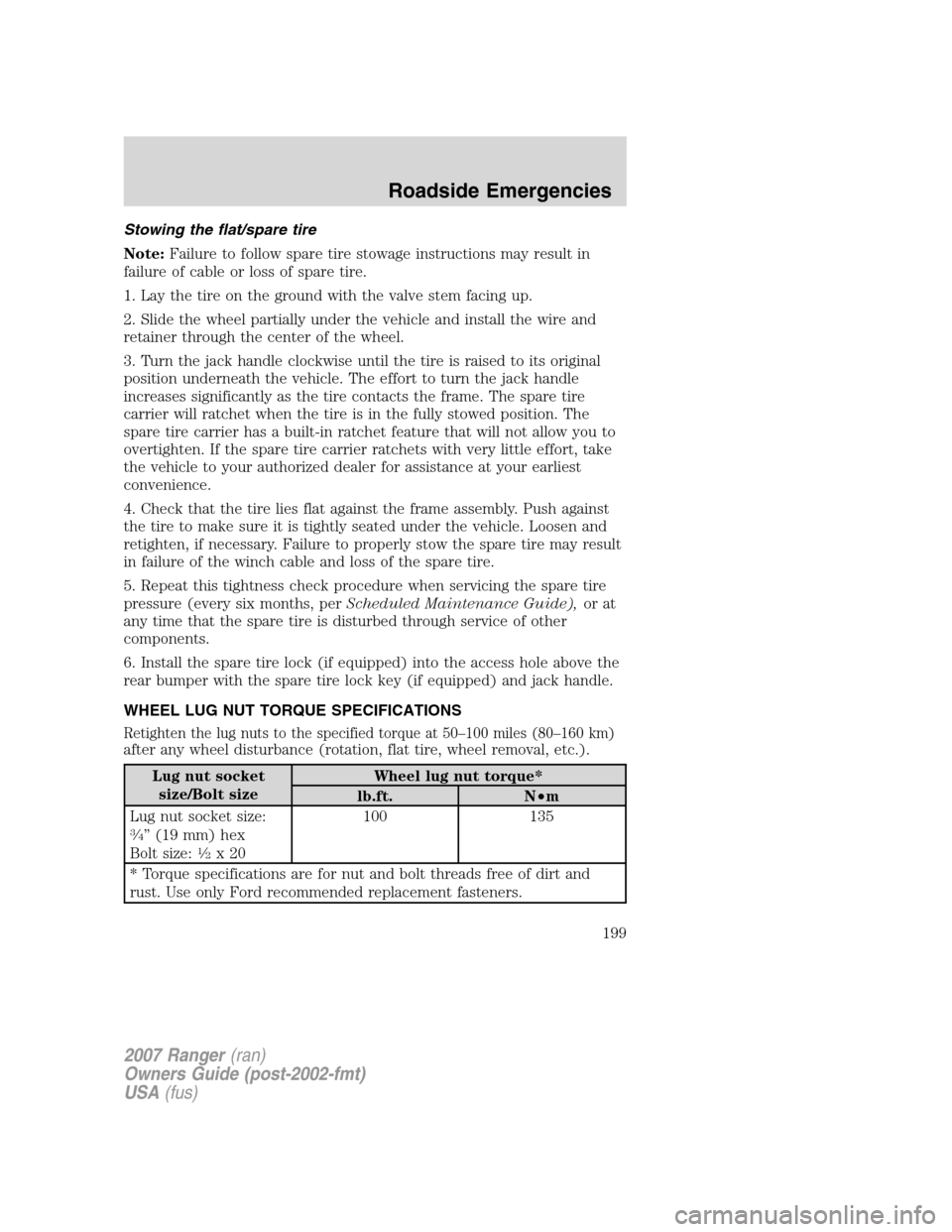
WHEEL LUG NUT TORQUE SPECIFICATIONS
Retighten the lug nuts to the specified torque at 50–100 miles (80–160 km)
after any wheel disturbance (rotation, flat tire, wheel removal, etc.).
Lug nut socket
size/Bolt sizeWheel lug nut torque*
lb.ft. N•m
Lug nut socket size:
34” (19 mm) hex
Bolt size:12x20100 135
* Torque specifications are for nut and bolt threads free of dirt and
rust. Use only Ford recommended replacement fasteners.
2007 Ranger(ran)
Owners Guide (post-2002-fmt)
USA(fus)
Roadside Emergencies
199
Page 247 of 280
•Revving the engine before turning it off may reduce fuel economy.
•Using the air conditioner or defroster may reduce fuel economy.
•You may want to turn off the speed control in hilly terrain if
unnecessary shifting between third and fourth gear occurs.
Unnecessary shifting of this type could result in reduced fuel
economy.
•Warming up a vehicle on cold mornings is not required and may
reduce fuel economy.
•Resting your foot on the brake pedal while driving may reduce fuel
economy.
•Combine errands and minimize stop-and-go driving.
Maintenance
•Keep tires properly inflated and use only recommended size.
•Operating a vehicle with the wheels out of alignment will reduce fuel
economy.
•Use recommended engine oil. Refer toLubricant specificationsin
this chapter.
•Perform all regularly scheduled maintenance items. Follow the
recommended maintenance schedule and owner maintenance checks
found inscheduled maintenance information.
Conditions
•Heavily loading a vehicle or towing a trailer may reduce fuel economy
at any speed.
•Carrying unnecessary weight may reduce fuel economy (approximately
1 mpg [0.4 km/L] is lost for every 400 lb [180 kg] of weight carried).
•Adding certain accessories to your vehicle (for example bug
deflectors, rollbars/light bars, running boards, ski/luggage racks) may
reduce fuel economy.
•Using fuel blended with alcohol may lower fuel economy.
•Fuel economy may decrease with lower temperatures during the first
8–10 miles (12–16 km) of driving.
•Driving on flat terrain offers improved fuel economy as compared to
driving on hilly terrain.
•Transmissions give their best fuel economy when operated in the top
cruise gear and with steady pressure on the gas pedal.
2007 Ranger(ran)
Owners Guide (post-2002-fmt)
USA(fus)
Maintenance and Specifications
247
Page 275 of 280

Safety Compliance
Certification Label ....................266
Satellite Radio Information ........47
Seat belts (see
Safety restraints) ........................82
Seats ............................................79
child safety seats ....................109
SecuriLock passive anti-theft
system ..........................................76
Servicing your vehicle ..............220
Setting the clock
AM/FM stereo ...........................19
AM/FM stereo CD ...............21, 24
Premium AM/FM stereo
CD6/MP3 .............................29, 33
Snowplowing .................................8
Spark plugs,
specifications .....................257, 264
Special notice
ambulance conversions ..............8
utility-type vehicles ....................7
Specification chart,
lubricants ...................................259
Speed control ..............................67
Starting your vehicle .......156–157,
159
jump starting ..........................200
Steering wheel
tilting .........................................65
T
Tilt steering wheel ......................65
Tire Pressure Monitoring
System (TPMS)
Roadside Emergencies ...........191
Tires, Wheels and Loading ....133Tires ...........................118–119, 191
alignment ................................126
care ..........................................123
changing ..........................191, 196
checking the pressure ............123
inflating ...................................120
label .........................................132
replacing ..................................124
rotating ....................................127
safety practices .......................125
sidewall information ...............128
snow tires and chains ............137
spare tire .........................192, 194
terminology .............................120
tire grades ...............................119
treadwear ........................119, 123
Towing .......................................143
recreational towing .................154
trailer towing ..........................143
wrecker ....................................205
Traction-lok rear axle ...............162
Transfer case
fluid checking .........................255
Transmission
automatic operation ...............163
brake-shift interlock (BSI) ....163
fluid, checking and adding
(manual) .................................254
fluid, refill capacities ..............259
lubricant specifications ..........259
manual operation ....................166
Turn signal ..................................57
V
Vehicle Identification Number
(VIN) ..........................................266
Vehicle loading ..........................137
camper bodies ........................155
Ventilating your vehicle ...........159
2007 Ranger(ran)
Owners Guide (post-2002-fmt)
USA(fus)
Index
275